Last week I received an email request from the New Israel Fund (NIF) to sign a rabbinical statement condemning the recent desecration of a mosque in the Bedouin village of Tuba-Zangariya in the north of Israel. Of course I signed without hesitation. It was a sick, racist act that deserved to be condemned from every quarter.
Thus my deep dismay when I did not receive any similar request when the Israeli army demolished a mosque this week in West Bank village of Kherbet Berza – for the third time. (An incident, btw, that was scarcely covered by the western media.)
As per usual, the administration claims additions to the mosque were built “without a permit.” Naturally no such permits are issued when the Israeli government is interested in creating facts on the ground – this case being the northern Jordan Valley. (The news item above was released last year following the first demolition.)
Of course it’s easy to condemn racist acts of individuals – apparently it’s more difficult (or “complicated”) when this kind of thing is carried out by a government. I have no such difficulty: terror is terror whether perpetrated by one person or by the state.
So for the record (and using the same language as the NIF statement) I’d like to take this opportunity to:
express my deep sadness and outrage at the destruction of a mosque in the West Bank village of Kherbet Berza. I condemn this act as an affront to God, the values of our Torah and the international standards of basic human rights.
I extend a hand in friendship and solidarity to the leaders and residents of this small village, a prayer for their safety and peace in the days to come, and a hope that the government that perpetrated this despicable act will be held to account.
And while we’re expressing concern for the welfare of Bedouins, this recent announcement offers some cause for deep dismay as well:
The Civil Administration (CA) is planning to expel the Bedouin communities living in Area C in the West Bank, transferring some 27,000 persons from their homes. In the first phase, planned as early as January 2012, some 20 communities, comprising 2,300 persons, will be forcibly transferred to a site near the Abu Dis refuse dump, east of Jerusalem.
More government terror. I express my deep sadness and outrage…
Cedric Cal was born to a single mother, in a family that lived below the poverty line on Chicago’s West Side. His father had left the family, married another woman and had very little to do with him. His mother Olivia worked constantly, doing her best to keep her family together. As the oldest of four, Cedric became the de facto father of the family and was entrusted with protecting his younger brother, who was legally blind.
Cedric’s family moved around a lot and he learned very early on how to make friends quickly. He liked sports, particularly baseball – and when his family lived on the West Side, he played sports in the local Park District. When they moved to the South Side, however, there were no Park District services available, so sports were not an option for him. Still, no matter where they moved, Olivia became very adept at finding ways of getting Cedric and and brothers into decent public schools. From 5th to 8th grade, he attended Alcott Elementary. Minding his younger brother, he took the public bus every day on a long trek from the West Side to Lincoln Park.
Cedric’s mother taught him how to fill out applications and interview for jobs, but there really weren’t any to be found. And those that were hiring certainly weren’t hiring African-American teenage boys. He was never really successful at finding a real job, but when he was 14 he learned that he could make money dealing drugs. He knew that his mother would be beyond furious if she ever found out, so he made sure to keep his drug dealing and his growing gang activity secret from her. Cedric never, ever, brought his earnings into their home – his mother had made it clear that drug money was not welcome anywhere near her house. Even when he bought a car, he parked it far away from their home.
I met and spoke with Cedric two weeks ago at the Stateville Correctional Center in Joliet. He explained to me that as he continued to sell drugs, as he continued the gang life, little by little, he became “desensitized to the things my mother had taught me.” It was quite poignant and sweet to listen to Cedric speak about his mother. “My mother,” he said, “has a lovely spirit,” adding: “I was scared to death of my mother.” He told me of one instance in which Olivia confronted drug dealers on a street corner with a two by four in her hand. Cedric laughed and said that even the toughest gang members in the neighborhood were scared of his mother.
In 2006, I was approached by JRC’s Peace Dialogue task force and asked if I would consider adding something to our Shabbat prayer for peace. Could we, they asked, introduce the prayer by reading the names of three American soldiers, three Iraqi civilians and three Afghan civilians who had been killed in these two ongoing wars?
The reason, they explained, was to remind ourselves that peace is not just an abstract concept. If we’re going to say a prayer for peace, we should own up to the stakes – we should acknowledge that we are citizens of nation at war, that war comes with a very real human cost, and that as American citizens, we are complicit in all actions made by our country.
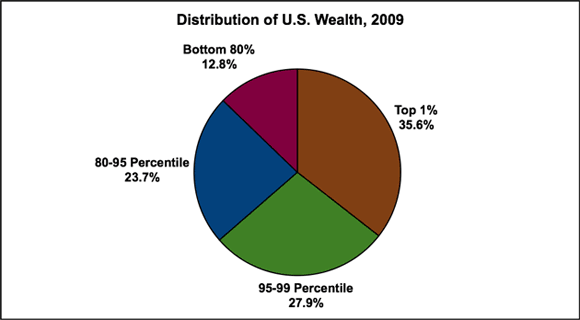
Source: Economic Policy Institute, The State of Working America 2011
Three years ago, I traveled with several JRC members and nearly 1,500 others to Postville, Iowa. We went to show our solidarity with 400 immigrant workers of the Agriprocessor kosher meat packing plant who had recently been arrested and imprisoned. It was, at the time, the largest single-site workplace raid in US history.
After participating in an interfaith service, we marched through the streets of Postville. As we reached the downtown area, we met up with angry counter-protestors, many of whom were holding signs condemning the invasion of “illegal immigrants” into their communities. One woman held a large sign that still sticks in my mind – it read: “What Would Jesus Do? Obey the Law.” I distinctly remember pointing out the irony of this sign to a fellow marcher, considering Jesus is actually considered to be one of the earliest practitioners of civil disobedience.
“How do we reach Jewish young people?” has long been one of the central mantras of the organized Jewish community, as those of us who work as Jewish professionals can surely attest. But while we wring our hands over at the state of the Jewish future, a remarkable new generation of Jews has been knocking insistently at our door.
Young Jews say the settlements delegitimize Israel!
Young Jews say the Occupation delegitimizes Israel!
Young Jews say the siege of Gaza delegitimizes Israel!
Young Jews say the loyalty oath delegitimizes Israel!
Young Jews say silencing dissent delegitimizes Israel!
With each successive interruption the shouts from the crowd grew louder and angrier. As security attempted to safely walk them out, one protester was put in a choke hold by a convention attendee and wrestled to the floor. Another conventioneer grabbed a banner and tore it in half with his teeth.
At the very same moment, “Young, Jewish, Proud” launched its website, featuring the “Young Jewish Declaration” — an astonishing statement of purpose that seemed to come directly from the collective heart, mind and gut of this newly formed youth movement:
We exist. We are everywhere. We speak and love and dream in every language…
We remember how to build our homes, and our holiness, out of time and thin air, and so do not need other people’s land to do so…
We refuse to have our histories distorted or erased, or appropriated by a corporate war machine. We will not call this liberation…
We commit ourselves to peace. We will stand up with honest bodies, to offer honest bread…
We are young Jews, and we get to decide what that means.
Predictably, the Jewish establishment wasted no time in excoriating the protesters. Some chided them condescendingly for their “misguided” behavior. Others angrily criticized them for “aiding the enemy.”
As for me, I watched these events unfold with genuine hope for our Jewish future.
After all, weren’t these young people claiming and proclaiming their Jewishness in classic Jewish fashion? Like young Abraham destroying his father’s icons, they stood up to the hypocrisy and corruption of their elders. In the heart of the the largest gathering of American Jewish leaders, these proud young Jews called out their community on its most sacred of sacred cows: namely, the unquestioning, unconditional support of the state of Israel.
In all honesty, I can’t say I’ve ever witnessed as authentic an act of young Jewish self-expression as I did that afternoon at the New Orleans General Assembly.
Yes, as a professional Jew, I’ve participated in the “how can we inspire young people?” conversation more times than I care to admit. I’ve watched a myriad of Jewish community-sponsored initiatives come and go. And invariably, all of them focused on what we believed was best for Jewish young people.
But while the Jewish establishment has been excellent at creating and funding expensive projects, we seem to be chronically incapable of actually listening. We love to tell young people how we think they should express their Jewishness, but rarely do we stop long enough to really, truly learn what drives and inspires them.
Taglit-Birthright Israel, the Jewish establishment’s signature youth initiative, is the most obvious case in point. For well over a decade, we have invested literally hundreds of millions of dollars in providing free, all-expense-paid trips to Israel. The essential goal of these trips, as Birthright’s Marketing Director puts it plainly, is to make Israel “an integral part of every Jew’s identity.”
It’s well known that Birthright was born in response to growing reports that American Jewish young people were becoming increasingly disconnected to the state of Israel. But by rushing to address this issue through a massive multimillion dollar community initiative, we successfully avoided asking the deeper questions.
Could it be that we were afraid to know the answers?
Could it be that young people are becoming disenchanted with Israel because they are becoming increasingly troubled by its treatment of Palestinians? Could it be that growing numbers of young Jews regard Israel more as an oppressive colonial project than a source of Jewish pride? Could it be that in the 21st century world, the identities of young Jews are tied less to Jewish ethno-nationalism than to a more universal vision of liberation?
“Young, Jewish, Proud” is decidedly not the product of a Jewish communal initiative. On the contrary it is a grass-roots, self-organized effort of young Jews who seek to express their Jewish identity in a time-honored Jewish manner: by speaking truth to power, by advocating unabashedly for peace, justice and liberation, by standing up to oppression, racism and persecution in Israel/Palestine and throughout the world. They simply aren’t buying what the Jewish establishment has been selling them. They are finding their own voices.
We are young Jews, and we get to decide what that means…
I am well aware that it is not easy for a Jewish community so thoroughly focused on Zionism to hear it challenged in such a fundamental way. But aren’t these young Jews doing precisely what they were raised to do? They are taking a good, educated look around them, thinking critically about what they see and are taking a stand for what they believe in as Jews. Are we really prepared to disown them because their conclusions make us uncomfortable?
In the Torah portion for the first day of Rosh Hashanah, we read that when God saves the life of young Ishmael in the wilderness, “God heeded the cries of the boy where he is” (Genesis 21:17). In other words, God was able to find Ishmael by truly listening to him. Not where God wanted him to be or where God thought he should be, but where he was.
This New Year, I fervently hope our community can do the same with our newest adult generation. These young people certainly have every reason to be disenchanted with the organized Jewish community, but for some reason they refuse to go away. They’re here, and they’re knocking loudly at our door.
Do we, the gatekeepers of the Jewish community, have the vision, the faith and the courage to open it up and let them in?
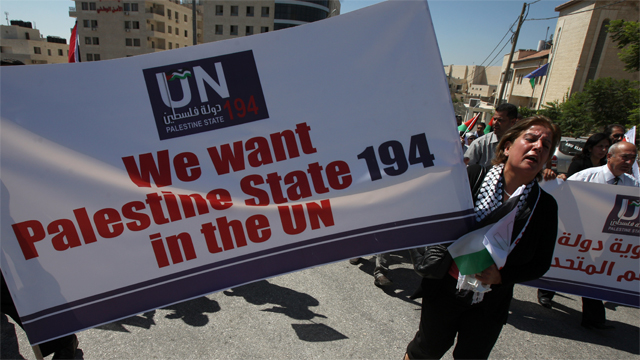
I was prepared to write extensively about Obama’s shameful speech at the UN General Assembly yesterday, but this post by Palestinian analyst/activist Abir Kopty (above) says everything I wanted to say and more.
I’ll just add that I genuinely believe that after last night, the US has utterly abdicated any meaningful role as a peace arbiter between Israel and Palestine. Where this political leadership will come from remains to be seen.
And meanwhile, the oppression continues…
We listened to you when you talked about Israel’s citizens who have been killed by rockets fired at their houses, and that other children are taught to hate Israeli children. Do you not think that Israeli children hear what is said by rabbis who preach hate about Arabs? And we listened about Jewish suffering. No doubt Jewish people have suffered Mr. Obama, but let us put things in order: Jewish people are not the victims here. The Israeli state is not the victim; it is the occupier and the oppressor which continues to deny Palestinians living in their homeland and in exile ‘their universal right to live in freedom and dignity’.
When you fail to mention Palestinian suffer under occupation, when you fail to consider Palestinian children as equal human beings who deserve a better future, who are also entitled to human rights, you might win elections, but you lose your integrity, and you make it clear to everyone why the ‘so called peace process’ should be out of your hands…
We listened to you when you talked about the Arab Spring with such a passion. We listened with much suspicion, as America was very happy with the leaders of those countries who ruled for decades, and did not care then for Egyptian, Tunisian, Libyan, Syrian, Yemeni and Bahraini aspirations for freedom and dignity. And we know that you won’t leave those nations alone.
We listened to you and we did not understand why Palestinian freedom and dignity can wait? The only thing your speech made clear is that you do not dare to speak honestly.
I strongly encourage you to read her full post – please click here.
Rabbi Eric Yoffie is the outgoing President of the Union for Reform Judaism, arguably the most important Reform Jewish leader in the country. In a recent blog post for the Jerusalem Post, he made the following point in defense of a two-state solution in Israel/Palestine:
I care about humankind, but I love my own group a bit more. I am more comfortable with them. I care more about them, just as I care more about my family than other families. Without a two-state solution, Israel will not longer be a state for my group; it will be a bi-national state without a clear Jewish identity. That is not the kind of place where I, or most Israeli Jews, will want to live.
So there you are. This is where the rubber hits the road. Is the best case we can make for liberal Zionism: that when push comes to shove, Jews prefer to live with Jews?
I think we all owe a very real debt to Rabbi Yoffie. In trying to make a dramatic pedagogical point, he has just shone a very bright light on the dark underbelly of this entire project.
This is abject tribalism, pure and simple. And if it truly is the essence of liberal Zionism, then count me out.
How can we understand the PA’s initiative to declare statehood at the UN? How should US and the international community respond? Will it advance the prospects for justice and peace in Israel/Palestine?
Ruebner is a former Analyst in Middle East Affairs at Congressional Research Service, a federal government agency providing Members of Congress with policy analysis. His analysis and commentary on US policy toward the Middle East appear frequently in media such as NBC, ABC Nightline, CSPAN, Al Jazeera, USA Today, Los Angeles Times, Huffington Post, Middle East Report, and more.
The US Campaign to End the Israeli Occupation is a national coalition of nearly 350 organizations working to end US support for Israel’s illegal 43-year military occupation of the Palestinian West Bank, East Jerusalem, and Gaza Strip, and to change U.S. policy toward Israel/ Palestine to support human rights, international law, and equality.
Call-in info:
Call in number: 1-800-920-7487
Code: 92247763#
Participants in the call are encouraged to read one or more of the following articles:
I don’t have a position on whether or not it is a good thing for the PA to seek membership status for Palestine at the UN. That is for the Palestinians to determine – and I know there are a variety of Palestinian opinions both pro and con on this issue.
On this one I’m in full agreement with former AJC Executive Director Henry Siegman, who offered this analysis yesterday:
(Is) there anyone who witnessed the frenzied applause that greeted Prime Minister Benjamin Netanyahu’s most recent speech before the U.S. Congress in which he left no doubt about his government’s intentions for East Jerusalem and for the West Bank, or heard President Obama’s assurances to AIPAC’s conventioneers that the ties that bind the U.S. to Israel are forever “unbreakable,” who still believes that the U.S. will ever exert the kind of pressure on Israel that will finally change its cost/benefit calculations with regard to its colonial project?
America will not turn our backs on the legitimate Palestinian aspiration for dignity, opportunity, and a state of their own…
The only resolution is for the aspirations of both sides to be met through two states, where Israelis and Palestinians each live in peace and security…
The United States does not accept the legitimacy of continued Israeli settlements. This construction violates previous agreements and undermines efforts to achieve peace. It is time for these settlements to stop…
And now here we are. The Obama administration has done everything it can to undermine its own publicly articulated goals. It continues to support Israel unconditionally as it settles the West Bank with impunity. Last February it cast the sole veto vote on a UN Security Council resolution that condemned the settlements. Now it is poised to publicly oppose Palestinians formal membership at the UN – the very body by which Israel itself became a state.
No, I’m not personally taking a stand on this because I don’t presume to preach to Palestinians what I think is in their best interest. But as an American citizen, I can’t accept my government’s claim that it is in any way committed to this so-called “peace process.” Until the Obama administration is truly ready to be an honest and effective broker, it could at the very least refrain from smacking Palestinians down when they seek recourse through other means.
And when it comes to the larger implications of a US veto, I’ll say this: whatever good will Obama might have engendered after Cairo is now on the verge of being completely and utterly squandered. You know things are looking dire when a former Saudi Ambassador to the US writes in the NY Times:
The United States must support the Palestinian bid for statehood at the United Nations this month or risk losing the little credibility it has in the Arab world. If it does not, American influence will decline further, Israeli security will be undermined and Iran will be empowered, increasing the chances of another war in the region.
When one of your only allies left in the Arab world makes a public statement such as this, I’d say its time to pay heed.
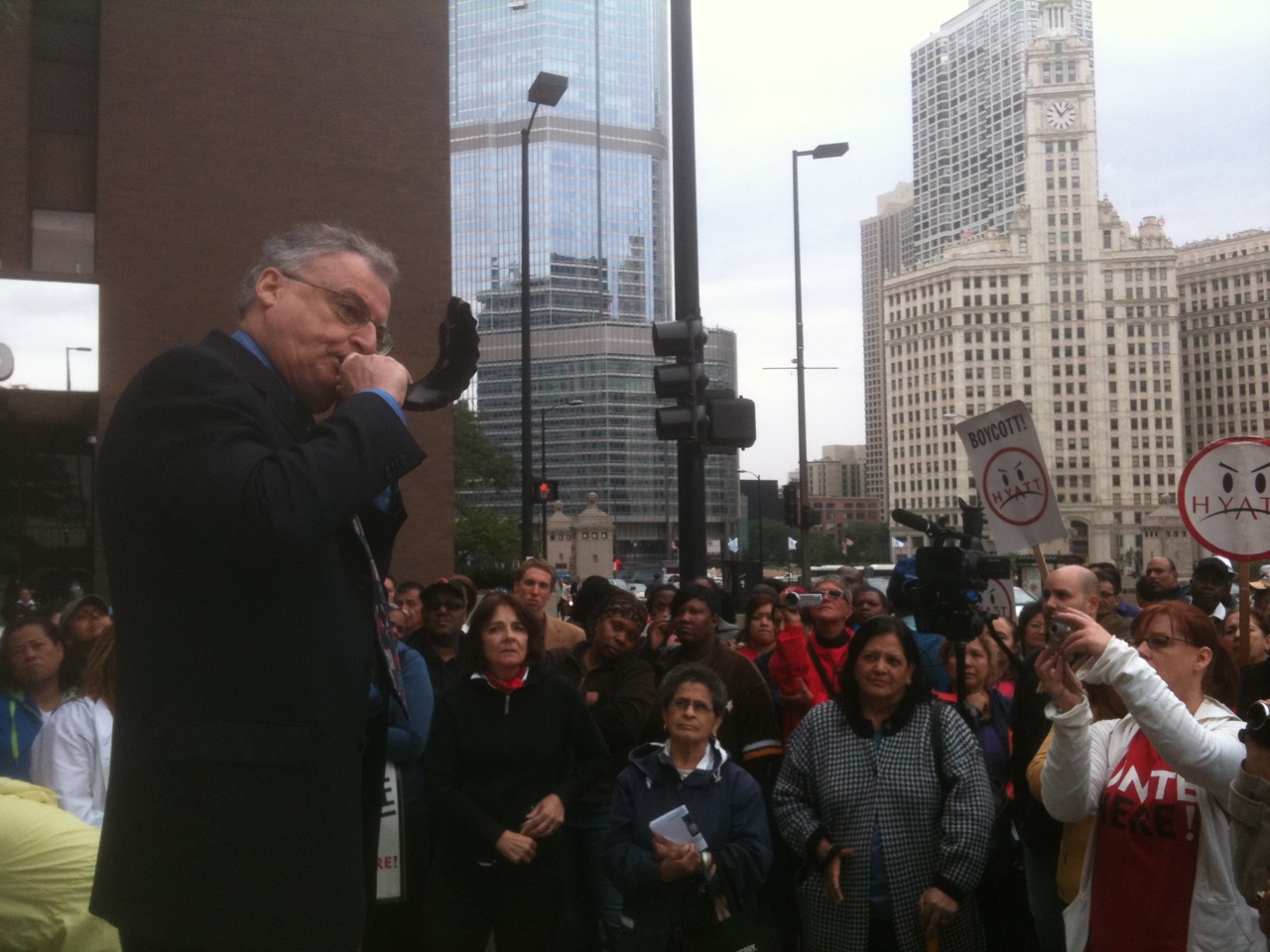
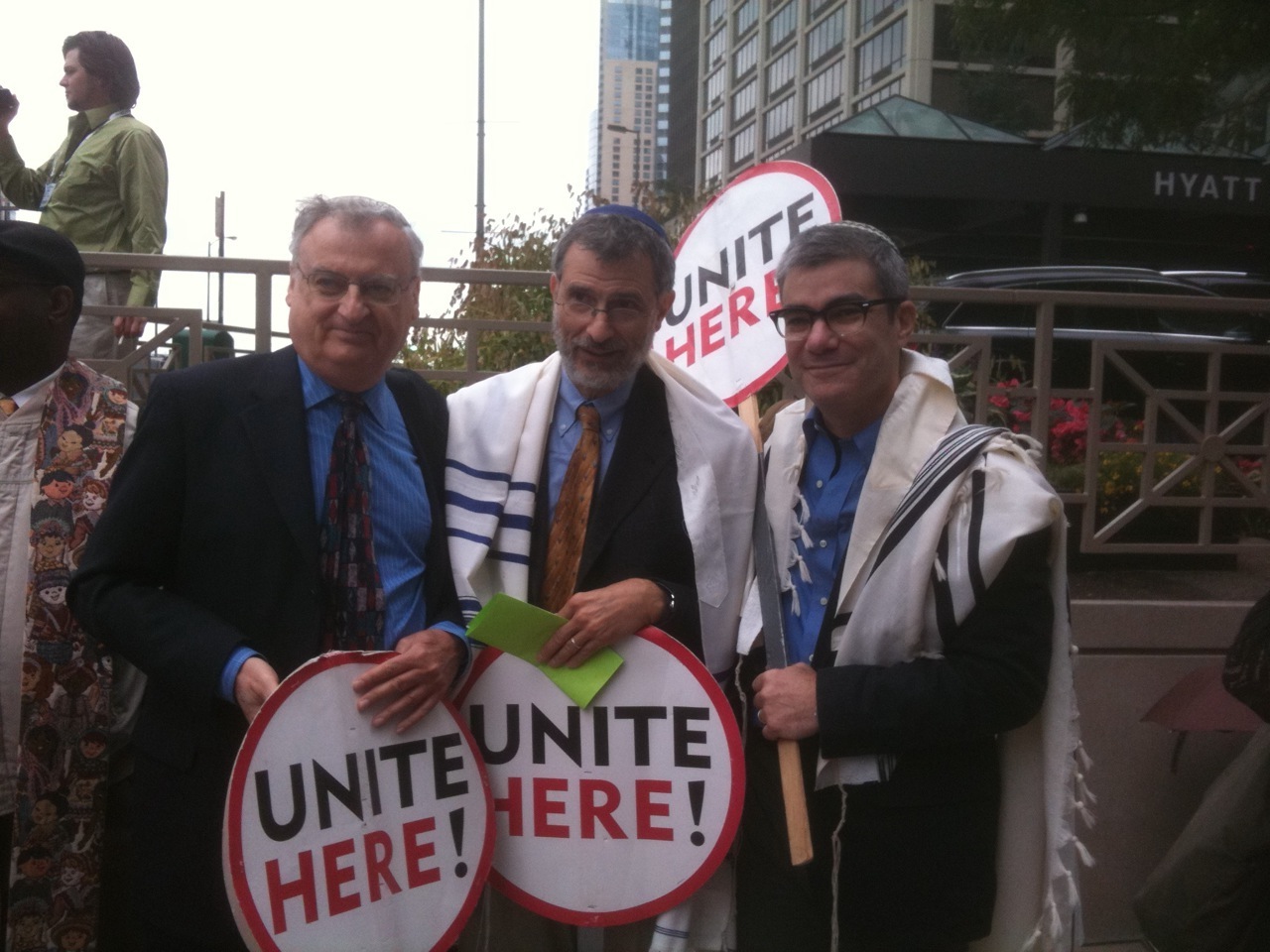
Today marked the end of a week-long strike at the Hyatt Regency Chicago and Hyatt Regency McCormick Place held simultaneously with Hyatt workers in Los Angeles, San Francisco and Honolulu. This morning I walked the picket line at the Hyatt Regency and had the honor of participating in an interfaith solidarity service with local Chicago clergy. That’s me in the pic below, together with Rabbi Victor Mirelman (left) of West Suburban Temple Har Zion and Rabbi Larry Edwards (center) of Congregation Or Chadash. Above you can see Victor sounding the shofar in a dramatic start to our service.
Again, I encourage you to read “Open the Gates of Justice: A Clergy Report on Working Conditions at Hyatt Hotels” for more information. The report contains the direct testimony of hotel workers themselves, who speak eloquently to the injustices they endure – as well as their desire only to be valued as workers for the important work they do for Hyatt hotels.
At the interfaith service today, I read an “Avinu Malkeinu” High Holiday prayer that I reworked in honor of the striking Hyatt workers. Click below to read:


 Shalom Rav