Elegy for Janine Denomme

It’s a brave new world. I’ve just officiated at the shiva for Janine Denomme, a 45 year old woman who also happened to be an ordained Catholic priest.

I did not have the honor of knowing Janine personally, but I do know she was a profoundly important spiritual teacher to many. She was active in the Catholic Church and served as a lay preacher, church musician, parish council member, spiritual director and religion teacher. And though she was a gay woman, she consistently considered the Catholic Church to be her spiritual home, and had always dreamed of becoming a priest.

Janine was ordained just this last April by Roman Catholic Womenpriests, an initiative within the Catholic Church that seeks to create “a more inclusive, Christ-centered Church of equals in the twenty-first century.”  Tragically, Janine was diagnosed with cancer as she prepared for ordination – but as it turned out, her struggle with her illness gave her a new spiritual calling. She wrote deeply profound reflections on the journey of a cancer patient, primarily through her Caring Bridge blog. I’ve just finished reading “Via Delorosa” – a piece she wrote this past February in which she charts the stages of her chemo treatment using the religious symbolism of the Stations of the Cross.  It’s quite simply as powerful a piece of contemporary spiritual writing as I’ve ever read.

Needless to say, the Catholic Church does not recognize Janine’s ordination in any fashion – and even more painfully, the Archdiocese of Chicago refused to allow her to be buried in her Catholic parish. Her funeral mass will take place in a Methodist church in Evanston this Saturday.

In a final 21st century twist to this story: Janine’s beloved partner, Nancy Katz, is a member of my congregation – and it was my honor to preside over a Shiva service at their home this evening. Truly an interfaith gathering of the most sacred kind.

You can read more about Janine here in the Windy City Times and in this piece from the Huffington Post. May her memory be for a blessing.

Jewish Blogger Panel Video Now Online

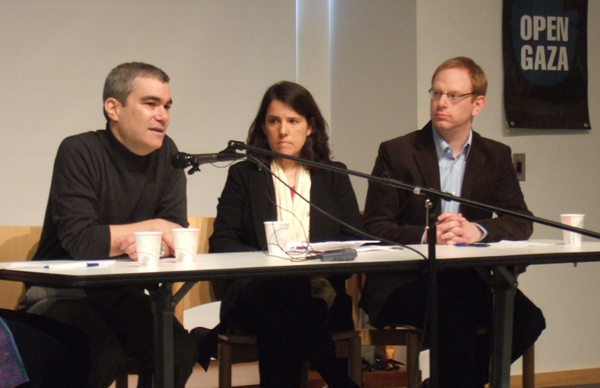
Last January I participated in a panel discussion on Jewish blogging sponsored by the Committee for a Just Peace in Israel and Palestine. I was honored to join two of my favorite bloggers in the world, Adam Horowitz of Mondoweiss and Cecilie Surasky of Muzzlewatch, for what turned out to be an extensive and incredibly thought-provoking conversation.

CJPIP has just uploaded a video of the program to their website. Click here to watch.

Alan Dershowitz and the Politics of Desperation

From a piece I’ve just posted in the Huffington Post:

I’ve noticed an interesting pattern in Alan Dershowitz’s recent HuffPo columns.

On April 21 he smeared Jeremy Ben Ami and the pro-peace, pro-Israel lobbying group J Street, putting words in Ben Ami’s mouth and saying that J Street has “gone over to the dark side.”

On May 4 it was Rabbi Michael Lerner, a leading figure of the American Jewish left, and editor of Tikkun Magazine. Dershowitz accused Tikkun of “McCarthyism,” disregarded the recent attack on Lerner’s home, and characterized Lerner’s criticism of Israeli policy as “blood libel.”

In between the two, Dershowitz lambasted Judge Richard Goldstone, the highly regarded international jurist who prepared a UN report on Israel’s Gaza War. He labeled the report as “evil” and attacked me and a group of American rabbis for having the temerity to find merit in Goldstone’s work – we are “bigoted,” apparently, and “ignorant,” and are – yes – leveling a “blood libel” against the Israeli government. Most recently, Dershowitz hit a new low when he went on Israeli television and compared Judge Goldstone to Dr. Joseph Mengele.

When a Jew starts to accuse rabbis of blood libel; when an American shouts “McCarthyism” at an American magazine editor whose life is dedicated to dialogue; when a professional, highly experienced lawyer accuses a world-renown jurist of “evil,” equating him with the Nazi “Angel of Death,” and uses Star Wars terminology against a legitimate, widely-supported political lobbying group – well, it adds up, and it indicates one thing: Desperation.

Click here to read the entire article.

My Lunch with Yonatan Shapira

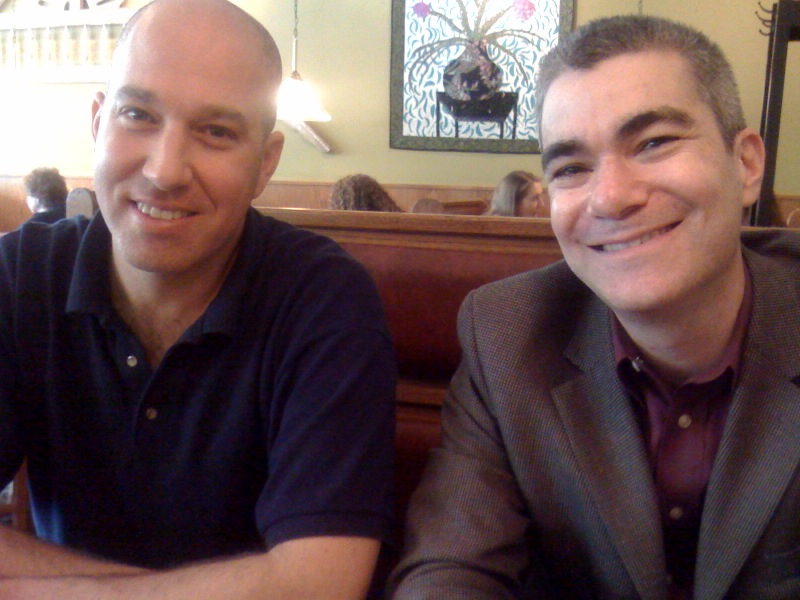
Had the pleasure of meeting Yonatan Shapira for lunch in Evanston yesterday.  If you’ve never heard of him, Yonatan was an officer in the Israeli Air Force and flew hundreds of missions over the territories in a Blackhawk helicopter squadron during the course of his eleven year career. Following a targeted bomb assassination of a Hamas leader that killed fourteen civilians in Gaza, he became a prominent Israeli “refusenik,” authoring the Pilot’s Letter – a 2003 statement signed by 27 Israeli pilots who publicly refused to fly missions over the Occupied Territories.

Since that time, Yonatan has gone on to co-found “Combatants for Peace” a prominent organization in the growing Israeli Refusenik movement. A few years ago he gained some more notoriety for writing and performing “Numu, Numu,” a powerful protest song written in the form of an ironic “Lullaby to Pilots.”   (More recently, he’s become the object of a pop love song that’s currently making the rounds on Israeli radio – Richard Silverstein has the story on that in Tikun Olam).

I had known of Yonatan’s refusenik activism, but during our lunch conversation I was surprised to learn that he is also very active in supporting non-violent Palestinian actions in Sheikh Jarrah, Bi’ilin and throughout the Occupied Territories. (He was, in fact, arrested last January at a demonstration in Sheikh Jarrah.) He told me that this work has been transformative for him, explaining that as an IDF officer and even as a leader in the Israeli peace movement he has always been socialized to step forward and lead the way. He said he’s come to realize that the most important way he can serve now is to “stand behind” Palestinians in their non-violent campaign for liberation.

He told me numerous stories about his experiences at demonstrations. He mentioned that the IDF is increasing their crackdown on protesters, that they hire infiltrators to throw stones at the army to given soldiers the a pretext to open fire. None of it succeeds, of course: quite the opposite. The Palestinian non-violence movement is growing steadily – a “White Intifada” that  Yonatan believes has already begun. As a IDF officer himself, he explained the Israeli military mentality – that army commanders truly believe they have the power to “outlaw” these protests through the sheer force of their military might.

Yonatan also mentioned that as part of his support of non-violent Palestinian activism, he has also signed on to the internal Israeli movement for Boycott, Divestment and Sanctions (BDS) known as “Boycott from Within.”   Now that is the new definition of bravery: a high ranking Israeli Air Force veteran who comes from a military family (his father was a fighter pilot during the Six Day War) has now firmly put himself on the front lines of a global non-violence campaign initiated by the very people he himself had once been trained to attack.

I assumed that Yonatan would be made a virtual pariah for his public stands. He replied that as a military man he understands how soldiers think and generally knows how to engage them in dialogue even when they strongly disagree with him.  He also mentioned that his family is supportive of his work – his father “is not quite there yet” but respects his activism and his mother is “the most active of them all.”

Click below for Yonatan’s “Lullaby for Pilots:”

Pride and Prejudice #3: My Response to David

Dear David,

Yes, it does indeed seem that the crux of our disagreement comes down to the historical issues surrounding the establishment of a Jewish state. Although I’m not a historian either, I am becoming increasingly sensitive to the ways in which we relate to our own history and how these perspectives impact on our reality today.

So yes, we do have very different views of the history of Israel’s founding – and as you put it, I am tempted to “counter your facts with my facts,” but I’ll refrain for now, only to say that those of us who have been raised on the Zionist narrative of events would do well to open our minds and our hearts to the reality of the Palestinian narrative as well. Otherwise I just don’t see how we will ever find a measure of justice for Palestinians – or peace for Jews.

On the most fundamental disagreement between us, you wrote:

But Brant, what really disturbs me is that I sense you are questioning whether the creation of a Jewish state in a territory with an indigenous Palestinian population is justified, given that inevitably, conflict would ensue.

Believe me, I’m disturbed by this as well. It has been a deeply painful experience to question the idea of Israel that has been so central to my Jewish identity for so long. But this is what it’s come to: I’ve reached the point in which I can’t help but question.

To be clear, I don’t disagree that the Jewish people have maintained a centuries-old attachment to this land – and I don’t disagree at all that we Jews should have a right to live in this land that we’ve long considered to be our ancient homeland. But I don’t believe that all this necessarily gives the Jewish people the “right” to have political sovereign control over it.

In this regard, I disagree strongly with Saul Singer when he writes about the Jewish people’s “legitimate claim to sovereignty.” What gives any people a “right” to sovereignty in a land? Let’s face it, when it come to these kinds of political claims, history has shown that might makes “right.” While I don’t think anyone can legitimately deny the Jewish claim to Israel as its ancestral homeland, it simply doesn’t follow that this religious/cultural connection ipso facto gives us the right of sovereign political control over it.

So yes, I am questioning whether by attaching 19th century European ethno-nationalism to Judaism, the Zionist movement was setting itself up for inevitable conflict. That’s invariably what nationalism does. You point out that there was “extreme Palestinian/Arab opposition to a Jewish state” and I certainly agree. But do we ever stop to consider why this might have been so?

Arab nations in general and Palestinians in particular had endured colonial control over the lands in which they lived for centuries. Following WW I, Britain and France extended the promise of decolonization to Arab nations – while at the very same time, the Zionist movement was increasing its own colonization of Palestine. How could Palestinian Arabs regard this with anything but alarm – especially since political Zionism was predicated upon the buildup of a Jewish majority in Palestine?

I see I’m slipping back into historical argumentation. So I’ll just end with this: where does all this leave us today? As I now see it, our insistence upon the “Jewish right” to Palestine will only prolong this 60-plus year old conflict. For me the important question is not “does Israel have the right to exist?” (or even, really, “does a Palestinian state have the right to exist?”) I believe the real question is “how can we find a way to extend civil rights, human rights, equality, and security for all inhabitants of Israel/Palestine?”

Like you, I hope against hope that this question can be sufficiently addressed through the peace process, culminating in a true and viable two-state solution. But I admit to growing cynicism on this front – and I truly fear the choice we will face should the peace process fail. For even if we disagree on the root causes of this conflict, I think we both agree that it would be beyond painful if it came to the point where are are forced to choose between an Jewish apartheid state ruled by a Jewish minority over a Palestinian majority or one secular democratic state of all its citizens.

So you see, David, these are the things that keep me up nights. But despite the painful issues involved, I’ve really appreciated this conversation. Please know that I’ve considered it, as they say in Pirke Avot, a “machloket l’shem shamayim” – a “debate for the sake of heaven.” I can only hope that it might, in some small way, inspire similar dialogues throughout our community.

In Friendship,

Brant

How to Boycott Arizona

If you are looking for ways to translate your outrage over Arizona’s anti-immigrant law into action, here is a list of companies based in Arizona that you should consider boycotting.  Some prominent examples include:

– Arizona Diamondbacks, Location: Phoenix, Arizona

– Best Western International, Inc., Headquarters: Phoenix, Arizona

– Cold Stone Creamery. Headquarters: Scottsdale, Arizona

– Grand Canyon

– P. F. Chang’s China Bistro. Headquarters: Phoenix, Arizona

– PetSmart. Headquarters: Phoenix, Arizona

– Sky Mall, Headquarters: Phoenix, Arizona

– U-Haul. Headquarters: Phoenix, Arizona

– US Airways. Headquarters: Tempe, Arizona

Click here to send a strongly worded message to Arizona Governor Jan Brewer. Click here to read a letter signed by 90 prominent organizations and individuals in the American Jewish community that was delivered this morning to congressional leaders.  And if you live my home state, I encourage you to check out the Illinois Coalition for Immigrant and Refugee Rights website for more information and action opportunities.

Rare Jewish Communal Consensus: Arizona Law is Hateful

While the American Jewish conversation on Israel-Palestine is filled with horrid and divisive rhetoric, it is heartening to read that a wide and diverse array of Jewish organizations have spoken out decisvely against the new Arizona anti-immigrant law:

The new law has been criticized by an array of Jewish groups, including the Hebrew Immigrant Aid Society, Anti-Defamation League, American Jewish Committee, Simon Wiesenthal Center, National Council of Jewish Women and the Jewish Council for Public Affairs, a public policy umbrella group comprised of the synagogue movements, several national groups and scores of local Jewish communities across North America.

Gideon Aronoff, the president and CEO of the Hebrew Immigrant Aid Society, who supports legislation like Schakowsky’s and that of Sen. Charles Schumer (D-N.Y.), said he is working actively with other Jewish organizations to draft a broad statement condemning the federal government’s failure to enact comprehensive reform. HIAS also is coordinating with its partners in Arizona and anticipates that rallies, the filing of amicus briefs and other actions may be warranted in the near future.

Pride and Prejudice: A Conversation With an Israeli-American Friend

In my last post, I cited a comment from a longtime friend of mine who has been living in Israel for the past twenty years. By way of introduction: his name is David Melman and he lives with his family in a small community village in the Upper Galilee. My friendship with David goes back to our undergraduate days at UCLA, where our mutual connection to Israel was always an important aspect of our relationship. Despite the long distance and the passage of time, our families have remained close.

David and I have been in communication since his first comment to my blog. I’ve asked him if he would be willing to allow me to post our dialogue and he graciously agreed. Click below for his comment, followed by my response.

Continue reading