Elie Wiesel Can’t Have it Both Ways

Elie Wiesel has long walked the tightrope between pious pronouncements of universal Jewish conscience and unabashed political advocacy. He’s been trying to have it both ways for years, but it seems to me that his balancing act is becoming more and more transparent.

Last week, as Wiesel unveiled an anti-Ahmadinejad ad with other Nobel Prize laureates, he blasted the Goldstone report, calling it “a crime against the Jewish people.”  Leaving aside the issue that he took this opportunity once again to speak on behalf of the entire Jewish people, I’m still somewhat staggered that Wiesel, of all people, would use such charged Holocaust rhetoric in such a patently political manner. (I think Richard Silverstein at Tikun Olam hit it right on the head when he asked, “What was the last event in world history you can recall being a ‘crime against the Jewish people?'”)

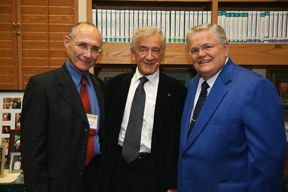
If this wasn’t enough, now I read on Max Blumenthal’s blog that Wiesel’s foundation received $500,000.00 for one speech he delivered at the church of fundamentalist Christian Zionist John Hagee (whom he referred to as “my dear pastor.”) Yes, this is the same John Hagee who publicly sermonized that Hitler was sent by God to create the Holocaust so that Jews would emigrate to Israel.  It’s simply astonishing to me that so many Jewish leaders are perfectly willing to cozy up to the likes of Hagee even after it has become so patently clear that his views are way off the rails. (That’s Wiesel, above, with Hagee, right, and Israeli minister Uzi Landau, left).

As far as I’m concerned, Justice Richard Goldstone is precisely the kind of courageous Jewish moral hero that Wiesel himself purports to be: someone committed to advocating for universal human rights even when doing so might mean holding our own community painfully to account.  As for Wiesel, I’m finding his words and actions increasingly craven. No one begrudges him his opinions – but it’s time he dropped the pretense that he’s somehow beyond the political fray.
More Join the Call to Lift the Blockade

When Brian Walt and I initiated the Jewish Fast for Gaza last year, advocating for a lifting of the Gaza blockade was not a particularly popular thing to do. I’m gratified to see that situation is beginning to change.

I’ve already reported on the Ha’aretz editorial; and now MJ Rosenberg, a respected Mideast analyst/columnist has recently made a forceful call to end the blockade as well.  In the political arena, 77 members of the British House of Commons have done the same through the introduction of an Early Day Motion. Here in the US, 54 members of Congress recently wrote a letter to President Obama that called for a lifting of the blockade, citing its dire strategic and humanitarian effects:

The unabated suffering of Gazan civilians highlights the urgency of reaching a resolution to the Israeli-Palestinian conflict, and we ask you to press for immediate relief for the citizens of Gaza as an urgent component of your Middle East peace efforts.

Several American Jewish organizations have publicly supported the letter and I was happy to learn that J Street actively lobbied members of Congress to sign on.  Take a look at all 54 signatories of the letter – if your Rep is not on the list, please consider contacting him/her to express your disappointment. (For my part, I’m very disappointed that my Rep, Jan Schakowsky – an active and vocal supporter of J St. – chose not to sign on).

Finally, if you agree with the sentiments expressed above, please sign on as a supporter of Ta’anit Tzedek – Jewish Fast for Gaza. Our next fast day is Thursday, February 18.

Rosenberg: BDS May Be Inevitable

MJ Rosenberg, a Mideast analyst I’ve respected for years, has just written a powerful blog post entitled, “Are Israeli-Palestinian Negotiations Finished?”  His words are particularly meaningful, I believe, coming from someone who is firmly ensconced in the mainstream liberal Zionist camp.

He opens with an all-too familiar concern: that Israel’s suicidal path of settlement expansion will soon make the possibility of a viable Palestinian state impossible (if it hasn’t already).

Then he takes this concern to its next logical conclusion, articulating what most two-staters are generally too frightened to say out loud:

What would happen is that the Palestinians would go to the United Nations, to the European Union, and even to the United States to seek ..consequences. And these would most likely come in the demand for sanctions. There is already a burgeoning BDS (Boycott, Divestment, Sanctions) movement that is seeking to bring down the occupation the way a similar movement brought down apartheid.

Is this what Israelis want? Do they really want those concerned about the occupation to be forced to turn to an option this extreme?

I know that the last thing I want is a successful international movement that would boycott and sanction Israel as if it was apartheid South Africa. But it’s probably inevitable unless Israelis come to their senses and begin the process of ending the occupation while the decision is still theirs to make.

In other words, sooner than later we’ll have to choose between a Jewish state and basic, fundamental human rights.  It’s not the first time we’ve heard sentiments such as this, but when they come from people like Rosenberg, it’s a sign that the lines on this issue are inexorably shifting.

The Sick Slandering of NIF

In my last post I addressed the sliming of J Street.  I’m so sorry to report on yet another slanderous campaign against a respectable Jewish organization.

The New Israel Fund, a institution that has long supported social justice efforts in Israel is now being viciously attacked by a right-wing ultra-nationalist group called Im Tirtzu (a shadow organization that apparently has connections to Christian Zionist leader Pastor John Hagee).

The most sickening aspect of their campaign is a full-page ad run in the Israeli press attacking NIF President Naomi Chazan. (See right: the anti-Semitic overtones of this image are truly astonishing, especially coming from a group that purports to support the State of Israel.)

This issue has been well covered in the Jewish blogosphere. For more info I recommend reports by Noam Sheizaf in Promised Land and Richard Silverstein in Tikun Olam. Click here to read a response by NIF CEO Daniel Sokatch – I also encourage you to click here to support the NIF.

(Yesterday, I received an email from a congregant that read “what the hell is going on in Israel?”  I’m asking the very same question…)

J Street’s Bumpy Philadelphia Road

Now that Brit Tzedek has merged with J Street, we’re witnessing the rapid growth of  “J Street Locals” proliferating throughout more than 20 regions across the country.  (I’m happy to be attending the launch of J Street Chicago at Emanuel Congregation this Thursday night and even happier to hear that a healthy turnout is expected).

I’m dismayed, tho, to learn that J Street Philadelphia‘s debut is receiving more than its share of ridiculous attacks from certain corners of the Philly Jewish community.  I’ve just read that even Penn Hillel has come under fire for renting out its facility to this “anti-Israel” group.

According to the Philadelphia Jewish Exponent:

A flap over Hillel of Greater Philadelphia’s decision to lease its space to J Street — for the official launch of its Philadelphia branch — is just one local manifestation of a debate that has roiled much of the national Jewish establishment since the advocacy organization was founded nearly two years ago…

Gary Erlbaum, who sits on the Jewish Community Relations Council’s Israel advocacy committee and is also a board member of the Jewish Publishing Group, has been outspoken in his opposition to J Street, and is upset about Hillel’s decision to host the group’s Feb. 4 event.

“What makes them pro-Israel? If the Palestinians had a lobby, it would be called J Street,” said Erlbaum. “The Hillel building is an inappropriate spot for a group that’s anti-Israel.”

Oh, for God’s sake. A group committed to supporting the two-state solution through a diplomatic means while safeguarding Israel security and its future as a Jewish and democratic state is somehow “anti-Israel?”

You know, sometimes when I’m feeling really, really optimistic, I dream about what it might feel like if the American Jewish community actually could tolerate the kind of vigorous and freewheeling debate that they enjoy in the actual Jewish state itself.  (Now wouldn’t that be “pro-Israel?”)

In Memory of Howard Zinn, z”l

I’ve been reading and listening to Howard Zinn’s work since learning of his death last week – and I’m become increasingly saddened at just what we’ve lost in his passing.  Here are just a few pieces that have moved me tremendously:

– Click above to see a clip in which Zinn  shares his thoughts on human nature and aggression.

– My friend Mark Braverman has posted a powerful and important piece by Zinn on the legacy of the Holocaust. An exerpt:

I would never have become a historian if I thought that it would become my professional duty to go into the past and never emerge, to study long-gone events and remember them only for their uniqueness, not connecting them to events going on in my time. If the Holocaust was to have any meaning, I thought, we must transfer our anger to the brutalities of our time. We must atone for our allowing the Jewish Holocaust to happen by refusing to allow similar atrocities to take place now—yes, to use the Day of Atonement not to pray for the dead but to act for the living, to rescue those about to die.

– One of his many columns for The Progressive, this one published four days after 9/11:

We need to imagine that the awful scenes of death and suffering we are now witnessing on our television screens have been going on in other parts of the world for a long time, and only now can we begin to know what people have gone through, often as a result of our policies. We need to understand how some of those people will go beyond quiet anger to acts of terrorism.

We need new ways of thinking. A $300 billion dollar military budget has not given us security. Military bases all over the world, our warships on every ocean, have not given us security. Land mines and a “missile defense shield” will not give us security. We need to rethink our position in the world. We need to stop sending weapons to countries that oppress other people or their own people. We need to decide that we will not go to war, whatever reason is conjured up by the politicians of the media, because war in our time is always indiscriminate, a war against innocents, a war against children. War is terrorism, magnified a hundred times.

Our security can only come by using our national wealth, not for guns, planes, bombs, but for the health and welfare of our people – for free medical care for everyone, education and housing guaranteed decent wages and a clean environment for all. We can not be secure by limiting our liberties, as some of our political leaders are demanding, but only by expanding them.

We should take our example not from our military and political leaders shouting “retaliate” and “war” but from the doctors and nurses and medical students and firemen and policemen who have been saving lives in the midst of mayhem, whose first thoughts are not violence, but healing, not vengeance but compassion.

Zichrono Livracha – may the memory of this righteous man be for a blessing.  And may we continue his work of bearing witness through our words and deeds…

Replanting the Uprooted on Tu B’shevat

Last week, Israeli Prime Minister Netanyahu celebrated the festival of Tu B’shevat (“The New Year of the Trees”) by leaving a meeting with American peace envoy George Mitchell and promptly embarking upon a tree-planting tour at Jewish settlements in the West Bank.

Here is what he had to say:

The message is clear – we are here and will remain here. We are planting and building; this is an inseparable part of the State of Israel.

For those looking for a different way to connect the festival of Tu B’shevat to the current political reality in the State of Israel, I recommend reading this at your seder, written by Rabbi Arik Ascherman of Israel’s Rabbis for Human Rights:

Lift the olive branch and say:

The olive branch, what is the reason for this?

We raise the olive branch as a symbol of responsibility, identification and hope.

We raise this branch in sorrow because each and every year, olive trees, the source of livelihood for Palestinian families, are intentionally chopped down, burned and uprooted.  In attempting to exercise their right to work their lands, farmers repeatedly put themselves in danger. Both the human being and the trees of the field are desecrated, and there is no earthly law or judge (ein din v’ein dayan). Only a few are guilty, but all are responsible (Rabbi Abraham Joshua Heschel).

On Tu B’shevat, we are taught that the trees cease to drink from the rains of the past year and begin to be nourished from the rains of the current year (Jerusalem Talmud, Rosh Hashanah 56a). However, into the old and the new waters have fallen the tears of the dove of peace whose feet cannot find a resting place (Genesis 8:9) because the earth has become filled with violence (Genesis 6:11). The olive branch has become bitter in her mouth – a symbol of strife.

We raise this branch as a symbol of identification with those Israelis and Palestinians who are doing everything in their power to change this reality and make enemies into friends (Pirke Avot De’Rabbi Natan) by planting, pruning, plowing and harvesting together, despite the voices of hate and incitement from both sides.

May it be Your will that the fruit of the olive, symbol of the World of Yetzirah/Creativity (Pri Eytz Hadar) inspire us to create justice and peace out of the basic materials of the soil, the fruit of the soil, and the human spirit (adamah, pri adamah, ve’ruakh ha’adam) so that by the time evening falls (Genesis 8:11) we will reconnect the olive branch to the root of the soul (Shoresh Nishmato).

May we thus beat our swords into plowshares and  our spears into pruning hooks…so that every person may sit under their vine or fig tree and none shall make them afraid (Micah 4:3-4) and the land shall know tranquility (Judges 3:11, etc.) and all of its inhabitants will rejoice.

Rabbi Brian Reports From Israel/Palestine

My friend Rabbi Brian Walt is currently living in Jerusalem with his family and will be there for next five months. I strongly encourage you to read his blog posts, in which he powerfully reflects on his experiences and describes the struggle for justice in Israel/Palestine. He just posted a piece on a recent demonstration in Sheikh Jarah; his post on a visit to Hebron last week is breathtaking.

Playing Politics at Yad Vashem

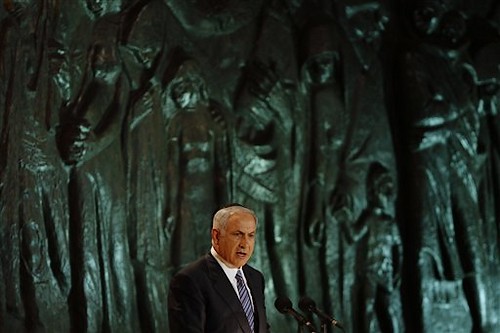
This is what I call cynically using the Holocaust for political purposes: Netanyahu recently used the opening of a new exhibit at Yad Vashem as an opportunity to denounce the Iranian regime, saying:

There is a new call to destroy the Jewish state, it’s our problem, but not only our problem. This is a crime against the Jews, and a crime against humanity, and it is a test of humanity. We shall see in the following weeks whether the international community deals with this evil before it spreads.

When I read this report, it sounded vaguely familiar – then remembered blogging about a similar comment Netanyahu made three years ago. Here’s what I wrote at the time:

Clearly Ahmadinejad’s murderous rhetoric toward Israel cannot and should not be taken lightly, and we should never minimize the threat posed by Iran’s nuclear ambitions. But we must also be very clear about what we are suggesting when we compare Ahmadinejad to Hitler and present day Iran to Nazi Germany. For what it’s worth, consider me to be one member of the organized Jewish community that finds this comparison unhelpful – and the prospect of an American or Israeli attack on Iran truly horrifying to contemplate.

Apropos of Netanyahu’s most recent comments: Ahmadinejad’s rhetoric toward Israel is definitely hateful, and is clearly designed to bait Israel and the West – but I can’t see how it possibly constitutes a “crime against humanity.”

Netanyahu’s Yad Vashem rhetoric certainly seems to indicate he’s itching to take the bait. Let’s hope the international community will see past his dangerous, wrongheaded invoking of a “second Holocaust” and deal with this crisis with intelligence and moderation.

On Haiti Remembered and Gaza Forgotten

Two prominent Israeli columnists ask: why are Israelis so eager to pitch in to the rescue effort in Haiti and yet show such little concern over the dire humanitarian crisis they’ve helped to create just a few kilometers away in Gaza?

Akiva Eldar, writing in Ha’aretz

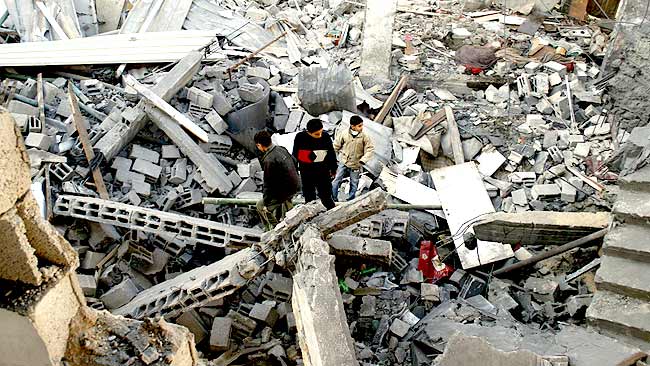
(The) remarkable identification with the victims of the terrible tragedy in distant Haiti only underscores the indifference to the ongoing suffering of the people of Gaza. Only a little more than an hour’s drive from the offices of Israel’s major newspapers, 1.5 million people have been besieged on a desert island for two and a half years. Who cares that 80 percent of the men, women and children living in such proximity to us have fallen under the poverty line? How many Israelis know that half of all Gazans are dependent on charity, that Operation Cast Lead created hundreds of amputees, that raw sewage flows from the streets into the sea?

The disaster in Haiti is a natural one; the one in Gaza is the unproud handiwork of man. Our handiwork. The IDF does not send cargo planes stuffed with medicines and medical equipment to Gaza. The missiles that Israel Air Force combat aircraft fired there a year ago hit nearly 60,000 homes and factories, turning 3,500 of them into rubble. Since then, 10,000 people have been living without running water, 40,000 without electricity. Ninety-seven percent of Gaza’s factories are idle due to Israeli government restrictions on the import of raw materials for industry. Soon it will be one year since the international community pledged, at the emergency conference in Sharm el-Sheikh, to donate $4.5 billion for Gaza’s reconstruction. Israel’s ban on bringing in building materials is causing that money to lose its value.

Gershon Baskin, in today’s Jerusalem Post:

Humanitarian disasters around the world bring out the best in Israel and in Israelis. The horrific devastation caused by the earthquake in Haiti and the scenes of unbearable human suffering brought about an immediate enlistment of both civilian and public efforts to come to the aid of the poorest nation in the Western hemisphere…

But what about the humanitarian disaster in our own backyard caused in a large part by our own doing? What about Gaza? More than 1.5 million people are living in total poverty, without sanitary drinking water, under an economic and physical siege, locked in what could easily be called the world’s largest prison. While we ask to see in all of the gory details, all of the destruction including hundreds of corpses on the streets of Port-au-Prince, we wish to see none of the human suffering of our Palestinian neighbors in Gaza where we literally hold the keys to the end of their suffering.