People You Should Know About: Ezra Nawi

If you’re looking for the definition of an Israeli hero, here’s my nomination: human rights activist Ezra Nawi.  Well-known in the Israeli-Palestinian peace movement, Nawi is a true original. This is how he was described by journalist Neve Gordon in a recent Guardian article:

Nawi is not a typical rights activist. A member of the Ta’ayush Arab-Jewish Partnership he is a Jewish Israeli of Iraqi descent who speaks fluent Arabic. He is a gay man in his fifties and a plumber by trade. Perhaps because he himself comes from the margins, he empathises with others who have been marginalised – often violently.

Nawi has long been active on behalf of the Palestinians and Bedouins of South Hebron, a region where the occupation is particularly oppressive and harassment at the hands of Jewish settlers is virtually constant. While his non-violent activism has helped bring international attention to this troubled region, it has also made him a target in the eyes of the occupation authorities. In July 2007, he was arrested and charged with assaulting a police officer while protesting the destruction of a Palestinian house. He will be sentenced next month and will most certainly face jail time unless there is a significant public outcry.

As it turns out, the home demolition and arrest were all captured on film and broadcast on the Israeli news. (Click above – Nawi is the one in the green jacket and the grey cap.)  The footage is riveting and everything is clearly documented from beginning to end (including the non-assault of the officer.)  Nawi himself gets the last word however. Sitting handcuffed in a military vehicle before laughing, scornful soldiers he says, “Yes, I was also a soldier, but I did not demolish houses. There’s a big difference. The only thing that will be left here is hatred…”

Since Nawi’s arrest, support has been building. Jesse Hochheiser’s blog, “Across the Borderline” contains several powerful testimonials, including this from Hebrew University professor and fellow Ta’ayush activist David Shulman:

Ezra Nawi is probably the most courageous person I have ever met. I have seen him in countless moments when settlers violently attacked him and other peace activists, Palestinians and Israelis; his presence of mind, steadfastness, and clarity always got us through such times. He is that most unusual of human beings– a person of profound inner gentleness and moral principle, selfless and creative in finding ways to help the Palestinian shepherds and farmers of the South Hebron hills.

The only thing standing between Ezra Nawi and imprisonment is your voice. Click here to offer your support.

Confessions of a Peace Process Cynic

Was2345642

Don’t get me wrong. I’m on board. I’m in there with the American Jews who are reassuring Obama that we’ve got his back. But I have to say it’s all I can do to resist my cynicism when I read about Peace Process, version 5.0. (And for safety’s sake, let me just reiterate my blog’s disclaimer: I’m writing this merely as a snarky private citizen – not on behalf of any organization with which I’m affiliated.)

As I’ve written before, I’m encouraged by Obama and Clinton’s tough talk on the settlements. Nevertheless, I’ve increasingly been wondering if/how the administration would back up their tough words with meaningful action.

Thus I confess to a distinctly familiar sinking sensation when I read this in the NY Times this morning:

As President Obama prepares to head to the Middle East this week, administration officials are debating how to toughen their stance against any expansion of Israeli settlements in the West Bank.

The measures under discussion — all largely symbolic — include stepping back from America’s near-uniform support for Israel in the United Nations if Prime Minister Benjamin Netanyahu of Israel does not agree to a settlement freeze, administration officials said.

Other measures include refraining from the instant Security Council veto of United Nations resolutions that Israel opposes and making use of Mr. Obama’s bully pulpit to criticize the settlements, officials said. Placing conditions on loan guarantees to Israel, as the first President Bush did nearly 20 years ago, is not under discussion, officials said.

Call me cynical, but “symbolic measures” simply aren’t going to cut it. Not when you’re up against the juggernaut that is Israel’s settlement movement. (Read Akiva Eldar’s “Lords of the Land” if you think “juggernaut” is too strong a word.) And certainly not when you are dealing with the most pro-settlement Israeli administration in recent memory.  Already several Israeli officials are complaining loudly that the demand for a settlement freeze is “unfair.” (“There are reasonable demands and demands that are not reasonable.” Bibi said today.)

I found it interesting that the NY Times article cited George H. W. Bush and the loan guarantees – now that brought back some memories. Remember the last time an American president tried to tie US aid to Israel’s settlement activity?

For many in the Jewish community, Bush’s presidency could be encapsulated in his offhand quip to reporters in September 1991 during an AIPAC lobbying effort on Capitol Hill in support of the proposed $10 billion loan guarantee to Israel: “I’m one lonely little guy” up against “some powerful political forces” made up of “a thousand lobbyists on the Hill.”

Bush had opposed the loan guarantees as long as Israel continued settlement in the West Bank and Gaza. The president finally agreed to a loan guarantee package in August 1992, requiring as a set-off any funds Israel spent to build housing or infrastructure in the territories. Despite this action, the political damage was done. The loan guarantee controversy later motivated Jewish opposition to President Bush, who received no more than 12% of the Jewish vote in the 1992 election (down from close to 35% in 1988).

More than fifteen years later, you’d still be hard pressed to find anyone in the American Jewish establishment supporting the withholding of aid to Israel under any circumstances.  As I’ve written before, this is the “third rail” in the American Jewish community. But trust me on this: it may well be the only diplomatic stick that will get Israel’s attention at the end of the day.

Now is Obama up to that level of political courage? And even more to the point: will the American Jewish community still have his back if/when that time comes?

In Search of Perspective in Bil’in

Recently read a piece on Ynet describing the experience of IDF soldiers stationed in Bil’in – a Palestinian village which has been the site of a weekly demonstration for the past four years. I was particularly intruiged by the description of one soldier, who described the detail as “more terrifying for us than dealing with terrorists in Gaza inside a tank:”

In Gaza you spot a terrorist, fire a shell, and it’s over. Here you face citizens who hurl a stone or a Molotov cocktail, but your ability to respond is limited. It may appear that we are the ones using force here, but in reality that’s not the case, as we are subject to very difficult restrictions.

I completely understand the perspective of an individual soldier who is ordered to perform a incomprehensibly difficult duty such as this. But I understand that there is also more to understand – so much more.  I certainly don’t begrudge the experience of individuals caught up in this bitter struggle. But I believe we do ourselves a huge disservice when we neglect – as this article did – the larger context in which this struggle occurs.

Some context: the Bil’in demonstration was born in response to Israel’s placement of its separation barrier in such a way that it now separates 60% of the village from its farming land – land that Israel is using to expand its settlement of Modi’in Illit, which lies immediately to the west.

In 2007, the Israeli Supreme Court ordered the government to reroute the barrier, which it called “highly prejudicial” to the villagers of Bil’in. Though Israel’s Defense Ministry has said it will abide by the ruling, the fence has yet to be moved. Just last month, the state submitted a new proposal to the Court to redraw the route of the barrier. According this plan, however, only 700 of the original 1,700 dunams of farmland will be returned to the villagers of Bil’in.

The Bil’in demonstration  is a non-violent direction action that began in January 2005 and has taken place every Friday since then (see clip above). Though Bil’in is a local initiative, it is an integral part of the larger Palestinian non-violence movement- a significant socio-political phenomenon that is chronically under reported by the Western media.  Indeed, it is important to note that Palestinian non-violent action vastly predates Bil’in – this is a movement that coalesced in large part during the years of the First Intifada. (I highly recommend Mary Elizabeth King’s excellent book, “A Quiet Revolution” for more on this important history.)

It has been well reported that the Bil’in demonstrations have witnessed tragedy in recent months. Four Palestinians, including two children, have been killed in the area since last summer and dozens have been injured. Last month Bassem Abu Rahmeh, a Palestinian demonstrator, was killed by a tear gas canister that sliced through his chest. A month earlier, an American demonstrator named Tristan Anderson was critically injured in a similar demonstration in the nearby village of Ni’ilin.

As the YNet article attests, some Palestinian demonstrators have indeed become increasingly violent. In a sense, we are witnessing the classic spiral. As any student of non-violent activism knows, it is difficult to contain the frustration that invariably sets in when an action settles in for the long haul – particularly when there is so little progress along the way.  This recent article from the Guardian illuminates the challenges the Bil’in protesters face in this regard – including the generational split in the villagers’ attitudes toward non-violence:

The Bil’in demonstration was always intended to be non-violent, although on Friday, as is often the case, there were half a dozen younger, angrier men lobbing stones at the soldiers with slingshots. The Israeli military, for its part, fires teargas, stun grenades, rubber-coated bullets and sometimes live ammunition at the crowd.

There have long been Palestinian advocates of non-violence, but they were drowned out by the militancy of the second intifada, the uprising that began in late 2000 and erupted into waves of appalling suicide bombings.

Eyad Burnat, 36, has spent long hours in discussions with the young men of Bil’in, a small village of fewer than 2,000, convincing them of the merits of “civil grassroots resistance”.

“Of course it gets more difficult when someone is killed,” said Burnat, who heads the demonstration. “But we’ve faced these problems in the past. We’ve had more than 60 people arrested and still they go back to non-violence. We’ve made a strategic decision.”

Some, like the moderate Palestinian MP Mustafa Barghouti, hope this might be the start of a broader movement throughout Palestinian society. “It is a spark that is spreading,” he said in Bil’in. “It gives an alternative to the useless negotiations and to those who say only violence can help.”

But it is not so much that all the young men of the village are converted to the peaceful cause, rather that they respect and follow their elders. “I personally don’t believe in non-violent resistance,” said Nayef al-Khatib, 21, an accountancy student. “They’ve taken our land by force so we should take it back from them by force.”

As always, perspective is everything. The Ynet article did a fine job of documenting the perspective of scared, frustrated young soldiers who find themselves in an impossible position. But there there are other equally valid and compelling perspectives we cannot ignore: the perspective of the farmers whose access to their own lands and livelihood have been taken from them; the perspective of villagers seeking justice in an inherently unjust situation; the perspective of non-violent activists trying to rise about the frustration and rage that inevitably surface during the course of their struggle.

As for us Jews, I only hope we can go beyond our narrow perspective of Palestinians as nothing more than violent terrorists who want nothing more than to wipe Jews off the face of the map. Is that a step we might be willing to take?

Six Months and Counting

250_bibiIt’s no longer speculation to imagine an Israeli military attack on Iran. Following his visit to Washington, Netanyahu has made his ultimate intentions perfectly clear:

These are not regular times. The danger is hurtling toward us. The real danger in underestimating the threat.  My job is first and foremost to ensure the future of the state of Israel … The leadership’s job is to eliminate the danger. Who will eliminate it? It is us or no one.

Never thought I’d  live to find myself saying this, but here goes: the voice of sanity on this issue comes from the US Secretary of Defense:

The only way we can prevent Iran from getting a nuclear weapon is for the Iranians themselves to decide that it’s too costly. And that it absolutely detracts from their security rather than enhances it.

If we or the Israelis or somebody else strike (Iran) militarily, in my view, it would delay the Iranian program for some period of time, but only delay it, probably only one to three years. You would unify the nation, you would cement their determination to have a nuclear program, and also build into the whole country an undying hatred of whoever hits them.

I have a sinking feeling about this. The Obama administration has painted itself into a corner by giving talks with Iran a six month deadline – a daunting task by any reasonable standard.  Are Netanyahu’s threats mere bluster? I for one wouldn’t want to test that theory.

Pray for the peacemakers…

“Now the Hard Work Starts…”

So Netanyahu managed to spend his entire sojourn in DC without uttering the magic words “two state solution.” On the upside, however, the Obama team has laid down the line on Israel harder than any American administration in recent memory – particularly on the issue of a settlement freeze.

Note Clinton’s forceful words on the subject during this recent Al-Jazeera interview:

We want to see a stop to settlement construction – additions, natural growth, any kind of settlement activity – that is what the president has called for.

Clinton’s words here were actually very carefully chosen. Indeed, one of the latest tactics of the Israeli government to skirt this issue is to insist on allowing additional construction on existing settlements to accommodate “natural growth.”  During a visit to Washington earlier this month, the increasingly disappointing Shimon Peres, put it this way:

Israel cannot instruct settlers in existing settlements not to have children or get married. These children are not going to live on roofs.

(The mind reels with potential witty rejoinders to that whopper. I’ll refrain..)

We should at least be heartened that Obama has unequivocally drawn the line on settlements – but he still has an incredibly difficult job ahead of him. As Clinton puts it in the interview, now the hard work starts.

We in the American Jewish community are not exempt from this work. If we truly believe that a just and viable two-state solution is in the best interest of all concerned, then it’s time for us to stand up and say so.  Click here to do just that.

Rabbis Remembering the Nakba

IMG_0324

“These I remember and I pour out my soul…”

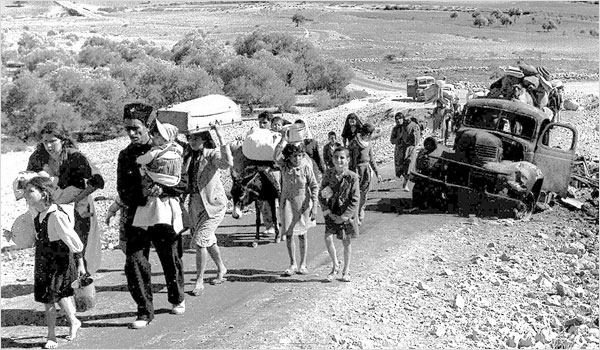
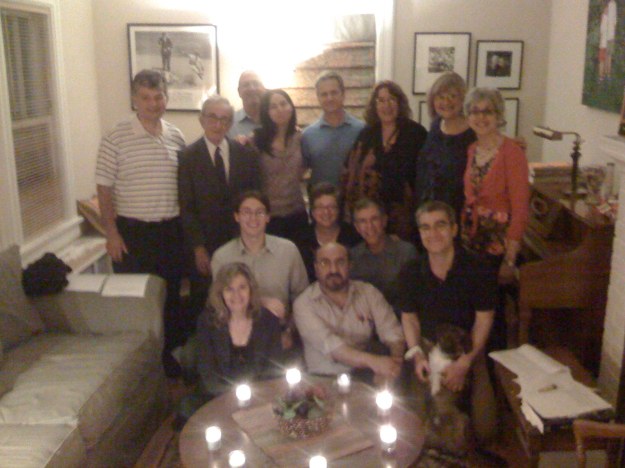
Last Thursday night I welcomed 14 people  – 9 Jews and 5 Palestinians – into my home for what turned out to be a powerful and sacred experience. The timing of our gathering was significant. May 14, 1948, the date of the State of Israel was declared, is a joyful milestone for Israel and Jews around the world. For the collective memory of the Palestinian people, however, this date represents their displacement and dispossession – an event they refer to collectively as the Nakba (“catastrophe.”)

The gathering in my home was one of four events that took place throughout the country on Thursday evening sponsored by “Rabbis Remembering the Nakba” – a new ad hoc group of rabbis and rabbinical students who seek to create a Jewish context for remembering this tragic event. Even more crucially, we believe it is critical that the Jewish community find a way to honestly face the painful truth of this event – and in particular, of Israel’s role in it.

In the words of a statement that was read at each gathering:

Our gathering tonight, “Rabbis Remembering the Nakba” is part of a series of programs occurring simultaneously around the country. It was originated by an ad-hoc group of American rabbis who desire to seriously reflect upon the meaning of Israel’s Independence Day. We are united in our common conviction that we cannot view Yom Ha’atzmaut – or what is for Palestinians the Nakba – as an occasion for celebration. Guided by the values of Jewish tradition, we believe that this day is more appropriately an occasion for zikaron (memory), cheshbon nefesh (“soul searching”) and teshuvah (“repentance.”)

These spiritual values compel us to acknowledge the following: that Israel’s founding is inextricably bound up with the dispossession of hundreds of thousands indigenous inhabitants of the land, that a moment so many Jews consider to be the occasion of national liberation is the occasion of tragedy and exile for another people, and that the violence begun in 1948 continues to this day. This is the truth of our common history – it cannot be denied, ignored or wished away.

Jewish tradition teaches that peace and reconciliation can only be achieved after a process of repentance. And we can only repent after an honest accounting of our responsibility in the wronging of others. While it is true that none of the Jews present tonight were actively involved in the dispossession of Palestinians from their homes in 1948, it is also true that if we deny or remain silent about the truth of these events, past and present, we remain complicit in this crime. In the words of Rabbi Abraham Joshua Heschel, “In a free society some are guilty, but all are responsible.”

Our gatherings this evening bring together Jews and Palestinians in this act of remembrance. This coming together is an essential, courageous choice. To choose to face this painful past together is to begin to give shape to a vision of the future where refugees go home, when the occupation is ended, when walls are torn down and where reconciliation is underway.

In addition to the event I hosted in Chicago, “Rabbis Remember the Nakba” gatherings were held simultaneously in Berkeley (led by Rabbi Lynn Gottlieb), New York (Rabbinical Student Alissa Wise), and Philadelphia (Rabbi Linda Holtzman). Though each event was organized separately and involved the additional participation of various local peace and justice groups, each gathering was linked by a few important common factors: each was led by a rabbi or rabbinical student, each involved the participation of both Jews and Palestinians, and each incorporated aspects of Jewish ritual in their ceremonies.

At the Chicago gathering, the guiding value of our ritual was zikaron – remembrance. As part of our ceremony, we bore witness by reading the history of the eight Palestinian villages that were destroyed on May 14, 1948. (In all, over 400 villages were depopulated of their inhabitants over the course of that year.)  In addition to learning about the events that transpired on the Nakba, we also learned about the history, culture, and communal life of each village. (Palestinian historian Walid Khalidi’s exhaustive and highly recommended work, “All That Remains” was an essential resource for our ceremony.) After hearing the history and fate of each village, a memorial candle was lit and we recited the following line from the Yom Kippur liturgy together: “These I remember and I pour out my soul.”

IMG_0328

On the whole I would describe our evening as a modest first effort that nonetheless contained some profound and indelible moments. By incredible coincidence, one of the Palestinian participants, Shafic Budron, mentioned that his wife’s family was from al-Bassa – one of the eight villages we commemorated in our ceremony. (Al-Bassa was a large village in Acre District, near the northwest coast of Palestine.)

As we read about al-Bassa’s fate during the Nakba, we learned this tragic account relayed by Palestinian eyewitnesses: after occupying the village, Haganah forces lined up some of the townspeople outside a church, shot them, and ordered others to bury the bodies. Shafic said he has heard numerous stories about al-Bassa from his mother-in-law over the year, including her traumatic recounting of the massacre on May 14. He added that his mother-in-law now has Alzheimer’s and has lost most of her adult memory – her only remaining memories are of her childhood village.

After our ritual, other Palestinian participants spoke at length about the stories of their own families. One man told us about the experiences of his mother, who was a survivor of an infamous massacre in the village of Deir Yassin, outside Jerusalem. Our gathering also included a Christian Palestinian from the north of the country, who experienced the Nakba personally.  Another Palestinian participant told us about his father who was saved by a Jewish friend during the Irgun’s attack on Jaffa.

In the end, the Palestinian participants were quite obviously moved that they were given this opportunity to have this conversation with Jews, as part of a ceremony convened by a rabbi. To put it mildly, it was obviously something quite unprecedented in their experience.  For the Jewish participants, there were a myriad of complex and powerful emotions. I’m personally still trying to sort through them all.

Whatever cognitive dissonance I might feel over this issue, I truly believe that this kind of reckoning is utterly essential for us as Jews. When it comes to the Nakba, most of us tend to respond through denial, avoidance, or dismissive rationalization (“that’s just how nations are made – what can you do?”)  The reason seems fairly clear: to face the painful truths of this history means to admit that our people  – a people who has been the victim of dispossession and dehumanization for centuries – has now become the perpetrator. And if we do indeed manage to face these truths, where does that leave the Zionist narrative that has been so deeply cherished by so many of us for so long?

I don’t know where we will go from here, but everyone present agreed that this was the tentative beginning of something enormously important. Our humble gathering resonated with a myriad of implications that ranged from the personal to the political. But by the end of the evening, it was clear that whatever happens next, Jews and Palestinians must do it together.

PS: Just learned that Yisrael Beiteinu, the party of Avigdor Lieberman, seeks to make it illegal for Arabs in Israel to commemorate the Nakba. This is what it has now come to: memory is not only denied, it is now deemed against the law…

Postville One Year Later

IMG_0312

Yesterday marked the one year anniversary of the ICE raid on the Agriprocessors plant in Postville, IA – at the time the largest immigration raid in US history.  Here in Chicago, I was honored gather with the Jewish Council on Urban Affairs and other orgs for an interfaith rally at Federal Plaza. It offered an important opportunity to remember this infamous milestone and to help keep immigration reform/worker justice alive on the national radar.

IMG_0314

Our gathering offered prayers, updates and testimonies, after which we marched several blocks to ICE headquarters where each name of the 389 arrested Agriprocessor employees was read aloud (below). It was a powerful moment of bearing witness – a reminder that our advocacy of immigration reform represents a fight for the real individuals, real lives, real families.

IMG_0317After all the names were read, we delivered a letter to Feds that demanded an end to unjust raids, detention and deportations. Following the rally, several members of our delegation traveled to Postville to mark the anniversary with a gathering at St. Bridget’s Church and the Agriprocessors plant. (Click here to donate to help support the residents of this devastated community.)

Though the Obama administration supports reform, there are any number of obstacles that might prevent immigration legislation from making it to a vote in Congress in 2009. Passage of the newly reintroduced DREAM Act would certainly be a great start (it’s currently eight votes short). Click here to offer your support.

Shandeh Du Jour: Pope Overly “Cosmopolitan” at Yad Vashem

pope-kotel-2711According to YNet, Rabbi Meir Lau criticized Pope Benedict for showing insufficient sensitivity during his speech at Yad Vashem today:

The visit ended with a somewhat strident tone, as Rabbi Yisrael Meir Lau, chairman of Yad Vashem, criticized the pope’s speech as being “devoid of any compassion, any regret, any pain over the horrible tragedy of the six million victims. Even the word ‘six’ was not included.”

Rabbi Lau also censured the pope’s use of the word “killed” instead of the word “murdered.” Benedict, he added “said nothing about the killers, neither Germans nor Nazis. What bothered me the most was the lack of condolences to the Jewish nation, which lost a third of its sons (in the Holocaust).

“I’m not talking about an apology, I’m talking about empathy… this was more about sympathy to the pain of humanity. This speech had a cosmopolitan phrasing to it.”

The article also notes that Museum Director Avner Shalev registered his disappointment that the speech lacked any “direct reference to anti-Semitism.”  Not to be outdone, Shas chairman Eli Yishai took the Pope to task for failing to “rebuke past and present Holocaust deniers.”

All those who are sick and tired of the cynical use of the Holocaust as a political battering ram, click here.

Why I Didn’t Celebrate Yom Ha’atzmaut

nakhba

I’ve decided not to celebrate Yom Ha’atzmaut today. I don’t think I can celebrate this holiday any more.

That doesn’t mean I’m not acknowledging the anniversary of Israel’s independence – only that I can no longer view this milestone as a day for unabashed celebration. I’ve come to believe that for me, Yom Ha’atzmaut is more appropriately observed as an occasion for reckoning and honest soul searching.

As a Jew, as someone who has identified with Israel for his entire life, it is profoundly painful to me to admit the honest truth of this day: that Israel’s founding is inextricably bound up with its dispossession of the indigenous inhabitants of the land. In the end, Yom Ha’atzmaut and what the Palestinian people refer to as the Nakba are two inseparable sides of the same coin. And I simply cannot separate these two realities any more.

I wonder: if we Jews are ready to honestly face down this “dual reality” how can we possibly view this day as a day of unmitigated celebration? But we do – and not only in Israel. Indeed, there is no greater civil Jewish holiday in the American Jewish community than Yom Ha’atzmaut. It has become the day we pull out all the stops – the go-to day upon which Jewish Federations throughout the country hold their major communal Jewish parades, celebrations and gatherings.

I wonder: how must it feel to be a Palestinian watching the Jewish community celebrate this day year after year on the anniversary that is the living embodiment of their collective tragedy?

I can’t yet say what specific form my new observance of Yom Ha’atzmaut will take. I only know that it can’t be divorced from the Palestinian reality – or from the Palestinian people themselves. Many of us in the co-existence community speak of “dual narratives” – and how critical it is for each side to be open to hearing the other’s “story.” I think this pedagogy is important as far as it goes, but I now believe that it’s not nearly enough. It’s not enough for us to be open to the narrative of the Nakba and all it represents for Palestinians. In the end, we must also be willing to own our role in this narrative. Until we do this, it seems to me, the very concept of coexistence will be nothing but a hollow cliche.

Toward a new understanding of Yom Ha’atzmaut, I commend to you this article by Amaya Galili which was published today in the Israeli newspaper Yediot Achronot. Galili is affiliated with Zochrot – the courageous Israeli org that works tirelessly to raise their fellow citizens’ awareness about the Nakba.

An excerpt:

The Israeli collective memory emphasizes the Jewish-national history of the country, and mostly denies its Palestinian past. We, as a society and as individuals, are unwilling to accept responsibility for the injustice done to the Palestinians, which allows us to continue living here. But who decided that’s the only way we can live here? The society we’re creating is saturated with violence and racism. Is this the society in which we want to live? What good does it do to avoid responsibility? What does that prevent us from doing?

Learning about the nakba gives me back a central part of my being, one that has been erased from Israeli identity, from our surroundings, from Israeli education and memory. Learning about the nakba allows me to live here with open eyes, and develop a different set of future relationships in the country, a future of mutual recognition and reconciliation between all those connected to this place.

Accepting responsibility for the nakba and its ongoing consequences obligates me to ask hard questions about the establishment of Israeli society, particularly about how we live today. I want to accept responsibility, to correct this reality, to change it. Not say, “There’s no choice. This is how we’ve survived for 61 years, and that’s how we’ll keep surviving.” It’s not enough for me just to “survive.” I want to live in a society that is aware of its past, and uses it to build a future that can include all the inhabitants of the country and all its refugees.

Click here to read the article in the original Hebrew. Click below to read the entire English version. (Heartfelt thanks to my friend Mark Braverman for sending it along.)

Continue reading

On Clowns and Illegal Hothouses

PD*28296118

I know I promised to pontificate on this week’s UN World Conference on Racism in Geneva, but I don’t know that I have anything to add that hasn’t already been said about this particular circus. (And I mean this literally – see above.)  For what it’s worth, I found Cecilie Surasky’s dispatches for Muzzlewatch to be the most incisive and helpful reporting on conference doings.

On a completely unrelated topic, I noticed this small news piece in yesterday’s Ha’aretz:

Five Border Policemen were wounded on Thursday in a clash with hundreds of residents of the Israeli Arab town of Kafr Qasem.

The violence broke out when security forces arrived to demolish a concrete surface upon which a hothouse was due to be built illegally. They were met at the scene by about 400 Kfar Kassem residents who had turned out to protest the move.

I suppose its just a minor news story in the scheme of things – still, it did remind me that the media’s impact is often less powerful for what it says than for what it leaves out. In this case, that would be the fact that almost all new building in Israeli Arab villages is technically “illegal” since Israel has made it virtually impossible for its Arab citizens to receive building permits.

From a New Israel Fund report:

There is a lack of planning for Arab neighborhoods and towns that has led to ongoing difficulties in obtaining building permits, and as a result, the demolishing of illegal buildings in the Arab sector. Since 1948, almost no Arab neighborhood or town has legally been permitted to expand.

Also left out of the article is any mention of this particular village’s  tragic history – and why a demolished hothouse is really just the latest chapter for the citizens of Kafr Kassem. Click here to learn more.