Tag Archives: Politics

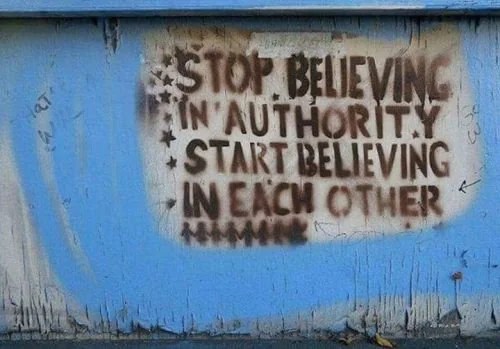
Inauguration Day 2025: “Love Work, Hate Authority and Don’t Cozy Up to the Government”

(Rabbi) Shemiah said, “Love work. Hate authority. Don’t get too friendly with the government.” Pirke Avot, 1:10 (translation, Jacob Neusner).

This classical rabbinic saying comes from “Chapters of the Fathers,” a well-known collection of rabbinic sayings and aphorisms from the 2nd century ACE. While there are many more finessed English renderings of this particular saying (one version, offered by Talmudic scholar Dr. Joshua Kulp reads: “Love work, hate acting the superior and do not attempt to draw near to the ruling authority”), I’ve always appreciated the bluntness of Jacob Neusner’s more direct translation. We don’t know much about Shemiah, but we do know that he was a Jewish leader in the 1st century BCE and the he wasn’t a big fan of Herod, the appointed authority over Palestine during the reign of the Roman empire.

As a member of the Jewish community, I definitely appreciated Shemiah’s caution over cozying up to state power after reading reports from yesterday’s inauguration of Donald Trump, which featured a prayer from Rabbi Ari Berman, the President of Yeshiva University. Among other things Rabbi Berman hailed this “moment of historic opportunity” and prayed for the new administration to “unite us around our foundational biblical values of life and liberty, service and sacrifice, and especially of faith and morality.” (Americans who do not adhere to Biblical tradition were presumably left out of his vision of national unity.)

Needless to say, Rabbi Berman’s legitimizing of Trump’s inauguration did not speak for many of us in the Jewish community, especially when you consider that Trump has now pardoned virtually all of the Capitol insurrectionists, including their white supremacist, neo-Nazi leaders. When you consider that Proud Boys were seen marching and chanting through the streets of DC for the first time since January 6 while Trump was being sworn in as President.

Then there was the moment in which Trump’s new friend Elon Musk – who has made no secret of his support for the European far right – made two clear and unmistakable Nazi salutes at an inaugural event. As painful as this was to witness, for me the even more nauseating moment occurred when the Anti-Defamation League subsequently issued a statement dismissing the salute as an “awkward gesture,” adding: “This is a new beginning. Let’s hope for healing and work toward unity in the months and years ahead.” Apologizing for Nazi messaging at Presidential Inaugural is a truly new low for the ADL – and that is saying a lot.

I also couldn’t help but think of Shemiah’s teaching yesterday as I watched so many public figures, corporate leaders and politicians (from both sides of the aisle) flashing cheerful smiles as they were wined and dined in Washington by this new authoritarian administration – on MLK Day, of all days. “Don’t get too cozy with the government” would have been particularly good advice to New York Mayor Eric Adams, who reportedly cancelled previously scheduled appearances at events celebrating MLK after he received a last-minute invitation to attend the inauguration.

There has been much commentary about how dramatically different Trump’s inauguration feels in comparison to his previous inaugural in 2106, when the resistance was actively organizing and protests would soon fill the streets. This time around, the main theme seems to be political resignation and capitulation. I have no doubt that Michigan’s Democratic governor Gretchen Whitmer spoke for many in her party when she said last week, “My job is to try to collaborate and find common ground wherever I can.” (Couldn’t she have at least chosen a better word than colloborate?”)

As yesterday mercifully came to a close, I finally decided on a new rendering of Rabbi Shemiah’s teaching – one more apropos to the current political moment:

Love the work of resistance. Hate fascism. And don’t expect politicians to save you.

The Gaza Ceasefire: Pharoah is Still Pharoah

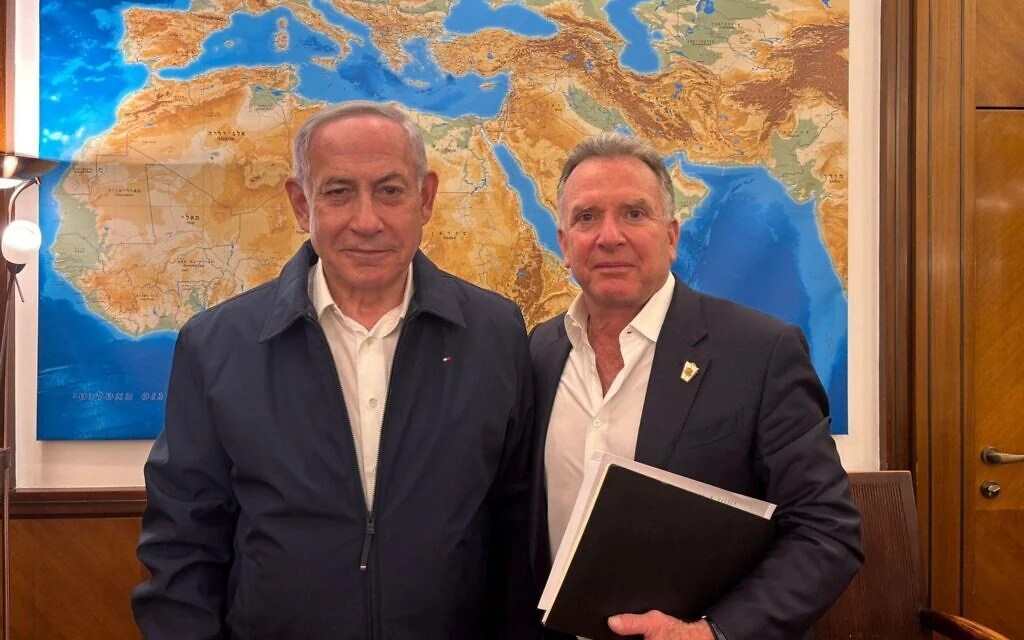
Benyamin Netanyahu and Steve Witkoff, January 11, 2025

For Palestinians and those who stand in solidarity with them, the news of a ceasefire agreement between the Netanyahu administration and Hamas was welcome news. When the reports first broke, and I saw images of Gazans singing and dancing in the streets, I couldn’t help but feel a joyful solidarity with them. But like all brokered agreements between Israelis and Palestinians, this deal is also fragile and fraught – and filled with deeply disingenuous political maneuvering.

Some history: according to reports, this ceasefire deal is identical to the one brokered by the Biden administration last May, which was accepted by Hamas leaders in early July. At the last minute, however, Netanyahu later backed out, insisting on nothing less than the total destruction of Hamas. Israel then assassinated Hamas’ political leader and chief negotiator, Ismail Haniyeh and continued its relentless bombardment of Gaza.

Though this was all a direct affront to the Biden administration, the US government responded not by pressuring Netanyahu to accept the deal but by rewarding Israel with a $20 billion arms sale. Biden and Secretary of State Blinken also actively promoted the lie that it was Hamas and not Israel that had kiboshed the deal. In the meantime, the Israeli military continued with its genocidal onslaught. From the time that the talks fell apart until now, the death toll of Palestinians rose from at least 39,000 to 46,707, including more than 18,000 children.

So why is Israel accepting the very same deal a half a year later? We now know it was due to the efforts of Donald Trump, who has made it clear he didn’t want to deal with the distraction of Israel’s war on Gaza as he began his presidency. Last week, Trump asked his friend, Steve Witkoff, a billionaire real estate developer, to call Netanyahu and tell him in no uncertain terms that Israel’s military operations in Gaza must end before the inauguration.

In other words, a President-elect was able to do with a single visit from a private citizen what the Biden administration was either unable or unwilling to do for over a year.

Though the ceasefire deal was welcome news, it was not accomplished through the “tireless efforts of the Biden administration.” Neither was it due to the altruism (needless to say) of the President elect. Trump is nothing if not transactional – and there is already speculation over what he might give Netanyahu in return, whether it’s a brokered diplomatic deal with Saudi Arabia or the annexation of the West Bank (or both).

In the meantime, within 24 hours of the announcement of the deal, Israel escalated its bombing of Gaza, killing 80 Palestinians. According to analyst Yousef Munayyer, Israel has a habit of late-hour bombing to empty its stockpiles in anticipation of larger military aid packages from the US. In this case, since Israel has not realized its military objective of obliterating Hamas, “there may be an urge to do great damage while they can before ceasefire comes in, reacting to that disappointment.” As of this morning, the Netanyahu government, is indicating his government is prepared to accept the deal, which is set to go into effect on Sunday, but it is still yet to be signed.  

But even if it is finalized, we should have no illusions. Like past deals, there is so much that Israel can do to pursue its own designs going forward. Like past deals, this one is set to unfold in stages. The first phase will feature a ceasefire, a withdrawal of Israeli troops, an initial swap of hostages and prisoners and an influx of humanitarian aid into Gaza. However, the second and third phases are far less developed. There is no agreement on the rebuilding of Gaza, the future of the Israeli military presence, who will govern, or how.

When I read the details of this agreement, I couldn’t help but recall the Oslo Accords in 1993, which was also negotiated in phases. The first was an interim phase, in which Israel would gradually withdraw from Palestinian areas in the West Bank and transfer administrative power to a temporary “Palestinian Authority.” The second phase involved permanent status details such as Jerusalem, refugee rights, settlements and borders. In the end, Israel agreed to the first phase as a cover to extend its settlement regime across the West Bank – all the while enacting policies that further dispossessed Palestinians from their homes.

Oslo was a hard lesson on the ultimate designs of all Israeli administrations, from left to right. No matter who is in power, the Israel’s goals are the goals of Zionism itself: the maintenance of a Jewish majority in the land. This goal necessarily entails the ongoing ethnic cleansing – an ongoing Nakba – of the Palestinian people. After the genocide in Gaza, we can honestly add the words “by any means necessary” to this sentence. No matter the diplomatic rhetoric around this current deal, we must not lose sight of this crucial history. Put simply: Netanyahu is all too likely to assent to phase one of the deal, get back a requisite number of hostages, then continue with the genocide in Gaza in order to destroy Hamas completely, ensure a maximum number of Palestinians are either dead or unable to return to their homes, and re-entrench Israeli civilian settlement there.

In this week’s Torah portion, Parashat Shemot, there arises a new Pharoah who “did not know Joseph.” Threatened by the demographic growth of the Israelite people in the land, he institutes murderous policies to stem their birthrate and reduce their number through harsh enslavement. But there are also those who resist Pharoah’s tyranny through acts of courageous civil disobedience: Hebrew midwives who refuse to kill Israelite baby boys, a mother and sister who save an Israelite child and a daughter of Pharoah who adopts him. All of these events set in motion a chain that will inexorably, inevitably lead toward the liberation of the Israelite people.

So in this moment, let us welcome the prospect of the cessation of hostilities. But let us have no illusions about the designs of all Pharoahs past and present. Like the Israelites in our Torah portion, the Palestinian people continue to cry out for liberation.

Let us continue to heed their call.

Toward a Judaism of Love over Land, People over Profit

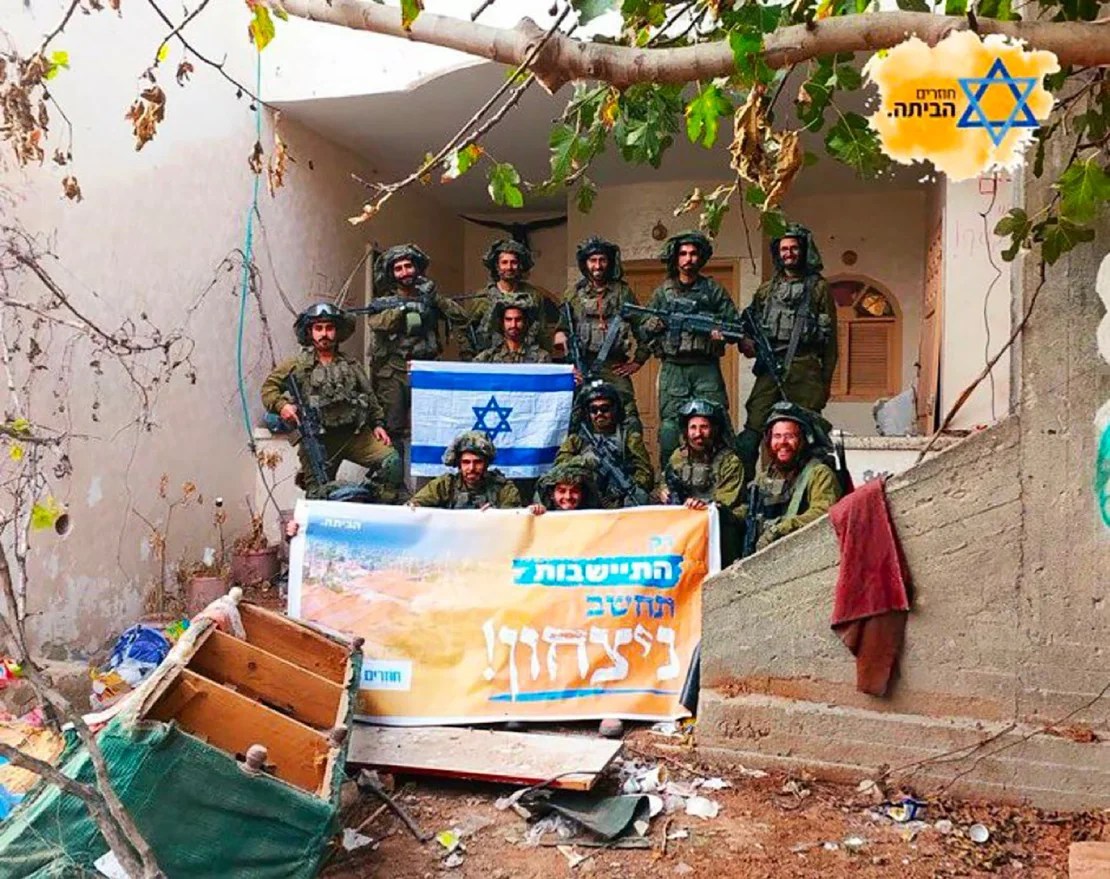
A photograph shows soldiers posing with an orange banner that reads: “Only settlement would be considered victory!” The color orange was used by the settler movement in 2004 and 2005 to protest Israel’s disengagement from Gaza.

It’s becoming ominously clear that the end game of Israel’s genocide in Gaza is the end of game of Zionism itself: namely, settlement. The writing has been on the wall for some time now. As I mentioned on Rosh Hashanah, we now know the existence of the so-called “General’s Plan,” in which:

Israel will control the northern Gaza Strip and drive out the 300,000 Palestinians still there. Major General Giora Eiland, the war’s ideologue, proposes starving them to death, or exiling them, as a lever with which to defeat Hamas. The Israeli right envisions a Jewish settlement of the area, with vast real estate potential of convenient topography, a sea view, and proximity to central Israel…

News accounts bear out that the General’s Plan is well underway. The vast majority of residents of Northern Gaza have now been ethnically cleansed from their homes and Israel has said it has no intentions to let them return. At a recent two-day conference, “Preparing to Resettle Gaza,” Israel’s National Security Minister Itamar Ben-Gvir told the hundreds who gathered, “If we want it, we can renew settlements in Gaza.”

With Trump now poised to take power, there will very likely be new wind behind these plans. Last March, Jared Kushner was quoted as saying: “Gaza’s waterfront property could be very valuable … It’s a little bit of an unfortunate situation there, but from Israel’s perspective I would do my best to move the people out and then clean it up.”  With Kushner widely expected to be “pivotal” to Trump’s Middle East policy, his words now take on a terrifying new resonance of possibility.

Even more ominously, there is every reason to expect these plans will be aided and abetted by the American Jewish communal establishment. One week after Donald Trump’s reelection, Karen Paikin Barall, the Jewish Federation’s VP of government relations, remarked to a group of local Jewish community relations councils, “We should all look forward to the day we can hope to buy townhouses in the West Bank and Gaza.”

As a settler colonial movement, Zionism was always focused on the maintenance of a majority Jewish presence in historic Palestine. However, the seizing and control of resources has been no less integral to this project. The settler colonial reality of the 21st century is driven in no small part by the corporate interest of weapons manufacturers as well as the billionaire and oligarch class that seek to profit off the spoils of war and genocide. In the current moment, it should come as no surprise that there is also unabashed talk about the annexation of the West Bank and even parts of South Lebanon.

Such is the natural result of a movement and ideology that prizes real estate over the well-being of the actual people who happen to live on the land. I’m particularly mindful of this as I contemplate this week’s Torah portion, Chayei Sarah, which begins with the famous episode in which Abraham negotiates with the Hittites to purchase the Cave of Machpelah as a burial site for his recently deceased wife Sarah. This story is often wielded by many Zionists as a deed of sale to this sacred site – and contemporary land acquisition in Palestine as the “inalienable possession of the Jewish people.”

There is, of course, another way to understand the spiritual meaning of this story: it is not about land acquisition but love and loyalty. Abraham is not motivated to purchase this land in order to claim exclusive entitlement to it: he is driven by his desire to honor his beloved wife Sarah, and to ensure that she and his extended family will have a permanent resting place. To read this episode only about entitlement to land is limited at best – and to judge by the apartheid and violence by which Israel maintains its control of this site today – a moral sacrilege at worst.

At the end of the portion, following the death of Abraham, we read that his sons Ishmael and Isaac buried their father together in the Cave of Machpelah. I can think of no better image to underscore the critical importance of pursuing a Judaism that prizes love over land. This Shabbat Chayei Sarah, may we rededicate our commitment to this sacred vision.

After Trump’s Election, We Need Each Other More Than Ever

Like all of you, I’m sure, I’m still in deep shock and anguish over Donald Trump’s electoral victory this past Tuesday. And while I certainly have my opinions about how this terrifying outcome could have possibly happened, I’m going to resist the urge to engage in post-election punditry. There’s more than enough to go around right now, some of it interesting, some of it clarifying, but to my mind, much of it tone-deaf and destructive. There will be time for the analysis, the interrogating and the strategizing. For now, however, I think it is critical that we sit with what has happened and give ourselves space to grieve and respond emotionally to the enormity of what has just occurred.

Of course, none of this happened overnight. Well before last Tuesday, were all too aware of the growth of fascism in the US and around the world, the scourge of state violence and mass incarceration, the loss of reproductive freedoms, the genocide against Palestinians, political targeting of immigrants, LGBTQ+ people, Muslims, disabled people, and other vulnerable minorities. After Tuesday, however, the stakes of these threats have reached a terrifying new level. Yes, what happened this week was shocking and heartbreaking. But it was also clarifying. We should no longer have any illusions about what we are up against.

I know that many of us who have been on the front line of the resistance to these threats are feeling exhausted and demoralized. Those who are members of targeted groups are understandably feeling a new level of fear for their own well-being. That is why, I believe to the core of my being, that the most important thing that those of us who have been organizing movements for justice can do in this moment is to reaffirm our commitment and care for one another.

In order to do that, we will need to resist the politics of division lest they infect the movements of solidarity we’ve been building so carefully and lovingly. During this past election, there was strong and passionate disagreement on whether a vote for Kamala Harris was a vote for genocide or a vote to hold back a Trump presidency. There were good, principled arguments to be made on both side of that debate. Even so, it was immensely painful to witness what this election did to the Palestine solidarity movement. Those who chose to vote for Harris were accused of “supporting genocide.” Those who chose withhold their vote for Harris were accused of being “MAGA enablers.” Our movement was faced with a profoundly untenable choice. There were times I feared it would rip us apart.

But after last Tuesday’s election, none of this really matters anymore. We simply cannot afford to turn on each other. Not now. We need each other more than ever.

I don’t yet know what kind of political strategies we will need to employ to resist the fascist reality posed by the MAGA movement – but I do know that whatever happens, we will need to show up for one another now more than ever. We will need to protect and defend one another. We will need to be clearer than ever about the values we hold sacred and be prepared to ground everything we do in the conviction that every single human life is of infinite worth – and is worth fighting for.

We will need to be clear-eyed about the challenges ahead and stand together to face them. For those of us in the Jewish community, that means lifting up solidarity as our most central sacred imperative. All the rest is mere commentary. As I said this past Yom Kippur:

In the 21st century, I believe this is the sacred calculus the Jewish people have to offer the world: Creation + Exodus = Solidarity. More than ever, the Jewish communities we create simply must value solidarity as our most sacrosanct mitzvah. In an age in which we are witnessing the increased scapegoating, yes of Jews, but also of Muslims, LGBTQ+ people, people of color, disabled people, immigrants, indigenous people and so many others, our sacred tradition must promote collective liberation first and foremost. 

The predominant theme in this week’s Torah portion, Lech Lecha, is the act of going forth into the unknown with nothing but a promise of blessing and liberation. But unlike the literal meaning of the words in our portion, we must affirm that this liberation cannot be for one privileged group of people alone. We must affirm a Lech Lecha of collective liberation, where all people are God’s people and all people are chosen and the boundaries of the Promised Land extend to include all who dwell on earth.

In this moment, like Abraham and Sarah, we are all being called into a land we do not yet know. But as we read in our portion, it is a collective going-forth – for the sake of both the living and future generations.

Yes, in this current moment, there is much we do not yet know. But we do know that we will have the hearts and minds to resist what is to come. That there is still a world worth fighting for. And that the way to that world is through our solidarity and care for one another.

Shabbat Shalom,

Rabbi Brant Rosen

Sukkah Descecration on College Campuses Reflect the Much Greater Desecration in Gaza

(Photo: JVP NU)

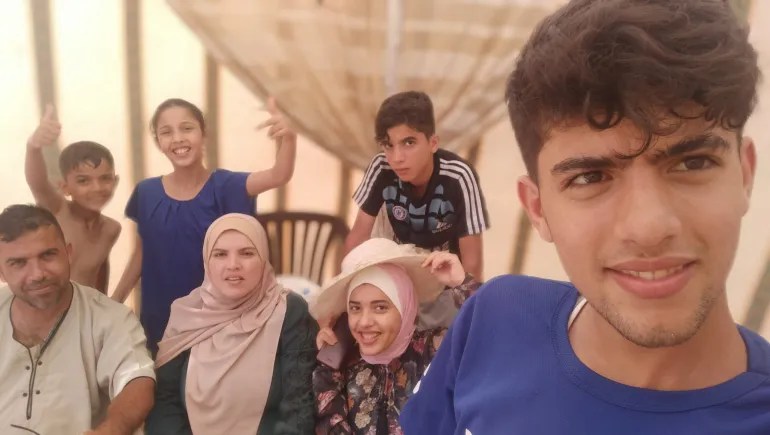
A few days before Sukkot, the world witnessed the unbearably tragic image of 19-year-old Sha’ban al-Dalou, a software engineering student burning to death after Israel bombed Gaza’s Al-Aqsa Hospital in Deir al-Balah in Gaza. In the horrifying video footage, Sha’aban’s was lying on a hospital gurney, screaming as the flames engulfed him and onlookers screamed for help. His mother and younger brother also died in that fire. It was recently reported that his younger sister Farah has succumbed to her burns as well. May their memories be for a blessing.

Before his death, Sha’aban had recorded videos asking for help to move his family to safety in Egypt. In one video, he described his and his families life attempting to survive amidst the genocide: “I’m taking care of my family, as I’m the oldest,” adding that his parents, two sisters and two brothers were displaced five times before finding refuge on the hospital’s grounds. “The only thing between us and the freezing temperatures is this tent that we constructed by ourselves.”

Shaban al-Dalou with his parents and siblings [Photo courtesy of the al-Dalou family]

Like so many, I was shattered after learning of Sha’aban’s life and death. I was particularly devastated to learn that he burned to death while he was recovering from a previous attack and was receiving medical treatment in a shelter he had constructed to protect his family.

As it would turn out, all of this transpired as the Jewish community was preparing for the Sukkot holiday, in which we build fragile, makeshift shelters to dwell and eat in during our week-long festival. Like all of the Jewish festivals, Sukkot has now taken on an entirely new and immediate meaning after witnessing more than a year of Palestinians being driven from their homes, forced to life in flimsy makeshift tent shelters, which all too often have served as the place of their final, terrifying moments on earth.

As has been the case with other Jewish holidays this past year, many of us were unable to treat the Sukkot festival as “business as usual.” Rather, this holiday which sanctifies the literal creation of shelter, has provided us a ritual means to express our sacred solidarity with the Palestinian people during a time of genocide. And not unsurprisingly, college students across the country have once again led the way for us. According to Nate Cohn, the National Campus Organizer for Jewish Voice for Peace, almost 30 “solidarity sukkot” have been built – or are planning to be built – on campuses around the US. At least four that we know of have already been destroyed by police forces.

In the wake of the student Palestine solidarity encampment movement last spring, college administrations have spent the summer devising ways to crack down on its resurgence by developing draconian new rules designed to severely restrict freedom of assembly and speech. Of course, when it comes to Jewish students constructing sukkot on their campuses, it adds in the critical issue of freedom of religious expression. Moving, dismantling or destroying sukkot is, quite simply, act of religious desecration.

(Photo: JVP NU)

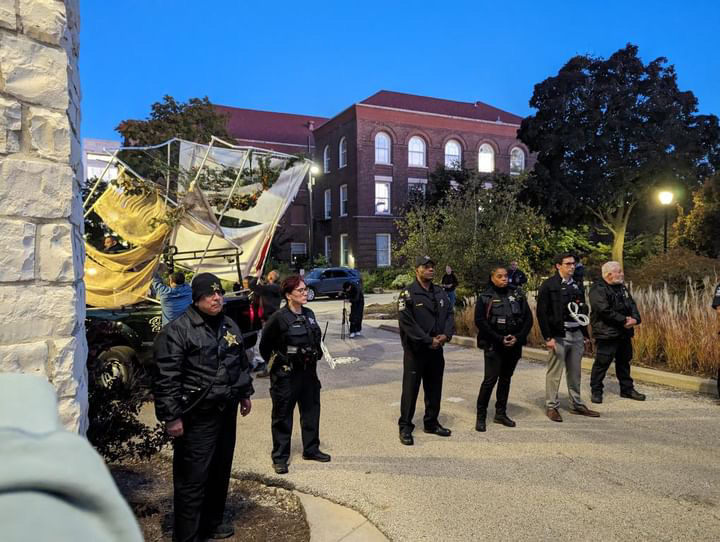
At Northwestern University, in my hometown of Evanston, the campus chapter of Jewish Voice for Peace attempted in vain to receive a permit to build a sukkah on their campus. On the eve of Sukkot last Wednesday evening, they put up a solidarity sukkah in Deering Meadow, a large open grassy area on campus (see above) – and within hours it was destroyed by campus police. With no other options, they decided to rebuild their sukkah last Friday at The Rock, a centrally located and historically protected space of expression which is the only area on campus where tents are techincally permitted.

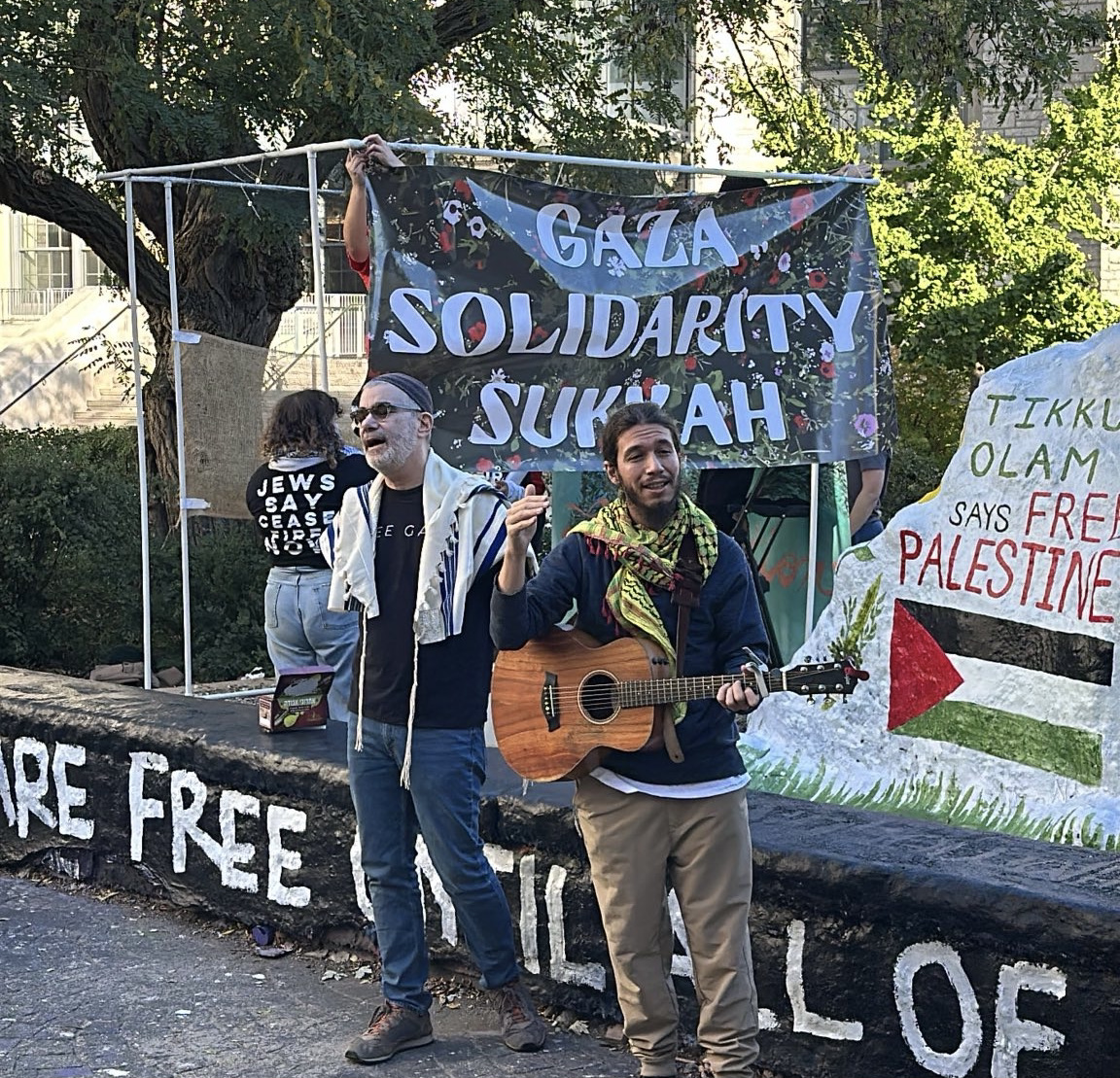
Leaders of JVP NU reached out to my congregation, Tzedek Chicago, to support and protect their rebuilding, which took place on the eve of Shabbat. And so when the time came, Tzedek cantorial soloist Adam Gottllieb and I led a Shabbat service (see top pic) as students constructed the sukkah next to The Rock, on which they had painted the messages “TIkkun Olam Means Free Palestine” and “None of Us are Free Until All of Us are Free.” Dozens of people enthusiastically in the ceremony, which culminated in the final touches on the structure and the communal blessing for dwelling in the sukkah.

Two hours after the end of the service, we learned that campus police had come, thrown the student’s sukkah in a truck and drove it away.

(Photo: JVP NU)

There is little more to be said: this is what things have come to in American Jewish life. Jewish religious expression of solidarity with an oppressed people is deemed “antisemitic” while college campuses are desecrating sacred Jewish ritual with impunity. These facts tell you everything you need to know about the moment we are currently in.

In the end, however, the destruction of these symbolic fragile structures must not and should not be viewed primarly as an act of repression against Jewish college students. This would be an egregious misreading of the true meaning of Sukkot 2024. Rather, I fervently believe these acts must only serve to further sensitize us and deepen our outrage a desecration that is far more egregious and tragic: i.e., the genocidal violence that Israel has been inflicting on the Palestinians of Gaza, who have been seeking in vain for shelter for over a year.

And even more importantly, it must strengthen our resolve to do everything we can to create a real and lasting shelter – by finally bringing this heinous genocide to an end.

Outside Does Not Mean Alone: A Guest Sermon for Erev Yom Kippur 5785

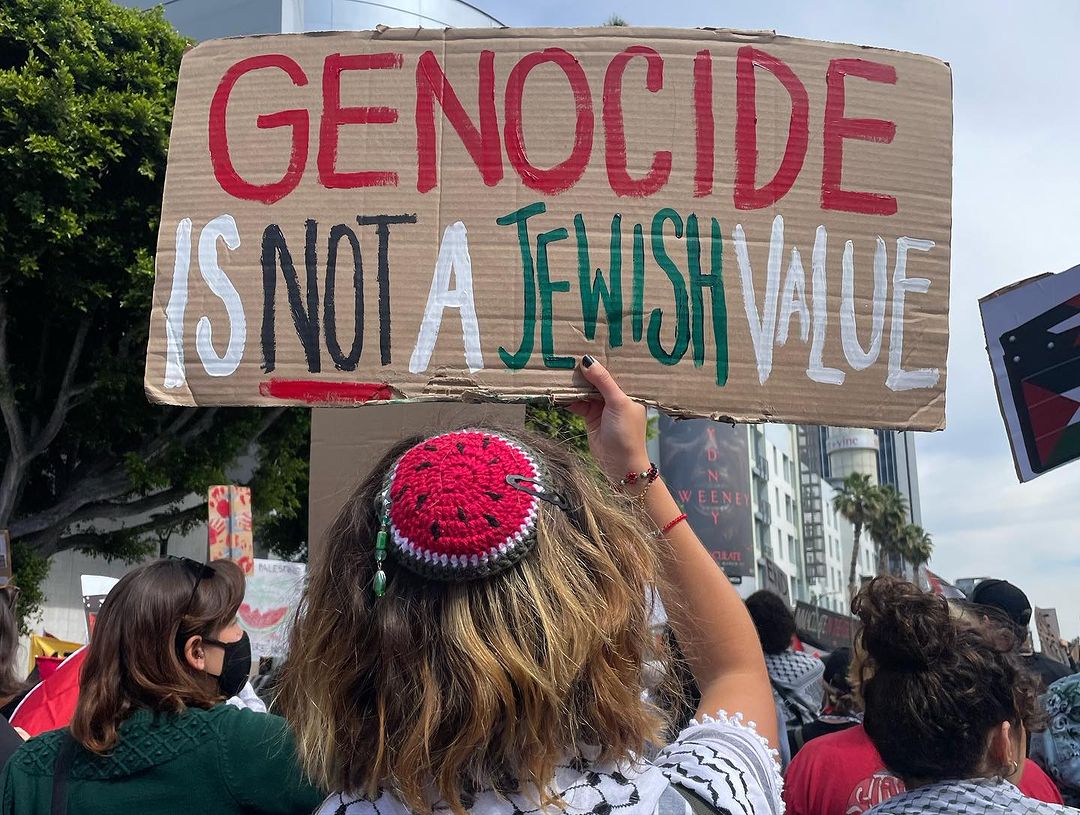
 (photo: Irfan Khan / Los Angeles Times via Getty Images)

Guest sermon at Tzedek Chicago’s Erev Yom Kippur service by Tzedek staff member Aviva Stein on October 11, 2024:

Good Yuntif.

I am honored to have the opportunity to speak to you all tonight. I began working at Tzedek Chicago as our Family Program Coordinator in early 2019. In July of this year I became Tzedek Chicago’s second full-time staff person, serving as the community and organizational director for this inspiring congregation.

I am speaking to you now at Kol Nidre of Yom Kippur in the year 5785, as a genocide is being carried out against the Palestinian people. 

For the past many months, and particularly on this day of reflection, as the gates of heaven open wide for our most intimate and vulnerable supplication, my mind keeps coming back to the question–how could we let this happen? 

One answer I keep returning to is that this tragedy is in part a product of the decades-long campaign by American Jewish institutions to build nationalist, dogmatic support for the state of Israel within our communities, and particularly in our children. When reflecting on my own upbringing, the clarity with which I can see the indoctrination of my Jewish education as a young person is chilling.

From my summer camp’s obligatory High School Israel trip, where we dressed up in IDF uniforms and took pictures for instagram, to “Israeli club,” the only Jewish affinity space at my public high school, which I later learned was funded by an Orthodox “youth education” organization, to the march for Israel being an annual youth group event to singing the Israeli national anthem in Hebrew school. When I look back, I see the many ways nationalist fervor a created an ersatz version of Jewish identity for me as a child. I had been taught that being Jewish was loving Israel, and I believed it. By the time I was in college, I had become a successful product of what all that institutional Zionist funding had set out to do. 

I got my first job after college in 2014 as a teacher’s aide at the local Jewish day school. It was sitting in on the daily “Jewish Studies” class, where I for the first time was able to clearly see the ideological manipulation of the Israel education machine. At that point, I did not identify as a Zionist – I didn’t feel I had enough political knowledge to know what that meant. I know now that internalized sense of ignorance is a tool well-used by the zionist establishment – telling us that it was “too complicated” and that “we didn’t understand” was a reliable way to suppress dissent among their targets. At that time I did, though, feel an obligation to the state of Israel as a Jewish person. 

Watching those children create maps of Israel that highlighted popular tourist destinations, making pita on Israel day, and hanging pictures of Jewish men praying at the Western Wall, I had the perspective I needed to question the establishment in which I was raised and in which I was watching these children grow up. Wasn’t Israel a country, just like the US, and wasn’t it a country at war? My family openly objected to the war in Iraq – why not in Israel?  I had questions that I as a young adult knew were too taboo to ask. But I had a new perspective in my position as a teacher of experiential and inquiry-based education: wasn’t being afraid to ask questions an indicator that something was very, very wrong?

That same year, #IfNotNow held its first public action, when a small group of young Jewish activists read the Mourner’s Kaddish in New York City in recognition of the Palestinian lives lost in the assault on Gaza that summer. And, also in 2014, my childhood rabbi, Brant Rosen, left the synagogue in which I had grown up in the wake of his increased outspokenness about human rights violations in Palestine that were being committed in our names as Jews. My questioning came at a moment in US history when objection to the occupation of Palestine in the Jewish community was more visible than ever. Without looking very hard, I was able to find community that ultimately carried me through the process of unlearning Zionism. I recognize that opportunity of being guided in loving, joyful Jewish community towards a Judaism of solidarity as a real gift for my generation, one that was not afforded to so many Jews of conscience in the decades before me. 

My heart breaks when I see the same cycle of propaganda and silencing posing as pedagogy continue in Jewish education today. Six years ago I took a job at a religious school where I felt it was special that I was allowed to teach there while being open with leadership about my politics. It was challenging to work somewhere where I was not politically aligned, but it was a job, and I could manage. In October of last year, something broke in that community. Donors who had made their contributions with strings attached started pulling those strings, and leadership, which had prided itself on a liberal and open perspective on Palestine, quickly adopted the right-wing politics of their biggest donors. This spring, after months of censorship posing as policy, when my coworker was told that they could not wear a keffiyeh for explicitly Islamophobic reasons, we quit. 

I am ashamed of the choice that synagogue made to uphold racism to shield its community from critical engagement with the devastation of Palestine. But my coworker and I were not alone – since March, eleven full and part time staff people at that “progressive” organization have left their jobs. In the past year, Adam and Leah, Tzedek Chicago’s cantorial team, both have left Jewish education jobs in solidarity with Palestine. Around the country, I know of a dozen more people who have left their jobs this past year, by being fired or quitting. There is an epidemic in the Jewish community –young people are losing and leaving their jobs, and the Jewish community is losing the passion, critical thinking, and vitality that their best and brightest brought to their work. So many Jewish organizations are breaking this way – the big tent, so to speak, has collapsed, and Jews of conscience, Jews who say no to genocide and no to Islamophobia and anti-Arab racism and war mongering, find ourselves on the outside. 

But outside does not mean alone. Over the past 10 years at Tzedek Chicago, our membership has seen tremendous growth to nearly 400 member households. Our family program community has grown from four families to seven to more than twenty, and for the past six years, we’ve seen our children build joyful Jewish space rooted in solidarity with Palestine. Our membership has grown as a blended community across generations and our most active members range from movement elders to very young children, all of whom are committed to this new Jewish future we are building together. 

These past 10 years have experienced a blossoming in Jewish communal life beyond zionism not just at Tzedek Chicago but around the world. Making Mensches in New York, Tirdof in Denver, and Makom in North Carolina are all explicitly anti zionist Jewish ritual communities. Organizing spaces #IfNotNow and JVP have become household names. The Jewish Liberation Fund has successfully challenged the status quo in philanthropy and offers grants for proudly anti-Zionist Jewish work (of which Tzedek Chicago has been a beneficiary). Tzedek UK/Ireland is a thriving community. In Chicago, we are now home to two prayer communities beyond Zionism, Tzedek Chicago and Higaleh Nah. There are of course many more chavurot, friend groups, and organizing communities around the country making meaningful Jewish life that reject Zionism. 

So much has changed in the last ten years. And I believe it with all my heart when I say that we have entered a paradigm shift, where the politicized young, queer, disabled and neurodivergent people we have relied on to staff our Hebrew schools and summer camps will no longer accept propaganda and nationalism as normal. We don’t have to. We can choose to work in Jewish organizations that are actually values aligned rather than those that just “allow” us our politics. Of course these opportunities are few relative to Zionist institutions, but I believe we are moving towards a Jewish future where the social norm of Zionism will become increasingly rare, and where communities like ours are not an anomaly but a standard of Jewish communities around the country. 

It has been truly meaningful to see what had felt like such a lonely landscape become so varied and rich. And, as heartening as this change is, it feels essential that we acknowledge that this is nowhere near enough. It breaks my heart that this is considered such a radical concept: a joyful community of people who are committed to a world beyond colonialism and oppression, and who say so, full stop. It breaks my heart that the victories we have to celebrate are about staffing and organizational capacity as we watch the devastation of Palestine in real time.

Twelve years ago I was pursuing a degree in environmental studies, and I remember very clearly a class where we discussed the mounting science pointing to the inevitability of climate collapse, just a couple years after it had become remotely socially acceptable to even use the term “global warming.”

 “Something really big is going to happen,” we said, “and people will realize, something will change, something has to give.” This was seven years after Hurricane Katrina, and two years after the Deepwater Horizon oil spill. Still, we found ourselves saying, “something really big is going to happen, and then, and then…” 

This memory haunts me as we consider the fight for Palestinian liberation. Climate collapse is here – I don’t need to list the many ways we experience its consequence. We know it’s here. We are right now seeing the extent of the destruction brought by Hurricanes Helene and Milton, record breaking storms inarguably exacerbated by rapidly warming seas. The consequence of our inaction is here.

The Nakba happened. The ethnic cleansing of hundreds of thousands of Palestinians from their homes, creating the largest refugee population in the world, happened. The occupation of millions of Palestinians happened. This year, at least 40,000 people, (though we know in truth many, many more) have been murdered. Entire family lines are gone from this earth and we suffer for the loss of each one of those lives. There is nothing bigger, nothing greater that will awaken our collective consciousness. The consequence of our inaction is here. The unthinkable has happened, and it’s happening right now as we sit here, gathered on this holiest day, the gates of heaven open wide. 

We will never get back the biodiversity that once blanketed the earth, nor the beauty, and freedom and abundance that it provided. And, the earth is not lost. Song birds migrate, leaves change their color, networks of fungus communicate through untold billions of channels under our feet. 

I mourn for the world we might have lived in had those tens of thousands of lives not been lost. The world and our souls are irrevocably damaged by this unthinkable loss of life. 

And, in the face of this unimaginable loss we, as Jewish people, as Americans, as living beings on this earth, owe Palestine our radical imagination. We owe our steadfast belief that Palestine will be free. Palestine will be free, nation states will fall, families will flourish, and we will live in a world where everyone is fed, and everyone is housed, and children will play in river beds and groves of olive trees.

We are painfully far from that dream. Our small successes in the face of unspeakable evil are just that: small. 

Kabbalah teaches that every time a person performs a mitzvah, they bring us that tiniest step closer to Olam Haba, the world to come. I do not believe that a Messiah will come and save us from the world we have created for ourselves. I do believe that when we make visible our refusal to participate in the Judaism of violence and supremacy that is normative in our institutions, we become that small bit more visible to the people who are looking for us. To the young people first entering a critical perspective of Israel, to the people who need to leave their job but don’t know where they can go, to the people who love being Jewish and don’t believe that it makes their safety more important than anyone else’s, they can find us. We’re here.

 And no, the visibility of Jews who reject Zionism will not free Palestine. But our communities are growing. And as we grow, and our voices become louder, and as we send our money and march in the streets and dedicate our prayer and build our power, we bring more and more people into the sacred responsibility of radical imagination. As Aurora Levins Morales writes in “V’ahavta:” 

When you inhale and when you exhale
breathe the possibility of another world
into the 37.2 trillion cells of your body 
until it shines with hope. 
Then imagine more.

We are here tonight, on the eve of Yom Kippur, to release all vows we have not fulfilled and to recommit ourselves to the holy work of teshuvah, of imagining more. Thank you for being here. We will be here. And Palestine will be free, soon and in our days.

G’mar chatimah tova. 

We Charge Genocide: A Sermon for Rosh Hashanah 5785

(photo credit: Jewish Voice for Peace)

Cross-posted, in article format, in Truthout

Why do we sound the shofar on Rosh Hashanah? Over the centuries, commentators have offered us a variety of reasons. Moses Maimonides famously called it a wake-up call to personal atonement; others view it a call to action or a tribute to God’s power. This new year, however, I believe one reason stands out among all others. Today, this Rosh Hashanah, we sound the shofar as a call to moral accountability.

Today, we begin the holiest season of the year. Over the next ten days, we’ll be challenged to break open the shells of inertia and complacency that have built up over the past year. We’ll sound the shofar to herald the inauguration of a deep, collective soul searching: to look deep within, to face honestly what must be faced, if we are to truly begin our new year anew. 

To put it frankly, I honestly cannot remember a Rosh Hashanah when the collective moral stakes were any higher for the Jewish community than this year. I would even go as far to say that this may be the most morally consequential High Holiday season of our lifetimes. As we begin this new year, the shofar calls us to account for a genocide, ongoing even as we speak, perpetrated by a nation acting in the name of the Jewish people. 

How can we begin to fathom a moral accounting of such a magnitude? Over 41,000 Palestinians killed in Gaza to date and over 95,000 injured, the majority of whom are women and children. According to one estimate, the ultimate death toll may eventually be nearly 200,000. Whole extended families, entire Palestinian bloodlines have been wiped out completely. Much of Gaza has been literally reduced to a human graveyard, with scores of bodies buried beneath the rubble of destroyed and bulldozed homes. Neighborhoods and regions have been literally wiped off the map. 

Gaza’s infrastructure and health care system has been decimated. According to the UN an “intentional and targeted starvation campaign” has led to widespread famine and disease throughout the Gaza strip. Polio has now broken out – relief workers are literally working to deliver vaccines to children as bombs and missiles fall around them. 

Health care workers, humanitarian workers and journalists are being killed, injured and imprisoned in massive numbers. Human rights agencies have documented widespread torture and abuse of prisoners, including sexual abuse, throughout a network of torture camps. 

Please note that this unspeakable litany is not a review of the past year. It is a description of a nightmare that continues as I speak, with no end in sight. 

As we contemplate this inhuman status quo, it occurs to me that this Rosh Hashanah, the broken sound of the shofar is more than a mere all to accounting. It is a broken wail of grief – and a desperate moral challenge. This year the shofar calls out to us in no uncertain terms: We Charge Genocide

This is not a point upon which we can equivocate. Not today. On this day, we face what must be faced and say out loud what must be said. To argue this point now would frankly be a sacrilege. 

From a purely legal point of view, a myriad of academic and legal experts have long since confirmed the charge of genocide. As far back as October, Holocaust and Genocide scholar Raz Segal has called Israel’s actions in Gaza “a textbook case of genocide.” On October 18, almost 800 scholars, lawyers and practitioners called on “all relevant UN bodies…as well as the Office of the Prosecutor of the International Criminal Court to immediately intervene…to protect the Palestinian population from genocide.” More recently, Omer Bartov, a respected historian of the Holocaust and Genocide Studies at Brown University accused Israel of “systematic war crimes, crimes against humanity and genocidal actions.” 

But beyond the legal arguments, there is a critical, moral imperative behind this claim. For many Jews, it’s impossible to imagine – let alone say out loud – that a Jewish state, founded in the wake of the Holocaust, could possibly be perpetrating a genocide. 

I understand the pain behind this refusal. I know it confronts many Jews with an unimaginable prospect: to accept that we have become our own worst nightmare. But if we cannot admit the truth on this of all days, then why bother gathering for Rosh Hashanah in the first place? To dither on this point would make a sham of a festival we dare to call the holiest season of the year. 

Not long ago I had a long conversation with my dear friend and colleague Rachel Beitarie, director of the Israeli organization Zochrot. Rachel is among the precious few Israeli activists who are in unabashed solidarity with Palestinians. You may remember her presentation to our Tzedek community several months ago. Among other things, she spoke about what it was like to be an Israeli activist for Palestinian liberation who grew up on a kibbutz near the Gaza border, who personally knew Israelis who were killed and taken hostage on October 7. 

During our recent conversation, Rachel and I talked in particular about the way Israel metabolizes the traumatic memory of the Holocaust as a way to rationalize away its genocidal violence in Gaza. In a follow up letter to our conversation, Rachel wrote the following words to me:

As years go by and most Holocaust survivors are no longer with us, the identification and reliving of the trauma of former genocide seems to only grow, in direct relation to the crimes committed under the excuse of the right to defend ourselves and “prevent a second Holocaust.” 

Because of this unrelenting propaganda, the linkage of the Hamas attack of October 7 to the Holocaust was made immediately, even though it was logically bogus. ​​It was understandable at first, especially from people – many of my friends and acquaintances among them – who personally experienced the horrors of that day, waiting for help that took many hours to come. 

Having grown up in Israel, exposed as we are to re-traumatizing Holocaust education, the associative connection was almost inevitable. Soon however, it became clear that this linkage was being overblown and manipulated to justify the annihilation of Gaza; to justify, dare I say it, another Holocaust.

Many outside of Israel have made the linkage between October 7 and the Holocaust as well. Almost immediately in fact, the terrible massacres of that day were openly characterized as “the worst mass murder of Jews since the Holocaust.” As Rachel pointed out, the two events have nothing to do with each other whatsoever. Still, it is indeed painfully poignant to consider that this mass killing occurred in a state founded in the wake of the Holocaust in order to safeguard Jewish lives once and for all.

We can only imagine what on earth will be said about October 7 on its one year anniversary, which will arrive exactly between Rosh Hashanah and Yom Kippur. From what I’ve read about officially sponsored Jewish community commemorations, the dominant message will be thoroughly suffused with a Holocaust-informed victim mentality: “Bring them home,” “We stand with Israel,” “It’s us against the world,” with nary a mention of the vengeful carnage Israel has been unleashing on Gaza for the better part of a year.

In contrast to this particular messaging, however, I would suggest that sacred Jewish tradition presents us with an important opportunity on this anniversary. Yes, the Days of Awe are an occasion to mourn the losses of the past year – but this season is also a time to seek out a deeper understanding. To do a genuine accounting and to take real accountability. 

As we start to reckon with the events of October 7, I would suggest that the first step would be to admit that this date was not a starting point. If we are to truly and honestly commemorate this tragic anniversary, we must understand it in the context of the ongoing violence and injustice known as the Nakba – a nightmare that began decades ago and is still ongoing. 

As Israel’s violence in Gaza escalated during the final months of 2023, Tzedek Chicago’s board had numerous conversations about whether or not to issue a congregational statement. I’ll make a confession: I wasn’t originally in favor of it. To be honest, I was starting to become dubious about the value of these kinds of gestures. At a moment when so many of us were working overtime organizing on behalf of the Palestine solidarity movement, it seemed like a waste of time to spend our time on a congregational statement. It felt as if the only statement that needed to be made, over and over again in the streets, was “Ceasefire Now!” 

Eventually, however, I came to agree with our board that Tzedek Chicago – as an avowedly anti-Zionist congregation – had a unique voice to offer on this issue. And so, during the month of December, we worked together to craft a statement titled, “In Gaza, Israel is Revealing the True Face of Zionism.” 

Here’s an excerpt:

We … know there was a crucial, underlying context to (the) horrible violence (of October 7). We assert without reservation that to contextualize is not to condone. On the contrary, we must contextualize these events if we are to truly understand them – and find a better way forward.

The violence of October 7 did not occur in a vacuum. It was a brutal response to a regime of structural violence that has oppressed Palestinians for decades. At the root of this oppression is Zionism: a colonial movement that seeks to establish and maintain a Jewish majority nation-state in historic Palestine.

While Israel was founded in the traumatic wake of the Holocaust to create safety and security for the Jewish people, it was a state founded on the backs of another people, ultimately endangering the safety and security of Jews and Palestinians alike. Israel was established through what Palestinians refer to as the Nakba: the ethnic cleansing of 750,000 Palestinians from their homes in 1948. And since that time, Israel has subjected Palestinians to a regime of Jewish supremacy in order to maintain its demographic majority in the land.

This ongoing Nakba is the essential context for understanding the horrifying violence of the past three months. Indeed, since October 7, Israeli politicians have been terrifyingly open about their intentions, making it clear that the ultimate end goal of their military assault is to ethnically cleanse Gaza of its 2.2 million Palestinian residents. One prominent member of the Israeli government put it quite plainly: “We are now rolling out the Gaza Nakba. Gaza Nakba 2023. That’s how it’ll end.” More recently, Prime Minister Netanyahu was reported as saying that he is actively working to transfer Palestinians out of Gaza. The problem, he said, “is which countries will take them.”

Israeli leaders are being true to their word: we are witnessing the continuation of the Nakba in real time. As in 1948, Palestinians are being driven from their homes through force of arms. As in 1948, families are being forced to march long distances with hastily-collected possessions on their backs. As in 1948, entire regions are being razed to the ground, ensuring that they will have no homes to return to. As in 1948, Israel is actively engineering the wholesale transfer of an entire population of people.

It is now eight months since we released that statement and I believe it is more accurate than ever. In her letter to me, Rachel observed the irony that more and more Israelis are now threatening a “second Nakba” when “until recently Israelis denied that the Nakba ever happened.” Now however, many Israelis are using the term with unabashed vengeance. Through word and deed, Israel’s ultimate end game is becoming all too clear: it is the ethnic cleansing of Gaza. 

This past August, in fact, the Israeli press revealed the presence of a government plan for Israel’s long term occupation of Gaza on “the day after.” According to the plan: 

Israel will control the northern Gaza Strip and drive out the 300,000 Palestinians still there. Major Gen.Giora Eiland, the war’s ideologue, proposes starving them to death, or exiling them, as a lever with which to defeat Hamas. The Israeli right envisions a Jewish settlement of the area, with vast real estate potential of convenient topography, a sea view, and proximity to central Israel… The southern Gaza Strip will be left for Hamas, which will have to care for the destitute residents under Israeli siege, even after the international community loses interest in the story and moves on to other crises.

In other words, a “real time Nakba” is being discussed openly in Israeli political and academic circles. More recently, on September 15, Professor Uri Rabi, a prominent researcher at Tel Aviv University, actually said these words in a radio interview: “Remove the entire civilian population from the north, and whoever remains there will be lawfully sentenced as a terrorist and subjected to a process of starvation or extermination.” 

As we engage in moral accounting over the next ten days, we must reckon seriously with words such as these. Indeed, from the very beginning of this genocide, Israeli leaders and politicians have been all too transparent about their intentions. Just as the founders of the Zionist movement themselves, from Theodor Herzl to David Ben-Gurion promoted the “transfer” of the native Palestinian population to make way for a majority Jewish state. Then, as now, we must take these leaders at their word. We must take them very seriously. We can never say we didn’t know. 

More than ever before, this High Holiday season calls to us to reckon seriously with what Zionism has wrought. Not only in Gaza, but throughout the West Bank, where violence and ethnic cleansing is running rampant and in Lebanon, which is now experiencing its own carnage and displacement, bringing the entire region ever closer to all-out war. 

How could it be otherwise? This is what comes of an ideology and movement that from the beginning viewed Jewish safety as zero sum; in which our security can only be achieved at the expense of others, empowerment gained through the sheer power of superior military technology, stronger weapons and higher walls. 

And finally, this High Holiday season, we must take this opportunity to ask ourselves collectively: where have we fallen short? This is a critical question in particular for those of us who have been active in the Palestine solidarity movement. 

If this is indeed the season for hard truths, we must face the fact that despite all our efforts this past year, we failed to stop a genocide. For all our calls for ceasefire, on street corners and in the halls of city governments, for all of the mass protests and acts of civil disobedience, for all of the courageous student activism on college campuses, a ceasefire seems farther away than ever at the moment. 

This is not to say that there has not been genuine progress this past year. But how do we measure these successes against the mass killing that has occurred and continues to occur every single day? On this point, I’d like to share with you the words of Sumaya Awad, of the Adalah Justice Project, who offered us this powerful challenge at the plenary for the Socialism 2024 conference here in Chicago last month:

We know that there has been a massive shift in the United States around Palestine. We have seen poll after poll show that the majority of Americans support an arms embargo, the majority of Americans don’t want to support Israel, are critical of Israel and yet we haven’t seen that translate into the mass action we need. 

Despite this massive shift, we grapple with the fact that this shift came at the expense of how many lives lost? How many people murdered? Who paid the price for these people to shift? And it’s not to say that this shift is not tremendous and incredible and good – it is all of those things, but we must also grapple with the fact that lives are being lost on the daily. And that it is all by design and that it all can be stopped in basically a moment.

And I say all of this not to pity Palestinians, quite the opposite, nor that we must grieve more. Grief is necessary, but that’s not the answer. I say it all because … we have to keep asking ourselves – you have to ask yourselves – what am I doing with this knowledge?  What am I doing with this education? How is it translating into action? How does it translate into action that does not preach to the choir, but preaches to those who are not yet where we need them to be? 

And you have to have an answer to that question. Because a year from now, when you are back here, you have to have an answer. Don’t find yourself just asking the same question. Be ready to answer, what have I done in the last year? 

Though Sumaya spoke these words in a very different context, I find them nonetheless appropriate to the sacred imperative of this new year. A year from now, when we are back here, we will have to have an answer. We can’t find ourselves just asking the same question. We must be ready to answer: what did we do in the last year to bring this genocide to an end? 

I know this in my heart and soul as well: years from now, we will likewise have to stand in judgment. When the story of this genocide is written, we will be asked: did we speak out? And if so, what did we say? What did we risk?  

For now, that book is still open, even if every new page is becoming increasingly unbearable to read. Even if the world would rather move on to another story. How will we write ourselves into this book when it is finally recorded? 

May we all play our part in bringing this book of the genocide to a finish. May it come to an end soon, in our own day. And when it does, may we come to understand it was only part of a larger story – an even greater book that will conclude with these glorious words: “then Palestine was finally free, from the river to the sea.”

Why I’ll Still be Participating in the Protests at the DNC Next Month

 (photo: AP/Jose Luis Magana)

By all accounts, the Democratic Party is closing ranks at lighting speed. As of this writing, Vice-President Harris now has more than enough delegates to clinch the party’s nomination, with a virtual roll-call planned prior to the convention in Chicago next month. The endorsements from powerful Dems continue to roll in, including from virtually all of those who might be considered viable as her potential opponents. Just two days after Biden’s withdrawal from the race, her coronation as the Democrats’ candidate is now all but assured.

I fully understand the euphoria of this moment. With Biden as the Democratic candidate, the prospect of another Trump presidency was becoming more terrifyingly real by the day. But make no mistake, Biden’s downfall was not the product of one horrible debate. On this point, I am in total agreement with Palestinian-American community organizer Linda Sarsour, who recently posted on her Facebook page:

They will never admit this but Joe Biden became a political liability for the Democratic Party on Gaza. Period. The media won’t say this. The pundits will talk around it and the party will say it’s not the case as not to offend their pro-Israel donors – but they knew that they could not win states like Michigan, Georgia, Wisconsin and they had lost big chunks of important constituencies like young people, Arab and Muslim voters, and many progressives. The fact that anyone thinks we are going to believe that one dismal debate performance was the reason they pushed Biden out is just ludicrous.

Absolutely. While the doubts over his age may have motivated his donors to abandon him in the end, Biden was fatally weakened as a candidate by his unabashed support for Israeli genocide – and the solidarity movement that held him to account. As was reported as far back as January, “It’s not just the major prime-time rallies that are now attracting the anti-Gaza war crowd’s wrath. Everywhere Biden goes he is being dogged, whether it is outside the church he attends near his home in Delaware or along the route of his presidential motorcade.”

Many are noting that Harris has been marginally better on the issue of Palestine/Israel than Biden. Last December, it was reported that she was pushing the Biden administration to “to show more concern publicly for the humanitarian damage in Gaza.” During a speech in Selma last March she called for a temporary ceasefire, adding that “too many innocent Palestinians have been killed.” In the same speech, she spoke empathetically about Gazans seeking aid who “were met with gunfire and chaos.”

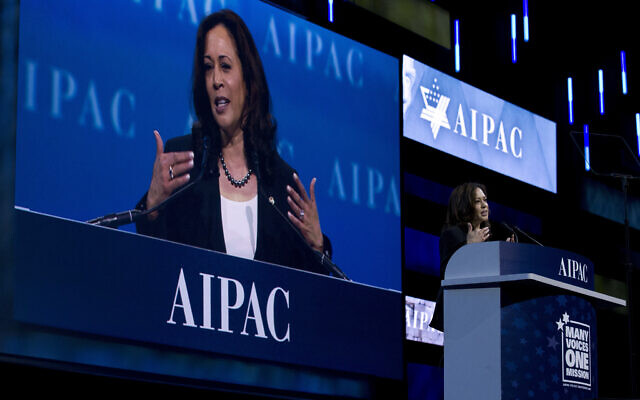
At the same time, we should have no illusions about Harris’ record of unconditional support for Israel. During a speech at the 2017 AIPAC conference, she offered the requisite oath of fealty, ““Let me be clear about what I believe. I stand with Israel because of our shared values, which are so fundamental to the founding of both our nations.”  And during her 2019 Presidential campaign, she was praised by the lobbying group Democratic Majority for Israel for running to the right of Obama on the Iran deal. Indeed, despite her softer tone, Harris has been in lockstep with the Biden administration – indeed with, the entire Democratic Party leadership – on this issue.

For the past several months I’ve been actively involved in the Palestine solidarity movement holding the Biden administration to account for enabling and support Israel’s genocidal violence in Gaza. Along with scores of others, I’ve made plans to participate in the protests planned at the Democratic National Convention next month. Even with Kamala Harris now leading the ticket, I have no intention of changing those plans.

Those of us who are part of this movement have not forgotten the essential reason for our organizing: we are living in a time of genocide – one that is being aided and abetted by a Democratic government. Whether it is Biden or Harris at the top of the ticket, nothing has changed in this regard. Moreover, conventions are the place where party policy and platforms are decided. Those of us who have been holding our government to account all year have a solemn responsibility to continue to do so: to demand that the governing party enact an arms embargo on the Israeli government and to establish a foreign policy centered in human rights.

Though news of Gaza has been swept off the front pages, Israel’s carnage against the Palestinian people has continued with impunity. It was reported today that “at least 84 Palestinians were killed over the past day in (Khan Yunis), with more than 300 others wounded. Medical staff at the Nasser Medical Complex report they are completely overwhelmed and have been forced to treat patients on hospital floors.” Yesterday, the World Health Organization revealed there is now a high risk of the polio virus spreading across Gaza – and beyond its borders – due to the dire health and sanitation situation there. The Israeli military has just announced that it will start offering the polio vaccine to its soldiers though there are not enough vaccines – or the distribution capacity – to reach the 2.2 million Palestinians in Gaza.

In other words, now is not the time to let up. In the words of Linda Sarsour, “no matter what, our work doesn’t change.” Or as Waleed Shahid of the Uncommitted Movement has correctly said:

We are making clear that we think that Biden and the White House’s disastrous policy on Gaza makes it harder for them to defeat Trump. In fact, having a campaign based on democracy, having a campaign fighting far-right authoritarianism, while sending bombs to one of the world’s biggest far-right authoritarians in Netanyahu, who is now visiting Washington, DC, makes a mockery of that party’s claim to be fighting on the right side of history, fighting on the behalf of democracy. And we want to see that party change course.

That’s why, no matter who is heading the ticket, I plan to be on the front lines with my friends and comrades when the DNC comes to town next month.

Don’t Normalize the Political Violence in Gaza

Israel killed at least 90 people in Al-Mawasi in several airstrikes on an area the military had designated as a “safe zone.” Here a child reacts as bodies are salvaged from the site on July 13. 
 Omar AshtawyAPA images

Warning: this post contains descriptions of extreme violence.

On Saturday, while the world was riveted to the news about the assassination attempt on Donald Trump, Israel unleashed airstrikes on Al-Mawasi in Central Gaza – in an area previously designated as a “humanitarian safe zone.” Gazan health officials reported that approximately 90 people were killed and at least 300 injured in this attack. Eyewitness testimonies attested to unspeakable carnage. According to 16 year old Gazan Shaima Farwameh:

A leg hit me, and I saw dismembered bodies a few meters away. I saw a young child screaming. He lost his lower limbs and was crawling on his hands and screaming. The bombs didn’t stop, and suddenly the boy disappeared. I saw how he vanished before me while we ran and lowered our eyes to the ground, unable to do anything but run…What a life we ​​live in these tents that we have to see the dismembered bodies of our siblings and families fly over our heads.

Yesterday, Israel bombed Southern and Central Gaza once again, killing more than 60 Palestinians. Among the targets was a UN school in Nuseirat where families were sheltering. Other strikes in Khan Younis and Rafah killed 12 people, according to medical officials and AP journalists. According to AP, “footage showed the school’s yard covered in rubble and twisted metal from a structure that was hit. Workers carried bodies wrapped in blankets, as women and children watched from the classrooms where they have been living.”

Given the reality of such hideous violence, it was difficult to ignore the irony in the rhetoric following the attempted assassination attempt last Saturday. For me, the most egregious example occurred when Biden said, In his speech to the nation, “There is no place in America for this kind of violence or for any violence ever.  Period.  No exceptions.  We can’t allow this violence to be normalized” (emphasis mine).

This statement is truly breathtaking in its hypocrisy. The genocidal violence Israel has been unleashing on Gazans for the past ten months has long been been normalized for most, save the Palestinian people and their allies. Even as the death toll has now reached nearly 40,000. Even as a new report in the British medical journal Lancet estimates that the actual death toll in Gaza could eventually reach 186,000 or even higher — roughly 8% of Gaza’s population.

It truly takes a special kind of moral gall for Biden to say “we can’t allow violence to be normalized” when it is his very administration that is unconditionally providing Israel with the very bombs that have killing and maiming Gazans on a daily basis. In terms of sheer numbers, President Biden is enabling the deadliest political violence in the world at this very moment.

There has been a chorus of condemnation of “political violence” from across the political spectrum over the past several days. As I’ve listened to the robotic sameness of these responses, it’s occurred to me that they are all unified over one common assumption: political violence is worthy of condemnation when Americans kill other Americans for political purposes – but when the US government commits or enables political violence around the world, it amounts to mere background noise.

Of course, the US itself was created by means of political violence – through the genocide of indigenous inhabitants and the stolen labor of black slaves. This country engages in political violence every day through deadly systems of mass incarceration and policing. And of course, the US has historically expanded its imperial power and influence throughout the world by fomenting the political violence of regime change. MLK famously made this point in his speech A Time to Break Silence when he excoriated “the greatest purveyor of violence in the world today – my own government.”

So please don’t stop raising your voice about Gaza. Please don’t allow this political violence be normalized. Please heed the words of my friend and colleague Jehad Abusalim (who comes from Deir Al-Balah in Gaza):

This is annihilation. There are no words left to capture the horror. Gaza is being obliterated—people are being murdered, starved, and displaced for months on end. Repeating these words feels like a hollow echo and a useless endeavor. But we have no choice but to persevere and keep pushing for an end to the genocide, for accountability, for justice, for healing, for rebuilding, and for liberation. We on the outside have no excuse. As long as Gaza’s defenders, doctors, nurses, first responders, and volunteers keep working and pushing, we have no choice but to keep working and pushing. Gaza needs your activism, your courage, your dedication, your boycott, your presence on the streets, and your donations now more than ever. This is a battle for hope, and hope is the last thing we’ve got. Let’s not let them take it away from us.

On Gaza: Religion, Politics and Solidarity

Here are my remarks from, “Gaza: Religion, Politics and Solidarity,” a program sponsored by Bright Stars of Bethlehem on May 5, held at the First Presbyterian Church in Evanston. It was my honor to speak in conversation with Palestinian liberation theologian Rev. Dr. Mitri Raheb (founder and President of Dar al-Kalima University College of Arts and Culture in Bethlehem), Dr, Rami Nashashibi, (founder and Executive Director of the Inner-City Muslim Action Network) and Dr. Iva E. Carruthers, (General Secretary of the Samuel DeWitt Proctor Conference).

To view the entire program, click here.