Monthly Archives: November 2008

The Ayatollah and the Archbishop

iran3-001

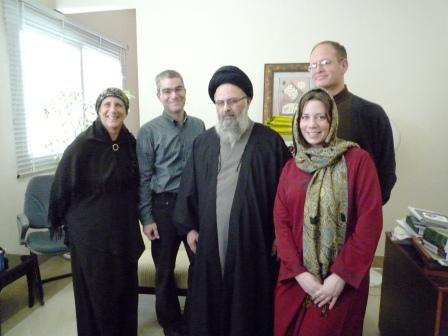
Our first full day in Iran was devoted largely to religious destinations – our first stop was a visit to the office of Ayatollah Bojnoordi, a prominent religious leader who teaches Islamic law at Tehran and Qom Universities.

Ayatollahs are clerics of the highest order in Shia Islamic communities and they exercise enormous authority over their respective flocks. They are educated in seminaries, the most prominent of which are located in Najaf, Iraq and Qom, Iran (we will be traveling to Qom on Monday). Ayatollahs are awarded their titles after attending many years of rigorous training, which include such subjects on theology, jurisprudence, literature, as well as grounding in Western as well as Islamic philosophy. The status of an Ayatollah depends largely upon his scholarship and publication as well as the breadth of his patronage over his congregation. In Iran, of course, Ayatollahs can be political as well as religious leaders. Though the country is governed by a parliamentary democracy, no political decisions can be made without the ultimate approval of Iran’s Supreme Council of Ayatollahs and the Iran’s Supreme Leader, the Ayatollah Khameini.

Like all of our Iranian hosts, Ayatollah Bojnoordi received us with the requisite Persian hospitality. (At every meeting we attend, we are invariably served with a generous spread of cakes, fruit, coffee, tea, juice etc.) He spoke to us for the better part of an hour, with Leila serving as interpreter. His message was largely one of religious tolerance and reconciliation: he said emphatically that he believes Islam teaches all Abrahamic religions ultimately have the same aim: to promote peace and coexistence. Quoting the Koran, he said that peace is the ultimate goodness and war is the ultimate evil. (Interestingly, he also cited Hobbes’ assertion that war represents the animal aspect of humanity). He condemned all who used violence to achieve their aims – adding that all Muslims who act violently act counter to the way of Islam.

The Ayatollah also did not flinch from addressing politics head on. He underlined Imam Khomeini’s statement that Iran is a peaceful nation that doesn’t want war with anyone. He mentioned that in the past two hundred years, Iran has never invaded another country. The eight year war with Iraq, he said, was a defensive war against a country that aggressively sought to seize Iranian territory. He made a point of saying that Iran is surrounded directly by fourteen countries and it must constantly be on its guard, especially against the US, who has a significant military presence in the region and has made periodic threats to invade their country. He made no bones about his loathing of George Bush in this regard and he expressed his hope that our new President will pursue a path of peace.

After we spoke, our group peppered him with questions, most of which he answered with what I believed was genuine thoughtfulness. While I agreed with much of what he said, I was eager to engage him more on the political front – and since he was so candid in opening the door on political issues, I decided to press him a bit. He had mentioned earlier that he thought Hezbollah was a force for good and unity in Lebanon. I asked him, given his condemnation of the use of violence, what he thought about Hezbollah’s claim of responsibility for numerous suicide bombing attacks.

To my surprise, he thanked me for my question. He responded that he believed these bombings were wrong and that he condemned them. But he added that since Hassan Nasrallah has assumed leadership of Hezbollah he believed the organization was making important strides in changing their approach and that he hoped/expected them to convert from a primarily military force to a political party.

In the end, I realized that as much as our trip is focused on interfaith dialogue, you can never completely divorce religion from politics, especially in a nation such as Iran (which is, after all, governed by clerics). As regards this particular conversation, I can only say that while I didn’t always agree with his political assertions, I never once felt that he was speaking to us in a disingenuous or cynical way. I saw something authentic about the way in which he received us and I did indeed believe him when he told us finally, that everything he said to us came from the bottom of his own heart.

For our part, we must constantly bear in mind that we have not come here to debate or coerce. The goal of our delegation is to learn, to share, and to create connections within what is currently a terribly poisoned atmosphere between our two countries. And at the end of the day, I genuinely believe that meetings such as this, in a small but critical way, contribute to that goal.
iran3-002

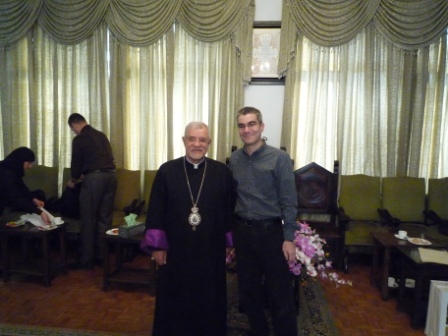
Our next stop was a visit with the Armenian Archbishop Sebouh Sarkissian at the Armenian Apostolic and Orthodox Church. Christianity, like Judaism, is an officially recognized religion in Iran and the Archbishop stressed to us that there have been Armenians in Persia even before the era of Jesus. Among other things, he stressed to us that the Islamic Republic is a religiously tolerant nation, and whatever difficulties there might be to live as a Christian in a Muslim nation, they were far outweighed by the benefits. (I am eager to explore the role of religious minorities in Iran further when we visit Jewish communal leaders on Sunday.

Like the Ayatollah, Archbishop Sarkissian addressed politics unabashedly, and he made no bones about his disgust that the US and Israeli governments refuse to officially recognize the Armenian genocide. But also like the Ayatollah, he espoused a tolerant and universal religious world view. I was especially taken by one comment: when asked of his opinion of evangelism, he emphatically rejected religious coercion, stating that in his view, “dialogue is a new kind of evangelism.”

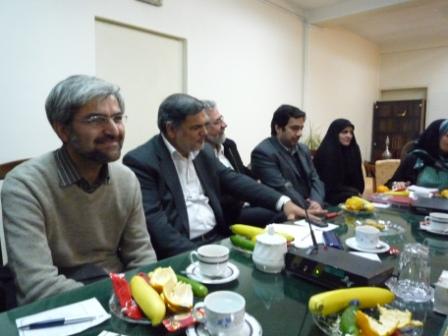
Our final visit of the day was with our hosts at the Center for Interreligious Dialogue. The Center is technically affiliated with the Iranian government (through the Department of Education and Research) but it operates in a sphere that ranges far beyond the government, conducting academic research and dialogue with a wide spectrum of faiths. The Center’s Director, Dr. Rasoul Rasoulipour, is a Professor of Philosophy and is clearly committed to religion as a force for uniting peoples. He also been the guiding presence for these eight FOR delegations from the Iranian side and his commitment to the power of dialogue and relationship is immediately obvious. We were all immediately taken by his warmth and humor, even as exhausted as we were by our first full day in Iran.
iran3-004

(Top pic: Rabbi Lynn Gottlieb, me, Ayatollah Bojnoordi, (HUC Rabbinical Student) Sarah Bassin, Brother Clark Berge (Franciscan); middle pic: me with Archbishop Sarkissian; Bottom pic: leadership of the Center for Interreligious Dialogue, Dr. Rasoulipour is on far left)

Shabbat at Abad Yosef

iran2-0011
Greetings from Iran! We arrived on Friday with no problems and have now settled comfortably into our home at the Howeyzeh Hotel in Northern Tehran. Since we actually arrived at 2:30 am, our first day here was really a half day. When we arrived at our hotel, we went promptly to sleep and woke up in time for lunch. We were delighted to see our friend Leila Zand, the FOR staff person in charge of organizing our trip. We were even more delighted to learn that she will be joining us for the duration of our delegation. Leila is an Iranian woman who has lived in NY for the past several years and in the short time we have gotten to know her, she has already become a dear friend to us.

After lunch many of us took the opportunity to informally walk in groups about the area near our hotel. It is no problem for us at all to walk about freely and it felt perfectly natural to do so. The neighborhood here is a downtown area, full of shops, offices and apartment buildings. Tehran is very much the big city, big, noisy, bustling and filled with constantly-busy trafffic. Even so, there was not a moment in which we felt unsafe and although we were clearly western tourists, many people smiled and nodded at us as we went by. Many in our group reported that they struck up conversations with folks – one group met some people who turned out to be Jewish and were excited to meet a group with American Jews. They invited us to their shul (which is apparently within walking distance to the hotel) for Shabbat services tomorrow morning.

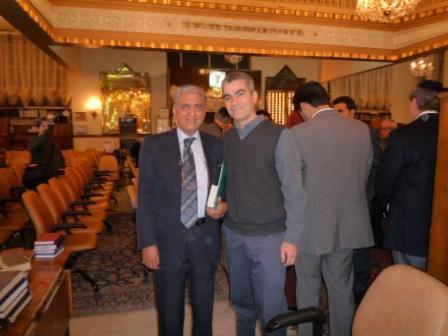
Later in the afternoon we went to Shabbat services at the Abad Yosef synagogue, also in Tehran. Although it is a relatively new shul by Iranian standards, it definitely has a venerable quality about it. The sanctuary is breathtaking, the ark decorated by exquisite tiling and mosaic in the Persian/Middle Eastern style (see pic above). We were the first to arrive and when we settled in for services there were maybe only 20 elderly worshippers with us. That soon changed. Like shuls everywhere, folks gradually trickled in and before we knew it, we were surrounded by over 200 people. The vitality and vibrancy of the community was truly something to behold – older men davening, people chatting animatedly, young children running and playing throughout the sanctuary. The service was led by a variety of members at different points, including young teenagers. The style of the service was what is typically referred to as Mizrahi (Eastern), sung in distinctive Middle Eastern nusach (melody).

As in most traditional shuls, there was something of a happy chaos to the proceedings. For some members of our group it was their first experience in a Jewish service. While it was virtually impossible to follow along at times, the atmosphere in the sanctuary was warm and infectious. After the rabbi gave a sermon on the weekly portion, our group was introduced to the congregation by Dr. Rahmat ollah Raffi, the President of the Tehran Jewish Committee (with me, below). Rabbi Lynn Gottlieb, one of the leaders of our group addressed the congregation and thanked them for receiving us. Rabbi Lynn attended the FOR Iran delegation last spring, and she was clearly familiar now to many in the room. When she asked our delegation to stand, the crowd burst out in loud applause. Then she introduced another member of our group, Sarah Bassin, and told them she was a studying to become a rabbi, the applause got even louder. When Lynn first visited, it was the first time a female rabbi had visited Iran. Obviously this is a concept with great appeal in this country. (Lynn told me later that after the service, a man came up to her and said he hopes his daughter will be able to become a rabbi some day).

iran2-002 Lynn then introduced me to the congregation and I got up and delivered a short Dvar Torah on the weekly Torah portion, which begins with the birth of Jacob and Esau. I mentioned to the congregation that since these twins are struggling in the womb, we might deduce from the text that war is simply preordained, inevitable. But of course we will soon learn that is in not that simple. Jacob will struggle mightily over the next two portions, and this struggle will transform him in powerful ways. So much so, in fact, that when he eventually meets up with his brother again, they will put their arms around one another once again – but this time they will embrace in forgiveness and reconciliation. Jacob remarks that to see his brother’s face is like seeing the face of God.

I concluded that our delegation was in Iran to prove this very point: that while too many believe that conflict is inevitable between our peoples, we are here so that we may truly look into the faces of our Iranian brothers and sisters – and in so doing to discover the face of God.

After the service we were received with great delight and enthusiasm, staying for introductions and conversations for the better part of an hour. What an incredible first experience for us. Most Westerners don’t even know that there are Jews in Iran, let alone a community this rich and vibrant. More importantly, though, it truly reminded us of why we have come: to reach out, to make friends, to build relationships, to find our common humanity. It certainly hasn’t taken us very long. Not even 24 hours in Iran and it already feels like we are home.

Orienting for Iran

iran1-001I’m writing this one from Amsterdam, where we are waiting for our connecting flight to Imam Khomeni Airport in Tehran. Our delegation has spent the last day and a half in Nyack NY at the Fellowship of Reconciliation offices, participating in sessions that reviewed Iranian history and politics, civilian diplomacy and interfaith dialogue. It’s a wonderful group and we are enjoying getting to know one another. That’s us in the pic above, taken outside the beautiful FOR house office on the mighty Hudson river. As you can see, the women in our delegation used the group photo as an opportunity to practice tying on their hijabs.

As far as group demographics go: there are fourteen of us: ten Jews and four Christians. (It’s by far the most Jews that FOR has ever sent on an Iran delegation). It’s a wonderfully diverse group generationally, ranging from ages 24 to 79. Our only major disappointment is that six original members of our delegation are not able to attend due to visa problems – including the two Muslim participants. We are holding out hope that two of the six might still be able to join us later, but prospects are looking increasingly grim on that front, alas.

At any rate, we are on our way and it’s safe to say that we are uniquely thankful this Thanksgiving day for having the opportunity to participate in this incredible trip. As I wrote earlier, I will do my best to blog whenever possible along the way. Please keep checking in.

I’m Off to Iran

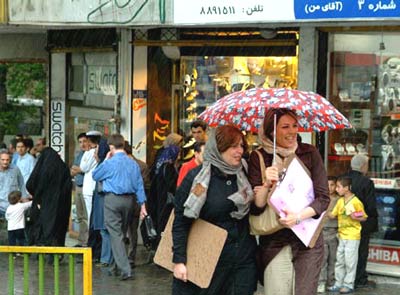
iranians_in_the_rain1As I mentioned in an earlier post, I’m off to Iran tomorrow on a two-week interfaith delegation sponsored by the Fellowship of Reconciliation. If you’ve been reading my blog even semi-regularly over the years (check out the “Iran” category) I’m sure you know I’ve long felt that as Americans and Jews our opinions of Iran are too often based on fear and ignorance. I’m especially concerned that unless our two countries make the effort to get to know one another, we may well be headed on a tragic collision course.

Our delegation, made up of Jews, Muslims and Christians will engage in civilian diplomacy and interfaith dialogue to help lay the groundwork for common understanding and create constituencies for peace in both of our countries. This is FOR’s eighth Iran delegation, and we’ll be building upon the significant relationships that have already been created and deepened over the years. We’ll be traveling to Tehran, Shiraz, Qom and Esfahan - I’m particularly excited that we’ll be spending significant time with the Jewish community of Iran.

I hope to blog some during my travels, but I’ll certainly post more significant descriptions of my experiences upon my return. Stay tuned for more…

Bubbe in the Dojo

rusty-portraitDid you know the undisputed mother of women’s judo is a Jewish great-grandmother named Rena Glickman? And did you know that Japan’s government recently awarded her with one of its highest honors, the Emperor’s Order of the Rising Sun?

I kid you not. The mighty Rena Glickman (known to millions of judo-devotees as Rusty Kanokogi) has been doing her thing since the 1950s, when she had to masquerade as a man to practice her art (a neo-Yentl saga if ever there was one!) A recent Sports Illustrated article gives the backstory:

(Kanokogi) had to collect 25,000 signatures and threaten legal action for sex discrimination against the International Olympic Committee and its TV partner, ABC, to get women’s judo into the Games in ’88…She also found time, in between, to coach the 1988 Olympic team, officiate the ’96 Olympics and provide NBC’s color commentary at the 2004 Games.

I was so sorry to read that Ms. Kanokogi is currently being treated for bone cancer – all the more reason to be proud that she is receiving this unprecedented honor. Mazel Tov Rusty! (Or as the judo masters teach: “Chiri mo tsumori yamato nari.”)

Recons Slam Gay Marriage Ban

06172008_dpm_gaymarriage_amberandsharon

I’m extremely proud to announce that all three arms of the Reconstructionist movement have released a joint statement condemning the recent passage of gay marriage bans across the country.  Read all about it in this JTA article. It was particularly gratifying to read this acknowledgment in the piece:

The Reconstructionist movement, the smallest of American Jewish religious denominations, has long been a leader in liberalizing Jewish approaches to homosexuality. In 1984, the movement became the first to ordain openly gay rabbis, followed six years later by the Reform movement and in 2006 by the Conservative movement.

Here’s the text of the entire statement:

The Reconstructionist Rabbinical Association, the Jewish Reconstructionist Federation, and the Reconstructionist Rabbinical College deplore the passage of Proposition 8 in California and similar discriminatory initiatives recently passed in Arizona, Florida, and Arkansas. We are saddened and deeply disturbed by the denial of fundamental human rights—to marry, to adopt and care for foster children—to thousands of gay and lesbian citizens across the United States. We are particularly dismayed by the passage of initiatives that have reversed previously recognized equality for same-sex unions.

Beginning in 1993, in a series of resolutions, the Reconstructionist movement has affirmed the holiness of commitments made by same-sex couples. Religious recognition of marriages does not confer the legal and civil rights and responsibilities bestowed by the state upon married couples. We recognize the right of every religious denomination to affirm its own definition of, and limitations upon, the sacred ritual of marriage. No member of the clergy should be compelled to sanctify any union that is contrary to his or her understanding of sacred text and tradition. But neither should any gay or lesbian citizen of the United States be denied the legal rights confirmed by civil marriage.

We call upon leaders of other faith communities who share the commitment to civic equality and to the separation of church and state in the realm of marriage to speak out against bans on same-sex marriage and discrimination against GLBT people in the realm of adoption and foster care. We look forward to the day when all states will grant equal access to the rights and responsibilities of civil marriage.

Enjoy Every Sandwich

So my son Jonah discovered the Warren Zevon tunes on my iPod and I’m kvelling to no end as he turns into a big fan. (I’m a lifelong Zevon-devotee; his 1981 concert in LA in 1981 remains for me an indelible musical memory). Jonah’s discovery has inspired me to go back and listen to the songs of the late, great WZ. In particular I’ve been appreciating his later stuff: the lesser known post “Werewolves of London” tunes that are at turns hilarious, morbid, touching and always so keenly intelligent.

I’m also listening more closely to his final album, “The Wind” – the project he worked on while he was dying from terminal lung cancer. When it first came out in 2003, just two weeks before he died, it was just to raw and painful for me to listen to at length. But returning to it now, I’m realizing what an amazing work it is – a kind of “musical living will” that touches on all of themes of his life’s work without ever being maudlin or over-sentimental. This is a artist who didn’t flinch from exploring his demons while he was alive and he was a true role model for how to make the most of one’s life down to the very end.

Check out the clip above, an excerpt from his astonishing appearance on the Letterman show several months before his death. Letterman (his longtime friend who featured Zevon countless times over the years) devoted the entire show to him and they talked at length. Even if you’re not a fan, I encourage you to watch. It’s truly an incredible TV moment: a dying musician speaking openly and honestly about his terminal illness on a late night talk show before performing some of his greatest songs in public for the final time. He couldn’t hit all the high notes, but it was still a muscial performance for the ages.

On Religious Tolerance, Hypocrisy and the UN

1859552240-world-leaders-plead-religious-toleranceReps from eighty countries met at the UN last week to discuss religious tolerance at a conference sponsored by Saudi Arabia. Now I’m sure many will immediately claim there is no small measure of hypocrisy when a Wahabi Islamic regime that outlaws all other forms of religion in its country convenes a conference on religious tolerance. For their part, however, many of the speakers from Islamic countries decried the hypocrisy of Western nations preaching individual freedom of religion while promoting stereotypes and intolerant attitudes toward Islam.

I often wonder if our respective cries of hypocrisy really only mask our inability to break free of our own inbred biases. It’s just so complicated. As a Westerner, I make no apologies in my advocacy for individual civil and human rights – but I will also admit that I will too often stand in judgment of other cultures before trying to understand their cultural viewpoints and their profound frustrations with the prejudices of the West.

That’s why, though I’m sure many will be cynical about such a conference, I am heartened that it happened at all and I truly hope it will lead to yet more dialogue. And I am particularly heartened that Israeli President Shimon Peres, a participant in the conference (and whose remarks apparently were quite warmly received), commented afterward that the event was “unprecedented,” adding that it would have been impossible just a decade ago:

“What we are witnessing today is a new beginning,” Peres said at a press conference. “What was today demonstrated was the will. We now have to work for the way.”

If you’re interested in further reading, check out these articles in Yahoo News and The Daily Star

For Armistice Day 2008

ww-1

Here’s my offering in honor of Veteran’s Day, formerly Armistice Day, the anniversary of the armistice that ended World War I (famously signed on the eleventh hour of the eleventh day of the eleventh month, 1918…)

An excerpt from one of my favorites: Erich Maria Remarque’s classic WW I novel “All Quiet on the Western Front” – still one of the greatest antiwar statements ever:

I am young, I am twenty years old; yet I know nothing of life but despair, death, fear and fatuous superficiality cast over an abyss of sorrow. I see how peoples are set against another, and in silence, unknowingly, foolishly, obediently, innocently slay one another. I see that the keenest brains of the world invent weapons and words to make it more refined and enduring. And all men of my age, here and over there, throughout the whole world see these things; all my generation is experiencing these things with me. What would our fathers do if we suddenly stood up and came before them and proffered our account? What do they expect of us if a time ever comes when the war is over? Through the years our business has been killing; – it was our first calling in life. Our knowledge of life is limited to death. What will happen afterwards? And what shall come out of us?

Obama, Don’t Be a Friend of Israel!

obama

Let’s hope Obama won’t be a friend of Israel, writes Gideon Levy in a recent Ha’aretz editorial. Now before you get your knickers in a knot, read on:

When we say that someone is a “friend of Israel” we mean a friend of the occupation, a believer in Israel’s self-armament, a fan of its language of strength and a supporter of all its regional delusions. When we say someone is a “friend of Israel” we mean someone who will give Israel a carte blanche for any violent adventure it desires, for rejecting peace and for building in the territories…

That’s just how we like U.S. presidents. They give us a green light to do as we please. They fund, equip and arm us, and sit tight. Such is the classic friend of Israel, a friend who is an enemy, and enemy of peace and an enemy to Israel.

Let us now hope that Obama will not be like them. That he will reveal himself to be a true friend of Israel. That he will put his whole weight behind a deep American involvement in the Middle East, that he will try to solve the Iranian issue through negotiation – the only effective means. That he will help end the siege on Gaza and the boycott of Hamas, that he will push Israel and Syria to make peace, that he will spur Israel and the Palestinians to reach a settlement.

We should hope Obama will help Israel help itself, because that is how friendship is measured. That he will criticize its policy when he must, because that, too, is a test of true friendship.

Let him use his clout to end the occupation and dismantle the settlement project. Let him remember that human and civil rights also apply to the Palestinians, not only to black Americans. And apropos world peace, he needs to start with peace in the Middle East, home to the most dangerous of conflicts, which has been threatening the world for a century now, and is feeding international terrorism…

Changing the Middle East was in the power of each and every U.S. president, who could have pressured Israel and put an end to the occupation. Most of them kept their hands off as if it were a hot potato, all in the name of a wonderful friendship.

So bring us an American president who is not another dreadful “friend of Israel,” an Obama who won’t blindly follow the positions of the Jewish lobby and the Israeli government. You did promise change, did you not?

Hear, hear. And those of us in the American Jewish community who agree with the above should do everything we can to give Obama the cover he needs to be such a friend…