Monthly Archives: June 2009

Banksy and the Art of Protest

I just read that the famed anonymous British graffiti artist Banksy is mounting his largest project to date: an unusual showcasing of his work at England’s  Bristol Museum. Although this particular project was legit, it still bears the hallmarks of Banksy’s trademark guerrilla approach:

He filled three stories of the building with his art in 36 hours under tight security, as only a few museum staff were aware of the shows’ imminent arrival.

His work is hidden among the museum’s usual exhibits and is split into different rooms, including installations, paintings and sculptures.

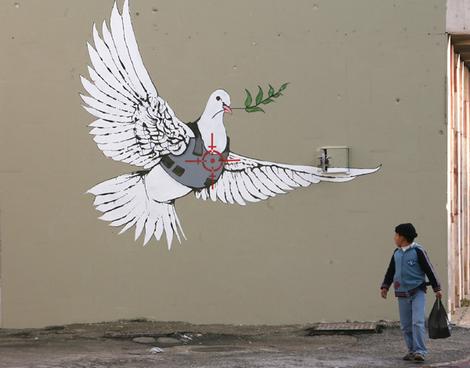
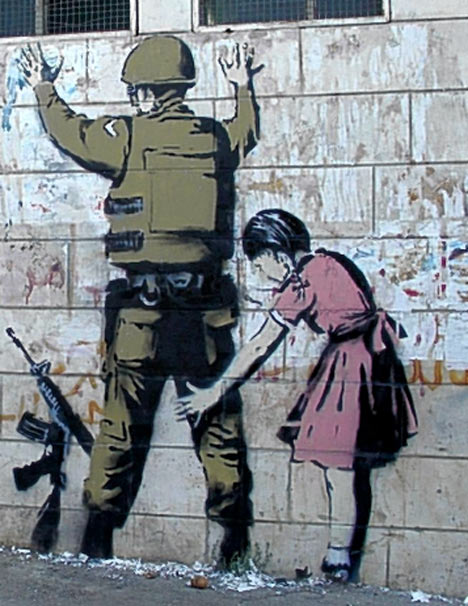
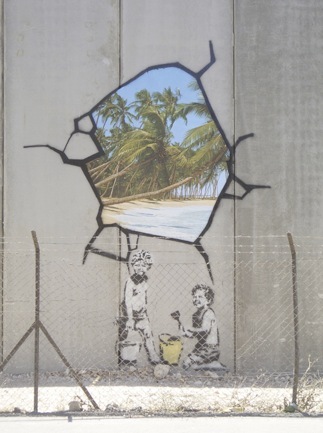
Reading this reminded me of another one of Banksy’s projects:  a series of amazing protest art he painted along Israel’s barrier wall a few years ago.  Scroll down to see some of the more well-known images he put up in Bethlehem.  Click the clip above to see the mysterious artist in action…

17banksyES_468x606

071208-banksyBanksyImage_wideweb__470x368,0

I Can’t Dance Any More

Salah_Fam

I know there are those who wonder why, with all of the various injustices going on in the world, do I seem to dwell on Israel’s treatment of Palestinians?  It’s a fair and important question.  For me it boils down to this: I’ve come to believe that too many of us in the Jewish community will unabashedly protest persecution anywhere in the world, yet remain silent when Israel acts oppressively.

I know all too well how we actively avoid this truth. We use any number of rhetorical and political arguments to deny it, to mitigate the discomfort and pain it causes us.  We engage in a kind of tortured dance of rationalization that we save for no other world issue but this one. But for me, at least, but none of it really addresses the core issue at hand: however difficult it might be for us to face, Israel is unjustly oppressing Palestinians.

So what are we going to do about it?

Many of us deal with it by putting our faith and efforts into the peace process. And well we should: though I’ve been honest in expressing my own doubts and concerns regarding the peace process, I understand that in the end the only true solution to this conflict will be a political one.  But as the peace process enters into its latest incarnation, as the various actors involved painfully wrangle over diplomatic parameters, it is safe to say this saga will continue to take its time to unfold. And in the meantime, the real lives of real Palestinians on the ground will continue to grow increasingly intolerable.

For myself, at least, I cannot use the peace process, critical as it is, as a kind cover to keep me from facing and protesting the oppression that is occuring in Israel/Palestine every day, even as I write these very words.  While I will do what I can to advocate for a just and peaceful political settlement to this crisis, this work does not give me a pass on speaking out. If we truly believe we must protest injustice anywhere, anytime, then it seems to me that this principle must apply to Israel/Palestine as well, no matter how painful or difficult the prospect of doing so.

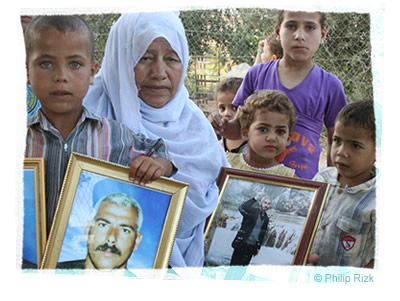
Earlier this week, I was the moderator of a discussion following the showing of a powerful new documentary, “This Palestinian Life” – a film that was often unbearably painful to watch. TPL documents a little-seen aspect of Palestinian life: the nonviolent steadfastness (in Arabic: “sumoud“) of Palestinian villagers who live with a crushing occupation, constant settler attacks, and the deliberate, relentless annexation of their farm land.

This quote from one villager sums up the movie’s essential theme:

I don’t own a gun.

I don’t own any weapons and I’m not prepared to own any…

My only weapon of defense is that I won’t leave this place…

and my hope is that the world will respond to Israel’s treatment of us.

As difficult as it was, I was honored to have been asked to moderate the post-film discussion. I know there are many who would regard my participation in such a program as an act of disloyalty or at the very least an exercise in masochism. But in the end, it really came down to this: I just can’t do the dance any more.

Iran for Iranians

28685775

In my final post from my visit to Iran this past fall, I wrote the following:

We’d be foolish to deny that there are troubling human rights issues that Iran would do well to address. But at the end of the day, the solutions to these problems are certainly not ours to impose.

I felt that passionately then and as I watch the Iranian people take to the streets day after day to demand justice in their country, I feel it even more passionately now.  I’m also immensely proud that our President refuses give in to the misguided voices that urge him to force himself on this process as it unfolds. Our country seems to finally be learning that imposing our “democracy” on other countries might not be the most effective foreign policy.

This is particularly the case with Iran, a nation that has experienced its share of empires meddle in its affairs over the centuries. Indeed, even as thousands of the Iranian people bravely demonstrate for democracy, you can be sure that it is lost on none of them that the last country to overthrow an Iranian regime was none other than the United States. The Islamic Republic may be odious in any number of ways, but at the end of the day, we must remind ourselves that it is the first Persian regime in centuries that truly belongs to its people.

Yesterday, I read a letter to the editor of the NY Times that said simply: “The Islamic Revolution has become the shah.”  A horribly mistaken analysis. For Iranians, the Shah was not simply an oppressive ruler – he was an oppressive ruler who was installed by the Americans after they took it upon themselves to overthrow Iran’s democratically elected Prime Minister.

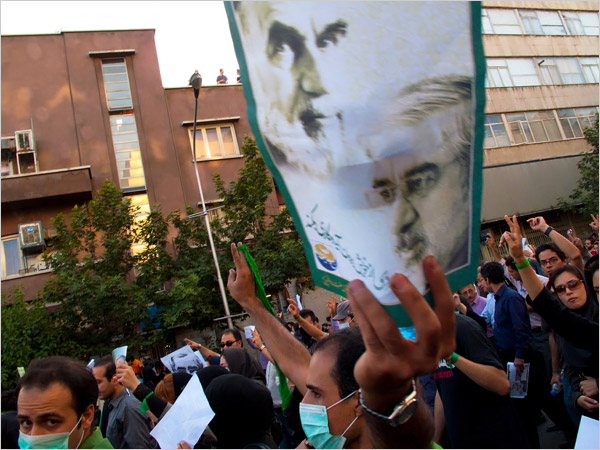
Take a look at the picture above (also from the New York Times.) It’s very telling: a demonstrator’s sign juxtaposes the Ayatollah Khomeini with Mir Hossein Moussavi (who was himself one the leaders of the 1979 revolution. An interesting article in today’s NY Times, in fact, explores the historically close relationship between Khomeini and Moussavi.)

This is enormously important for us in the West to understand: whatever we might think about Khomeini, in the eyes of many Iranians, he was the one who gave their country back to them. Whatever we might think about the republic to which the revolution gave rise, it is the Iranians’ republic. Those who demonstrate in the streets are not rebelling against the revolution – they are demanding that it live up to its promise.

“Justice, justice shall you pursue.” This is what precisely what we are witnessing in the streets of Iran. We can surely support their pusuit in any number of ways, but in the end, this particular justice is theirs’ to pursue and achieve – not ours’ to dictate.

PS: Among the many blogs and e-news outlets I’ve been following, my favorite is a photo blog called Tehran 24 that updates daily with astonishing pix of the demonstrations. Definitely worth a thousand words…

Bibi’s History Tutorial

netanyahu

I’m in agreement with the pundits who conclude that there was absolutely nothing new for consideration offered in Netanyahu’s speech. Perhaps he achieved a personal milestone by finally uttering the words “Palestinian state” but beyond this it was a tune we’ve all heard before. He offered “peace negotiations immediately without prior conditions” then proceeded to spell out the all too familiar prior conditions that everyone knows are non-starters for the Palestinians (i.e. Jerusalem remains the “united capital of Israel,” “natural growth” of the settlements will continue, there will be no right of return for the Palestinians.)

Same old, same old.   For me at least, the most interesting parts of his speech were not his tired policy pronouncements, but his extended forays into historical analysis – and in particular, his repeated justifications of the Jewish people’s right to the land:

The connection of the Jewish People to the Land has been in existence for more than 3,500 years. Judea and Samaria, the places where our forefathers Abraham, Isaac and Jacob walked, our forefathers David, Solomon, Isaiah and Jeremiah this is not a foreign land, this is the Land of our Forefathers.

It seemed clear that Netanyahu’s history lesson was a pointed rejoinder to Obama’s Cairo speech, in which Obama stated that the “Jewish homeland is rooted in a tragic history that cannot be denied.” You may have heard that following his speech, many in the Jewish community criticized Obama for connecting Israel’s right to exist to the Holocaust and failing to cite the Jewish people’s historical connection to the land.  Witness this livid Jerusalem Post editorial:

Mr. President, long before Christianity and Islam appeared on the world stage, the covenant between the people of Israel and the Land of Israel was entrenched and unwavering. Every day we prayed in our ancient tongue for our return to Zion. Every day, Mr. President. For 2,000 years.

Perhaps it’s because Palestine was never sovereign under the Arabs that even moderate Palestinians cannot find it in their hearts to acknowledge the depth of the Jews’ connection to Zion. Instead, they insist we are interlopers.

When Obama implies that Jewish rights are essentially predicated on the Holocaust—not once asserting they are far, far deeper and more ancient—he is dooming the prospects for peace.

For why should the Arabs reconcile themselves to the presence of a Jewish state, organic to the region, when the US president keeps insinuating that Israel was established to atone for Europe’s crimes?

Thus Netanyahu’s pointed words yesterday:

The right of the Jewish People to a state in the Land of Israel does not arise from the series of disasters that befell the Jewish People over 2,000 years – persecutions, expulsions, pogroms, blood libels, murders, which reached its climax in the Holocaust, an unprecedented tragedy in the history of nations…The right to establish our sovereign state here, in the Land of Israel, arises from one simple fact: Eretz Israel is the birthplace of the Jewish People.

It’s facinating to me that Netanyahu et al are so threatened by the suggestion that Israel’s establishment is ultimately bound to the Holocaust.   After all, didn’t Theodor Herzl himself found political Zionism as a reponse to world anti-Semitism?  And whatever historical claim the Jewish people might have to the land of Israel, it’s safe to say there would never have been international support for a Jewish state had it not been for the Holocaust.

Beyond this, I’m troubled by the need to continuously and defensively remind the world of the historical Jewish connection to this particular piece of land. I’m not at all sure that this is really a road we really need or want to go down.

What does it really mean for any people to have a “right” to a land?  I understand that the Jewish nation, like every nation, has its historic narrative, but let’s face it: nations don’t exist by right, they exist by fiat. Nations exist by virtue of military power and by their ability to maintain a system of governance  that will ensure their survival as a polity. Beyond this, it’s pointless to argue one’s historical or moral right to a land. It seems to me that if history has proven anything, it’s that might makes right – and all the rest is commentary.

The real question here is not who has a right to this land. The central issue is how its inhabitants will see fit to exist on the land. And on this point, I don’t see that Netanyahu gave us anything fresh to consider.
People You Should Know About: Ezra Nawi

If you’re looking for the definition of an Israeli hero, here’s my nomination: human rights activist Ezra Nawi.  Well-known in the Israeli-Palestinian peace movement, Nawi is a true original. This is how he was described by journalist Neve Gordon in a recent Guardian article:

Nawi is not a typical rights activist. A member of the Ta’ayush Arab-Jewish Partnership he is a Jewish Israeli of Iraqi descent who speaks fluent Arabic. He is a gay man in his fifties and a plumber by trade. Perhaps because he himself comes from the margins, he empathises with others who have been marginalised – often violently.

Nawi has long been active on behalf of the Palestinians and Bedouins of South Hebron, a region where the occupation is particularly oppressive and harassment at the hands of Jewish settlers is virtually constant. While his non-violent activism has helped bring international attention to this troubled region, it has also made him a target in the eyes of the occupation authorities. In July 2007, he was arrested and charged with assaulting a police officer while protesting the destruction of a Palestinian house. He will be sentenced next month and will most certainly face jail time unless there is a significant public outcry.

As it turns out, the home demolition and arrest were all captured on film and broadcast on the Israeli news. (Click above – Nawi is the one in the green jacket and the grey cap.)  The footage is riveting and everything is clearly documented from beginning to end (including the non-assault of the officer.)  Nawi himself gets the last word however. Sitting handcuffed in a military vehicle before laughing, scornful soldiers he says, “Yes, I was also a soldier, but I did not demolish houses. There’s a big difference. The only thing that will be left here is hatred…”

Since Nawi’s arrest, support has been building. Jesse Hochheiser’s blog, “Across the Borderline” contains several powerful testimonials, including this from Hebrew University professor and fellow Ta’ayush activist David Shulman:

Ezra Nawi is probably the most courageous person I have ever met. I have seen him in countless moments when settlers violently attacked him and other peace activists, Palestinians and Israelis; his presence of mind, steadfastness, and clarity always got us through such times. He is that most unusual of human beings– a person of profound inner gentleness and moral principle, selfless and creative in finding ways to help the Palestinian shepherds and farmers of the South Hebron hills.

The only thing standing between Ezra Nawi and imprisonment is your voice. Click here to offer your support.

Confessions of a Peace Process Cynic

Was2345642

Don’t get me wrong. I’m on board. I’m in there with the American Jews who are reassuring Obama that we’ve got his back. But I have to say it’s all I can do to resist my cynicism when I read about Peace Process, version 5.0. (And for safety’s sake, let me just reiterate my blog’s disclaimer: I’m writing this merely as a snarky private citizen – not on behalf of any organization with which I’m affiliated.)

As I’ve written before, I’m encouraged by Obama and Clinton’s tough talk on the settlements. Nevertheless, I’ve increasingly been wondering if/how the administration would back up their tough words with meaningful action.

Thus I confess to a distinctly familiar sinking sensation when I read this in the NY Times this morning:

As President Obama prepares to head to the Middle East this week, administration officials are debating how to toughen their stance against any expansion of Israeli settlements in the West Bank.

The measures under discussion — all largely symbolic — include stepping back from America’s near-uniform support for Israel in the United Nations if Prime Minister Benjamin Netanyahu of Israel does not agree to a settlement freeze, administration officials said.

Other measures include refraining from the instant Security Council veto of United Nations resolutions that Israel opposes and making use of Mr. Obama’s bully pulpit to criticize the settlements, officials said. Placing conditions on loan guarantees to Israel, as the first President Bush did nearly 20 years ago, is not under discussion, officials said.

Call me cynical, but “symbolic measures” simply aren’t going to cut it. Not when you’re up against the juggernaut that is Israel’s settlement movement. (Read Akiva Eldar’s “Lords of the Land” if you think “juggernaut” is too strong a word.) And certainly not when you are dealing with the most pro-settlement Israeli administration in recent memory.  Already several Israeli officials are complaining loudly that the demand for a settlement freeze is “unfair.” (“There are reasonable demands and demands that are not reasonable.” Bibi said today.)

I found it interesting that the NY Times article cited George H. W. Bush and the loan guarantees – now that brought back some memories. Remember the last time an American president tried to tie US aid to Israel’s settlement activity?

For many in the Jewish community, Bush’s presidency could be encapsulated in his offhand quip to reporters in September 1991 during an AIPAC lobbying effort on Capitol Hill in support of the proposed $10 billion loan guarantee to Israel: “I’m one lonely little guy” up against “some powerful political forces” made up of “a thousand lobbyists on the Hill.”

Bush had opposed the loan guarantees as long as Israel continued settlement in the West Bank and Gaza. The president finally agreed to a loan guarantee package in August 1992, requiring as a set-off any funds Israel spent to build housing or infrastructure in the territories. Despite this action, the political damage was done. The loan guarantee controversy later motivated Jewish opposition to President Bush, who received no more than 12% of the Jewish vote in the 1992 election (down from close to 35% in 1988).

More than fifteen years later, you’d still be hard pressed to find anyone in the American Jewish establishment supporting the withholding of aid to Israel under any circumstances.  As I’ve written before, this is the “third rail” in the American Jewish community. But trust me on this: it may well be the only diplomatic stick that will get Israel’s attention at the end of the day.

Now is Obama up to that level of political courage? And even more to the point: will the American Jewish community still have his back if/when that time comes?