Archive for November, 2009

Eerie Harmony, Hot Rhythm and Radical Braininess

You haven’t discovered Charming Hostess yet?  Well, if you’re interested in the latest in the radical Jewish creative spirit unleashed, then you’ve been sleeping on the job.

There’s no way I could do them justice, so I’ll let them describe themselves:

Charming Hostess is a whirl of eerie harmony, hot rhythm and radical braininess. Our music explores the intersection of text and the sounding body – complex ideas expressed physically, based on voice and vocal percussion, handclaps and heartbeats, sex-breath and silence. We live where diasporas collide, incorporating piyyutim and Pygmy counterpoint, doo-wop and niggunim, work songs and Torah chanting.

ChoHo’s leader is Jewlia Eisenberg, a San Francisco-based  “composer, extended-technique vocalist, lay cantor” who has been exploring exciting musical terrain with a variety of collaborators.  Their last CD, “Sarajevo Blues,”  juxtaposed music and text from the Jewish, African, and Bosnian Diasporas to explore

(Genocide) and nationalism, freedom under siege, the nature of evil, and resisting war by any means necessary – themes that Jews think about, maybe even obsess over.

And if that’s not enough for you, just check out ChoHo’s current work-in-progress, “The Bowls Project:”

The Bowls Project is an immersive music performance that takes place in a dome. (It) is based on texts from incantation bowls, common amulets 1500 years ago in Babylon. Simple clay bowls were inscribed with a householder`s secrets and desires, then buried under the house. Incantation bowls speak of mysticism and sex; angels and demons;and the trials and joys of daily life. Especially (and unusually) audible are the voices of the era`s women–their work, hopes, and dreams.

These spiraled Aramaic inscriptions from the same time and place as the Talmud open up a larger discussion: of the connections between material and literary culture, between canonized and marginalized voices, between ritual power and popular practice, and of how music mediates these relationships.

Click the link below to  “Yedidi,” my personal favorite from “The Bowls Project.”  On the YouTube clip above Jewlia Eisenberg performs the classic Ladino lullaby “Durme, Durme” at the 2008 Krakow Jewish Culture Festival.

Current Findings in Gratitude Theory

In honor of Thanksgiving, here’s a rundown on the latest findings in the science of gratitude:

Several years ago, Dr. Michael McCollough of the University of Miami and Dr. Robert Emmons of the University of California at Davis conducted a scientific study that charted the benefits of regular, mindful thankfulness. Their research concluded:

- Those who kept gratitude journals on a weekly basis exercised more regularly, reported fewer physical symptoms, felt better about their lives as a whole, and were more optimistic about the upcoming week compared to those who recorded hassles or neutral life events.

- Participants who kept gratitude lists were more likely to have made progress toward important personal goals (academic, interpersonal and health-based) over a two-month period compared to subjects in other experimental conditions.

- A daily gratitude intervention (self-guided exercises) with young adults resulted in higher reported levels of the positive states of alertness, enthusiasm, determination, attentiveness and energy.

- Participants in the daily gratitude condition were more likely to report having helped someone with a personal problem or having offered emotional support to another.

- In a sample of adults with neuromuscular disease, those who kept gratitude journals resulted in greater amounts of high energy positive moods, a greater sense of feeling connected to others, more optimistic ratings of one’s life, and better sleep duration and sleep quality.

- Children who practice grateful thinking have more positive attitudes toward school and their families.

Interestingly (but perhaps not surprisingly), the study also concluded that gratitude is not religiously dependent:

McCullough says these results also seem to show that gratitude works independently of faith. Though gratitude is a substantial part of most religions, he says the benefits extend to the general population, regardless of faith or lack thereof. In light of his research, McCullough suggests that anyone can increase their sense of well-being and create positive social effects just from counting their blessings. (The Osgood File).

So put that spiral notebook on your nightstand and give thanks.

The Voice of Reason and Honest Hearts in Dark Times

I’ve been reading With an Iron Pen, a newly translated anthology of Israeli protest poetry from the past two decades.  I can’t recommend it enough – especially for those prefer poetry that goes straight to the heart and the gut.

Though I’d heard of some of these poets, I was unfamiliar with the remarkable depth and breadth of this particular genre.  It’s a diverse collection with one critical aspect in common: all these poems express a powerful voice of protest against Israel’s oppressive treatment of Palestinians dating back to the days of the First Intifada. The collection felt to me like nothing other than forty-two poets letting loose one singular prophetic howl of rage and sorrow over what their nation has wrought.

And like all protest poetry, this is art that clearly seeks to transform. As the editors write in introduction:

The ethical stand taken by the poets and poems of this anthology represents today the minority position – a minority that is seen by the majority of the Jewish Israeli public as “self-hating” and as desecrators of sacred ideals. And still, throughout history, literary creations have expressed  the forbidden and revolutionary and have preceded – in fact precipitated – changes in attitudes and societal norms. The day will come when the poems collected in With an Iron Pen will be read as the voice of reason and of honest hearts in dark times.

I see something quintessentially Jewish in the inner struggle reflected these poems – and at the same time, the tradition of protest they draw upon is so clearly universal.  I can’t help but think that these works represent, in their way, a contemporary form of sacred text.

Check out Richard Silverstein’s wonderful review for Tikkun. Click below for two of my particular favorites from the collection:

Continue reading ‘The Voice of Reason and Honest Hearts in Dark Times’

Parsing Ft. Hood

I’ve been voraciously reading the various editorial reactions to the Ft. Hood shooting – and have found much of it to be confused at best and patently offensive at worst. If you’re eager for some intelligent commentary, I recommend this post from my friend Rabbi Nancy Fuchs-Kreimer, who took NY Times columnist David Brooks to task for his recent piece that explored the nature and causes of religious extremism, focusing exclusively on Islam.

Nancy writes:

Yes, there is evil in human hearts. Yes, religion can be the carrier of malevolent narratives. But it is both historically and ethically flawed to write a whole column devoted to this theme and never once even mention that Islam is not the only tradition that has this problem. Brooks speaks about suicide bombers and terrorists but he does not mention that we have seen these troubled tales of “us and them” played out by many other religious folks.

As a Jew, David Brooks might have had the grace to remind us that in 1994 an orthodox Jew,  Baruch Goldstein,  killed 29  Muslims and wounded 150 while they prayed in Hebron.  Like Dr. Hassan, Dr. Goldstein, also a physician,  was both a deeply troubled individual and a product of a deeply problematic version of his faith tradition.

Another adherent to a deeply problematic version of our faith tradition is Rabbi Yitzhak Shapira, head of the Od Yosef Chai Yeshiva in the West Bank settlement of Yitzhar, who recently published a book in which he opined that gentile babies and children can be killed if they pose a threat to the Jewish nation. This followed on the heels of the arrest of Jewish terrorist Yaakov Teitel, a West Bank settler who was charged with murdering two Palestinians in 1997 and bombing the home of a prominent Israeli professor last year.  (Teitel reportedly had this to say when arraigned in an Israeli courtroom: “It was a pleasure and an honor to serve my God. I have no regret and no doubt that God is pleased.”)

Intolerance is intolerance, regardless of the faith tradition to which it is attached.  As Nancy correctly points out, all religions can be carriers of malevolent narratives. And when deeply disturbed individuals such as Teitel and Hassan attach themselves to these toxic world views, we can predict all too well the tragic results.

“Cursed Be He That Keepeth Back His Sword From Blood.”

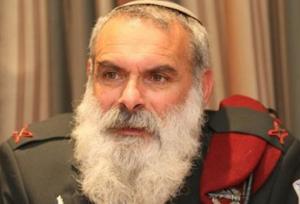
Rabbi-Avi-Ronzki_From yesterday’s Ha’artez:

The Israel Defense Forces’ chief rabbi told students in a pre-army yeshiva program last week that soldiers who “show mercy” toward the enemy in wartime will be “damned.”

Brig. Gen. Avichai Rontzki also told the yeshiva students that religious individuals made better combat troops.  Speaking Thursday at the Hesder yeshiva in the West Bank settlement of Karnei Shomron, Rontzki referred to Maimonides’ discourse on the laws of war. That text quotes a passage from the Book of Jeremiah stating: “Cursed be he that doeth the work of the Lord with a slack hand, and cursed be he that keepeth back his sword from blood.”

In Rontzki’s words, “In times of war, whoever doesn’t fight with all his heart and soul is damned – if he keeps his sword from bloodshed, if he shows mercy toward his enemy when no mercy should be shown.”

Whatever else we might think about Maimonides’ (or Jeremiah’s) words, we are certainly free to debate their academic meaning. But when they are uttered by the Chief Rabbi of the IDF to future Israeli soldiers, words such as these are much, much more than merely academic.

You may remember that Rabbi Rontzki (above) was in the news following Israel’s military operation in Gaza, when soldiers alleged that he gave them a religious booklet entitled “Go Fight My Fight.”  This publication includes extensive quotes by Rabbi Shlomo Aviner, head of the Ateret Cohanim yeshiva in Jerusalem, who ruled that Palestinians were the equivalent of the Biblical Philistines and that cruelty can sometimes be a “good attribute.”

You may also remember that Israeli soldiers from the organization Shovrim Shtika (“Breaking the Silence”) brought this issue to light following the war in Gaza.  Though they have been attacked mercilessly by the Israeli political establishment, these young soldiers have continued to speak out. Last September, Gal Einav and Shamir Yeger, two reserve infantry soldiers who fought in Gaza wrote a powerful editorial in the Israeli press about what they considered to be an unwelcome “messianic” religious influence into the IDF:

There is a problem with the growing tendency to provide religious elements with a monopoly on values and fighting spirit, and particularly with the legitimacy granted to organizations with a missionary and messianic character to operate amongst the soldiers. Most of the commanders in our division are religious, yet up until the last war there was complete separation between their private world and their military position.

If we fail to clearly draw the line right now, in a few years we shall find ourselves shifting from wars of choice or no-choice to holy wars.

In a September BBC report, Reserve General Nehemia Dagan had this to say about the issue:

We (soldiers) used to be able to put aside our own ideas in order to do what we had to do. It didn’t matter if we were religious or from a kibbutz. But that’s not the case anymore.

The morals of the battlefield cannot come from a religious authority. Once it does, it’s Jihad. I know people will not like that word but that’s what it is, Holy War. And once it’s Holy War there are no limits.

(You can watch the BBC report in its entirety here and here. Highly recommended).

What explains the growth of this right-wing religious influence in the IDF? I tend to agree with blogger Zachary Goelman, who points out an larger demographic trend in Israeli society:

With conscription rates dropping annually, especially among secular Jews, and a simultaneous increase in the country’s religious population, Yeger and Einav are part of a shrinking minority. No doubt they know many who ducked their conscription call. If they have draft-age children, they’ve certainly heard them discuss the myriad ways of obtaining a deferral.

This trend is reversed in the dati-le’umi sector, the category of Israeli Jews broadly classified as “national religious.” In one way or another the men and women woven from this cloth see military and national service as a form of religious duty, and their ranks in uniform and civil society will increase in the coming decades. Coupled with the consistent growth of ultra-orthodox families, secular Israel may be in the final throes of its götterdämmerung.

Whatever the explanation, I personally find the implications of this trend to be beyond troubling. How will we, as Jews, respond to the potential growth of Jewish Holy War ideology within the ranks of the Israeli military?  How do we  feel about Israeli military generals holding forth on the religious laws of warfare? Most Americans would likely agree that in general, mixing religion and war is a profoundly perilous endeavor.  Should we really be so surprised that things are now coming to this?

I do not ask these questions out of a desire to be inflammatory. I ask them only because I believe we need to discuss them honestly and openly – and because these kinds of painful questions have for too long been dismissed and marginalized by the “mainstream” Jewish establishment.

For myself at least – as a Jew and as a rabbi – I will take this opportunity to register my personal offense at statements such as those made last week by Rabbi Rontzki.

My HR 867 Postmortem

Last week, the US House of Representatives passed Resolution 867 by the whopping margin of 344 to 36.  For all you non-House watchers, HR 867 was the one that called upon

…the President and the Secretary of State to oppose unequivocally any endorsement or further consideration of the “Report of the United Nations Fact Finding Mission on the Gaza Conflict” in multilateral fora.

In plain English this means that the US Congress has, for all intents and purposes, quashed the Goldstone report.

A few thoughts post-mortem:

- In this age of non-partisan Congressional gridlock, what do we make of the eye-popping rapidity in which this resolution was crafted, brought to the floor, and passed in an overwhelmingly bipartisan manner?  For me at least, it proves only this:  Walt and Mearshimer are right. (If you haven’t read their book yet, check it out – I believe it’s becoming more relevant by the day.)

- During the House debate, Goldstone wrote a letter to the sponsors, addressing the resolution point by point and identifying numerous factual inaccuracies. Even though the vote is now history, I encourage you to read it.  I wonder how many of the 344 yeas voters actually took the time to do so (or if it would have made a difference if they had?)

- I commend to you this powerful Huff Post article, written by Fred Abrahams of Human Rights Watch. An excerpt:

The resolution succumbs to predictable American politics, in which criticisms of Israeli actions are rejected as delegitimizing attacks on Israel, and even as anti-Semitism. It misses a chance to break the impunity on all sides that has dogged the conflict and impeded efforts at peace. And, most significant for US foreign policy, it gives abusive governments around the world a handy excuse to deflect US criticism of their own unlawful conduct.

-  These are the House members who voted nay:

Baird, Baldwin, Blumenauer, Boustany, Capps, Carson (IN), Clarke, Clay, Davis (KY), Dingell, Doggett, Edwards (MD), Ellison, Filner, Grijalva, Hinchey, Johnson, E. B., Kilpatrick (MI), Kucinich, Lee (CA), Lynch, McCollum, McDermott, McGovern, Miller, George, Moran (VA), Olver, Pastor (AZ), Paul, Price (NC), Rahall, Snyder, Stark, Waters, Watt, Woolsey.

If your rep is on the list above, I encourage you to write him/her the following letter:

Dear Rep. _________ ,

As one of your constituents and as an American Jew who believes very firmly in the need for a just resolution of the Israeli-Palestinian conflict, I want to thank you for your vote against House Resolution 867. I was deeply disappointed that the Congress passed this resolution regarding the Goldstone Report and the situation in Gaza. Turning our eyes away from ugly truths will not make them any less true, and it’s time that the Jewish people and the American political class understand the truth of Gaza.

Thank you again and all the best,

NAME, ADDRESS, PHONE

If your Congressional rep is not on the list above, please consider sending him/her this letter:

Dear Rep. _________ ,

As one of your constituents and as an American Jew who believes very firmly in the need for a just resolution of the Israeli-Palestinian conflict, I was deeply disappointed that you voted in favor of House Resolution 867.  I believe the Goldstone Report raised troubling concerns about Israel (and Hamas’) wartime behavior during in Gaza. At the very least we should, as this report does, ask that both Israelis and Palestinians hold independent investigations and hold any guilty parties accountable. Turning our eyes away from ugly truths will not make them any less true, and it’s time that the Jewish people and the American political class understand the truth of Gaza.

Thank you for your consideration and all the best,

NAME, ADDRESS, PHONE

-  One particularly shining moment during this whole sad affair came from Rep. Brian Baird (WA), whose expression of personal moral conviction on the House floor (above) was truly breathtaking.

(H/T to my friend Emily Hauser, whose letter I’ve adapted above.)

Underground Genesis

R__Crumb_-_Abraham_and_Isaac

OK, I’ll weigh in: I really, really like the new R. Crumb new version of Genesis.

When it was announced that the legendary underground comic book artist was going to take a crack at the Book of Genesis,  I’m sure that many expected it to be an exercise in post-modern Biblical irony. They needn’t have worried. Crumb has reimagined Genesis like nothing I’ve read/seen in a long, long time.

Some might quibble with his rendering of certain episodes (and I do), but I don’t think anyone can reasonably call this a novelty version. Crumb has definitely done his homework – and while he admits in his introduction that he does not regard the Bible as the word of God, he clearly has a healthy respect for its mythic power:

(The Bible) is a powerful text with layers of meaning that reach deep into our collective unconsciousness, our historical consciousness, if you will. It seems indeed to be an inspired work, but I believe that its power derives from its having been a collective endeavor that evolved and condensed over many generations before reaching the final fixed form as we know it during the “Babylonian Exile,” circa 600 BCE…

If my visual, literal interpretation of the Book if Genesis offends or outrages some readers, which seems inevitable considering that the text is revered by many people, all I can say in my defense is that I approached this as a straight illustration job, with no intention to ridicule or make visual jokes. That said, I know that you can’t please everybody.

Though it seems like an unlikely project for him, Crumb’s earthy, hyper-realistic style actually serves the Biblical narrative quite well. Many will undoubtedly regard his graphic representation to be reductionist or even idolatrous (the most obvious example being God rendered as a stern, old bearded man). I personally experienced his effort as “visual midrash” that has intellectual and emotional impact in virtually every panel.

There have been a number of worthwhile reviews of the Crumb Genesis. If you are interested in reading up on the critical reaction, I highly recommend Biblical scholar Robert Alter’s recent piece in The New Republic.

Gaza 1956

gaza1956

Earlier this year I shared a 2004 Jerusalem Post interview with Arnon Soffer, the architect of Israel’s disengagement from the Gaza Strip. It was a painfully sobering read, not least for his chilling predictions of Israel’s post-disengagement reality:

(When) 2.5 million people live in a closed-off Gaza, it’s going to be a human catastrophe. Those people will become even bigger animals than they are today, with the aid of an insane fundamentalist Islam. The pressure at the border will be awful. It’s going to be a terrible war. So, if we want to remain alive, we will have to kill and kill and kill. All day, every day…

If we don’t kill, we will cease to exist. The only thing that concerns me is how to ensure that the boys and men who are going to have to do the killing will be able to return home to their families and be normal human beings.

I thought of this article today as I read another piece about Gaza: a famous 1956 eulogy given by Moshe Dayan for a young kibbutznik named Ro’i Rotenberg, who was killed by Gazan Arabs who had crossed over the border into Israel.

At the start of his eulogy, Dayan offered these astonishingly candid remarks:

Do not today besmirch the murderers with accusations. Who are we that we should bewail their mighty hatred of us?  For eight years they sit in refugee camps in Gaza, and opposite their gaze we appropriate for ourselves as our own portion the land and the villages in which they and their fathers dwelled.

Not from the Arabs in Gaza, but from ourselves shall we require the blood of Ro’i. How did we close our eyes so as not to see the goal of our generation in its full measure of cruelty?  Did we forget that this group of young men and women, which dwells in Nahal Oz, bear on their shoulders the heavy gates of Gaza, gates on the other side of which are crowded together with hundreds of thousands of eyes and hands that pray for our weakness, that it may come, so that they may rip us to shreds – have we forgotten this?

This we know: that in order that the hope to destroy us should die we have to be armed and ready, morning and night. We are a generation of settlement, and without a steel helmet and the barrel of a cannon we cannot plant a tree and build a house. Our children will not live if we do not build shelters, and without a barbed wire fence and a machine gun we cannot pave a road and channel water. The millions of Jews that were destroyed because they did not have a land look at us from the ashes of Israelite history and command us to take possession of and establish a land for our nation.

(Translation, Michael Shalom Kochin, 2009)

Shabbat with a Shi’ite Cleric

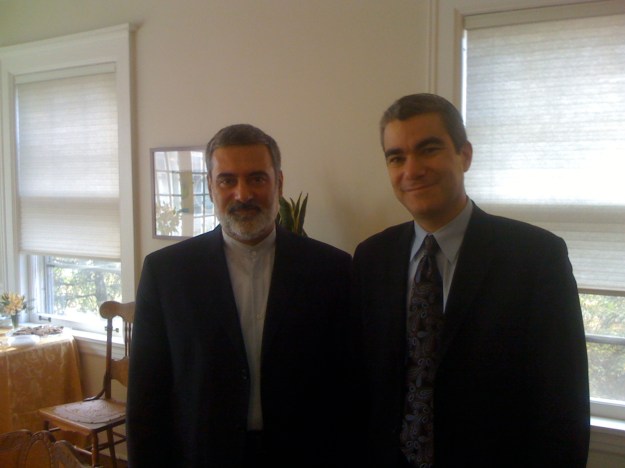
IMG_0689
I spent a remarkable Shabbat lunch yesterday at the home of JRC members Mark and Margie Zivin, where I had the opportunity to meet and talk with prominent Iranian cleric, Dr. Mohsen Kadivar.  Those who assume all Iranian Shi’ite clergy are fundamentalist totalitarians would do well to learn about figures such as Dr. Kadivar, who is both a respected Muslim scholar and a vocal proponent for religious and political reform in his home country.

Among other things, Dr. Kadivar is well-known for his important three-volume treatise in which he sets forth a religious argument for the creation of an Iranian state based on the values of human rights, freedom and democracy.  He also has the dubious honor of having been jailed twice for his activism: once by the Shah and once by the Islamic regime.

During the latter imprisonment, he spent 18 months in Iran’s notorious Evin prison, where he repeatedly rejected offers of clemency if he renounced his religious ideas.  Political pressure has led Dr. Kadivar to leave his post at the Iranian Institute of Philosophy. He is currently serving as a visiting professor of Religious Studies at Duke University.

Our lunch conversation ran the gamut from political discussions of the current nuclear standoff, to human rights, to the political realities in Iran post-election.   For me, however, the most fascinating element of our discussion came when  Dr. Kadivar expressed his religious views.

Indeed, his dissent is notable because it is essentially spiritual rather than political. At the core of his critique is a challenge to the concept of velayat-e faqih, the religious rationale that was used by the Ayatollah Khomeini to grant absolute power to a Supreme Leader:

Kadivar argues that because the concept was conceived by clerics rather than by Allah, it cannot be considered sacred or infallible. And if clerics have no God-given right to rule, he says, that means that Muslims may freely select their government in a democratic Islamic republic. Kadivar has also formulated a theory on why terrorism is forbidden in Islam—an indirect reproach to an Iranian regime that is widely accused of backing terrorist groups (from Time Magazine, 2004.)

I find the notion of religious reform in Iran to be immensely exciting and I am eager to learn more. In the meantime, our conversation provided yet one more reminder for me that it is enormously important for us – as Americans and as Jews – to make the effort to understand the rich complexities of Iranian society. I am more convinced than ever that the most important way we can engage with Iran is by reaching out to and supporting of courageous individuals such as Dr. Kadivar.


Welcome

Welcome to "Shalom Rav," a collection of posts that have nothing much in common other than my desire to share them with you.

While some of my posts are related to my day job (I serve as Rabbi of Jewish Reconstructionist Congregation in Evanston, IL), the opinions I express here are mine alone and do not reflect official stands of my congregation or any organization with which I'm affiliated.

Enter your email address to subscribe to Shalom Rav and receive notifications of new posts by email.

Follow Me on Twitter:

Categories