Archive for February, 2010

Queen Esther is Coming to Town…

Apparently, this is how they celebrate Purim in Mea Shearim…

An Israeli Voice of Sanity on Iran

Avner Cohen asks exactly the right questions in a Ha’aretz editorial:

What if our leaders and pundits had reacted to the Iranian nuclear program in a completely different way than they actually have? What if they had not viewed an Iranian bomb as an “existential threat” and instead treated it as something that, even if it became a reality, would be a major global political problem, but not a military threat – because Iran (like every other nuclear state) would never be able to use a nuclear bomb as an operational military weapon?

What if Israel had treated Iran’s nuclear project as an exhibitionist, even childish, attempt by a nation mired in a deep identity crisis to exploit the prestige and mystique of nuclear power to create a national ethos of technological progress at home, as well as a diplomatic miracle cure that would enable it to challenge the West and move to the center of the international stage?

And his answers are spot on. Click here to read.

Anatomy of a Pastrami Sandwich

Interesting report on a recent panel discussion in Berkeley: will the Jewish deli survive the sustainable food movement?

One critical historical note courtesy of Karen Adelman and Peter Levitt (owners of a Bay Area deli that uses local, grass-fed meat, fish from sustainable farms and homemade celery soda) :

What American Jews think of as the authentic Jewish deli is an ossified construct based on post-World War II ideals of abundance that had little to do with how Jews ate in early 20th-century New York, let alone in the Old World.

That mile-high, fatty pastrami sandwich served at Katz’s or the Carnegie Deli? American, not Jewish, they say. Jewish cooking a century ago was all about thrift, seasonality and resourcefulness. Every part of the animal was used; portions were small; tomatoes were served in summer and beets in winter.

Today’s customers want everything on the menu year-round; if they don’t get it, Levitt said, “they complain it isn’t a ‘real’ Jewish deli.”

“‘Authentic’ is a moving target,” Adelman added, pointing out how Jewish cuisine in this country has developed with each new immigration wave. “What we’re arguing is, we’re more authentic. What’s authentic about mass-produced food and giant menus?”

Click here to consume the full article

Tel Aviv: “One of Your Own Kind, Stick to Your Own Kind…”

In past posts I’ve raised questions about the implications inherent in the establishment of a Jewish state – and the problems that invariably seem to arise in relations with Israel’s non-Jewish citizens and residents.

How do we American Jews  react, for instance, when we read that Israel is concerned about a “demographic threat” to the Jewish state? (That is to say, what would we say if  our President raised questions about the “demographic threat” of a particular minority group to the “American character” of our country?)

And now:  what would we say if an American city funded a campaign to discourage girls from dating or marrying boys from another ethnic group?

From Coteret (an Israeli news/media aggregator):

Maariv reported reported on February 23 that the Tel Aviv municipality  launched  a “counselling program” to “help”  Jewish girls who date and/or marry Arab boys.

Grassroots and governmental campaigning against interfaith mingling is  nothing new in Israel…But this is the first time officially sanctioned racism, funded by taxpayers, has come to Tel Aviv, Israel’s liberal heartland.

I’m not asking these questions to “bash Israel.”  I’m genuinely concerned by certain realities that seem intrinsic to ethnocracies. If we truly do cherish values inherent to American civil democracy, how do we react to news such as this?   Do we simply put these values on the shelf out of our desire for a Jewish state?  Or can we understand these kinds of measures in a way that is consonant with our most essential civic beliefs (beliefs, by the way that have been quite kind to the American Jewish community)?

And if not, then how will we respond?

The Politics of Archaeology Unearthed

This just in from AP:

An Israeli archaeologist said Monday that ancient fortifications recently excavated in Jerusalem date back 3,000 years to the time of King Solomon and support the biblical narrative about the era.

If the age of the wall is correct, the finding would be an indication that Jerusalem was home to a strong central government that had the resources and manpower needed to build massive fortifications in the 10th century B.C.

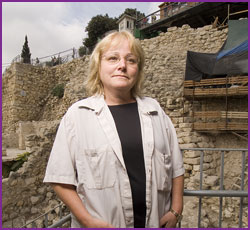
Just dig a little deeper, however and the plot thickens even more. The researcher in question is Eilat Mazar (above), an old school Israeli archaeologist whose essential goal is to prove the historical veracity of the Bible.  She’s made no bones (sorry) about this over the years.  In a 2006 interview with Moment Magazine, she made this very telling comment:

One of the many things I learned from my grandfather was how to relate to the biblical text. Pore over it again and again, for it contains within it descriptions of genuine historical reality.  I work with the Bible in one hand and the tools of excavation in the other. That’s what biblical archaeologists do. The Bible is the most important historical source and therefore deserves special attention.

The only problem with this is that the Bible is not a history book – it’s religious literature.  There certainly may be kernels of historical fact to be found in these narratives, but I’d say it’s exceedingly problematic for an archaeologist to assume ipso facto the historical veracity of the Bible.  Mazar’s comment that she works with a Bible in one hand and her tools in the other speaks volumes about her fundamental bias.

It’s also noteworthy that Mazar worked until recently for the Shalem Center, a partisan Israeli think-tank.  Among other things, the Shalem Center believes archeology should support “the claim that the Bible can be viewed as a work whose historical narrative is in large part accurate, and (strengthen) the ancient connection of the Jewish people to the land of Israel.”

It’s striking to compare Mazar’s approach to that of Israel Finkelstein, who comes from a new school of Israeli archaeologists who are aren’t driven by political ideology and are willing to go wherever their research takes them.   In a nutshell, Finkelstein and his colleagues have argued convincingly that it’s impossible to say much of anything about ancient Israel until the 7th century BCE (around the time of the reign of King Josiah). This casts doubt on the historical veracity of the Biblical narrative from the period of the Patriarchs/Matriarchs through the reigns of David and Solomon. These claims have largely been accepted as normative by most mainstream archaeologists outside of Israel.

If you are interested the current thinking of Israeli researchers who are unfazed by nationalist bias, I highly recommend Finkelstein’s 2002 book (with Neal Asher Silberman), “The Bible Unearthed.” Also check out this 2001 piece from Salon, which explores the deeper socio-political implications of Israeli archeology.

Ajami: A Review

Just saw “Ajami,” the Israeli entry for Best Foreign Language film, over the weekend. I recommend it highly, though it’s not a movie for the emotionally faint of heart.

“Ajami” is a crime drama with a “Babel”- like structure – it unfolds in five chapters, each telling a separate narrative from the point of view of different characters. It portrays a powerfully claustrophobic world, in which ordinary people struggle to better their lives against exceedingly tall odds.

Almost everyone in this film is trapped in some sense. At least two of the film’s protagonists are literally house-bound: one is being targeted for murder by a Bedouin gang and the other is a resident of the occupied West Bank working on the other side of the Green Line. Another character, an Israeli policeman, is searching in vain for his brother who has gone ominously missing. There are also two fatally star-crossed love affairs: one between a Palestinian and a Jewish Israeli and another between an Arab Muslim and an Arab Christian.

More than anything else, I experienced this film as a portrait of ethnic and religious communities in constant, tragic collision with one another. At times, it’s sometimes difficult to keep all of the complicated rivalries straight. There is tension between Bedouins and Palestinian Arabs, Palestinian citizens of Israel and Palestinian residents of the Occupied Territories, citizens of Arab Jaffa and citizens of Jewish Tel Aviv, Arab Muslims and Arab Christians. The Israel portrayed here is not simply a Jewish state – it is nothing less than a simmering multi-ethnic powder keg.

As a portrait of Israeli society, it’s a decidedly non-redemptive vision. You watch the drama play out, knowing deep down that nothing good will possibly come of any of this. And yet what I loved about this film its genuine heart. You can’t help feel a deep compassion for the humanity of these characters, no matter how flawed or broken they are. Even though it’s technically a crime drama, there are really no heroes and villains in “Ajami” per se – just ordinary, imperfect individuals doing their best to survive under increasingly dire circumstances.

I’m sure there will be those who understand this film as a reflection of the hopeless political situation in Israel/Palestine. But I think the true genius of the film is how it works on so many levels: as a crime thriller, a family drama, or a slice of socio-political commentary. Whichever way you choose to take it, it’s not a pretty picture. As befits a film directed jointly by a Jewish Israeli and a Christian Palestinian, however, it’s an exceedingly courageous statement.

Gideon Levy Begs to Differ on Dubai

Just watched the incredibly creepy step by step video of the Dubai assassins’ liquidation of Hamas leader Mahmoud al-Mabhouh.  Sort of like watching a real-life version of “Munich” without the pretentious dialogue.

From all reports, Israelis are overwhelmingly approving of the operation (if not of the way it was amateurishly botched).  Ha’aretz’s Gideon Levy, as usual, begs to differ – cutting to the heart of the matter with the critical questions:

Let’s suppose the Dubai assassination project had worked out well. Mahmoud al-Mabhouh would have received his kiss of death, the assassins would have returned safe and sound to their bases, and no Israeli would have run into identity complications. And then? Mahmoud’s place would have been taken by Mohammed, who also would have tried to kill Israeli soldiers and smuggle Iranian arms into Gaza. Perhaps the heir would even outperform his predecessor, as has happened in several previous liquidations.

We eliminated Abbas al-Musawi? Well done, Israel Defense Forces. We got Hassan Nasrallah. We killed Ahmed Yassin? Well done, Shin Bet security service. We got a Hamas many times stronger. Abu Jihad was eliminated? Well done to the Sayeret Matkal special forces unit – of course, according to foreign news reports. We killed a potential partner, relatively moderate and charismatic. As a bonus, we got revenge attacks like those after “the Engineer” Yihyeh Ayash was slain. We also got the danger hovering over every Israeli and Jew in the world each anniversary of the assassination of Imad Mughniyeh, which was also blamed on Israel.

Click here for the full article.

What the US Should Do About Iran

Some of you may have noticed that I’ve been engaging in a bit of lively back and forth with one reader over my 2008 Yom Kippur sermon on Iran. I haven’t posted on Iran in some time, but that certainly doesn’t mean I’m not following developments there with great interest.

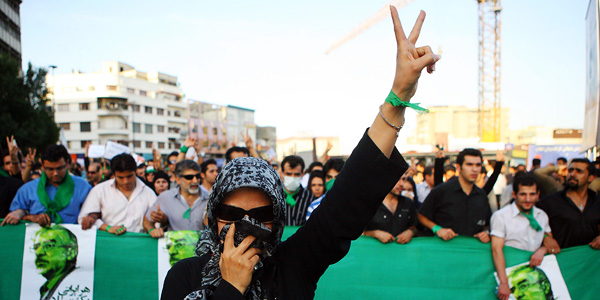
I do believe the Islamic regime’s increasingly brutal crackdown on human rights is a sign that it is taking the challenge of the Green Movement very, very seriously.  For our part, the the US administration appears somewhat paralyzed – issuing tepid statements, wary of throwing too much support to the Greens lest they get accused of meddling in Iranian politics yet again.  Meanwhile, the regime-change drumbeats of the right continue to grow ominously louder and louder.

Still, it would be mistaken and foolhardy to assume the only choice we have is between doing nothing and doing too much. In this regard, I commend to you this very insightful and helpful article by Dr. Trita Parsi and Alireza Nader of the National Iranian American Council.

Here’s my edited version:

(Between) the extremes of doing nothing and doing everything, there is a middle ground: providing the Iranian pro-democracy movement with breathing space, rather than engaging in risky and imprecise exercises that would directly involve America as an actor on the Iranian scene. The United States can achieve this through a few simple steps.

First, the United States should tread carefully when it comes to issuing military threats. Under the shadow of a foreign military threat, the uphill battle of the Iranian pro-democracy movement becomes even steeper, as the Iranian regime is quite adept at exploiting foreign threats to stifle criticism at home…

Second, the United States should avoid sanctions that put a burden on the Iranian people, rather than the Iranian government. Broad-based sanctions that hit the entire economy hurt common citizens far more than the powerful elites. Any new sanctions should demonstrate not only international discontent with the conduct of the Tehran government, but also an effort by the United States to keep from harming average Iranians…

Third, Washington should slow down the diplomatic process. Negotiation with Iran in and of itself is not the problem; engagement doesn’t legitimize the Iranian government, as only the people of Iran can do that. But in spite of President Mahmoud Ahmadinejad’s latest offer to accept the International Atomic Energy Agency nuclear deal, Iran remains in political turmoil. It is questionable that Tehran can make enduring decisions on issues of this magnitude under these circumstances…

Fourth, the international community, including the White House and U.S. State Department, should be vocal in excoriating Iran’s human rights abuses. Condemning abuses should not be confused with interfering in internal Iranian affairs…The Iranian government is, perhaps surprisingly, very sensitive in this area, due to its ambition to be perceived as a regional leader. This sensitivity should be utilized to make advances on the human rights front in Iran…

Finally, Washington should exercise patience and view Iran as a long-term factor in shaping U.S. national security interests across the Middle East. The green movement will not and cannot adjust its action plan to suit the U.S. political timetable. But if patience is granted – which includes avoiding a singular focus on the nuclear issue at the expense of all other considerations – Washington will access a far greater potential for change.

Thank You, Rep. Baird

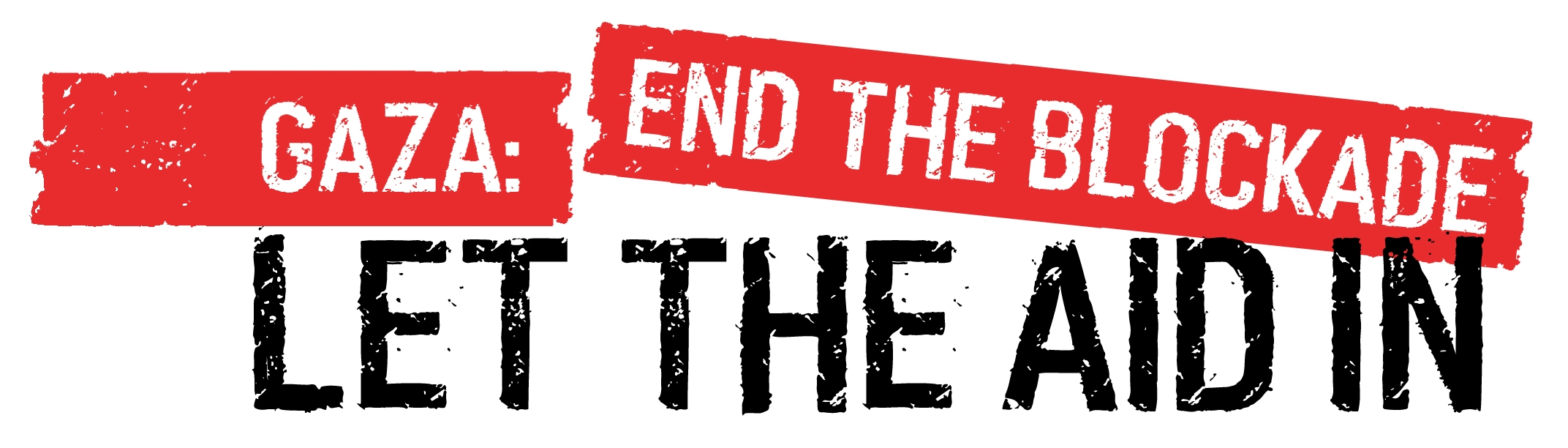
Yet another American political voice calls to lift the Gaza blockade. From yesterday’s NY Times:

The United States should break Israel’s blockade of Gaza and deliver badly needed supplies by sea, a U.S. congressman told Gaza students.

Rep. Brian Baird, a Democrat from Washington state, also urged President Barack Obama’s Mideast envoy to visit the Hamas-ruled territory to get a firsthand look at the destruction caused by Israeli’s military offensive last year.

Rep. Baird’s statement on Gaza, from his website:

(Rocketing) from Gaza doesn’t necessarily mean that any response, regardless of scope, target or impact on civilians, is necessarily justified, moral or strategically prudent.  This kind of misleading duality itself reflects the thinking, on both sides, that can make peace so hard to achieve and violence so easy to justify.  The fact is, there were and are many alternative responses possible and it is a false dichotomy to suggest, as some have, that if one criticizes the actions taken by Israel in Gaza and the West Bank then one is necessarily ignoring the rocket attacks from Gaza or somehow siding with or enabling terrorists.

In my judgment what has happened in Gaza and what goes on in the West Bank every day endangers U.S. integrity and security and ultimately strengthens hard line extremists at the expense of moderates and to the detriment of long term Israeli security.   I also believe, having traveled and met with people throughout the region, that this adverse effect is not confined to Palestine but extends to varying degrees throughout the Islamic world and beyond.

I understand that people may disagree strongly with this perspective, but I am certainly not alone in expressing it.  Many people have contacted my office to convey support for what we have said about our visit and this includes many friends of Israel within our own country.

Click here to thank Rep. Baird for his courage.

An Ajami Backgrounder

Israel’s entry for Best Foreign Language Film, “Ajami,” is coming to Chicago this Friday and I’m looking forward to seeing it. It’s been getting great reviews and attracting particular attention for its being directed by two best friends, Yaron Shani, an Israeli Jew and Scandar Copti, a Palestinian Christian.

The film’s website describes it as “a powerful crime drama set on the streets of Jaffa’s Ajami neighborhood – a melting pot of cultures and conflicting views among Jews, Muslims and Christians.” From the sound of it, “Ajami” certainly seems to highlight aspects of Israeli life that don’t tend to get much attention in the general media.

For those who are interested in the seeing the film (or even those who aren’t), here’s a bit of background on the complex history of the Ajami neighborhood:

Toward the end of the 19th century al-Ajami Neighborhood, stretching south of Old Jaffa and projecting into the Mediterranean, started to be built outside the walls of Old Jaffa. The neighborhood is named after one of prophet Muhammad’s companions, Ibrahim al-Ajami, who is believed to have been buried in the neighborhood, next to al-Ajami mosque…

In the beginning of the 20th century hundreds of families, mainly Christian-Arabs, from different financial background and different places in the country had settled in al-Ajami, the neighborhood expanded to the south as a narrow strip between the seashore to the west and orchards to the east, until in merged with al-Jabaliyya neighborhood…

During the war of 1948 the majority of Jaffa’s population (that was mainly Arab) fled the country and were not able to return. The deserted neighborhood was soon settled with Jewish immigrants from East Europe, the Balkans and North Africa. A large Arab population from different parts of the country moved to the neighborhood as well. Al-Ajami changed into a crowded and lively immigrant city. To accommodate the influx, its palaces-houses were subdivided among many families. Gradually, however, it became inflicted with poverty and crime.

The municipalities of Jaffa and Tel-Aviv merged in 1950. As time passed, new plans developed to transform Ajami into a modern neighborhood, in the spirit of Tel Aviv. This decision was immediately followed by the demolition of houses and evacuation of al-Ajami’s inhabitants. The neighborhood’s conditions drastically and quickly deteriorated, while modern infrastructure was not built. In addition to this, the neighborhood was badly harmed by the casting of construction waste into its once beautiful shores. The pile of waste accumulated to the height of 20m, blocking the beautiful neighborhood from the sea.

During the 1980′s the architectural and historical values of al-Ajami neighborhood were finally recognized by the municipality of Tel-Aviv-Jaffa. It stopped the demolition and developed a conservation plan, trying to save what remained. Today, the opulent past of al-Ajami is still visible in its alluring ‘palaces-houses’, colorful plastered walls, ample spaces and decorated elements. At the same time the wounds of its history are still present in the abundance of empty lots and in the mound of waste obstructing the access to the sea. (from Archnet Digital Library)

Some troubling recent news: Ha’aretz has just reported that the Tel Aviv District Court has upheld the legality of a Jews-only housing complex in the Ajami neighborhood:

Attorney Gil Gan-Mor of the Association for Civil Rights in Israel said afterward that the petitioners will appeal to the Supreme Court. Kemal Agbariya, who heads the Ajami neighborhood council, said that activists and elected officials in the city also intend to organize protests.

Next Page »


Welcome

Welcome to "Shalom Rav," a collection of posts that have nothing much in common other than my desire to share them with you.

While some of my posts are related to my day job (I serve as Rabbi of Jewish Reconstructionist Congregation in Evanston, IL), the opinions I express here are mine alone and do not reflect official stands of my congregation or any organization with which I'm affiliated.

Enter your email address to subscribe to Shalom Rav and receive notifications of new posts by email.

Follow Me on Twitter:

Categories