Monthly Archives: May 2012

After Cast Lead, Israeli Companies Now Profit from Rebuilding Gaza

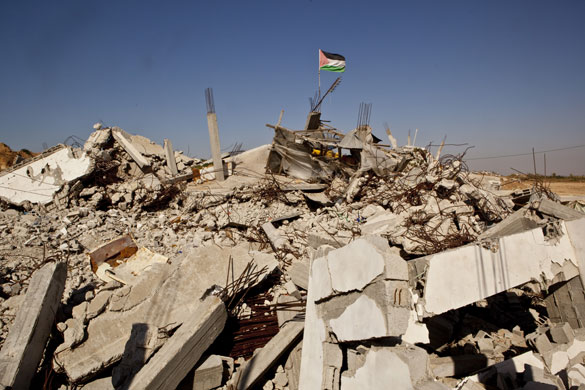
More than three years after Israel inflicted widespread damage on the infrastructure of Gaza during Operation Cast Lead, two Israeli companies have now won bids issued by the UNICEF for reconstruction projects there.  In other words, after destroying much of the Gaza Strip, Israel is now reaping significant economic benefits from its reconstruction.

This is called “disaster capitalism” – something Israel has turned into something of an art form. To understand the phenomenon more thoroughly, read Chapter 21 of Naomi Klein’s essential book “The Shock Doctrine,” which explains in vivid detail why Israel now believes it is more in its economic interest to wage war than to make peace:

Clearly, Israeli industry no longer has reason to fear war. In contrast to 1993, when conflict was seen as a barrier to growth, the Tel Aviv Stock Exchange  went up in August 2006, the month of the devastating war with Lebanon. In the final quarter of the year, which had also included the bloody escalation in the West Bank and Gaza … Israel’s overall economy grew by a staggering 8 percent – more than triple the growth rate of the U.S. economy in the same period. The Palestinian economy, meanwhile, contracted by between 10 and 15 percent in 2006, with poverty rates reaching close to 70 percent.

My Congregation Presents “Untold Stories” of Life Under Occupation

My hometown paper, the Evanston Roundtable, has just published a thorough feature on “Untold Stories,” a program initiated by my congregation’s Peace Dialogue Task Force that features Palestinians sharing their personal stories of their lives under occupation.

“Untold Stories” was initiated after we invited two Chicago-area Palestinians  – a man from Gaza and a woman from the West Bank – two speak about their lives during our Rosh Hashanah discussion groups. The presentation was so successful and well-received, the Peace Dialogue decided to make it an ongoing program – and eventually invite other faith communities in Evanston to participate as well.

From the article:

This fall, St. Nicholas Church will host another chapter of “Untold Stories,” knowing the narratives lend themselves to surprise endings. They allow (Palestinian presenter) Daniel Bannoura to learn that in Chicago, some of his best friends can be Jewish. And (JRC’s Peace Dialogue chairperson) Sallie Gratch can discover that her involvement with Palestinians and their stories “sticks closer to my Jewish values than anything I’ve ever done.”

NATO in Chicago: A Meaningless Demonstration

Now that the NATO Summit has swept out of my city, the local press can’t stop fawning over the performance of the Chicago police – and gloating over how silly and meaningless the mass demonstrations turned out to be in the end.

Mission accomplished. With all of the focus on the Chicago streets, I guess we were successfully distracted from the truly meaningless demonstration that was the NATO Summit.

As for me, I’m in full agreement with Stephen Walt, who has correctly pointed out that this massive, fancy, expensive, city-paralyzing event was little more than a “fig-leaf” for NATO – a pageant designed to put a happy face on an Afghanistan war that is hugely unpopular and has suffered from ever-changing objectives from the very beginning.

Actually, Obama’s summit pledge “to responsibly wind down the war” by the summer of 2014 is worse than a fig leaf – it’s simply not true. Earlier this month, Obama visited Afghanistan and signed a pact with Afghan president Hamid Karzai that will ensure a US military presence in Afghanistan until at least 2024. (This agreement was first made in secret, then when the news leaked out, the administration vehemently denied it. Later they conceded it was true, making no attempt to explain why they lied in the first place.)

And please don’t be fooled by the explanation that NATO will be ending “combat operations” by 2014.  Officials have openly stated that these post-2014 “non-combat” troops will continue to launch “anti-terror” raids – which is simply just another way of saying they will continue to do what they’ve been doing all along.

But for the most powerful rejoinder to the farce that was NATO in Chicago, I strongly encourage you to read this important piece by Gary Younge, who pointed out the irony (or if you prefer, the utter hypocrisy) of Mayor Rahm Emanuel’s boast that the summit was “an opportunity to showcase what is great about the greatest city in the greatest country.”

The murder rate in Chicago in the first three months of this year increased by more than 50% compared with the same period last year, giving it almost twice the murder rate of New York. And the manner in which the city is policed gives many as great a reason to fear those charged with protecting them as the criminals. By the end of July last year police were shooting people at the rate of six a month and killing one person a fortnight.

This violence, be it at the hands of the state or gangs, is both compounded and underpinned by racial and economic disadvantage. The poorer the neighbourhood the more violent, the wealthier the safer. This is no coincidence. Much like the NATO summit – and the G8 summit that preceded it – the system is set up not to spread wealth but to preserve and protect it, not to relieve chaos but to contain and punish it…

The paradox inherent in a city like Chicago hosting a summit like this not only lays bare the brutal nature in which these inequalities are maintained at a global level, but it lends us an opportunity to understand how those inequalities are replicated locally.

Chicago illustrates how the developing world is everywhere, not least in the heart of the developed. The mortality rate for black infants in the city is on a par with the West Bank; black life expectancy in Illinois is just below Egypt and just above Uzbekistan. More than a quarter of Chicagoans have no health insurance, one in five black male Chicagoans are unemployed and one in three live in poverty. Latinos do not fare much better. Chicago may be extreme in this regard, but it is by no means unique. While the ethnic composition of poverty may change depending on the country, its dynamics will doubtless be familiar to pretty much all of the G8 participants and most of the NATO delegates too.

The gated communities – like the one in which Trayvon Martin was killed – have been erected on a global scale to protect those fleeing the mayhem wrought by our economic and military policies. This was exemplified last March when a boat with 72 African refugees fled the NATO-led war in Libya. When the boat found itself stranded it sent out a distress signal that was passed on to NATO which had “declared the region a military zone under its control”, and then promptly ignored it, as did an Italian ship. The boat bobbed around in the Mediterranean for two weeks. All but nine on board were left to die from starvation, thirst or in storms, including two babies.

A meaningless demonstration indeed…

Chatting Up Beinart’s Book on “Beyond the Pale”

I recently had the pleasure of being interviewed on WBAI radio’s “Beyond the Pale” to discuss Peter Beinart’s (much-discussed) new book “The Crisis of Zionism” with hosts Lizzy Ratner and Adam Horowitz.

Here’s a description of the program:

We spend the hour discussing Peter Beinart’s controversial and much-discussed new book about the struggle at the heart of contemporary zionism: the occupation of the West Bank and Gaza. We begin with a lengthy interview with Beinart himself, who argues that the only way to save Zionism is to end the Occupation and recommit to the ideals of “democratic” Israel. From there we head to Israel-Palestine for a fascinating discussion with Abir Kopty, a human rights activist and Palestinian citizen of Israel, who tells of the ugly discrimination faced by Palestinians within the Jewish state and questions the notion that a “democratic” Israel ever has or ever can exist. Finally, we conclude with an interview with Rabbi Brant Rosen, a Reconstructionist rabbi and Palestinian solidarity activist, who hails The Crisis of Zionism as a passionate effort that came twenty years too late.

Click here to give it a listen.

In Support of the “Battle of the Empty Stomachs”

Photo: AFP

From the Palestinian NGO, Adameer: Prisoner Support and Human Rights Association:

After nearly a full month of fasting, around 2,000 Palestinian political prisoners ended last night their mass hunger strike upon reaching an agreement with the Israeli Prison Service (IPS) to attain certain core demands…

The written agreement contained five main provisions: the prisoners would end their hunger strike following the signing of the agreement; there will be an end to the use of long-term isolation of prisoners for “security” reasons, and the 19 prisoners will be moved out of isolation within 72 hours; family visits for first degree relatives to prisoners from the Gaza Strip and for families from the West Bank who have been denied visits based on vague “security reasons” will be reinstated within one month; the Israeli intelligence agency guarantees that there will be a committee formed to facilitate meetings between the IPS and prisoners in order to improve their daily conditions; there will be no new administrative detention orders or renewals of administrative detention orders for the 308 Palestinians currently in administrative detention, unless the secret files, upon which administrative detention is based, contain “very serious” information.

This is heartening news to be sure, particularly for the families of the strikers.  But on an even deeper level, this deal is a testimony to the astonishing moral/political power of fasting in response to oppression.  As my colleague Rabbi Alissa Wise recently wrote:

I can not even begin to fathom the pain, the discomfort, the anguish of starving yourself to protest injustice. Their decision to take up this action surely was not taken up lightly, and neither, I imagine, (was) their decision each and every day to continue with the fast.

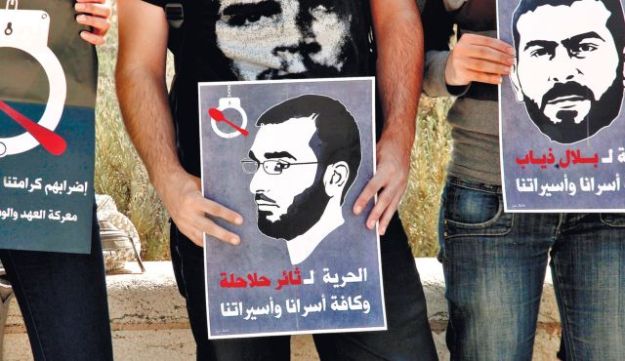
Nor can I think of any more basic or courageous form of resistance than the simple act of refusing food. For an eloquent, heartbreaking expression of this principle, look no farther than the widely published letter written by hunger striker Thaer Halahleh to his two year old daughter Lamar. (Halahleh hovered between life and death for weeks before ending his strike at 77 days):

When you grow up you will understand how injustice was brought upon your father and upon thousands of Palestinians whom the occupation has put in prisons and jail cells, shattering their lives and future for no reason other then their pursuit of freedom, dignity and independence. You will know that your father did not tolerate injustice and submission, and that he would never accept insult and compromise, and that he is going through a hunger strike to protest against the Jewish state that wants to turn us into humiliated slaves without any rights or patriotic dignity.

Hunger striking is, of course, is an ancient time-honored form of protest. And as a Jew, I’m particularly mindful that the Book of Isaiah passionately connects the act of fasting to the pursuit of justice:

Is not this the fast that I choose:
to loose the bonds of wickedness,
to undo the straps of the yoke,
to let the oppressed go free,
and to break every yoke?

Indeed, it is critical that we understand that the Palestinians’ “Battle of the Empty Stomachs” as part of this long and honorable tradition of nonviolent resistance. As we have seen from the events of the past several months, it has lasted so long largely because it is a tactic that works.

At the same time, however, it is imperative to bear in mind what has been accomplished and what has not.  While several specific demands regarding prison conditions have been met, Israel’s overall policy of administrative detention essentially remains in place. Adameer’s press release rightly noted this point:

Addameer is concerned that these provisions of the agreement will not explicitly solve Israel’s lenient and problematic application of administrative detention, which as it stands is in stark violation of international law.

In a recent blog post for +972mag, Palestinian journalist Omar Rahman also viewed this agreement in context of the overall Israeli/Palestinian power dynamic:

We must also remember that Israel holds all the chips. These hunger strikers have managed to pressure Israel into a level of accommodation, but only while people are focused on the issue. As soon as that attention dissipates, Israel is free to take back what it has offered. In the relationship between the occupier and the occupied, Israel is the Lord who giveth and taketh away. What will the Palestinians do? Stage another collective hunger strike only to repeat the process of give and take? The costs are simply too high to stage such a strike every time the need arises to challenge the system.

In the meantime, it seems to me, the most important outcome of the hunger strike campaign is the way in which it powerfully frames the ethical stakes of Israel’s occupation. As a recent Guardian editorial stated plainly, “Israel cannot claim the moral high ground while it is holding Palestinians without charge.”

For Jews, the “Battle of the Empty Stomachs” thus represents a profoundly critical challenge. Will we, who are the bearers of a tradition that bids us to call out oppression, find the wherewithal to stand with those who fast in response to their oppression by the Jewish state?

I don’t know how to say it any better than my colleague Rabbi Rachel Barenblat:

When I read anything which speaks ill of Israel and of Judaism, my heart aches. I do not want to hear these things about my coreligionists. But the answer is not to silence or ignore those who are speaking out. The answer is for my fellow Jews to live up to what is best in our tradition. Detaining people without trial, without informing them or their lawyers of the charges against them, is wrong. When the only Jewish government in the world makes those choices, we are all diminished.

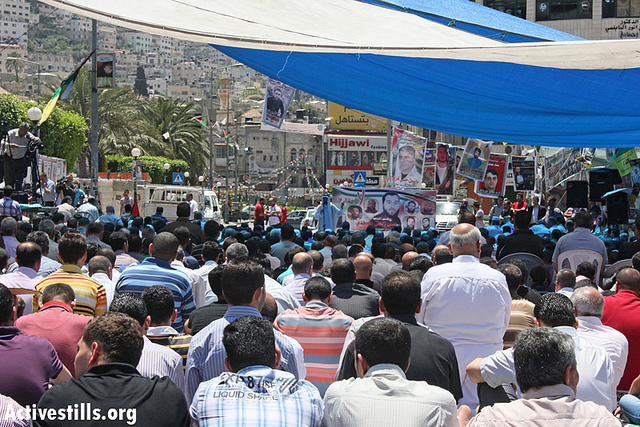
2,000 Palestinians are on Hunger Strike – Tell Hilary to Break Her Silence!

Protest tent, Nablus, May 11, 2012. (Photo: Ahmad Al-Bazz/ActiveStills)

Did you know that two thousand plus imprisoned Palestinians have been on an hunger strike for months demanding basic human rights and an end to detention without trial?  Did you know that two of them have not eaten since February 28 and are hovering between life and death? Did you know that thousands of Palestinians have been protesting in support of the strikers in growing demonstrations throughout the West Bank?

Alas, while it’s been reported fairly regularly via the world media, there’s been a near-total silence from the American government on the matter.  Actually, that’s not quite correct – at a recent press briefing, spokesperson Victoria Nuland remarked that the State Department doesn’t “have anything to say (about it) one way or the other.”

As journalist Robert Naiman recently observed, the State Department did manage to speak out in support of Bahrainian Abdulhadi al-Khawaja, also on hunger strike to oppose his unjust detention. Yet 2,000 Palestinian hunger strikers do not rate even an official acknowledgement?

At present, Egypt is attempting to broker a solution – and as Naiman rightly points out, “a few words from the State Department could help tip the balance toward a more positive resolution.”  I encourage you to join me in signing this petition urging Hilary Clinton to end her silence and use her good offices to help save the lives of these nonviolent Palestinian protesters.

For a deeply moving meditation on the hunger strikers campaign, I commend to you this post by Vicky at Bethlehem Blogger:

Through the hunger strike, the prisoners have demonstrated that there are some things that can never be taken from them – dignity first of all. Maher Halahleh, whose brother Thaer is in a critical condition after seventy-four days without food, said today, “This is a new weapon that is stronger than a nuclear bomb. Israel is fighting people who have no weapons, only their will.”

Coming Soon: 5 Broken Cameras

If you haven’t heard about the documentary “5 Broken Cameras,” you will very soon. It was the talk of the 2012 Sundance Festival (winning the World Cinema Directing Award) and it’s going to be hitting theaters this summer.

Click here for a NY Times feature on the film. Here’s a description, according to the distributor’s website:

An extraordinary work of both cinematic and political activism, 5 Broken Cameras is a deeply personal, first-hand account of non-violent resistance in Bil’in, a West Bank village threatened by encroaching Israeli settlements. Shot almost entirely by Palestinian farmer Emad Burnat, who bought his first camera in 2005 to record the birth of his youngest son, the footage was later given to Israeli co-director Guy Davidi to edit. Structured around the violent destruction of each one of Burnat’s cameras, the filmmakers’ collaboration follows one family’s evolution over five years of village turmoil. Burnat watches from behind the lens as olive trees are bulldozed, protests intensify, and lives are lost. “I feel like the camera protects me,” he says, “but it’s an illusion.”

Some Final Thoughts on the United Methodist Divestment Vote

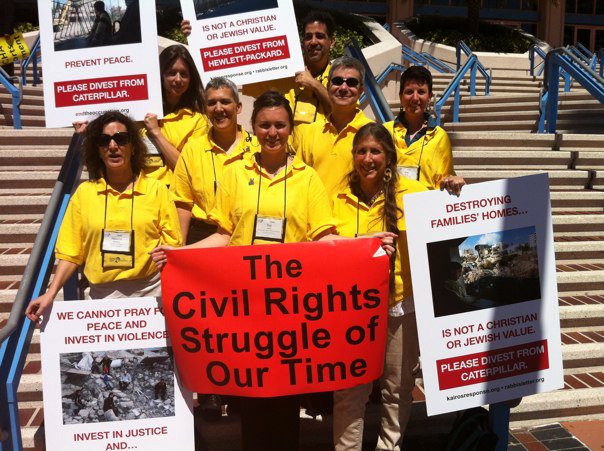
Jewish activists at the 2012 UMGC in Tampa, from left to right: Rebecca Vilkomerson (Executive Director of Jewish Voice for Peace), Anna Baltzer, (National Organizer, US Campaign to End the Israeli Occupation), Dalit Baum (Founder, “Who Profits?”), Rae Abileah (Co-director, CODEPINK Women for Peace), Sydney Levy, (Director of Advocacy, JVP), Rabbi Brant Rosen, Rabbi Lynn Gottlieb (Founder, Shomer Shalom Center for Jewish Nonviolence), Ariel Vegosen (Fair Trade and Media Social Justice Activist)

After the United Methodist divestment resolution was voted down at the UM General Conference last week, I’ve received my fair share of gloating responses from divestment opponents.  (Award for the most colorful goes to “Tzahal,” who sent in this attention-grabber: “BDS Fail, you f***ing KAPO”).

Actually, while many of us were disappointed by the final vote, I don’t view this as a fail. Not by a long shot.

First of all, as I reported from Tampa, I was deeply inspired to meet so many remarkable activists – Christians, Muslims, Palestinians, Israelis and American Jews – who constitute a new community of conscience working for justice in Israel/Palestine. This new interfaith/inter-ethnic coalition is growing rapidly and we are most certainly succeeding in raising conscience and awareness each time these kinds of resolutions are brought forth.

Beyond the final vote on this one specific resolution, we should consider it a success that these issues are increasingly being publicly discussed by our religious communities. My fellow activists and I had numerous conversations with delegates in the convention hall and we were heartened to engage so many people so honestly on this difficult issue. I was particularly gratified to speak with the numerous African delegates (who constituted 40% of the convention) who immediately understood the very real parallels to the legacy of colonialism in their own countries.

In addition, as my fellow activist Anna Baltzer recently pointed out, while the divestment resolution did not ultimately pass, the UM General Conference did adopt a resolution that among other things urged the US government to “end all military aid to the region,” called on all nations “to prohibit… any financial support by individuals or organizations for the construction and maintenance of settlements,” and “to prohibit… the import of products made by companies in Israeli settlements on Palestinian land.”

In BDS terms, this means that while the United Methodists did not affirm D (“Divestment”), they did support B and the S (“Boycott” and “Sanctions”).  No small statement, this.

I am coming away from this experience more convinced than ever that divestment is a critical tool in our quest for a just peace in I/P.  Over and over I’ve heard that divestment is an unduly harsh and polarizing tactic – and that the emphasis should be on positive engagement and investment. This, despite the fact that decades of political engagement by our government have failed miserably. This despite almost a decades worth of failed attempts by church groups to engage companies such as Caterpillar, Motorola Solutions and Hewlett/Packard – companies that literally profit from an oppressive, illegal occupation.

Add to this the testimonials of numerous Palestinian leaders who addressed “positive investment” by telling us it wasn’t charity they needed, but real, actual justice. In the words of Zahi Khouri, a prominent Palestinian Christian businessman and CEO of Coca-Cola Palestine:

It may shock you, but whenever there is a viable project identified in Palestine, we can raise the funds. We don’t need your financial help, your charity. What we need is to be able to operate freely. Divestment is the best, most immediate way that you can help us achieve that. We have been waiting for more than 40 years; we need action now.

Archbishop Desmond Tutu was so correct when he urged support of the divestment resolution by invoking MLK’s “Letter from a Birmingham Jail.” Then, as now, those who sought justice were counseled by religious leaders to “be patient” and to address the issue of oppression through engagement and non-confrontational tactics. Then, as now, there was an assumption that those who wielded corrupt power could somehow be “convinced” to give up their power voluntarily. Then, as now, this kind of patronizing counsel rings hollow and false in the ears of those who continue to suffer daily from ongoing injustice and persecution.

No, this was not a fail. There is a movement is building and this was only the beginning. Stay tuned. Similar resolutions will soon be considered in Pittsburgh at the General Assembly of the Presbyterian Church (USA) and the General Convention of the Episcopal Church in Indianapolis.

My new colleagues and I look forward to continuing this sacred work together.

Archbishop Tutu in Support of Methodist Divestment

Archbishop Desmond Tutu has just written a powerful op-ed in support of United Methodist church divestment.

I have no doubt that he will once again incur the wrath of the Jewish establishment – especially since he criticizes the 1,200 rabbis who recently signed a public letter opposing church divestment:

While they are no doubt well-meaning, I believe that the rabbis and other opponents of divestment are sadly misguided. My voice will always be raised in support of Christian-Jewish ties and against the anti-Semitism that all sensible people fear and detest. But this cannot be an excuse for doing nothing and for standing aside as successive Israeli governments colonize the West Bank and advance racist laws.

I recall well the words of the Rev. Martin Luther King Jr. in his Letter from a Birmingham Jail in which he confesses to his “Christian and Jewish brothers” that he has been “gravely disappointed with the white moderate … who is more devoted to ‘order’ than to justice; who prefers a negative peace which is the absence of tension to a positive peace which is the presence of justice; who constantly says: ‘I agree with you in the goal you seek, but I cannot agree with your methods of direct action;’ who paternalistically believes he can set the timetable for another man’s freedom. …”

King’s words describe almost precisely the shortcomings of the 1,200 rabbis who are not joining the brave Palestinians, Jews and internationals in isolated West Bank communities to protest nonviolently against Israel’s theft of Palestinian land to build illegal, Jewish-only settlements and the separation wall. We cannot afford to stick our heads in the sand as relentless settlement activity forecloses on the possibility of the two-state solution.

Hear, hear. His invocation of MLK’s “Letter from a Birmingham Jail” is apt and spot on.

I’m particularly appreciative of the Archbishop’s shout out to “the brave rabbis of Jewish Voice for Peace.”  It’s wonderful to see our letter of support garnering such widespread acclaim from so many quarters.  And it’s especially gratifying to be showing a decidedly different face of the Jewish community to our brothers and sisters in the Christian community over this issue.

The divestment resolution is scheduled to voted on by the UM Conference plenum tomorrow. Stay tuned.