Monthly Archives: December 2012

“Beneath the Blindfold” and Torture’s Tragic Legacy

“Zero Dark Thirty” hasn’t come to Chicago yet, so I can’t weigh in on the controversy surrounding its portrayal of the torture in the Bin Laden raid. Having read countless articles already, however (most notably the pointed criticisms by Glenn Greenwald), I can safely say it’s going to be pretty hard for me to overcome my prejudices going in. I certainly can’t imagine feeling sanguine about a film that gives the mistaken (and dangerous) impression that torture “works.” Still, I’ll do my best to keep an open mind – and offer my thoughts after I’ve actually seen the movie.

In the meantime, if you’re looking interested in a film that accurately and powerfully explores torture’s tragic legacy, check out “Beneath the Blindfold,” a new documentary by Evanston-based independent filmmakers Ines Somer and Kathy Berger. The film follows the lives of four torture survivors – a nurse from Africa, an actor from Colombia, A US Navy veteran from Chicago, and a physician from Guatemala – and documents their journeys as they attempt to build new lives, careers, and relationships. Despite the painful fallout from their experiences, we witness each of them becoming empowered to speak out and become public advocates for an end to torture.

“Beneath the Blindfold” has been garnering rave reviews and was just voted the Best Political Documentary of 2012 by the Chicago Reader. JRC was honored to host Ines and Kathy four years ago when they showed and discussed some footage of their work in progress. Now that the film in finished, we are thrilled to screening and discussion with the filmmakers on Saturday, January 19 at 7:00, in partnership with Percolator Films. (Click here for more info.)

Click here for Ines’ and Kathy’s recent interview with Jerome McDonnell on WBEZ’s Worldview.

Pay a Visit to the Gaza Kitchen

gazanfood

Now that the dust has cleared from Israel’s “Operation Pillar of Defense,” Gaza has sadly faded off the media radar screen once again. In the meantime, if you’re interested in some new essential reading about this significant but chronically misunderstood region, I have just the thing: a cookbook.

Yes, “The Gaza Kitchen: A Palestinian Culinary Journey” by Palestinian blogger Laila El-Haddad and Madrid-based writer/researcher Maggie Schmitt, newly published by Just World Books, is far and away the most important book I’ve read on Gaza in some time – and I’m not even a cook.

I’ve been a huge fan of Laila El-Haddad’s work for years. Her blog “Gaza Mom” provided me with my first real “beyond-the-headlines” insights into Gazan life and culture and I remain a devoted reader. For those unfamiliar with her work, her “Gaza Mom” anthology (also published by Just World Books) is the perfect introduction – if it leaves you hungry for more, then you must check out “The Gaza Kitchen.”

If you had any doubts that this was not your typical cookbook, the authors of “Gaza Kitchen” will explicitly lay them to rest for you in their Introduction:

“(This) is a hybrid sort of book: it is mostly a cookbook which recovers and compiles both traditional and contemporary elements of a rich and little-known cuisine. But it also attempts to do a little ethnography, a little history, a little political analysis. Cuisine always lies somewhere at the intersection of geography, history and economy. What makes it such a compelling subject is that it serves as a cultural record of daily life for ordinary people, traces of a history from below made palpable in something as evocative and delicious as a plate of food. Our hope in this book is to share this food with you and in so doing, something of the indefatigable spirit of the people we interviewed.

Indeed, history has indeed left an indelible imprint on Gazan cuisine. Gaza was historically an important station along the spice route, providing a link between southern Arabia and the Mediterranean – and eastern spices continue to shape Gazan cuisine to this very day. Food historian Nancy Harmon Jenkins illuminates this point vividly in the Foreword:

In many ways, food in Gaza is classic Palestinian, Middle Eastern cuisine, but it is unique with its own regional diversity, which includes a deep appreciation for the kick of red chili peppers, the zest of eastern spices (cardamom, cloves, cinnamon), and the soothing calm of fresh dill and dill seeds. You can see this immediately in Gazan-style falafel, those those delectably crisp, deep-fried morsels of ground chickpeas with spices, universal street food throughout the Middle East, from Turkey to the banks of the Nile. In Gaza, however, the addition of chopped chilis and fresh green dill gives a special twist to felafel. (Only in Greece is dill used to the delicious extent it is in Gaza.)

More recent history has also impacted Gazan cuisine. After the Nakba of 1947/48, Gaza was filled with a massive population influx of Palestinian refugees. As Jenkins points out, this event turned the newly-created Gaza Strip into “a repository of traditional foods and dishes from all over historic Palestine, a living legacy of the refugees who flocked here, driven from their homes in the north and the east.” All this to say that “The Gaza Kitchen” succeeds not only because of its delicious recipes, but through its illumination of the social-cultural-political context from which they emerged.

Moreover, sprinkled among the dishes the authors include brief essays that consistently debunk the image of Gazans as either “hapless objects of pity or as vicious objects of fear.” It is impossible to read this book and not be powerful affected by the lives of ordinary Gazans (notably Gazan women) who struggle to maintain their cultural dignity amidst an almost total socio-economic isolation from the rest of the world.

In addition to learning new recipes, we meet Gazans themselves: we eavesdrop on neighbors sharing Arabian fables while kneading dough for hulba (feungreek cake); we meet Fatema Qaadan, a widow and single mother who supports her family by rearing rabbits through the help of a local community center; and we learn about al-Muharrarat (“Liberated Lands”), a Hamas government-sponsored initiative that responds to blockade shortages through a variety of innovative agricultural projects.

The authors also do not flinch from exploring the political impact of Zionism on Gazans and their cuisine. One interesting short essay entitled “On Schnitzel,” points out that many Gazan fast food joints serve schnitzel – the classic pan-fried “Wienerschnitzel” brought to the region by European Zionist immigrants. The authors continue:

Now, with Gaza totally isolated, it is easy to forget that for decades thousands of Gazans went every day to work in Israel, that Israeli and Gazan entrepreneurs had partnerships, that both commerce and social relations existed, albeit on unequal footing. Adult Gazans remember this, and many speak admiringly of aspects of Israeli society or maintain contact with Israeli business partners, employers and friends. But for the enormous population of young people who were not old enough to work or travel before Israel sealed the borders in 2000, this is impossible. Though their lives are completely conditioned by Israeli political decisions, they have never laid eyes on a single Israeli person except the soldiers that have come in on tanks or bulldozers, wreaking destruction. And the generation of young Israelis to which those soldiers belong has likewise never met a single Gazan Palestinian in any other context. A terrible recipe for continued conflict.

I personally consider the legacy of Israeli cuisine to be a complex and painful one. Reading through this book through the eyes of an American Jew, I was constantly reminded that so many of the foods that we assume to be uniquely “Israeli” are in fact dishes that have long been indigenous to Palestinian culture.

It is certainly true that there is really no such thing as uniquely “Jewish food.” To be sure, Jews have lived (and cooked) in a myriad of societies and cultural contexts over the centuries – and our cuisine has traditionally emerged from a (pardon the expression) fusion of Jewish sensibilities with our respective host cultures. Given the circumstances of Israel’s creation, however, I have long been troubled by Israel’s appropriation of Palestinian/Mediterranean culture – and the assumption, for instance, that dishes such as hummous and felafel are somehow “uniquely Israeli.”

(An interesting case in point occurred when the Harvard Business School cafeteria recently featured an “Israeli Mezze station” with such “authentically Israeli” dishes as Cous Cous, Za’atar Chicken, Fattoush, and Tahini Sauce. In response, Lebanese Harvard graduate Sara el-Yafi posted an impressively researached and widely shared Facebook comment that sought to set culinary record straight once and for all. Also highly recommended reading).

For their part, El-Haddad and Schmitt have now created their own cultural reclamation project. It deserves to be read, served up and shared widely. Bravo to my good friends and colleagues at Just World Books for making this delicious document available to the world.

American Rabbis to Obama: Hold Netanyahu Accountable!

Obama-and-Netanyahu-rangling-over-Iran

The following letter was just released by Jewish Voice for Peace and will soon be delivered to the White House:

Dear President Obama,

We are writing this letter to you as American rabbis, cantors and rabbinical students, serving a wide range of Jewish communities.   We were dismayed to learn that, immediately following the recognition by the United Nations of observer status for Palestine, the government of Israel issued permits to begin development of two large tracts of settlement housing in highly contested areas in  East Jerusalem (E-1) and the West Bank (Maaleh Adumim.)

As you well know, these expansion permits are damaging not only to prospects for Palestinian self-determination but also for peace in the region.  We urge you in the strongest terms to use your full authority to oppose these expansions, which are illegal under international law and which also make impossible any hope of creating a viable Palestinian state in the West Bank.

We represent a growing voice within American Jewry which seeks an end to Israel’s occupation of the West Bank and its stranglehold by blockade of the people of Gaza.  We believe that the aggressive expansion of settlements in the Occupied territories constitutes a deliberate strategy to obstruct a peaceful resolution to the conflict between Israel and Palestine.  We believe further that the United States, as the primary global source of financial and political support for the  Israeli government, has an obligation to hold the Netanyahu government accountable for these actions, which thwart the possibility of peaceful resolution of the conflict.

It is no longer the case — if it ever was — that the Jewish community in the United States  is unified in its support of the policies of successive Israeli governments, which have sought to create “facts on the ground” that obstruct the hopes of independence and sustainability for the Palestinian people.  Absent active intervention by the United States and other nations, Israel will surely continue to implement these destructive policies.

As leaders of the American Jewish community, we join you in hope for a just peace for all the peoples of the region.  Please know that you have our strong support for demanding that the government of Israel reverse for this latest action and for all that you can do to lead the way to a fair and sustainable resolution.

Yours sincerely,

Rabbi Margaret Holub

Rabbi Brant Rosen

Rabbi Brian Walt

Rabbi Lynn Gottleib

Rabbi Joseph Berman

Rabbi Laurie Zimmerman

Rabbi Elizabeth Bolton

Rabbi Julie Greenberg

Rabbi Borukh Goldberg

Rabbi Eyal Levinson

Rabbi David Mivasair

Rabbi Rebecca Lillian

Rabbi Rachel Barenblat

Alana Alpert

Cantor Michael Davis

Rabbi Michael E. Feinberg

Rain Zohav

Rabbi Zev-Hayyim Feyer

Jessica Rosenberg

Ken Rosenstein

Rabbi Shai Gluskin

Rabbi Rebecca Alpert

Ari Lev Fornari

Rabbi Art Donsky

Rabbi Jeremy Milgrom

Rabbi Linda Holtzman

Rabbi Leonard Beerman

Rabbi Alexis Pearce

Rabbi Sarra Lev

David Basior

On the Killing of Children and the Price of Our Freedom

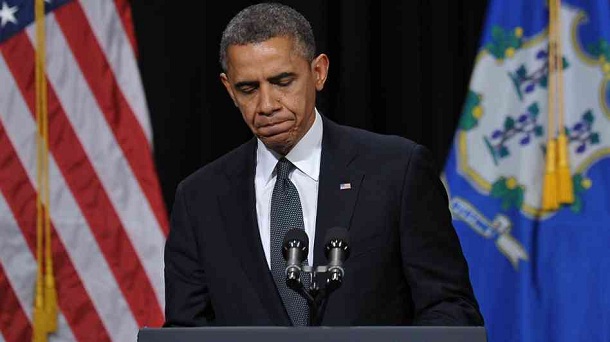
obama-newtown-speech

Last night Hallie and I watched President Obama’s eloquent and moving speech at the interfaith prayer vigil for those killed in the Sandy Hook Elementary School shootings. About halfway through, when Obama discussed our nation’s collective responsibility to our children, a certain cognitive dissonance popped into my head – a pesky, but familiar distraction that remained with me for the rest of the speech.

Obama concluded by reciting the first name of each of the 20 children killed. When it was over we both sat silently looking at the screen. “Don’t say it, just don’t say it” I thought to myself.

“What did you think?” she finally asked me.

“Very moving” I said, “but..”

“But what?”

“What the hell,” I thought to myself, “go ahead and say it…”

“I don’t know, it’s hard for me to listen to Obama talk about our responsibility to keep our children safe knowing that he personally approves the drone strikes that kill hundreds of innocent children in other countries.”

Hallie rolled her eyes at me. But before she could say “Oh my God, can’t you give it a rest just this once?” I said it myself: “I know, I know, I can’t help it..”

Over the weekend, I thought of a certain moment in the Michael Moore documentary “Bowling for Columbine.” Toward the outset of the movie, Moore pointed out that the Columbine shooting took place during the largest one day bombing by the US in the Kosovo war.  He showed news footage from that day which showed the bloody aftermath of the bombing that killed numerous civilians, including those in a local hospital and primary school. The news footage also included President Clinton telling reporters that the US military was trying to “minimize harm to innocent people.”

Then Moore flashes the words “One Hour Later” and there’s Clinton again: “We all know there has been a terrible shooting at a high school in Littleton, Colorado.” Moore’s point was clear: there is an important connection to be made between our killing of Serbian civilians and the killing of students in Columbine.

So too, I believe there is a similar connection between the killing of innocent children in Newtown to the killing of innocent children in Pakistan.  Both are the product of a uniquely American culture of violence, insecurity and fear – and both are the consequences of a national penchant for manufacturing, selling and profiting from ever more sophisticated weapons of death.

Might it be that our Constitutional right to bear arms reflects a national sense of entitlement to create and sell weapons and to use them wherever and whenever we see fit?  And if so, might we be ready to limit this right for the sake of our children both here and around the world?

In this regard, I think the most telling moment in Obama’s speech was when he asked the rhetorical question:

Are we prepared to say that such violence visited on our children year after year after year is somehow the price of our freedom?

Would that our President would ask himself that very question before he approves his next drone strike.

(Please read this recent report by the Bureau of Investigative Journalism that determines over 160 children have been killed in seven years by US drone strikes in Pakistan’s tribal areas.)

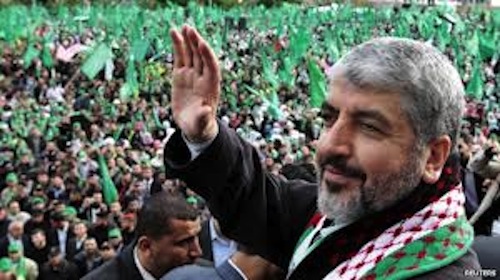
Khaled Meshaal’s Speech: Actions Speak Louder

Khaled-Meshaal

I’ve just finished reading Hussein Ibish’s excoriation of Hamas leader Khaled Meshaal’s victory speech in Gaza last week, in which he accuses Meshaal of “unhelpful escalating rhetoric” against Israel. Along the way, Ibish dishes out a fair amount of rhetorical hyperbole himself, calling Meshaal’s speech “one of the most cynical, damaging and dangerous speeches in the history of the Palestinian national movement” and “profoundly toxic from every perspective.”

It’s certainly true that Meshaal’s speech, which he delivered as he made his first-ever visit to Gaza on the occasion of the 25th anniversary of Hamas and the end of Israel’s latest military campaign, Operation Pillar of Defense, struck a note of resolute defiance.

Here’s a translated excerpt from an Al Jazeera report:

“Palestine is our land and nation from the [Mediterranean] sea to the [Jordan] river, from north to south, and we cannot cede an inch or any part of it,” he said. “We fight Zionists, not Jews. We fight whoever occupied our land, regardless of religion … Statehood will be the fruit of resistance, not negotiations,” Meshaal told cheering fans.

Hamas does not belong to the PLO, but Meshaal said a year ago that it and other factions were “on the path to joining” it.

While this is certainly strong – even incendiary – stuff, are we really to believe it was “one of the most cynical, damaging and dangerous speeches in the history of the Palestinian national movement?”

First of all, let’s take a closer look at the context in which this speech occurred. Shortly before Meshaal’s visit, Israel had leveled a devastating military assault against Hamas in Gaza. During two weeks of fighting, Hamas sent numerous missles into Israel – some of which landed close to major population centers in Tel Aviv and Jerusalem. The violence was eventually quelled through a US/Egypt brokered ceasefire. 

In other words, this is what it took to elicit the US’s active engagement with Israel and Palestine. Years of IDF crushing of Palestinian non-violent demonstrators have garnered nothing but silence. The PA’s attempt to gain recourse through the UN was met with active opposition from the Obama administration. It was only the armed resistance of Hamas in Gaza that managed to bring Hilary Clinton to the region and actively engage with the Israelis and Palestinians. In the end, what kind of message does that send to the Palestinian people?

So yes, Khaled Meshaal, told a cheering crowd that “statehood will be the fruit of resistance, not negotiations.” But should we really be so surprised? While negotiations have proved disastrous for the Palestinian people, armed resistance seems to be the only way they ever catch the attention of the international community.  Did Ibish really think Meshaal was going to get up on the podium and call for a resumption of the peace process?

Although those who consider Hamas to be an unrepentant “Islamist” terror organization would likely scoff, Meshaal and other Hamas leaders have in the past made noteworthy overtures that indicated a willingness to engage in a US-led peace process (albeit fundamentally different than the one embodied by the follies of Oslo.)  Most notably, following President Obama’s Cairo speech (which signaled at the time, a different American attitude toward the Muslim world), Meshaal responded with an important 2009 policy speech in which he welcomed a “change of tone” from Obama.  He went on to attribute this new American tone as the fruit of the “stubborn steadfastness of the people of the region, while resisting in Palestine, Lebanon, Iraq and Afghanistan” and stressed that it was not merely a change of tone but a change of policy that was needed to make progress in the region.

Meshaal added that Palestinians would judge the US not by its words but by its actions, which would have to “begin with reconstruction of Gaza and the lifting of the blockade, lifting the oppression and security pressure in the West Bank, and allowing Palestinian reconciliation to take its course without external pressures or interference.”

Whether or not one believes these overtures were genuine, we’ll never really know. Meshaal’s opening went utterly unregarded by the Obama administration, who refused to deal with Hamas and chose to maintain its support of Israel’s crippling siege of Gaza.

Given this history, are we really to believe, as Ibish would have it, that Meshaal’s recent speech is one of the most “cynical, damaging and dangerous speeches” Palestinian history?  Or is it merely a reflection of its time – a moment in which the Obama administration has thoroughly squandered its own stated desire to usher in a new era of engagement in the Middle East?

In the end, Meshaal’s speech was simply that – a political speech. And history (particularly Middle East history) has shown us time and again that parsing a politicians words are a notoriously bad way to predict what he/she will eventually agree to. In the words of the very insightful Israeli blogger Noam Sheizaf:

The bottom line is that none of this matters. It’s all a huge red herring. Nothing a leader says now determines the way he will act in the future. Public statements are important only to a limited extent and agreements depend on the continued willingness of both sides to uphold them. As long as both parties feel that they benefit from a certain status quo, or that their interests are better served than by any alternative, the deal they reach could hold. If one party is coerced into signing but doesn’t have its interests and desires addressed, all the nice declarations won’t matter. Twenty years after the historic peace deal that should have ended the Israeli-Palestinian conflict but didn’t, you’d think that people would get it.

The arguments about the meaning and importance of the Hamas charter are all but identical to the decade-long debate over the PLO charter. How much effort and time was put into forcing Arafat to change it, and how little did it matter when negotiations collapsed in Camp David and violence returned. The same goes for today: Given the right pressure, a certain Palestinian leadership could be made to promise Israel anything. Yet none of it would matter if you don’t address the fundamentals of the conflict: The occupation, the refugees, the holy sites, the settlements, the access to land and to water. The leaders would change their minds and if they don’t new leaders (“more extreme”) will come. Reality will prevail over rhetoric.

So let’s be honest. Meshaal didn’t mince his words –  but in the end it is actions that ultimately matter.  And in this regard, Meshaal’s words were considerably less damaging to the cause of the Palestinian national movement than the Netanyahu government’s announcement that it would build 3,000 more units in the E1 region, which would successfully cut the West Bank in half and cut it off completely from East Jerusalem, ending any reasonable hope for a viable two state solution. Sadly, the only response this deeply damaging action elicited from the Obama administration were words such as “counterproductive” and “we urge restraint.”

To my mind these kinds of words are considerably more dangerous to the cause of a just peace in Israel/Palestine.

Marching in Solidarity: A Guest Post by Hallie Rosen

Gaza March

Guest post by Hallie Rosen

Like almost every Jew, I too have a complicated relationship with Israel.

Israel has always been an important part of my Jewish identity. Brant and I met doing Israel activism on campus at UCLA and we spent almost two years in Israel before we were married. I’ve worked in the organized Jewish community for almost twenty years, first at the Anti-Defamation League and more recently at the Illinois Holocaust Museum.

And like Brant, my views on Israel/Palestine have evolved. While I admire Brant’s courage regarding the Israel/Palestine issue, I haven’t felt completely comfortable taking the same kinds of public stands that he does. I agree with many of Brant’s viewpoints, but I admit there have been times I have felt uncomfortable with his being so public with his views – my ingrained impulse against airing Israel’s “dirty laundry.”

While I have read his blog and his book, and we have had many conversations about his activism and the general political situation in Israel/Palestine, I have never personally taken such a public stand on the issue until November 19, when I marched with Brant at a Chicago rally protesting Israel’s military actions in Gaza.

It was not a major decision on my part. I was very upset by the news out of Gaza, so when Brant invited me to join him in the march/rally, I readily agreed.  Since I work near the rally site and it took place at the end of the day, it was a simple matter to walk over and join the group as people gathered at the Federal Plaza.

My first impression was surprise at how many young families were in attendance. I expected to see primarily college age students, but I was struck by the sight of many parents with school aged children and a fair amount of strollers.  Since Brant was wearing a kippah, people knew that he was Jewish and several people came up to him to thank him for attending the rally and showing his support.  They didn’t necessarily know who he was, but it clearly meant a lot for see a Jew walk with them.  For me, it underscored that this was an issue of conscience for all peoples – not just Palestinians.

I expected to see protest posters and I braced myself for anti-Israel and anti-Jewish sentiments.  From my ADL days, I knew that these kinds of protests can easily become an opportunity for fringe elements to chant anti-Semitic slogans.

But that didn’t happen.  All of the messages were strong, but on target. As the group of about 700 people walked peaceably through the Loop during rush hour, there was chanting  but also simple non-political conversations among the marches – about shopping, uncomfortable shoes, upcoming holidays, etc.  I only saw one incident of an onlooker, who provoked some of the crowd – the police quickly subdued him and we continued on our way. As a relative newcomer, I didn’t fully feel ready to join the chanting. Perhaps I’ve not fully come to grips with what it means to be a Jew in solidarity with Palestinians.

We gathered once again after the walk to listen to speakers. Everyone was on message, asking for sanctions from the US, end of violence and settlement building, requesting a just peace, etc. When Brant spoke, he received a strong enthusiastic reception from the crowd – particularly when he was introduced as a rabbi.

As the crowd dwindled, we walked to the train station and back home. Later that night, I watched the news coverage of the rally and was surprised, at how violent the images were.  The piece included edited snippets of protestors chanting and because there were kafiyyahs and head coverings, it seemed that the news media was only interested in showing us the familiar images of “angry Arabs.”

The news report failed to convey the racial and religious diversity of the crowd – and there were none of the mothers and young children with whom I had just spent a few hours marching.  Once again I became profoundly aware of the power of stereotypes – and to a greater extent, of racism and how the images that we see on a regular basis prejudice our views and shape our opinions.

I also became aware of how important it is to step outside of one’s own comfort zone and find common cause with those whom you’ve previously assumed to be your enemy. In the end, marching for justice was for me an affirmation of our common humanity.

Book Readings (and a Legislative Visit) in Baltimore/DC

helenasarahbrant

Helena Cobban (left), Sarah Grey and me at the FCNL office

Had a wonderful whirlwind visit in Baltimore/DC, highlights included book readings in Baltimore, DC and Georgetown and a visit with the National Friends Legislative Committee to Senator Dick Durbin’s office to encourage him not to support a Senate defense authorization bill that sought to punish Palestinians for seeking non-member observer status at the United Nations. Thankfully, the amendment never came up for a vote.

While in DC, I also had the pleasure of being interviewed by blogger/journalist Mitchell Plitnick for Inter Press Service News Agency. (The full version appears on Mitchell’s blog.)

A snippet:

To create political power, leveraging people power is the best method, and historically, this has been shown to be the case. The fact that Israel is reacting so harshly against it shows its potential. When Hillary Clinton says 3000 new settlements are “not helpful,” that doesn’t get Israel’s attention. But when (Jewish Voice for Peace), (Students for Justice in Palestine) and church groups move to get corporations and holding companies to divest from Israel, that’s front page news in Israel. That is a sign that this has a great impact, when used in a smart and concerted way.

One of the big pleasures of the trip was finally getting the chance to meet Just World Books publisher Helena Cobban and my editor, Sarah Grey, both of whom have thoroughly become my kindred spirits.

Some more pix from my trip:

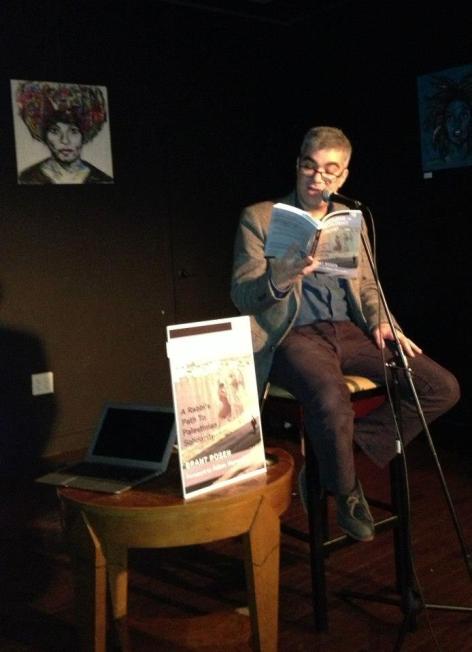
readingb&P

Book reading at Busboys and Poets, Washington DC (under the watchful gaze of Angela Davis)

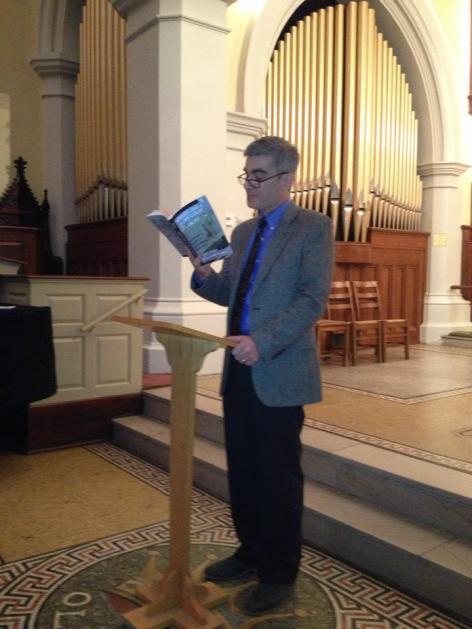
readinggeorgetown

Book Reading at St. John’s Episcopal, Georgetown

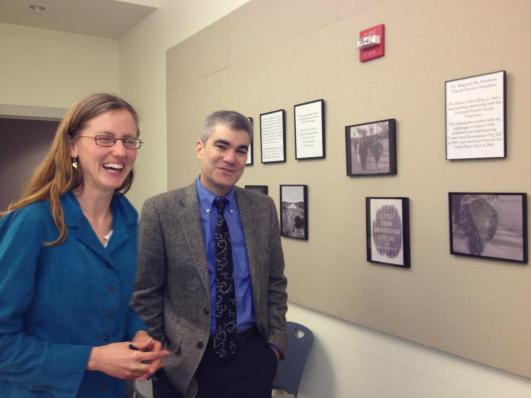
With Kate Gould, Legislative Associate for Middle East Policy at FCNL