Monthly Archives: July 2013

Shalom Rav Now On Sabbatical!

indexYou may have noted that my posts on Shalom Rav have gotten fewer and more far between of late. There are many reasons for this, but the long and short of it is that I’ve decided to take a brief hiatus from my Shalom Rav postings – at least until after the Jewish High Holidays.

But don’t fret – in the remote possibility that you absolutely need to read my writing on a regular basis, you should know that I’m still posting daily poetry on my other blog, Yedid Nefesh (yes, my “Psalm a Day” project is still going strong!)  So please feel free to check in and, as always, to add your thoughts and comments.

All the best for a restful and renewing summer.

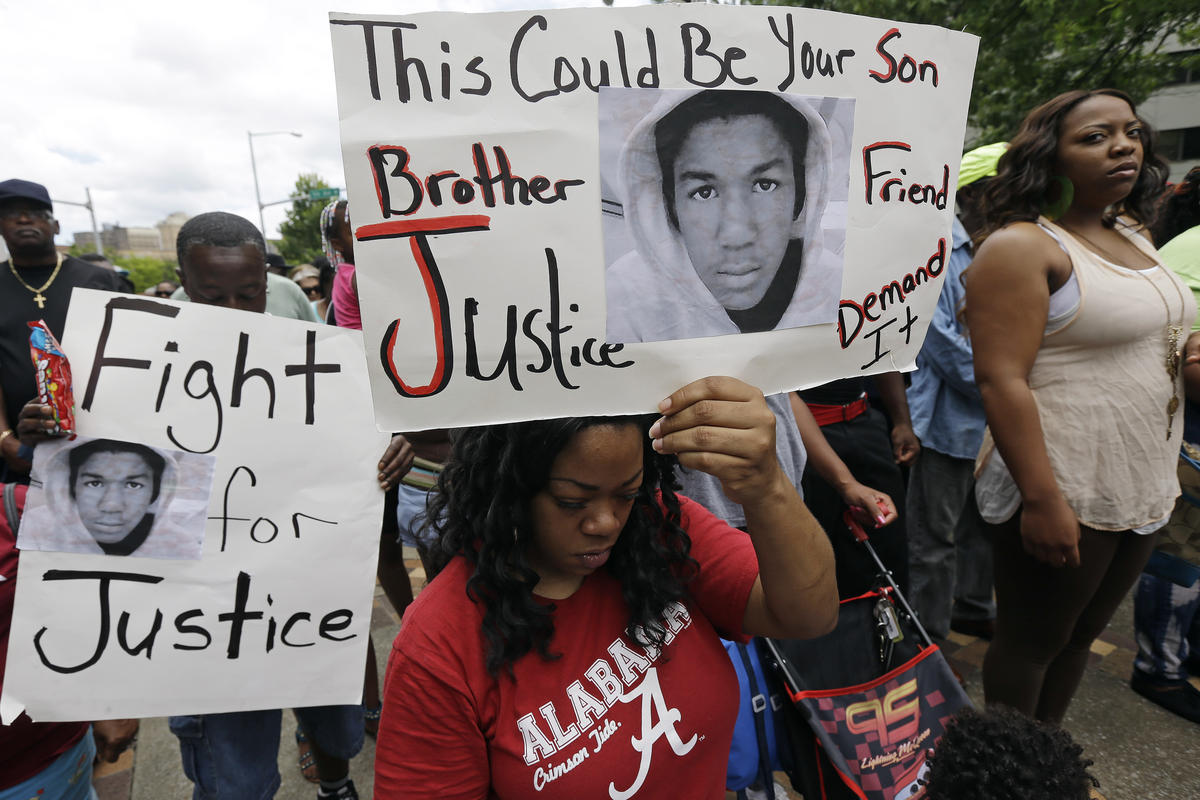
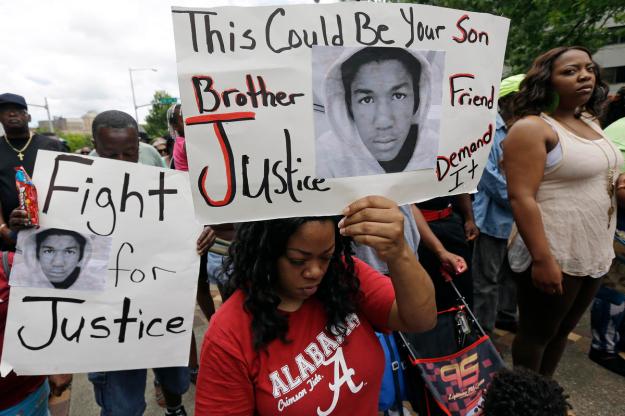
On the Trayvon Martin Verdict and the “National Conversation”

photo credit: Boston Herald

photo credit: Boston Herald

A few thoughts in the wake of Tisha B’Av yesterday…

According to Jewish tradition the Second Temple was destroyed because of the Jewish people’s sinat chinam – or “baseless hatred.”  On Tisha B’Av we affirm that isn’t enough to simply mark our collective tragedies and mourn our collective losses. We must honestly own the ways our own prejudices and intolerance have contributed to these losses.

I was particularly mindful of this spiritual insight this year, as Tisha B’Av followed directly on the heels of the Trayvon Martin verdict and the communal soul-searching it sparked on racism in America. Indeed, more than once over the past several days we’ve heard politicians and pundits call for yet another “national conversation on race.”  Witness Attorney General Eric Holder’s post-verdict remarks:

Independent of the legal determination that will be made, I believe that this tragedy provides yet another opportunity for our nation to speak honestly about the complicated and emotionally-charged issues that this case has raised. We must not – as we have too often in the past – let this opportunity pass.

This isn’t the first time, of course, that we’ve heard the call for such a conversation. I distinctly remember President Bill Clinton making just such a call back in 1997.  It was actually considered fairly controversial at the time  – sad to say we haven’t made much headway in the conversation over the past 17 years.

I don’t mean to be facetious about this. Part of the problem, I think, is that I’m not sure anyone really knows what something as monumental as a “national conversation” would actually look like, particularly on a subject as profoundly charged as race.  Though I hesitate to say so, in some ways I think this call does more harm than good. While I do believe in the importance of dialogue, I can’t help but think that the constant call for communal conversation on race mostly serves to help us to feel better while we dodge the deeper infrastructural realities of racism in America.

While we regularly call for “conversation,” for instance, hard facts such as these continue to go chronically unaddressed:

– Prison sentences of black men are nearly 20% longer than those of white men convicted of similar crimes;

– While people of color make up about 30 percent of the United States’ population, they account for 60 percent of those imprisoned;

– While people of color are no more likely to use or sell illegal drugs than whites, they have higher rate of arrests;

– Voter laws that prohibit people with felony convictions from voting  disproportionately impact men of color.

And the list of shameful statistics goes on and on…

This litany, quite frankly, is nothing short of institutional sinat chinam. And at the end of the day, its going to take much more than dialogue it we’re going to take down the patently unjust and racist laws that oppress people of color in our country.  In this regard, I’d claim national conversation is only truly valuable inasmuch as it leads to real socio-political transformation and change.

So where do we start?  Why not with the “Stand Your Ground” laws, one of which egregiously allowed a man go free after stalking and shooting an unarmed African-American teenager?  It’s critically important that we know that history of laws such this, many of which have been long been pushed through legislatures by the corporate-funded American Legislative Exchange Council (ALEC) and have subsequently been spreading across the country:

Ostensibly a network of state legislators, ALEC is a shadowy, $7 million-a-year organization funded by powerful corporate interests like the Koch brothers, Big Oil, and Big Tobacco.  The NRA has been a longtime financial supporter and served as the corporate co-chair of the ALEC Criminal Justice Task Force, voting with legislators on “model” bills.  Through ALEC, special interests groups like the NRA push their dream legislation through state legislatures. Wal-Mart was corporate co-chair of ALEC task
force approving FL’s “Shoot First” bill as a “model” for other states. The NRA was the next co-chair of that ALEC committee.

According to PR Watch’s Brendan Fischer, ALEC’s influence has has been behind other racially discriminatory legislation as well:

ALEC’s connections to those issues are not limited to Stand Your Ground. The group was instrumental in pushing “three strikes” and “truth in sentencing” laws that in recent decades have helped the U.S. incarcerate more human beings than any other country, with people of color making up 60 percent of those incarcerated. At the same time ALEC was pushing laws to put more people in prison for more time, they were advancing legislation to warehouse them in for-profit prisons, which would benefit contemporaneous ALEC members like the Corrections Corporation of America.ALEC has also played a key role in the spread of restrictive voter ID legislation that would make it harder to vote for as many as ten million people nationwide — largely people of color and students — who do not have the state-issued identification cards the laws require.

If you’d like to engage in action as well as conversation, you can click here to sign a petition urging Attorney General Holder to “review the application of Stand Your Ground laws nationwide and the importance of their repeal.”

And if you live in or around Chicago, I encourage you to join me and other activists of conscience at the ALEC Exposed Protest Rally, which will take place outside ALEC’s 40th Anniversary Conference on Thursday, August 8 at 12 noon.

I hope I’ll see you there.

Stand in Sacred Solidarity with Imprisoned Hunger Strikers

This year, the Islamic fast of Ramadan (which began Monday night and will last until August 7) will serendipitously coincide with the Jewish fast of Tisha B’Av (Monday night July 15 to Tuesday, July 16). Given this harmonic interfaith convergence, I’ve been thinking more about the function of fasting as a time honored tactic of sacred protest – and in particular as a powerful act of civil disobedience. And so in honor of both of these sacred fasting festivals, I’d like to spotlight several ongoing fasts/hunger strikes that I believe are profoundly worthy of our attention and solidarity:

At Guantanamo Bay, many prisoners have been engaged in a longtime hunger strike to protest their conditions and their indefinite confinement. Lawyers for prisoners say the most recent strike began in February; according to the military, 106 of the 166 detainees met criteria to be declared hunger strikers (a definition that includes missing nine consecutive meals):

Prison medical officials have determined that 45 of the prisoners have lost enough weight that they can be fed liquid nutrients, by force if necessary, with a nasogastric tube to prevent them from starving themselves to death. The U.S. military intends to feed all prisoners, including those on hunger strike, before dawn and after sunset during the Muslim holy period of Ramadan to accommodate the men’s religious practices. Military officials have said the feeding process is not painful and only done to prevent any of the men from dying, not as punishment.

A recently released video (above) certainly belies the military’s claims.  In an act of what can only be called deeply courageous solidarity, rapper/actor/activist Yasiin Bey (aka Mos Def) subjected himself to the force-feeding to demonstrate the grievous nature of this procedure. I will warn you that it’s not at all easy to watch. I’ll let you judge for yourself as to whether this act constitutes torture or cruel/unusual punishment, but as far as I’m concerned, this video is worth a thousand words.  On this point, it’s worth nothing that a US federal judge ruled yesterday the practice appears to violate international law – and that President Obama can resolve the issue.

Click here to sign a petition that condemns the use of force-feeding, and demand that President Obama help end the hunger strike by addressing the legitimate grievances of detainees.

Here at home, 30,000 prisoners in California prisons began a hunger strike yesterday in what has been described as possibly “the largest prison protest in state history.”  The protest, organized by a group of inmates held in segregation at Pelican Bay State Prison demands an end to state policies that allow inmates to be held in isolation indefinitely, in some cases for decades.  While the UN has determined solitary confinement for longer that 15 days constitutes torture, many prisoners in California state prisons have languished in solitary for 10 to 40 years.

In California, there are nearly 12,000 prisoners who spend 23 of 24 hours living in a concrete cell smaller than a large bathroom. The cells have no windows, no access to fresh air or sunlight. People in solitary confinement exercise an hour a day in a cage the size of a dog run. They are not allowed to make any phone calls to their loved ones or talk to other prisoners.  They are denied all educational programs, and their reading materials are censored.

Yesterday, the Prisoner Hunger Strike Solidarity Coalition released a lengthy statement that details the history of this issue and explains why the decision was made to begin a hunger strike:

Family members, advocates, and lawyers will announce their support for the peaceful hunger strike and job actions beginning today throughout the California prisons starting on Monday July 8.   Prisoners have been clear since January that they are willing to starve themselves unless the California Department of Corrections and Rehabilitation (CDCR) agrees to negotiate honestly about their demands.

Click here to support the California prison hunger strikers and to sign a personal “Pledge of Resistance.”

I’ve also written extensively in the past about Palestinian prison hunger strikers who have long been engaged in nonviolent resistance to Israel’s illegal practice of administrative detention. While these protests consistently and egregiously fly under the radar of the mainstream media, they demand our attention – particularly as a response to the chronic question “where are the Palestinian Ghandis?”

Click here to learn more about the most current Palestinian hunger strikers. This link also includes the names/addresses of Israeli government, military and legal authorities to whom you can write to protest the prisoners’ treatment and demand their release.

May our respective fasts bring us closer to empathy and solidarity. As we say in my spiritual tradition: Baruch matir asurim – Blessed is the One who liberates the imprisoned.

UNITE HERE and Hyatt Reach an Agreement!

dscn95343

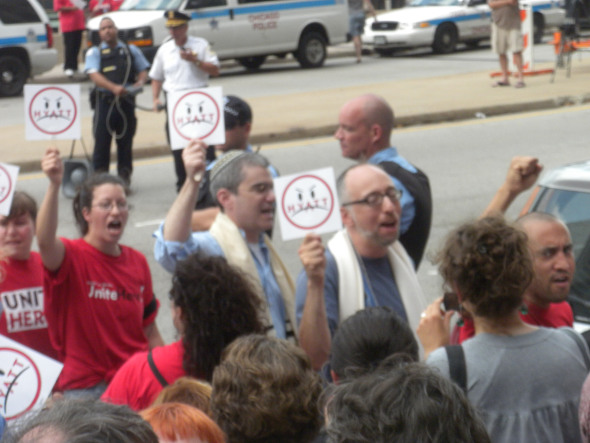
Readers of this blog know I’ve long stood in solidarity with Hyatt hotel workers during their four year struggle for justice. (If you’d like a little history, you can read about it here, here, here and here, for instance.)

I’m thrilled to now learn that the Hyatt workers’ union, UNITE HERE has reached a national agreement with Hyatt. According to a union press release which came out yesterday, both UNITE HERE and Hyatt have hailed the agreement as “a positive step:”

The agreement will go into effect upon the settlement and ratification of union contracts by Hyatt associates in San Francisco, Honolulu, Los Angeles, and Chicago.  Pending associate approval, the contracts will provide retroactive wage increases and maintain quality health care and pension benefits.  The proposed new contracts would cover associates into 2018.A key provision of the agreement establishes a fair process, which includes a mechanism for employees at a number of Hyatt hotels to vote on whether they wish to be represented by UNITE HERE.  As part of the accord, upon ratification of the union contracts, UNITE HERE will end its global boycott of Hyatt.

D. Taylor, the president of UNITE HERE, said, “We look forward to a new collaborative relationship with Hyatt.  This agreement shows that when workers across the hotel industry stand together, they can move forward, even in a tough economy.  Both organizations deserve credit for working out this constructive step forward.”

“We are delighted that our associates in Chicago, Los Angeles, San Francisco, and Waikiki will have contracts and the pay raises that go with them,” said Doug Patrick, Senior Vice President, Human Resources for Hyatt.

The Chicago Tribune has reported that according to the agreement, about 5,000 workers would see pay and benefits packages rise an average of 4 percent a year. Regarding the issues of job safety and outsourcing (two key issues for the union), Chicago Public Radio reports “the new contracts will include no new safety language but will bring some outsourced work back to Hyatt.”

I’m delighted for the workers of Hyatt and it has been my honor to stand with them during the course of this long and difficult struggle. One important takeaway for me is the importance and effectiveness of boycotts as an essential tool of the labor movement. In particular, I hope organizations will increasingly insist upon protective language in their hotel contracts so that they can honor boycotts without penalty.

This campaign has also opened my eyes to the hard truth that labor justice is nowhere near the priority in the Jewish community that it once was. Indeed, the Hyatt boycott represented an important test to my community – and it is clear to me that there is much work left to be done. I wrote as much in the Jewish Forward last year when it was revealed that the Religious Action Center of Reform Judaism had signed contracts with boycotted Hyatt Hotels for their conventions:

It is simply not enough to invoke the International Ladies Garment Workers Union and offer bland statements about the historic role Jews played in building the American labor movement. True solidarity means understanding that the struggle ever continues. And that there are flesh and blood “stakeholders” in our own day who call on us to support the sacred cause of worker justice.

Congratulations to UNITE HERE and to all those who stood in solidarity with the workers of Hyatt. And now the struggle continues…