Monthly Archives: April 2016

On Passover, Israel and Demographic Threats

2016_0427rrisr_

(Image: Jared Rodriguez / Truthout)

Crossposted with Truthout

The weeklong Jewish festival of Passover is coming to a close, but like many Jews around the world I’m still digesting the myriad questions, answers and discussions that ensued as we retold the biblical story of the Exodus at our seder. While it’s a story our community returns to over and over again, I’m continually astonished at the ways it provides a frame for understanding struggles for liberation past and present.

This year, I’ve been contemplating one aspect of the story in particular: when a new pharaoh arises over Egypt “who did not know Joseph.” We immediately learn in no uncertain terms that this new ruler was considerably more xenophobic than his predecessor:

And (Pharaoh) said to his people, “Look, the Israelite people are much too numerous for us. Let us deal shrewdly with them, so that they may not increase; otherwise in the event of war they may join our enemies in fighting against us.” (Exodus 1:8-9)

To use contemporary parlance, Pharaoh clearly views the Israelites as a “demographic threat” to the Egyptians.

The demographic threat meme, of course, has been played out countless times since the age of the pharaohs. It has certainly been a deeply woven thread in the fabric of American culture from our very origins. To cite but one example: Centuries before Donald Trump started railing against Mexican “criminals” and “rapists,” Benjamin Franklin wrote a 1751 essay in which he bemoaned the influx of “Palatine Boors” into the colonies who would “shortly be so numerous as to Germanize us instead of our Anglifying them, and will never adopt our language or customs, any more than they can acquire our complexion.”

So yes, as an American, I can’t read these words from the Exodus story without connecting it to an ignoble aspect of my own country’s legacy — one that is all too real even today.

And as an American Jew, I can’t help but connect it to another country that also purports to act in my name.

Indeed, ever since Israel’s establishment, Zionist leaders knew well that the future Jewish state would only be “viable” if it could create and maintain a demographic Jewish majority in historic Palestine. In the late 19th century, this must surely have seemed like a tall order, since Jews constituted but 2 to 5 percent of the population. By 1947, following decades of Zionist colonization and Jewish immigration, their number had swelled to 32 percent. Under the UN-sponsored partition plan, the percentage of Jews allotted to the new Jewish state would have been 55 percent.

During the 1948 war — known as the War of Independence by Zionists and the Nakba (“catastrophe”) by Palestinians — the issue of demographics was solved through the forced expulsion of Palestinians from their homes and Israel’s refusal to allow them to return. However, the demographic stakes were raised once again in 1967, when Israel conquered the West Bank and Gaza and began a military occupation that exists to this day.

In 2010, Jews officially become a minority population from the Jordan River to the Mediterranean Sea; around the same time, it was determined that the Jewish majority in Israel proper was slowly diminishing. For some time now, Zionists have been warning that the Palestinians’ birth rate poses a “demographic threat” to the future of the Jewish state.

Perhaps the most surprising aspect of this rhetoric is that it doesn’t only come from Israel’s far right, but from liberal Zionists, who use the demographic argument to advocate for a two-state solution. Witness, for instance, the words of J Street executive director Jeremy Ben-Ami:

When it comes to Israeli-Palestinian peace, the two-state solution and the inexorable demographic threat to Israel’s future as a democratic state that remains the homeland for the Jewish people, our position is the same as that of the Israeli government, the Obama administration and the vast bulk of the American Jewish community.

Leaving aside the issues of whether or not the two-state solution actually is the policyof the Israeli government, let’s unpack this statement for a moment. The liberal Zionist argument for a “democratic Jewish state” is predicated on a view of Palestinians as a “demographic threat.” As an American, if I referred to any other ethnic group in this country with such a term, I would surely be viewed as a bigot or a racist. But as a Jew, I can refer to Palestinians with this epithet and still remain a member in good standing of the liberal peace camp.

Thus the inherent contradiction of liberal Zionism: democracy and demographic engineering simply do not go hand in hand. At the end of the day, there is nothing liberal about supporting an ethno-national project predicated upon the identity of one group over another. The late Meir Kahane, revered by Israel’s ultra right, loved to make liberal Zionists squirm by repeatedly articulating this point: “A western democracy and Zionism are not compatible. You can’t have both.”

Kahane’s solution, of course, was “forced transfer” of the Palestinian population. The current government of Israel is accomplishing this goal through more subtle means:home demolitions, land expropriation and the revocation of Palestinians’ residency and citizenship. In truth, Israel has been dealing with its demographic threat under cover of US support for years, all the while claiming the mantle of “the only democracy in the Middle East.”

This, along with its massive settlement expansion has brought Israel’s demographic problem home to roost. The real decision before them is not between a one-state or two-state solution, but between two one-state solutions: an apartheid Jewish state or one state of all its citizens, regardless of religion or ethnicity.

As I watch this tragic process unfold this Passover, I find myself returning to the universal lesson this festival imparts on the corrupt abuse of state power. Although the Exodus story is considered sacred in Jewish tradition, it would be a mistake to assume that the contemporary state of Israel must be seen as equivalent to the biblical Israelites.

On the contrary, any people who suffer under oppressive government policies are, in a sense, Israelites. And any state — even a Jewish state — that views a people in its midst as a demographic threat can become a Pharaoh.

For Passover: “Your Child Will Ask”

europe-migrants-hungary

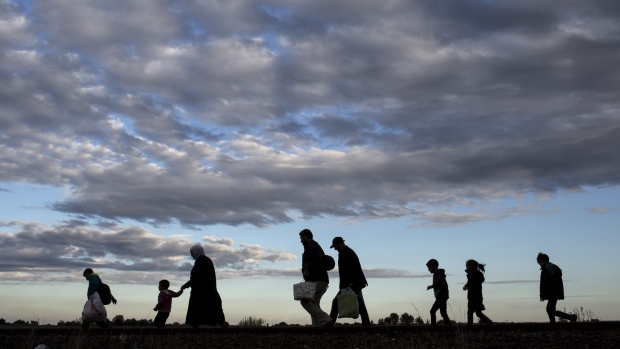
Photo:Marko Djurica/Reuters

Your child will ask
why do we observe this festival?

And you will answer
it is because of what God did for us
when we were set free from the land of Egypt.

Your child will ask
were we set free from the land of Egypt
that we might hold tightly
to the pain of our enslavement
with a mighty hand?

And you will answer
we were set free from Egypt
that we might release our pain
by reaching with an outstretched arm
to all who struggle for freedom.

Your child will ask
were we set free from the land of Egypt
because we are God’s chosen people?

And you will answer
we were set free from the land of Egypt
so that we will finally come to learn
all who are oppressed
are God’s chosen.

Your child will ask
were we set free from the land of Egypt
that we might conquer and settle
a land inhabited by others?

And you will answer
we were set free from the land of Egypt
that we might open wide the doors
to proclaim:

Let all who are dispossessed return home.
Let all who wander find welcome at the table.
Let all who hunger for liberation
come and eat.

Campus Update: Hateful Islamophobia at IUPUI

iupui-university-library

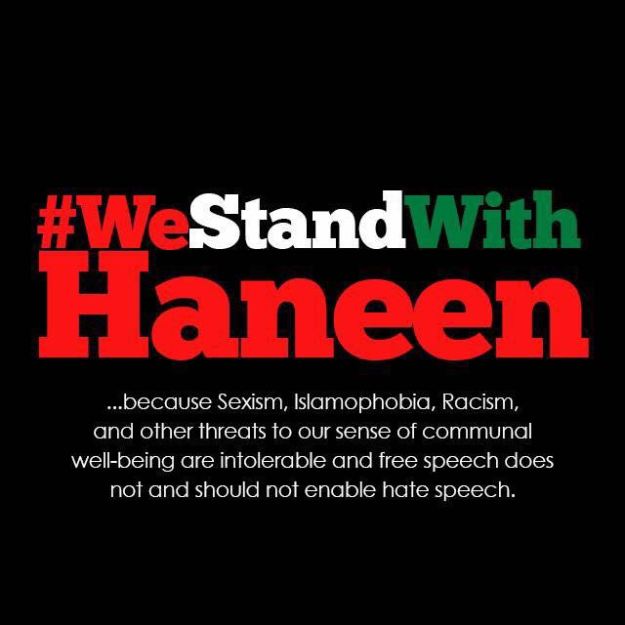
Students for Justice in Palestine (SJP) has done important and inspirational work on colleges around the country – often in the face of death threats, harassment and personal attack. The latest example: just this past week, a student leader of the SJP at University of Indiana – Purdue University Indianapolis (UIPUI) named Haneen (I’ve been asked to not use her last name out of concern for her safety) has been subject to threats, harassment and defamation through anonymous blog posts and flyers left on campus.

Among other things, this hate campaign characterized her as an advocate and supporter of terrorism, made sexist comments about her appearance, urged “authorities to look into her history of violence and investigate whether or not she is an immediate threat to…the nation’s capital.” One post attacked her for partnering with Black Lives Matter , calling it “a group that is also prone to acts of violence.” She has also received harassing phone calls at her home.

Haneen has received heartening support from a variety of corners, including a group of seventy five UIPUI faculty members and student who have signed a letter that calls upon UIPUI Chancellor Nasser Paydar to:

(1) to issue a strong public statement condemning these attacks and (2) to make clear the status of the University’s investigation of these heinous acts.

We encourage the Deans of each IUPUI school to educate their communities on sexism, Islamophobia, racism, and other threats to our sense of communal well-being.

We ask every IUPUI community member to challenge sexism, racism, Islamophobia, and all other forms of discrimination in their everyday interactions both on and off campus.

Making clear our university community’s values and mission in the face of fear and intimidation is necessary to creating a welcoming campus for all. Courage, hope, and love can defeat the hatred that has shown its face among us. We pledge to help in whatever ways we can.

I was encouraged to learn that the Indianapolis Jewish Community Relations Council has written Haneen a letter of support as well. Despite the appropriate demands that the University administration take immediate and meaningful action, however, the only response to date has been a bland, general statement from Chancellor Paydar that IUPUI “abhors all forms of racism, bigotry and discrimination, including discrimination based on religious beliefs or political views.” 

Representing the faculty letter signers, lecturer Lindsay Lettrell rightly and eloquently responded:

Dear Chancellor Paydar,

While we welcome your statement affirming that “the university abhors all forms of racism, bigotry and discrimination, including discrimination based on religious beliefs or political views,” we, faculty, staff and student supporters of Haneen, believe that these immediate, specific problems of racism, sexism, and Islamophobia need to named and condemned explicitly. Our student’s safety and future is on the line, and Haneen has asked that her University speak publicly about her right to safety as a part of our campus community. While the generalities in your message are relevant, we still ask you to address this specifically. After all, as the team of her supporters has reminded us, “She is a real person, not an idea. Her name is Haneen. She is Palestinian. She is a Muslim. She is a woman. (And, I add, she is our student.) She has a face. She has a voice. And her voice is our voice.”

Click here to contact Chancellor Paydar and demand that IUPUI denounce this act of hatred and move swiftly to investigate it.

12987033_448742761996059_3715131622213391113_n


Yes, Zionism is Settler Colonialism

20090927

Is Zionism “settler colonialism?” It’s an important question that is increasingly invoked in public debates over Israel/Palestine – and BDS in particular.

While I personally do believe Israel to be a settler colonial state, I think it’s critical to understand what we mean when we use this term, what it means in the context of Israel/Palestine, and its implications for the wider struggle against systems of oppression in the US and throughout the world.

Let’s start with the definition itself. Many people use the term “settler colonialism” and “colonialism” interchangeably, but they are not in fact the same thing. Colonialism is defined by the Collins Dictionary as “the policy and practice of a power in extending control over weaker peoples or areas.” Historically speaking, it generally refers to specific European imperial powers during a period that lasted from the 16th to mid-20th centuries.

“Settler colonialism,” is a different concept, as Professor of Anthropology Tate A. LeFevre explains:

Though often conflated with colonialism more generally, settler colonialism is a distinct imperial formation. Both colonialism and settler colonialism are premised on exogenous domination, but only settler colonialism seeks to replace the original population of the colonized territory with a new society of settlers (usually from the colonial metropole). This new society needs land, and so settler colonialism depends primarily on access to territory. Britain, for example, implemented the doctrine of “terra nullius” (“land belonging to no one”) to claim sovereignty over Australia. The entire continent was thereby declared legally uninhabited, despite millennia of Aboriginal occupation.

In other words, while colonialism typically refers to events, settler-colonialism is viewed as an ongoing process. Professor LeFevre puts it this way: “Settler colonialism is premised on occupation and the elimination of the native population, while colonialism is primarily about conquest.”

Given this definition, the claim that Zionism is a form of settler colonialism it is not at all inappropriate and certainly not anti-Semitic (as some of the more vociferous Israel advocates will often claim).

There is, for instance, a striking similarity between the British colonial concept of “terra nullius” and the early Zionist slogan, “a land without a people for a people without a land.” This is not say that Zionists viewed the land as literally empty – they most certainly recognized the existence of an Arab population in Palestine. It does mean, however, that they did not always factor its indigenous inhabitants into their equations – and when they did, it was invariably as a problem to be dealt with.

The father of modern Zionism made this clear in his diary when he wrote of Palestinian Arabs:

We shall try to spirit the penniless population across the border by procuring employment for it in the transit countries whilst denying it any employment in our own country.

David Ben-Gurion expressed similar intentions in a 1937 letter to his son Amos (who was critical of his father’s intention to support the 1937 Peel Commission partition plan):

My assumption (which is why I am a fervent proponent of a state, even though it is now linked to partition) is that a Jewish state on only part of the land is not the end but the beginning…

The establishment of a state, even if only on a portion of the land, is the maximal reinforcement of our strength at the present time and a powerful boost to our historical endeavors to liberate the entire country.

We shall admit into the state all the Jews we can. We firmly believe that we can admit more than two million Jews. We shall build a multi-faceted Jewish economy– agricultural, industrial, and maritime. We shall organize an advanced defense force—a superior army which I have no doubt will be one of the best  armies in the world. At that point I am confident that we would not fail in settling in the remaining parts of the country, through agreement and understanding with our Arab neighbors, or through some other means.

Thanks to Israeli historians such as Benny Morris, Avi Shlaim, Tom Segev and Ilan Pappe, we now know that the creation of Israel was accomplished through “some other means.”  More recently, journalist Avi Shavit recently made reference to this ignoble history in his book, “My Promised Land.” The most chilling chapter (which was reprinted in the New Yorker magazine) describes in detail the depopulation of the Palestinian village of Lydda.

Even more chilling are Shavit’s musings on the meaning of this tragic event:

Looking straight ahead at Lydda, I wonder if peace is possible. Our side is clear: we had to come into the Lydda Valley and we had to take the Lydda Valley. There is no other home for us, and there was no other way. But the Arabs’ side, the Palestinian side, is equally clear: they cannot forget Lydda and they cannot forgive us for Lydda. You can argue that it is not the occupation of 1967 that is at the core of the Israeli-Palestinian conflict but the tragedy of 1948. It’s not only the settlements that are an obstacle to peace but the Palestinians’ yearning to return, one way or another, to Lydda and to dozens of other towns and villages that vanished during one cataclysmic year. But the Jewish State cannot let them return.

Many who reject the “Zionism as Settler Colonialism” label often argue that this claim ignores the historic and Biblical connection of the Jewish people to the land – and that Jews are its “true indigenous people” who have been longing for a return and restoration to their ancient homeland for centuries.

Leaving aside the use of a profoundly ahistorical document such as the Bible as justification for the establishment for a modern Jewish nation state, let’s look more closely at the Zionist claim of Jewish indigeneity to the land.

It is certainly true following the destruction of the Temple in 73 CE and the spread of the Jewish people throughout the diaspora, Jewish tradition continued to maintain an important attachment to the land of Israel. Eretz Yisrael (“the Land of Israel”) is a central subject in many sacred Jewish texts and numerous traditional Jewish prayers express a longing for a return of the Jewish people to the land. It is also true that there have been small Jewish communities in historic Palestine throughout the ages and that pilgrimage to Eretz Yisrael was considered to be a mitzvah  (“or sacred commandment”.)

However, it is important to note that the Jewish attachment to this land has traditionally been expressed as an inherently religious connection. From its very beginnings, Judaism has spiritualized the concept of the land. Moreover, throughout the centuries, rabbinical authorities strictly prohibited an en masse return to the land in order to establish a Third Jewish Commonwealth. Such an act was viewed as an anathema – a profane forcing of God’s hand. The restoration of the Jewish People to the land would only occur with the coming of the Messiah and the onset of the Messianic Era.

It is against this context that we must understand Zionism as a modern political movement, arising in the 19th century as an explicit rejection of Jewish tradition. While Judaism was a diaspora-based religion that taught God could be found anywhere in the world, Zionism preached “shlilat hagalut” (“negation of the diaspora”), advocating for a literal return to the land in order to establish a modern Jewish nation state. Influenced by the European nationalisms of its day, Zionism sought to create a new kind of Judaism and indeed, a new kind of Jew.

This radical revisioning of Jewish life and culture in many ways represents the exact opposite of indigeneity. Indigenous peoples by definition maintain unique cultural and linguistic practices distinctive to their presence in a particular land. Zionism created a completely new Hebraic Jewish culture – one that was deeply influenced by a European Ashkenazic ethos and transplanted into the Middle East. To be clear: this is not to say that Jews have no connection to this land and no right to live there, only that the claim of Jewish indigeneity is ideological, rather than factual – and that this claim has had a devastating impact on the actual indigenous people of this land.

Other critics of the settler colonialist label point out that there is no such thing as a discrete “Zionism;” that this movement was historically made up of many different Zionisms, not all of which shared the same political goals. There were, for instance, cultural Zionists such as Ahad Ha’am who did not share Herzl’s desire of a Jewish political state but rather advocated for a gradual colonization of Palestine that would make it the center of a Jewish cultural renaissance. There also Zionists such as Judah Magnes and Hannah Arendt, who believed in the creation of a bi-national Jewish/Arab state in Palestine.

These variants of Zionism represent an important fact of history. But it is also true that they are precisely that: part of the historical past. If Magnes or Arendt were living today, they would surely be considered “anti-Zionist”. In the end, the form of Zionism that ultimately triumphed was the political Zionism advocated by those who sought to create a sovereign Jewish state in historic Palestine. And it was this Zionism that aimed to solve the problem of Palestine’s indigenous population “through some other means” – that is, by means of settler colonialism.

In one of the most comprehensive treatments I’ve yet read on this subject, Bennett Muraskin writes:

Zionism is described by its supporters as the national liberation movement of the Jewish people, but it must be recognized that until the 1947 UN Partition Plan, the land it sought to liberate had a minority of Jews, consisting mainly of recent Europeans immigrants living under the protection of an imperial power. When the British turned against the Jewish colony, the Zionists succeeded in liberating themselves, but in the war it fought with the Palestinian Arabs and Arab armies, the Zionists dispossessed the native population.

In this sense, Israel is a colonial settler state.

Muraskin, however, then goes on to list the ways that make Israel different from other settler colonial states.  His intention, I assume, is to leave open the possibility that it somehow isn’t. This equivocal attitude is obvious from the outset – Muraskin’s article is actually entitled “Is Israel a Colonial Settler State? Perhaps but with Lots of Provisos.”

In the end, however, I believe these “provisos” only demonstrate that Zionism represents but one form of settler colonialism. One obvious difference is that Israel was created by what began as a small movement, not an existing colonial power such as Great Britain, France or Belgium. However it is also true that Israel could never have been created without the help of great world powers (Britain and later the US) who supported the creation of the Jewish state because it advanced their own imperial agendas. James Baldwin put it very aptly in 1979: “The state of Israel was not created for the salvation of the Jews; it was created for the salvation of the Western interests.”

In the end, this insight explains why the debate over this term is more than just academic or semantical. Israel’s oppressive policies against the Palestinians do not exist in a vacuum. They are but part of a larger hegemonic system of white supremacy and institutionalized racism that exists in the US and throughout the world.

As Professor LeFevre writes, “Settler colonialism does not really ever ‘end.’”  Perhaps the first step in that direction is to call it out for what it really and truly is.