Monthly Archives: February 2017

Apocalyptic Extremism: No Longer a Laughing Matter

gettyimages-632915360-1280x720

photo credit: Getty Images

In my previous post, I explored how Zionism has historically fed off of anti-Semites and anti-Semitic regimes to justify the need for a Jewish state. In this post, I’d like to discuss a phenomenon that has even more ominous resonance for the current political moment: the willingness of political Zionists, Israeli politicians and right wing Israel advocates to court the support of Christian millenarians and apocalyptic extremists.

Some history: In the century after the Protestant reformation, the religious ideology of millenarianism began to spread throughout Europe. Millenarianism took many forms, most of which were rooted in the belief that the physical restoration of the Jews to the land would be a necessary precursor to the apocalypse and the eventual second coming of the Messiah. This religious dogma was eventually brought by English Puritan colonists to North America, where it evolved into present-day Christian Zionism.

It is safe to say that Jewish political Zionism could not have succeeded without the support of Christian millenarians. Reverend William Hechler, a prominent English clergyman who ascribed to eschatological theology and the restoration of the Jews to the land of Israel, was a close friend and colleague of Theodor Herzl, the founder of the political Zionist movement. Lord Arthur Balfour, who issued the historic Balfour Declaration in 1917 was likewise a Christian Zionist, motivated as much by his religious convictions as by British imperial designs in the Middle East.

Today of course, Christian Zionists are most famously represented by Pastor John Hagee and Christians United for Israel (CUFI), the largest coalition of Evangelical Zionists in the world. Hagee has never made a secret of his apocalyptic religious views. In his 2007 book “Jerusalem Countdown,” he wrote that Armageddon might begin “before this book gets published.” He also claimed The Antichrist “will be the head of the European Union,” and that during the final battle, Israel will be covered in “a sea of human blood.” The Jews, however, will survive long enough to have “the opportunity to receive Messiah, who is a rabbi known to the world as Jesus of Nazareth.”  In Hagee’s more recent book, “Four Blood Moons,” he wrote: “In these next two years, we’re going to see something dramatic happen in the Middle East involving Israel that will change the course of history in the Middle East and impact the whole world.”

While one might expect Jewish leaders to keep their distance from a popular Christian pastor with extremist views such as these, Hagee has been closely embraced by Israeli governments (Netanyahu is a fixture at CUFI conventions), Jewish American politicians (Former Senator Joseph Lieberman has referred to Hagee as a modern-day Moses) and prominent American Jewish leaders (Elie Wiesel once called Hagee “my pastor.”)

CUFI’s Jewish Executive Director, David Brog, clearly serves to give cover to Christian Zionists, painting them as “mainstream” and not nearly as scary as their beliefs would indicate. Following the outcome of the recent election, however, Brog seems to smell blood in the water; he recently announced CUFI’s plans to get “a little more aggressive” in pushing its policies with the Trump administration, where it has clout and connections, particularly with evangelical Vice President Mike Pence.

To put it mildly, Jews should be among the least of those who would seek to find common cause with one such as Mike Pence. In an extremely important piece for the Intercept, last November, reporter Jeremy Scahill convincingly argued that Pence  is “the most powerful Christian supremacist in US history,” concluding:

The implications of a Pence vice presidency are vast. Pence combines the most horrid aspects of Dick Cheney’s worldview with a belief that Tim LaHaye’s “Left Behind” novels are not fiction, but an omniscient crystal ball.

It should not come as a surprise that Pence family’s last trip to Israel was funded by, you guessed it, John Hagee. Pence, who was then the governor of Indiana, took the time to meet with Netanyahu during his visit. Now connect those dots to Pence’s meeting with Israeli prime minister during his recent visit to DC. Both Pence and Netanyahu later commented that they met to discuss, among other things, the creation of a “mechanism” that would help the White House and Israel better coordinate construction in the settlements on the West Bank.

When it comes to the Trump administration of course, most of the attention has been directed toward his chief strategist, former Breitbart editor Stephen Bannon. When Bannon’s appointment was announced, there were a variety of responses from the Jewish community, ranging from outrage to support.  For his part, when Netanyahu was asked on 60 Minutes whether or not he was concerned about Bannon, he responded blithely, “I think Mr. Trump and his associates are going to be very strong, not merely in support for the Jewish state, but also in support for the Jewish people.”

While most of the Jewish concern toward Bannon has primarily focused on his alt-right leanings and his personal comments about Jews, less attention has been given to his apocalyptic world view. Strongly influenced by generational theorists William Strauss and Neil Howe’s book “The Fourth Turning: What Cycles of History Tell Us About America’s Next Rendezvous with Destiny”  Bannon ascribes to the theory that American history has operated in four-stage cycles, moving from major crisis to awakening to major crisis.

Linette Lopez, writing for Business Insider:

According to the book, the last two Fourth Turnings that America experienced were the Civil War and the Reconstruction, and then the Great Depression and World War II. Before that, it was the Revolutionary War.

All these were marked by periods of dread and decay in which the American people were forced to unite to rebuild a new future, but only after a massive conflict in which many lives were lost. It all starts with a catalyst event, then there’s a period of regeneracy, after that there is a defining climax in which a war for the old order is fought, and then finally there is a resolution in which a new world order is stabilized.

This is where Bannon’s obsession with this book should cause concern. He believes that, for the new world order to rise, there must be a massive reckoning. That we will soon reach our climax conflict. In the White House, he has shown that he is willing to advise Trump to enact policies that will disrupt our current order to bring about what he perceives as a necessary new one. He encourages breaking down political and economic alliances and turning away from traditional American principles to cause chaos.

Indeed, Bannon expresses his Fourth Turning-influenced ideas unabashedly. During a 2011 presentation to the Liberty Restoration Foundation, a conservative non-profit, he said:

This is the fourth great crisis in American history. We had the Revolution. We had the Civil War. We had the Great Depression and World War II. This is the great Fourth Turning in American history, and we’re going to be one thing on the other side.

And in a 2014 speech at the Vatican:

We’re at the very beginning stages of a very brutal and bloody conflict … to fight for our beliefs against this new barbarity that’s starting, that will completely eradicate everything that we’ve been bequeathed over the last 2,000, 2,500 years.

In more recent statements Bannon openly posits that this new war will be fought between “the Judeo-Christian West” and a coalition of “jihadist Islamic fascists,” “expansionist China” and “the aristocratic Washington class.”

According to Strauss and Howe’s book, once the defining climax takes place, America will coalesces under one leader — a boomer “Gray Warrior” — who will “urgently resist the idea that a second consecutive generation might be denied the American Dream. No matter how shattered the economy … ” As frightening as it may sound, Bannon seems to have the perfect “Gray Warrior” figure in Donald Trump – a man who he once described as “a blunt instrument for us,” adding,”I don’t know if he really gets it or not.”

While it’s easy to giggle when, Israeli politicians, rabbis and evangelical pastors publicly call Trump the Messiah, it is far less funny when we consider that the chief advisor to the President is a man who may well view him as a “useful idiot Gray Warrior.” Either way, this is what a century-long willingness to collaborate with apocalyptic extremists has wrought. We are now one terrorist attack away from a truly unthinkable scenario. As journalist Murtza Hussain put it: “As tensions rise, Steve Bannon and ISIS get closer to their common goal: civilizational war.”

In the end it is all too easy to accept the support of religious zealots while we patronizingly dismiss their views as harmless. Now that these zealots are literally in the halls of very real power however, I think it’s finally time to take them at their word.


Zionism’s Marriage of Convenience to Anti-Semitism

judenstaat

I’m sure many have been scratching their heads trying to figure out why on earth the government of Israel and so many staunch Zionists are just fine with the election of Donald Trump – the darling of the anti-Semitic alt-right. The answer however, is really pretty straightforward: this is nothing new. Zionism has had a cozy, if somewhat Faustian relationship with anti-Semitism since its very origins.

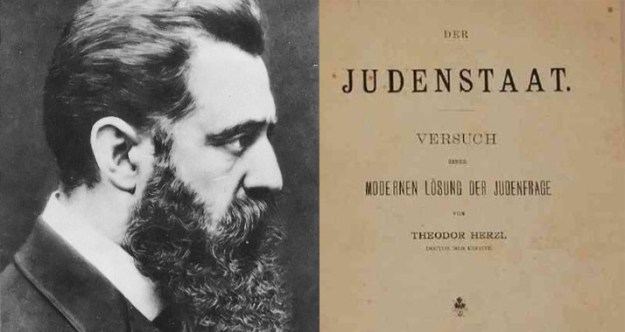
The founder of modern Zionism, Theodor Herzl never made a secret of his belief that his new movement would have to depend upon anti-Semitism and anti-Semites in order to create a Jewish state. In his pamphlet, “The Jewish State,” he suggested raising money for the effort by means of a “direct subscription,” adding that “not only poor Jews but also Christians who wanted to get rid of them would subscribe a small amount to this fund.”

In his diary, he was even blunter:

The anti-Semites will become our most dependable friends, the anti-Semitic countries our allies.

True to form, in 1903 Herzl met with the Russian minister of the interior Vyacheslav von Plehve, an infamous anti-Semite who encouraged the Kishinev pogroms that very same year. Plehve’s reply: as long as the Zionists encouraged emigration of Jews from Russia, the Russian authorities would not disturb them.

This Zionist strategy was also central to the diplomatic process that led to the 1917 Balfour Declaration, in which British Foreign Secretary Arthur Balfour famously announced that his government “view(ed) with favor the establishment of a national home in Palestine for the Jewish people and will use their best endeavors to facilitate the achievement of this object.” Although Balfour has long been lionized as a Zionist hero, he wasn’t particularly well-known for his love for Jews or the Jewish people.  When he was prime minister, his government passed the 1905 Aliens Act, severely restricting immigration at a time in which persecuted Jews were emigrating from Eastern Europe. At the time, Balfour spoke of the “undoubted evils which had fallen on the country from an alien immigration which was largely Jewish.” Balfour, like many Christians of his class, “did not believe that Jews could be assimilated into Gentile British society.”

In this regard, it is worth noting that the sole Jewish member of British government, Edwin Montagu, strongly objected to the Balfour Declaration, submitting a memorandum to the British cabinet in August 1917 that resonates with haunting prescience today:

I wish to place on record my view that the policy of His Majesty’s Government is anti-Semitic and in result will prove a rallying ground for Anti-Semites in every country in the world…When the Jews are told that Palestine is their national home, every country will immediately desire to get rid of its Jewish citizens, and you will find a population in Palestine driving out its present inhabitants…

When the Jew has a national home, surely it follows that the impetus to deprive us of the rights of British citizenship must be enormously increased. Palestine will become the world’s Ghetto. Why should the Russian give the Jew equal rights? His national home is Palestine. Why does Lord Rothschild attach so much importance to the difference between British and foreign Jews? All Jews will be foreign Jews, inhabitants of the great country of Palestine.

The most troubling example of Zionist association with anti-Semitism occurred in 1933, when the Jewish Agency struck a deal with the Nazis’ Economic Ministry known as the Ha’avrah (Transfer) agreement. Breaking the international Jewish boycott, the Zionist movement negotiated with Nazi Germany in order to facilitate the transfer of German Jews and their property to Palestine.

In an essay for Yad Vashem’s Shoah Resource Center, Israeli historian Y’faat Weiss pointed out that the Nazi regime’s participation in the agreement was motivated both by a fear of the boycott and its desire to rid Germany of its Jews. While it is clear that this deal occurred in the context of very real persecution, history has not been kind to the legacy of the Ha’avrah agreement. As Weiss herself noted:

In retrospect, and in view of what we know about the annihilation of European Jewry, these relations between the Zionist movement and Nazi Germany seem especially problematic.

It is not difficult to understand why, on a practical level, the Zionist movement would find a perverse kind of common cause with anti-Semitic regimes. As a form of ethnic nationalism, Zionism has always been dependent upon the maintenance of a demographic majority of Jews in the land. It makes sense that Zionists have been willing to deal with nations that were more than happy to rid themselves of their Jews in order that they maintain their own national ethnic homogeneity.

But it has been a Faustian bargain. From its very origins, Zionism has necessarily fed off the existence of anti-Semites to justify the need for a Jewish state. Even more tragically, as Edwin Montagu predicted, Jewish ethnic nationalism did indeed result in a “population in Palestine driving out its inhabitants.”

Fast-forward to present day and the rise of an alt-right movement promoting a new form of white ethnic nationalism that takes its cue from Israel. Alt-right leader Richard Spencer claims he doesn’t hate Jews, but in fact admires them. He openly says he merely wants for “his people” what Zionism offers the Jewish people. But of course, Spencer’s “genteel white supremacy” is nothing but a fig leaf for the age old desire of anti-semites to create Jew-free nations.

As journalist Betsy Woodruff correctly observed in the Daily Beast:

White supremacists, alt-right leaders argue, think white people are the best race. The alt-right doesn’t necessarily think that, they say; instead, they say they just want white people to have their own homeland.

With no Jews.

Alt-right leader Richard) Spencer in particular fixates on the homeland idea.

The alt-right needs to aspire to something, even if that dream won’t come true in his lifetime—and that means they should aim to build an ethno-state for just whites. And Spencer made it clear that white-only means Jews aren’t invited. They have their own identity, and it isn’t white-slash-European, and that’s that.

“Jews are Jews,” he said.

As troubling as this all may sound, political Zionism has made another, even darker sort of Faustian bargain – namely with Christian Millenarians and End-of-Days extremists. In the era of Trump, this is a relationship that should concern us deeply.

I’ll have more to say about that in my next post.

The Equal Opportunity Hate of White Supremacy

mosque

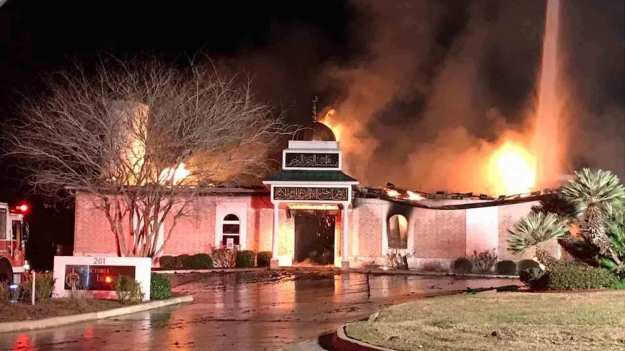
The Victoria Islamic Center destroyed by fire on Jan. 28, 2017 (Photo: Al Jazeera)

Amidst reports of an alarming uptick of anti-Semitic vandalism and bomb threats against JCCs (and an even more alarming reluctance of our new president to even admit its existence), I can’t help but think of an email exchange I had with my friend and colleague Rabbi Rebecca Lillian three years ago.

Rebecca lives in Malmo, Sweden, a city that has seen its share of anti-Semitic vandalism and violence over the past several years. In 2012, the Malmo JCC, where Rebecca lives was vandalized by heavy rocks and an explosive device that thankfully did little damage. In a subsequent blog post for Jewschool, she wrote about the trauma of the incident, but also expressed her dismay that American Jewish leaders exploited it to demonize Muslims and exhort Jewish citizens of Malmo to flee to Israel.

Rebecca pointed out that immediately after the attack, Malmo’s Network for Faith and Understanding held a solidarity vigil in which women, men and children demonstrated their support for the Jewish community by gathering in front of the JCC with candles. Leaders of several Christian churches, two Muslim groups and other spiritual and social organizations came together and offered public speeches of support and solidarity.

Two years later, I wrote to Rebecca and asked her about the latest atmosphere in Malmo. She wrote that the war in Gaza had created an increase in anti-Semitic incidents, but that her interfaith group was “stronger than ever.” She added that the rise of the political far-right was even more concerning, referring to it as the “dark underbelly” of Swedish anti-Semitism. Rebecca noted that in recent elections, “a relatively large percentage of the voters went for Sweden Democrats, a hard-line anti-immigrant group that has roots in neo-Nazism. There is a group of thugs that are equal opportunity haters, who are fans of neither Muslims nor Jews.”

Needless to say, that last line has a troubling resonance when I read it in 2017 – now that a group of “equal opportunity haters” has become firmly ensconced in the White House. But at the same time, I take heart in her description of Malmo’s interfaith solidarity – particularly as I witness a similar kind of solidarity occurring in Trump-era America.

chicagoloopsynagoguevandalized24

Anti-semitic vandalism at Loop Synagogue, Feb. 4, 2017 (Photo: NBC Chicago)

Some examples: when earlier this month a mosque in Texas was destroyed by arson, a neighboring synagogue gave them the keys to their facility so they could continue to worship. Here in Chicago, after an incident of anti-Semitic vandalism at the downtown Loop Synagogue, the very first response of public condemnation came from Ahmed Rehab, director of CAIR – Chicago:

Chicago’s Muslim community stands in full solidarity with our Jewish brothers and sisters as they deal with the trauma of this vile act of hate. No American should have to feel vulnerable and at risk simply due to their religious affiliation.

Unfortunately, we know the feeling all too well as mosque vandalism and burning has spiked recently in the US. We recognize the source of hate as one, and regardless of religious affiliation, we stand together in solidarity against it as one.  An attack on any is an attack on us all. Today, the congregation of this temple are in our thoughts and prayers.

It is worthy of note that the man arrested and charged with this hate crime is a white supremacist who had also menaced Latino members of a church in Pilsen. Following his arrest, one church member reported:

We are a church of Latinos, of immigrants, and we’re just worried and scared, and this guy walks in and he’s alone and asking weird questions. It was just an instinctual thing. We don’t want to turn anybody away, but we felt that something was wrong…He was not there to pray; he was not there to worship God. He was definitely there scouting who we are and what we are about.

The takeway?  As our government – and Israel’s – continue to whip up Islamophobic hatred and brand “Muslim extremism” as the enemy, the true threat before us is the “equal opportunity hate” of white supremacy. And that the only appropriate response is – as ever – solidarity.

The Sacred Carob Tree of Khirbat al-Lawz

DCF 1.0

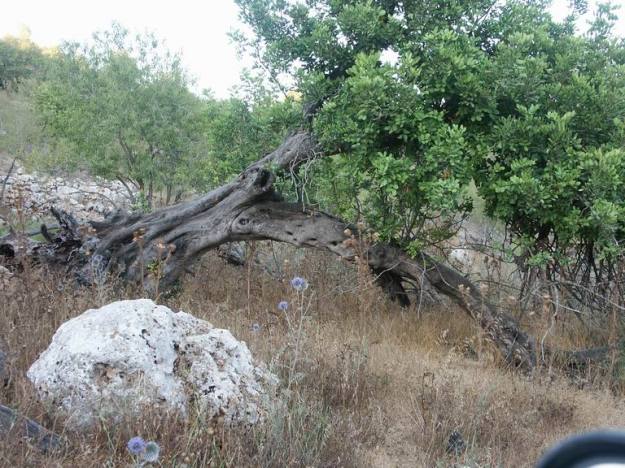
The carob tree in the old village center of Khirbat al-Lawz

Every Tu B’shvat,
on a hill just west of Jerusalem,
almond trees are blooming their white blossoms
down a rocky terraced hillside.
Stone rubble is laced here and there along its slope –
the only remaining traces of the village
they called Khirbat al-Lawz.

Not long ago this place was populated by
hundreds of villagers who grew
olives, grapes, figs and tended farms
with sheep and chickens.
On the hillside there are two springs
called Ein al-Quff that sent water
down ducts that led to a well
built into the hillside.

Generation after generation
the farmers of the region
would parcel and share this water
to grow their crops.
Every evening after work, it is said,
the men of Khirbat al-Lawz
would gather near a carob tree
in the village center
to talk, smoke, drink and sing
late into the evening.

This life vanished forever on July 14 1948,
when the Haganah occupied and expelled
the people of Khirbat al-Lawz during a military action
known as “Operation Dani.”
The villagers remained in the nearby hills
hoping to return at the end of war,
but soldiers from the Harel Brigade
forbade their return
on pain of death.

Soon after the Jewish National Fund
built a thick forest of non-indigenous
evergreens around Khirbat al-Lawz
and the neighboring village of Sataf.
Today, the JNF website tells us:

This site offers many stunning walks in nature,
where you can also see olive orchards
and agricultural plots on
ancient agricultural terraces.
The two springs that emerge
from the site serve as a reminder
of an almost vanished Hebrew culture
dating back thousands of years.
Here, as in the days of the ancient Israelites,
irrigated vegetable gardens grow
alongside vineyards, olive groves and almond orchards
that need no artificial irrigation
and color the countryside green all year round.

Hikers today will surely not notice it,
but not far from these well groomed trails
you can still find the village center of Khirbat al-Lawz.
The spot is marked by an ancient carob tree
rising out of the thorns and dead grass –
bent and tilted to the side, but still growing.

According to the Jewish sages
it takes carob trees seventy years to fully bear fruit.
When we plant them, they say,
it is not for our own sake,
but for the benefit of future generations.

So this Tu B’shvat, think of a hillside
just west of Jerusalem
where the almond trees are blooming
down a rocky terraced hillside
and a sacred carob tree grows sideways
where a village center once stood.

Then close your eyes and imagine
the wind breezing through its leaves,
whispering to future generations:
you are not forgotten,
the time will yet come
for your return.