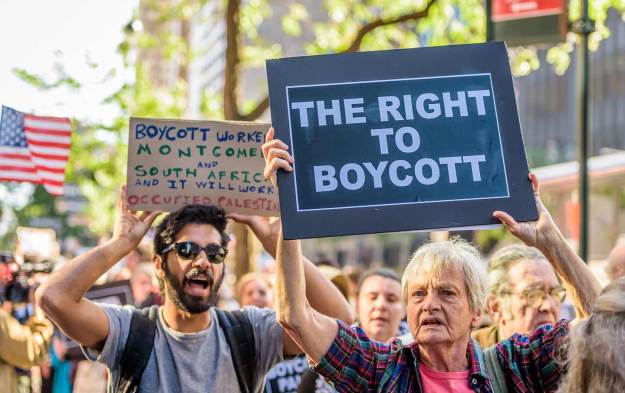
I delivered the remarks below yesterday during a session at the annual conference of the American Academy of Religion in Boston. This panel was originally intended to be an exploratory roundtable entitled “Arguing Boycott, Divest, and Sanction (BDS) and Religion,” featuring six presenters to discuss this issue in the spirit of respectful, collegial debate. As the organizers of the program noted, “Rather than demonizing those either for or against BDS, this exploratory session will allow a variety of voices to be heard.”
Late last week, we learned that two anti-BDS panelists and the moderator had withdrawn from the session. One panelist claimed that she did not know who the rest of the panelists would be, specifically objecting to me and Dr. Hatem Bazian of (Zaytuna College and UC Berkeley) being included in the program.
After a hastily organized meeting, the AAR Executive Committee decided to postpone the roundtable, but allowed the room to be available for “information discussion.” At the session I read my original paper; Dr. Bazian and Dr. Zareena Grewal of Yale presented as well. A paper written by Dr. Steven Zunes (University of San Francisco), who was unable to attend, was also presented at the session.
***
In my remarks to you today, I’d like to address one of the questions originally presented to the panelists of our session:
What, from your perspective, what stands out as a particularly important element of religious ethics and theology that motivates those inspired to take up the cause of Boycott, Divestment and Sanctions?
For me, this question leads directly to one of the most important theological teachings of Jewish tradition: God hears and hearkens to the cry of the oppressed.
We first encounter this divine attribute in Genesis 18:20-21, when God says to Abraham:
The outrage of Sodom and Gomorrah is so great, and their sin so grave! I will go down to see whether they have acted altogether according to the outcry that has reached Me…
Later, at the outset of the Exodus story, God says to Moses:
Now the cry of the Israelites has reached Me; moreover I have seen how the Egyptians oppress them. (Exodus 3:9)
It should be noted that Godly attributes in Jewish tradition are not mere academic concepts – they are nothing short of divine imperatives. God’s ways must be our ways as well. Judaism is replete with references to imitatio dei, including this oft-cited teaching from the Talmud:
Why does it say (Deut. 13: 5): “One should walk after God“? Is it possible to walk after the Divine Presence? Is God not like a consuming fire (ibid., 4:24)? Rather, it means that one should imitate God’s ways. As God clothed Adam and Eve (Gen. 3:21), so should we clothe the naked; as God visited the ailing (Gen. 18: 1), so should we visit the sick; as God comforted Isaac after Abraham’s death (Gen. 25: 11), so should we comfort mourners; as God buried Moses (Deut. 34:6), so should we care for the dignity of the dead (Babylonian Talmud, Sotah 14a).
To this list, we might well add: “As God hears the cry of the oppressed, so should we hear the cry of the oppressed.”
One of my favorite recent teachings on this concept is offered by Rabbi Aryeh Cohen, in his 2009 essay, “Hearing the Cry of the Poor.” Pointing to the well known verse in Exodus 20: “Do not oppress or mistreat the stranger, for you were strangers in Egypt,” Cohen writes:
Many have understood this verse as meaning that the lesson of oppression is compassion. That is, “You Israelites know what it means to be enslaved, oppressed, to be the stranger. Now that you are the dominant group, you must exercise compassion toward those who were like you were. You must exercise the compassion that Pharaoh did not exercise toward you.”
This understanding, however, does not take into account verse 22 (“If you do, and they cry out to me, I will certainly hear their cry. My anger will be aroused, and I will kill you with the sword; your wives will become widows and your children fatherless.”)
Cohen interprets thus:
On the one hand, God heard the cry of the Israelites, and this led to redemption. On the other hand, Pharaoh did not hear the cry and this led to the devastation of Egypt. The ethical choice is between imitatio dei and imitatio pharaoh. As is the wont of the Biblical authors, these choices bring with them repercussions. Choosing to be like God leads to redemption while choosing to be like Pharaoh leads to death.
Later, noting Nachmanides commentary on this verse, Rabbi Cohen concludes:
The lesson of the slavery and liberation in Egypt is not an exhortation to dwell on shared victimization…It is not the empathy of shared suffering that is at stake here but the certain knowledge that God hears the cries of the oppressed that others choose to ignore – and benefit thereby from their continued exploitation….
Nachmanides teaches us that the experience that we share with all marginal, oppressed or exploited people is the possibility of redemption. The Torah puts this starkly, to quote Eldridge Cleaver: “What we’re saying here today is that you’re either part of the solution or you’re part of the problem.” You can choose to be like God, and hear the cries of the oppressed, or you can choose to be like Pharaoh and ignore those cries. In either event, the oppressed will be redeemed. If, however, the salvation is left to God you will go the way of the Egyptians (from “Crisis, Call and Leadership in the Abrahamic Traditions,” edited by P. Ochs and W. Johnson, pp. 112-114).
While Rabbi Cohen does not address BDS specifically in his essay, I find his teaching to be directly relevant to our subject. To put it simply, the BDS call is a cry from the oppressed. Will we choose to be like God, and hear the cry of the Palestinian people?
This simple, essential point is too often drowned out by the clamor and din of the hysteria around BDS: its origin point is a call from an oppressed people who are seeking support and solidarity from the international community.
Some critical history: the BDS movement dates back to 2005, when 170 Palestinian civil society organizations came together to strategize at critical political moment. The Oslo peace process had been ongoing for over ten years. During that time – a period ostensibly dedicated to a final status agreement – Israel had expanded its settlement enterprise across the West Bank at a staggering rate. The settler population in the West Bank had doubled – particularly in areas meant to be part of an eventual Palestinian state. Palestinians were being forced into isolated cantons, hemmed in by the barrier wall and checkpoints, increasingly cut off from Israel and each other.
It had become clear to many – certainly to Palestinians – that Israel had no interest in negotiating a viable two state solution. They were extending their control over Palestinian lands and they were doing it with impunity. At the same time, in Israel proper, Palestinians were increasingly deprived of their rights as citizens. Adalah – the Legal Center for Minority rights in Israel had documented over 65 laws that discriminated against Palestinians on the basis of their national belonging. And then there was the question of Palestinian refugees. Since Israel steadfastly refused to even consider negotiating the Palestinian Right of Return, over 7 million Palestinian refugees remained in exile – unable to even set foot in the land in which their ancestors lived.
During the decade following Oslo, no political entity – not the US government, the UN, the governments of the international community, nor the PA itself – were willing or able to hold Israel to account. It was under this context that the leadership of Palestinian civil society came together in 2005 to issue the BDS call. The efforts of the political powers had failed them. Together, they determined that the only way to create the opening for a just solution was to leverage popular support – that is to say, people power.
Thus, a wide coalition of Palestinian unions, political parties, refugee networks, women’s organizations, professional associations, popular resistance committees and other Palestinian civil society bodies made a crie de cour for solidarity and support. They issued a call to the world to use the time honored nonviolent strategy of Boycott, Divestment and Sanctions to pressure the state of Israel to meet three essential demands:
- To end the occupation and colonization of the West Bank and Gaza and dismantle the separation wall;
- to recognize the fundamental rights of Arab-Palestinian citizens of Israel to full equality;
- and to respect, protect and promote the rights of Palestinian refugees to return to their homes and properties as stipulated in UN Resolution 194
Although BDS is an inherently nonviolent tactic, it is striking to note the lengths to which the government of Israel has devoted time, energy and resources in trying to defeat it over the past decade. It has spent literally hundreds of millions of dollars to this effort, enlisted a myriad of Israel advocacy organizations and has even created a new government ministry devoted exclusively to fighting BDS. And though demands of the BDS call are based in human rights and international law, it is routinely referred to as antisemitic “economic terrorism” that “delegitimizes the state of Israel.”
Why such a strong response? I would suggest it is because Israel knows this is the one arena in which it is the most vulnerable. While it enjoys a distinct advantage on politically and militarily, it now faces the mobilization of a nonviolent popular movement that is holding it to account – and it takes this very seriously. Indeed, BDS is modeled on the similar movement that was mobilized in response to apartheid South Africa. History has proven that this kind of popular resistance can actually work.
Admittedly, the idea of a worldwide boycott of Israel pushes all kinds of Jewish hot buttons. Many, for instance, compare it to the Nazi boycott of Jewish businesses during the rise of the Third Reich. While I understand the visceral nature of this response, it perversely misrepresents the essential core of the BDS call. In the case of Nazi Germany, a government used boycott as a tool to persecute minority citizens of its own nation. The Palestinian civil society call is a cry from the oppressed themselves for solidarity in the face of state violence. In this regard it is much more comparable to the Montgomery Bus Boycott during the American civil rights movement or the United Farm Workers call for boycott of grape growers in California.
BDS also pushes buttons for those who believe it unfairly singles Israel out. Those who have answered the call by supporting boycott and divestment campaigns are routinely accused of practicing a double standard. “Of all the oppressive regimes throughout the world, Israel is surely not the worst” many critics claim. Thus it is problematic, if not downright antisemitic, to target Israel exclusively with such campaigns.
Here again, the essential nature of the BDS call is being twisted out of context. BDS does not originate in boycott campaigns or divestment resolutions. The BDS call comes from Palestinians themselves. The proper question before us it not “what about these other oppressive regimes?” but rather, “the Palestinian people have issued a call for solidarity and support in the face of very real oppression – will we respond to their call or not?”
There is currently no call comparable to the one that has been issued by Palestinian civil society. If oppressed people anywhere in the world saw fit to issue such a call, it would naturally be worthy of our consideration and support. But the lack of one does not invalidate the worthiness of the call that has been placed before us by the Palestinian people.
Back in 2009, when I was just starting to grapple myself with my own response to this call, I wrote a blog post in which I shared my own nascent thoughts on the subject. Here is how I concluded:
Beyond the fears of BDS articulated by so many in the Jewish communal establishment, I think there’s an even deeper fear for many of us in the Jewish community: the prospect of facing the honest truth of Israel’s oppression of Palestinians.
For so many painful reasons, it is just so hard for us to see Israel as an oppressor – to admit that despite all of the vulnerability we feel as Jews, the power dynamic is dramatically, overwhelmingly weighted in Israel’s favor. Though a movement like BDS might feel on a visceral level like just one more example of the world piling on the Jews and Israel, we need to be open to the possibility that it might more accurately be described as the product of a weaker, dispossessed, disempowered people doing what it must to resist oppression.
In the end, I believe this is the real crux of the issue. Many liberals analyze the issue of Israel/Palestine with what I would call a “Conflict Analysis” – that is to say, the tragic collision of two peoples, each of whom have compelling claims to the same piece of land. In this instance, the appropriate response naturally, would be to negotiate a political compromise between the two parties.
Others however, myself included, analyze the issue with an “Oppression Analysis.” In this case, this tragedy was caused by an essential injustice. It occurred as the result of an ethnic national movement that colonized, settled and forcibly seized a land from people who were living there. Indeed, this injustice is not part of history but is ongoing even now. In such a context, the structures that perpetuate this injustice must be recognized and dismantled before any sustainable solution can be reached.
I realize there may be some in this room who cannot bear to hear me say these words, but I – and increasing numbers of people around the world – believe them to be true, no matter how painful it feels to hear them. Israel is oppressing Palestinians. And when a people are oppressed, they will inevitably resist their oppression – yes sometimes violently.
In this case, however, a nonviolent call for popular resistance has been placed before us. Thus, for those of us that believe God hears the cry of the oppressed and demands that we do the same, the BDS call represents a direct challenge to our faith. Will we be like God, and hearken to their cries, or will we be like Pharaoh and ignore them?
As a Jew, as an American, as a person of conscience, I would suggest this call presents us with nothing less than the most consequential spiritual challenge of our time.


 Shalom Rav