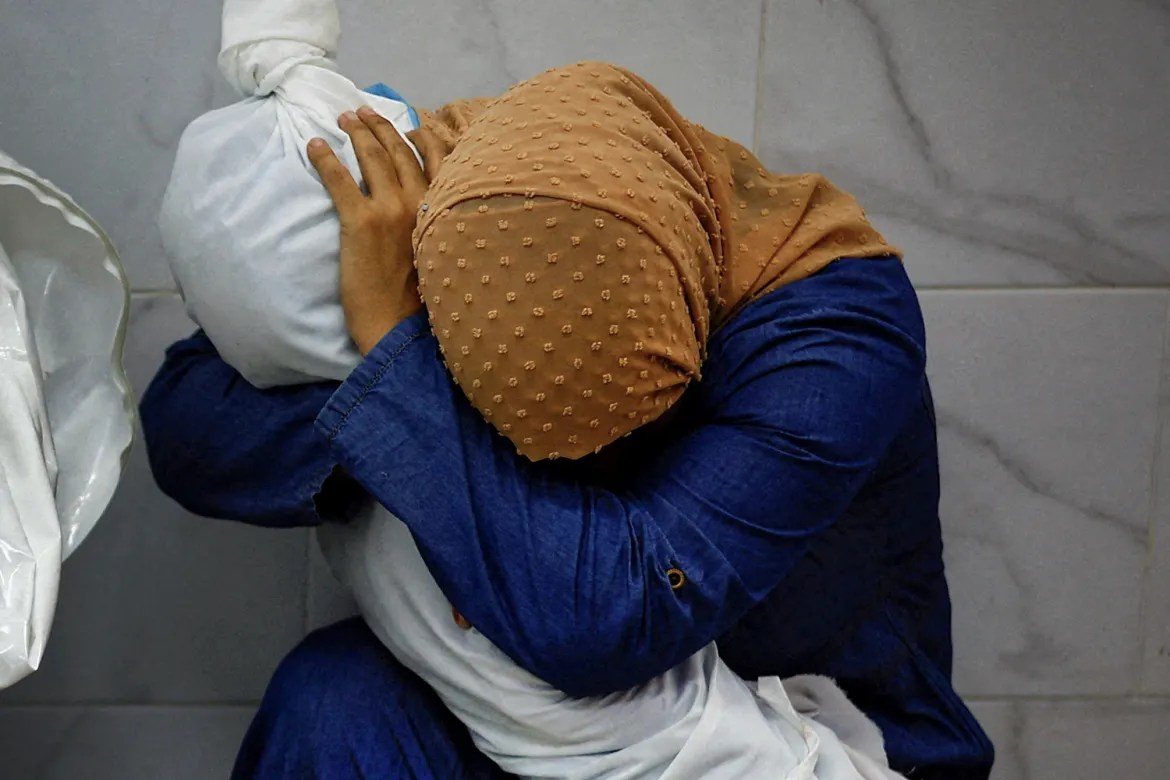
Exactly ten years ago, the Jewish fast day of Tisha B’Av arrived as Israel was winding down “Operation Protective Edge” – it’s deadly two-month military assault on Gaza. By the end of the summer of 2014, it would eventually leave more than 2,000 Palestinians dead and more than 10,000 wounded. I remember thinking at the time how the scale of human loss was utterly incomprehensible, which of course, it was.
With Tisha B’Av 2014 approaching, I met with a small group of Jewish friends and activists who had been active in the Palestine solidarity movement to plan an observance. Tisha B’Av (literally, the 9th of the month of Av) is a day of mourning for the destruction of the 1st and 2nd Temples in Jerusalem – and by extension the myriad of other tragedies that have befallen the Jewish people throughout the centuries. In addition to a day-long fast, the traditional Tisha B’Av observance includes the chanting Biblical book of Eicha (Lamentations), which vividly and painfully describes the fall of Jerusalem to the Babylonians.
Given the violence Israel had been unleashing on Palestinians in Gaza that summer, we just couldn’t bear to observe the festival in the traditional manner, i.e., as a day of mourning exclusively for Jewish loss. And so, when the festival arrived, we gathered in a home in Evanston to share our fears, our grief, our outrage, over what had transpired over the course of that tragic summer. In a sense, we were mourning the loss of Judaism itself as we had known it. Though it was obviously far from a traditional Tisha B’Av observance, those who attended will never forget that gathering – and would agree it was a turning point in our Jewish lives and identities.
Among the readings shared at the ceremony, was a new poetic translation of the first chapter of Eicha that I had written for the occasion, entitled “A Lamentation for Gaza.” This is how it began:
Gaza weeps alone.
Bombs falling without end
her cheeks wet with tears.
A widow abandoned
imprisoned on all sides
with none willing to save her.We who once knew oppression
have become the oppressors.
Those who have been pursued
are now the pursuers.
We have uprooted families
from their homes, we have
driven them deep into
this desolate place,
this narrow strip of exile.
It’s fair to say that none of those who attended that ceremony could ever have imagined the scale of the genocidal carnage that Israel would unleash on Gaza ten years later. To date, nearly 40,000 Gazans have been killed, though the actual number will almost surely climb far higher. The Israeli military has indiscriminately killed random civilians, relief workers, journalists and health care workers. Israel has wiped out the bloodlines of entire families. The Gaza strip is now gripped by spreading famine and polio epidemics. And unlike ten years ago, this current violence has now brought the entire region to the brink of all-out war.
In anticipation of Tisha B’Av this year, I recently re-read my “Lamentation for Gaza” – and while it’s an accurate snapshot of my feelings at the time, I don’t think it fully expresses my heart and soul now the way it did during the summer of 2014. Most fundamentally, I no longer relate to the essential perspective of the lamentation itself, which I wrote in the first-person plural:
We have become Gaza’s master
leveling neighborhoods
with the mere touch of a button
for her transgression of resistance.
Her children are born into captivity
they know us only as occupiers
enemies to be feared
and hated.
When I read this now, it is jarring to realize how I – a diaspora Jew living in the United States – wrote from the perspective of “Gaza’s master” and an “occupier.” When I wrote those words, I still maintained a personal connection to Zionism and reflexively adopted Israel’s perspective. At the same time, however, I clearly expressed deep anguish over what “we” had wrought – as if I didn’t know fully where I stood anymore.
Ten years later, I’m fully secure in my identity as an anti-Zionist Jew. Tzedek Chicago, is (yes) almost ten years old – and avowedly lifts up core values that express diasporist-focused Judaism beyond Zionism. I’m part of a Jewish community that is unabashed about taking a stand in the face of genocide.
I don’t believe it’s an exaggeration to say that as Tisha B’Av falls this year, the Jewish communal fissures over Palestine/Israel have become an abyss – perhaps even a schism. We are facing a deep and profound divide between those who place political nationalism at the center of their Jewish identity and those who refuse to associate settler colonialism, apartheid – and now genocide – with their Judaism. And though it pains me to say so, I don’t think there will be any bridging this gap. Contrary to the final line of Lamentations, “chadesh yameinu ke’kedem” (“renew our days as they were before”), there is no going back to the days of old. There will be no putting the pieces back together the way they were.
According to classical Jewish theology, the cataclysmic fall of the Second Temple in Jerusalem occurred as a result of “sinat chinam” – the baseless internecine hatred in the Jewish community that allowed the Romans to come breach the walls of the city and conquer Jerusalem. There is deep division in the Jewish community in the current moment as well, but now our Jewish trauma and hatred is directed outward rather than inward. Now, it is the Palestinian people – not we – who are bearing the full brunt of violent dispossession and collective loss.
While it would be hubris to predict what the future will hold for our tradition, I fervently believe that the Judaism of the future must be universalist in nature. Just as I suggested this past April that Passover cannot commemorate Jewish liberation exclusively, so too Tisha B’Av can no longer focus on Jewish mourning alone. Our cries of grief must include the Palestinian people – and all who are targeted, othered, and singled out for oppression through state violence.
This year, Tisha B’Av eve falls on Monday night August 12 – and this time, I know where I belong. I encourage local members of Tzedek Chicago to join us at Federal Plaza in downtown Chicago, where we will collaborate with Higaleh Nah, a local non-Zionist havurah, to chant the entire book of Eicha. It feels absolutely fitting that we will gather at the seat of state power to send forth our lamentations toward the nation that is arming and enabling this ongoing genocide in our name.
May our cries pierce the highest heavens, and may our mourning be expansive enough to include all who are oppressed in our midst.
 Shalom Rav