Category Archives: American Friends Service Committee

We Have Failed Gaza: Sermon for Erev Yom Kippur 5686

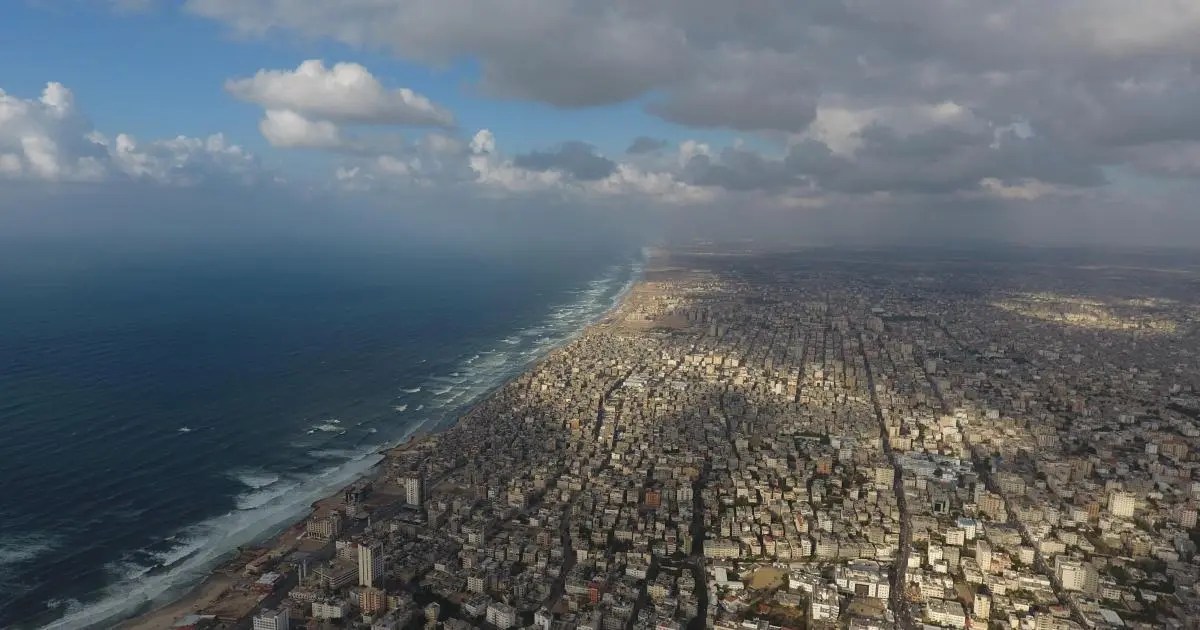
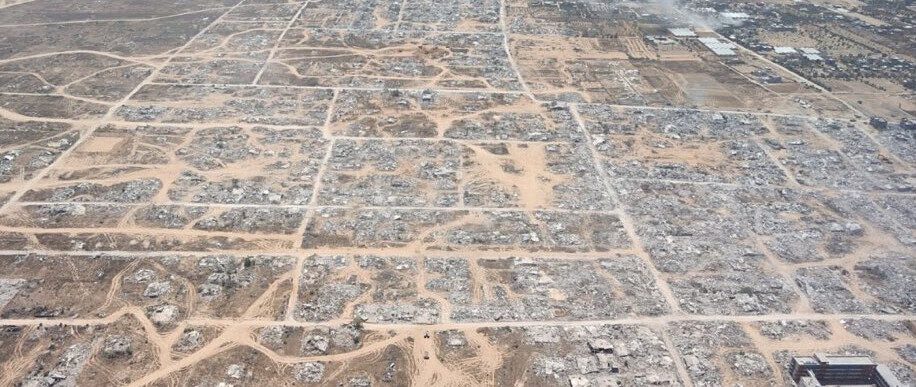
photo: Amnesty International/Younis Tirawi

On Yom Kippur, we say the hard truths out loud. On Yom Kippur, we proclaim together as a community: chatanu, we have sinned. We have failed. We have not lived up to our promises of the past year. 

I don’t know that I’ve ever experienced these words more brutally than I do this year. In last year’s Rosh Hashanah sermon, I ended with these words: “A year from now, when we are back here, we will have to have an answer. We can’t find ourselves just asking the same question. We must be ready to answer: what did we do in the last year to bring this genocide to an end?”

We have failed. It is now one year later and Israel’s genocide against the Palestinian people in Gaza is continuing toward its second year mark. As I speak these words, the Israeli military is literally leveling the entire northern region of Gaza to the ground. Earlier today, Israel issued its final warning for Palestinians in Gaza City to evacuate, saying everyone who remains will be considered a “terrorist.” Many are refusing to leave, many are unable to leave. 

It is horrifying to even say these words out loud: on this Yom Kippur, the day when we plead to be written into the Book of Life, Israel is systematically erasing Gaza from the map – and the people of Gaza along with it. 

I’ll be honest with you: I’ve struggled mightily over what I could possibly say tonight that would be worthy of Yom Kippur. I could discuss the geo-political causes that have been prolonging this genocide. I could discuss craven US politicians and corporate gangsters who are planning to carve up Gaza for their own profit. I could spend my time excoriating the Jewish establishment for supporting this genocide – and too many Jewish communal leaders for their silence. But frankly, none of it would be particularly new. None of it feels worthy of the grief pervading this sacred moment of Yom Kippur. 

I also don’t want to spend this sermon describing the specific litany of the atrocities being inflicted on the people of Gaza – to reduce them to trapped, powerless victims. We’re all too familiar with the horrors of the past two years. Like so many of you, I’ve been scrolling daily through unbearable pictures and videos live streaming Gazan’s agony, their erasure. There’s something obscene about the casual way we’ve been viewing these horrors on our mobile devices, right alongside memes and texts and emails as we go about our daily business. 

And yet at the same time, I know we must bear witness. We owe it in particular to the courageous young Gazans reporting on their own erasure from the ground even as Israel maintains a total media blackout. We cannot and must not look away. This has been our sacred responsibility to the people of Gaza. It is precisely through this bearing witness that we affirm their essential humanity. 

As I thought about what I could possibly say to you tonight, I kept returning the same basic truth: if these days are to have any meaning for us at all, it is Yom Kippur’s sacred challenge to publicly affirm our accountability to the Palestinian people – as Jews and as human beings of conscience. We cannot let ourselves become complicit in their erasure. If we are truly serious about Yom Kippur, we must vow that solidarity is our sacred obligation. 

When I think about Jewish accountability to the Palestinian people, I must mention our profound debt to Prof. Marc Ellis, of blessed memory, the great Jewish scholar, writer and theologian, who was an important teacher to me and a friend to our congregation from our earliest days. I quoted Marc in my very first sermon at Tzedek Chicago and many more times over the years. He was a prolific writer, but more importantly he was a courageous writer. Among other things, he wrote a great deal about what he called “revolutionary forgiveness” and the imperative for a collective Jewish confession to the Palestinian people. As he put it:

Revolutionary forgiveness in Israel-Palestine begins with a confession by the Jewish people. The confession is simple. What we as Jews have done to the Palestinian people is wrong. What we are doing to the Palestinian people today is wrong. With that confession, we agree to begin to walk the path with Palestinians towards justice and equality. As that path begins to be walked, the memories of each people, broken by history, remain. But as that path is walked, new memories begin to be created. As those memories of justice and equality are created, they begin to dominate the history of both peoples until in the end an injury against one is an injury against all.  Revolutionary forgiveness; confession, justice at the center.  

Marc died last year, far too young, as Israel’s genocide against the Palestinian people was raging in full force. I yearn to talk to him now about this confession. I so want to ask him if he would still, in this terrible moment, be writing about mutual, revolutionary forgiveness? I want to ask: is forgiveness even possible any more? Or is what Israel is doing to the Palestinian people truly unforgivable? And if that is the case, is there really any future at all? Can there ever be any hope for real justice in Palestine/Israel?

For the past two years I’ve been in touch with my friend Rachel Betarie, an antizionist Israeli Jew and activist and former director of the organization Zochrot. Over the months, her words to me have become progressively more despairing as she’s described how it feels to live in Israel at this terrifying moment, in a country where the majority of its citizens support the genocide.

Recently, Rachel told that she was part of a new working group organized by Zochrot, as she put it, “of activists in Palestine, colonized and Anti-Zionist colonizers, who have been meeting since April to think, re-imagine, and suggest concrete processes through which the right of return for Palestinian refugees from Gaza could be realized after the genocide.” She went on to write:

It is not easy to imagine a better, more just future at a time when the ground is crumbling under our feet. Some of us have families in Gaza and most of us have deep ties there. All of us see our future here in Palestine, between the river and the sea. The question arose again and again in our meetings: Is it even relevant to talk about the future right now? Isn’t this just escapism? Still, we chose to trust each other – a work in progress – and our deeply held values, and extract some ideas from our process of learning and discussing. With every meeting it became clearer to what extent the Nakba, and the ongoing system of settler colonialism – not October 7, 2023 – was and still remains the root of the problems we face today, and that return is the core of every future solution that has a chance to bring any stability, justice and peace to our communities, and that entails dismantling of the Zionist colonial regime.

Through this work, we came to the conclusion that return from Gaza must begin – not at some distant point in the future. Our discussions did not only focus on the design of return but also raised questions of community, of collective and individual healing, and of how social processes of repair can accompany physical return. With our hearts shattered daily by the horrors of the genocide, and with fear and hopelessness engulfing us, envisioning this still possible future is in itself a remedy.

I’m so inspired by their effort, their determination to come together, Israelis and Palestinians – or as Rachel put it, colonized and colonizers – even in this unbearably tragic moment, to vision a future of reparation and return. They know full well that they are a tiny minority in Israeli society, a small island of hope amidst an ocean of trauma and fury. And yet they are determined to keep this vision alive despite it all.

As I think further about how we might envision the future this Yom Kippur, particularly here in the diaspora, I keep returning to one basic truth: Palestinian voices must be centered in our observance. Quite frankly, I don’t know how we can do the work of teshuvah, of repentance and return if we don’t hear their stories directly, open up fully to their voices and honor their experience. 

As I said earlier, as we gather tonight for Yom Kippur, Israel is erasing the entire northern region of Gaza City, the most populous, built-up region of the Gaza Strip. According to reports, the scale of these demolitions are unprecedented. Over the past few weeks, the Israeli military has been systematically destroying every high-rise building in Gaza City. Satellite pictures show that the most populous region of Gaza has been reduced to a lunar landscape. Israel has already done this to large swathes of the Gaza Strip, including the city of Rafah in the south and the town of Beit Hanoun in the north. 

These words, however, are mere reportage. I believe it’s critical that we hear the story of this erasure from those who are most directly impacted. And so I’d like to share with you two extended testimonies for this Yom Kippur, our day of reckoning. The first is the voice of Taher Herzallah, who comes from Gaza City and works as the Director of Organizing for American Muslims for Palestine. These are the words that Taher recently posted his Facebook page: 

Gaza has fallen.

I’m not a sensationalist, nor am I someone who likes to shatter people’s hopes. But what we are witnessing today is the complete and utter annihilation of a people. It really feels like the end of Gaza City, and I don’t say this lightly, especially since I have family members and friends in Gaza who follow me on this page. This is the city where my father was born and where my family has lived for centuries.

Many of my relatives held out for two years under the worst conditions human beings can live under. But for more than 700 days, they’ve endured and found ways to survive in Gaza City.

No longer.

They’ve decided to leave Gaza City for the first time since this all started. It is just no longer possible to live there. With Israel’s systematic destruction of many of the major residential high rises in the city this week, the message is unequivocal: all of Gaza City will be leveled to the ground, the way Rafah and Jabalya and Khan Younis and Beit Hanoun were.

The images of displacement today broke something inside of me. People, looking back at Gaza with tears in their eyes, are moving south into another uncertain reality. Death and suffering are still a high likelihood as “safe zones” don’t truly exist. They know a return to Gaza is unlikely and they will be stuck in a cycle of displacement and suffering for years to come. But what choice do people have?

Some people refuse to leave Gaza. Not only out of stubbornness but also because they don’t have the means to leave. With the lack of aid organizations or large-scale efforts to facilitate the transfer of the population to another area, everyone in Gaza is left alone to figure out how to move their families to safer zones.

I have family members in Gaza who have gone back and forth from Gaza City to Deir El Balah 3 or 4 times to find a small plot of land to set up their tents. Finding an apartment or a built structure to live in is an absolutely hopeless endeavor. The best-case scenario now is to find a small plot of land large enough to erect a tent. With 2 million people squeezed into a small area on the Gaza coast, even that has become nearly impossible…

The stories we are hearing out of Gaza are heartbreaking and soul-crushing. A 10-year-old child in Gaza City was asked what his hopes are for ending this war. His response: “I only hope for one thing–to find my dad’s body and to bury him.” This is the extent of the boy’s hopes and dreams. To find consolation in burying the body of his father, who was killed at a Gaza Humanitarian Foundation distribution site.

Other people have similar stories. They refuse to leave Gaza City, not because they don’t think it’s dangerous, but because they have loved ones buried under the rubble that they have not retrieved and can’t fathom moving on in life without burying them. The psychological and physical trauma of this genocide is so severe that people know that carrying that trauma will be the end of them anyway, and would rather die in Gaza City than endure years of more suffering…

To my family reading this: I am sorry. I have failed you. I don’t know what else to say. I hope you forgive me.

For the rest of us: whatever happens next will be very difficult. So prepare accordingly.

The next Palestinian voice I’d like to share with you is that of Asem Alnabih, an engineer and PhD student and spokesman for the Gaza municipality, who recently evacuated from the Shujayea region of Gaza City. Shujayea is one of the largest neighborhoods in Gaza and once had up to 100,000 residents. It is also a historically significant neighborhood, located in the southern quarter of Gaza’s Old City. Shujayea dates back to the 13th century and is named after Shuja’ al-Din Uthman al-Kurdi, a Muslim commander who died fighting the Crusaders. In the Ottoman period, it was the only mixed quarter in the Old City, where Muslims, Christians and Jews once lived together.

I remember Shujayea well when I visited Gaza in 2017 as a staff member for the American Friends Service Committee. It’s residents were clearly proud of their home, of its history, its deep sense of community and especially of its resilience. Although Shujayea was heavily bombed by Israel in its 2009 and 2014 assaults, residents rebuilt their homes each time. 

Here is Asem Alnabih’s testimony, which he wrote in an article for Al-Jazeera:

My neighbourhood in east Gaza, Shujayea, is gone! The streets that once echoed with the laughter of children, the calls of vendors, and the familiar rhythms of daily life now lie in silence, smothered by dust and destruction. What was once a vibrant community, full of stories and memories, has been erased in a matter of moments.

A few days ago, my brother Mohammed went back to Shujayea to check on our family home. When he came back he told my father that nothing remained except for a few broken walls and scattered columns. A few hours later, we were shocked to learn that my father himself had braved extreme danger to see it with his own eyes. In a place where every step can mean death, he chose to walk through the ruins of our past.

This was the house my grandfather and father had built with years of effort, the house that carried my dad’s dreams and bore the marks of his sweat and sacrifice. It was where he raised his children, where we celebrated weddings and birthdays, where countless family memories were made. And now, it is nothing but rubble.

But our family’s loss is not just this one house. My father’s destroyed home is now added to my own burned apartment, my sister Nour’s bombed apartment, my sister Heba’s demolished home, and my sister Somaia’s two apartments – one reduced to rubble and the other burned. To this list are added my uncle Hassan’s destroyed building, my uncle Ziad’s building, my uncle Zahir’s home, my aunt Umm Musab’s apartment, my aunt Faten’s apartment, and the completely destroyed homes of my aunts Sabah, Amal, and Mona. And these are only the losses within our immediate family. All around us, countless relatives, friends, and neighbours have seen their homes obliterated, their memories buried under the debris.

This is not simply about the staggering material value of what we have lost. Yes, the homes were filled with furniture, personal belongings, and cherished possessions, but the destruction goes far deeper than material things. What has been taken from us is irreplaceable. A house can be rebuilt, but the sense of belonging that comes from walking familiar streets, from living in the same neighbourhood where generations of your family have grown up – that cannot be reconstructed with bricks and cement.

Shujayea was more than just buildings. It was a community stitched together by relationships, shared histories, and the memories of ordinary lives. It held the neighbourhood bakery where we bought fresh bread at dawn, the small corner shop where neighbours gathered to chat, the ancient Ibn Othman mosque that echoed with prayers during Ramadan. These were the spaces where children played, where families celebrated, and where neighbours supported each other through good times and bad.

When a neighbourhood like Shujayea is erased, it is not only walls that fall; it is a whole way of life. The destruction severs ties between neighbours, scatters families across shelters and refugee camps, and leaves a deep wound that no reconstruction project can truly heal. A rebuilt house may have four walls and a roof, but it will not be the same home that once carried generations of stories.

The pain of this loss is not unique to my family. Across Gaza, entire neighbourhoods have been flattened. Each pile of rubble hides the history of a family, the laughter of children, the wisdom of elders, and the love of a community that once thrived there. Each destroyed home is a silent witness to the human cost of this war, costs that cannot be measured in money or damage assessment.

What we have lost is not just property, but identity. A home is where a person’s life unfolds, where milestones are celebrated, where griefs are shared, where bonds are formed. To see so many homes destroyed is to see an entire people uprooted from the places that defined them. It is a calculated erasure, not only of lives, but of memory, heritage, and belonging.

Rebuilding will not bring back what was taken. The new buildings, if they ever come, will stand on top of the graves of our memories. They will not bring back my father’s years of hard work, nor the sense of comfort and security that once came with having a home. They will not resurrect the neighbourhood we knew, the one full of warmth, familiarity, and life.

The destruction of Shujayea is a wound that will remain open for generations. It is not simply a matter of humanitarian aid or reconstruction funds. This is about the deliberate dismantling of a community’s heart and soul. No amount of concrete can rebuild trust, restore memories, or bring back the neighbours who have been killed.

Shujayea is gone. And with it, a part of us has been buried. Yet even as we grieve, we hold on to the stories, to the love that once filled our homes, to the hope that someday justice will prevail. Because while they can destroy our houses, they cannot destroy the bonds we carry in our hearts, nor the memories that no bulldozer or bomb can erase.

On Yom Kippur, we say the hard truths out loud. And this Yom Kippur we must vow to hear them directly from the voices of those who would otherwise be silenced. Those whose lives would otherwise be erased.  We cannot even imagine atonement if these voices are not with us during this most sacred observance. 

On this evening of Kol Nidre, we admit publicly that we will fail to live up to the vows we make in the coming year. Does that mean we should adjust our vows to be more realistic, more achievable? Does it mean we should not make them at all? I personally find that prospect unbearable. On Yom Kippur, we are obliged to strive for our highest selves, even as we know we will not fully succeed. 

So tonight, let us hold tight to these vows. Let us vow that our movement will end this genocide in the coming year. Let us vow that the armies will withdraw, that Gaza will be rebuilt, that the dead will be given dignified burials, that the dispossessed will find home and shelter. 

And further, let us vow that Israel will be held accountable for its crimes, that the refugees will return, that reparations will be paid. Let us vow that Palestine will be free, that all will be liberated from the river to the sea. 

Yom Kippur demands that we make such vows, as unreal as they may seem to us now. Because as Asem reminds us, “even as we grieve, we hold on to the stories, to the love that once filled our homes, to the hope that someday justice will prevail. Because while they can destroy our houses, they cannot destroy the bonds we carry in our hearts, nor the memories that no bulldozer or bomb can erase.”

On Yom Kippur we vow these vows because we know that as long as we hold on to these stories, to these memories, to this love, then nothing and no one can ever truly be erased. And the hope for justice will never die.

Ken Yehi Ratzon – May it be God’s will. V’chen Yehi Retzoneinu – And may it be our’s.

Amen.
“All Who are Hungry Come and Eat:” A Report from a Passover Action at the Gaza Border

Cross-posted with The Nation

In 2017, I spent several days in Gaza as a staff person for the American Friends Service Committee. Although I took away many powerful and vivid memories from that trip, some of the most indelible involved the delicious food that was continuously served to us by our Gazan hosts. Gazans are famously proud of their cuisine, and rightfully so, as it provides them with a palpable connection to Palestinian history and life outside that small 140 square mile strip – to communities in Palestine that their ancestors used to live. As journalist Laila El-Haddad has observed, Gazan food is “a sort of treasure map to a largely invisible, or invisibilized, world of Palestinian history going back well before the 1948 Nakba.”

During the course of our visit, Ali, a member of the AFSC Gaza staff, mentioned more than once that Gazan knafeh (a traditional Arabic dessert) was by far the best in Palestine. When our staff group gathered at a restaurant in Gaza City for our final meal, Ali was chagrined to learn that there was no more knafeh left in the kitchen. Determined, Ali got up, ran down the street to another restaurant, and returned with a huge round plate of the sticky, golden pastry for our table. It was indeed more delicious than any knafeh I have eaten before or since.

I’ve recalled that sweet memory often over the past seven years. When I think of it now, however, I find its sweetness has curdled into horror. As far back as December, human rights agencies determined that Israel “was using starvation as a weapon of war.” According to the World Food Program, Gaza’s food system was on the brink of collapse and the population was facing a “high risk of famine.”

This past March, the mainstream media published shocking, heartbreaking pictures of Yazan Kafarneh, a 10 year old Gazan boy reduced to skin and bones from starvation. To date, it has been estimated that 28 children have died of malnutrition and starvation in northern Gaza. By all accounts, starvation in Gaza has now reached “catastrophic” proportions. Knowing about the Gazan people’s deep pride in their food culture, I’m experiencing deep heartbreak as I read reports that Palestinians in Gaza are now forced to eat grass just to survive.

As a congregational rabbi, I’ve spoken with many people have told me that they are not sure how – or even if – they will celebrate Passover this year. With the genocide and forced starvation of the people of Gaza deepening with no end in sight, they say, it just feels beyond challenging to celebrate a festival of Jewish liberation. To make the moral dissonance even more dissonant, many in the Jewish communal establishment are framing Passover by focusing exclusively on the Israeli hostages in Gaza and call for their liberation from Hamas, with nary a mention of the 35,000 Gazans who have been destroyed in the process through Israel’s genocidal war of vengeance.

More than once I’ve been asked, “How can I partake of this festive meal while Israel has been starving Palestinians in the name of the Jewish people?” How can I read about Pharaoh’s oppression of Israelite children when I’ve just read the latest death count of Palestinian children dying increasingly things from forced starvation?

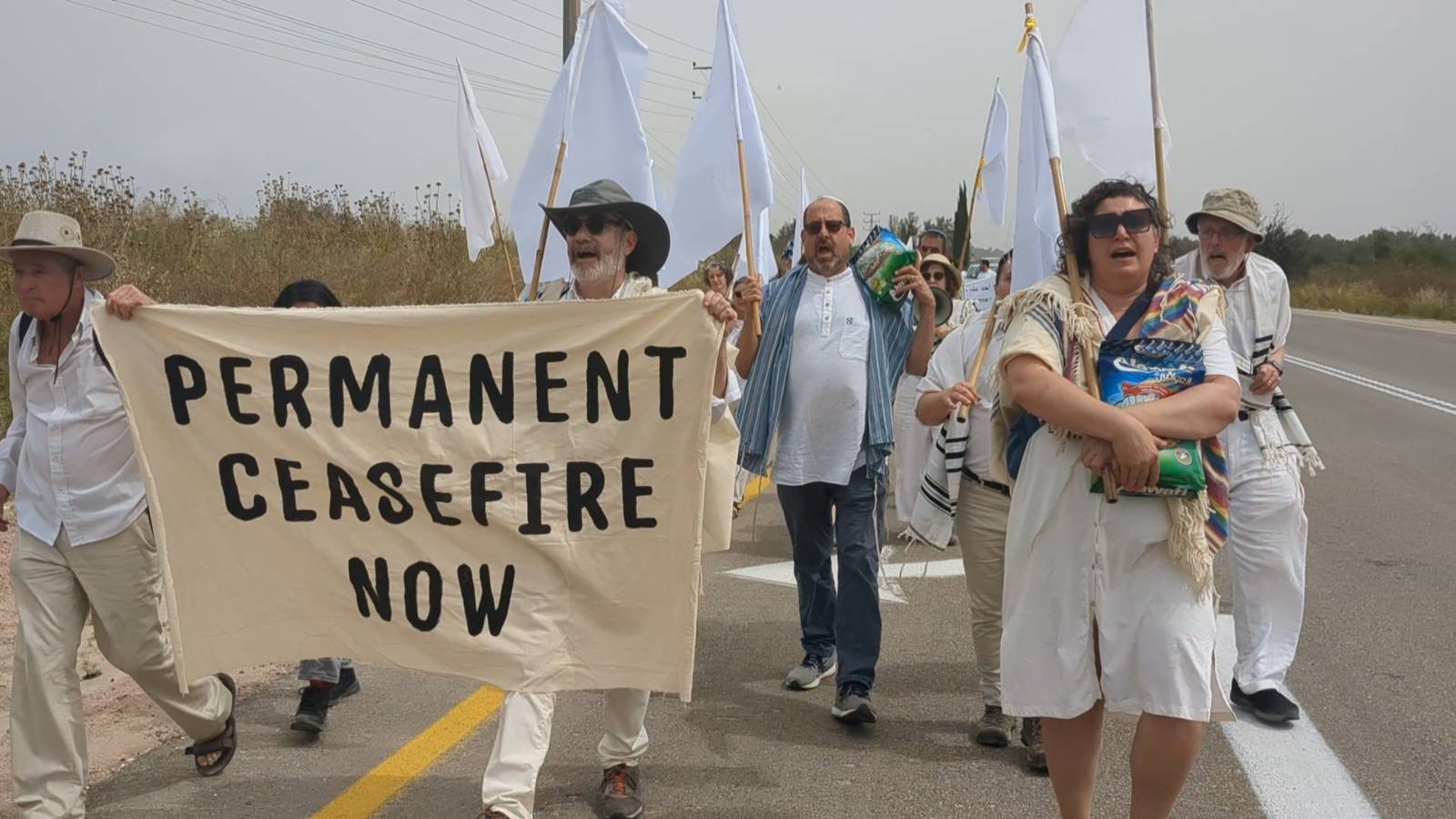
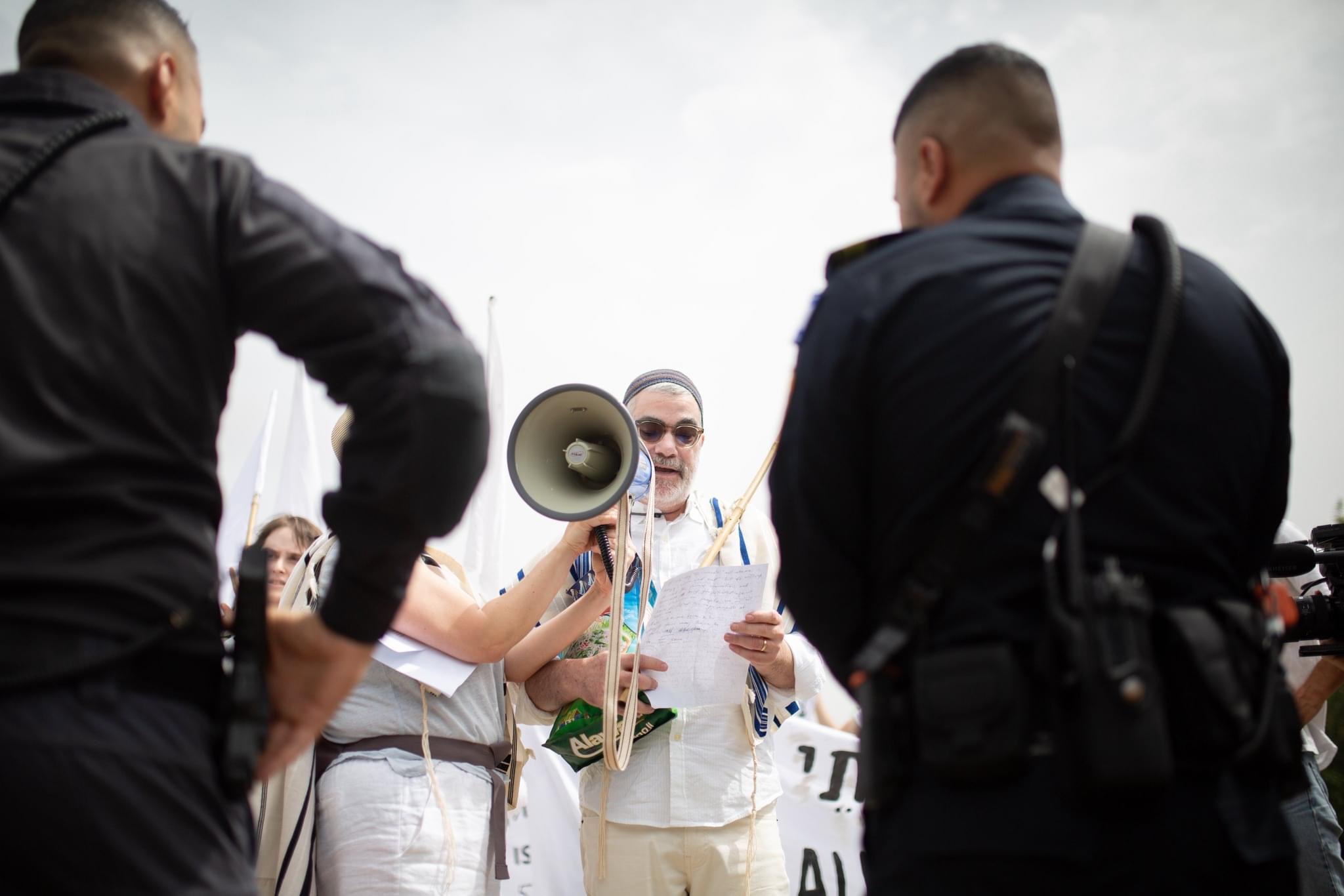
As a political-spiritual response to this unprecedented Passover moment, Rabbis for Ceasefire mobilized and began to organize as action at the Gaza border, to literally bring food supplies with us and demand to that Israel allow us to pass through the Erez Crossing, motivated by Passover’s central imperative, “All who are hungry come and eat!” Our action would include 10 American rabbis, writer/essayist Ayelet Waldman and 30 other Israeli activists – including Israeli rabbis – who have been tirelessly protesting both at the Gaza border and organizing protective presence for West Bank communities targeted by settler violence.

Our action was originally planned for the week leading up to Passover; but when Iran’s missile attack caused the country to go on alert and airlines cancelled their flights to Israel, we almost had to cancel our action. As we read the news, Israel’s escalating hostilities with Iran took front and center The US and the West were rearming Israel and focusing on the threat from Iran – even as Israel continuingly maintained its policy of starvation and bombardment of Gaza. Most alarming were the reports that an Israeli agreement to retaliate lightly against Iran would give them leeway to move ahead with a potentially disastrous ground invasion of Rafah.  We bought plane tickets for the next week, determined to make a collective Passover statement that felt more critical than ever.

During our action, we gathered at a preplanned meet-up location, with a truck filled with half a ton of flour. We each shouldered backs of rice and, carrying banners and flags, march in the direction of the Erez Crossing. The Israeli police quickly drove up to intercept us. During that initial stand-off, several of us offered statements. I began with an opening prayer, an adaptation of the “Magid” section of the Passover Haggadah:

“This is the bread of affliction, the bread and food systemically, cruelly denied the people of Gaza. Let all who are hungry come and eat. Let all who are oppressed be liberated this Pesach. Now we are here – tomorrow let there be bread for Gaza. Now we are here – next year may there be liberation from the river to the sea!”

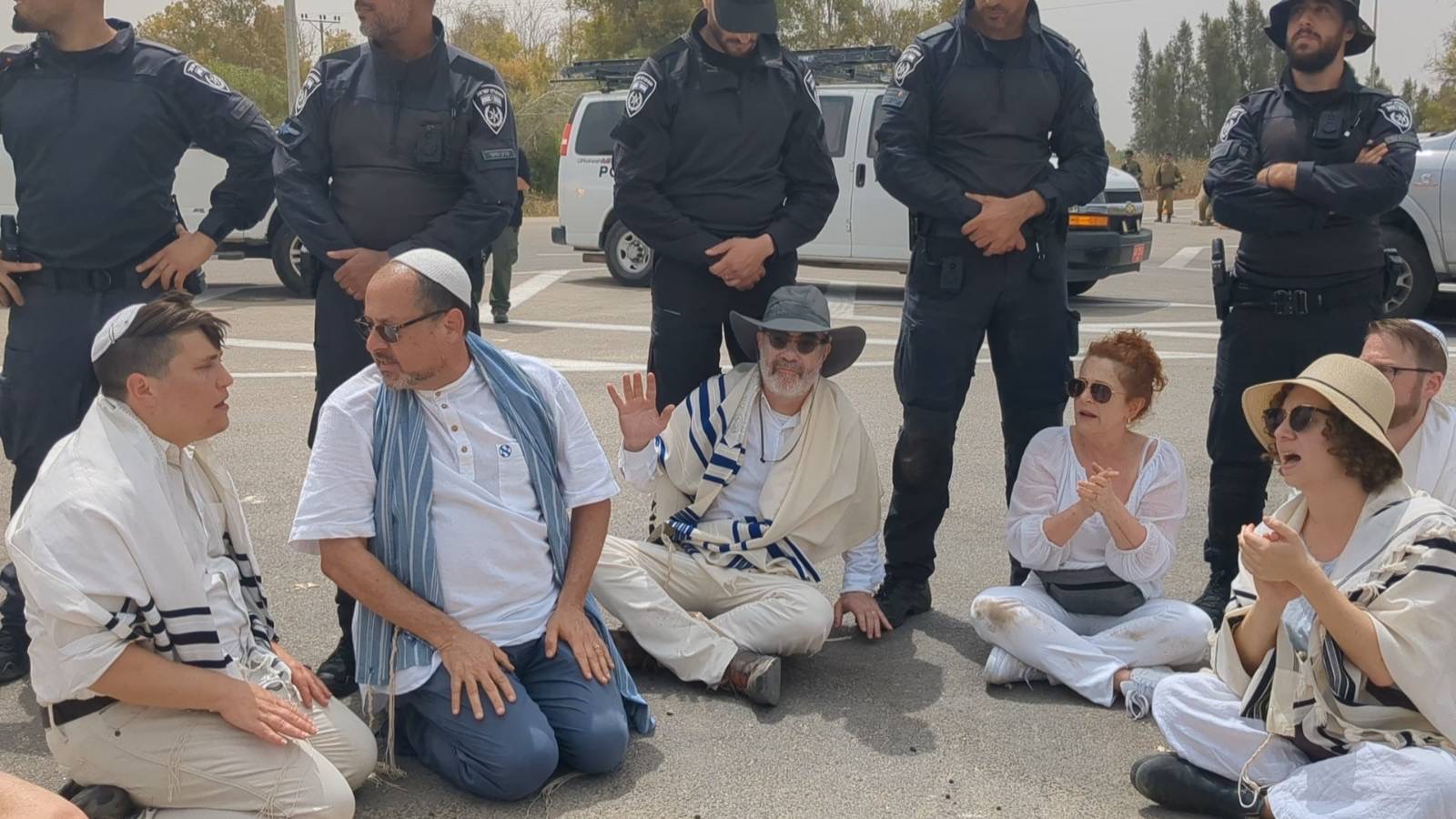
Other speakers included Israeli Rabbi Avi Dabush of Rabbis for Human Rights, a resident and survivor of a kibbutz that was attacked on October 7 and Noam Shuster-Eliassi, a well-known Israeli activist, writer and comedian. When our program was over, we pushed forward toward the border. When the soldiers violently attempted to break us up, several of us sat down in the road. During the course of the protest seven of our group: four Americans and three Israelis were arrested.

All of the arrested were fully prepared for this eventuality – the Israelis were in fact veterans at protest-arrests and had previously briefed us on protocol. They were taken to two dentention centers and interrogated for eight to nine hours. The American were told, perversely, that they were being held for “attempting to bring food into Gaza.” All the arrested were released that evening; thankfully the food we attempted to bring into Gaza was not confiscated; as we have previously planned, it was donated to the community of Masafer Yatta – an area in the South Hebron Hills were almost 3,000 residents are resisting the daily threat of demolitions, evictions and dispossession.

While we are satisfied with the attention our action has received, we have no illusions about the current moment in Gaza. Nearly 2.2 million Palestinians in Gaza currently face mass starvation and encroaching famine, these words have resonated with unbearably profound force during Passover this year. Hundreds of trucks filled with humanitarian goods have been sitting idle on roads leading into the Rafah crossing on the border with Egypt, blocked from entering Gaza by a draconian inspection process that severely limits the number of trucks that can pass through. Inside Gaza, the Israeli has been attacking efforts aid efforts with tragic results. According to the UN, the Israeli military has killed 196 relief workers; soldiers have also shot and killed hundreds of Gazans who venture out to seek food.

Amidst it all, the one agency that has the capacity and infrastructure to effectively distribute relief to the people of Gaza, the United Nations Relief and Works Agency (UNRWA), has been defunded by the Biden administration. This past January, the Israeli government leveled the still-unsubstantiated claim that 12 UNRWA employees were involved in Hamas’ October 7 attacks in Israel. Though UNRWA immediately fired the employees in question and launched an investigation, the US immediately withdrew their financial support of the agency, which was founded in 1949 to provide support to the hundreds of thousands of refugees created by the establishment of the state of Israel.

In its spending bill this past March, the US government extended its defunding of UNRWA for a year. Though the agency reports it has sufficient funds to operate until the end of May, its ability to operate in Gaza has already been gutted. Last month, Israel announced it would no longer approve UNRWA food convoys to the north of Gaza, where famine is the most. According to its report this month, the agency noted that “a total of 420 trucks food trucks were denied or impeded by Israeli authorities (during the month of March) …Gaza is on the brink of famine, with 1.1 million people—half of its population—experiencing catastrophic food insecurity due to the intense conflict and severe restrictions on humanitarian access.”

Most ominously, Israel continues to amplify its threats to invade Rafah, which would almost certainly result in massive human tragedy and the complete ethnic cleansing of Palestinians from Gaza. And yet, in the wake our action on the border, I continue to hold out hope. It is clear to me that our border-protest was part of something much larger: the dramatic rise in student resistance on college campuses throughout the US and unprecedented popular Palestine solidarity increasing around the world. For me, this moment expresses the core meaning of Passover powerfully than I have every experienced in my lifetime: in every generation, the cry of the oppressed demands to be heard.

This Passover, I also hold out hope from my own memory of meals in Gaza back in 2017. To be sure, AFSC’s Gaza staff has suffered terribly during this genocidal onslaught – and I’m sure the restaurants and neighborhoods where we enjoyed such delicious meals with our Gazan friends are no more. But I will never forget the tastes of the food that were so graciously served, as well as the communities in Palestine that they represent. And I am more convinced than ever that Israel cannot, try as it may, starve, bomb, or shoot away the Palestinian people’s love for their culture that is so deeply, fragrantly rooted in their homeland: In the words of El-Haddad:

Lately, I’ve been thinking about what I would go back to, and what I would find, if I returned to Gaza. Most of the landmarks have been destroyed. Gone too are many of the people I cherished. But … it feels like I am the torchbearer now, the family’s keeper of treasured recipes. Like Um Hani (Leila’s aunt, who was killed in an Israeli airstrike), I will cook and I will teach, connecting the next generation of Palestinians to our homeland.

Seeking Understanding Amidst the Horror in Israel/Palestine

When I heard the initial reports that Palestinians had breached the fences of Gaza this past Saturday, I will be completely honest – my first reaction was “good for them.” Israel had been collectively punishing Palestinians in Gaza for years with a crushing blockade with little to no care from the rest of the world. Now, amazingly, Palestinians had broken free from this seemingly impenetrable open-air prison. With power and ingenuity, they were resisting their oppression, reminding Israel – and the world at large – that they were still here. That they would not submit.

Inevitably, as the news of the attacks trickled in during the course of the day, however, my emotions turned to shock and grief. Along with the rest of the world, I learned about the sheer scale of violence committed by Hamas militants against Israeli civilians: the largest single day massacre in Israeli history. At last count, at least 1,200 Israelis have been killed and it is estimated that 150 have been abducted and taken hostage into Gaza. Everyone in Israel and many Jews throughout the world, know people – or know of people – who were killed, injured or taken hostage. Like so many in the Jewish community, my social media feed has been filled with heartbreaking pictures and stories of Israelis who have been slain or are still unaccounted for.

Amidst all the grief, however, I was also deeply troubled by the ominous, growing cries for vengeance voiced by the Israeli government and media, and felt a creeping dread over the shattering military response that would almost certainly rain down on the people of Gaza. And now that day has come. Israel has shut off all electricity and water for over two million Palestinians as the military wreaks complete and total devastation on across that tiny strip, attacking hospitals, schools, mosques, marketplaces, and apartment buildings.  As of this writing, the death toll has risen to more than 1,200, with 5,600 wounded. More than 250,000 people have been rendered homeless – and these numbers will almost certainly rise significantly in the coming days and weeks.

In a letter to my congregation a few days ago, I wrote that “so many of us are feeling layers upon layers of intense emotion, in often confusing and contradictory ways. For Jews who stand in solidarity with Palestinians, I know these confusing contradictions are particularly keen.” Even so, I wrote, we simply must lift up the underlying context of this horrible violence. I continue to hold tightly to this conviction. While the sheer scope of our grief may feel incomprehensible, we simply must find the wherewithal to say out loud that the facts of these events have not only been comprehensible, but in fact inevitable.

Indeed, Palestinians and their allies have long been sounding the alarm that Israel was subjecting Palestinians to a brutally violent apartheid regime with impunity – and that there would be terrible consequences if the international community failed to intervene. Over and over, we’ve been warned about the cataclysmic violence that would inevitably ensue if Israel was not held to account. As Palestinian historian Rashid Khalidi put it recently, “an entire people (has been) living under this kind of incredible oppression, in a pressure cooker. It had to explode.”

As we attempt to understand the context of this recent violence, I believe it’s utterly critical to know where to plot the starting point – and to my mind, this is precisely where most of the media analyses of the past several days have sadly gone astray. To judge by any number of pundits, this current outbreak of violence began alternatively with the US – Saudi deal or the policies of the far-right Netanyahu administration. While it might be said that any of these causes may have provided the most recent spark, I’ve been deeply disappointed, if not surprised, that precious few of these analyses have even mentioned the Nakba in relation to this latest outbreak of violence.

To be sure, the Nakba was an act of violence and harm that has been reverberating through the land between the river and the sea from 1948 until this very day. To put it simply, for the past 75 years, Israel has been violently dispossessing Palestinians in order to make way for a majority Jewish state. And for just as long, the Palestinian people have been resisting their dispossession – yes, often violently.

It is not by chance that this most recent violence has occurred in and around Gaza. As many commentators have observed, Gaza has in many ways been the epicenter of the Nakba – and of the Palestinian people’s resistance to it. To grasp this fully, it is important to understand the history of this region. Gaza’s narrative did not begin with Israel’s blockade or the political ascension of Hamas. What we call today the “Gaza Strip” was artificially created in 1949, when it became a repository for a flood of ethnically cleansed Palestinian refugees from cities and villages in the coastal plain and lower Galilee. Before the Nakba, the population of this small region numbered 60 to 80,000 residents. By the end of the hostilities, at least 200,000 refugees were crowded into this 140 square mile strip of land.

At the time, most of the refugees fully expected to return home – some could even see their towns and villages through the fences. Those who crossed the border to gather their possessions or harvest their crops were considered “infiltrators” by Israel and shot on sight. Eventually, it became all too clear there would be no return. Over the years the tents turned into concrete buildings that grew ever higher along that narrow corridor. The numbers of that once sparse territory have grown to a population today of over 2,000,000 people – at least 70% of whom are refugees.

Following the founding of the state of Israel, many of the original settlements and kibbutzim founded on the border with Gaza were military outposts, most of which were built on top of or near demolished Palestinian villages. In fact, the sites that suffered the brunt of last Saturday’s massacres (including Kibbutz Kfar Aza, Re’im and Sderot) were settlements that were originally established in these locations for reasons of Israeli “national security.”

One such site was Kibbutz Nahal Oz, which was flooded by dozens of Hamas militants, and where, according to witnesses, at least two entire families were killed, and two more kidnapped and taken to Gaza as hostages. When I heard about the massacre at Nahal Oz, I couldn’t help but recall that this was not the first time this community had experienced Palestinian armed resistance. Back in 1956, a group of Palestinian militants entered Nahal Oz and killed a kibbutznik named Roi Rotenberg. At the time, this tragedy was keenly felt throughout the nascent state of Israel. At Roi’s funeral, the famed Israeli general Moshe Dayan offered a eulogy, expressing himself with brutal and unexpected honesty:

Do not today besmirch the murderers with accusations. Who are we that we should bewail their mighty hatred of us? For eight years they sit in refugee camps in Gaza, and opposite their gaze we appropriate for ourselves as our own portion the land and the villages in which they and their fathers dwelled…This we know: that in order that the hope to destroy us should die we have to be armed and ready, morning and night. We are a generation of settlement, and without a steel helmet and the barrel of a cannon we cannot plant a tree and build a house. Our children will not live if we do not build shelters, and without a barbed wire fence and a machine gun we cannot pave a road and channel water. The millions of Jews that were destroyed because they did not have a land look at us from the ashes of Israelite history and command us to take possession of and establish a land for our nation.

Dayan’s words resonate today with terrible prescience. Decades later, the descendants of this original Gazan generation still remain in refugee camps in Gaza, “gazing though the barrier fences as Israel appropriates as its own portion the land and the villages in which their ancestors dwelled.” Dayan’s eulogy also powerfully described a hypervigilant Israeli mindset that has only deepened throughout the decades. Since the Nakba could not and did not result in the complete ethnic cleansing of Palestinians from their homes, Israel has attempted to control them with a “steel helmet and the barrel of a cannon” for the past 75 years. During this time, Israel has widened its regime of violence in order to contain Palestinians in the occupied territories, subjecting them to a daily context of systemic, unceasing state violence every moment of their lives.

It is also telling that Dayan invoked the trauma of the Holocaust in his eulogy – and today, so many decades later, we can clearly see that this trauma was not limited to his generation alone. If anything, it has been handed down to subsequent generations in way that are all too real and all too palpable. Indeed, we can clearly see this generational trauma at work in Jewish responses to this latest violence, which is being openly characterized as “the worst mass murder of Jews since the Holocaust.” It is painfully poignant to consider that these massacres occurred in a state that was founded in the wake of the Holocaust in order to safeguard Jewish lives once and for all.

At the same time, however, this Holocaust rhetoric is deeply troubling given the vengeful fury currently being whipped up by a far-right Israeli government that is demonizing Palestinians with unabashedly genocidal language. Israel’s Defense Minister Yoav Gallant recently stated “Israel is fighting human animals” and should “act accordingly.” Netanyahu has promised that Israel’s military offensive on Gaza will “reverberate for generations.” One prominent Israeli general has promised to “open the gates of hell.” And perhaps most chillingly, a member of Israeli Parliament has called for a “second Nakba that will overshadow the Nakba of 1948.”

As I write these words, the Israeli military is mercilessly bombarding the Gaza Strip with a ferocity that is truly terrifying to behold. For the past few days, I’ve been combing social media for their postings from friends in Gaza, as I helplessly watch footage of whole neighborhoods and communities completely destroyed along with their inhabitants. One of the last messages I read came from a friend and former colleague at American Friends Service Committee: “Nothing left to say. More than 80 hours without electricity, water, or internet connection. Communication is very limited with everyone inside or outside Gaza. Carnage everywhere, hard to recognize streets, we are all waiting for the time to die.”

It is not an understatement to suggest that the Jewish community is now faced with a profound moral challenge. Even as we mourn our dead in Israel, we must acknowledge and protest the genocide Israel is currently perpetrating in their memory in no uncertain terms. I cannot say this forcefully enough: those of us who ignore this reality – who mourn the Jewish dead exclusively without even a mention of the massive crimes Israel is actively committing against the Palestinian people – will be quite frankly, complicit in this horrific bloodshed.

Over the past several days, I’ve found myself returning to a famous narrative from this week’s Torah portion: the story of Cain and Abel. In the wake of the first act of violence in human history, God says to Cain, “What have you done? The blood of your brother is crying out to me from the ground! Cursed by the ground that opened its mouth to receive the blood of your brother.”  From this we learn, among other things, that bloodshed actually has the power to pollute the earth. Later on in the Torah, we will learn that nothing can ever be the same – or considered normal again – when blood is spilled. it must be expiated, or atoned for through a set of very complex and explicit sacrificial rituals. In our day, we can understand these to be acts of reparation, restoration and repatriation. We will only truly make atonement for this bloodshed with very real measures that will restore justice and balance for those who dwell in the land. 

As I read this story, I can’t help but think of the blood originally shed in the terrible days of the Nakba, and how it continues to cry out to us all from the ground. I can’t help but think of the immense amount of blood that has been shed since, whose collective cry must certainly be a searing roar, if only we would allow ourselves to hear it. But we will never heed the cry as along as we remain hardened into sides, into “us and them.” In fact, in this week’s Torah portion, there are no “sides” to speak of. There are no nations, no Israelites, no Canaanites, no Amalekites, no Moabites. There is only one common humanity, struggling how to live together in a too often harsh and unyielding world.

Those it may seem more painfully difficult than ever, let us hearken to this voices that have so long been crying out from the ground. Let us respond with understanding, compassion and action. Even amidst the terrible grief, let us shine an unflinching light on the true roots of this violence – and on the vision of a future based on justice and equality for all who live in the land.

With this in mind, I will conclude now with the prayerful words of my dear friend and colleague Rabbi Alissa Wise:

May the One Who Remembers allow us to hold in one hand 75 years of occupation,
dispossession and violence and in the other a future of peace, justice and freedom;

May the One Who is Slow to Anger soften our hearts and our fists helping us to put down the sword even at the height of the arc of our rage;

May the One of Possibility remind us that a future of peace with justice is possible;

May the One Who Awakens Us to Life hold us in our pain and vindictiveness until we set those down for the sake of life;

May the One Who Endures allow us to act for the sake of the coming generations;

May the One Who is Without Limit expand our senses of what is possible as we reach for justice, freedom and peace for us all.

Amen.

Speaking the Unspeakable on Israel/Palestine: Sermon for Yom Kippur 5784

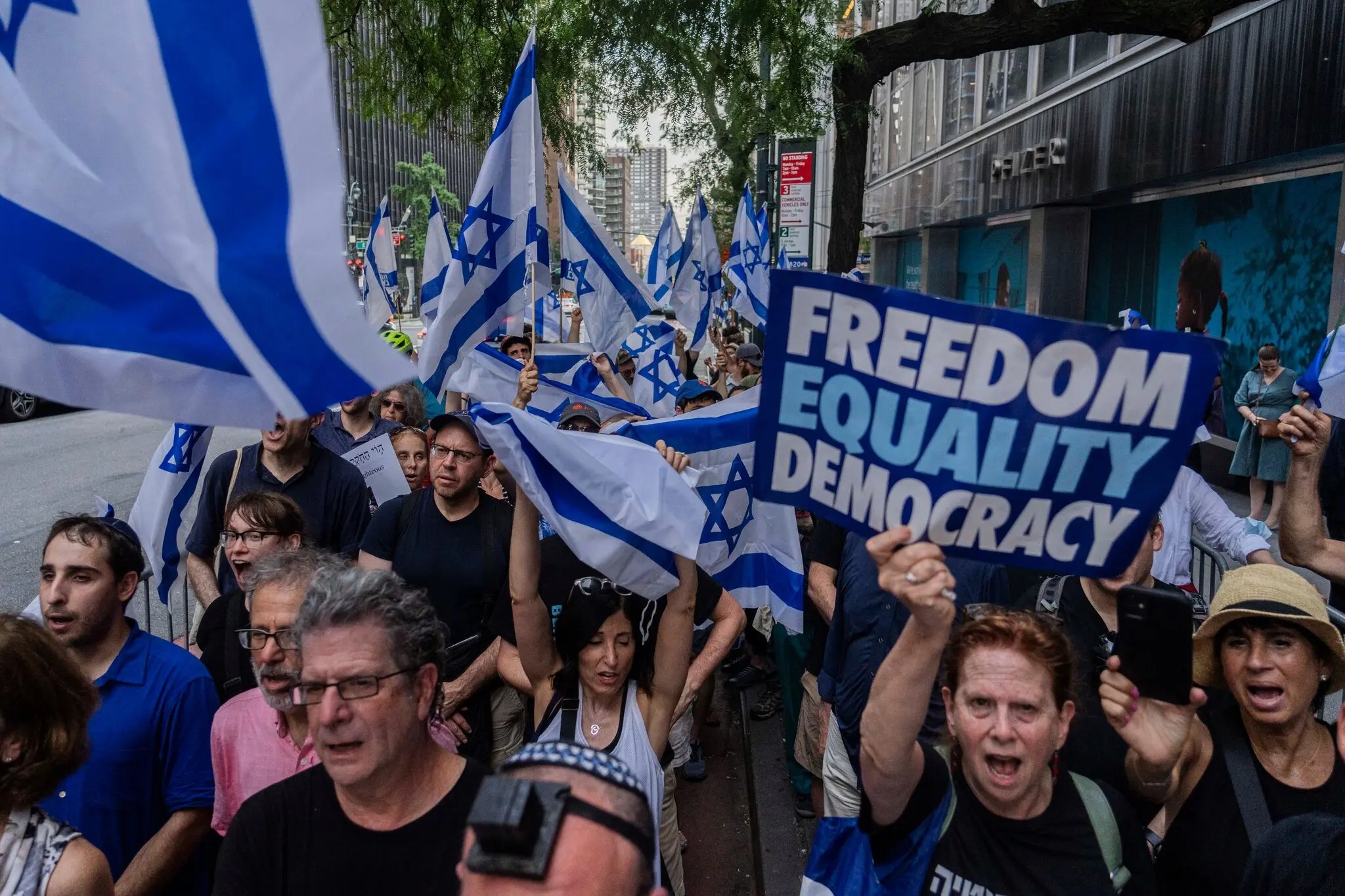
phot: Hiroko Masuike/The New York Times

An op-ed version of this sermon was published in Truthout

Jewish tradition teaches that words have a sacred power. In the very beginning of the Torah, God creates the world itself through the power of the word. In the book of Exodus, the Israelites speak as one people at Sinai, thereby entering into a covenant with God. It is said that on Yom Kippur, the High Priest would enter the Holy of Holies in the Jerusalem Temple and utter the otherwise unspeakable name of God – and at that moment the fate of the very world would hang in the balance. On Yom Kippur, we ourselves stand as a community and say the words of our collective confessions together. As our liturgy would have it, we may not be written into the book of Life for the new year unless we speak these words out loud.

In their way, the power of words is akin to energy. Once they are spoken, they are out in the world – and from that point on there are a myriad of ways their impact might be manifest. Sometimes their power will remain dormant. Other times, our words can be the conduit for deep and powerful transformation.

I think a great deal about the impact of our words when it comes to the issue of Israel/Palestine. We have witnessed their power for instance, over the course of this past year, as thousands of Israelis have been holding regular demonstrations against the current Israeli administration and its plans to limit the power of the Israeli judiciary. Week after week, protesters have chanted words in the streets and carried them on signs, expressing their collective outrage over the government’s “threat to Israeli democracy.” More recently, many in the American Jewish community – including many rabbis – have voiced their support for these protests and have even been staging public protests of their own.

On one level, it could be said that these massive rallies have had a powerful impact. They are the largest and most sustained protests in Israeli history and the most massive mobilization of the Israeli left in years. The rhetoric of the rally has also empowered Zionists in general. Many who advocate for Israel will often refer to it as “the only democracy in the Middle East.” I would suggest that the use of this word is powerful for all the wrong reasons. It covers up the reality that while Israel may be a democracy for Jews, it is decidedly not one for Palestinians. Indeed, for many centrist and right wing Israelis these demonstrations are important because they bolster the illusion of democracy. In so doing, they serve to entrench Zionism and strengthen the Jewish state.

It is true that at many of these demonstrations, there have been some chants and signs condemning Israel’s “occupation. However, this is an oft-invoked word that can mean different things to different people. For some it refers only to Israel’s military occupation of the West Bank and Gaza. For others it also includes annexed territories such as East Jerusalem and the Golan Heights. For still others, the entire land between the river and the sea is considered to be occupied territory. Thus, when the word “occupation” is invoked during the demonstrations, there is little clarity on what it actually means – or what is actually being demanded.

There is yet another powerful word that has recently emerged in relation to Israel/Palestine, and that word is “apartheid.” Last year, three respected human rights organizations: Amnesty International, Human Rights Watch and the Israeli group B’Tselem, all released well-researched reports concluding that Israel is an apartheid regime. Over the past year, many surprising figures have also been increasingly using this word in relation to Israel, including a retired Israeli general.

This past year, a letter was posted online by Israeli academics that openly criticized American Jews for “(paying) insufficient attention to the elephant in the room: Israel’s long-standing occupation.” The letter pointedly stated that “there cannot be democracy for Jews in Israel as long as Palestinians live under a regime of apartheid, as Israeli legal experts have described it.”  The so-called Elephant in the Room Letter was widely distributed and was eventually signed by Jewish leaders and figures – to date it has over 2,700 signatures.

With liberal Jewish leaders increasingly willing to use the “A” word in public, there is every indication that it is losing its stigmatized, transgressive status in the Jewish community. But even here, the meaning of the word “apartheid” depends on how it is used. The B’Tselem report, for instance, claims that Israeli apartheid extends “from the Jordan River to the Mediterranean Sea.” The Israeli general, on the other hand, limited it to the West Bank alone.

There are also those who would say that the term “apartheid” itself doesn’t go far enough – that it is a technical term from international humanitarian law that has limited legal applications. Many would argue that the word “settler colonialism” is much more powerful and meaningful because it is related to decolonization – a concrete process of action that includes the return of refugees and reparations to the Palestinian people.

Yes, all of these words do indeed have a complex kind of power when it comes to Israel/Palestine, and I’m often fascinated by the strategic ways we utilize this power. Years ago, I used to avoid controversial and potentially incendiary words in connection with Israel, feeling that they might well alienate and push away the very people I was trying to reach. I would typically use words I thought were less triggering: “dispossession” instead of “ethnic cleansing,” “non-Zionist” instead of “anti-Zionist,” “occupation” instead of “settler colonialism.”

I feel differently about this now. I actually think it’s important to use words such as these. I believe it’s important to name oppression explicitly and not to soften it with euphemisms. If some words make people uncomfortable, that’s OK. Once a word is said, it can’t be unsaid. It’s now part of the discourse. While some may well recoil from that word, they may well come around to accept it in time.

Words can indeed push the line of what is considered acceptable. But they can also represent one step too far, or the crossing of a line. There is still, for instance, a hard line drawn on the word Zionism. For most Jews, it is still considered beyond the pale to refer to oneself as an anti-Zionist: to break not just with the Israeli government, not just with the 1967 occupation, but with the very concept of an exclusively Jewish nation-state.

Apropos of Yom Kippur, it seems to me that when we say these words and cross this particular line openly, we’re really making a kind of confession. It’s not merely a political opinion – it’s an ethical admission that our Jewish identity has been inextricably connected to the oppression of another people.

When I was growing up, I was routinely taught that Zionism was the national liberation movement of the Jewish people. But I was never taught that this “liberation” came at the expense of another people. Like many American Jews, I was raised to view the establishment of the state of Israel as the exclusive Jewish homeland; a Jewish refuge after centuries of persecution; a redemptive homecoming following the collective trauma of the Holocaust.

Our trauma has been compounded by the sense that the world was complicit in it – that the Jewish people were abandoned by the international community. To be sure, the allied nations should rightly bear deep shame for their inaction during the Holocaust and their refusal to accept Jewish refugees following the war. But even as collective Jewish trauma is all too real, it was tragic and profoundly wrong to justify it by inflicting trauma on another people: by establishing a Jewish state on their backs and creating what has now become the largest refugee population in the world.

When Jewish Zionists publicly confess and act on the truth of this history it can often shake their Jewish identity to the core. This phenomenon often reminds me of something James Baldwin wrote in his classic 1962 essay, “A Letter to My Nephew:”

As you will discover, people find it very difficult to act on what they know. To act is to be committed and to be committed is to be in danger. In this case the danger in the minds and hearts of most white Americans is the loss of their identity. Try to imagine how you would feel if you woke up one morning to find the sun shivering and all the stars aflame. You would be frightened because it is out of the order of nature. Any upheaval in the universe is terrifying because it so profoundly attacks one’s sense of one’s own reality.

Though Baldwin was addressing white supremacy in the US, I think his words are equally applicable to Jewish supremacy in Israel. Zionism has become such an indelible part of Jewish identity that it has caused us to enable – or at the very least tolerate – the oppression of another people. The power of this mythic Zionist narrative manages to keep the truth of this ongoing oppression at bay, lest it causes everything we once held so dear to come crashing to the ground.

I experienced this upheaval personally in 2008, at my former congregation. During Israel’s military assault on Gaza, I experienced deep anguish – and I expressed those feelings in a blog post. While I had often been critical of Israel in the past, this was very different. Rather than using the usual words, calling for “balance” and a plea for “peace on both sides,” I used strong and angry language, explicitly naming Israel as the oppressor. I concluded my post with these words:

We good Jews are ready to protest oppression and human rights abuses anywhere in the world but are all too willing to give Israel a pass. It’s a fascinating double standard, and one I know all too well. I understand it, because I’ve been just as responsible as anyone else for perpetrating it.  

So no more rationalizations. What Israel has been doing to the people of Gaza is an outrage. It has brought neither safety nor security to the people of Israel and it has wrought nothing but misery and tragedy upon the Palestinian people.

There I said it. Now what do I do?

Now many years after later, I realize that post was a kind of confession. Though I didn’t know it at the time, when I wrote those words I was actually crossing a line that would eventually force me to leave my congregation. To use Baldwin’s words, it was upheaval so profound that it attacked my sense of my own reality. I was fairly sure I couldn’t continue as a congregational rabbi – and I wasn’t completely sure what kind of Jew I would be either.

But as I said earlier, once our words are out in the world, there are myriad ways their power might be manifested. I was eventually able to recover my Jewish identity along with my Jewish conscience. Speaking those words was unexpectedly liberating. I discovered there were other Jews like me – lots and lots of them. And together we became part of an emergent Jewish community that had the freedom to say out loud what must be said. I have no illusions that there is a distinct minority of Jews on this side of the line, but I also know that there are many who are now crossing over, breaking their silence on Israel/Palestine in unprecedented ways.

In its way, this new Jewish community is creating a new counter-narrative to the Zionist narrative that has been dominant for so long. One critical part of this counter-narrative is the understanding that standing in solidarity with Palestinians is a mitzvah – a sacred act. When it comes to solidarity in particular, words are enormously important. Those who engage in solidarity with disenfranchised people know that while words may have great power, words can quickly lose their power if they do not lead to action.

Indeed, history is littered with the betrayal of empty words, promises unkept and treaties broken. Staying true to one’s word can often be a challenge for those who are trying to practice solidarity in good faith. The growing popularity of land acknowledgements is a good example. Land acknowledgements are significant and important, but as many Native people have pointed out, they amount to empty words unless they contain accountability – unless they exist in a larger context of decolonization and reparation. As President Robert Larsen of the Lower Sioux Indian Community has put it, “An apology or an acknowledgment is one thing, but what are you going to do next?”

The same applies to those of us who express solidarity with the Palestinian people. Yes, the words we say matter, but unless they lead to genuine transformation, they will remain little more than empty words. To return to my metaphor of energy, words represent the initial spark, but once kindled, it takes real effort to sustain and increase its power. We must take active responsibility to maintain that initial spark by acting on our words, lest it eventually sputter out.

Putting our words of solidarity with Palestinians can take many forms, but a core priority requested by Palestinian civil society groups is support for BDS – the Palestinian-led Boycott, Divestment and Sanctions movement. In this regard, I encourage those who are able to attend our Yom Kippur afternoon program today. We will be hosting a conversation with Omar Barghouti, the co-founder of the BDS national committee, whose presentation is entitled, “Repentance, Reparation and Ethical Reconciliation: A Palestinian Vision for Common Liberation.” Omar was deeply honored to be asked to be our teacher for Yom Kippur – but as I told him, I could think of no more appropriate way for a congregation such as ours to observe this day.

I also want to remind our members that Tzedek Chicago was one of the first congregations to sign a pledge from the Apartheid-Free Communities initiative, a newly created interfaith coalition convened by the American Friends Service Committee. In that statement, signatories pledge “to join others in working to end all support to Israel’s apartheid regime, settler colonialism and military occupation.” Now that we have publicly made this pledge, it will be our challenge to live out these words as a community – and in the spirit of Yom Kippur, I want to encourage us to explore what this will mean for our congregation in the years ahead. By signing this public pledge, it is also our hope that it will give other Jewish congregations and organizations the courage to speak these previously unspeakable truths as well.

In the Shacharit service – the Jewish morning prayer – we say the words, “Baruch she’amar ve’haya ha’olam” – “Blessed is the one who spoke and the world became.” While this literally refers to God but it is also a statement about the potential within each and every one of us. Our words have the power to transform our lives and our world – indeed, to create whole new worlds anew.

So let this be our collective blessing this Yom Kippur: let us find the courage to speak the words that must be spoken. Let our words kindle sparks of possibility, and may they inspire us all to create the world we know is possible: a world of Tzedek/Justice, of Tikkun/Repair and of Shalom/Wholeness for all who dwell on earth. 

Punishing Gaza: When Narratives Collide

I delivered this sermon yesterday at Second Unitarian Universalist Church of Chicago:

When Reverend Jason invited me to give the sermon to you today, I had some idea of what I wanted to talk to you about. My original thought was to address the idea of collective narrative. To explore the stories communities tell about themselves – and the often unintended impact those stories have on our lives and on our world.

I think it’s important to understand the way collective narratives can blind us to the narratives of others. It’s particularly critical for communities of power and privilege to understand how the stories tell about themselves affect their actions toward disenfranchised communities. Or more to the point, the communities they disenfranchise.

I think it’s safe to say that white America is starting to challenge the dominant narratives that are told about the birth of this country – and the harm they continue to cause to this very day. In a very similar way, increasing numbers of us in the Jewish community are now starting to confront the Zionist narrative that has been instilled in us for the past 73 years. Much like the American narrative, it is also rooted in colonialism and racism – i.e., the story of about a nation created on the backs of a dispossessed and disenfranchised people. 

However, given the terrible, tragic events that are still ongoing now in Palestine/Israel, I’ve decided to address this issue in a more immediate way – and a more personal way. In particular, I want to talk to you about Gaza. I’ve chosen this subject because that’s where the greatest and most tragic violence is occurring right now. I also believe Gaza epitomizes the ways Israel’s national narrative has inflicted harm on Palestinians – and how it continues to inflict such unthinkable harm even as we speak.

The subject of Gaza also has a special place in my own heart. In 2008, Israel launched a military operation on Gaza known as “Operation Cast Lead” not unlike the one we are witnessing at this very moment. This event became a pivotal turning point in my own relationship to Israel/Palestine – and to Zionism in general.

By the end of this “operation,” the Israeli military killed over 1,300 Palestinians, including 300 children. Beyond my anguish over these horrific casualties, it was the response of many in my Jewish community that shook me to my core. The rationalizations. The moral equivocation. The inability to face with the wider context in which these actions were occurring. The vilification of those – including many reputable human rights organizations – who suggested that Israel’s actions constituted war crimes and even crimes against humanity. 

Then it happened again in 2014: the Israeli military killed over 2,000 Palestinians were killed, 495 of whom were children. And now today: Israel is once again unleashing overwhelming military firepower against a population of 2,000,000 whom they’ve blockaded in a tiny strip of land and who literally have nowhere to run. This is not a difficult moral calculus for me anymore – as a rabbi, as a Jew, and as human being of conscience. 

Like many American Jews, my identity growing up was profoundly informed by the classic Zionist narrative: the story of a small underdog nation forging a national and cultural rebirth out of the ashes of its near-destruction. The redemptive nature of this narrative assumed a quasi-sacred status for me, as it did for many American Jews of my generation and older.

Politically speaking, I identified with what tends to be referred to today as “liberal Zionism.” I connected in particular with Israel’s Labor Zionist origins and generally aligned myself with positions advocated by the Israeli left and the Israeli peace movement. When it came to the ongoing conflict with the Palestinians, I’d invariably intone a familiar refrain of liberal Zionists: “It’s complicated.”

2008, however, was a tipping point for me. I read about the bombing of schools, whole families wiped out, children literally burned to the bone with white phosphorous. Somehow, it didn’t seem so complicated to me anymore. At long last, it felt as if I was viewing the conflict with something approaching clarity.

My relationship to Gaza deepened yet further in 2017, when I visited Gaza as a staff person for the American Friends Service Committee to meet with our programmatic staff there. I don’t know any other way to say it other than that I now take Gaza very, very personally. I have been indelibly transformed by my experience of there and by the friendships that I cherish to this day. As a result, it has given me an even deeper sensitivity into a narrative about a place that has become hideously twisted, even by the most well-meaning of people.

Too often, I believe, we tend to fetishize Gaza and Gazans, describing them alternatively as murderous terrorists, helpless pawns of Hamas or poor, passive victims. And since most people only tend to think of Gaza when the bombs are falling, this is generally about as far as its public image tends to go. Gaza becomes an objectified symbol of people’s fears, their political agendas and their own internalized prejudices.

So for some time now, it’s been something of a personal mission of mine to try and expand the one-dimensional narratives that are routinely told about Gaza. To contextualize Gaza’s history with information that is generally unknown to most of the world but is absolutely critical if we want a deeper understanding of the events currently unfolding there. I also see it as a mission to shine a light on the moral and religious challenge that Gaza presents to the Jewish community – and to all people of conscience. 

First, a brief geography tutorial: what we call the “Gaza strip” constitutes a 140 square mile piece of land on the southeastern Mediterranean coast. While we generally think of “Gaza” as this one little crowded land mass, this term historically refers to a much larger territory that has been continuously inhabited for over 3,000 years. In ancient times it enjoyed extensive commerce and trade with the outside world and was a major port and an important stop along the spice and incense route. As such, it was located at a significant cultural crossroad, connecting a wide variety of different civilizations over the centuries.

Of course if folks associate Gaza with anything today, it’s with violence, refugees and refugee camps. But it’s important to bear in mind that this is a relatively recent phenomenon in its history. The so-called “Gaza strip” was created in 1949, when it became a repository for a flood of Palestinian refugees from cities and villages who had been expelled from their homes by Zionist militias. Before the outset of war, the population of this small strip of land numbered 60 to 80,000. By the end of the hostilities, at least 200,000 refugees were crowded into what we call today the Gaza Strip. The borders of this area were drawn arbitrarily, determined by the position of Egyptian and Israeli forces when the ceasefire was announced. It ended up being smaller by at least a third than the entire area of the Gaza District during the British mandate.

At the time, most of the refugees fully expected to return home – some could even see their own towns and villages through the barbed wire fences. Those who crossed the border to gather their possessions or harvest their crops were considered “infiltrators” by Israel and shot on sight. Eventually, it became all too clear there would be no return. Over the years the tents turned into concrete buildings that grew ever higher in that narrow corridor. The population of that once sparse territory has now grown to almost 2,000,000 people.

Given this context, it was natural that Gaza would become a center for the Palestinian resistance movement. We know from history that when a people are oppressed, they will inevitably resist their oppression. And yes, sometimes that resistance will be violent in nature.

As early as the 1950s, groups of Palestinians known as “fedayeen” crossed over the border to stage violent attacks in the surrounding settlements. One of these attacks offers an important insight into the course of Gaza’s history in ways that reverberate for us even today. In 1956, a group of fedayeen entered a field in Kibbutz Nahal Oz and killed a kibbutznik named Roi Rotenberg. The famed Israeli general Moshe Dayan spoke at his funeral – and he expressed himself himself in his eulogy with remarkable candor:

Do not today besmirch the murderers with accusations. Who are we that we should bewail their mighty hatred of us?  For eight years they sit in refugee camps in Gaza, and opposite their gaze we appropriate for ourselves as our own portion the land and the villages in which they and their fathers dwelled…

This we know: that in order that the hope to destroy us should die we have to be armed and ready, morning and night. We are a generation of settlement, and without a steel helmet and the barrel of a cannon we cannot plant a tree and build a house. Our children will not live if we do not build shelters, and without a barbed wire fence and a machine gun we cannot pave a road and channel water. The millions of Jews that were destroyed because they did not have a land look at us from the ashes of Israelite history and command us to take possession of and establish a land for our nation.

It’s now 73 later and Israel continues to rule with a barbed wire fence and the barrel of a gun. Just as importantly, the descendants of the original Gazan refugees have lost none of their ancestors’ desire for return. Most of them know full well where their ancestral homes and fields are located – in some cases just a few short kilometers from where currently live. 

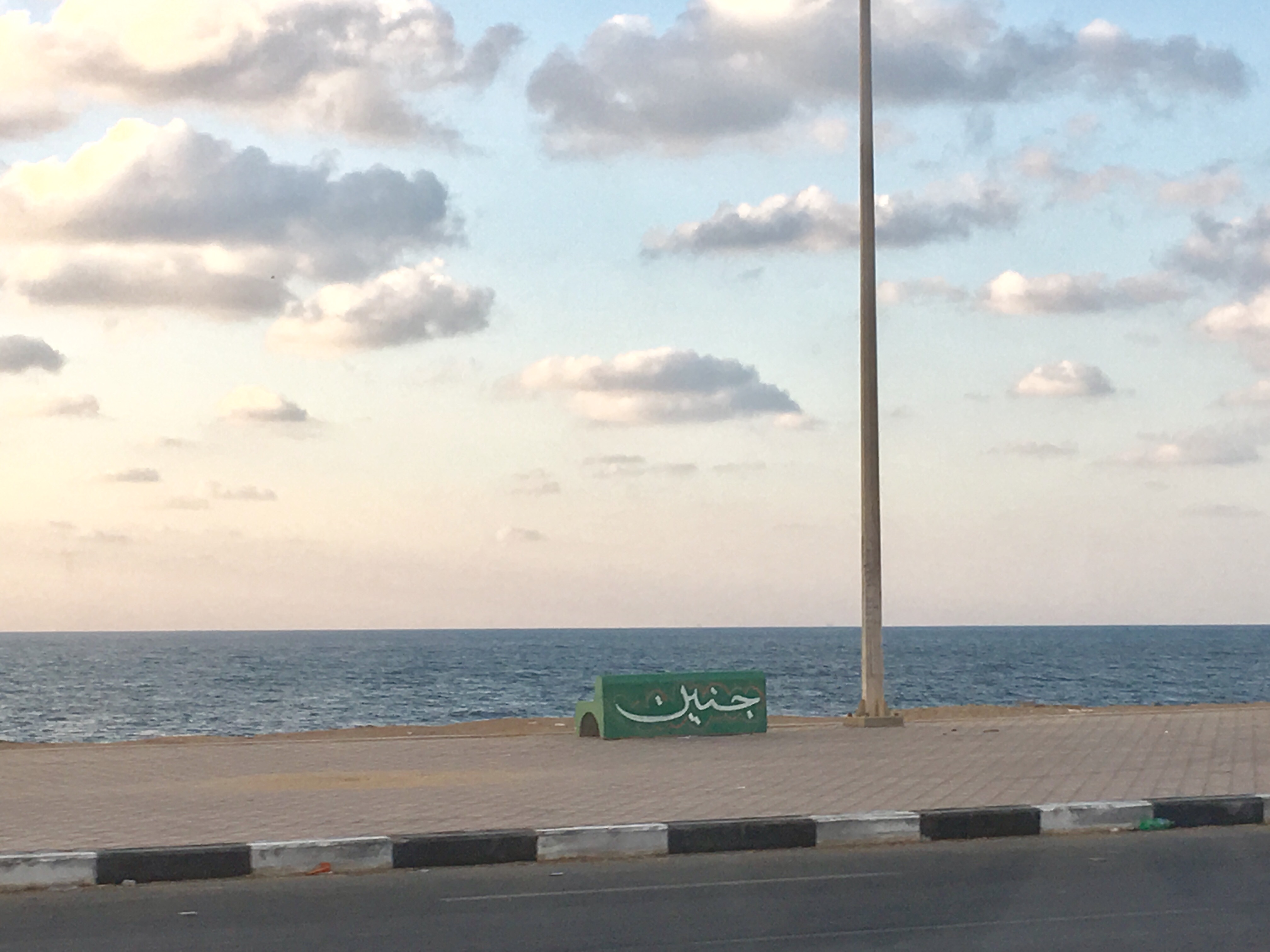
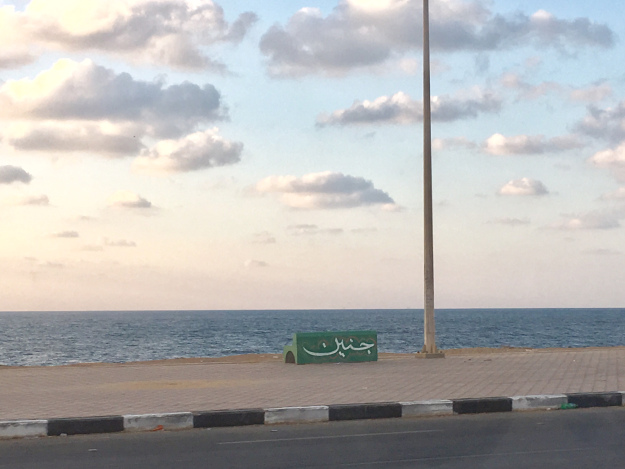
As in other parts of Palestine, the memory of home and the desire for return are a palpable part of Gazan culture. I experienced this in a simple yet powerful way during my visit there. One afternoon, while we were traveling north along the coast from Rafah to Gaza City, I noticed a series of colorful concrete benches along the beachfront. My colleague Ali explained that each one bore the name of a Palestinian city or town where Gazans lived prior to 1948. 

It’s not difficult to grasp the sacred significance of these simple seaside benches to the refugees of Gaza. Unlike most memorials, which commemorate what was lost and is never to be found, I’d wager that those who come to these beaches don’t believe their home cities and villages to be lost at all. On the contrary, I believe these benches testify that these places are still very real to them. And to their faith that they will one day return home.

When we consider the narrative of Gaza, I believe we must keep this critical piece of context in mind: long before there was a Hamas, Palestinians in Gaza have been resisting their oppression – and Israel has been retaliating brutally against their resistance. Of course, when we do the moral calculus, we can argue about the strategic sense and morality of the rockets Hamas fires into Israel – as many Palestinians do.  But if we truly seek to understand Gaza’s narrative, we must honestly ask ourselves – what would we ourselves do in their situation?

As I noted earlier, many white Americans are starting to reckon seriously with the colonial narratives instilled about the birth of this country. The narratives of the powerful and the privileged have great power. But when they collide with the narratives of those they’ve disenfranchised, the impact can sometimes create a spark of transformation – it can indeed, lead to the construction of a new and more just narrative. The Black Lives Matter protests that were born last summer are a powerful example of this phenomenon. I think we’ve all been astonished and inspired by a new narrative struggling to be born in this country.

I fervently believe there is a potential for a similar transformation in Israel/Palestine. It will not happen easily, or painlessly, but I do believe it can happen. In a very real sense, it has to happen. 

May we commit ourselves to this transformation – and may it happen soon in our day. 

I Witnessed the Horror of Border Militarization, and Vow to Fight It

Cross-posted with Truthout

2018 1210 loveknowsnoborder pano stevepavey-8

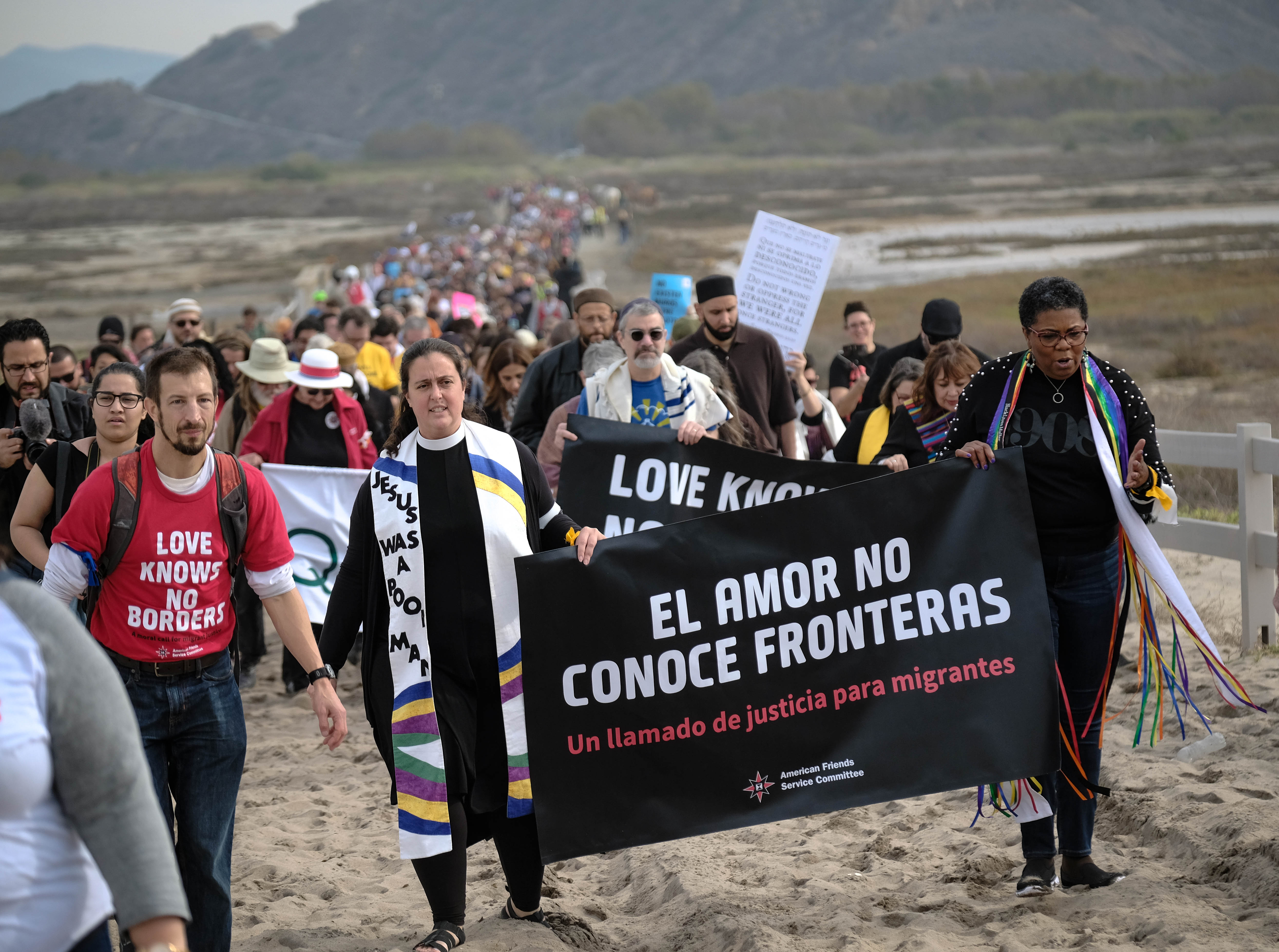
Interfaith clergy lead demonstrators through Border Field State Park en route to the San Diego – Tijuana border (photo: Steve Pavey, Hope in Focus, stevepavey.com)

I‘ve just returned from the San Diego-Tijuana border where I had the honor of participating in “Love Knows No Borders” — an interfaith action sponsored by the American Friends Service Committee (AFSC) and co-sponsored by a myriad of faith organizations from across the country. As a staffer for AFSC and a member of Jewish Voice for Peace (one of the many co-sponsoring organizations), I took a special pride in this interfaith mobilization, in which more than 400 people from across the country gathered to take a moral stand against our nation’s sacrilegious immigration system. I’m particularly gratified that the extensive media from our action could shine a light on the brutal reality at our increasingly militarized southern border.

The date of the action (December 10) was symbolically chosen to take place on the anniversary of the Universal Declaration of Human Rights and served as the kick off to a nationwide week of action that will conclude on December 18, International Migrant’s Day. The action set three basic demands before the US government: to respect people’s human right to migrate, to end the militarization of border communities, and to end the detention and deportation of immigrants.

Over the course of this past weekend, hundreds of participants streamed into San Diego for orientation and training. To conclude our preparation and as a precursor to the upcoming action, an interfaith service was held in the packed sanctuary of University Christian Church. As one of the Jewish leaders of the service, I noted that it was the eighth and final night of Hanukkah and invited the Jewish members of our delegation up to sing the blessings.

Before the lighting, I explained that the final night of Hanukkah is the night in which our light shines the brightest, and I pointed out the wonderful confluence of this Jewish festival with our interfaith action the following day. Rev. Traci Blackmon, a United Church of Christ leader and prominent social justice activist, delivered one of the most powerful messages of the evening, properly placing the issue of immigrant justice within the context of US white supremacy. (You can find the Facebook Live video of the service here. The Hanukkah lighting begins at the 24:30 mark; Rev. Blackmon’s remarks begin at 1:19:16.)

Arrests at the Border

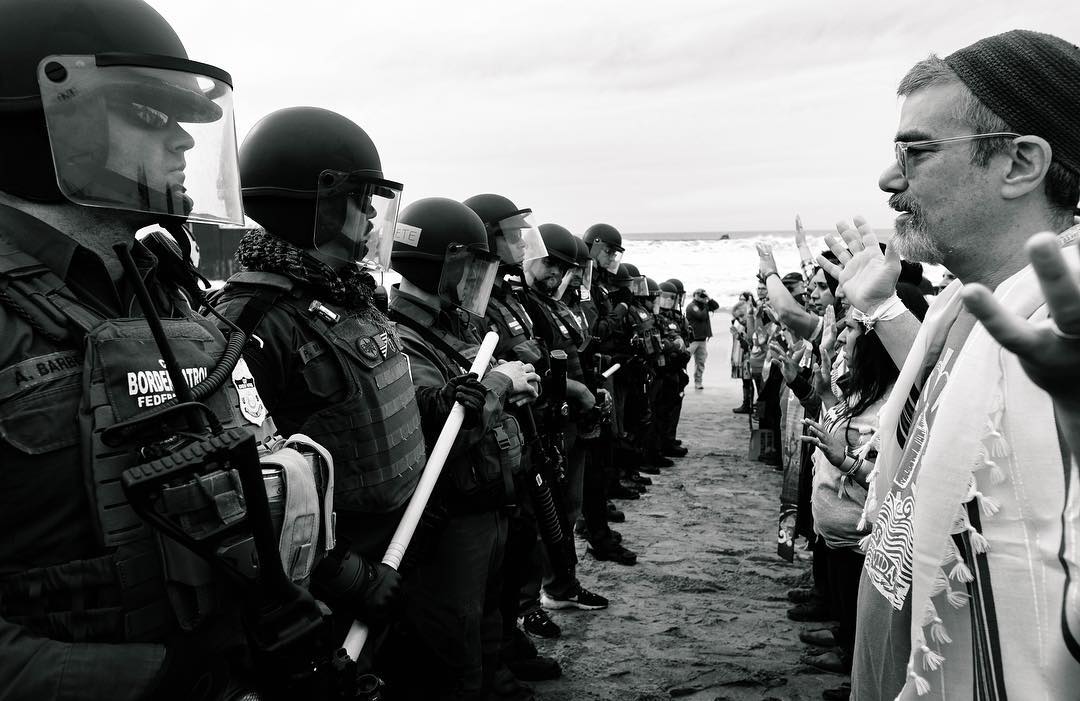
The next morning, we gathered at AFSC’s San Diego office and left in buses to Border Field State Park, located just north of the border with Tijuana. After a press conference, we marched west down the trail to the beach, then turned south and approached the border fence, which snaked across the beach and jutted several hundred feet into the water. As we got closer, we could see a tangle of barbed concertina wire laid out in front of the fence. Behind the wire stood a phalanx of heavily armed border patrol.

When we reached the edge of the wire, some of the clergy formed a semi-circle and offered blessings for the migrants. As the prayers were spoken aloud, border patrol officers used a megaphone to inform us that we were trespassing on federal property and that we needed to move to the back of the wire. I recited the Priestly Benediction in Hebrew and English (“May God bless you and keep you …”), doing my best to articulate the prayer between the voices of border patrol barking out orders (a ceremonial first for me).

When our blessings were over, we went back to the other side of the barbed wire and those of us in front formed a line directly facing the guards. A border patrol officer repeatedly told us to leave, adding that he did not want any violence — an ironic statement considering that he and the rest of the riot-gear clad border patrol officers wielded automatic weapons in front of our faces. We began to chant freedom chants and held the line, even as the border patrol officers inched forward and started to push us back.

While we were careful not to touch any officers, we continued to hold the line as the border patrol pushed us forward. Eventually, protesters who did not yield were grabbed, pulled to the border patrol’s side of the line and arrested. Most men were thrown to the ground and held down with their faces in the sand while their hands were bound together with plastic ties; women were generally allowed to kneel before they were led away from the beach to waiting border patrol vans

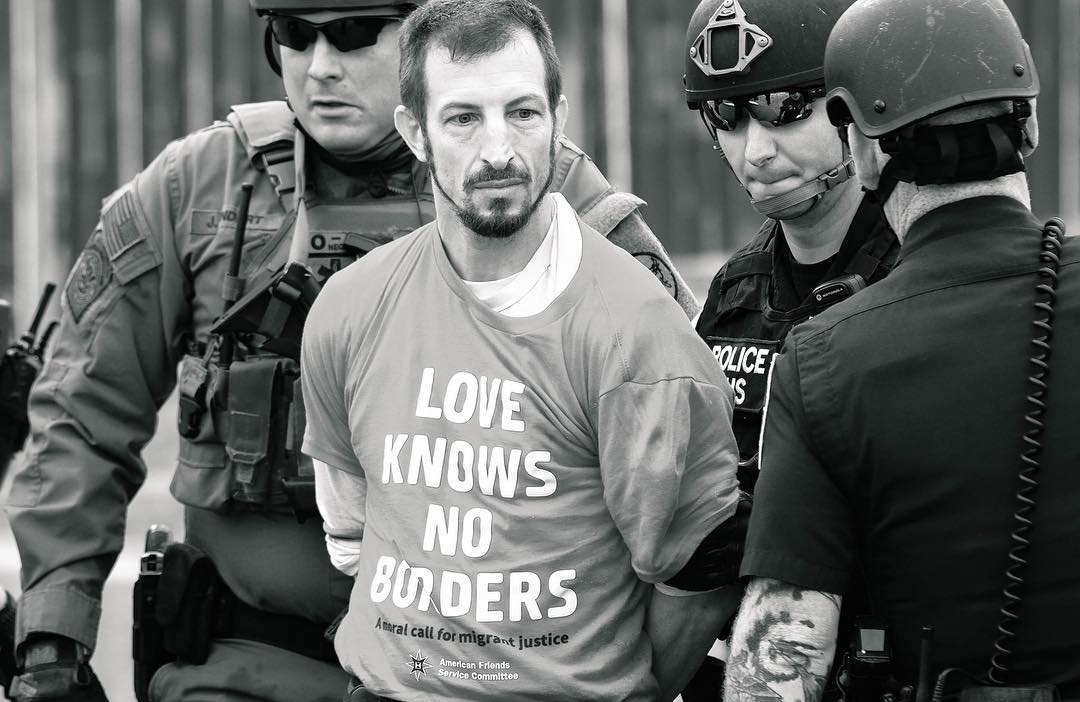
As I continued to hold the line on the far west end of the front line, I noticed a commotion at the other end: Officers had broken through the line and were chasing protesters down the beach. I saw one of our protest organizers, AFSC staffer Matt Leber, roughly thrown to the ground by at least five or six border patrol officers, handcuffed and led away. While Leber did not intend to take an arrest, this kind of intentional targeting of organizers is a common law enforcement tactic.

In this video taken of the incident you can see Leber (wearing the red T-shirt and backpack) guiding the protest when he is suddenly attacked, unprovoked, by the border patrol, who lunge at him and yank off his backpack. You can also see AFSC staffer Jacob Flowers (wearing the yellow vest) being thrown to the ground.

matt_leber_arrested

Border patrol officers arrest AFSC staffer Matt Leber (photo: Steve Pavey, Hope in Focus, stevepavey.com)

Shortly after Leber’s arrest, I dropped to my knees and was grabbed and pinned down by two border patrol officers. When it became clear that I wasn’t resisting, they allowed me to stand of my own accord and led me to the line of arrested protesters who were arrayed along a fence, waiting to be placed into vans.

According to the border patrol, 32 of us were arrested. We don’t currently have an exact arrest count, but it seems that most of us were charged with the misdemeanor of “nonconformity to the orders of a Federal Law Enforcement officer.” When a day went by with no further word about Leber, AFSC released a statement calling for his immediate release. To our collective relief, he was eventually let out of the Metropolitan Correction Center on Tuesday afternoon.

The True Meaning of Border Militarization

During our debrief, many noted the ferocity of the border guard’s response to our prayerful, nonviolent demonstration. Many of us — in particular the white, privileged members of our delegation — agreed that we had gained a deeper sense of empathy and solidarity with our migrant neighbors, a stronger understanding of the toxic effects of militarization on our border communities, and a more profound conviction than ever that we must all fight for a nation that receives immigrants with open hearts and open doors.

This experience also served to demonstrate what “militarization of the border” truly means. My friend and fellow Jewish Voice for Peace member Elaine Waxman put it well when she wrote about our experience on her Facebook page:

What has stuck with me most in the last 24 hours is a deeply uncomfortable sense of what that border surely looks like when the witnesses are gone, the journalists are not taking pictures, and the encounters are with migrants instead of documented (and often white) community leaders. Because what we saw yesterday looks like a police state.

Indeed, when we stood up to the line of armed border patrol officers, I couldn’t help but flash back to my very similar experience in a direct action with Youth Against Settlements during the summer of 2006 in Hebron. In both cases we faced heavily armed soldiers, the loud screaming of orders, and the use of the threat of violence to intimidate and deter those who do not yield to state control.

brant_border_b-w

Clergy demonstrators hold the line at the San Diego – Tijuana border fence. (photo: Steve Pavey, Hope in Focus, stevepavey.com)

I also noticed another, more specific similarity between these two experiences. When I stood in front of the border guards on the beach, I noticed familiar tear gas canisters belted across their chests. I’d seen the same on soldiers throughout the West Bank and Gaza: silver cylinders with blue writing manufactured by Combined Tactical Systems in Jamestown, Pennsylvania.

Seeing those same canisters at the US-Mexico border reminded me of the multiple intersections between systems of state violence and corporate profit – and of the need for a movement that will expose and dismantle them once and for all.

Atoning for Gaza: A Sermon for Yom Kippur 5779

img_3380

One year ago, on the morning after Yom Kippur, I traveled to Palestine in my capacity as a staff person for the American Friends Service Committee. Among other things, my trip included several days with our staff in Gaza.

AFSC has a particularly significant connection to Gaza. In 1949, at the onset of the Palestinian refugee crisis, the organization was asked by the UN to organize relief efforts for refugees in the Gaza Strip. The AFSC agreed, believing their service to the new refugees would be temporary. But when it became clear Israel had no desire or intention to let Palestinian refugees return to their homes, the organization’s General Secretary Clarence Pickett, told the UN that they could not in good conscience enable the situation, insisting that there must be a political solution to the crisis. Shortly after, the UN created UNRWA (The United Nations Relief Works Agency), the organization that has served the needs of Palestinian refugees ever since. AFSC has, however, retained its programmatic presence throughout Israel/Palestine to this very day.

As you might expect, I came away from this experience with a myriad of feelings and emotions, most of which continue to resonate powerfully for me even one year later. First and foremost, I’ve been transformed by the collegial and personal relationships I created with our staff and the Palestinian Gazans we met there. I remain moved by the efforts of so many people creating communities of dignity and purpose, doing their best to live their lives with something approaching normalcy while they are so utterly choked off from the world outside. While they cannot access the most basic necessities of life. While they are literally waiting for the next bomb to fall.

Since that time, of course, much has happened in Gaza. They’ve initiated the Great Return March, a popular protest action which has taken place weekly along their eastern border with Israel. Since the first day of the march last spring, the mostly nonviolent demonstrators have consistently been met by live fire from the Israeli military. To date, 170 Palestinians have been killed and tens of thousands wounded and maimed, most of them unarmed demonstrators, including children, medics and bystanders. Over the summer, Israel has also bombarded Gaza with its most sustained military assault since 2014, destroying numerous civilian targets, including the Said al-Mishal Cultural Center in Gaza City.

I’ve written a great deal about Gaza over the years, most of it in the form of commentary and political debate. As you know, I certainly have my own strong opinions – and I’ve engaged in my share of spitting matches on this issue over the years. And I will admit I’m tempted, given the events of this past year, to give an angry political sermon about Gaza. But I’m going to resist the temptation.

I do believe these debates are important as far as they go – but only up to a point. For one thing, it seems to me, these arguments too often end up fetishizing Gaza and Gazans, describing them either as murderous terrorists, helpless pawns of Hamas or poor, passive victims. Since most people only tend to think of Gaza when the bombs are falling and the bullets flying, this is generally about as far as its public image tends to go. Gaza becomes an objectified symbol of people’s fears, their political agendas and their own internalized prejudices.

So today, I’m going to try to do my best not to give that sermon. Instead, I’d like to offer you some thoughts and impressions based on my own experiences and on my growing personal relationship with Gazans. I’d also like share a little bit of Gaza’s culture and history with you. Information is virtually unknown to most of the world but is I believe, critical if we want to understand Gaza in a three dimensional, non-objectified way. And finally, apropos of this Yom Kippur, I’d like to explore what I believe is the moral and religious challenge Gaza presents to us Jews, as Americans and as people of conscience.

I’ll begin with a little geography. What we call the “Gaza strip” constitutes a 140 square mile piece of land on the southeastern Mediterranean coast. While we generally think of “Gaza” as this one little crowded land mass, is was historically actually part of a much larger Gazan territory that has been continuously inhabited for over 3,000 years. In ancient times it enjoyed extensive commerce and trade with the outside world – difficult to imagine given Gaza’s current state of economic and social isolation. But once upon a time, Gaza was a major port and an important stop along the Spice and Incense Route. As such, it was located at a significant cultural crossroad, connecting a wide variety of different civilizations over the centuries.

While this is literally ancient history now, it has left a cultural impact on Gaza that continues to this day. One example that was very obvious to me during my stay last year was the unique nature of Gazan cuisine. Anyone who knows Gaza knows that the food in this region is filled with distinctive flavors and spices that are dramatically different from other regional forms of Palestinian food. One common example is Gazan tahini, which is made from roasted sesame seeds, making it a dark shade of red. Gazan food is also typically made with chiles, eastern spices like cardamom, cloves and cinnamon and lots of dill.

For more on this subject, I strongly recommend reading “The Gaza Kitchen” by Laila El-Hadad and Maggie Schmitt – a cookbook that offers local recipes, placing them in the context of Gaza’s cultural history and politics. The authors point out that since the strong majority of Palestinians living in Gaza today are refugees from other parts of Palestine, other regional Palestinian foods have been introduced into their culinary mix. And the authors point out that many Gazan fast food joints serve Israeli-style food such as schnitzel, which was brought to the region by European Zionist immigrants.

As the authors write:

Now, with Gaza totally isolated, it is easy to forget that for decades thousands of Gazans went every day to work in Israel, that Israeli and Gazan entrepreneurs had partnerships, that both commerce and social relations existed, albeit on unequal footing. Adult Gazans remember this, and many speak admiringly of aspects of Israeli society or maintain contact with Israeli business partners, employers and friends. But for the enormous population of young people who were not old enough to work or travel before Israel sealed the borders in 2000, this is impossible. Because their lives are completely conditioned by Israeli political decisions, they have never laid eyes on a single Israeli person except the soldiers that have come in on tanks or bulldozers, wreaking destruction. And the generation of young Israelis to which those soldiers belong has likewise never met a single Gazan Palestinian in any other context. A terrible recipe for continued conflict.

When most people think of Gaza of course, they don’t think of trade routes or cuisine; if they associate Gaza with anything at all, it’s refugees and refugee camps. But it’s important to bear in mind that the creation of these camps is a very recent phenomenon in its history. As I mentioned earlier, Gaza was historically a much larger district in historic Palestine. Under Ottoman and the British mandate for instance, the Gaza District included what would later become the Israeli cities of Ashdod, Ashkelon, Sderot, Kiryat Gat and Kiryat Malachi, among others.

The so-called “Gaza strip” was created in 1949, when it became a repository for a flood of Palestinian refugees from cities and villages in the coastal plain and lower Galilee. Before the outset of war, the population of this small region numbered 60 to 80,000. By the end of the hostilities, at least 200,000 refugees were crowded into what we call today the Gaza Strip. The borders of the strip were drawn arbitrarily, determined by the position of Egyptian and Israeli forces when the ceasefire was announced. It ended up being smaller by at least a third than the entire area of the Gaza District during the mandate period.

At the time, most of the refugees fully expected to return home – some could even see their towns and villages through the fences. Those who crossed the border to gather their possessions or harvest their crops were considered “infiltrators” by Israel and shot on sight. Eventually, it became all too clear there would be no return. Over the years the tents turned into concrete buildings that grew ever higher in that narrow corridor. The numbers of that once sparse territory has grown to a population today of almost 2,000,000 people.

Given this context, it was natural that Gaza would become a center for the Palestinian resistance movement. We know from history that when a people are oppressed, they will inevitably resist their oppression. And yes, sometimes that resistance will be violent in nature. As early as the 1950s, groups of Palestinians known as “fedayeen” crossed over the border to stage violent attacks in the surrounding settlements.

One of these attacks offers an important insight into the course of Gaza’s history in ways that reverberate for us even today. In 1956, a group of fedayeen entered a field in Kibbutz Nahal Oz and killed a kibbutznik named Roi Rotenberg. The famed Israeli general Moshe Dayan spoke at his funeral – and during his eulogy he expressed himself with brutal and unexpected honesty:

Do not today besmirch the murderers with accusations. Who are we that we should bewail their mighty hatred of us? For eight years they sit in refugee camps in Gaza, and opposite their gaze we appropriate for ourselves as our own portion the land and the villages in which they and their fathers dwelled…

This we know: that in order that the hope to destroy us should die we have to be armed and ready, morning and night. We are a generation of settlement, and without a steel helmet and the barrel of a cannon we cannot plant a tree and build a house. Our children will not live if we do not build shelters, and without a barbed wire fence and a machine gun we cannot pave a road and channel water. The millions of Jews that were destroyed because they did not have a land look at us from the ashes of Israelite history and command us to take possession of and establish a land for our nation.

When I read Dayan’s comments today, I find them to be unbearably tragic – particularly when you consider how much time has elapsed since they were spoken. We have only to change the number of years in Dayan’s speech and the leave the rest intact: “For seventy years they’ve sat in refugee camps in Gaza, and opposite their gaze we appropriate for ourselves as our own portion the land and the villages in which they and their fathers dwelled.”

It’s clear that the descendants of the original Gazan refugees have lost none of their ancestors desire for return. Most of them know full well where their ancestral homes and fields are located, in some cases just a few miles from where currently live. As in other parts of Palestine, the memory of home and the desire for return are a palpable part of Gazan culture. I experienced this in a simple yet powerful way during my visit to Gaza last year. One afternoon, as we traveled north along the coast from Rafah to Gaza City, I noticed a series of colorful concrete benches along the beachfront. My colleague Ali translated the Arabic words on the backs of each bench, pointing out that each one bore the name of a Palestinian city or town where Gazans lived prior to 1948.

It’s not difficult to grasp the sacred significance of these simple seaside benches to the refugees of Gaza. Unlike most memorials, which commemorate what was lost and is never to be found, I’d wager that those who come to these beaches don’t believe their home cities and villages to be lost at all. On the contrary, I believe these benches testify that these places are still very real to them. And to their faith that they will one day return home.

In the end my trip to Gaza affected me in ways I could not predict at the time. Most importantly, for lack of a better term, I find I’m taking the issue much more personally. When Israel drops bombs on Gaza, I invariably get a sick, sinking feeling in the pit of my stomach, and immediately send emails to my colleagues and friends to check on their welfare. When a young Gazan is killed during the weekly Return March demonstrations, it’s not unusual for me to read a grief stricken testimony on social media by a friend, or friend of a friend. I increasingly hear their stories of their loved ones whose visas were denied or who cannot travel to access proper health care – and increasingly, I find myself taking their stories to heart.

Of course, I also take it personally when I hear so many in the Jewish community rationalizing this oppression away or worse – blaming Gazans for their own misery. When Israel was bombarding Gaza with bombs this past July, for instance, I recalled the fall of 2014 and how the American Jewish communal establishment characterized Israel’s war as a moral and religious imperative. In their view, the leadership in Gaza posed nothing short of an existential threat to Israel and the Jewish people – and in the wake of the Holocaust, ensuring Jewish survival is the most sacrosanct commandment of our time.

In early August of that year, Elie Wiesel wrote a public statement that was published as a paid ad in many prominent newspapers, including the New York Times. It was entitled “Jews rejected child sacrifice 3,500 years ago. Now it’s Hamas’ turn.” Wiesel’s words, I think, are a perfect representation of the ways the Jewish communal establishment framed the religious challenge of Gaza:

More than three thousand years ago, Abraham had two children. One son had been sent into the wilderness and was in danger of dying. God saved him with water from a spring. The other son was bound, his throat about to be cut by his own father. But God stayed the knife. Both sons – Ishmael and Isaac – received promises that they would father great nations.

With these narratives, monotheism and western civilization begin. And the Canaanite practices of child sacrifice to Moloch are forever left behind by the descendants of Abraham.

Except they are not.

In my own lifetime, I have seen Jewish children thrown into the fire. And now I have seen Muslim children used as human shields, in both cases, by worshippers of death cults indistinguishable from that of the Molochites.

What we are suffering through today is not a battle of Jew versus Arab or Israeli versus Palestinian. Rather, it is a battle between those who celebrate life and those who champion death. It is a battle of civilization versus barbarism.

I remember when I first read these words. I remember how deeply, how viscerally, I reacted to them – particularly while I had been reading day after day about Gazan children like the four Bakr boys, who were shot down not as “human shields” but while they were playing soccer on the beach one morning. I remember how desperately I wished there were other Jews or Jewish communities ready to provide an alternative religious understanding of what was going on in Gaza.

There was only one religious response to Wiesel I recall reading at the time. It came from scholar and theologian Marc Ellis, who addressed Wiesel’s statement head on:

The problem is the news that keeps coming from Israel. Israel’s bombing of residential areas, hospitals and UN schools and shelters is international news. In Gaza, even after Israel’s proclaimed “withdrawal,” the death toll mounts. Among the dead are children sacrificed for Israel’s obvious goal – to deny Palestinians statehood, their political and human rights, which include the right to resist occupation.

The question for Elie Wiesel and the Jewish establishment is not about Abraham’s binding of Isaac – a treasure trove for interpreters of all types – but how many Palestinian children in Gaza will be sacrificed on the altar of Israel’s national security.

If God stayed Abraham’s knife, who will stay Israel’s?

“If God stayed Abraham’s knife, who will stay Israel’s?” This, to me is as profound an articulation of the moral and religious challenge presented to us by Gaza as we are likely to find. And I simply cannot understand how Jewish communities can gather for Yom Kippur every year without even thinking to consider this question. This is after all, the season of our cheshbon nefesh – our moral accountability. On Yom Kippur we are asked to come together and dig deep as a community to search our collective soul and confess our collective sins. How many synagogues will include confessions for what Israel is doing to Palestinians in Gaza and elsewhere?

On Yom Kippur we chant over and over an annual liturgy that literally asks “who shall live and who shall die,” while the people of Gaza ask themselves that question every waking day. In a very real sense, Israel is playing God with the people of Gaza. Who shall live and who shall die? In the end, it is not God but Apache helicopters and sniper fire that will provide the answers to that question. Wouldn’t it be more appropriate to change the Une’taneh Tokef prayer to read, “Who will we kill and who will we spare?”

On Yom Kippur we gather to confess our sins and vow to do teshuvah – to actively repair what we have broken in the past year. But if we do believe that Israel is oppressing Gazans and Palestinians in our name, how can this day have any meaning for us at all? How can it be anything but an empty ritual? If we do believe this day still has religious relevance for us, what are we ready to do to make this teshuvah we speak of real?

My friend and colleague Jehad Abusalim was born in Gaza and is now earning his Phd from NYU. This past year he joined the Chicago staff of AFSC to work on our campaign “Gaza Unlocked.” I’d like to end with his words, because like so many of the Gazans I’ve come to know, he presents us with a question that highlights what I believe is the current religious challenge of Yom Kippur:

Our message is that we are human beings. Despite 70 years of exile, 50 years of occupation, and 11 years of a blockade, we still can carry signs in Arabic, Hebrew, and English that say, “We are not coming to fight — we are coming to return to our lands!” Gazans who saw wars and blood, who lost relatives to graves and prisons, who have four hours of electricity, who are besieged and tired — these Gazans still have faith that the international community cares. Will the rest of humanity hear them?

On Yom Kippur we plead to God, “Shema Koleynu” – “Hear our voice!” The people of Gaza – indeed all Palestinians – are calling out to us “Shema Koleynu!” Are we ready to their prayer? And if we are, what will we do to ensure our Yom Kippur prayers have not been made in vain?

G’mar Hatimah Tovah – may this be the year we write the people of Gaza into the Book of Life.


Unacceptable and Inhumane: A Response to Rabbi Jill Jacobs

AASC_8275-460x307

I continue to be troubled by Rabbi Jill Jacobs’ recent Washington Post op-ed, “How to tell when criticism of Israel is actually anti-Semitism,” and frankly disappointed to witness how warmly it has been received in progressive Jewish circles. In context and content, I find it to be anything but progressive.

Jacob’s article was written in response to the Israeli military’s killing of over 100 Palestinians in demonstrations in Gaza since March 30, including 14 children, and injured over 3,500 with live fire. Certainly, as the Executive Director of Tru’ah – an American rabbinical organization that seeks to “protect human rights in North America, Israel and the occupied Palestinian territories” – one might have expected her to follow the lead of other human rights organizations and protest (or even call into question) Israel’s excessive use of force.

On the very same day as Jacobs’ op-ed, for instance, Human Rights Watch called for an international inquiry “into this latest bloodshed,” adding that “these staggering casualty levels (were) neither the result of justifiable force nor of isolated abuses; but foreseeable results of senior Israeli officials’ orders on the use of force.” For its part, Amnesty International called Israel’s actions “an abhorrent violation of international law” and Doctors Without Borders termed them “unacceptable and inhuman.”

Tru’ah itself released a statement about the violence four days earlier, but notably refrained from any criticism of Israel’s behavior. In fact, the statement neglected to even mention the fact that the Israeli military had shot and killed scores of protesters, noting only that Tru’ah was “deeply saddened by the deaths.” It went on to quote a Talmudic commentary in which a commander of King Saul’s forces was criticized for killing a man when he could have easily “hit him in one of his limbs.” (This citation was particularly egregious considering the widespread reports of many Gazans – including children – whose limbs were amputated after being maimed by Israeli gunfire.)

In her op-ed, Jacobs likewise avoided any judgement of Israel’s mass killings, choosing instead to discuss the “rhetorical battle” between Israel advocates and pro-Palestinians activists, analyzing in detail when antisemitism “masquerades as criticism of Israel.” I’m not sure that Jacobs has added anything new to this particular conversation, which has been explored extensively over the past several decades. I personally disagree strongly with several of her specific points and perhaps in a future post I’ll discuss them in greater detail. For now, however, I’m far more troubled that given the outrages of the past few months, the leader of a rabbinical organization committed to human rights is more concerned about the rhetoric of Israel-criticism than Israel’s choice to kill and maim scores of nonviolent protesters with live gunfire.

Indeed, while Jacobs dedicated an entire section of her analysis to “Dismissing the humanity of Israelis,” nowhere did she stop to consider the humanity of the Palestinian people, except to ask when their rhetoric might be considered antisemitic. She made a particular point of singling out Palestinian academic/activist Steven Salaita by name as an antisemite with the flimsiest of evidence – knowing full well the damaging stigma of such an epithet. (I strongly commend Salaita’s eloquent response to Jacobs, in which he addresses her destructive “tone-policing of Palestinians” in the face of their “exclusion and privation.”)

In truth, it has been difficult to avoid the abject dehumanization of Gazans by the Israeli government and Israel advocates these past few months. In statement after statement, Palestinians have all but been blamed for their own mass murder. During the course of these massacres, my Palestinian friends in Gaza have asked me repeatedly: What will it take? What will it take for the world to see us as real, living breathing human beings rather than either incorrigible terrorists or unthinking puppets of Hamas? My friend and colleague Jehad Abusalim, a Gazan who currently works in the Chicago office of the AFSC wrote powerfully about this phenomenon in a recent article for Vox:

The idea of the march has been part of the political discussion in Gaza for years, and I witnessed it evolve. Contrary to Israeli propaganda, which claims that the march is staged by Hamas, participation in the march transcended factional and ideological affinities.

The march was a product of Palestinian civil society efforts. In fact, grassroots organizers, young intellectuals, and activists struggled to renew Gaza’s confidence in peaceful and nonviolent mass mobilization as a tactic that would end their dehumanization by Israel.

Yet despite all these efforts, official Israel and US messaging focuses on few violent manifestations in the march — which amounted to a small group throwing burning tires, Molotov cocktails, and stones, according to the Israeli military — and try to cast the incongruous words of a few marchers as nothing but Hamas propaganda. Such an approach not only dehumanizes Palestinians, it also assumes that they are nothing but mindless pawns of Hamas with no agency over their destiny and lives.

While this victim-blaming may be excruciating however, at least it is consistent. In some ways, articles such as Jacobs are even more troubling: they passively validate this dehumanization by leaving it unchallenged while purporting to occupy a “progressive higher ground.” It’s not uncommon for liberal Zionists to fortify their moral position by stating they are equally criticized by the left and the right. But in the end, this studious avoidance to name oppression out loud only strengthens the “moral claims” of the oppressor.

I’ve long been frustrated at my liberal Zionist colleagues who are more than willing to condemn any number of human rights abuses around the world, yet refuse to apply the same standard when it comes to Israel. It does not befit an organization that purports to uphold human rights to “mourn the deaths” rather than “condemn the killing.” And it is deeply disappointing when the director of that organization responds only by criticizing the rhetoric of those who are justifiably outraged by Israel’s inhumane actions.

Quakers, Jews and Israel’s BDS Blacklist

RS11675_EvanJonesGaza1949 5812013620

AFSC volunteer Evan Jones meeting with Palestinian refugees, 1949 (photo: AFSC)

Cross-posted with Acting in Faith.

Last Sunday, Israel revealed their list of 20 social justice groups from around the world it was henceforth banning from the country because of their support for the Boycott, Divestment and Sanctions (BDS) movement. For me, the list represented more than just another news item of the day. As staff person for one organization included on the list – the American Friends Service Committee (AFSC) – this news struck home personally as well as professionally

As a rabbi who works for AFSC, I’m proud of the important historical connections between Jewish community and this venerable Quaker organization. As the US Holocaust Memorial Museum itself has noted, AFSC was at the forefront of efforts to help and rescue Jewish refugees after 1938, “ assisting individuals and families in need… helping people flee Nazi Europe, communicate with loved ones, and adjust to life in the United States.”

The USHM has also acknowledged that “the AFSC helped thousands of people in the United States transfer small amounts of money to loved ones in French concentration camps (and helped) hundreds of children, including Jewish refugees and the children of Spanish Republicans, come to the United States under the care of the US Committee for the Care of European Children in 1941–42.”

AFSC became involved with a different group of refugees – the Palestinians – several years later. At the end of 1948, while military hostilities in Palestine were still raging, the UN asked the AFSC to help spearhead the relief effort in Gaza, which was rapidly filling up with Palestinian refugees. Historian Nancy Gallagher has noted refugee relief was not the ultimate goal of their work in Gaza – rather, they “had accepted the invitation to participate in the relief effort with the expectation of assisting in the repatriation and reconciliation process.” (from “Quakers in the Israeli-Palestinian Conflict: The Dilemmas of Humanitarian Activism,” p. 97)

In March 1949, AFSC Executive Secretary Clarence Pickett offered a six-point plan to solve the refugee problem, urging “a substantial repatriation of Arabs into the State of Israel.” (p. 103) However, when it became clear that there was no international will for a political solution to the Palestinian refugee problem, AFSC formally stated that it wished to withdraw from Gaza, stating that “prolonged direct relief…militates against a swift political settlement of the problem.” (p. 104)

I have long been dismayed at the hypocrisy of those who applaud the Quakers’ work on behalf of Jewish refugees, yet bitterly criticize them for applying the very same values and efforts on behalf of Palestinian refugees. In a recent article for Tablet, for instance, Asaf Romirowsky and Alexander Joffe, made the spurious accusation that AFSC “has gone from saving Jews to vilifying them,” claiming that AFSC’s experience in Gaza convinced them to “get out of the relief business altogether” in order to promote “progressive Israel-hatred.”

In light of such invective, it’s not surprising to learn that Romirowsky and Jaffe are both professionally connected to the Middle East Forum – a notoriously Islamophobic radical right organization led by Daniel Pipes that has been categorized as a hate group by the Southern Poverty Law Center. Beyond the nasty rhetoric however, it bears noting that AFSC has never been solely a relief organization. From its inception 100 years ago in the wake of WW I, it has consistently promoted reconciliation and repatriation alongside direct service to peacefully address conflicts around the world. AFSC’s work in Gaza was/is no exception.

Romirowsky and Jaffe further reveal their prejudiced agenda when they suggest that Palestinian refugees only wanted “to be maintained at someone else’s expense until Israel disappeared.” In fact, the AFSC’s refugee relief efforts in Gaza took place while Palestinians were actively being driven from their homes and were being housed in hastily constructed refugee camps. It is patently outrageous to suggest that they were motivated by anything other than their desire to return to their homes. Under such circumstances, it was not at all unreasonable for the AFSC to advocate for their return and repatriation.

In their article Romirowsky and Jaffe also parrot the Israeli government’s accusation that the BDS movement is “opposed to Israel’s existence.” What they refer to as “the BDS movement” is in fact a response to a call issued by a wide coalition of Palestinian unions, political parties, refugee networks, women’s organizations, professional associations, popular resistance committees and other Palestinian civil society bodies in 2005. The BDS call is a crie de cour from Palestinians to the world to use this time honored nonviolent strategy to pressure Israel to meet three essential demands:

  • To end the occupation and colonization of the West Bank and Gaza and dismantle the separation wall;
  • to recognize the fundamental rights of Arab-Palestinian citizens of Israel to full equality;
  • and to respect, protect and promote the rights of Palestinian refugees to return to their homes and properties as stipulated in UN Resolution 194.

Although BDS is an inherently nonviolent tactic, it is striking to note the lengths to which the government of Israel has devoted time, energy and resources in trying to defeat it over the past decade. It has spent literally hundreds of millions of dollars to this effort, enlisted a myriad of Israel advocacy organizations and has even created a new government ministry devoted exclusively to fighting BDS. And though demands of the BDS call are based in human rights and international law, it is routinely referred to as antisemitic “economic terrorism” that “delegitimizes the state of Israel.” The blacklist of organizations is thus only the latest in a long line of draconian, non-democratic responses to this rapidly growing non-violent resistance movement.

As such, AFSC’s support of BDS is fully in keeping with its 100-year-old mission. As their recent organizational statement put it:

All people, including Palestinians, have a right to live in safety and peace and have their human rights respected. For 51 years, Israel has denied Palestinians in the occupied territories their fundamental human rights, in defiance of international law. While Israeli Jews enjoy full civil and political rights, prosperity, and relative security, Palestinians under Israeli control enjoy few or none of those rights or privileges.

The Palestinian BDS call aims at changing this situation, asking the international community to use proven nonviolent social change tactics until equality, freedom from occupation, and recognition of refugees’ right to return are realized. AFSC’s Principles for a Just and Lasting Peace in Palestine and Israel affirm each of these rights. Thus, we have joined others around the world in responding to the Palestinian-led BDS call.  As Palestinians seek to realize their rights and end Israeli oppression, what are the alternatives left to them if we deny them such options?

Quakers pioneered the use of boycotts when they helped lead the “Free Produce Movement,” a boycott of goods produced using slave labor during the 1800s. AFSC has a long history of supporting economic activism, which we view as an appeal to conscience, aimed at raising awareness among those complicit in harmful practices, and as an effective tactic for removing structural support for oppression.

This past October I traveled with other AFSC staff people to East Jerusalem, the West Bank and Gaza, for meetings with our staff there. Yes, our efforts in Israel/Palestine still continue. While we do not yet know this latest action will impact our work, we are well aware that hundreds of thousands of Palestinians have been denied entry into the land of their ancestors for decades. The AFSC, like the other organizations on Israel’s odious list, know that peace can only come to this land when the essential injustice that occurred 70 years ago is justly addressed, and the human rights of all are recognized and respected.

This Hanukkah, Light a Candle for Gaza

2017_1212br_

Palestinian children do their homework during a power cut in an impoverished area in Gaza City, on September 11, 2017. (Photo: Mahmud Hams / AFP / Getty Images)

Cross-posted with Truthout.

The festival of Hanukkah commemorates the victory of the Maccabees, a Jewish priestly family from the Hasmonean dynasty, over the Seleucid Empire in 2nd century BCE. According to the Talmud, when the Maccabees entered the desecrated Temple in Jerusalem and attempted to relight the menorah, there was only enough oil for one day. But when they lit the fire, a miracle occurred and it lasted for eight full days.

What’s the meaning of this simple parable? Some say that the image of increasing light is appropriate to the dark winter season — a time in which many religious traditions celebrate festivals by kindling lights. Others say that this story underscores a powerful political/spiritual truth: Even in the bleakest of times, an oppressed people will somehow find the strength to continue the struggle.

When I light my Hanukkah candles this year, I plan to light an extra one each night for Gaza.

This year marks 10 years since Israel commenced its blockade of Gaza, turning this 140-square-mile strip of land into a virtual open-air prison. Next year will be the 10th anniversary of Israel’s Operation Cast Lead — a devastating military assault that killed 1,419 (including at least 308 children), wounded over 5,000 more and left more than 20,000 homeless. (The name of the operation, perversely enough, was a reference to a children’s Hanukkah song based on a poem by Israeli poet Chaim Nachman Bialik: “My teacher gave a dreidel to me/A dreidel of cast lead.”)

Two months ago, I had the opportunity to travel to Gaza as a staff person for the American Friends Service Committee (AFSC). My visit left me with a myriad of impressions and emotions, foremost of which was a sense of awe at the ability of Palestinian Gazans to live with resilience and dignity under the most oppressive of conditions.

This is, of course, not to minimize their trauma nor to tokenize them as victims. A recent, presumably well-meaning article in Ha’aretz did precisely that, interviewing a volunteer psychologist for Physicians for Human Rights, who portrayed Palestinians in Gaza as overwhelmingly obsessed with sex and addicted to behavior-altering drugs. The psychologist claimed that due to Gaza’s devastating conditions, many Palestinians have “lost their humanity” and are unable to “see the other, his pain.” In an important rejoinder to the article, Palestinian activist Nada Elia responded pointedly:

I do not want to minimise the severity of daily life in Gaza. I am someone who has insisted the siege be recognised as genocidal. Nevertheless, I am appalled at the callousness of the interviewer as she asks for an elaboration of how people in Gaza have lost their “internal morality,” their very “humanity”.

I saw a great deal of humanity during my short stay in Gaza. I traveled there to participate in strategic planning meetings with AFSC staff colleagues, to sharpen our vision for our Israel/Palestine programs in the US, Israel, the West Bank and Gaza. We began with three days of meetings in Ramallah, with our Gaza staff members joining us via Skype. Following these meetings, six of us traveled to Gaza to meet with our two full-time staff members there: Ali Abdel Bari and Firas Ramlawi.

Up until relatively recently, AFSC’s Palestine youth program focused largely on public achievement, seeking to strengthen the civic ties of youth to their communities. Our current program, Palestine Youth Together for Change (PYTC) is a more ambitious project, working to combat Palestinian geographical, social and cultural fragmentation in Israel, the West Bank and Gaza. It’s difficult to overestimate the devastating impact of this fragmentation — particularly on Palestinian youth who are growing up with increasing separation from one another. This isolation is most keenly felt, of course, by the youth of Gaza, who are literally imprisoned by Israel inside a small 140-square-mile strip of land.

American Friends Service Committee staff with youth from their Gaza program. (Photo courtesy of Brant Rosen)

AFSC staff with participants from the Palestine Youth Together for Change program

When we met the Gazan youth who participated in the PYTC program, they spoke powerfully about their experiences growing up with a strong sense of Palestinian identity while isolated from their peers in Israel and the West Bank. This particularly hit home for me when I heard one young woman speak of entering into Israel through the Erez Crossing for the first time to travel to the West Bank for meetings with her fellow participants. She was 18 years old and had never seen an Israeli Jew in person in her life. Up until that time, she said, she had only seen them as “helicopters, planes and bombs.” Needless to say, this contrasted dramatically with the experiences of her West Bank peers, who encountered Israeli soldiers as a very real, everyday presence in the streets and at checkpoints.

It’s also important to bear in mind that this isolation is not a “humanitarian” issue that can be fully addressed by greater NGO and civil society investment. Rather, it is the result of very real and very intentional policies promulgated by Israel to purposefully divide and weaken Palestinian society. By the same token, the PYTC program is not merely a youth service project; its ultimate goal is to strengthen Palestinian identity in order to counter the brutal and unjust occupation of their people. In this regard, this program is connected in important ways to AFSC programs in the US that promote “co-resistance”: initiatives that support the Palestinian civil society call for Boycott, Divestment and Sanctions; advocate for Palestinian children held by Israel in military detention; and educate the public about the devastating costs of the Gaza blockade. The latter program, “Gaza Unlocked,” seeks to educate the public about the reality of the blockade by sharing the stories — and the humanity — of the people who live there.

Here’s a sample of their testimonies:

College graduate Fidaa Zaanin, 27:

This is life. We should not give up. I will maintain my humanity and my dreams despite the siege. I believe in change, if not immediate then with time. I will be an example for my brothers and my sisters and whoever dreams of a future, for they are my hope for the future.

Freelance photographer Ezz Al Zanoon, 24:

We reject the images of us that are being shown to the world. We are humans. We are proud of our humanity. We are proud of our achievements despite the difficult circumstances. No one can achieve what we have done. Despite the blockade, the wars, the structured destructions, we continue to live and fight for a dignified life. We fight against the imposed restrictions, being triggered by our desire for life.

NGO project coordinator Shareef Hamad, 34:

I must challenge this situation. I don’t have any choice. This affects our daily lives and our emotional well-being. We are under all this pressure.

What inspires me is the faith that this situation is not eternal. I can change it or its consequences. I can at least limit its impact on me and those I love. According to history, no oppression lasts forever. This nation deserves better.

During our final night in Gaza, my colleagues and I walked through the streets of Gaza City on our way back from dinner. Because Gaza only receives four hours of electricity a day, the street lights and home windows around us were dark. The only light came from beachfront hotels that had their own generators. We were well aware that we were staying in the affluent tourist part of town and that we were privileged enough to soon be leaving Gaza to travel without restriction. But to paraphrase Shareef Hamad, I am inspired by the faith that no darkness is eternal.

During Hanukkah, we celebrate the miracle of light that sustains us even when the world is at its darkest. This Hanukkah, I’ll be lighting a candle for Gaza.