Category Archives: Anti-Semitism

Zionism’s Marriage of Convenience to Anti-Semitism

judenstaat

I’m sure many have been scratching their heads trying to figure out why on earth the government of Israel and so many staunch Zionists are just fine with the election of Donald Trump – the darling of the anti-Semitic alt-right. The answer however, is really pretty straightforward: this is nothing new. Zionism has had a cozy, if somewhat Faustian relationship with anti-Semitism since its very origins.

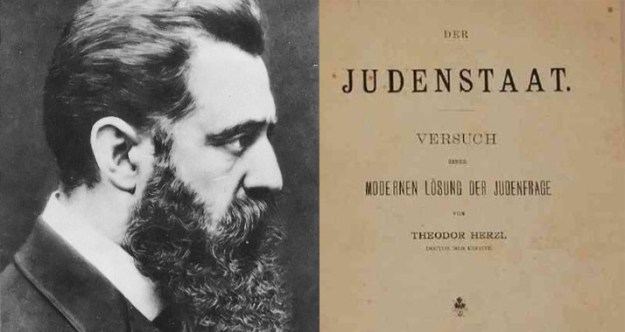
The founder of modern Zionism, Theodor Herzl never made a secret of his belief that his new movement would have to depend upon anti-Semitism and anti-Semites in order to create a Jewish state. In his pamphlet, “The Jewish State,” he suggested raising money for the effort by means of a “direct subscription,” adding that “not only poor Jews but also Christians who wanted to get rid of them would subscribe a small amount to this fund.”

In his diary, he was even blunter:

The anti-Semites will become our most dependable friends, the anti-Semitic countries our allies.

True to form, in 1903 Herzl met with the Russian minister of the interior Vyacheslav von Plehve, an infamous anti-Semite who encouraged the Kishinev pogroms that very same year. Plehve’s reply: as long as the Zionists encouraged emigration of Jews from Russia, the Russian authorities would not disturb them.

This Zionist strategy was also central to the diplomatic process that led to the 1917 Balfour Declaration, in which British Foreign Secretary Arthur Balfour famously announced that his government “view(ed) with favor the establishment of a national home in Palestine for the Jewish people and will use their best endeavors to facilitate the achievement of this object.” Although Balfour has long been lionized as a Zionist hero, he wasn’t particularly well-known for his love for Jews or the Jewish people.  When he was prime minister, his government passed the 1905 Aliens Act, severely restricting immigration at a time in which persecuted Jews were emigrating from Eastern Europe. At the time, Balfour spoke of the “undoubted evils which had fallen on the country from an alien immigration which was largely Jewish.” Balfour, like many Christians of his class, “did not believe that Jews could be assimilated into Gentile British society.”

In this regard, it is worth noting that the sole Jewish member of British government, Edwin Montagu, strongly objected to the Balfour Declaration, submitting a memorandum to the British cabinet in August 1917 that resonates with haunting prescience today:

I wish to place on record my view that the policy of His Majesty’s Government is anti-Semitic and in result will prove a rallying ground for Anti-Semites in every country in the world…When the Jews are told that Palestine is their national home, every country will immediately desire to get rid of its Jewish citizens, and you will find a population in Palestine driving out its present inhabitants…

When the Jew has a national home, surely it follows that the impetus to deprive us of the rights of British citizenship must be enormously increased. Palestine will become the world’s Ghetto. Why should the Russian give the Jew equal rights? His national home is Palestine. Why does Lord Rothschild attach so much importance to the difference between British and foreign Jews? All Jews will be foreign Jews, inhabitants of the great country of Palestine.

The most troubling example of Zionist association with anti-Semitism occurred in 1933, when the Jewish Agency struck a deal with the Nazis’ Economic Ministry known as the Ha’avrah (Transfer) agreement. Breaking the international Jewish boycott, the Zionist movement negotiated with Nazi Germany in order to facilitate the transfer of German Jews and their property to Palestine.

In an essay for Yad Vashem’s Shoah Resource Center, Israeli historian Y’faat Weiss pointed out that the Nazi regime’s participation in the agreement was motivated both by a fear of the boycott and its desire to rid Germany of its Jews. While it is clear that this deal occurred in the context of very real persecution, history has not been kind to the legacy of the Ha’avrah agreement. As Weiss herself noted:

In retrospect, and in view of what we know about the annihilation of European Jewry, these relations between the Zionist movement and Nazi Germany seem especially problematic.

It is not difficult to understand why, on a practical level, the Zionist movement would find a perverse kind of common cause with anti-Semitic regimes. As a form of ethnic nationalism, Zionism has always been dependent upon the maintenance of a demographic majority of Jews in the land. It makes sense that Zionists have been willing to deal with nations that were more than happy to rid themselves of their Jews in order that they maintain their own national ethnic homogeneity.

But it has been a Faustian bargain. From its very origins, Zionism has necessarily fed off the existence of anti-Semites to justify the need for a Jewish state. Even more tragically, as Edwin Montagu predicted, Jewish ethnic nationalism did indeed result in a “population in Palestine driving out its inhabitants.”

Fast-forward to present day and the rise of an alt-right movement promoting a new form of white ethnic nationalism that takes its cue from Israel. Alt-right leader Richard Spencer claims he doesn’t hate Jews, but in fact admires them. He openly says he merely wants for “his people” what Zionism offers the Jewish people. But of course, Spencer’s “genteel white supremacy” is nothing but a fig leaf for the age old desire of anti-semites to create Jew-free nations.

As journalist Betsy Woodruff correctly observed in the Daily Beast:

White supremacists, alt-right leaders argue, think white people are the best race. The alt-right doesn’t necessarily think that, they say; instead, they say they just want white people to have their own homeland.

With no Jews.

Alt-right leader Richard) Spencer in particular fixates on the homeland idea.

The alt-right needs to aspire to something, even if that dream won’t come true in his lifetime—and that means they should aim to build an ethno-state for just whites. And Spencer made it clear that white-only means Jews aren’t invited. They have their own identity, and it isn’t white-slash-European, and that’s that.

“Jews are Jews,” he said.

As troubling as this all may sound, political Zionism has made another, even darker sort of Faustian bargain – namely with Christian Millenarians and End-of-Days extremists. In the era of Trump, this is a relationship that should concern us deeply.

I’ll have more to say about that in my next post.

The Equal Opportunity Hate of White Supremacy

mosque

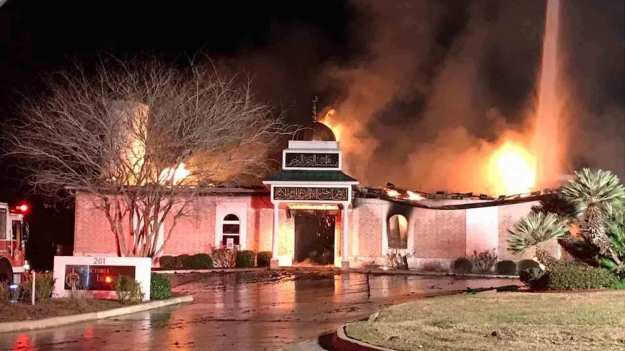
The Victoria Islamic Center destroyed by fire on Jan. 28, 2017 (Photo: Al Jazeera)

Amidst reports of an alarming uptick of anti-Semitic vandalism and bomb threats against JCCs (and an even more alarming reluctance of our new president to even admit its existence), I can’t help but think of an email exchange I had with my friend and colleague Rabbi Rebecca Lillian three years ago.

Rebecca lives in Malmo, Sweden, a city that has seen its share of anti-Semitic vandalism and violence over the past several years. In 2012, the Malmo JCC, where Rebecca lives was vandalized by heavy rocks and an explosive device that thankfully did little damage. In a subsequent blog post for Jewschool, she wrote about the trauma of the incident, but also expressed her dismay that American Jewish leaders exploited it to demonize Muslims and exhort Jewish citizens of Malmo to flee to Israel.

Rebecca pointed out that immediately after the attack, Malmo’s Network for Faith and Understanding held a solidarity vigil in which women, men and children demonstrated their support for the Jewish community by gathering in front of the JCC with candles. Leaders of several Christian churches, two Muslim groups and other spiritual and social organizations came together and offered public speeches of support and solidarity.

Two years later, I wrote to Rebecca and asked her about the latest atmosphere in Malmo. She wrote that the war in Gaza had created an increase in anti-Semitic incidents, but that her interfaith group was “stronger than ever.” She added that the rise of the political far-right was even more concerning, referring to it as the “dark underbelly” of Swedish anti-Semitism. Rebecca noted that in recent elections, “a relatively large percentage of the voters went for Sweden Democrats, a hard-line anti-immigrant group that has roots in neo-Nazism. There is a group of thugs that are equal opportunity haters, who are fans of neither Muslims nor Jews.”

Needless to say, that last line has a troubling resonance when I read it in 2017 – now that a group of “equal opportunity haters” has become firmly ensconced in the White House. But at the same time, I take heart in her description of Malmo’s interfaith solidarity – particularly as I witness a similar kind of solidarity occurring in Trump-era America.

chicagoloopsynagoguevandalized24

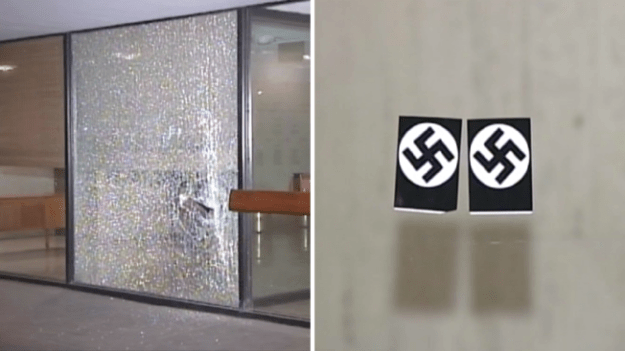
Anti-semitic vandalism at Loop Synagogue, Feb. 4, 2017 (Photo: NBC Chicago)

Some examples: when earlier this month a mosque in Texas was destroyed by arson, a neighboring synagogue gave them the keys to their facility so they could continue to worship. Here in Chicago, after an incident of anti-Semitic vandalism at the downtown Loop Synagogue, the very first response of public condemnation came from Ahmed Rehab, director of CAIR – Chicago:

Chicago’s Muslim community stands in full solidarity with our Jewish brothers and sisters as they deal with the trauma of this vile act of hate. No American should have to feel vulnerable and at risk simply due to their religious affiliation.

Unfortunately, we know the feeling all too well as mosque vandalism and burning has spiked recently in the US. We recognize the source of hate as one, and regardless of religious affiliation, we stand together in solidarity against it as one.  An attack on any is an attack on us all. Today, the congregation of this temple are in our thoughts and prayers.

It is worthy of note that the man arrested and charged with this hate crime is a white supremacist who had also menaced Latino members of a church in Pilsen. Following his arrest, one church member reported:

We are a church of Latinos, of immigrants, and we’re just worried and scared, and this guy walks in and he’s alone and asking weird questions. It was just an instinctual thing. We don’t want to turn anybody away, but we felt that something was wrong…He was not there to pray; he was not there to worship God. He was definitely there scouting who we are and what we are about.

The takeway?  As our government – and Israel’s – continue to whip up Islamophobic hatred and brand “Muslim extremism” as the enemy, the true threat before us is the “equal opportunity hate” of white supremacy. And that the only appropriate response is – as ever – solidarity.

Anti-Racism as a Sacred Jewish Value: A Sermon for Yom Kippur 5777

img_2616

I’d like to begin my remarks today where I left off on Rosh Hashanah:

Because of our diverse, multi-racial nature, Jews must necessarily embrace anti-racism as a sacred value. The Jewish Diaspora is a microcosm of the world we seek to create. If the term Ahavat Yisrael means love of your fellow Jew, it must also affirm that love crosses all lines and borders and boundaries.

“Jews must embrace anti-racism as a sacred value” – it must be a mitzvah if you will. At Tzedek Chicago, we’ve actually articulated this as one of our congregation’s core values. If you go to our website, you will read: “We promote a Judaism rooted in anti-racist values and understand that anti-Semitism is not separate from the systems that perpetuate prejudice and discrimination.”

Like all of our other values this one has very practical implications. It will necessarily guide the choices we make as a community: the issues we work on, the groups we stand with, the public statements we make. And in general it will mean we must always foreground the question: “what does it mean, as a Jewish congregation observe anti-racism as a sacred value?”

I’m sure most liberal Jews wouldn’t find this question all that controversial. After all, American Jewry has a long and venerable history of standing up for racial equality, particularly when it comes to our participation in the civil rights movement. But I’d suggest this question presents an important challenge to the Jewish community of the 21st century. And it was actually put to the test this past summer, when a the Movement for Black Lives released their policy statement, “Vision for Black Lives.”

I’m sure many of you are very familiar with Movement for Black Lives. It’s a coalition of over 50 organizations from around that country that focus on issues of concern to the black community. One year ago, their Policy Table began an extensive process, convening national and local groups, and engaging with researchers and community members. This summer they published their Vision for Black Lives: a comprehensive policy platform that focuses on six main areas: Ending the War on Black People, Reparations, Invest/Divest, Economic Justice, Community Control and Political Power.

I will say unabashedly that I believe the Vision for Black Lives platform is one of the most important American policy statements of our time. It’s both an unflinching analysis of the institutional racism against black people in country as well as a smart policy statement about what can be done (and in some cases already being done) to dismantle it.

What makes Vision for Black Lives platform particularly unique is that it wasn’t produced by the usual method, namely by a think tank or special interest group. Rather, it was developed by a coalition of national and grassroots organizations that reflect the communities most directly affected by these particular issues. Moreover, it serves both as an ideological manifesto as well as a practical hard-nosed policy statement that lays out a path toward achieving very specific legislative goals. In so doing, as many have observed, it is moving Black Lives Matter from a structureless network of local organizations toward becoming a genuine political movement.

To quote from their introduction:

We want this platform to be both a visionary agenda for our people and a resource for us. We take as a departure-point the reality that by every metric – from the hue of its prison population to its investment choices – the U.S. is a country that does not support, protect or preserve Black life. And so we seek not reform but transformation…

Our hope is that this is both an articulation of our collective aspirations as well as a document that provides tangible resources for groups and individuals doing the work. We recognize that some of the demands in this document will not happen today. But we also recognize that they are necessary for our liberation.

This platform is also important because it doesn’t limit its concern to issues facing the black community alone. It understands that the systemic racism impacting people of color in this country is but a part of many interlocking systems of oppression that affect communities the world over. As the platform puts it: “We are a collective that centers and is rooted in Black communities, but we recognize we have a shared struggle with all oppressed people; collective liberation will be a product of all of our work.”

If you haven’t read Vision for Black Lives yet, I highly recommend it. I’ll warn you it’s not easy. It’s very long and heavily referenced, so really reading and integrating it will take commitment. I’ve read it three times now and every time I did, I discovered something new and challenging that I hadn’t considered before. But in the end, I found it profoundly inspiring – and that is not something you often say about policy platforms. I would go as far as to call it a prophetic document. As I quoted earlier, it seeks “not reform but transformation.”

Like me, I’m sure many of you have read innumerable books and articles that analyze the institutional racism inflicted on people of color in this country. Usually they leave us pent up with frustration or else just a sense of abject hopelessness. The problem is just so vast and pervasive – how on earth can we ever hope to dismantle it?  But this is first time I’ve read such an analysis along with extensive prescriptions toward political solutions. It lays out the problems then it puts forth real solutions. But it has no illusions about the daunting task ahead. As the report says. “We recognize that some of the demands in this document will not happen today. But we also recognize that they are necessary for our liberation.” (When I read this, I can’t help but recall the famous ancient dictum by Rabbi Tarfon: “It is not up to you to complete the work, but neither are you free to desist from it.”)

Is Jewish community ready to observe anti-racism as a sacred value? I think one important test would be to judge by its response to the release of the Vision for Black Lives platform. And in this regard, I’m sorry to say that the American Jewish establishment failed the test miserably.

Almost immediately after its release, every mainstream Jewish organization responded with statements that ranged from critical to outright hostility. Why? Because in the Invest/Divest section there is one section that advocates diverting financial resources away from military expenditures and investing in “domestic infrastructure and community well being.” And in that section there were some brief references to Israel – one that referred to “the genocide taking place against the Palestinian people” and another that called Israel “an apartheid state.” And as you might expect from a section entitled Invest/Divest, there was a statement of solidarity with the nonviolent Palestinian call for Boycott, Divestment and Sanctions (BDS) against Israel.

The first official Jewish response to Vision for Black Lives came from the Boston Jewish Community Relations Committee, just two days after it was released. The Boston JCRC said it was “deeply dismayed” by the report and denounced the use of the word genocide and its support for BDS. It had nothing more to say about this voluminous, wide-ranging platform. It spent seven paragraphs on this one issue – and most of that was devoted to this one word.

Over the next few weeks, one Jewish organization after another denounced the platform for its statements about Israel with only a glancing nod to its analysis, its conclusions and its policy recommendations. Jonathan Greenblatt, the National Director of the Anti-Defamation League called its reference to Israel “repellent” and added patronizingly, “let’s work to keep our eyes on the prize.” Even liberal Jewish organizations such as J St., the Religious Action Center of Reform Judaism and T’ruah, an American rabbinical organization devoted to human rights, responded with criticism and chastisement.

These responses tell us all we need to know about the Jewish communal establishment’s commitment to the value of anti-racism. But it really shouldn’t come as a surprise. The Jewish institutional community hasn’t been in real solidarity with black Americans and people of color for decades. Most of what we call solidarity is actually nostalgia. For far too long we’ve been championing the role of Jews in the American civil rights movement, invoking the memory of Jewish martyrs such as Michael Schwerner and Andrew Goodman and Jewish heroes such as Rabbi Abraham Joshua Heschel. But those days are over – and it is disingenuous of us to wield its memory as some kind of entitlement when it comes to issues of racism in the 21st century.

There was a time that being a Jew in America meant being part of a discriminated minority, but that has no longer been the case for generations. Today, white Jews are part of the white majority – and as I mentioned on Rosh Hashanah, since white Jews are racialized as part of the majority, we enjoy all of the privileges that come along with it.

I know for many American Jews, particularly young Jews, it might seem downright silly to ask whether or not white Jews are white. But it is actually a subject of debate – at least among white Jews. In fact it’s become a something of a cottage industry. (If you doubt me, just Google “are Jews white?” and see how many hits you get.)

There’s actually a very simple way to answer this question: ask a Jew of color. Let Lina Morales, a Mexican-American Jew, who recently wrote a powerful article on the subject explain it to you:

With all due respect to my white Jewish friends and colleagues, people of color in the United States don’t need to take a course on critical race theory to understand the nuances of race. Anti-Semitism exists, and I’ve received a fair amount of it from fellow people of color, but its impact and extent doesn’t compare to the systematic racism of American society. White Jews simply don’t face the criminalization that black and brown people in this country do. They are not locked up or deported in record numbers. Nor is their demographic growth or struggle to not be capriciously murdered by police considered a threat by a large and reactionary part of our population.

It should be mentioned that thankfully, there were some Jewish organizations that did in fact welcome and endorse the Visions for Black Lives. Not surprisingly, all of them came from outside the Jewish institutional establishment – organizations such as Jewish Voice for Peace, IfNotNow, and Jews for Economic and Racial Justice. For me, the most trenchant and powerful response came from the Jews of Color Caucus, which works in partnership with JVP. Among the many important points made in their statement was this one that was sent directly to the Jewish communal establishment:

Recent statements by the Boston JCRC, Truah: the Rabbinic Council for Human Rights, and The Union for Reform Judaism condemning the BLM Platform also send the message that the lives of Black Jews (along with Black gentiles) directly affected by US police brutality are less important than protecting Israel from scrutiny. We reject this message and call on these groups to commit themselves to honor the leadership of Jews of Color, including those critical of Israel…

We are appalled at the actions of the white US institutional Jewish community in detracting and distracting from such a vital platform at a time when Black lives are on the line, simply because the organizers chose to align their struggle with the plight of Palestinians. US Black relationships to Palestine and Israel have never been monolithic, but there are deep historical ties between Black and Palestinian struggle that go back to the Black Power Era. Any attempt to co-opt Black struggle while demeaning these connections, is an act of anti-Black erasure.

Their reference to the Black Power movement of the late 1960s is critically important. This marks the time in which white Jews were leaving cities for the suburbs to become part of the white majority. It also marks the time, following the Six Day War, in which Israel began to become central to American Jewish identity. For many white American Jews, this new relationship between Black and Palestinian liberation movements was experienced as a betrayal of former allies. Many American Jews looked to Zionism as the “liberation movement of the Jewish people” and considered it downright anti-Semitic to claim that Israel was actually a settler colonial project that militarily expelled and displaced indigenous people.

Of course, many American Jews still identify deeply with Israel. And that is why the Jewish institutional responses to the Vision for Black Lives resonate with a strong sense of betrayal. That is why the ADL’s Jonathan Greenblatt wrote we must “keep our eyes on the prize.” There is this yearning for a coalition that no longer exists – and a refusal to accept, as the Movement for Black Lives does, that Israel is part of this system of oppression.

So many otherwise liberal American Jews will insist: Israel is different. Don’t compare Israel to the racist system that oppresses blacks and people of color in this country. Don’t compare Israel to apartheid South Africa or any other state where one ethnic group wields power over another. It’s not the same thing.

Of course every nation is different in many ways from one another – but it’s time to admit that when it comes to systems of oppression, Israel is not different. And this is precisely the place that so many in the Jewish community, even those who are otherwise progressive in every other way, are simply unwilling to go. To admit that in the end, Israel is by its very nature an oppressor state: a system that privileges one ethnic group over another. And that this system is fundamentally connected to a larger system of oppression.

In fact it plays a very integral role in that system. The very same tear gas canisters that are used daily against Palestinians are the ones that were used against protesters in Ferguson. The same security apparatus that is used on the West Bank separation wall is the one that is used on the border wall that the US is building on our southern border with Mexico. The same stun grenades that Israeli soldiers use against demonstrators in Bil’in or Nabi Saleh are the very same ones used by American SWAT teams in Cincinnati and Oakland and St. Paul.

Here in Chicago, as in so many cities around the country, there is a new recognition of how the militarization of police departments is being used in ways that target communities of color. Those who say that we can’t compare this systemic racism to Israel should know that Chicago’s Jewish Federation regularly sponsors “police exchange programs” – trips that take the CPD to go to Israel to learn the latest military techniques from the IDF.

Regarding these exchange programs, the JUF’s Executive VP Jay Tcath has said this:

Helping connect and thereby improve the work of both Israeli and Chicago police is a natural role for JUF, committed as we are to the safety of the entire Chicago community and the Jewish State. From advising us on ways to enhance the physical security of our Jewish community’s institutions to helping us ensure the safety of JUF events – everything from dinners to pro-Israel rallies – we are grateful for the extraordinary commitment of CPD, Cook County’s Homeland Security and Emergency Management and our other public law enforcement partners. These missions to Israel both reflect and help deepen these valued relationships.

So we can’t have it both ways. The Jewish establishment cannot simultaneously empower the systems that oppress people of color in this country and at the same time say we stand in solidarity with them. If we are going to be anti-racist, we can’t make an exception for Israeli militarism or rationalize away its critical place in these systems.

Some of us have already made it clear where we stand. But sooner than later all of us in Jewish community will have stop dancing around this issue and make a decision. When it comes to Israel, we cannot continue to cling to a two state solution that Israel has already made impossible. As I’ve said before, the real choice we will have to face is a choice between two one-state solutions: one apartheid state in which a Jewish minority rules the non-Jewish majority or a state where all have equal rights and citizenship, regardless of their ethnicity or religion.

But on still deeper level, we must also reckon with the separatist assumptions behind the “two state solution.” What are we really doing when we advocate for a Jewish state that must have a demographic majority of Jews in order to exist? The same liberal Jews who cling to the notion of a two state solution would recoil at the suggestion of solving Jim Crow by separating black Americans from white Americans. That the only way two peoples living in the same country can co-exist is to physically segregate them from one another.

So to return once again to my original question: how can we, as Jews, embrace anti-racism as a sacred Jewish value? I’d like to offer a few suggestions in conclusion:

1. It would mean that the white Jewish establishment must embrace the concept of solidarity. Specifically, that means we cannot make it about us. The objects of oppression are the ones who must dictate the terms of their struggle. If we have issues with how they articulate their vision, we must raise these issues with them face to face in genuine relationship – not through public chastisement.

2. It would mean letting go of our reverence of a civil rights era that is long past and take an honest look at our complicity in the current reality in which white Jews are part of the privileged white majority. Anti-Semitism does exist in the US today, but it is not institutionally imposed upon us the way it is upon communities of color.

3. It would mean letting go of the old paradigm of “Black-Jewish relations” – a term that utterly erases the presence of black Jews from our community. Any new anti-racist paradigm we formulate must reject Jewish white supremacy and center the experience of Jews of color.

4. It would mean subjecting Israel to the same analysis we use when it comes to our own country. Israel is not separate from the systems that oppress people of color at home and abroad. We must be willing to identify these connections and call them out as we would any other aspect of institutional racism.

Finally, and perhaps most difficult, it would mean to letting go of a Zionist dream that never really was. To recognize that the Zionist dream was realized on the backs of Palestinians – just as the American Dream was realized on the backs of indigenous peoples and blacks who were brought to this country in chains. Yes, it painful to give up on dreams, but it is even more painful to hold onto them until they turn into a nightmare for all concerned.

After all, on Yom Kippur we vow to let go of the dreams of what might have been, but have led us down the wrong path. But it is also the day in which we can dream new dreams. We can dream of a world in which systems of exploitation and oppression are no more. As Sarah Thompson reminded us in her guest sermon last night, we must begin the year by focusing on the end – even if we know that by the end of the year we will not have arrived at the ultimate end we seek. To paraphrase the Vision for Black Lives, we recognize that some of these dreams will not happen today – or even in our lifetime. But we also recognize that they are necessary for our liberation.

May we realize this dream bimheyra beyameynu – speedily in our day.

Amen.
Guest Post: Observations on the Jewish Response to the Movement for Black Lives Platform from a Self Loving Antiracist White Jew

imageA guest post from my friend Martin Friedman:

For the purpose of this piece I will be referring to Blacks who are for the most part gentile and white Jews (Jews who have come to get the racial designation of White in the context of the US regardless of self identification).

This particular piece is really written for Jews who have come to be called White. Jews who are also people of color are writing excellent pieces from their unique perspective. I will not attempt to speak from that perspective.

What a(nother) crucial time for relationships between “Blacks” and “Jews”! What will we choose? Will we, as we have done so many times in the past, choose whiteness and the perceived safety that we feel goes with that in the US or will we choose to align ourselves with those that are most oppressed in a given society? This is a very familiar spot for the Ashkenazi (and occasionally Sephardi) Jew who now gets a racial designation as white in the US.

Let’s get this out of the way right now. Jewish, in the United States, isn’t a race. It is a culture that includes both spirituality and religion and also includes non religious ways of life. Jewish is also, arguably, an ethnicity based on being a cultural marker that has traveled with us and defined us. In this country Jewish is not a race.

So please, Ashkenazi Jews, just stop saying, “I’m not white. I’m Jewish.” Yes we are Jewish and we will also be assigned a race based on how we are commonly perceived by institutions and systems. How we see ourselves or how we self identify does not matter in this race-constructed and race-constitutionalized country. A Jewish person who is also Black, Latino, Asian, Native American or mixed race will be identified first by their race even as they self identify as a Jew.

OK, let’s get something else out of the way too. I am a self loving Jew (who is also white). I love my Jewishness. I am unapologetically Jewish. So let’s just wipe out the whole, “Oh, he must be a self hating Jew because he isn’t mortally offended that the Movement for Black Lives platform used the terminology of genocidal and apartheid policies in relationship to Israel.” Or, “Oh, we don’t have to listen to Martin because he went to Israel and visited the West Bank and East Jerusalem and has been critical of Israeli policy on his Facebook page”. Not true! On my grand and great grandparents! On my great Aunt Leah from whom I got my middle name. I love my Jewishness! I love the connection I feel to my Eastern European Jewish heritage.

I am also in love with an ideal of Jewishness that isn’t rooted in whiteness and domination. A Jewish ideal of true Tikkun Olam; of Repairing the world. All the world! Not just a world defined by whiteness or Europeanness. Not a world where we get to control the conversation.

The world is broken. Does our refusing to engage with BLM help repair it? Can we repair it if we don’t engage with people who criticize current Israeli policy and US financial and Military support for the government that developed and enforces those policies?

It’s time for White Jews to stop choosing whiteness and align ourselves with those most oppressed in the US because that is what true Jewishness is about. And why wouldn’t we? The point of the Movement for Black Lives Platform was to speak truth to all power, not to use pleasing language. It is our duty to sit across the table from people who have been most oppressed in our country and hear what they have to say about what they perceive to be genocidal policy that’s connected to Institutional, Systemic and Structural Racism in the US.

What are we afraid of? Why are we, of all people, afraid of conversation about oppression? If the policies of the Israeli government really are leading to a fair two or one state solution, why can’t we sit at a table and discuss it? Remember, the one piece of the platform we are so hyped up about is about governmental policy both here and in Israel not about hating or oppressing Jews? Remember that Egypt was mentioned at the same time as Israel? I hope we are not forgetting those things because this is just an easy reason to disengage.

We are a people who have such a long history of debate and multiple interpretations of the same text (or in this case policies) so why are we shutting this conversation down? Because of multigenerational historical trauma from the European Holocaust? All the more reason to sit down with people who have multigenerational historical trauma from the Trans-Atlantic slave trade and US chattel slavery. Multigenerational trauma from lynchings and Jim Crow. From a Eugenics narrative that was studied here in the US by German Nazis. My people, we share roots in our historical trauma.

We, White Jews, have confused comfort with safety. And the root of that confusion is the root of the problem, power. Power is defined (by the People’s Institute for Survival and Beyond) as legitimate access to institutions and systems sanctioned by the state. Power that is equivalent to Whiteness. People that have strong access to institutional and systemic power confuse discomfort with safety all the time.

I put forth, vehemently, that the wording of one section of the Movement for Black Lives platform makes us uncomfortable, not unsafe. We must be willing to engage. It’s pure privilege to get to pick and choose when and with whom we engage on this subject. It’s extreme privilege to just say no, I’m done. Extreme privilege to be able to shut someone down.

This is another in a long line of moments in history where we as white Jews get to chose alignment with whiteness or with People of Color. And what’s even crazier this time is that it feels like it’s our Jewishness that is at stake. It’s even crazier because it feels like this is anti Semitism. Again, being anti-Israeli policy and anti-US government policy is not the same thing as being anti-Semitic.

Historically, we’ve chosen the perceived safety of whiteness. Our ability to become fully White was due to governmental policy, the GI bill plus redlining which gave us our whiteness while excluding Blacks and Latinos who such a short time earlier had been our partners and friends. But they couldn’t access it in the same way as we could due to racism.

Yes, many of us were in the civil rights movement. Yes, many of us marched side by side. But we let ourselves get coopted so soon after. We chose whiteness because it got us out of the ghetto (named because of us by the way!) It was our literal ghetto pass. We need to understand that we left our brothers and sisters behind.

What are the costs of choosing Whiteness over Jewishness? One of the costs of our comfort and our privilege is Black and Brown lives. As long as we align ourselves with whiteness we contribute to the deaths of Black and Brown people at the hands of institutions. Their deaths are part of the the cost of our comfort, safety and privilege.

The other loss is the loss of what it really means to be Jewish. That it means to not stand idly by our neighbor’s blood. That it means true Tikkun Olam. We are at such a(nother) crucial time of choice.

Let’s choose our Jewishness over Whiteness this time. Let’s choose life.

Jewish Solidarity with Black Lives Matter: We Can’t Have it Both Ways

lives

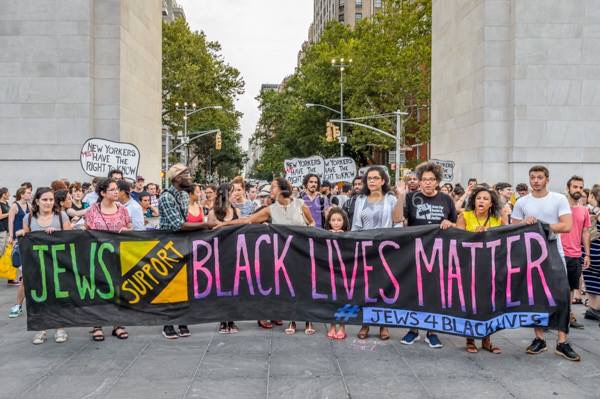
The Black Lives Matter movement has just taken a huge and important step. A new coalition called Movement 4 Black Lives recently released “Vision for Black Lives,” a powerful, comprehensive policy statement released by thirty grassroots organizations and endorsed by sixty others.

“Vision for Black Lives” is the product of a collaborative research and writing process that took more than a year by an eight person team – and is intensely relevant to the current political moment.  Team member Marbre Stahly-Butts summed up the purpose of the statement this way: “Democrats and Republicans are offering anemic solutions to the problems that our communities face… We are seeking transformation, not just tweaks.”

In contrast to the hollow posturing that counts for political discourse in the US, the M4BLM platform offers an important alternative vision: a deep analysis of how systems of oppression intersect and the devastating impact they have on people/communities of color. It’s particularly vital because it doesn’t come from a political party, think tank or special interest lobby, but rather directly from the grassroots communities most impacted by racism and oppression. In so doing, it represents a huge step toward the creation of a real movement for social and political change in our country.

As journalist Collier Myerson recently wrote in Fusion:

This is a really, really big deal. By shedding its previous identity as a largely reactionary, structureless movement, Black Lives Matter seeks to definitively lead the national discussion on the safety, health, and freedom of black people. Painting the movement with a broad brush is a seismic shift. And it’s a shift that Occupy Wall Street never put in motion, a failure which many point to as the reason for the movement’s eventual dissolution. The list of demands set forth by M4BL explicitly unifies organizations across the United States—and though the goals are purposefully lofty, it’s a significant move towards harnessing the power of local groups into something bigger.

Vision for Black Lives has been welcomed enthusiastically by many allies in this growing movement (such as those fighting for immigrant justice for instance). And as for the Jewish communal establishment?  For its part, the Jewish Community Relations Council of Greater Boston angrily “disassociated” itself from the statement, calling it “false” and “malicious”. Why?  Because in the midst of this vast and extensive platform, the M4BLM statement referred to Israel’s “genocide” against the Palestinian people and expressed its support for the Boycott, Divestment and Sanctions movement.

Actually, I wouldn’t expect anything else from an organization such as the Boston JCRC. Earlier this year, in fact, David Bernstein, the President and CEO of the Jewish Council on Public Affairs (the parent organization of JCRCs around the country), wrote an op-ed in which he thoroughly denounced “the solidarity between the Black Lives Matter and Palestine movements” and made a strong pitch for finding allies that will help them drive a wedge into Black-Palestinian solidarity. (Notably the Boston JCRC statement referred to its “friends and neighbors in the African-American community” who share their views on Israel and Zionism.)

I was very disappointed however, to read a statement released by Tru’ah – a progressive rabbinical organization that advocates for human rights that has in the past articulated strong support of BLM. Yet in their immediate response to the M4BLM platform, T’ruah spent almost all of its wordage decrying the genocide reference and BLM’s support for BDS.

Though I have many friends and colleagues in T’ruah whose work I respect greatly, I find this statement much more disturbing than the one released by the Boston JCRC. While the latter group openly vilifies the BLM movement, T’ruah purports to stand in solidarity with them. As opposed to more conservative Jewish establishment institutions, I’ve always had the impression that T’ruah truly “got it” when it came to the BLM movement.

On T’ruah’s website, for instance, you will find a powerful “Prayer for Black Lives Matter“. You will also find a post written by Rabbi Susan Talve and Sarah Barasch-Hagans entitled “10 Rules for Engagement for White Jews Joining the Black Lives Matter Movement,” a smart and insightful document that appears to grasp the complex issue of allyship. Among the rules listed are “Practice Deep Listening and Less Talking;” “Do Your Own Communities’ Work” and “Hold Yourself Accountable”.

In the rule, “Go outside of your comfort zone while staying in your lane,” the authors write:

Pay attention. Don’t hide when it gets messy. We all have a role to play and we will all make mistakes. Accept guidance. Remember this is a movement to awaken compassion. No name calling. “Call people in” rather than calling them out. Give the benefit of the doubt whenever possible. We are all sad and scared (or should be). Faith communities can be bridge builders, healers, and witnesses in this movement to make Black and Brown lives matter.

Sadly, T’ruah itself has broken its own rule by releasing this statement. If they truly purport to stand in solidarity with BLM, they cannot publicly “call them out” because their new platform lands outside their comfort zone. If they were to be true to their own articulated values, T’ruah should have reached out to them, engaged with them and tried to understand where they were coming from, thus opening a real dialogue. T’ruah does not give the BLM “the benefit of the doubt” when it issues an immediate counter-statement such as this; tantamount to a group in a position of power saying to an oppressed group, “we will stand in solidarity with you but only on our terms.”

The claim that Israel is committing “genocide” against the Palestinians undeniably pushes all kinds of buttons for many Jews. But there are also Jews and Israelis who feel it is not an inappropriate word to use, particularly in regard to Israel’s regular military assaults against Gaza. Likewise, while the BDS call is extraordinarily controversial for many Jews, there are also Jews who respect it as a legitimate call for nonviolent resistance from over 150 Palestinian civil society organizations. And it is simply not true to claim, as T’ruah does, that “the BDS movement (rejects) Israel’s right to exist.” On the contrary, the goal of the BDS call is equal rights for Palestinians as well as Jews.

But even if T’ruah feels it is wrong for BLM to refer to Israel in this manner, it can’t claim to stand in solidarity with them while publicly calling them out over the parts that make them uncomfortable. Rather, they should hold themselves to their own standard by “calling BLM in,” engaging with them and be “bridge builders” – especially in the places where there is pain or disagreement.

At the end of the day however, I don’t think this is T’ruah’s issue alone – it’s a challenge for the entire progressive Jewish community at large. If we claim to ascribe to a power analysis that views systems of oppression as intersectional and interrelated, we simply constantly cannot make an exception when it comes to Israel. The black community is increasingly finding common cause with Palestinians – and for good reason. Both are oppressed by the same systems, the same weapons, and the same security companies. It is not by coincidence that American police departments around the country are increasingly trained by the Israeli military.

If we truly seek to be to relevant this undeniably growing movement, we need to make these connections as well. No matter how uncomfortable it might make us.

What is Really Behind the UC’s Statement on Anti-Semitism?

University of California Intolerance

(AP Photo/Eric Risberg)

The regents of the University of California have spoken and has voted unanimously to adopt its working group’s “Principles Against Intolerance.” As I wrote last week, it is a report that dangerously conflates anti-Zionism with anti-Semitism in ways that make the report muddled, unenforceable, and a very real threat to the free speech of pro-Palestinian student groups on campus.

While most of the public debate over this report has focused on the challenge of balancing the UC’s desire to combat intolerance with the need to protect freedom of speech, it seems to me that one critical aspect of this issue has gone largely unaddressed: the fact that this report which purports to address the issue of intolerance on campus frames the issue almost exclusively in terms of anti-Semitism.

To be sure, if this report was intended to be a comprehensive statement on intolerance, wouldn’t the UC’s working group have consulted with a wide variety of experts on the campus intolerance currently faced by Muslim students, students of color, LGBTQ students, etc?  Tellingly, the report states that the working group “invited four recognized scholars and/or leaders on the subjects of discrimination, with a particular focus on anti-Semitism, and on free speech.” (Among these four expert/scholars were Rabbi Marvin Hier, of the Simon Wiesenthal Center, a high profile Israel advocate whose organization is currently building its”Museum of Tolerance” on top of an ancient Muslim cemetery in Jerusalem.)

Even more troubling, the opening “Contextual Statement” of the report states that the working group was formed in response to”public comment and concern from a variety of sources that there has been an increase in incidents reflecting anti-Semitism on UC campuses.”  The regents offer nothing more than this anecdotal statement to justify the formation of a working group and a months-long deliberation and debate on this issue. There is, however, no real evidence to support the claim that campus anti-Semitism is on the rise. Quite the contrary, as the Anti-Defamation League itself recently reported:

While (anti-Semitic) inci­dents are cer­tainly dis­turb­ing, it is important to note that these inci­dents are rel­a­tively rare, and the vast major­ity of Jew­ish stu­dents report feeling safe on their cam­puses.

This all begs the obvious question: why did the regents of UC feel the need to form a working group and hold a long public debate over a report such as this? I would submit it has nothing to do with genuine concern about intolerance on campus and everything to do with politics. This report is but a part of a much larger effort that seeks to stem the growing tide of the Boycott, Divestment and Sanctions movement on college campuses.

As the LA Times just reported:

The drive for the UC statement was led by the Amcha Initiative, a group that combats anti-Jewish bias on college campuses. Tammi Rossman-Benjamin, the group’s director and a lecturer at UC Santa Cruz, said campus demonstrations against Israeli policies and calls for the university to divest from firms with financial ties to Israel’s military have created blowback for Jewish students.

The involvement of the AMCHA Initiative with this “drive” tells you everything you need to know about the motivation behind the UC’s statement. AMCHA is a zealous Israel advocacy organization that fights campus “anti-Semitism” by monitoring college classes, spying on students and publishing names of “anti-Israel”professors. It bears noting that AMCHA was publicly admonished in 2014 by San Francisco State University (along with, you guessed it, the Simon Wiesenthal Center) for making false accusations against a professor. That same year, a group of forty Jewish studies professors from across North America wrote a public letter condemning AMCHA and its tactics.

Here’s an excerpt:

It goes without saying that we, as students of antisemitism, are unequivocally opposed to any and all traces of this scourge. That said, we find the actions of AMCHA deplorable.

Its technique of monitoring lectures, symposia and conferences strains the basic principle of academic freedom on which the American university is built. Moreover, its definition of antisemitism is so undiscriminating as to be meaningless. Instead of encouraging openness through its efforts, AMCHA’s approach closes off all but the most narrow intellectual directions and has a chilling effect on research and teaching.

Given the involvement of groups such as AMCHA, it is difficult to view the regents’ statement as anything other than a caving in to the pressure of professional advocacy groups determined to quash BDS and shut down pro-Palestinian advocacy on college campuses. Sadly, by labeling this criticism of Israel and anti-Zionism as anti-Semitic, it only silences students, renders the term meaningless and makes it that much harder to take actual allegations of campus anti-Semitism seriously.

As the ADL has reported, the vast major­ity of Jew­ish stu­dents report they feel safe on their cam­puses. Some of them may be made to feel uncomfortable by Palestinian activism and divestment resolutions, but uncomfortable is a far cry from unsafe. And it is shameful that UC has allowed itself to be pressured into issuing an unnecessary and downright dangerous statement such as this.

Given the current climate in our nation, I’d wager if there was a group of students who might well feel justifiably unsafe, it is Muslim students. By all reports, college campuses are feeling the impact of anti-Muslim hatred that began with 9/11, and is currently being fanned yet further during this horrid election cycle. For more this particular subject, I highly recommend this powerful article by Nasreen Mohamed, an administrator at the University of Minnesota. I’ll end with her words:

After the ending of a successful program to welcome new international students, I noticed one of the students who attended the program struggling to figure out the bus route to get home. I stopped to assist her, and we ended up walking together as I happened to be going in the same direction. We struck up a conversation about walking on campus. She is a Lebanese Muslim woman who wears a hijab.  She asked me how safe it was for her to walk on campus. I gave her my administrative cautionary tale about taking safety precautions and avoiding walking alone late in the evening. After a pause, she asked me how safe it was to walk on campus as a Muslim woman, wearing a hijab. I realized in her pause and clarification that there was very little I could offer her in terms of a sense of safety. All I could do was to give her a realistic picture. I told her that there had been violence in the Twin Cities  and in Greater Minnesota, but nothing violent had occurred on campus. After I walked away, I realized that she will be met with the same micro aggressions that I had experienced post 9/11, and that our campus was still not equipped to protect her spirit.

Anti-Zionism Isn’t a ‘Form of Discrimination,’ and It’s Not anti-Semitism

2261882899

Cross-posted with Ha’aretz

As an alum of UCLA, I was particularly interested when I learned that the working group for the Regents of the University of California Board had released their draft “Statement of Principles Against Intolerance.”  Having followed the news at my alma mater I knew that despite its title, this report wasn’t going to be merely a general statement about the importance of tolerance on campus. It was written in response to allegations of rising anti-Semitism at UCLA and other UC campuses.

On the face of it, there is much to admire about the report, particularly its strong support of campus environments “in which all are included, all are given an equal opportunity to learn and explore, in which differences as well as commonalities are celebrated, and in which dissenting viewpoints are not only tolerated but encouraged.”

In the end, however, this “Statement of Tolerance” actually achieves the exact opposite of its stated goals. If heeded, it would serve to silence dissent and open debate on college campuses.

At the beginning of the draft report, it states:

Fundamentally, commenters noted that historic manifestations of anti‐Semitism have changed and that expressions of anti‐Semitism are more coded and difficult to identify.In particular, opposition to Zionism often is expressed in ways that are not simply statements of disagreement over politics and policy, but also assertions of prejudice and intolerance toward Jewish people and culture.

The statement thus concludes that “anti‐Semitism, anti‐Zionism and other forms of discrimination have no place at the University of California.”

It is certainly important to state unequivocally that anti-Semitism will not be tolerated on UC campuses. But it is incorrect and even disingenuous of the report to make the unsupported claim that anti-Zionism is “often expressed (as) assertions of prejudice and intolerance toward Jewish people and culture,” and blithely conflate anti-Semitism with anti-Zionism as a “form of discrimination”.

It is true that some anti-Semites lurk behind the label of anti-Zionism – and when they do they should rightly be exposed and condemned. But it is deeply problematic to label anti-Zionism as a form of discrimination.

In fact, growing numbers of Jews and others identify as anti-Zionists for legitimate ideological reasons. Many profess anti-Zionism because they do not believe Israel can be both a Jewish and democratic state. Some don’t believe that the identity of a nation should be dependent upon the demographic majority of one people over another. Others choose not to put this highly militarized ethnic nation-state at the center of their Jewish identity.  Far from being discriminatory, their beliefs are motivated by values of equality and human rights for all human beings.

Blurring the distinction between anti-Zionism and anti-Semitism muddles the definition of anti-Semitism to the point that it becomes meaningless.This conflation is irresponsible and harmful and invariably draws our attention away from real anti-Semitism, whether it be the targeting of Jews, the vandalization of synagogues and cemeteries or the proliferation of hate groups at home and abroad.

Certainly all forms of racism should be called out in no uncertain terms. But erasing the lines between anti-Semitism and anti-Zionism only makes this task more difficult.

I can’t help but notice that this report’s broadside on anti-Zionism strongly evokes the right-wing agenda of groups such as the AMCHA initiative. Tammi Rossman-Benjamin, Director of AMCHA has long made it clear that tarring anti-Zionists as anti-Semites is part of a larger strategy to ban Palestinian solidarity groups from campuses across the country.

Such a policy would have a devastating impact on Palestinian activists and their allies. It would prevent many Palestinian and Israeli human rights advocates from speaking on college campuses. It would prevent students from displaying a model of Israel’s separation wall to demonstrate to the oppressive effects of Israel’s occupation. And it would forbid student efforts to hold Israel accountable through economic pressure, through campaigns to boycott and divest from settlements or from corporations that profit from the abusive policies of the state of Israel.

Having long worked in the Jewish community, I know that some Jewish organizations equate anti-Zionism with anti-Semitism because they seek to protect Israel’s image or because they do not want Jewish college students to have to tolerate criticism of Israel and Zionism.Those who believe in a one state solution are accused of seeking “the destruction of the Jewish state” when they actually hold their position as a result of honest political analysis and a genuine concern for all who live in the land, regardless of their religion or ethnicity.

Yes, critics of Israel and Zionism can sometimes be harsh and their tactics confrontational, but I do believe we do our young people no favors when we attempt to silence them. Though I have come a long way since my UCLA days, I still remember all too well how uncomfortable it was to have one’s beliefs and opinions challenged.But we should not confuse “uncomfortable” with “unsafe.” Forbidding debate and free speech will not create more comfortable campus environments – it will only marginalize students for legitimately expressing their beliefs.

The UC Regents claims to support the open exchange of ideas on their campuses. But they will never accomplish this if they teach students that their ideas only matter if they pass a political litmus test.

The “Religious Roots” of Palestinian Violence: A Self-Fulfilling Prophecy?

al

Benjamin Netanyahu’s recent comment at the World Zionist Congress attributing the Final Solution to the Grand Mufti of Jerusalem was stupid and ignorant – and he has been justifiably ridiculed around the world for making it. But those who think these kinds of crazy comments will somehow prove his downfall should think twice. Netanyahu has long been willing to take his lumps for his silly behavior as long as it ultimately serves his political purpose. In this case, his purpose is clear: he is attempting frame Palestinian violence as the result of religious (read “Muslim”) intolerance of Jews.

And those of us who delight in ridiculing Bibi the Clown should take heed: there is every indication that his attempts to shift this particular narrative are starting to gain traction.

Just a few days before Netanyahu’s comments, for instance, Jeffrey Goldberg, a well-known mainstream media journalist, published an article in The Atlantic entitled “The Paranoid, Supremacist Roots of the Stabbing Intifada.” His conclusion?

One of the tragedies of the settlement movement is that it obscures what might be the actual root cause of the Middle East conflict: the unwillingness of many Muslim Palestinians to accept the notion that Jews are a people who are indigenous to the land Palestinians believe to be exclusively their own…

In his piece, Goldberg traces this “root cause” as far back as the 1920s. Like Netanyahu, he casually portrays the wretched Mufti of Jerusalem, Haj Amin al-Husseini as a surrogate for the Palestinian people writ large, conveniently neglecting to point out that al-Husseini was not in fact chosen by Muslim Palestinians, but was actually appointed by the British High Commissioner Herbert Samuel in 1921 – and that he was dismissed as Mufti in 1936, five years before he famously met with Hitler. Even more crucially, treating a colonially-appointed Muslim leader as representative of the entire Palestinian people conveniently ignores the presence of Palestinian Christians, who in the 1920s made up one tenth of the population of Palestine.

In its way, his post was even more dangerous than Netanyahu’s silly remark, as it put a legitimate face on the claim that the Israel-Palestine conflict can essentially be reduced to Muslim intolerance of Jews. In contrast to Netanyahu’s remarks, Goldberg’s article was widely respected and went viral across the social media. Much to my dismay, many of my liberal rabbinic colleagues approvingly posted it on their Facebook pages.

In his article, Goldberg also pointed to recent “harsh” statements by Palestinian Authority President Mahmoud Abbas, suggesting that “these sorts of comments…suggest a tragic continuity between the 1920s and today.” Abbas’ comments were odious to be sure, but it is ludicrous in the extreme to somehow characterize him as a wide-eyed Muslim extremist. And it is even more ludicrous to suggest that the majority of young Palestinians engaging in the current violence have been “incited” by his words.

As Israeli journalist Mya Guarnieri has rightly observed:

Those who call this a religious war, and who point to Abbas’ words as incitement, have got it backwards. Abbas — whose term expired in 2009 and has little legitimacy on the Palestinian street — is trying to insert himself into recent events in a bid to regain popularity.

But the Palestinian youth who are protesting and carrying out attacks on Israelis care little what he or other politicians say. Indeed, their actions can also be understood as moves against the current state of politics, including the Palestinian Authority itself. The young people are calling for something new, for something more than endless negotiations that go nowhere or that buy Israel the time to build more settlements and deepen the occupation. After all, this is the generation that was born and raised after the Oslo Accords were signed in 1993 — their difficult lives are a testimony to what negotiations will get the Palestinian people. That is to say, little.

That’s right: the true “roots” of this tragedy are not religious but political. If we are to draw a direct from the violence of the 1920s until today, it should more accurately be traced from a collision between a Jewish ethno-nationalist enterprise and an indigenous population resisting displacement and occupation.

I find it notable that Goldberg does not track his “religious intolerance” narrative further back than the 1920s. In fact, while there has always been a Jewish presence in this land, there was relatively little tension between the religious communities of Palestine before the 19th century – when the Zionist movement began colonizing it with the express purpose of creating an exclusively Jewish state in a historically multi-religious and multi-ethnic land.

Having said this, however, I do fear that the longer this political injustice is allowed to continue – the longer Israel’s oppression of Palestinians is allowed to continue with impunity – the more likely we will witness the rise of religious extremists on both sides. This is clearly Netanyahu’s strategy of course: to “manage the conflict” until the religious extremist meme invariably becomes a reality.

Just yesterday, for example, the Israeli Prime Minister was quoted as saying that although he does not want a bi-national state, “at this time we need to control all of the territory for the foreseeable future…I’m asked if we will forever live by the sword – yes.” Then most tellingly, he added this all-too-familiar analysis: “half of the Palestinians are ruled by an extreme Islam that wants to destroy us.”

Yes, on the one hand it’s just more Bibi-bombast. But don’t dismiss his words too easily. As long as Israel seeks to “control all of the territory,” the more likely the chances that his cynical narrative will tragically become a self-fulfilling prophecy.

Confronting the “New Campus Anti-Semitism”

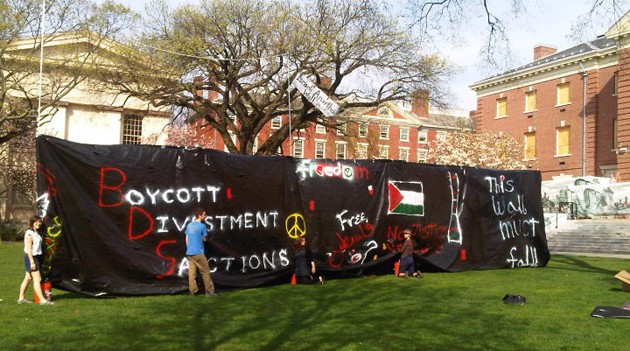
wall-palestine-side1-brown-u

Throughout the organized Jewish community, the mainstream media and academia, we’re hearing increasing talk of a sharp increase in anti-Semitism on American college campuses. In response to recent incidents at UCLA and elsewhere, one congregational rabbi from LA has warned of  “something deeper, more troubling, insidious, and pervasive…on college campuses nationwide.” Another rabbi has declared ominously, “This is a war — a war for the heart, mind, and soul of the American university.” Barry Kosmin of Trinity College, who co-authored a recent study alleging rising antisemitism on campus, has opined that the “the events in California” were not “isolated incidents” and that this “type of hatred, stereotyping and bias is a worrying new development that suggests a generational problem.”

To judge from these comments, it would appear that colleges and universities have become virtual petri dishes of Jew-hatred. Have our campuses indeed become overrun by anti-Semitism?

I would argue that something very different is going on. As the movement for Boycott, Divestment and Sanctions against Israel grows and student divestment campaigns increasingly find traction throughout the United States, we’re witnessing a new kind of tension forming between Palestinian solidarity activists and Israel advocates on college campuses. And while it doesn’t surprise me that some Jewish community leaders are raising the all too familiar cry of anti-Semitism, I believe it’s critical to carefully examine the context that lies beyond the hysteria.

Some background: the UCLA incident occurred last February, when a student candidate for the Judicial board of the Undergraduate Students Association was asked by a student member how, given that she was Jewish and affiliated with Jewish campus organizations, would she “see (herself) being able to maintain an unbiased view?”  After a subsequent discussion, the council first voted to reject her nomination – but after a faculty adviser pointed out that it was not appropriate to view a student’s affiliation with Jewish organizations as a conflict of interest, the students voted again and unanimously approved of her nomination.

This incident, which was captured on video and posted on YouTube, led to an intense and at times painful reckoning throughout the UCLA campus community. The four students who initially opposed the student’s nomination wrote a public apology in the campus newspaper, stating that their “intentions were never to attack, insult or delegitimize the identity of an individual or people” and that they were “truly sorry for any words used during this meeting that suggested otherwise.” UCLA’s chancellor, referred to the incident as a “teaching moment.” Later, the student council  unanimously passed a sweeping resolution condemning anti-Semitism.

Many observers have referred to the board members’ line of questioning as “anti-Semitic,” claiming that their questions raised the infamous anti-Jewish tropes of dual loyalties. But whether their comments were anti-Semitic, obnoxious, or merely naive, it is important to note that in the charged world of campus divestment politics, attitudes toward Jewish students – particularly those who serve on student boards – do not exist in a vacuum.

To begin with, any serious analysis of this issue must factor in the heavy-handed interventions of off-campus advocates of Israel into student politics. Perhaps the most infamous example is Adam Milstein, a businessman and convicted felon who is connected to right-wing Zionist groups and has reportedly funneled money through UCLA Hillel to influence student elections and oppose divestment campaigns.

Blogger Richard Silverstein has written extensively on the controversies surrounding Milstein’s activities at UCLA:

For at least the past three years, Milstein has donated funds via UCLA Hillel (another comprehensive review of the entire scandal is here) to support the pro-Israel student government slate Bruins United, an affiliate of Bruins for Israel.  Though we know that Milstein personally donated $1,000 to the slate (e-mails confirming this are published here), he also solicited funding from other pro-Israel donors.  Both he, Hillel, and the slate have refused to reveal how much external funding was given. Milstein was much more than a mere donor.  He held strategy sessions with the executive candidates.  He held a gala fundraising event at his home attended by Hillel staff, prospective donors, and UCLA faculty and staff.  The purpose was to encourage donors to participate in the project to benefit both Hillel and Bruins United and to oppose BDS.

In addition to individual actors such as Milstein, there are many Jewish institutional initiatives (such as AIPAC Campus Initiatives, Hasbara Fellows, the JNF Campus Fellowship Program) that receive direct support from the State of Israel  to train students to advocate for Israel and combat divestment initiatives. Last year, in fact, the Judicial board of the UCLA Undergraduate Students Association heard a complaint that two student government members had taken trips to Israel sponsored by the Anti-Defamation League and the American Jewish Committee prior to voting on a student divestment resolution.

Although this context has not been widely reported, it is crucial to our understanding of the most recent incident involving the questioning of the student Judicial board candidate. Given the high profile of professional Israel advocates in student affairs, it is fair to assume that these interventions might well affect attitudes and assumptions about the loyalties of Jewish students at UCLA.

Having said this, it would be a mistake to characterize these campus tensions in simple binary terms as a conflict between Jewish students and Palestinian solidarity activists. In truth, there is a significant and growing percentage of Jewish students actively participating in campus divestment campaigns through Students for Justice in Palestine and student chapters of Jewish Voice for Peace. I know first hand that many of them are motivated to their activism by their deeply held Jewish values of justice and the dignity of all. I took it as something of a sign of the times when just a few months ago, I was contacted by a undergraduate at Northwestern University who grew up in my congregation. This young man, whom I had not seen since his Bar Mitzvah, told me he was involved in the student divestment campaign and invited me to speak in support of it on campus.

By the same token, it would be mistaken to assume that all campus Israel advocates are necessarily Jewish. There are for instance numerous Christian Zionist campus groups that work alongside Jewish Israel advocates, the most prominent of which is CUFI on Campus – the student affiliate of Pastor John Hagee’s Christians United for Israel.

On their website, CUFI on Campus notes:

As anti-Semitic activity on American college campuses has steadily increased, CUFI recognizes that Christian students have a responsibility to speak up on behalf of Israel and the Jewish people.Field Organizers travel the country actively developing student leaders. Our Field Organizers travel the country actively developing student leaders to ensure they have the skills, resources, and guidance they need to do this successfully on their campuses.

Anyone familiar with the right wing Evangelical theology of Christians United for Israel might well find it puzzling that CUFI on Campus is concerned with rising anti-Semitism on college campuses, particularly when you consider that CUFI Pastor John Hagee has long preached that the Holocaust was God’s will, that the Jewish people need to accept Jesus to avoid going to hell, and that the contemporary Zionist settlement of Israel is a necessary precursor to Armageddon.

Despite these its embrace of these wildly anti-Semitic beliefs, Jewish Federations and Zionist organizations have had no qualms about partnering with CUFI when it comes political Israel advocacy. The same can be said for student groups. Earlier this month, for instance, CUFI on Campus co-sponsored a program with Rutgers Hillel which focused, ironically enough, on “how to combat anti-Semitism.”

Given these realities, I would suggest we avoid simplistic narratives that blame Palestinian solidarity activists for creating an “unsafe environment” for Jewish students. The truth is that there are Jewish students and non- Jewish students on both sides of this issue.

We should also think seriously about what we mean by the term “unsafe” – an oft-heard complaint of Jewish Israel advocates on campus. I have no doubt that some Jewish students are uncomfortable with divestment resolutions and other actions employed by Palestinian solidarity activists. I also have no doubt that on occasion such actions might spill over into the inappropriate or offensive. But as a rabbi who has worked together with activists from SJP and JVP on several campuses over the years, I can personally attest that I have found these student leaders to be smart, passionate organizers who are motivated by deeply held anti-racist values – and who understand full well the difference between anti-Israel and anti-Semitic.

And if, on occasion, the line between the two sometimes get blurred, we might well ask ourselves: is this due to the abject Jew-hatred on the part of Palestinian solidarity activists or a contemporary Jewish communal mentality that has placed support for the State of Israel at the center of Jewish identity?

In fact, for all of the hue and cry about the rise of campus anti-Semitism, statistics show otherwise. In fact, a recent Forward editorial entitled “The Anti-Semitism Surge that Isn’t” dismissed the Trinity College report as flawed, citing studies by the Anti-Defamation League that show campus anti-Semitism is in fact at “the lowest it’s been since the ADL started keeping track in 1999:”

In its audit of 2014, set to be released April 1 and shared with the Forward, the ADL said there were 47 incidents of anti-Semitism on campuses nationwide, where hundreds of thousands of Jews study. The number organically fluctuates year to year … but this is one trend that’s unmistakeable. Overall, anti-Semitic incidents are at the lowest point in 15 years.

47 incidents of anti-Semitism on campuses nationwide. Now compare that to the institutional repression faced by Palestinian campus activists during the same year. According to Liz Jackson, a staff attorney with Palestinian Solidarity Legal Support:

The reality is that, for every real incident of anti-Semitism on campus, Palestine Solidarity Legal Support has documented many more false accusations aimed solely at thwarting serious discussions about Israel’s treatment of Palestinians. In 2014 alone, we documented over 240 incidents of repression and requests for legal advice, nearly 75% on campuses. These ranged from disciplinary actions against students for peaceful speech activities, to attempts to cancel events, to smear campaigns against groups, students and professors, to death threats and anti-Arab and Islamophobic slurs and assaults against activists because they voiced their views. Virtually all of these cases resulted from unfounded accusations of anti-Semitism and unrelenting pressure from Israel advocacy groups to censor and punish those organizing and engaging in speech activities advocating for Palestinian rights. So far this year, we have already documented over 80 such cases, 40 of which occurred in California.

In the end, I would suggest this concern over the “new campus anti-semitism” is really a red herring. Anti-semitism, like all forms of racism should certainly be condemned and stood down in no uncertain terms. But for all the concern over anti-Jewish attitudes, it is worth noting that Jewish students and Israel advocates face absolutely no institutional restrictions to their cause or to their freedom of speech on campus.

It is far from clear that the same could be said for students who advocate on behalf of Palestinian rights.

Debating Israel/Palestine on Chicago Tonight

mezzanine_916.png.resize.768x432_0Last night I appeared on WTTW’s “Chicago Tonight” with my friend and colleague Rabbi Andrea London to discuss the issue of Israel/Palestine in the wake of Netanyahu’s re-election. Andrea spoke to the J Street position while I represented the Jewish Voice for Peace point of view. Although the station tried repeatedly to find a local rabbi to represent the AIPAC line, none were willing to participate. I’m sad to report that several of the rabbis contacted cited my presence on the panel as the reason for their refusal.

On the other hand, I was so heartened that Andrea and I were able to model a principled and respectful Jewish communal debate on this issue and I was so grateful for her willingness to engage.  Click here to watch.