Category Archives: Civil Rights

Tent of Nations Told to Stop Working its Own Land – Be Ready to Act!

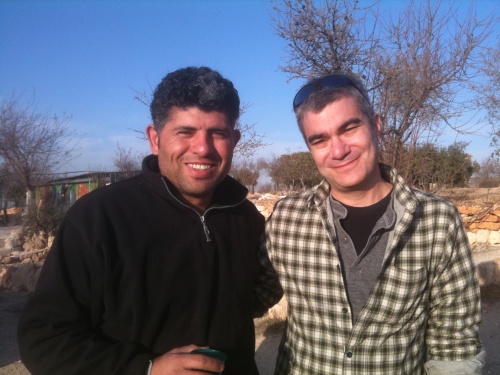
Friends of Tent of Nations has just shared this upsetting letter from Daoud Nasser (above left):

Dear Friends,

Today, the 14th of  February at 1.30 PM and as we were working on our land, specifically in the tree of life orchard, we found on three different places ,  papers with maps signed by the civil administration of Judea and Samaria which is the Israeli military government.

The papers say that we have to stop working  on the land specified on the map, because they declared it as a state land. According to them, this land doesn’t belong to us but it is a state land and we are cultivating it. The papers also say  that if we want to challenge this order, we can appeal against it within 45 days in front of the military representative office.

It is a shock to receive something like that after 21 years of legal battle defending our land and the right to it in front of Israeli courts.

We sent those papers to our attorney in Jerusalem and he is going to appeal against it within the next days.

This is just to inform you about what happened today, please be aware that the situation might get worse, please be prepared in case actions are needed. In the meanwhile, our attorney will appeal against it and we will see what kind of reaction we receive”

We will keep you updated and will inform you about our next steps and how you can help.

Thank you so  much for your support and solidarity. Please keep us in your thoughts and prayers.

Blessings and Salaam.

Readers of my blog should be well acquainted with my friend and personal hero Daoud Nasser. Last year I wrote about Tent of Nations and my visit, together with twenty JRC congregants, with Daoud on his family farm.

This new development is just the latest in a long history of harassment courtesy of the military administration in the West Bank – an institution that provides the shameful “legal” cover for Israel’s outright theft of Palestinian lands. Please stand by – I will forward any further news from Daoud and let you know how you can act on his behalf.

Moment of Truth for Liberal Zionism

For the last ten plus years, advocates of a two-state solution in Israel/Palestine have been warning that the “window of opportunity” for a two-state solution is closing fast.

Here’s Jordan’s King Abdullah II using the image in a 2005 speech:

Israelis and Palestinians must take advantage of a “small window of opportunity” for peacemaking, he warned. “If we don’t do it, I think the Middle East will be doomed, unfortunately, to many more decades of violence.”

From a 2007 Boston Globe report:

Secretary of State Condoleezza Rice said yesterday that a “two-state solution” in the Middle East is in jeopardy and described a narrow window of opportunity to push Israel and the Palestinians toward peace.

J Street director Jeremy Ben-Ami, writing in a 2008 Forward op-ed:

The window is closing on a two-state solution, and Israel’s prospects for a second, safer 60 years grow are growing ever dimmer.

And as recently as two weeks ago, Ben-Ami used a different metaphor to underscore the urgency of the latest “moment:”

If this round of talks breaks down yet again – and you’ll be hard-pressed to find a single observer who’ll argue that they won’t – then Israel, like the boater on the river, can briefly revel in having avoided the risk of heading to shore.

But bear in mind that “sitting this one out” isn’t an option. The waterfall is still dead ahead.

As someone who’s invoked the “closing window” more than once myself over the years, I’m quite familiar with this pedagogy. Time is running out for a viable negotiated two-state agreement between Israelis and Palestinians – and thus the future of a Jewish and democratic state. The status quo – namely unrestricted Israeli settlement of the West Bank, coupled with an ever-increasing Palestinian birth rate – simply cannot be sustained.

At a certain point, however, I think it’s fair to pose the challenge: how many times can you repeatedly warn of a last chance before the notion is rendered devoid of all meaning? How long can advocates of a two-state solution invoke the urgency of a fleeting opportunity before admitting that this solution is simply no longer a realistic option any more?

To be sure, with each passing day, the warning of a last chance opportunity appears increasingly toothless. The latest “window of opportunity” occurred earlier this month when it was reported that Israeli Prime Minister Bibi Netanyahu was “mulling gestures to Palestinians to keep the peace talks going.” Barely a week later, we learned that Israeli officials had formally informed the PA of its position that West Bank settlements “must be a part of the Israeli State.”

Such a position, of course, makes a complete mockery of any suggestion of a viable, contiguous Palestinian state. It lays bare the truth that Israel is not really interested in two actual states, but merely the formalization of an inherently inequitable status quo.

The political realities here are stark and undeniable. Israel’s settlement of the West Bank continues with impunity and the US continues to provide its “closest ally” with all the diplomatic cover it needs to do so. Politically speaking, it is no longer possible to invoke windows of opportunity with a straight face. Perhaps the real question before us is not “how many times have we missed these opportunities?” but rather, “did they ever really exist at all?”

So what happens now? It’s reasonable to assume that this paralyzed, inequitable status quo will continue apace into the indeterminate future. Israel will continue to create facts on the West Bank with the tacit permission of the US, creating a conditions that no Palestinian leader could possibly be expected to accept.

Under such circumstances, it is equally reasonable to expect the reality for Palestinians on the ground to grow increasingly oppressive and dire.  As this occurs, their plight and their cause will be more difficult for the world to ignore. Governments, individuals and institutions will increasingly rally to Palestinian requests for support, most prominently the Palestinian civil society call for Boycott, Divestment and Sanctions against Israel.

In turn, Israel’s actions will be increasingly more difficult for its supporters to defend.  As the status quo is allowed to languish, the state of Israel will become further and further isolated from the rest of the world community and more pressure will be brought to bear upon the political elites to fundamentally change their approach to ending this conflict.

While these are certainly sobering and painful prospects, I don’t think they are exaggerated or far-fetched. On the contrary, I believe the burden of proof is on those who believe the same tired approach to the “peace process” will somehow yield results in the future when it has failed repeatedly in the past.

Once we accept that a division into two states is no longer realistically possible, the calculus is sobering, to put it mildly: we will be forced to choose between a patently undemocratic apartheid Jewish state, in which a minority rules over a majority or a civil democracy in which all citizens have equal rights under the law.

For many liberal Zionists, this unbearably painful decision will represent a profound moment of truth. If forced to choose, which will it be? A Jewish state that parcels out its citizens’ rights according to their ethnicity – or a democratic state in which equal rights are enjoyed by all its citizens?

I truly believe this is more than an academic question.  Perhaps it’s time to stop talking about mythic “windows of opportunity” and open a new discussion: what will it take for us to admit that it is finally closed? And what will our options be then?

New Report on Israel’s Abuse of Palestinian Children

I strongly encourage you to read Guardian reporter Harriet Sherwood’s devastating new piece, which investigates allegations of human rights abuse of Palestinian children inside Israel’s Al Jalame prison.

I’m already anticipating the angry comments I invariably get when I share this kind of information. But what else should I do?  As an American Jew, what else am I supposed to do with the news that that Israel – the Jewish state, the “only democracy in the Middle East” and America’s “special ally” – is abducting, abusing and torturing Palestinian children?

I don’t know anything else to do but to bring this information into the light of day, urge you to share it, and encourage you to voice your outrage to your elected leaders.

Here’s the start of the article:

The room is barely wider than the thin, dirty mattress that covers the floor. Behind a low concrete wall is a squat toilet, the stench from which has no escape in the windowless room. The rough concrete walls deter idle leaning; the constant overhead light inhibits sleep. The delivery of food through a low slit in the door is the only way of marking time, dividing day from night.

This is Cell 36, deep within Al Jalame prison in northern Israel. It is one of a handful of cells where Palestinian children are locked in solitary confinement for days or even weeks. One 16-year-old claimed that he had been kept in Cell 36 for 65 days.

The only escape is to the interrogation room where children are shackled, by hands and feet, to a chair while being questioned, sometimes for hours.

Most are accused of throwing stones at soldiers or settlers; some, of flinging molotov cocktails; a few, of more serious offences such as links to militant organisations or using weapons. They are also pumped for information about the activities and sympathies of their classmates, relatives and neighbours.

At the beginning, nearly all deny the accusations. Most say they are threatened; some report physical violence. Verbal abuse – “You’re a dog, a son of a whore” – is common. Many are exhausted from sleep deprivation. Day after day they are fettered to the chair, then returned to solitary confinement. In the end, many sign confessions that they later say were coerced.

These claims and descriptions come from affidavits given by minors to an international human rights organisation and from interviews conducted by the Guardian. Other cells in Al Jalame and Petah Tikva prisons are also used for solitary confinement, but Cell 36 is the one cited most often in these testimonies.

Between 500 and 700 Palestinian children are arrested by Israeli soldiers each year, mostly accused of throwing stones. Since 2008, Defence for Children International (DCI) has collected sworn testimonies from 426 minors detained in Israel’s military justice system…

Human rights organisations say these patterns of treatment – which are corroborated by a separate study, No Minor Matter, conducted by an Israeli group, B’Tselem – violate the international convention on the rights of the child, which Israel has ratified, and the fourth Geneva convention.

Ahmed Moor on the One-State Solution

Last Thursday, Ta’anit Tzedek hosted a fascinating, stimulating conference call with Palestinian-American journalist Ahmed Moor. Moor, who was born in Gaza, has reported from Lebanon and Egypt and is currently a graduate student in public policy at Harvard.  He has been an outspoken advocate of a one-state solution in Israel/Palestine – and during our conversation he elaborated extensively on a subject not commonly countenanced in the American Jewish community.

We recorded the call and will be posting it on our website soon. In the meantime, I’ve transcribed portions of our conversation and have posted them below. Personally speaking, I find Moor’s way of thinking to be fresh and important and I believe these kinds of ideas deserve a fair hearing in our community.

On the notion that Israel must exist in order to safeguard Jewish culture:

First I want to address this idea that a Jewish state has a right to exist because Jewish culture is valuable.  Jewish culture is valuable. Hebrew culture is valuable. It is intrinsic – that’s true whether or not Newt Gingrich thinks it’s invented. But the question of whether culture needs to be mapped on a geographical space in a state environment, I think, is one that is open to discussion.

And so when we think about Jewish life here in America, I don’t know that many people would disagree with me when I say that some of the most vibrant examples of Jewish life are here in America, in the diaspora, amongst non-Jewish people. So right-wing Israelis like to make the argument that where Hitler failed, assimilation is going to succeed. Intermarriage is the biggest threat to the Jewish people, not Iran.

Well, if you believe that Israel is the homeland of the Jewish people and that it’s the only state guarding Jewish culture, well then you are in a sense aligning yourself with those arguments.  It’s illiberal, fundamentally illiberal.  We know from American experience that a multiplicity of cultures can exist alongside one another and engage with one another and strengthen one another and maybe, even yes, impact one another in positive ways.

And when it comes to Palestine and Israel, American Jews say, “Well this is kind of the homeland of the Jewish people, it’s going to preserve Jewish culture for us,” but it’s almost a relationship apt to an amusement park. “I don’t want to live there – I want to experience it for two weeks. I want to take some of the symbols home with me, but I don’t really want to engage with it in the way that I do at home.”

Well, that’s unfair. No matter how much you value Jewish culture, and no matter how much you believe Israel needs to exist for the preservation of Jewish culture, if it’s a museum, which I don’t think it is, you’ve got to realize that your cultural progress is coming at the expense of somebody else’s freedom. And I think that there’s an asymmetry there in what matters.

On the notion that Israel should exist in case another Holocaust should occur – and Israelis’ fears that a one-state solution is just a pretext for “throwing them into the sea:”

I think that first we’ve got to look at the reality today. The status quo is about expelling Palestinians from Jerusalem, their land in the West Bank, and disenfranchising them in greater ways in Israel proper…So the reality is exactly the opposite. The status quo, the two-state solution process, is about pushing the Palestinians not into the sea, but in the other direction.

First I want to address Jewish American fear, and I hear this from a lot of Jewish Americans of a certain age, when they talk about the Holocaust, which is obviously an evil, genocidal but I want to emphasize, a historical act. I had the benefit of speaking with (New York Times columnist) Roger Cohen recently, and we talked about American Jewish life and I asked him whether he feels unsafe in America. And he was unequivocal: “Absolutely not, America is safe for the Jewish people, we’re welcome here, we’re part of the people, we’re part of the cultural fabric. We are America. America is us.”

Do you ever believe as American people that there’s ever going to be something like Kristallnacht or a pogrom targeting the Jewish people in America?  If the answer is yes, well then perhaps it’s time to move to Israel – and that’s what most right-wing Israelis say. If the answer is no, well then you’ve got to realize that you are opting for the preservation of an insurance policy, but the price of that insurance policy is being borne by another people. The Palestinians are paying the cost of a Jewish American insurance policy. There’s that asymmetry again. That doesn’t work. That’s not a moral position to take and it’s unsustainable.

As for Israelis’ fear about whether we seek to ethnically cleanse them, I think there’s again a gap in perceptions of realities. The Israelis are the ones with the guns. The Israelis are the ones with the American support. When the one-state solution is actualized, it’s going to be necessarily through Israeli consent. The idea that the Middle East or Palestine has to be in any way ethnically cleansed of Jewish people is a European action transplanted onto Palestine.

On Israeli historian Gershon Gorenberg’s recent claim that a one-state solution in Israel/Palestine would create civil war à la Lebanon:

Gershon’s fear is related directly to governmental structures – the way in which you structure multi-ethnic, multi-religious societies, or sectarian societies. In Lebanon I think it was structured exactly the wrong way. In Lebanon, whether you’re liberal or you’re somebody who’s more conservative, whether you believe in one policy versus another, the state almost compels you to vote along sectarian lines.

In Lebanon the Speaker of the Parliament has to be a Shia Muslim, the Prime Minister is a Sunni and the President has to be a Maronite Christian. That’s constitutionally true – that’s mandated. And so what that means is that you end up voting – where your vote is impactful and meaningful – is in your sectarian group. The Lebanese demography there is so sensitive – they haven’t had a national census since 1932 or 33, I think.

You have the American case, on the other hand – the structure of this country is along a federal basis. Federalism enabled this country to recover from the wounds of the Civil War and to persist for another 150 – 160 years since the Civil War ended.

It’s important that we think about questions like the ones Gershon is raising, but I don’t think that those questions necessarily stand in the way of a one-state solution. So there are good federal structures, confederal structures even, for dealing with ethnic or religious strife in democracy.

What I’m thinking of specifically is a state with four federal units: the Gaza Strip, Jerusalem is its own district, sort of like Washington DC, central Israel and the Negev and finally the West Bank and the Mediterranean corridor so now you’ve got four districts and Jerusalem. And each of those federal units would be defined geographically and every one of them, with the exception of the Strip, would be made up of minorities either of Jewish people or Palestinian people.

And so in the West Bank federal state you’d have an expression mostly of Palestinian culture. Why? Because 5 out of every 6 people on the West Bank are Palestinians. In the Gaza Strip you could have an expression of Palestinian culture. In the northwestern state there’s a big minority of Palestinian Israelis, but it’s primarily Jewish. I mean we’re talking about the Tel Aviv – Haifa corridor and that would be a majority Hebrew culture state. Same with the Negev.

So you have parity amongst the states because the states are defined geographically and you enable people over time to move for personal preference reasons. Over time your could get a drift across these federal lines, kind of like what happened in the States. You used to define yourself as an American 100 years ago as a South Carolinian or a New Yorker, but today your primary locus of identity is as an American when you deal with the rest of the world. This was the failure of Lebanon – instead of geographically defining the states, the individual community boundaries within Lebanon don’t allow for that drift, so what they’ve ended up with is kind of ossified sectarian structure.

So I don’t think it will be perfect, I don’t it will be easy, but the idea is that you grant people equal rights and give them the freedom to move back and forth across borders. They won’t initially, but they will eventually. That’s been the American experience.

On the political future of the one-state solution:

I heard an Israeli speak recently, an older guy, an activist, and he mentioned the one-state solution is about where he remembers the two-state solution was in the seventies. And so it’s really about changing discourse, changing people’s thought patterns. Lots of people will come into the one-state conversation because they’ve realized the two-state solution is unworkable and that apartheid is just not something they are capable of supporting.  We’ll achieve a critical mass. It’s impossible to predict how or when, but two states isn’t going to work and apartheid isn’t going to work. And so you can arrive at this position by default even if you don’t actually believe it’s the best thing anyway.

On cultural autonomy in one democratic state:

People talk about a unitarian model where it would be just one man/one vote and I think that’s a great model to think about. My biggest concern there would be preservation of cultural autonomy, which I think many people at this stage really, really value in that part of the world. Palestinians don’t want to give up what it means to be a Palestinian and I think Jewish Israelis have developed a Jewish kind of culture. I don’t know whether its an Ashkenazic culture or a Sephardic culture, I don’t know. It’s not for me to decide. But there is an Israeli culture and I think those people want to preserve it. And when American Jewish people talk about Jewish culture in Israel, that’s something they’d like to be capable of accessing. And so I’m concerned that the unitary system may not permit the kind of cultural autonomy that many people would like.

But we’re still in the early stages of imagining what it could look like and the question of how to get there really does hinge on people of good will standing up and saying no to apartheid.

On the Palestinian right of return:

The right of return today for the Palestinians is actually about the right to be able to go back and live in Palestine. Lots of people still remember native villages which no longer exist, so the practicalities of it are difficult to map out.

The right of return for the diaspora is more about, I think, official recognition of the ethnic cleansing of Palestine in 1948 and in the period leading up to May 15 1948. It’s an official apology, reparations where appropriate and possible and just recognition. And I think the Jewish people probably understand this better than anybody. Once a historical injustice has been done to you as a people, recognition matters. Apologies matter. Reparations matter. Even symbolic measures matter a great deal.

When it comes to the practical implementation of the right of return, (Palestinian researcher) Salman Abu-Sitta has done really great work on identifying where refugees could return to.  Eitan Bronstein of Zochrot, an Israeli organization, has also done a lot of great work on the right of return…

Who do I believe will return to Palestine? I think most of us will not. The Palestinians in the diaspora have done pretty well for themselves. Palestinians in Jordan have done pretty well, the ones in Western Europe, in Latin America, in Northern America are doing pretty well. I think you could draw a direct analogy to the Jewish American diaspora. You want to go you want to visit, you want to go and hang out on the beach and go home to where you’re from.

The only missing group of Palestinian refugees who will actually return to Palestine if they have the opportunity are the 300,000 or 400,000 Palestinian refugees who live in Lebanon. Their lot really is very, very poor and the Lebanese state is racist in many ways in the way they interact with Palestinians there – it’s inexcusable, but that’s also the reality. And given the opportunity I think many of them will leave their squalid and impoverished camps and return to Palestine. But everywhere else, I think you’ll get kind of a vibrant interaction with a diaspora community and the country itself, which I think mirrors, in many ways, the Jewish experience.
Some Thanksgiving Thoughts for America

Some reading material for you this Thanksgiving. Feel free to read excerpts around the table tonight:

A powerful meditation on lost opportunity by journalist Robert Scheer, writing in Truthdig:

How many folks from my generation are honestly sanguine about the economic future of their children and grandchildren? What I have heard constantly, and just this week from a former top investment banker addressing a college class I teach, is that our offspring probably will face a decade of lost opportunity. I thought back to my college days and how shocked any of us, even those from the most impoverished of circumstances, would have been to hear such a prediction.

As The New York Times editorialized this Thanksgiving, “One in three Americans—100 million people—is either poor or perilously close to it.”

A bummer of a message, I know, until I think of those pepper-sprayed college students linking arms, and of all the Americans, young, old and between, who have occupied their minds with a challenge—that it doesn’t have to be this way. For their brave spirit of resistance we should be most grateful this Thanksgiving.

Retired Air Force lieutenant colonel William J. Astore expresses some Thanksgiving gratitude for our nation’s public servants:

As we sit down to our Thanksgiving dinners, we should reflect on the true roots of our national greatness: Our enshrinement of individual freedoms and liberties exercised within communal settings that are consistent with principles of human dignity and decency. True public servants support such ideals, to include our troops, our police – and our protesters, who dare to confront us with reminders of democratic ideals that we as a country are failing to meet.

Yes, protesters are public servants too, deserving of a fair hearing and a measure of respect. Yet the more we deploy armed forces to suppress such protesters, the more our democracy withers from within, even as we claim to be spreading it from without.

A nation simply cannot sow the seeds of democracy in other lands while poisoning the seedlings of democracy in its own land.

This Thanksgiving, let us reflect on the dangers of using one group of public servants (the police) to suppress another group of public servants (the protesters).  Let us ponder the dangers of putting armed forces empowered by noble oaths to ignoble purposes. And let us ponder as well what suffers most when our public servants are turned against one another – and who profits most.

And finally, Aisha Ali’s excellent and important survey of the real history of Thanksgiving:

Americans should know the history behind Thanksgiving. The images of Pilgrims continually celebrating Thanksgiving, and Native Americans being invited out of goodwill is false. As tension mounted, and wars erupted between Native Americans and Pilgrims, there were no future Thanksgivings.  Native American history involves successive colonization, intrusion of colonists’ beliefs, sacrilege of lands and sacred burial sites, and the unjust force of Native Americans further west. However, this was not always the story of Native Americans.  Native Americans used to live in a harmonious society.  “Earth Mother” or “Mother Earth” was respected and she in return, blessed Native Americans with bountiful crops, peace, and health. Since then, America has become a place of corruption, racism, segregation, and capitalism– all due to the foundation on which America was built.  As Abigail Adams once questioned how could any good come from a White House that was built by half-hungry slaves, how can America be a place of good will, liberty, and welfare without acknowledging the bloodshed and tragedy of its native peoples?

What many of us eat today, including our Thanksgiving menu, comes from the harvest crop initially cultivated by Natives, which accounts for nearly 70 percent of all crops, including corn, potatoes, and tomatoes.  It is important that we teach our children the truth on which America was founded.  The images, the story, the history of Native Americans must be changed.  What we have all learned is based on both truth and myth.  It is our duty as parents to educate our children and teach them the real story of not only Thanksgiving, but also America, wholly.  How can races/ethnicities ever heal unless we are able to address the problems and move on together to face them?

Yet, the true theme existing behind Thanksgiving should not be ignored, as everyone should be thankful for his or her blessings and this is something we must instill in all children: the acknowledgment of your blessings and being grateful for them.   But most importantly, we must instill in them, the truth.

From the American South to the West Bank: A Freedom Rider Bears Witness to Human Rights in Israel/Palestine

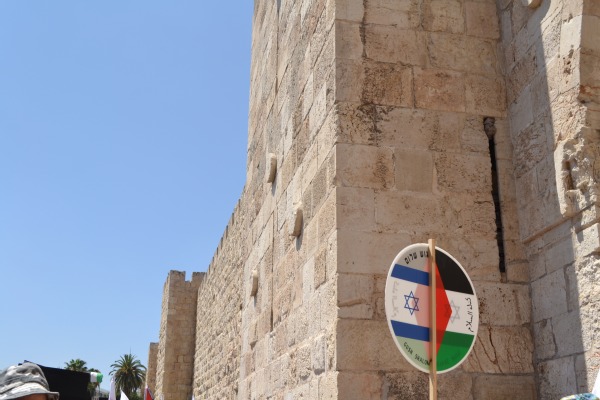
On November 15, Palestinian activists will attempt to board segregated Israeli settler public transport headed to occupied East Jerusalem in an act of civil disobedience inspired by the Freedom Riders of the US Civil Rights Movement.

Fifty years after the US Freedom Riders staged mixed-race bus rides through the roads of the segregated American South, Palestinian Freedom Riders will be asserting their right for liberty and dignity by disrupting the military regime of the Occupation through peaceful civil disobedience. Organizers say this ride to demand liberty, equality, and access to Jerusalem is the first of many to come.

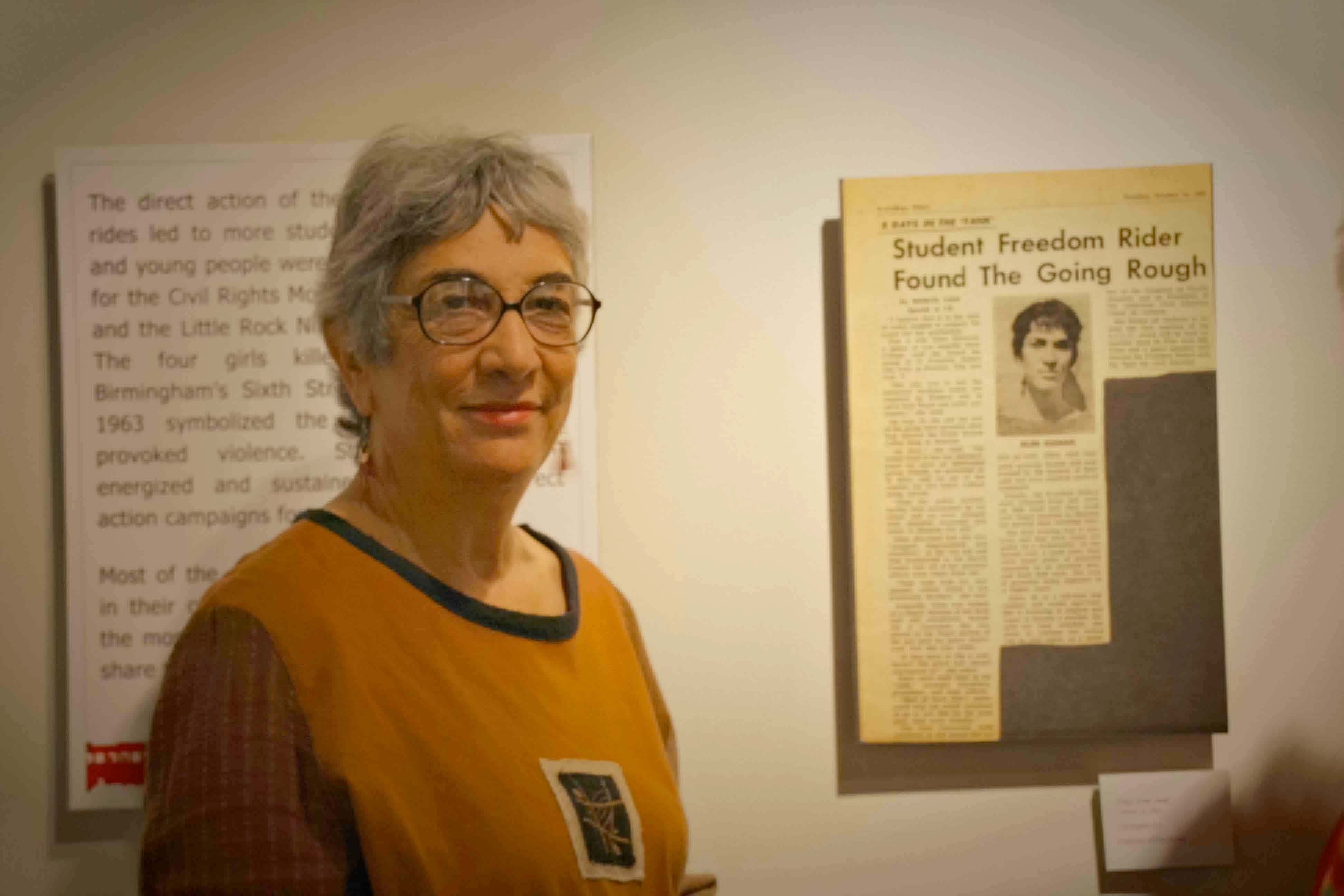
Ta’anit Tzedek – Jewish Fast for Gaza will stand in solidarity with the West Bank Freedom Riders with a very special conference call on the day of the demonstration. Please join us Tuesday, November 15 at 12 pm Eastern Time  to join our conversation with Ellen Broms, one of the original Freedom Riders for civil rights in the American South and currently an activist for a just peace in Israel/Palestine.

During our call, Ms. Broms will talk about her own experiences as an activist/demonstrator for civil rights in the 1960’s and why her activism has led her to take a stand on behalf of Palestinian human and civil rights.

Ellen Broms is a retired state worker who resides in Sacramento, CA. Her involvement in the civil rights movement began when, as a student at Los Angeles City College, she demonstrated at Woolworth lunch counters in support of  similar sit-ins by students in the South.

In June 1961, Ms. Brom attended a freedom rally at the Sports Arena in Los Angeles where Dr. Martin Luther King, Jr. gave the keynote speech.  After hearing a freedom rider speak, she was inspired to participate in the rides herself. On August 11, Ms. Brom was arrested with other freedom riders after they sat down and demonstrated in a Houston coffee shop.

In her words:

The police arrived, having been summoned by the owner and we were charged with unlawful assembly and taken to the Houston city jail. We were fingerprinted, mugged, and classified at the city jail and then transferred to the Harris County Jail. Ironically, I was booked as a “Negro” because of my dark hair and complexion. We declined to state “race” and they classified me as “High Yellow”. Marjorie, a very fair skinned, green eyed female rider of African American descent was classified and booked as white. I was placed in the “tank” for black women and Marjorie went to the white women’s tank. If we did nothing else during that ride, we did succeed in briefly integrating the jail.

After spending eight days in jail, Ms. Brom was released. The riders were found guilty of “unlawful assembly” by an all-white jury and fined $100 each. Their case was eventually appealed to a higher court and overturned.

Ellen Broms has since been honored by Congress, the state of Texas and the city of Houston for risking incarceration and violence as a Freedom Rider. She continues to work as an activist for peace and justice, particularly in the area of a just peace in Israel/Palestine. She is actively involved in the Sacramento branch of Jewish Voice for Peace and is campaigning on behalf of the West Bank Freedom Riders.

To participate in the call:

Dial Access Number: 1.800.920.7487
Enter Participant Code: 92247763#

There will be opportunities for questions and answers during the call.

Please click here for more information about how you can get involved in support of the West Bank Freedom Riders. Please share this information with others you think may be interested in participating.

We looking forward to your joining the call!

Coming Soon: Martin Luther King Jr. in Palestine

Last March, Academy Award nominated documentary director Connie Field went to Palestine with Clayborne Carson, director of the Martin Luther King, Jr. Institute, to film Carson’s play about King performed by the Palestinian National Theater and an African-American gospel choir.  Along the way, Field documented the accompanying cultural exchange between the two peoples – and the growing consciousness of the African-American choir members as they bore witness to the harsh realities of Palestinian life in the occupied West Bank.

I’ve long believed that the growing nonviolent movement in Palestine is reminiscent of the American civil rights movement in so many ways – and I’ll wager this film certainly has the potential to drive this point home in a powerful way. (Click above to see the trailer and you’ll see what I mean.)

Field and her production company, Clarity Films, are seeking donations via Kickstarter in order to complete the film. Click here if you’d like to contribute. You can also learn more about this worthy project through their Facebook page.

Chicago Hyatt Propaganda – The Workers Respond!

I’ve written about my support of the Hyatt hotel boycott in the past – now here’s a powerful way you can learn about the issues at stake.

Not long ago, Hyatt Chicago produced a slick film entitled “An Important Message to Our Valued Employees” (above) that cynically smears the the Chicago Hyatt workers’ union (Unite Here Local 1). Among it’s many uses, apparently the film has played on an continuous loop in the staff cafeteria, where employees are compelled to watch a professional actor slam their union, claiming that Unite Here has a “a national agenda” that “nothing to do” with them.

Now Unite Here has produced a response (below). In addition to being a hilarious satire of the Hyatt video, it contains important history and context to the Hyatt workers struggle. I encourage you to watch the Hyatt clip first and then click on the one below. Despite the tongue-in-cheek nature of their message, the workers’ video provides an important reminder of the daunting challenges working women and men are facing in the current national climate.

Check out the Hotel Workers Rising website for the latest news on the Hyatt boycott nationwide.

New Knesset Rulings: Are Democracy and Ethnicity Compatible?

Avigdor Liberman, Israel's Foreign Minister, Deputy Prime Minister, and Chairman of the Yisrael Beiteinu Party

This just in:

The Knesset has just passed legislation sponsored by Yisrael Beiteinu party that gives Israel’s Supreme Court the power to strip the citizenship of anyone convicted of espionage, treason or aiding the enemy during war.

If that sounds reasonable to you, consider that even the Shin Bet, Israel’s internal security service, opposed the bill, claiming that current laws were already sufficient:

During the bill’s final committee hearings, a Shin Bet attorney said that there are enough provisions in existing law to strip citizens’ citizenship as needed. He added that the bill itself was problematic and that Israeli Arabs indeed believe that the law is aimed at them.

Bingo. This bill has nothing to do with security and everything to do with ethnic politics.

Consider also that the Knesset recently passed legislation that would fine any Israeli communities that hold events commemorating Israeli Independence Day as an occasion of mourning. In other words, Israel has essentially criminalized the cultural memory of 20% of its citizens.

Yisrael Beiteinu MK Alex Miller defended the so-called “Nakba Law” thus:

(There) is a limit to how much we can allow democracy to be exploited in Israel.

Consider also that the Knesset recently approved legislation that appoints “admission committees” for communities in the Negev and the Galilee that have up to 400 families:

The law would empower admissions committees to reject candidates for residency if they are minors, if they lack the economic means to establish a home in the community, if they have no intention of basing their home life in the community, if a professional evaluation indicates that they are ill-suited to the community’s way of life, or if they do not suit the community’s social-cultural fabric.

Ill-suited to the community’s way of life, or if they do not suit the community’s social-cultural fabric? Disturbing words such as these shouldn’t come as too much of a surprise to anyone who knows about Israel’s long-held and well-known efforts to “Judaize” the Negev and Galilee.

As I read about the increase of this troubling Judeo-centric legislation in Israel, I couldn’t help but recall a memorable 2008 interview with the courageous Israeli journalist Amira Hass, who was asked if she thought democracy and ethnicity were compatible.

Her response:

They are incompatible in any state. Same with democracy and religious purity, like in Saudi Arabia. There, Jews or Christians cannot enter. They need a special permit to do so. Not to mention what women are going through there. But of course, Saudi Arabia doesn’t claim to be the only democracy in the Middle East, while Israel does.

A Blessing From Wisconsin

The following blessing was just sent to me by my friend and colleague Rabbi Laurie Zimmerman, of Reconstructionist congregation Sha’arei Shamayim in Madison, WI. It was said during the Shabbat morning Torah service for all those who participated in the many protests, vigils, or hearings at the Wisconsin State Capitol last week.  Laurie reports that 90% of the congregation and guests came up for the blessing.

Mi sheberach Avoteynu Avraham, Yitzhak, v’Ya’akov
May the One who blessed our forefathers Abraham, Isaac, and Jacob,

V’Imoteynu Sarah, Rivka, Rachel, v’Leah
And our foremothers Sarah, Rebecca, Rachel, and Leah,

Bless all of you who have come up to the Torah this morning.

No matter what happens in the next week may you be reminded that even tiny actions can affect others, create ripple effects, and make a difference in our world.

May you take responsibility for what you say, for how you behave, for what you do and for what you do not do.

May you pursue justice, act with integrity, and work hard to create a society where all are cared for, where every person has the resources that he or she needs.

May you remember to take care of yourselves and your families so that your work is sustainable.

And may you heed the words of Pirke Avot: “If I am not for myself, who will be for me?  If I am only for myself, what am I?  And if not now, when?”

And let us say, Amen.