Category Archives: Colonialism

God is in the Resistance: Sermon for Rosh Hashanah 5786

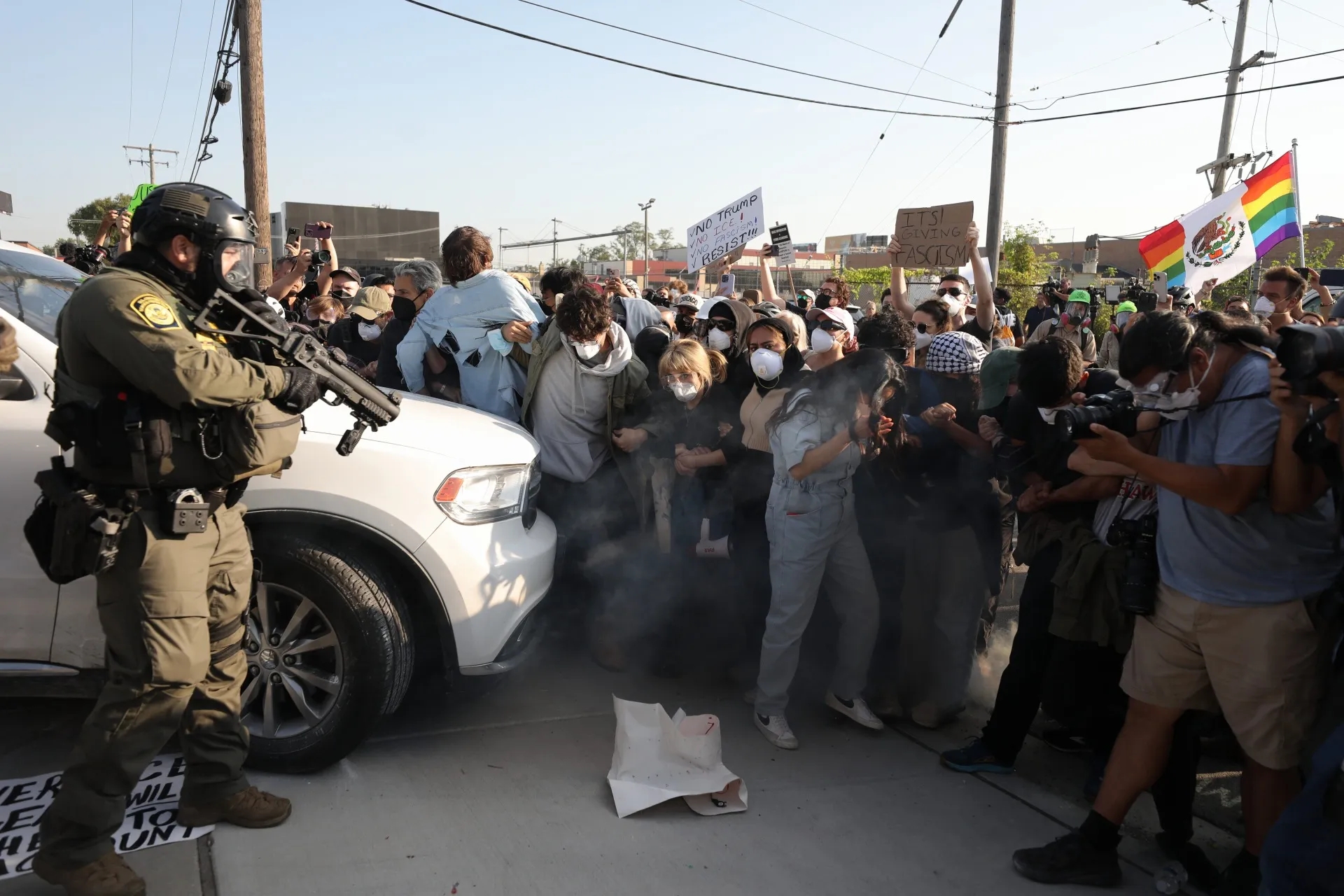
Protesters outside an ICE processing facility, Broadview Chicago. (Credit: Vincent D. Johnson/Block Club Chicago)

I’ll be honest with you: I never liked High Holiday services when I was a kid. 

There were so many things that just rubbed me the wrong way: they felt interminably long, the old school Reform choir music wasn’t my thing, and my parents would constantly shush me and my brothers when we got squirrelly (which was often). But most of all, I resented the seeming irrelevance of it all. I just couldn’t relate to the content of the services – and there was never any effort to explain why it should be relevant to me. 

On Rosh Hashanah in particular, I just couldn’t relate to the constant stream of prayers singing God’s praises, extolling God’s greatness and invoking God’s power. It all seemed designed to make us feel small and insignificant: this repeated glorification of an all-powerful God to whom we must beg and plead for another year of life. 

I realize now that I was a pretty astute kid. “Malchuyot,” which literally means “sovereignty,” is one of the central themes of Rosh Hashanah. Every new year we declare over and over that God is our supreme ruler. This theme is repeated throughout the liturgy, particularly during the Musaf service, when it is traditional to physically prostrate oneself on the floor before the divine throne during the Aleinu prayer. 

Over the years, however, as I began to attend services on my own terms rather than under duress, I came to appreciate Rosh Hashanah, yes, even the idea of Malchuyot. In fact, the older I get, the more relevant and important this concept feels to me. On a personal level, I understand to be a Malchuyot is a reminder that we often labor under illusions of our own power and control. We face these illusions head on during Rosh Hashanah when we do the work of teshuvah: the sacred process of return and repentance.

Of course, we are not all powerful. But ironically, acknowledging the limits of our power can actually be liberating. By affirming a transcendent source of power greater than our own, we can better focus and identify the things we can control in our lives. When we invoke God’s Malchuyot on Rosh Hashanah, we do so in the spirit of this liberation, to break free of our illusions of power and put ourselves on a more productive, healing path during the Days of Awe. 

Beyond the personal, I’d suggest Malchuyot has a collective and political dimension as well. It’s deeply rooted in Judaism’s central sacred narrative, the Exodus story. I actually made this very point during my very first sermon for Tzedek Chicago on Rosh Hashanah ten years ago:

At its core, I would suggest affirming Malchuyot means affirming that there is a Force Yet Greater: greater than Pharoah in Egypt, greater than the mighty Roman empire, greater than the myriad of powerful empires that have oppressed so many peoples throughout the world.

I would argue that this sacred conviction has been one of the central driving forces of Jewish tradition throughout the centuries: that it is not by might and not by power – but by God’s spirit that our world will ultimately be redeemed. I would further argue that this belief in a Power Yet Greater has sustained Jewish life in a very real way. After all, the Jewish people are still here, even after far mightier empires have come and gone. It might well be said that this allegiance to a Power Yet Greater is the force that keeps alive the hopes of all peoples who have lived with the reality of dislocation and state oppression.

I went on to suggest that through Zionism, the Jewish people have tragically betrayed this sacred Jewish narrative of liberation. When you think about it, the raison d’etre of Zionism literally is human sovereignty. It is an ideology that unabashedly deifies state power as a redemptive force in Jewish life and overturns centuries of Jewish tradition. It has subverted the sacred ideal of Malchuyot by centering and sacralizing human power above all else.

When I delivered that first Rosh Hashanah sermon, however, I never could have predicted where Zionism’s bargain with state power would lead us. In the misguided name of Jewish safety and supremacy, Israel has doubled down on its assumption of human Malchuyot to an unbearable degree. As we gather for Rosh Hashanah this year, Israel has been perpetrating an almost two-year genocide against the Palestinian people. Nearly 70,000 Palestinians have been killed, with real numbers likely to reach the hundreds of thousands. Whole families have been killed and entire bloodlines erased. Untold numbers of people have been buried under rubble, burned alive, dismembered and starved to death. At this very moment, Israel is literally bombing the entire north of Gaza off the map, trapping scores of residents who cannot leave their homes and sending scores of others to the south into active war zones.

And yet of course. Of course it has come to this. From the very beginning, the goal of establishing a Jewish-majority nation state could only be realized by dispossessing another people – what the Palestinian people refer to as the Nakba. Israel’s genocide against the Palestinians did not begin on October 7; it has been ongoing for over 70 years. There is a direct line leading from Zionism’s idolatrous attachment to Malchuyot to the crimes we are witnessing daily in Gaza.

This idolatrous attachment, of course, is not unique to Zionism. Looking back, I realize that Tzedek Chicago’s first Rosh Hashanah service took place shortly after Trump announced his first Presidential campaign. It’s also fair to say when I gave that first sermon, I never would have dreamed that just ten years later, the US would be rapidly descending into authoritarian fascist rule. That ICE would serve as our President’s secret police force, prowling the streets in plain clothes and face masks, abducting immigrants and student activists in unmarked vans. That thousands of National Guard troops would be mobilized to occupy American cities. That so many of our nation’s institutions would be defunded, plundered and centralized by unelected oligarchs. That our government would openly declare whole groups of people, including immigrants, trans people, people of color and unhoused people to be literal “enemies of the state.”

In the wake of Charlie Kirk’s murder, the incitement against these imagined enemies has reached a terrifying fever pitch. Trump and the movement he spawned are now seizing this moment to foment fury against a broad array of individuals and institutions they call the “radical left.” Trump’s aide Stephen Miller has chillingly characterized the current moment in America as a battle between “family and nature” and those who celebrate “everything that is warped, twisted and depraved.” 

Words such as these should not sound new to us; the Trump regime is using a time-honored tactic from the fascist playbook. We know that totalitarian regimes have historically consolidated their power during times of instability by fomenting a toxic “us vs. them” narrative. Hannah Arendt identified this mentality very clearly seventy-five years ago in her book The Origins of Totalitarianism: “Tribal nationalism always insists that its own people are surrounded by a ‘world of enemies’ – one against all – and that a fundamental difference exists between this people and all others.” 

Although the context of 21st century fascism is different in many ways from fascisms of the past, the fundamental building blocks of this phenomenon remain the same. In the parlance of Rosh Hashanah, the fascists of today are claiming Malchuyot – ultimate power – for themselves. And they are consolidating their power by demonizing those who do not fit into their idealized, privileged group as enemies who must be fought and eradicated at all costs. 

However, as overwhelming as the current political moment might feel, there is a textbook for resisting fascism as well. The essential rules for fighting fascism remain the same as they ever were. And the first order of business is: do not collaborate. 

This may seem obvious, but given the hard truth of the moment, I don’t think it can be repeated enough. It has been truly breathtaking to witness how quickly ostensibly independent non-governmental institutions have capitulated to Trump’s bullying and blackmail: from universities firing professors and defunding whole programs to businesses eradicating their DEI programs; from corporate media outlets becoming state mouthpieces, to law firms allocating hundreds of millions of dollars in legal services to defend the federal government. 

Has the liberal establishment been up to the challenge of this moment? Just consider its response to the murder of Charlie Kirk. Let’s be clear: Kirk was an unabashed white Christian Nationalist who incited young people on college campuses to hatred under the cynical pretense of “open dialogue.” Even so – and even as the MAGA movement is dangerously exploiting this moment – liberal leaders and institutions have been normalizing Kirk by openly praising him as a paragon of free speech and good faith debate. 

After he was killed, CA Governor Gavin Newsom eulogized Kirk by saying: “The best way to honor Charlie’s memory is to continue his work: engage with each other, across ideology, through spirited discourse. In a democracy, ideas are tested through words and good-faith debate.” Similarly, following Kirk’s murder, the Dean of Harvard College, David J. Deming publicly vowed to protect conservative students on campus, adding that Kirk’s enthusiasm for publicly debating his opponents could be a model for Harvard’s own civil discourse initiatives. And for his part, liberal New York Times columnist Ezra Klein wrote an op-ed entitled “Charlie Kirk Practiced Politics the Right Way.” 

It’s not clear if these apologists honestly believe what they are saying or if they’re just trying to avoid the government’s takedown of anyone who has anything remotely critical to say about Charlie Kirk. But in the end, it really doesn’t matter. The bottom line: liberal normalization will not appease fascists. 

To put it frankly, the government has declared war on us – and we must respond accordingly. The days of partisan cooperation and dialogue are over. The days of good faith debate and civic compromise are over. Capitulating to demagoguery and hatred will not convert the MAGA movement to the values of democracy and civil discourse. Yes, in a healthy democratic society, the concept of “collaboration” is something to be valued. But in a fascist regime, the term “collaborator” has a different meaning entirely. 

The first step in resisting collaboration is to accept that none of this is normal. We must let go of old assumptions, many of which, frankly, have led us to this moment. If we are to be totally honest, it must be said that the Democrats and the liberal establishment have been collaborating with corporate interests along with Republicans for years. As we interrogate the abnormality of this moment, we must admit that the entire system has been disenfranchising whole groups of people in this country for far too long. 

Resisting fascism also means letting go of our ultimate faith in the “rule of law.” Indeed, both the left and the right tend to fetishize the rule of law as an absolute good. And while it’s true that the law can be a tool to ensure a more just society, it can just as often be used as a blunt instrument to dismantle democracy. 

We know from history that governments routinely create laws that are inherently unjust. Slavery was legal in the US for almost 250 years. Apartheid in South Africa was legal. Apartheid continues to be legal in Palestine/Israel. In the face of such legal injustice, the obvious moral and strategic response is not to follow but to break the rule of law. As Dr. Martin Luther King famously wrote in his “Letter from a Birmingham Jail:” 

We should never forget that everything Adolf Hitler did in Germany was “legal” and everything the Hungarian freedom fighters did in Hungary was “illegal.” It was “illegal” to aid and comfort a Jew in Hitler’s Germany. Even so, I am sure that, had I lived in Germany at the time, I would have aided and comforted my Jewish brothers.

This is, in fact, the radical truth we affirm every Rosh Hashanah. When we affirm Malchuyot, we affirm that there is a moral law yet greater than any law levied by a government or regime. On this Rosh Hashanah in particular, the sound of the shofar calls on us to resist conformity; to vow to become criminals when confronted with laws that are inherently unjust. More than any Rosh Hashanah in our lifetimes, we must be ready to defy the illegitimate laws wielded by the illegitimate rulers who would govern us. 

Even if we do accept this challenge, however, the question remains: where does Malchuyot, ultimate Power, reside, if not with governments, politicians or the rule of law? Here, I’d like to quote yet another one of my heroes, the Puerto-Rican Jewish liturgist Aurora Levins Morales:

They told me we cannot wait for governments.
There are no peacekeepers boarding planes.
There are no leaders who dare to say
every life is precious, so it will have to be us.

Yes. God’s power is revealed in our readiness to show up for one another.  When we acknowledge Malchuyot on Rosh Hashanah, we affirm that the Divine Presence is manifest whenever we struggle and resist and fight for our communities, for a world where all are liberated and cherished and protected. When there are no leaders who dare to ensure that every life is precious, it will have to be us. 

Here are two concrete examples of Malchuyot in action: this last January, shortly after the inauguration, the Trump administration launched a series of raids in Chicago they called “Operation Safeguard” where, over the course of a few days, ICE, the FBI, the ATF and other federal forces coordinated massive raids in neighborhoods throughout the city and suburbs. We don’t know how many were arrested or detained, but we do know that this federal blitzkrieg was deeply frustrated by local organizing. Trump’s so-called “border czar” Tom Homan later complained that immigration organizers in Chicago were “making it very difficult” to arrest and detain people. He said, “They call it Know Your Rights. I call it how to escape from ICE.”  

Of course, even as we win these battles, this fierce war continues to escalate. ICE violence continues to rage in the neighborhoods of our cities. In Chicago, ICE has now launched another sweep, this one called “Operation Midway Blitz.” Just last Friday, at an immigrant processing center in the Broadview section of Chicago, federal agents shot tear gas, pepper spray and flash bang grenades into hundreds of demonstrators. Ten protesters were taken into custody by federal agents over the course of the day. Even amidst this escalating violence, however, local organizers here in Chicago continue to hold the line. 

Another example: in Washington DC which is still under occupation by National Guard troops, groups of local residents called “night patrols” have been regularly patrolling the streets. According to journalist Dave Zirin, whose reports from the ground have become invaluable:

These night patrols watch over the city to ensure that people are protected from state violence, false arrest, abduction, and harassment. Failing that, their goal is to document the constitutional violations or brutality they witness, so people can see the truths about the occupation that a compliant, largely incurious media are not showing. 

Critically, these neighborhood patrols are being led and stewarded by members of impacted groups: As one night patroller put it: “a lot of young people, a lot of people of color, queer and trans folks, people who have been directly impacted by policing, and folks with street medic backgrounds. It skews toward people who already know what it’s like to be criminalized.” 

Though it isn’t being highlighted by the corporate mainstream media, this local organizing is happening in communities all over the country: in Los Angeles, where there are also still hundreds of National Guard troops, as well as New Orleans, Memphis, Baltimore and other cities that the Trump administration is directly threatening with military invasion. I know that many Tzedek Chicago members have long been active in these organizing efforts, here in Chicago, around the US and even around the world. But again, we can have no illusions over what we are up against. 

I know that the magnitude of these events often leads us to a state of overwhelm and despair. We doom-scroll through the news every day, we read about Trump’s newest executive order, the latest regressive Supreme Court ruling or some other heinous event and the ferocity of this onslaught can literally leave us breathless. This is, of course, yet another page from the authoritarian textbook: to neutralize the population through a calculated strategy of shock and awe. They want us to feel that all is lost, to give in to our despair that their power over us is all but inevitable. 

Our experience of shock and overwhelm is compounded all the more by an all-pervasive sense of grief. So much of what we have fought for has been lost. So many of the institutions we assumed would be eternally with us are being plundered and dismantled. Some of these losses may be permanent, some may not, but the harms they are causing are very, very real. 

I feel this grief myself, believe me, I do. But I also know that if we surrender to it, then their victory over us will become self-fulfilling. The way through the fear and the grief, I truly believe, is to never forget that we have power, that our words and actions matter and that nothing is ever inevitable unless we let it be so. 

Whenever we feel overwhelmed, I think the critical first step is to reclaim our equilibrium by asking ourselves, what matters most to me? What are the issues that are nearest to my heart? Most of us have the capacity to devote our time and energy to one or two causes at most. What are the most effective organizations fighting for this cause? Who are the people in my life that can connect me with the people doing this work? If I don’t have the capacity or physical ability to engage actively in these kinds of responses, what are other meaningful ways I can show up?  

Amidst all this loss, we must never forget: even if our victory is not guaranteed, there are still things in this world worth fighting for. Generations of resisters have understood this axiom well: “If I’m going to go down, I’m sure as hell going to go down swinging.” In the words of my friend and comrade, Chicago organizer Kelly Hayes, who I’ve quoted in more than one High Holiday sermon over the years:

I would prefer to win, but struggle is about much more than winning. It always has been. And there is nothing revolutionary about fatalism. I suppose the question is, are you antifascist? Are you a revolutionary? Are you a defender of decency and life on Earth? Because no one who is any of those things has ever had the odds on their side. But you know what we do have? A meaningful existence on the edge of oblivion. And if the end really is only a few decades away, and no human intervention can stop it, then who do you want to be at the end of the world? And what will you say to the people you love, when time runs out? If it comes to that, I plan on being able to tell them I did everything I could, but I’m not resigning myself to anything and neither should you. Adapt, prepare, and take the damage done seriously, but never stop fighting. Václav Havel once said that “Hope is not the conviction that something will turn out well, but the certainty that something is worth doing no matter how it turns out.” I live in that certainty every day. Because while these death-making systems exist both outside and inside of us, so do our dreams, so long as we are fighting for them. And my dreams are worth fighting for. I bet yours are too.

This New Year, I realize I’ve come a long way from that beleaguered kid who felt disempowered on the High Holidays to a rabbi telling you Rosh Hashanah is our clarion call to fight facism. But here I am. And here we are. May this new year inspire us all with the knowledge that true sovereignty, true Malchuyot, lives at the heart of the struggle. 

On this, my final Rosh Hashanah with this amazing community, this is what I am feeling to my very bones at this moment: that while Pharaohs may rise, they will inevitably fall, that beyond the horizon of Olam Hazeh, this terribly broken world, there lies Olam Haba: the world we know is possible. And no matter what may happen this new year – and every new year to come – that world is always worth fighting for.

Shanah Tovah.
Peter Beinart’s New Book Makes Important Political Points – But Does it Reckon With Israel’s Genocide?

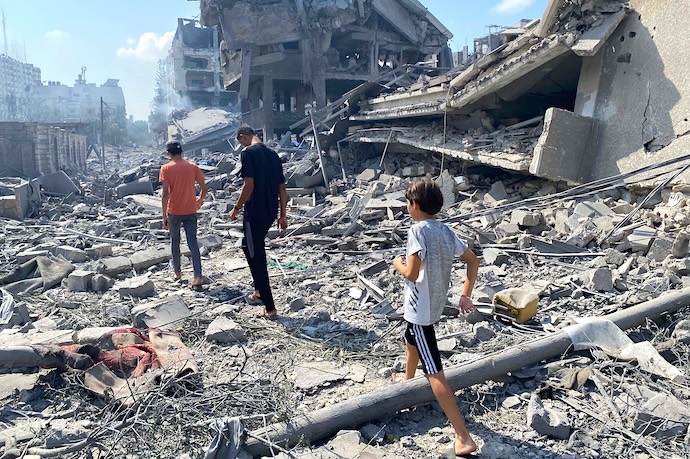
photo: Wafa/AP

Cross posted with Religion Dispatches

The ambitious intentions of Peter Beinart’s new book are evident from the title: Being Jewish After the Destruction of Gaza: A Reckoning. Responding to the current moment, Beinart has written nothing short of a spiritual manifesto for the future of Judaism. 

It’s a tall-order for such a slim volume, but it’s one that Beinart is uniquely positioned to take on. As a well-known journalist, thought leader, and editor-at-large for the journal Jewish Currents, Beinart’s ideas carry a great deal of weight among large swaths of the Jewish establishment. His 2010 article in The New York Review of Books, “The Failure of the American Jewish Establishment” and his subsequent book, The Crisis of Zionism were widely read and debated in the American Jewish community. Since then, he’s continued to push the envelope in the discourse on Israel/Palestine. His 2020 New York Times op-ed, “I No Longer Believe in a Jewish State” and his 2021 Guardian essay, “A Jewish Case for Palestinian Refugee Return” were likewise considered game-changers in the Jewish communal discussion on Israel-Palestine. 

Being Jewish, which attempts to reframe the Jewish spiritual narrative itself, is arguably his most dramatic attempt at game-changing. Following October 7 and Israel’s devastating military onslaught on Gaza, Beinart suggests that Judaism and Jewish identity have now reached a critical turning point. As he writes in the Prologue: 

Jews have told new stories to answer the horrors we endured. We must now tell a new story to answer the horrors that a Jewish country has perpetrated, with the support of many Jews around the world… [This new Jewish story must be] based on equality rather than supremacy—because the current one doesn’t endanger only Palestinians. It endangers us. 

As if this isn’t ambitious enough, Beinart also hopes his book will help heal the widening fractures over Israel/Palestine in the Jewish community. To drive this point home, he begins with a letter to a friend with whom he’s become estranged over the issue of Israel/Palestine. “I know,” he writes, “you believe that my public opposition to this war…constitutes a betrayal of our people…[and] I consider your single-minded focus on Israeli security to be immoral and self-defeating.” He ends his letter with the words: “I hope the rupture is not final, that our journey together is not done.” 

While Being Jewish was published by a mass-market publisher and is being promoted to a wide readership, Beinart states at the outset that he’s suggesting a new Jewish narrative to bring the Jewish “family” together; to mend the deep familial rifts that have widened over Israel’s destruction of Gaza. “This book,” he writes, “is for the Jews who are still sitting at that Shabbat table, and for the Jews—sometimes their own children—who have left in disgust. I yearn for us to sit together.”

Beinart thus begins his book with a formidable—perhaps unbridgeable—tension. While he’s clear about his intention to bring Jews together, he also suggests that Israel’s oppression of Palestinians is rooted in a narrative of Jewish supremacy—a view which surely won’t endear him to millions of Jews in Israel and throughout the diaspora who identify deeply with Israel and Zionism. In many ways, this tension is characteristic of Beinart’s pedagogy: he seeks to influence Jewish communal discourse even as he pushes hard on the ideological envelope. It’s a balancing act that’s become increasingly precarious with his writings over the past several years. Given the stakes of the current moment, he sets a profoundly daunting goal for himself with his latest book.  

For most of Being Jewish, Beinart does what he does best, expertly dismantling Israel’s hasbara—the propagandistic talking points used to justify Israel’s oppression of the Palestinian people. In chapter one, “They Tried to Kill Us We Survived, Let’s Eat,” for example, he interrogates the ways that Israel and Israel’s Jewish communal advocates, conveniently ignore Zionism’s colonial origins and reframe Israel’s founding to fit a Jewish narrative of victimhood:

The plot goes like this. We have finally achieved what every other people takes for granted: a state of our own. Yet in the case of Jews, and Jews alone, that right is contested. So even with a state, we remain victims.  

His repeated willingness to frame political Zionism in a colonial context is a powerful, ongoing theme for Beinart. In another chapter “To Whom Evil is Done,” he considers the ways the violence committed by Hamas and other Palestinian resistance groups on October 7 was compared to the Holocaust by Israelis and Jews around the world. He goes on to assert that such a framing “transforms Palestinians from a subjugated people into the reincarnation of monsters of the Jewish past.” Again, Beinart doesn’t hesitate to reject this comparison in favor of a settler colonial framework. A better analogy, he suggests, would be the violent attacks of colonized Haitians, Creek Indians, or Mau Mau rebels against their colonial oppressors.

In “Ways of Not Seeing,” Beinart systemically eviscerates many other familiar claims wielded by Israeli leaders and Israel advocates: from their rejections of death estimates by the Gazan Health Ministry to the canard of Hamas’ human shields. He also devotes a chapter to the issue of antisemitism, using convincing argumentation along with hard survey data to demonstrate how Israel cynically uses the claim of antisemitism—which is much more prevalent on the Right than the Left—to cudgel Palestinians and their supporters. Taking the claim that anti-Zionism equals antisemitism head on, he writes astutely:

The whole point of conflating anti-Zionism with antisemitism is to depict Palestinians and their supporters as bigots, thus turning a conversation about the oppression of Palestinians into a conversation about the oppression of Jews.

Beinart’s book is strongest when he makes these kinds of expert political arguments. Yet, as critical as they are, as I read Being Jewish I found myself increasingly wishing he would drill deeper into the themes suggested by the title. Beyond promoting a Judaism of equality over conquest, how should Jews respond to the devastating moral reality of this moment? In his final chapter, “Korach’s Children,” he attempts to do precisely this, suggesting that Jewish political nationalism has become a form of Jewish “idolatry,” arguing that the only way toward an equitable future in Israel/Palestine is a single state in Israel that guarantees full citizenship for all. 

While it’s a compelling vision, there’s little in his final chapter that he hasn’t already argued for more extensively in his 2020 and 2021 articles, which were written well before Israel’s destruction of Gaza. In this book, as with his earlier articles, Beinart offers examples from Ireland and South Africa to demonstrate how colonizers and colonized have found the political wherewithal—however imperfect—to dismantle systems of oppression and engage in processes of reconciliation. 

In the midst of his argument, however, there’s little reckoning with the possibility that anything has fundamentally changed with Israel’s genocide in Gaza. Instead, Beinart simply repeats his talking points, continuing to hold out hope for a better future for Israeli Jews and Palestinians:

Although it won’t look the same, this kind of liberation is possible for us. We can lift the weight that oppressing Palestinians imposes on Jewish Israelis, and indirectly, on Jews around the world.

But who is the “we” in this statement? It’s certainly not in the power (nor is it currently the desire) of American or Diaspora Jews to leverage a socio-political transformation of such a magnitude in Israel/Palestine. The majority of Israelis have, for their part, long rejected a one-state solution—and by all accounts, they’re farther away than ever from embracing such a vision. 

Indeed, Israelis post-October 7 are a thoroughly traumatized nation, inured to the carnage their nation is inflicting on Palestinians and according to polls, overwhelmingly supportive of Israel’s genocide in Gaza. As for Palestinians, many, if not most, are undoubtedly less inclined to imagine the realistic possibility of living side by side with Israeli Jews in a single state given the horrific reality of the past 16 months.

It’s notable that, even as Beinart doesn’t flinch from describing Israel’s onslaught in Gaza—often in terrifying detail—he largely avoids using the word “genocide” to describe it. This is more than merely a semantic issue. If we are to truly reckon with what it means to be Jewish after the destruction of Gaza, we must face this central question: what does it mean for the Jewish people that a Jewish state, founded in the wake of the Holocaust, is actively committing a genocide against another people? 

Though Beinart writes that he “yearns for us to sit together,” it’s well worth asking: can we truly create Jewish community within such a reality? Can Jews who believe Israel is committing genocide coexist in community with those who are actively supporting it—or rationalizing it away? Is it possible for Jews to pray and study and make Shabbat and celebrate holidays together under such circumstances? If Jewish ethical values are the bedrock of our spiritual life, how do we truly bridge such a massive moral divide?

Although he doesn’t answer this question in his book, Beinart did give a clue to a potential response during a recent appearance at Duke University. Admitting that Israel was no longer a “unifying force” among Jews, he responded:

What I would like people to do is to bring Jews together across the ideological, political and religious spectrum, to study Torah, to study our texts. This is what ultimately unifies us, and I think that it can be a foundation for other kinds of conversations.

This kind of response might make sense to Beinart, an Orthodox Jew who cherishes traditional Jewish study, but it’s doubtful such an approach will bring together Jews in the way he envisions. It’s optimistic, to put it mildly, to assume that Jews will be able to put aside their differences on Israel and find a foundation for fruitful conversation through the study of Torah and Jewish text. It may be time for us to admit that being Jewish after the destruction of Gaza means our community isn’t simply fractured, but separated by a deep moral abyss that may well be unbridgeable. 

As I read Beinart’s new book, I couldn’t help but be struck by the significant debt it owes to the landmark work of Jewish scholar and theologian Marc Ellis, who asserted as far back as the 1980s and 90s that post-Holocaust, the fusion of Judaism and Jewish state power had created a conquest-focused “Constantinian Judaism,” even as Israel maintained a collective myth of innocence

In fact, in 2014, during an earlier Israeli military assault on Gaza, Ellis wrote Burning Children: A Jewish View of the War in Gaza which reached strikingly similar conclusions to Beinart’s: 

The central question is how to move Jews in Israel and around the world to see that Jews can only be free if Palestinians are free as well. During the Gaza war, we could not be further from this goal. This makes it even more imperative that we begin now. 

But while Beinart’s and Ellis’ analyses of the crisis may have been similar, their prescriptions for going forward were dramatically different. As Ellis put it in a 2018 interview, Israel’s state oppression of the Palestinian people represented the “end of ethical Jewish history”:

We Jews, all of us, no matter our various political positions, are responsible for what Israel has done and is doing to the Palestinian people. That is why I believe that we, as Jews, dwell in the abyss of injustice. The injustice we have perpetrated upon Palestinians has brought us to the end of ethical Jewish history. The question for Jews, the only question, is what are we to do at this end?

Marc Ellis died in July 2024, while Israel’s genocide in Gaza was raging in full force. His question, however, offers an important counterpoint to Beinart’s. While Beinart asks how we will come together to write a new Jewish story, Ellis asks how Jews will dwell in the abyss of injustice. In the end, Beinart’s book, for all of its courage, is ultimately unwilling to take this step: to truly reckon with how Jews of conscience should respond to the ongoing moral devastation that is Israel’s genocide in Gaza.

Standing at Sinai: Interrogating our National Myths of Unity

In the week’s Torah portion, Parashat Yitro, the Israelites stand at Mt. Sinai and collectively enter into a covenant with God. With a message conveyed through Moses, God says to the people:

“(If) you will obey Me faithfully and keep My covenant, you shall be My treasured possession among all the peoples. Indeed, all the earth is Mine, but you shall be to Me a kingdom of priests and a holy nation.” (Exodus 19:5-6)

Shortly after, the Israelites collectively accept:

…All the people answered as one, saying, “All that God has spoken we will do!” (19:8)

In this mythic moment, the Israelites become a nation unified in a shared, transcendent purpose.

But do they really, though? Most of the Torah’s narrative post-Sinai is less a record of a nation united by a shared purpose than a portrayal of a deeply fractured collection of tribes struggling mightily to live up to the covenant they made with God at Mt. Sinai. This certainly tracks with the evolution of Jewish peoplehood throughout the centuries. Though the organized Jewish community routinely clings to the mythic notion that “We are One,” we have always been a nation of sub-communities: a family divided by a of myriad of assumptions over what it means to be and behave as a Jew, often rancorously.

Of course, in the current moment the Jewish people are experiencing an exceedingly powerful and painful division. As I suggested in my sermon this past Yom Kippur:

Jewish life is going through … a monumental crisis and transformation right now. I’m speaking of course, about the abyss that has opened over the issue of Zionism – an abyss that has widened considerably this past year as a result of Israel’s genocide in Gaza.  

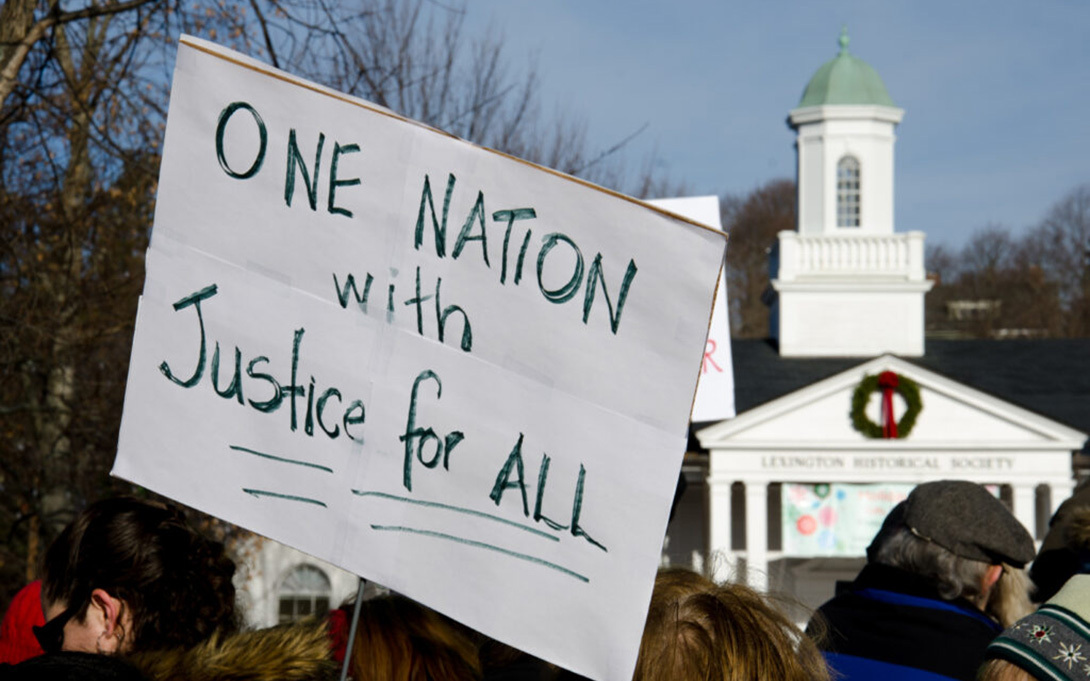
This mythology of national unity, however, is not unique to the Jewish people. Those of us raised in the US are all too familiar with such tropes, socialized as we were with the famous line from the Pledge of Allegiance: “One nation, under God, indivisible, with liberty and justice for all.” In truth, however, the US has been a deeply divided nation since the day it was founded. While the preamble of the Constitution reads “We the People,” the “people” it referred to were white, landowning men. The Naturalization Act of 1790 limited access to citizenship to “free white persons.” Later on, the US broke in two after slaveholding states succeeded – and the nation only became “one” again after fighting a bloody civil war. In too many ways, it’s a war that has never really ended.

As we see the rise of nativism and authoritarianism in nations around the world, it’s fair to say that this reckoning over national identity is truly a global phenomenon. Like many, I’ve been watching with alarm the rise of the far right nationalist AfD party in Germany (with the unabashed support of the ubiquitous Elon Musk) as they seek to build a coalition with conservative opposition parties. German Vice Chancellor Robert Habeck has warned ominously that such an alignment would “destroy Europe.”

So where does this leave us? Can we actually affirm these narratives of national unity in good faith? Do they serve us in any way – or do inevitably lead to authoritarianism and genocide?

I personally believe that national mythologies should not be literal oaths to be sworn to, but collective narratives to be interrogated deeply. In the case of the US narrative, we must ask honestly: what is the place of dispossessed indigenous nations in our national narrative? What is the place of descendants of kidnapped Africans who were brought here in chains to build up this nation? What is the place of immigrants who come to these shores seeking a better life – or to escape certain harm in in their home countries? What is the place of LGBTQ+ people, disabled people and members of other historically marginalized groups?

Those who uphold national mythologies must ask honestly, who exactly is the “we” in “We the People?” Because these narratives will only be useful if they lead to actual collective liberation for all. More critically, those of us who are committed to a truly inclusive national vision must prepare for the inevitable, often violent backlash from those who do not share our narrative. Indeed, history has proven all too often that a truly inclusive national vision never comes easily. On the contrary, it must be fought for.

At the end of the Torah, God says to the Israelites:

“I make this covenant and this oath, not with you alone, but both with those who are standing here with us this day before the ETERNAL our God and with those who are not with us here this day.” (Deuteronomy 29:13-14)

This Shabbat Yitro, as we stand once more at Sinai, let us ask ourselves: “Who are not with us on this day?” Why are they not here? What are we willing to sacrifice to ensure that they will be included in the covenant as well?”

Toward a Judaism of Love over Land, People over Profit

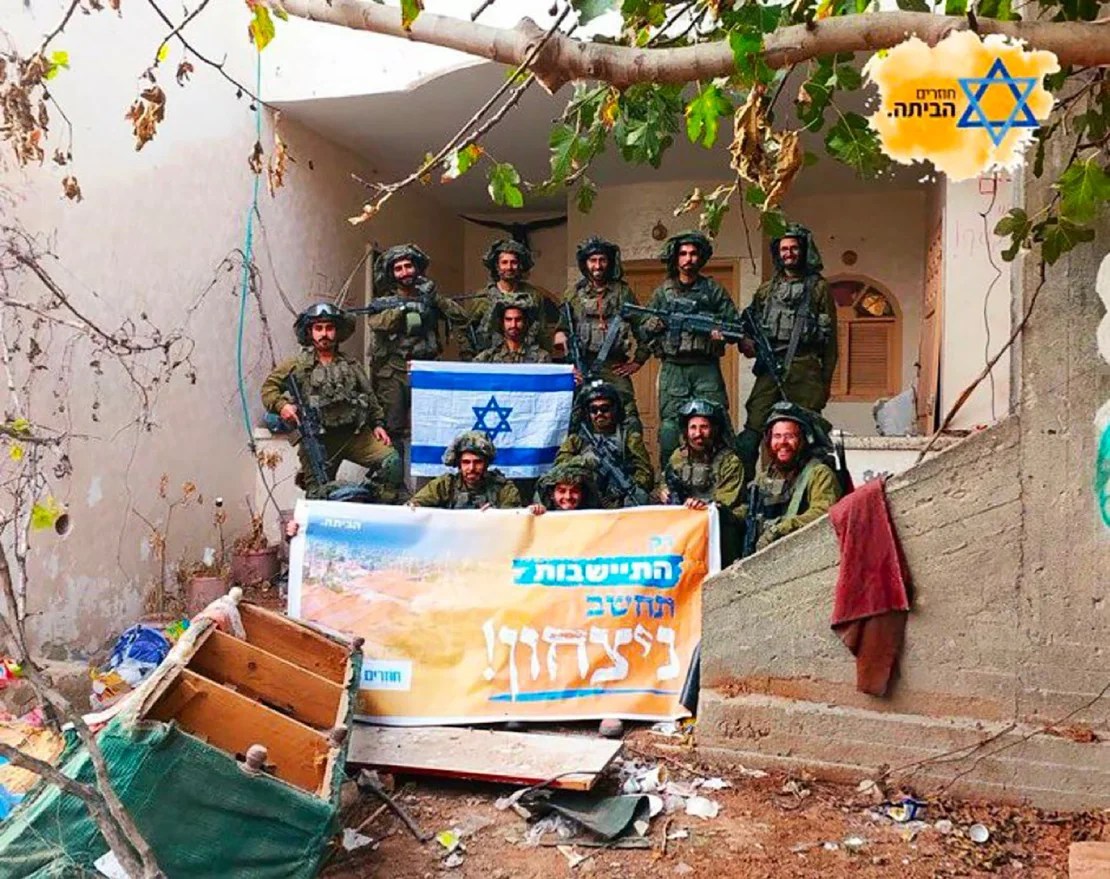
A photograph shows soldiers posing with an orange banner that reads: “Only settlement would be considered victory!” The color orange was used by the settler movement in 2004 and 2005 to protest Israel’s disengagement from Gaza.

It’s becoming ominously clear that the end game of Israel’s genocide in Gaza is the end of game of Zionism itself: namely, settlement. The writing has been on the wall for some time now. As I mentioned on Rosh Hashanah, we now know the existence of the so-called “General’s Plan,” in which:

Israel will control the northern Gaza Strip and drive out the 300,000 Palestinians still there. Major General Giora Eiland, the war’s ideologue, proposes starving them to death, or exiling them, as a lever with which to defeat Hamas. The Israeli right envisions a Jewish settlement of the area, with vast real estate potential of convenient topography, a sea view, and proximity to central Israel…

News accounts bear out that the General’s Plan is well underway. The vast majority of residents of Northern Gaza have now been ethnically cleansed from their homes and Israel has said it has no intentions to let them return. At a recent two-day conference, “Preparing to Resettle Gaza,” Israel’s National Security Minister Itamar Ben-Gvir told the hundreds who gathered, “If we want it, we can renew settlements in Gaza.”

With Trump now poised to take power, there will very likely be new wind behind these plans. Last March, Jared Kushner was quoted as saying: “Gaza’s waterfront property could be very valuable … It’s a little bit of an unfortunate situation there, but from Israel’s perspective I would do my best to move the people out and then clean it up.”  With Kushner widely expected to be “pivotal” to Trump’s Middle East policy, his words now take on a terrifying new resonance of possibility.

Even more ominously, there is every reason to expect these plans will be aided and abetted by the American Jewish communal establishment. One week after Donald Trump’s reelection, Karen Paikin Barall, the Jewish Federation’s VP of government relations, remarked to a group of local Jewish community relations councils, “We should all look forward to the day we can hope to buy townhouses in the West Bank and Gaza.”

As a settler colonial movement, Zionism was always focused on the maintenance of a majority Jewish presence in historic Palestine. However, the seizing and control of resources has been no less integral to this project. The settler colonial reality of the 21st century is driven in no small part by the corporate interest of weapons manufacturers as well as the billionaire and oligarch class that seek to profit off the spoils of war and genocide. In the current moment, it should come as no surprise that there is also unabashed talk about the annexation of the West Bank and even parts of South Lebanon.

Such is the natural result of a movement and ideology that prizes real estate over the well-being of the actual people who happen to live on the land. I’m particularly mindful of this as I contemplate this week’s Torah portion, Chayei Sarah, which begins with the famous episode in which Abraham negotiates with the Hittites to purchase the Cave of Machpelah as a burial site for his recently deceased wife Sarah. This story is often wielded by many Zionists as a deed of sale to this sacred site – and contemporary land acquisition in Palestine as the “inalienable possession of the Jewish people.”

There is, of course, another way to understand the spiritual meaning of this story: it is not about land acquisition but love and loyalty. Abraham is not motivated to purchase this land in order to claim exclusive entitlement to it: he is driven by his desire to honor his beloved wife Sarah, and to ensure that she and his extended family will have a permanent resting place. To read this episode only about entitlement to land is limited at best – and to judge by the apartheid and violence by which Israel maintains its control of this site today – a moral sacrilege at worst.

At the end of the portion, following the death of Abraham, we read that his sons Ishmael and Isaac buried their father together in the Cave of Machpelah. I can think of no better image to underscore the critical importance of pursuing a Judaism that prizes love over land. This Shabbat Chayei Sarah, may we rededicate our commitment to this sacred vision.

On Tu B’Shevat, Our Call for Ceasefire Affirms the Sacredness of All Life

Guest Post by Maya Schenwar

Remarks by Maya Schenwar, from last night’s Tu B’shvat gathering sponsored by Tzedek Chicago and the Jewish Fast for Gaza. (Maya is director of the Truthout Center for Grassroots Journalism. She is also a coordinator of the Jewish Fast for Gaza and a member of Tzedek Chicago.)

Many of those of us involved in Jewish Fast for Gaza are breaking our fast tonight. We’ve been fasting weekly on Sundays since mid-October, and we will keep fasting weekly until a ceasefire. We donate the money we would’ve spent on food to organizations supporting people in Gaza in this time of starvation and mass death. And each week, we are also reflecting on and renewing our commitment to solidarity with our Palestinian co-strugglers and people around the world who are calling for an end to this genocide, an end to US funding for Israel’s weapons, an end to colonization and apartheid.

When we call for a ceasefire, when we fast for a ceasefire, we are uplifting a call for life. In the months since October 7, I’ve heard many people quote Ruth Wilson’s Gilmore’s sacred words, “Where life is precious, life is precious.” And one of the things Ruthie is saying, with that message, is that in societies where life is actually treated as precious—where they don’t have the death penalty and life sentences and large-scale state violence and state-sanctioned environmental devastation—in those places, violence is less likely overall, the culture is less violent, because life is affirmed.

We should bear in mind that as the US fuels Israel’s genocide in Gaza, here in the US, Alabama is preparing to carry out the US’s first execution via nitrogen gas—which is torture—on the day of Tu B’Shvat.

People are more likely to treat life as precious when their own lives are treated as precious. So we have to create the conditions in which everyone’s life is treated as inherently sacred and irreplaceable. That work is on all of us.

Our Fast for Gaza draws inspiration from the Jewish tradition of fasting as an act of mourning, and it also draws inspiration from Palestinians incarcerated inside Israeli jails, who have launched many hunger strikes to protest their incarceration, and the incarceration of all Palestinians under occupation, to INSIST that their lives are precious.

When Ruth Wilson Gilmore first introduced this idea—where life is precious, life is
precious—she was at an environmental justice conference for youth, where, among other things, the youth denounced the effects of pesticides, including on humans– and of course, pesticides also have impacts on native plants and animals. I think this is significant, for Tu B’Shvat. Recognizing that all life is precious means recognizing our interconnection with all life around us. It means we need to, in the words of Thich Nhat Hahn, “awaken from the illusion of our separateness.” It means recognizing the ways that trees have been weaponized to push Palestinians off their land. It means recognizing Israel’s mass destruction of olive trees.

Trees themselves recognize that where life is precious, life is precious. Forests are social
systems in which trees support each other through their root systems, through chemical signals in their leaves, through the social climate they create. As we celebrate the trees’ birthday today, we can also celebrate their preciousness, the preciousness of all the life they nurture and that nurtures them. And we can express that through our urgent calls for a ceasefire, for Palestinian liberation, and for collective liberation.

When we say ceasefire now, we are also saying environmental justice now. When we say ceasefire now, it is a call for Indigenous liberation now, from Palestine to Turtle Island and beyond.

Ceasefire now can be a call to stop death penalties of all kinds, including this execution that is set to happen in our own country on the day of Tu B’Shvat. Let’s insist on the preciousness of people, and of trees, and of the interconnectedness of all beings.

Chag Sameach and peace to you all.

“In Gaza, Israel is Revealing the True Face of Zionism”

Last week, the board of my congregation, Tzedek Chicago released this statement in repsonse to Israel’s ongoing military assault in Gaza. Although it is addressed to all people of conscience, it contains a specific challenge to the Jewish community at large. I’m immensely proud of the statement, which I hope will be considered seriously even (especially) by those members of the community aren’t ready to heed its words.

Our statement is not so much an academic argument as it is a call to moral action. As we say in our statement, “We are witnessing the continuation of the Nakba in real time…Now more than ever, it is time for Jews of conscience to call out the essential injustice at the heart of Zionism in no uncertain terms.

The full statement follows below:

The unspeakable violence currently unfolding in Gaza is confronting the Jewish community with the most critical moral challenge of our lifetime.

As of this writing, over 21,000 Palestinians have been killed by the Israeli military, almost half of them children. According to the UN, nearly two million people have been internally displaced, confining them to less than one-third of the Gaza Strip’s territory. Disease and starvation are rampant, subjecting one in four households into “catastrophic conditions.” As the Secretary General of the UN recently described, “(Gaza) is at a breaking point. There is a high risk of a total collapse of the humanitarian system.”

Together with Jews and allies around the world, we grieve the massive loss of life that occurred as a result of Hamas’ heinous violence in Israel on October 7. We join with those around the world who are demanding the safe return of the remaining hostages currently being held in Gaza. We unreservedly condemn Hamas’ actions on that terrible day – there can be no justification for this brutal attack on civilian life.

We also know there was a crucial, underlying context to this horrible violence. We assert without reservation that to contextualize is not to condone. On the contrary, we must contextualize these events if we are to truly understand them – and find a better way forward.

The violence of October 7 did not occur in a vacuum. It was a brutal response to a regime of structural violence that has oppressed Palestinians for decades. At the root of this oppression is Zionism: a colonial movement that seeks to establish and maintain a Jewish majority nation-state in historic Palestine.

While Israel was founded in the traumatic wake of the Holocaust to create safety and security for the Jewish people, it was a state founded on the backs of another people, ultimately endangering the safety and security of Jews and Palestinians alike. Israel was established through what Palestinians refer to as the Nakba: the ethnic cleansing of 750,000 Palestinians from their homes in 1948. And since that time, Israel has subjected Palestinians to a regime of Jewish supremacy in order to maintain its demographic majority in the land.

This ongoing Nakba is the essential context for understanding the horrifying violence of the past three months. Indeed, since October 7, Israeli politicians have been terrifyingly open about their intentions, making it clear that the ultimate end goal of their military assault is to ethnically cleanse Gaza of its 2.2 million Palestinian residents. One prominent member of the Israeli government put it quite plainly: “We are now rolling out the Gaza Nakba. Gaza Nakba 2023. That’s how it’ll end.” More recently, Prime Minister Netanyahu was reported as saying that he is actively working to transfer Palestinians out of Gaza. The problem, he said, “is which countries will take them.”

Israeli leaders are being true to their word: we are witnessing the continuation of the Nakba in real time. As in 1948, Palestinians are being driven from their homes through force of arms. As in 1948, families are being forced to march long distances with hastily-collected possessions on their backs. As in 1948, entire regions are being razed to the ground, ensuring that they will have no homes to return to. As in 1948, Israel is actively engineering the wholesale transfer of an entire population of people.

In a statement last week, the UN Special Rapporteur on the human rights of internally displaced persons warned:

As evacuation orders and military operations continue to expand and civilians are subjected to relentless attacks on a daily basis, the only logical conclusion is that Israel’s military operation in Gaza aims to deport the majority of the civilian population en masse.

In short: Israel’s military onslaught on Gaza is revealing the true face of Zionism.

From its founding, Tzedek Chicago has openly rejected the conflation of Judaism with Zionism. As expressed in our congregation’s core values statement: We are anti-Zionist, openly acknowledging that the creation of an ethnic Jewish nation state in historic Palestine resulted in an injustice against the Palestinian people – an injustice that continues to this day. 

Since Israel’s most recent military assault on Gaza began, Tzedek Chicago has been a proud and active participant in the cease-fire movement, which has been steadily growing in the Jewish community. This movement is collectively motivated by the Jewish mitzvah of pikuach nefesh – the sacred imperative to save life. At the same time, however, it is critical to assert the Jewish value of “tzedek, tzedek tirdof” – “justice, justice shall you pursue.” Beyond ceasefire, we must acknowledge and call out the human dispossession that is at the root of Israel’s latest assault on Gaza. 

Now more than ever, it is time for Jews of conscience to call out the essential injustice at the heart of Zionism in no uncertain terms. This is a critical moment for our Jewish communal organizations as well. We know it is not easy for Jewish institutions to reject Zionism, but we believe it’s critical that they do. In particular, we ask synagogues that are proudly “standing with Israel” to morally reckon with whom they are choosing to stand and consider the real human costs of their position. 

There are some Jewish congregations that maintain an inclusive “wide tent” that makes room for both Zionists and anti-Zionists alike. While this may seem like a welcome development, we encourage these synagogues to consider how this inherently contradictory position nonetheless enables the violence Israel is perpetrating against Palestinians. We also invite congregations that publicly support “Palestinian liberation” to be clear about what this liberation will ultimately look like. Will it be a liberation in name only or will it include the dismantling and transformation of the colonial Zionist project once and for all?

The moral challenge of the moment is clear. We invite other Jews of conscience to join us in the creation of a thriving movement of Judaism beyond Zionism. A Judaism that lifts up a diasporic consciousness that doesn’t express entitlement over land. A Judaism that rejects ethno-nationalism, militarism and dispossession and celebrates our spiritual tradition of justice, liberation and solidarity with all who are oppressed. 

Let our call for ceasefire be but the first step toward a greater liberation: one that extends true justice and equality for all who live between the river and the sea. 

In Solidarity and Shalom, 

The Tzedek Chicago Board

Rabbi Brant Rosen

Speaking the Unspeakable on Israel/Palestine: Sermon for Yom Kippur 5784

phot: Hiroko Masuike/The New York Times

An op-ed version of this sermon was published in Truthout

Jewish tradition teaches that words have a sacred power. In the very beginning of the Torah, God creates the world itself through the power of the word. In the book of Exodus, the Israelites speak as one people at Sinai, thereby entering into a covenant with God. It is said that on Yom Kippur, the High Priest would enter the Holy of Holies in the Jerusalem Temple and utter the otherwise unspeakable name of God – and at that moment the fate of the very world would hang in the balance. On Yom Kippur, we ourselves stand as a community and say the words of our collective confessions together. As our liturgy would have it, we may not be written into the book of Life for the new year unless we speak these words out loud.

In their way, the power of words is akin to energy. Once they are spoken, they are out in the world – and from that point on there are a myriad of ways their impact might be manifest. Sometimes their power will remain dormant. Other times, our words can be the conduit for deep and powerful transformation.

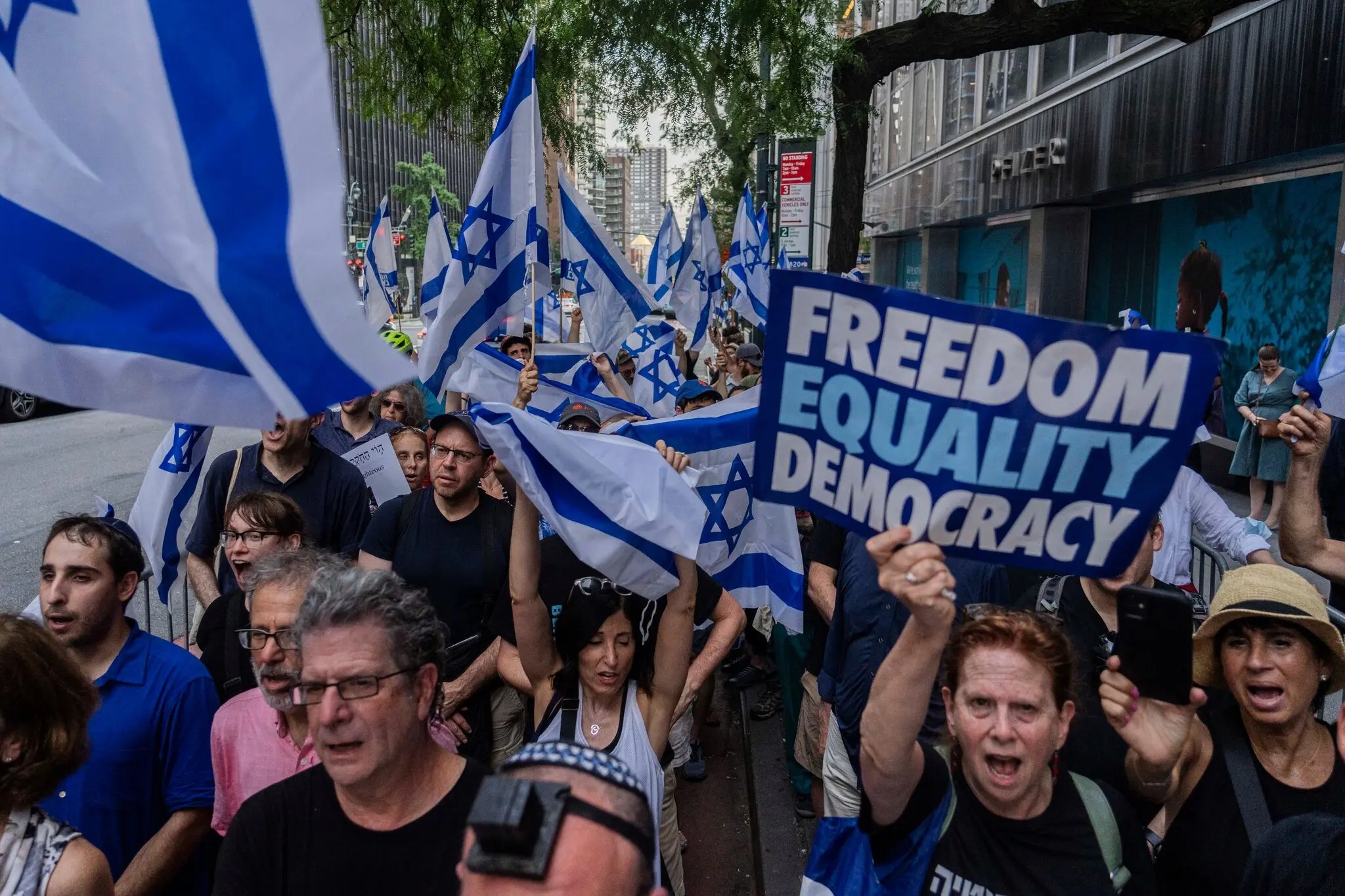
I think a great deal about the impact of our words when it comes to the issue of Israel/Palestine. We have witnessed their power for instance, over the course of this past year, as thousands of Israelis have been holding regular demonstrations against the current Israeli administration and its plans to limit the power of the Israeli judiciary. Week after week, protesters have chanted words in the streets and carried them on signs, expressing their collective outrage over the government’s “threat to Israeli democracy.” More recently, many in the American Jewish community – including many rabbis – have voiced their support for these protests and have even been staging public protests of their own.

On one level, it could be said that these massive rallies have had a powerful impact. They are the largest and most sustained protests in Israeli history and the most massive mobilization of the Israeli left in years. The rhetoric of the rally has also empowered Zionists in general. Many who advocate for Israel will often refer to it as “the only democracy in the Middle East.” I would suggest that the use of this word is powerful for all the wrong reasons. It covers up the reality that while Israel may be a democracy for Jews, it is decidedly not one for Palestinians. Indeed, for many centrist and right wing Israelis these demonstrations are important because they bolster the illusion of democracy. In so doing, they serve to entrench Zionism and strengthen the Jewish state.

It is true that at many of these demonstrations, there have been some chants and signs condemning Israel’s “occupation. However, this is an oft-invoked word that can mean different things to different people. For some it refers only to Israel’s military occupation of the West Bank and Gaza. For others it also includes annexed territories such as East Jerusalem and the Golan Heights. For still others, the entire land between the river and the sea is considered to be occupied territory. Thus, when the word “occupation” is invoked during the demonstrations, there is little clarity on what it actually means – or what is actually being demanded.

There is yet another powerful word that has recently emerged in relation to Israel/Palestine, and that word is “apartheid.” Last year, three respected human rights organizations: Amnesty International, Human Rights Watch and the Israeli group B’Tselem, all released well-researched reports concluding that Israel is an apartheid regime. Over the past year, many surprising figures have also been increasingly using this word in relation to Israel, including a retired Israeli general.

This past year, a letter was posted online by Israeli academics that openly criticized American Jews for “(paying) insufficient attention to the elephant in the room: Israel’s long-standing occupation.” The letter pointedly stated that “there cannot be democracy for Jews in Israel as long as Palestinians live under a regime of apartheid, as Israeli legal experts have described it.”  The so-called Elephant in the Room Letter was widely distributed and was eventually signed by Jewish leaders and figures – to date it has over 2,700 signatures.

With liberal Jewish leaders increasingly willing to use the “A” word in public, there is every indication that it is losing its stigmatized, transgressive status in the Jewish community. But even here, the meaning of the word “apartheid” depends on how it is used. The B’Tselem report, for instance, claims that Israeli apartheid extends “from the Jordan River to the Mediterranean Sea.” The Israeli general, on the other hand, limited it to the West Bank alone.

There are also those who would say that the term “apartheid” itself doesn’t go far enough – that it is a technical term from international humanitarian law that has limited legal applications. Many would argue that the word “settler colonialism” is much more powerful and meaningful because it is related to decolonization – a concrete process of action that includes the return of refugees and reparations to the Palestinian people.

Yes, all of these words do indeed have a complex kind of power when it comes to Israel/Palestine, and I’m often fascinated by the strategic ways we utilize this power. Years ago, I used to avoid controversial and potentially incendiary words in connection with Israel, feeling that they might well alienate and push away the very people I was trying to reach. I would typically use words I thought were less triggering: “dispossession” instead of “ethnic cleansing,” “non-Zionist” instead of “anti-Zionist,” “occupation” instead of “settler colonialism.”

I feel differently about this now. I actually think it’s important to use words such as these. I believe it’s important to name oppression explicitly and not to soften it with euphemisms. If some words make people uncomfortable, that’s OK. Once a word is said, it can’t be unsaid. It’s now part of the discourse. While some may well recoil from that word, they may well come around to accept it in time.

Words can indeed push the line of what is considered acceptable. But they can also represent one step too far, or the crossing of a line. There is still, for instance, a hard line drawn on the word Zionism. For most Jews, it is still considered beyond the pale to refer to oneself as an anti-Zionist: to break not just with the Israeli government, not just with the 1967 occupation, but with the very concept of an exclusively Jewish nation-state.

Apropos of Yom Kippur, it seems to me that when we say these words and cross this particular line openly, we’re really making a kind of confession. It’s not merely a political opinion – it’s an ethical admission that our Jewish identity has been inextricably connected to the oppression of another people.

When I was growing up, I was routinely taught that Zionism was the national liberation movement of the Jewish people. But I was never taught that this “liberation” came at the expense of another people. Like many American Jews, I was raised to view the establishment of the state of Israel as the exclusive Jewish homeland; a Jewish refuge after centuries of persecution; a redemptive homecoming following the collective trauma of the Holocaust.

Our trauma has been compounded by the sense that the world was complicit in it – that the Jewish people were abandoned by the international community. To be sure, the allied nations should rightly bear deep shame for their inaction during the Holocaust and their refusal to accept Jewish refugees following the war. But even as collective Jewish trauma is all too real, it was tragic and profoundly wrong to justify it by inflicting trauma on another people: by establishing a Jewish state on their backs and creating what has now become the largest refugee population in the world.

When Jewish Zionists publicly confess and act on the truth of this history it can often shake their Jewish identity to the core. This phenomenon often reminds me of something James Baldwin wrote in his classic 1962 essay, “A Letter to My Nephew:”

As you will discover, people find it very difficult to act on what they know. To act is to be committed and to be committed is to be in danger. In this case the danger in the minds and hearts of most white Americans is the loss of their identity. Try to imagine how you would feel if you woke up one morning to find the sun shivering and all the stars aflame. You would be frightened because it is out of the order of nature. Any upheaval in the universe is terrifying because it so profoundly attacks one’s sense of one’s own reality.

Though Baldwin was addressing white supremacy in the US, I think his words are equally applicable to Jewish supremacy in Israel. Zionism has become such an indelible part of Jewish identity that it has caused us to enable – or at the very least tolerate – the oppression of another people. The power of this mythic Zionist narrative manages to keep the truth of this ongoing oppression at bay, lest it causes everything we once held so dear to come crashing to the ground.

I experienced this upheaval personally in 2008, at my former congregation. During Israel’s military assault on Gaza, I experienced deep anguish – and I expressed those feelings in a blog post. While I had often been critical of Israel in the past, this was very different. Rather than using the usual words, calling for “balance” and a plea for “peace on both sides,” I used strong and angry language, explicitly naming Israel as the oppressor. I concluded my post with these words:

We good Jews are ready to protest oppression and human rights abuses anywhere in the world but are all too willing to give Israel a pass. It’s a fascinating double standard, and one I know all too well. I understand it, because I’ve been just as responsible as anyone else for perpetrating it.  

So no more rationalizations. What Israel has been doing to the people of Gaza is an outrage. It has brought neither safety nor security to the people of Israel and it has wrought nothing but misery and tragedy upon the Palestinian people.

There I said it. Now what do I do?

Now many years after later, I realize that post was a kind of confession. Though I didn’t know it at the time, when I wrote those words I was actually crossing a line that would eventually force me to leave my congregation. To use Baldwin’s words, it was upheaval so profound that it attacked my sense of my own reality. I was fairly sure I couldn’t continue as a congregational rabbi – and I wasn’t completely sure what kind of Jew I would be either.

But as I said earlier, once our words are out in the world, there are myriad ways their power might be manifested. I was eventually able to recover my Jewish identity along with my Jewish conscience. Speaking those words was unexpectedly liberating. I discovered there were other Jews like me – lots and lots of them. And together we became part of an emergent Jewish community that had the freedom to say out loud what must be said. I have no illusions that there is a distinct minority of Jews on this side of the line, but I also know that there are many who are now crossing over, breaking their silence on Israel/Palestine in unprecedented ways.

In its way, this new Jewish community is creating a new counter-narrative to the Zionist narrative that has been dominant for so long. One critical part of this counter-narrative is the understanding that standing in solidarity with Palestinians is a mitzvah – a sacred act. When it comes to solidarity in particular, words are enormously important. Those who engage in solidarity with disenfranchised people know that while words may have great power, words can quickly lose their power if they do not lead to action.

Indeed, history is littered with the betrayal of empty words, promises unkept and treaties broken. Staying true to one’s word can often be a challenge for those who are trying to practice solidarity in good faith. The growing popularity of land acknowledgements is a good example. Land acknowledgements are significant and important, but as many Native people have pointed out, they amount to empty words unless they contain accountability – unless they exist in a larger context of decolonization and reparation. As President Robert Larsen of the Lower Sioux Indian Community has put it, “An apology or an acknowledgment is one thing, but what are you going to do next?”

The same applies to those of us who express solidarity with the Palestinian people. Yes, the words we say matter, but unless they lead to genuine transformation, they will remain little more than empty words. To return to my metaphor of energy, words represent the initial spark, but once kindled, it takes real effort to sustain and increase its power. We must take active responsibility to maintain that initial spark by acting on our words, lest it eventually sputter out.

Putting our words of solidarity with Palestinians can take many forms, but a core priority requested by Palestinian civil society groups is support for BDS – the Palestinian-led Boycott, Divestment and Sanctions movement. In this regard, I encourage those who are able to attend our Yom Kippur afternoon program today. We will be hosting a conversation with Omar Barghouti, the co-founder of the BDS national committee, whose presentation is entitled, “Repentance, Reparation and Ethical Reconciliation: A Palestinian Vision for Common Liberation.” Omar was deeply honored to be asked to be our teacher for Yom Kippur – but as I told him, I could think of no more appropriate way for a congregation such as ours to observe this day.

I also want to remind our members that Tzedek Chicago was one of the first congregations to sign a pledge from the Apartheid-Free Communities initiative, a newly created interfaith coalition convened by the American Friends Service Committee. In that statement, signatories pledge “to join others in working to end all support to Israel’s apartheid regime, settler colonialism and military occupation.” Now that we have publicly made this pledge, it will be our challenge to live out these words as a community – and in the spirit of Yom Kippur, I want to encourage us to explore what this will mean for our congregation in the years ahead. By signing this public pledge, it is also our hope that it will give other Jewish congregations and organizations the courage to speak these previously unspeakable truths as well.

In the Shacharit service – the Jewish morning prayer – we say the words, “Baruch she’amar ve’haya ha’olam” – “Blessed is the one who spoke and the world became.” While this literally refers to God but it is also a statement about the potential within each and every one of us. Our words have the power to transform our lives and our world – indeed, to create whole new worlds anew.

So let this be our collective blessing this Yom Kippur: let us find the courage to speak the words that must be spoken. Let our words kindle sparks of possibility, and may they inspire us all to create the world we know is possible: a world of Tzedek/Justice, of Tikkun/Repair and of Shalom/Wholeness for all who dwell on earth. 

From Interfaith Dialogue to Interfaith Solidarity: Sermon for Rosh Hashanah 5784

(AP photo by Adam J. Dewey/NurPhoto)

During the course of my rabbinical career, I’ve participated in a good number of interfaith dialogues. These were facilitated conversations, usually involving the three so-called Abrahamic traditions – Christians, Muslims and Jews – in which we would explore our respective faith traditions together. The goal of the dialogues, generally speaking, was to achieve a deeper level of interfaith appreciation and understanding – to walk away with a respect for our differences as well as the underlying values we had in common. 

I haven’t participated in an interfaith dialogue in many years. If truth be told, I’m not sure I really believe in them anymore. It’s not that I don’t think it’s a good thing for people of different religions to learn from one another – I certainly do. It’s just that our dialogues never seemed to go much further than the talking. While our conversations were often substantive, we generally avoided more uncomfortable political topics. The underlying assumption seemed to be that religion and politics didn’t mix.

During Jewish – Christian conversations in particular, we rarely delved too deeply into issues such as Christian hegemony, white supremacy and antisemitism. When we did, we tended to treat such issues as part of the past. We seemed to be guided by the liberal assumption that such things belonged to a bygone, less enlightened age than our own. 

I can’t help but think such assumptions feel downright quaint today, in an age in which White Christian Nationalism is openly amassing political power. In which a mob wielding crosses and Christian banners literally stormed the Capitol in a coup attempt. In which Republican politicians have openly declared themselves to be Christian nationalists and a Republican candidate for president has called on his followers to “put on the full armor of God.” In the current political age, I think it’s safe to say the interfaith need of the moment goes far beyond liberal religious dialogue. The stakes are now far too serious – and far too consequential – for that.

Over the past two years, there’s been a great deal of analysis of the political threat posed by White Christian Nationalism: an ethno-nationalist movement that espouses a toxic combination of Christian exceptionalism and white supremacist ideology. White Christian Nationalists are guided by the belief that God has destined America, like Biblical Israel, for a special role in history – and that it will receive divine blessing or judgment depending on its obedience. It also promotes Replacement theory and actively demonizes Muslims, Jews, LGBTQ+ people, immigrants, and all others who do not fit into their white Christian ideal.

In the age of Trump, this movement has become entrenched in the Republican Party – and while they’re still a minority, their power has become critical to the GOP’s political strength. According to polls, most Republicans support declaring the US to be Christian nation, even if such a move would be unconstitutional. And among White Christian nationalists as a whole, 40% believe ​that “true patriots might have to resort to violence to save our country.”

Though this movement has emerged in a specific political moment, it is not uniquely of the moment. It actually dates as far back as the early days of European colonialism. Experts trace its roots back to the Doctrine of Discovery: a 15th century papal decree proclaiming European civilization and western Christianity to be superior to all other religions and cultures. The Doctrine of Discovery, of course, was an important driving force behind European colonial domination of the so-called New World and the conversion of the native peoples who lived there. 

This movement is also deeply rooted in white supremacist ideology. In his book, “White Too Long: The Legacy of White Supremacy in American Christianity,” Robert P. Jones wrote powerfully about this connection: how a wide spectrum of white Christians – from evangelicals in the South to mainline Protestants in the Midwest and Catholics in the Northeast – developed theologies that justified American slavery and Jim Crow. 

This legacy of white supremacy in American Christianity is alive and well in 2023. In 2015, a white supremacist entered Mother Emanuel AME Church in Charleston, South Carolina and murdered nine African American members of the congregation during a Bible study. Though there was extensive press at the time about his white supremacist beliefs, there was relatively little discussion of his Christian faith. In fact, his manifesto was filled with Christian imagery, including a drawing of a resurrected white Jesus rising from the tomb. He also wrote in his journal a call to action to white people to transform American Christianity from being “this weak cowardly religion” to “a warrior’s religion.”

Of course, Jews have every reason to be alarmed by such a movement as well. It was a brutal wake-up call indeed to watch torch carrying marchers in Charlottesville calling to “reclaim” America as a Christian nation while chanting “Jews will not replace us!” That wake-up call became downright deafening on a Shabbat in 2018, when a Bible quoting white supremacist murdered 11 Jewish worshippers at the Tree of Life synagogue in Pittsburgh.

At the same time, the Jewish community has been the recipient of genuine solidarity from Christian allies and friends. I’ve experienced this first hand more than once. This past February, for instance, when it was reported that Christian nationalists were planning to mobilize a “Day of Hate” against the Jewish community, my colleague and comrade, Reverend Tom Gaulke, wrote these beautiful words in a letter to our congregation:

As we hear of Christian Nationalists and Christian Supremacists calling for a “day of hate,” I would like to renew a promise on my own behalf and on behalf of the communities I’ve served:

For over a decade, we have marched side by side. And we’re not going to stop. As your family, we’ve got your back, come what may. Together, we’ve got a love that will conquer hate and a love that can only overcome.

To my mind, this gesture sums up the critical need of our new political moment: not so much interfaith dialogue, as interfaith solidarity. We must find a way to mobilize an interfaith movement that, in Tom’s words, ‘will conquer hate and can only overcome.”

If we are truly serious about this level of solidarity, however, each of our religious communities will need to engage in a great deal of deep discernment in our own backyards. I know there are many examples of white Christian communities who are doing this work in important ways; who understand that white solidarity must go hand in hand with justice and reparation. In his book, Robert Jones wrote about one white Baptist minister whose congregation has entered into an ongoing relationship with a black Baptist church. In describing that relationship, the minister said:

I’ve stopped using the word reconciliation…for what we’re doing. I’ve started using justice work more… When we throw around the word reconciliation, especially as white Christians, white people, we’re betraying our desire to just kind of move through all of the hard stuff to get to the happy stuff. So, when we’re talking about justice work, for me we’re getting into these much stickier questions of what has been lost, what is owed. 

Christian solidarity with non-Christians can also be hampered when well-meaning Christians fall back on a myth of innocence – when they distance themselves from White Christian Nationalism by saying “it’s not my religion.” I’ve witnessed this repeatedly – last year, for instance, the presiding Episcopal Bishop stated that White Christian Nationalism was “not Christianity.” Another progressive Christian activist has written it is a “political ideology rather than a religious one.” 

While I understand the good intentions behind these kinds of statements, I believe it’s deeply problematic when Christians disavow the more unsavory aspects of their religious tradition. In so doing, they avoid accountability for centuries of their own history and invisiblize its victims. As I’ve often commented, no religion is pure – all religions have their good, their bad and their ugly. In the end, I would submit that the proper way to confront the toxicity in our traditions is for people of faith to own the all of our religions – and to grapple with them seriously, honestly and openly. 

This will be a reckoning for the Jewish community as well. For one thing, in order to confront White Christian Nationalism, we will need to honestly interrogate persistent myths about Jews and whiteness. While white Jews understandably feel vulnerable at this particular moment, we still dwell under a shelter of white privilege. We must not assume that the threat of White Christian Nationalism poses a danger to all members of the Jewish community equally. White Jews will have to reckon with the fact that we are protected from this threat in ways that Jews of color are not. In other words, for the Jewish community, intra-communal racial solidarity will be just as critical as interfaith solidarity.

There is another issue facing the Jewish community that is perhaps even more challenging: if we are to truly stand down this movement – this toxic fusion of religion and nationalism – we’ll have to do so without exception. That means that Israel cannot get a pass. 

Though it may be troubling for many to consider, there are clear parallels between white Christian Nationalism and Zionism. Consider this: the Doctrine of Discovery holds that America was “discovered,” glorifying the noble innocence of the nation’s original “pioneers.” The ideology of Manifest Destiny is deeply connected to a vision of European Christian chosenness, viewing America as a “new Zion.” 

For its part, Zionism is rooted in a similar colonial view of a “land without a people for a people without a land.” It venerates the heroism of the chalutzim – the pioneers who “drained the swamps” and cultivated the land. And Zionism’s central narrative also comes from the Bible, utilizing texts that emphasize Jewish chosenness and exclusive entitlement to the land. 

Even more to the point, both White Christian nationalism and Zionism are forms of ethno-nationalism: movements that seek to establish and maintain nation-states predicated on the identity of one specific group of people. In its way, these two movements are religious nationalist mirror-images of each other, both seeking to create exclusive, homogeneous nation-states at the expense of their native inhabitants. 

Believe me, I know all too well that there are many in the Jewish community who will vociferously object to this kind of analysis. But painful as it may be, we can no longer cling to this myth of innocence when it comes to Israel. I think it’s absolutely critical that we find the strength to say these things out loud: to admit that after centuries of persecution at the hands of Christian empire, a modern Jewish movement is now actively following in its footsteps. 

All of this means that Jews, Christians – and all people of faith will need to reckon seriously with the issue of power – and in particular, the fusing of religion and state power. After all, don’t we know all too well from history where this road leads? We know what happens when religion is used by nations as a weapon of conquest. When God is invoked by the state to demonize others and exert their power over them. And make no mistake, religions that follow Biblical tradition will find ample justification for conquest and domination in that particular text.

But there is, however, another, decidedly different religious vision: it is a sacred act to resist oppressive state power. This path comes from the Bible as well; it is embodied by the Exodus narrative, the sacred story that lifts up the God of Liberation, and stands down the god of conquest. That puts the oppressed, not the oppressor at the center. That views the Promised Land not as a territory to be conquered by a chosen few but a land of equity and justice that is open to all.  We don’t have to look far to find contemporary examples of this sacred narrative in action. To name but two examples, it is exemplified by the Latin American liberation theology movement and the American black church: both of which lift up sacred visions of resistance that have leveraged genuine socio-political change.

This sacred narrative of liberation runs mightily through Jewish tradition as well. We are currently witnessing an emergent movement of radical, liberative Judaism that is truly exciting to behold. And I am so proud that Tzedek Chicago is an active and important participant in this movement. As we’ve done this work together, it’s been striking to me how integral and basic these values of solidarity and liberation are to Jewish tradition: from the weekly radical revolution that is Shabbat, to our deep-seated culture of study, questioning and Godwrestling, to our holidays, all of which contribute to a sacred drama that enact and re-enact the possibility of change and transformation in our world.

We enact these sacred values, in fact, each and every Rosh Hashanah. One of the central themes of the New Year is malchuyot – “divine sovereignty.” As I’ve come to understand it, this concept doesn’t have to refer to a literal belief in an all-powerful supernatural God sitting on his Kingly throne. Another way of understanding malchuyot, is as an affirmation of a Force Yet Greater – greater than any human or institution in our world: a power greater than Pharaoh in Mitzrayim, greater than the mightiest empire – and yes, even greater than systems of colonialism and white supremacy. 

Rosh Hashanah is also the day in which we stand before the open gates of heaven and sound the shofar as a wake-up call for the new year. We declare Hayom Harat Olam – “today the world was created,”affirming the eternal potential for transformation in our world. Over the next ten days, we will dig deeply into our individual and collective souls and discern what needs changing. Then, at the close of Yom Kippur, we will sound the shofar once final time as a call to action to go forth and create the world we know is possible. 

I’d like to close now with the words of a contemporary religious leader who truly embodies these ideas and values of interfaith solidarity: the great Rev. William Barber, co-chair of the Poor People’s campaign and president of Repairers of the Breach. May his words be our call to action this Rosh Hashanah:

The world doesn’t change when powerful people get new ideas. The world changes when people who’ve been rejected come together and realize that they are blessed to show their neighbors that another world is possible. Change happens when those who have been otherized decide we ain’t takin’ it no more…

There’s some stuff wrong in America and there’s no way to mend the flaws of this nation and be one nation under God with liberty and justice for all, unless the rejected people are at the center.

May this be the year we discover the true source of our collective power. May this be the year we transform the world that is into the world we know is possible. 

On the Battle of Jenin and “The Battle of Algiers”

For many, Gillo Pontecorvo’s “The Battle of Algiers” (1966) remains one of the truly great movies of modern times – and arguably the greatest anti-colonial film ever made. So much has been written about its audacious pseudo-documentary style and its radical ideological pedagogy – and well as the ways it has provided a kind of real life template for colonial powers and liberation movements throughout history. For me, this latter point has particular resonance and relevance in the wake of Israel’s latest military “counter-terrorism” operation in Jenin.

I use the word “latest,” because this recent assault was precisely that – the latest of a continuum of Israeli military incursions into the Jenin refugee camp on the pretense of rooting out Palestinian “terrorists” and “militants.” Jenin – a camp composed of refugees who were ethnically cleansed from their homes in 1948 – has long been a center of Palestinian resistance by groups such as the PLO, the Al Aqsa Martyrs Brigades, Hamas and Palestinian Islamic Jihad (PIJ), among others. Despite a long litany of Israeli operations to crush them, however, Palestinian resistance groups have inevitably continued to regroup and thrive throughout the years.

This dynamic was incisively described in a recent New York Times op-ed by Tareq Baconi, “The Tale of Two Invasions,” in which he compared Israel’s recent assault on Jenin to its 2002 Jenin assault led by then Prime Minister Ariel Sharon. Baconi powerfully concludes:

Residents of the Jenin camp, some of whom had fled from their homes in what is now Israel in 1948, are refugees once again. And some of the toddlers who were in the camp in 2002 are now the young men of the Palestinian resistance. As the history of other struggles against apartheid and colonial violence have taught us, today’s children will no doubt take up arms to resist such domination in the future, until these structures of control are dismantled.

After reading Baconi’s article, I immediately flashed on a memory from Israel’s 2002 invasion of Jenin (in which, according to Human Rights Watch, 52 Palestinians were killed, at least 22 of whom were civilians, including children, physically disabled, and elderly people). I well recall reading at the time that Israeli commander, Col. Moshe “Chico” Tamir, believed that “The Battle of Algiers” was “a valuable source of information” for his soldiers who were fighting against PIJ in the Jenin casbah. It was also noted that PIJ leader Iyad Sawalhe was hunted down and killed much in the same manner as in the conclusion of the film, when the Algerian rebel leader Ali La Pointe is killed by the French military.

Much of the power of “The Battle of Algiers” derives from its complex portrayal of the military mentality and tactics of the French in Algeria. In one of its most famous scenes, the French commander Col.  Mathieu offers a long monologue at at press conference in which he calmly and rationally presents the colonial case for what amounts to the torture and oppression of the Algerian people. When he concludes, he offers this final rhetorical argument: “Do you think France should stay in Algeria? If you do, you have to accept the necessary consequences.”

This colonial rationale, of course, is often made in a myriad of ways by the state of Israel and its defenders – and it goes a long way in explaining why Israel continues to stage brutal assaults upon Jenin, Gaza and other sites of Palestinian resistance. In essence: “Do you believe a Jewish state must continue to exist? If so, you have to accept the necessary consequences.”

Every time I watch “The Battle of Algiers,” I’m always moved by the dramatic finale, which portrays the killing of Ali La Pointe then abruptly jump cuts five years later to the liberation of the resistance and end of French colonial rule in Algeria. The message is all too clear: colonial powers may win the battles, but they will inevitably be defeated in the end.

So too in Jenin: Israel’s regular assaults may succeed in quashing the latest leaders of the Palestinian resistance, but it will never destroy the Palestinian people’s will to resist. As Baconi so aptly put it: “today’s children will no doubt take up arms to resist such domination in the future, until these structures of control are dismantled.”

Our Vision of Liberation This Passover Must Include Palestinians

NASSER ISHTAYEH / SOPA IMAGES / LIGHTROCKET VIA GETTY IMAGES

Crossposted with Truthout

On Passover, when we gather at the seder table to tell the story of the Exodus, we are reminded by the haggadah (the seder text) that merely telling the story is not enough. We are asked to not only relate but to interrogate this sacred narrative, to contemplate its meaning and to discuss the questions it raises for us. Most importantly, we must connect the lessons of the Exodus story to liberation struggles “in every generation.”

This year, many have inevitably been making connections between the Passover story and the recent anti-government protests that have unfolded in Israel since January. In a widely read sermon last February, for instance, Rabbi Sharon Brous compared the protests to the “great birth story” of the Exodus. In a recent New York Times op-ed, Bret Stephens wrote that the protests were “as close to a revolution as the modern state of Israel has ever seen.” One Jewish leader commented to the press that he plans to read from the Israeli Declaration of Independence at his seder, particularly the passage that promises the “complete equality of social and political rights to all its inhabitants.”

On the surface, this framing might seem to make sense: Since late last year, thousands of Israelis have regularly been filling the streets to protest draconian policies proposed by the newly elected far right government of six-term Prime Minister Benjamin Netanyahu. The protests have largely focused on the “threat to democracy” posed by the government’s plans to drastically curtail the power of the judiciary. The demonstrations seem to have succeeded: late last month Prime Minister Netanyahu announced that he would seek a compromise with his political opponents in order to “avoid civil war.”

While this certainly seems like a “power to the people moment,” it’s worth asking: who exactly are the “people” who have taken back the “power?” Though it was not widely noted by the mainstream media, the protests were largely organized and attended by centrist and liberal Israeli Jews — Palestinians were notably absent. Indeed, it was difficult to ignore the sea of Israeli flags at these demonstrations, along with the drumbeat messaging over “saving Israeli democracy.” By the end, it had become clear that these protests were less about equal rights for Jewish Israelis and Palestinians alike than a desire to reclaim the patriotic Zionist mantle from a newly elected far right government.

In other words, before we’re tempted to connect the Israeli demonstrations to the festival of Passover, it’s worth investigating how we tell the story of liberation, who tells it, who we include, and who we leave out.

These questions are not, in fact, unique to this year. It is common for Zionists to refer to Zionism — the movement to build a political Jewish nation-state — as “the national liberation movement of the Jewish people.” Many might find this to be a curious use of the term, as it is typically used in regard to movements that struggle for liberation against colonial oppression — not settler colonial movements themselves. Such rhetoric belies the origins of an ideology inspired by 19th-century European nationalism and a movement that actively sought to transplant European Jews in historic Palestine.

However, even Zionists who view Jewish nation-statehood in liberative terms must ultimately admit that from the beginning, Zionism focused exclusively on Jewish liberation — and that this liberation most certainly did not extend to Palestinians. Quite the contrary, of course. As a nation-state whose identity was predicated on a demographic majority of Jews in the land, Palestinians were, through their very existence, viewed as an obstacle to Jewish liberation.

Israel’s Declaration of Independence makes it clear that this nation was created first and foremost for Jews. The 10 paragraph-long preamble essentially reads as a Jewish history lesson, ending with the line, “This right is the natural right of the Jewish people to be masters of their own fate, like all other nations, in their own sovereign State.” There is only one paragraph that pertains to the rights of non-Jews:

THE STATE OF ISRAEL will be open for Jewish immigration and for the Ingathering of the Exiles; it will foster the development of the country for the benefit of all its inhabitants; it will be based on freedom, justice and peace as envisaged by the prophets of Israel; it will ensure complete equality of social and political rights to all its inhabitants irrespective of religion, race or sex; it will guarantee freedom of religion, conscience, language, education and culture; it will safeguard the Holy Places of all religions; and it will be faithful to the principles of the Charter of the United Nations.

Note that the Declaration “ensures” social, political and religious — but not national — rights to its Palestinian citizens. This language is quite intentional: Israel considered Jews throughout the diaspora to be part of the “Jewish nation,” granting any Jew who immigrated to the state from anywhere in the world instant citizenship through its Law of Return. Conversely, the over 700,000 Palestinians refugees who were forcibly displaced from their homes and forbidden to return were decidedly not included as part of the newly established nation.

To this day, Israel has maintained a careful distinction between “nationals” and “citizens.” As non-Jews, Palestinians in Israel can be citizens, but they are not nationals, thus depriving them of rights and privileges enjoyed by Israeli Jews. As a result, to this day, there are more than 60 laws that discriminate against Palestinian citizens of Israel directly or indirectly, impacting virtually every aspect of their lives, including housing, employment, education, health care, and who they can marry.

The status of Palestinian citizens was compromised yet further in 2018 with Israel’s passage of the so-called Nation-State Law, which determined that “the right to exercise national self-determination” in Israel is “unique to the Jewish people,” established Hebrew as Israel’s official language, and established “Jewish settlement as a national value,” mandating that the state “will labor to encourage and promote its establishment and development.” According to Adalah:

This law – which has distinct apartheid characteristics – guarantees the ethnic-religious character of Israel as exclusively Jewish and entrenches the privileges enjoyed by Jewish citizens, while simultaneously anchoring discrimination against Palestinian citizens and legitimizing exclusion, racism, and systemic inequality.

Of course, the injustices facing the almost 3,000,000 Palestinians who live under military occupation in the West Bank — and the over 2,000,000 who live under a crushing blockade in Gaza — are dramatically worse than those experienced by Palestinian citizens of Israel. But it would be a mistake to draw a fundamental distinction between these different Palestinian populations. As the Israeli human rights organization B’Tselem puts it in its 2021 report, Israel maintains “a regime of Jewish supremacy from the Jordan River to the Mediterranean Sea.” Put simply, as a Jewish nation-state, Israel systemically denies basic civil and human rights to all non-Jews who live under its control.

It’s interesting to note that the “selective liberation” story we tell about Israel is not dissimilar from the story we tell about the establishment and history of another notable settler colonial state — namely, the United States. Indeed, I’m often struck that we typically use the term “American Revolution” to refer to what was essentially a political-economic secession by colonists from the British empire, whose nation was built on the genocide of Native peoples, enabled by the stolen labor of Black slaves.

Here too, it’s critical to interrogate how we tell the story of this national liberation, who tells it, who we include, and who we leave out. It has often been observed that the opening words to the American Constitution, “We the People,” is a radical misnomer as the founders originally defined “we” to be limited to white, property-owning males. This inherent inequity was already being openly challenged not long after the founding of the state. As Frederick Douglass famously declared in his 1852 speech, “What to a Slave is the Fourth of July:”

The rich inheritance of justice, liberty, prosperity and independence bequeathed by your fathers, is shared by you, not me. The sunlight that brought light and healing to you, has brought stripes and death to me. This Fourth of July is yours, not mine. You may rejoice, I must mourn.

When it comes to this legacy of American structural injustice, one can draw a direct line from Douglass to the words of Malcolm X, from his 1964 speech “The Ballot or the Bullet”:

No, I’m not an American. I’m one of the 22 million Black people who are the victims of Americanism. One of the 22 million Black people who are the victims of democracy, nothing but disguised hypocrisy. So, I’m not standing here speaking to you as an American, or a patriot, or a flag-saluter, or a flag-waver — no, not I. I’m speaking as a victim of this American system. And I see America through the eyes of the victim. I don’t see any American dream; I see an American nightmare.

At the same time, however, there remains a uniquely American tension between the “American nightmare” of Malcolm X and the “American Dream” referred to by Dr. Martin Luther King Jr. in his “I Have a Dream” speech, where he famously challenged the United States to be true to its stated intention to form a more perfect union: “I have a dream that one day this nation will rise up and live out the true meaning of its creed: We hold these truths to be self-evident, that all men are created equal.”

More recently, Nikole Hannah-Jones, author of the “1619 Project” has observed that “the United States is a nation founded on both an ideal and a lie.” Still, she concluded:

Despite being violently denied the freedom and justice promised to all, Black Americans believed fervently in the American creed. Through centuries of Black resistance and protest, we have helped the country live up to its founding ideals. And not only for ourselves — Black rights struggles paved the way for every other rights struggle, including women’s and gay rights, immigrant and disability rights.

Of course, we are currently witnessing a white supremacist backlash against those who seek to challenge the legacy — and reality — of American structural racism. As ever, Americans are struggling openly over how inclusive, extensive and complete our liberation will be. It is a tension that has been ongoing since the very founding of this country — it is at its core, a quintessentially American struggle.

In Israel, however, the struggle for democracy is far more complicated. As a Jewish state, Israeli democracy can only truly extend to its Jewish citizens. Unlike the U.S., where those who advocate equal rights for all can still be described as “believing fervently in the American creed,” those who call for one state with full citizenship for all are routinely accused of antisemitism, seeking nothing less than “the destruction of the Jewish state.”

Another important difference: unlike the U.S., Israel does not have a Constitution that, theoretically at least, ensures equal rights for its citizens. Noting Israel’s early, aborted attempts at creating a Constitution, journalist Joshua Leifer has recently commented:

America’s Constitution begins, “We the People.” One of the things that’s very striking when you read the drafts of the Israeli constitution that were written in 1950 is that the proposed version of Israel’s constitution began with “the Jewish people.” The ethnos was imagined as the demos from the beginning.

Like many Americans, I believe it is my responsibility to challenge my country to, as MLK put it, “live out the true meaning of its creed.” Among other things, this means actively supporting anti-racist struggles in the U.S. that demand full and equal rights for all its citizens. As an American Jew living in the age of Zionism, I can demand nothing less for all who live between the river and the sea.

As Aurora Levins Morales concludes in her classic poem “Red Sea:”

This time that country
is what we promise each other,
our rage pressed cheek to cheek
until tears flood the space between,
until there are no enemies left,
because this time no one will be left to drown
and all of us must be chosen.
This time it’s all of us or none.

This Passover, it is clearer than ever before that we need a new Jewish liberation story: one that is inseparable with the vision of liberation for all.