Category Archives: Current Events

A Conversation with Judge Goldstone

Ta’anit Tzedek convened an conference call last night between Judge Richard Goldstone and 150 American rabbis. I’m still sorting through this remarkable, inspiring experience but what I’m mostly left with is this: the world owes Judge Goldstone an enormous debt of gratitude for his commitment to humanitarian ideals and much of the Jewish world owes him a huge apology for the egregious way he has been assailed for his efforts.

A full audio file of the call can be found on the Ta’anit Tzedek website. Kudos to the Velveteen Rabbi, who has already transcribed major portions of the conversation. The JTA has reported on the call today as well.

A full written transcript will be up on the Ta’anit Tzedek website this Thursday. It deserves to be read as widely as possible. Beyond its value as a new item, it provides us all with a profound, resolutely moral statement of purpose.

Please read it.

On Gaza and Yom Kippur: A Call to Moral Accounting

From my op-ed in this morning’s Sunday Chicago Tribune:

The actions of the Jewish State ultimately reflect upon the Jewish people throughout the world. We in the Diaspora Jewish community have long taken pride in the accomplishments of the Jewish State. As with any family, the success of some reflects a warm light on us all. But pride cannot blind us to the capacity for error on the part of the country we hold so dear. We cannot identify with the successes, but refuse to see the failures.

As we approach Yom Kippur, I call on America’s Jews to examine the Goldstone findings, and consider their implications. In the spirit of the season, we must consider the painful truth of Israel’s behavior in Gaza, and understand that we must work, together, to discover the truth — and then urge on all relevant parties in the search for peace.

Iran for Iranians

28685775

In my final post from my visit to Iran this past fall, I wrote the following:

We’d be foolish to deny that there are troubling human rights issues that Iran would do well to address. But at the end of the day, the solutions to these problems are certainly not ours to impose.

I felt that passionately then and as I watch the Iranian people take to the streets day after day to demand justice in their country, I feel it even more passionately now.  I’m also immensely proud that our President refuses give in to the misguided voices that urge him to force himself on this process as it unfolds. Our country seems to finally be learning that imposing our “democracy” on other countries might not be the most effective foreign policy.

This is particularly the case with Iran, a nation that has experienced its share of empires meddle in its affairs over the centuries. Indeed, even as thousands of the Iranian people bravely demonstrate for democracy, you can be sure that it is lost on none of them that the last country to overthrow an Iranian regime was none other than the United States. The Islamic Republic may be odious in any number of ways, but at the end of the day, we must remind ourselves that it is the first Persian regime in centuries that truly belongs to its people.

Yesterday, I read a letter to the editor of the NY Times that said simply: “The Islamic Revolution has become the shah.”  A horribly mistaken analysis. For Iranians, the Shah was not simply an oppressive ruler – he was an oppressive ruler who was installed by the Americans after they took it upon themselves to overthrow Iran’s democratically elected Prime Minister.

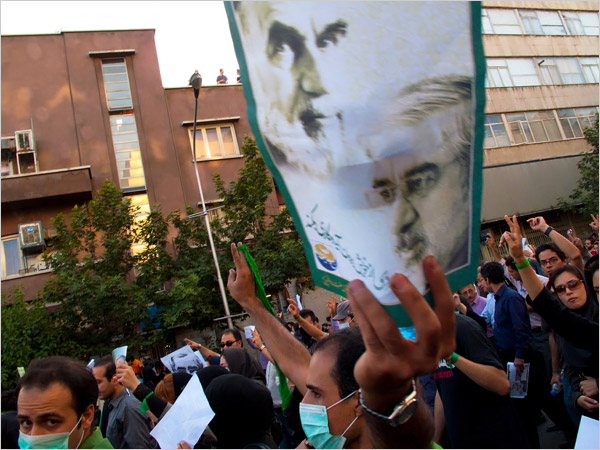
Take a look at the picture above (also from the New York Times.) It’s very telling: a demonstrator’s sign juxtaposes the Ayatollah Khomeini with Mir Hossein Moussavi (who was himself one the leaders of the 1979 revolution. An interesting article in today’s NY Times, in fact, explores the historically close relationship between Khomeini and Moussavi.)

This is enormously important for us in the West to understand: whatever we might think about Khomeini, in the eyes of many Iranians, he was the one who gave their country back to them. Whatever we might think about the republic to which the revolution gave rise, it is the Iranians’ republic. Those who demonstrate in the streets are not rebelling against the revolution – they are demanding that it live up to its promise.

“Justice, justice shall you pursue.” This is what precisely what we are witnessing in the streets of Iran. We can surely support their pusuit in any number of ways, but in the end, this particular justice is theirs’ to pursue and achieve – not ours’ to dictate.

PS: Among the many blogs and e-news outlets I’ve been following, my favorite is a photo blog called Tehran 24 that updates daily with astonishing pix of the demonstrations. Definitely worth a thousand words…


On Clowns and Illegal Hothouses

PD*28296118

I know I promised to pontificate on this week’s UN World Conference on Racism in Geneva, but I don’t know that I have anything to add that hasn’t already been said about this particular circus. (And I mean this literally – see above.)  For what it’s worth, I found Cecilie Surasky’s dispatches for Muzzlewatch to be the most incisive and helpful reporting on conference doings.

On a completely unrelated topic, I noticed this small news piece in yesterday’s Ha’aretz:

Five Border Policemen were wounded on Thursday in a clash with hundreds of residents of the Israeli Arab town of Kafr Qasem.

The violence broke out when security forces arrived to demolish a concrete surface upon which a hothouse was due to be built illegally. They were met at the scene by about 400 Kfar Kassem residents who had turned out to protest the move.

I suppose its just a minor news story in the scheme of things – still, it did remind me that the media’s impact is often less powerful for what it says than for what it leaves out. In this case, that would be the fact that almost all new building in Israeli Arab villages is technically “illegal” since Israel has made it virtually impossible for its Arab citizens to receive building permits.

From a New Israel Fund report:

There is a lack of planning for Arab neighborhoods and towns that has led to ongoing difficulties in obtaining building permits, and as a result, the demolishing of illegal buildings in the Arab sector. Since 1948, almost no Arab neighborhood or town has legally been permitted to expand.

Also left out of the article is any mention of this particular village’s  tragic history – and why a demolished hothouse is really just the latest chapter for the citizens of Kafr Kassem. Click here to learn more.

The Plight of Roxana Saberi

340x-121Several people have asked me, now that Iranian-American Roxana Saberi has been sentenced to eight years in Iranian prison, if I have reconsidered my opinions about Iran and the importance of American-Iranian diplomacy. If anything, this current crisis has only deepened my convictions on both counts.

As I’ve written here before, I certainly don’t harbor any illusions about the more odious aspects of Iranian politics. In fact, I wrote precisely that upon my return from my trip to Iran this past fall:

None of this is to sugar-coat the more disturbing aspects of the Islamic Republic. If our delegation was ever tempted to do so, we received a hard dose of reality when we read in the Tehran Times about a public hanging of two men convicted of bombing a mosque that was scheduled to take place in Shiraz shortly after we were there. Yes, we are justified in recoiling from reports such as these – and we’d be foolish to deny that there are troubling human rights issues that Iran would do well to address. But at the end of the day, the solutions to these problems are certainly not ours to impose.

How do we further Saberi’s cause and for all who suffer from human rights abuse within Iran? The answer is the same as it ever was: by choosing to speak out and by supporting the grassroots efforts of those citizens and groups on the ground who are directly affected by these violations.  However if we make this choice, we cannot do it selectively – we must apply the same criteria to all human rights abuse whenever and wherever it might occur.  Indeed, that’s what makes the current diplomatic dance over Saberi’s fate is so complex and delicate. For at the end of the day, we Americans must be willing to admit that we are on fairly slippery moral ground whenever we speak out against things like wrongful arrest, imprisonment without due process, and the absence of legal transparency.

Many analysts are suggesting that Saberi is being used as a political pawn between Iran’s hard line judiciary and President Ahmadinejad, whose administration seems to be inclining toward diplomatic engagement with the United States. Others point out that Ahmadinejad is all too happy to exploit this impasse as a feather in his cap in Iran’s current election campaign. Either way, Roxana Saberi’s plight seems to be a symptom of some significant growing pains within the Islamic Regime as well as in their relationship to the international community. The long-term stakes are high – all the more reason that this crisis must be handed with diplomatic skill and care rather than the tired, counterproductive saber-rattling of old.

Speaking of nasty international diplomatic imbroglios, I’ve got some thoughts about the loud noises coming out of Durban II.  More on that later…

Addendum 4/21/09: Click here to send a personal letter to Iran’s Ayatollah Khamenei, urging him to review Saberi’s trial and conviction and to release her immediately from prison.

Exxon Valdez: A Dubious Anniversary

Hard to believe, but Tuesday, March 24 will mark the 20th anniversary of the Exxon Valdez oil spill in Prince William Sound, Alaska. On that infamous day nearly 11 million gallons of crude oil was spilled into this exquisite sea habitat, covering 11,000 square miles of ocean. Hundreds of thousands of animals died as a result; untold aftereffects continue to plague the sound and its surroundings to this day.

To mark this important anniversary (which will likely fly pretty low under the media radar) I recommend this excellent series from Buzzflash.com which reveals, among other things, that Exxon is still avoiding reparations to struggling Alaskans while making record profits (see clip above.)

Stumped for a way to acknowledge the importance of this day? Click on this action alert from Ocean Conservancy, and encourage your senator and representative to pass legislation that addresses the severe challenges confronting our ocean and marine ecosystems.