Category Archives: Gaza

Moral Courage from the General’s Son

Please, please take 30 minutes of your time to watch this presentation by Israeli peace activist, Miko Peled, author of the recently published book, “The General’s Son.”

Among other things, Peled’s ideas and convictions carry a profound sense of moral authority because he comes with impeccable Zionist credentials. His grandfather, Avraham Katznelson, was a prominent Zionist leader and signer of the Israeli Declaration of Independence. His father Matti Peled was a major Israeli military leader who fought in the 1948 War of Independence and was an Aluf (“Major-General”) during the 1967 Six-Day War. He later became a scholar of Arabic literature, a leftist politician, and a prominent Israeli advocate of peace talks with the PLO.

Miko is following in his father’s footsteps in more ways than one. In reading his book, it is so clear to me that he is an Israeli through and through and very much a product of his family’s remarkable history. At the same time, he has carried his father’s work of moral witness firmly into the 21st century.

In the video above, he addresses what he considers the fundamental myths of Israeli society: the “Land Without a People for a People Without a Land” myth of 1948, the “War of Survival” myth of 1967, and the myth of “Israeli democracy.” He also speaks eloquently about the moral outrage of the war in Gaza and the issue of Palestinian terror.  (Tragically, Peled’s family has first-hand experience with the latter subject: his niece Smadar was killed by a Palestinian suicide bomber in Jerusalem in 1997).

Please watch the clip and send the link on. Moral heroes such as Miko Peled deserve the widest possible audience.

PS: I’m thrilled to be able to say that the publisher of “The General’s Son,” Just World Books, will be soon publishing my book – a curated anthology of “Shalom Rav” posts and comments from 2008-2010.  Much more on this soon – stay tuned!

Light One More Candle for Gaza

It’s the last day of Hanukkah and the third anniversary of Israel’s devastating military assault on Gaza. Although we are technically finished lighting candles, I’d like to suggest lighting one more tonight in commemoration of this tragic anniversary.

To this end, please read the post below, slightly adapted from a piece co-written by myself and Rabbi Alissa Wise for the JVP Rabbinical Council’s new blog, Palestinian Talmud:

On the morning of December 27, 2008, the sixth day of Hanukkah, Israel initiated a massive military assault against Gaza it called “Operation Cast Lead.”  The name of the operation was a reference to a popular Hanukkah song written by the venerable Israeli poet Chaim Nachman Bialik:  “My teacher gave a dreidel to me/A dreidel of cast lead.”

When Israel’s military actions ended on January 18, some 1,400 Palestinians had been killed. Among the dead were hundreds of unarmed civilians, including some 300 children.

Tonight begins the last day of Hanukkah—and we pause today to remember the lives lost three years ago, and the devastating blockade that continues to this day. Tonight, we invite you to light a ninth candle for Gaza.

As you gather to light the Hanukkah candles with your community and/or family, consider adding some moment of reflection on Gaza. You might include:

Discussing how Hanukkah, the festival that enshrines the ongoing human struggle for freedom, the season that seeks to shed light on the dark places of our world, can be a time for us stand in solidarity with all who are oppressed.

Researching the restrictions that continue to rob the people of Gaza of a life of normalcy and dignity. After all, Israel’s military assault occurred in the midst of a crushing blockade that Israel has imposed upon Gaza since January 2006. Despite Israel’s claims to the contrary, its blockade remains very much in force. You can find the most recent reports issued by Gisha – Legal Center for Freedom of Movement for information on the restrictions of movement for Gazans.

Reflecting on the personal testimonies from Gazans who lived through Israel’s military assault indicate tragedy beyond human comprehension. Here is one such account – excerpted from Amnesty International’s 2009 Report, “Operation Cast Lead: 22 Days of Death and Destruction”:

After Sabah’s house was shelled I ran over there. She was on fire and was holding her baby girl Shahed, who was completely burned. Her husband and some of the children were dead and others were burning. Ambulances could not come because the area was surrounded by the Israeli army. We put some of the injured in a wagon tied to the tractor to take them to hospital. My nephew Muhammad (Sabah’s son) picked up his wife, Ghada, who was burning all over her body, and I took her little girl, Farah, who was also on fire. My nephew Muhammad-Hikmat drove the tractor and my son Matar and my nephews ‘Omar and ‘Ali also came with us and took the body of baby Shahed and two other bodies. Sabah and the other wounded were put into a car; other relatives were also leaving. We drove toward the nearest hospital, Kamal ‘Adwan hospital. As we got near the school, on the way to al-‘Atatrah Square we saw Israeli soldiers and stopped, and suddenly, the soldiers shot at us. My son Matar and Muhammad-Hikmat were killed. The soldiers made us get out of the wagon. I ran away with ‘Ali and ‘Omar, who had also been shot and were injured. Muhammad, Ghada and Farah were allowed to go on but only on foot and the soldiers did not allow them to take the dead.

This Hanukkah, please light an extra candle for Gaza.

Ahmed Moor on the One-State Solution

Last Thursday, Ta’anit Tzedek hosted a fascinating, stimulating conference call with Palestinian-American journalist Ahmed Moor. Moor, who was born in Gaza, has reported from Lebanon and Egypt and is currently a graduate student in public policy at Harvard.  He has been an outspoken advocate of a one-state solution in Israel/Palestine – and during our conversation he elaborated extensively on a subject not commonly countenanced in the American Jewish community.

We recorded the call and will be posting it on our website soon. In the meantime, I’ve transcribed portions of our conversation and have posted them below. Personally speaking, I find Moor’s way of thinking to be fresh and important and I believe these kinds of ideas deserve a fair hearing in our community.

On the notion that Israel must exist in order to safeguard Jewish culture:

First I want to address this idea that a Jewish state has a right to exist because Jewish culture is valuable.  Jewish culture is valuable. Hebrew culture is valuable. It is intrinsic – that’s true whether or not Newt Gingrich thinks it’s invented. But the question of whether culture needs to be mapped on a geographical space in a state environment, I think, is one that is open to discussion.

And so when we think about Jewish life here in America, I don’t know that many people would disagree with me when I say that some of the most vibrant examples of Jewish life are here in America, in the diaspora, amongst non-Jewish people. So right-wing Israelis like to make the argument that where Hitler failed, assimilation is going to succeed. Intermarriage is the biggest threat to the Jewish people, not Iran.

Well, if you believe that Israel is the homeland of the Jewish people and that it’s the only state guarding Jewish culture, well then you are in a sense aligning yourself with those arguments.  It’s illiberal, fundamentally illiberal.  We know from American experience that a multiplicity of cultures can exist alongside one another and engage with one another and strengthen one another and maybe, even yes, impact one another in positive ways.

And when it comes to Palestine and Israel, American Jews say, “Well this is kind of the homeland of the Jewish people, it’s going to preserve Jewish culture for us,” but it’s almost a relationship apt to an amusement park. “I don’t want to live there – I want to experience it for two weeks. I want to take some of the symbols home with me, but I don’t really want to engage with it in the way that I do at home.”

Well, that’s unfair. No matter how much you value Jewish culture, and no matter how much you believe Israel needs to exist for the preservation of Jewish culture, if it’s a museum, which I don’t think it is, you’ve got to realize that your cultural progress is coming at the expense of somebody else’s freedom. And I think that there’s an asymmetry there in what matters.

On the notion that Israel should exist in case another Holocaust should occur – and Israelis’ fears that a one-state solution is just a pretext for “throwing them into the sea:”

I think that first we’ve got to look at the reality today. The status quo is about expelling Palestinians from Jerusalem, their land in the West Bank, and disenfranchising them in greater ways in Israel proper…So the reality is exactly the opposite. The status quo, the two-state solution process, is about pushing the Palestinians not into the sea, but in the other direction.

First I want to address Jewish American fear, and I hear this from a lot of Jewish Americans of a certain age, when they talk about the Holocaust, which is obviously an evil, genocidal but I want to emphasize, a historical act. I had the benefit of speaking with (New York Times columnist) Roger Cohen recently, and we talked about American Jewish life and I asked him whether he feels unsafe in America. And he was unequivocal: “Absolutely not, America is safe for the Jewish people, we’re welcome here, we’re part of the people, we’re part of the cultural fabric. We are America. America is us.”

Do you ever believe as American people that there’s ever going to be something like Kristallnacht or a pogrom targeting the Jewish people in America?  If the answer is yes, well then perhaps it’s time to move to Israel – and that’s what most right-wing Israelis say. If the answer is no, well then you’ve got to realize that you are opting for the preservation of an insurance policy, but the price of that insurance policy is being borne by another people. The Palestinians are paying the cost of a Jewish American insurance policy. There’s that asymmetry again. That doesn’t work. That’s not a moral position to take and it’s unsustainable.

As for Israelis’ fear about whether we seek to ethnically cleanse them, I think there’s again a gap in perceptions of realities. The Israelis are the ones with the guns. The Israelis are the ones with the American support. When the one-state solution is actualized, it’s going to be necessarily through Israeli consent. The idea that the Middle East or Palestine has to be in any way ethnically cleansed of Jewish people is a European action transplanted onto Palestine.

On Israeli historian Gershon Gorenberg’s recent claim that a one-state solution in Israel/Palestine would create civil war à la Lebanon:

Gershon’s fear is related directly to governmental structures – the way in which you structure multi-ethnic, multi-religious societies, or sectarian societies. In Lebanon I think it was structured exactly the wrong way. In Lebanon, whether you’re liberal or you’re somebody who’s more conservative, whether you believe in one policy versus another, the state almost compels you to vote along sectarian lines.

In Lebanon the Speaker of the Parliament has to be a Shia Muslim, the Prime Minister is a Sunni and the President has to be a Maronite Christian. That’s constitutionally true – that’s mandated. And so what that means is that you end up voting – where your vote is impactful and meaningful – is in your sectarian group. The Lebanese demography there is so sensitive – they haven’t had a national census since 1932 or 33, I think.

You have the American case, on the other hand – the structure of this country is along a federal basis. Federalism enabled this country to recover from the wounds of the Civil War and to persist for another 150 – 160 years since the Civil War ended.

It’s important that we think about questions like the ones Gershon is raising, but I don’t think that those questions necessarily stand in the way of a one-state solution. So there are good federal structures, confederal structures even, for dealing with ethnic or religious strife in democracy.

What I’m thinking of specifically is a state with four federal units: the Gaza Strip, Jerusalem is its own district, sort of like Washington DC, central Israel and the Negev and finally the West Bank and the Mediterranean corridor so now you’ve got four districts and Jerusalem. And each of those federal units would be defined geographically and every one of them, with the exception of the Strip, would be made up of minorities either of Jewish people or Palestinian people.

And so in the West Bank federal state you’d have an expression mostly of Palestinian culture. Why? Because 5 out of every 6 people on the West Bank are Palestinians. In the Gaza Strip you could have an expression of Palestinian culture. In the northwestern state there’s a big minority of Palestinian Israelis, but it’s primarily Jewish. I mean we’re talking about the Tel Aviv – Haifa corridor and that would be a majority Hebrew culture state. Same with the Negev.

So you have parity amongst the states because the states are defined geographically and you enable people over time to move for personal preference reasons. Over time your could get a drift across these federal lines, kind of like what happened in the States. You used to define yourself as an American 100 years ago as a South Carolinian or a New Yorker, but today your primary locus of identity is as an American when you deal with the rest of the world. This was the failure of Lebanon – instead of geographically defining the states, the individual community boundaries within Lebanon don’t allow for that drift, so what they’ve ended up with is kind of ossified sectarian structure.

So I don’t think it will be perfect, I don’t it will be easy, but the idea is that you grant people equal rights and give them the freedom to move back and forth across borders. They won’t initially, but they will eventually. That’s been the American experience.

On the political future of the one-state solution:

I heard an Israeli speak recently, an older guy, an activist, and he mentioned the one-state solution is about where he remembers the two-state solution was in the seventies. And so it’s really about changing discourse, changing people’s thought patterns. Lots of people will come into the one-state conversation because they’ve realized the two-state solution is unworkable and that apartheid is just not something they are capable of supporting.  We’ll achieve a critical mass. It’s impossible to predict how or when, but two states isn’t going to work and apartheid isn’t going to work. And so you can arrive at this position by default even if you don’t actually believe it’s the best thing anyway.

On cultural autonomy in one democratic state:

People talk about a unitarian model where it would be just one man/one vote and I think that’s a great model to think about. My biggest concern there would be preservation of cultural autonomy, which I think many people at this stage really, really value in that part of the world. Palestinians don’t want to give up what it means to be a Palestinian and I think Jewish Israelis have developed a Jewish kind of culture. I don’t know whether its an Ashkenazic culture or a Sephardic culture, I don’t know. It’s not for me to decide. But there is an Israeli culture and I think those people want to preserve it. And when American Jewish people talk about Jewish culture in Israel, that’s something they’d like to be capable of accessing. And so I’m concerned that the unitary system may not permit the kind of cultural autonomy that many people would like.

But we’re still in the early stages of imagining what it could look like and the question of how to get there really does hinge on people of good will standing up and saying no to apartheid.

On the Palestinian right of return:

The right of return today for the Palestinians is actually about the right to be able to go back and live in Palestine. Lots of people still remember native villages which no longer exist, so the practicalities of it are difficult to map out.

The right of return for the diaspora is more about, I think, official recognition of the ethnic cleansing of Palestine in 1948 and in the period leading up to May 15 1948. It’s an official apology, reparations where appropriate and possible and just recognition. And I think the Jewish people probably understand this better than anybody. Once a historical injustice has been done to you as a people, recognition matters. Apologies matter. Reparations matter. Even symbolic measures matter a great deal.

When it comes to the practical implementation of the right of return, (Palestinian researcher) Salman Abu-Sitta has done really great work on identifying where refugees could return to.  Eitan Bronstein of Zochrot, an Israeli organization, has also done a lot of great work on the right of return…

Who do I believe will return to Palestine? I think most of us will not. The Palestinians in the diaspora have done pretty well for themselves. Palestinians in Jordan have done pretty well, the ones in Western Europe, in Latin America, in Northern America are doing pretty well. I think you could draw a direct analogy to the Jewish American diaspora. You want to go you want to visit, you want to go and hang out on the beach and go home to where you’re from.

The only missing group of Palestinian refugees who will actually return to Palestine if they have the opportunity are the 300,000 or 400,000 Palestinian refugees who live in Lebanon. Their lot really is very, very poor and the Lebanese state is racist in many ways in the way they interact with Palestinians there – it’s inexcusable, but that’s also the reality. And given the opportunity I think many of them will leave their squalid and impoverished camps and return to Palestine. But everywhere else, I think you’ll get kind of a vibrant interaction with a diaspora community and the country itself, which I think mirrors, in many ways, the Jewish experience.

Ta’anit Tzedek Conference Call: Journalist Ahmed Moor on the One State Solution

As the prospects for a viable two-state solution for Israel/Palestine grow more and more unlikely, we are witnessing a tentative but growing discussion of a one-state solution in the Jewish community.

Indeed, this concept has already been raised and advocated by respected Israelis. As far back as  2002 a one state solution was publicly supported by famed political scientist Meron Benenisti. And more recently, Israeli journalist Dimi Reider has pointed out:

In light of the ongoing deadlock in Israeli-Palestinian peace talks, leaders such as U.S. Secretary of State Hillary Clinton and Israeli opposition leader Tzipi Livni have raised the specter of a one-state solution. Their intention, of course, is to scare some sense into Israeli Prime Minister Benjamin Netanyahu and his intransigent coalition partners. But, as this once-taboo idea becomes a legitimate part of political discussion in the region, some Israeli intellectuals are making the case that this is not something to fear, but a path toward a viable resolution to the region’s long-running crisis.

Here in the American Jewish community, however, this sort of discussion is considered to be naive at best and heresy at worst. But as difficult and painful as it might be for us to contemplate, I believe that sooner or later (and probably sooner than later) it is a conversation we will inevitably have to have – regardless of where we might personally stand on the issue.

To this end, I am proud to announce the next conference call sponsored by Ta’anit Tzedek – Jewish Fast for Gaza: “Conceiving of a One-State Solution” with Palestinian-American journalist Ahmed Moor on Thursday, December 15 at 12 noon EST.

Ahmed Moor was born in Gaza and raised in the US, graduated from University of Pennsylvania in 2005 and spent several years as a freelance journalist based in Lebanon and Cairo. His work as been published in numerous publications, including Al Jazeera, Huffington Post, and the Los Angeles Times. He is currently a graduate student of Public Policy at Harvard University.

During our conversation, Moor will share his views on the need and the prospects for one secular democratic state in which Jews and Palestinians live together as equal citizens.  Can we conceive of such a solution and what would such a state look like practically speaking?  What are the political realities that mitigate against it and how could they ever be shifted? What are the prospects that these two peoples could live and govern a state together?

Call Info:

Thursday, December 15 at 12 noon EST
Access Number: 1.800.920.7487
Participant Code: 92247763#

As always, there will be opportunities for questions and answers during the call.

We are looking forward to an informative and respectful conversation. I encourage you to join us.

From the American South to the West Bank: A Freedom Rider Bears Witness to Human Rights in Israel/Palestine

On November 15, Palestinian activists will attempt to board segregated Israeli settler public transport headed to occupied East Jerusalem in an act of civil disobedience inspired by the Freedom Riders of the US Civil Rights Movement.

Fifty years after the US Freedom Riders staged mixed-race bus rides through the roads of the segregated American South, Palestinian Freedom Riders will be asserting their right for liberty and dignity by disrupting the military regime of the Occupation through peaceful civil disobedience. Organizers say this ride to demand liberty, equality, and access to Jerusalem is the first of many to come.

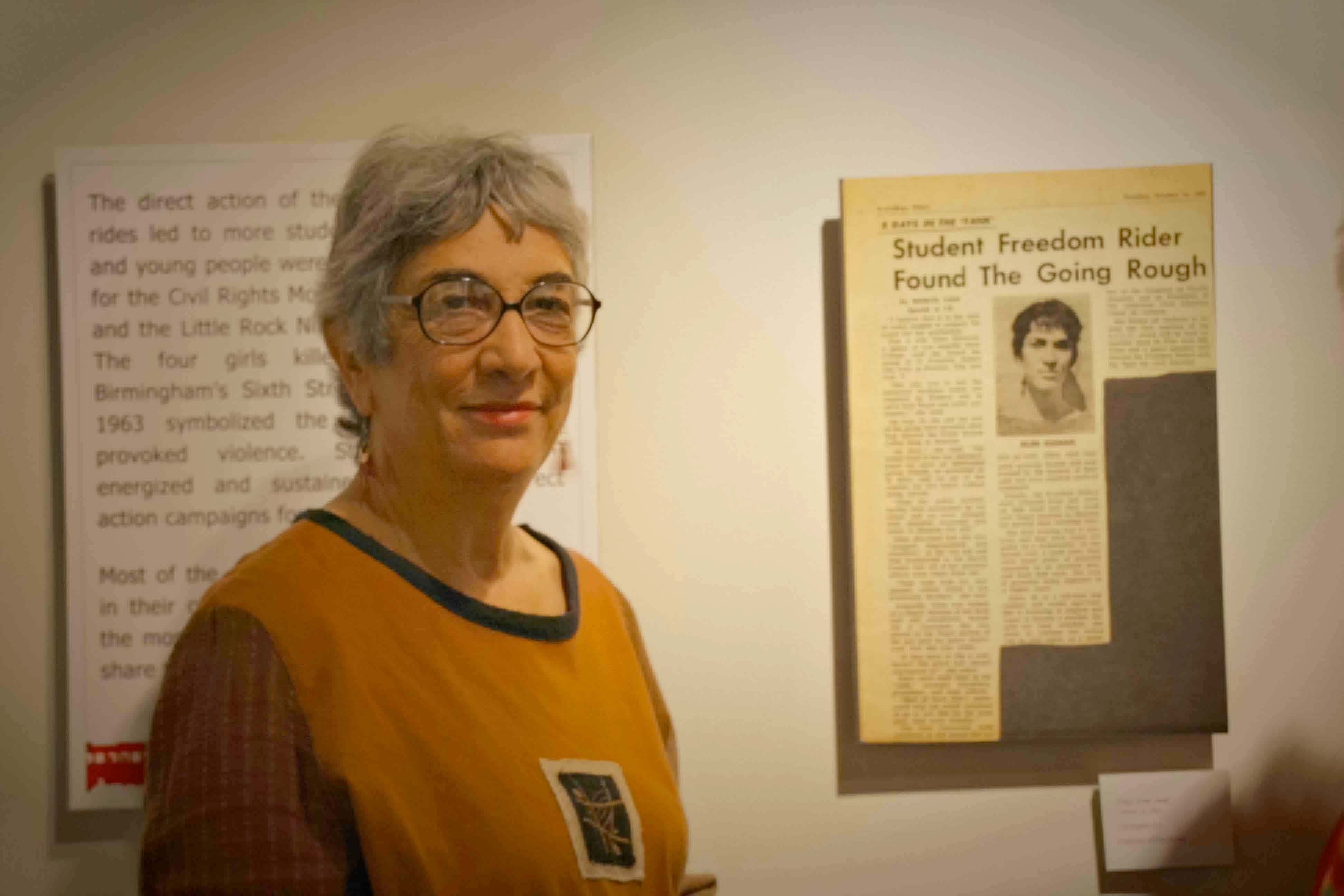
Ta’anit Tzedek – Jewish Fast for Gaza will stand in solidarity with the West Bank Freedom Riders with a very special conference call on the day of the demonstration. Please join us Tuesday, November 15 at 12 pm Eastern Time  to join our conversation with Ellen Broms, one of the original Freedom Riders for civil rights in the American South and currently an activist for a just peace in Israel/Palestine.

During our call, Ms. Broms will talk about her own experiences as an activist/demonstrator for civil rights in the 1960’s and why her activism has led her to take a stand on behalf of Palestinian human and civil rights.

Ellen Broms is a retired state worker who resides in Sacramento, CA. Her involvement in the civil rights movement began when, as a student at Los Angeles City College, she demonstrated at Woolworth lunch counters in support of  similar sit-ins by students in the South.

In June 1961, Ms. Brom attended a freedom rally at the Sports Arena in Los Angeles where Dr. Martin Luther King, Jr. gave the keynote speech.  After hearing a freedom rider speak, she was inspired to participate in the rides herself. On August 11, Ms. Brom was arrested with other freedom riders after they sat down and demonstrated in a Houston coffee shop.

In her words:

The police arrived, having been summoned by the owner and we were charged with unlawful assembly and taken to the Houston city jail. We were fingerprinted, mugged, and classified at the city jail and then transferred to the Harris County Jail. Ironically, I was booked as a “Negro” because of my dark hair and complexion. We declined to state “race” and they classified me as “High Yellow”. Marjorie, a very fair skinned, green eyed female rider of African American descent was classified and booked as white. I was placed in the “tank” for black women and Marjorie went to the white women’s tank. If we did nothing else during that ride, we did succeed in briefly integrating the jail.

After spending eight days in jail, Ms. Brom was released. The riders were found guilty of “unlawful assembly” by an all-white jury and fined $100 each. Their case was eventually appealed to a higher court and overturned.

Ellen Broms has since been honored by Congress, the state of Texas and the city of Houston for risking incarceration and violence as a Freedom Rider. She continues to work as an activist for peace and justice, particularly in the area of a just peace in Israel/Palestine. She is actively involved in the Sacramento branch of Jewish Voice for Peace and is campaigning on behalf of the West Bank Freedom Riders.

To participate in the call:

Dial Access Number: 1.800.920.7487
Enter Participant Code: 92247763#

There will be opportunities for questions and answers during the call.

Please click here for more information about how you can get involved in support of the West Bank Freedom Riders. Please share this information with others you think may be interested in participating.

We looking forward to your joining the call!

The Return of Gilad Shalit: Reactions

On the subject of the Gilad Shalit prisoner exchange, I can’t put it any better than blogger Emily Hauser, who has written a number of eloquent posts on this subject over the years. Click here and here to read her latest reactions.

Also highly recommended: this recent op-ed by journalist Rachel Shabi:

But meanwhile, the terms of the Israel-Hamas brokered prisoner swap – one Israeli, whose name the world knows, for 1027 faceless Palestinians – has generated some absurd comments on the value each side places on human life. In reports of how much Israelis care about the soldier Shalit – all true – there is somehow the inference that Palestinians don’t cherish their loved ones in the same way. But it is clearly more approachable a task to keep one soldier’s name in people’s hearts and in the headlines, than it is with countless thousands of Palestinian men. And the undertaking is smoothed by a media skew on the subject: taking part in a panel discussion on reporting the conflict last year, I heard a European journalist explain that Shalit was an easier pitch because he seemed innocent and blameless, while Palestinian prisoners didn’t generate the same assumptions. Meanwhile, the cold exchange rate of a thousand prisoners to one Israeli obviously doesn’t mean that Palestinians morally agree with this equation; it just points to the brutal asymmetry of forces and capacity in this struggle.

There is, however, one setting in which the two sides stand on level ground. When the prisoner deal was announced this week, there were jarringly rare images of both Israelis and Gaza strip Palestinians joyously celebrating the same news story. There it was, in that moment: an equality borne of shared humanity.

Eilat Attack Aftermath: Gazans Pay the Price Again

Since I wrote about last week’s Eilat/Gaza violence, I’ve read several news articles that report on increasing evidence that the Eilat attackers actually came from Egypt/Sinai and not Gaza.

From a +972 post by Yossi Gurvitz last week:

Yesterday evening the Egyptian newspaper Al Masry Al Youm reported that Egyptian security forces have identified three of the dead attackers. Egypt has a strong interest to claim the attackers were Gazans, since this would lessen its responsibility for the attacks; nevertheless, they say at least two of the attackers were known terrorists in the Sinai Peninsula. As far as I could find out, the rest of the bodies are in the hands of the IDF – which, again, does not reveal their identity.

This story has also been covered extensively by blogger Richard Silverstein at Tikun Olam, and more recently, by Amira Hass, writing for Ha’aretz. (Most of the mainstream media has, not surprisingly, long since moved on from this one.)

For an astute analysis of this whole tragic mess, I highly recommend Paul Woodward’s piece in War in Context:

As for those who have an interest in evidence, rather than taking comfort in deeply ingrained prejudice, the evidence suggests that the men who attacked Israelis yesterday and Egyptians today are in conflict with both states. More than likely, this has much less to do with Gaza or the Palestinian national cause than it has with the aspirations of radical groups based in the Sinai.

Those responsible for maintaining Israel’s security quickly claimed they knew exactly who was behind yesterday’s attacks in Eilat and duly dispatched the Israeli air force to rain down missiles on Gaza. No one explained why, if Israeli intelligence was so good, they had not prevented the attacks. Even so, the domestically perceived legitimacy of a security state depends less on its ability to thwart terrorism than its willingness to make a timely show of force. Indeed, the occasional tragedy has obvious political utility. The attacks in Eilat serve to remind Israelis that the state created as a safe haven for Jews can only remain safe so long as everyone remains afraid.

In the meantime, Israel’s assault against Gaza still continues. According to the Palestinian Center for Human Rights:

In the early morning of Thursday, 25 August 2011, two Palestinian civilians were killed and 25 others, including 11 children and 7 women, were wounded as Israeli warplanes bombarded a sports club in a densely-populated area in the northern Gaza Strip town of Beit Lahia. The attack resulted extensive damages to dozens of neighboring houses and facilities. On Wednesday, 24 August 2011, an elderly farmer and a worker were killed and four civilians were wounded, while three other persons are missing inside a tunnel at the Egyptian border due to an Israeli air strike against the tunnels.

It is looking increasingly likely that this latest violence has more to do with Israel-Egypt relations than Gaza. Is anyone asking why, then, is it largely Gazans who are paying the price?

Tragedy in Eilat and Gaza: How Should We Respond?

In the wake of yesterday’s tragic violence in Eilat and Gaza, I commend to you this wise and rational-minded statement from Jewish Voice for Peace.

I would only add that I frankly think it’s remarkable, given Israel’s oppressive policies toward the people of Gaza, that we haven’t seen even more attacks such as this.  To be sure, these kinds of incidents do not exist in a vacuum. History has shown us again and again that when people are oppressed, they tend to resist – often violently.

And when it comes to the history of Gaza, this resistance – followed by overwhelming Israeli military retaliation – has been ongoing since 1948.

As Moshe Dayan said during a funeral of an Israeli killed by a Gazan in 1956:

Do not today besmirch the murderers with accusations. Who are we that we should bewail their mighty hatred of us?  For eight years they sit in refugee camps in Gaza, and opposite their gaze we appropriate for ourselves as our own portion the land and the villages in which they and their fathers dwelled.

This we know: that in order that the hope to destroy us should die we have to be armed and ready, morning and night. We are a generation of settlement, and without a steel helmet and the barrel of a cannon we cannot plant a tree and build a house.

Dayan, to his credit, understood the true source of Palestinians’ frustration and rage. But I think he was tragically wrong in his belief that Israeli machine guns and bomb shelters would be able to keep their rage at bay – or that their military power would ultimately keep Israelis safe. Yesterday’s incident in Eilat is but the latest proof of this sad reality. It didn’t work then, and it’s still not working now.

While I do not in any way condone Palestinian violence against Israelis, I do understand its source.  And until these root causes are fundamentally addressed, I fear we’ll only continue to hear more tragic news such as this.

Action Alert: Free Captain Jack and the US Boat to Gaza!

This from Joseph Dana yesterday:

The US boat to Gaza, The Audacity of Hope, is dead in the water. Its captain, an American citizen who goes only by the name Captain Jack, will be brought before a judge on felony charges on Tuesday in Athens. Passengers on the ship have been given the freedom to leave the military port where the boat is currently detained but crew members have been forced to stay on board. Many passengers are choosing to stay with the ship and its captain out of solidarity for their plight. Some passengers have begun a hunger strike to protest the Greek government and its handling of the US boat captain…

Saturday night, charges against the US captain were elevated to felony charges for which he could face jail time. This has generated guilt among the passengers of the US boat split between leaving the boat and standing in solidarity with their captain. Some passengers have already left Athens, including the Pulitzer Prize winning author Alice Walker. Other passengers have begun a hunger strike in protest of the Greek government.

Please join me in voicing your protest over the Greek government’s unjust treatment of Capt. Klusmire and the passengers of Flotilla II. Here is some contact info:

– Call the State Department at  (202) 647-4000. Ask for the Overseas US Citizen Services Duty Officer and you can speak to a live State Department official.

– E-mail the US Embassy in Athens at: athensamemb@state.gov or  athensamericancitizenservices@state.gov.

– Call the US Embassy in Athens at 011-30-210-721-2951.

– Please also try to call, fax or email your members of Congress.

When you call, I recommend focusing on US to Gaza’s three key requests:

– That the State Department fulfill its duty to advocate on behalf of Captain Klusmire and insist that Greek authorities drop the charges against him.

– That the State Department demand the immediate release of the US boat, The Audacity of Hope, and allow it to sail to Gaza.

– That the State Department demand the Greek Government stop the harassment of all boats involved in a nonviolent action and to let the entire Freedom Flotilla go.

Freedom Flotilla II Ready to Set Sail

A year after the tragedy aboard the Mavi Marmara, Freedom Flotilla II to Gaza is getting ready to set sail. This time around it will include a US-flagged boat, “The Audacity of Hope,” that will carry dozens of American activists. Click above to watch an interview with two such Americans: attorney Richard Levy and my friend Kathy Kelly, from Voices for Creative Nonviolence.

Here’s Kathy:

It isn’t just a matter of humanitarian cargo being brought into Gaza. It’s a matter of people having been subjected to a state of siege, isolated, 45 percent unemployment, inability to reconstruct after the terrible assaults in Operation Cast Lead, people being trapped, young people not being able to get out to avail themselves of education. There are so many reasons why this siege is wrongful. And so, I think it’s misleading to think that we’re people that are trying to be charitable. We’re people who are trying to say that it’s wrong to impose collective punishment on a civilian population because you want to affect their governance.

(Click here for a full transcript of the interview.)

Joseph Dana will be aboard “The Audacity of Hope” and will report on his experiences for The Nation, blog on +972, and, as usual, send out his ubiquitous tweets via @ibnezra. Medea Benjamin will also be on the boat and will be posting reports on the Code Pink Blog. Other American passengers include Gabriel Schivone, a young Jewish Voice for Peace member, and novelist Alice Walker. (Click here for her essay, “Why I’m Sailing to Gaza.”)

Readers of my blog know how I feel about Israel’s immoral, illegal blockade of Gaza. I also remain firm in my agreement with the UN Human Rights Council report findings that the Israeli military attack on Mavi Marmara passengers amounted to “extra-legal, arbitrary and summary execution.”  (Among those killed was an American, Furkan Dogan, who was shot while videotaping the attack. The US has thus far refused to hold Israel accountable for killing an American citizen in international waters.)

The IDF is already holding military exercises in anticipation of Flotilla II. We can only hope and pray for a peaceful conclusion to this peaceful act of civil disobedience.

For their part, the American passengers of “The Audacity of Hope” have sent the following letter to President Obama:

As U.S. citizens we expect our country and its leaders to help ensure the Flotilla’s safe passage to Gaza – as our country should support our humanitarian demand that the Gaza blockade be lifted. This should begin by notifying the Israeli government in clear and certain terms that it may not physically interfere with the upcoming Flotilla of which the U.S. boat—The Audacity of Hope — is part. We—authors, builders, firefighters, lawyers, social workers, retirees, Holocaust survivors, former government employees and more—expect no less from our President and your administration.

Our boat will sail from the eastern Mediterranean in the last week of June. We shall be grateful to you for acting promptly and decisively to uphold the rights of civilians to safe passage on the seas.