Category Archives: Genocide

Anti-Racism as a Sacred Jewish Value: A Sermon for Yom Kippur 5777

img_2616

I’d like to begin my remarks today where I left off on Rosh Hashanah:

Because of our diverse, multi-racial nature, Jews must necessarily embrace anti-racism as a sacred value. The Jewish Diaspora is a microcosm of the world we seek to create. If the term Ahavat Yisrael means love of your fellow Jew, it must also affirm that love crosses all lines and borders and boundaries.

“Jews must embrace anti-racism as a sacred value” – it must be a mitzvah if you will. At Tzedek Chicago, we’ve actually articulated this as one of our congregation’s core values. If you go to our website, you will read: “We promote a Judaism rooted in anti-racist values and understand that anti-Semitism is not separate from the systems that perpetuate prejudice and discrimination.”

Like all of our other values this one has very practical implications. It will necessarily guide the choices we make as a community: the issues we work on, the groups we stand with, the public statements we make. And in general it will mean we must always foreground the question: “what does it mean, as a Jewish congregation observe anti-racism as a sacred value?”

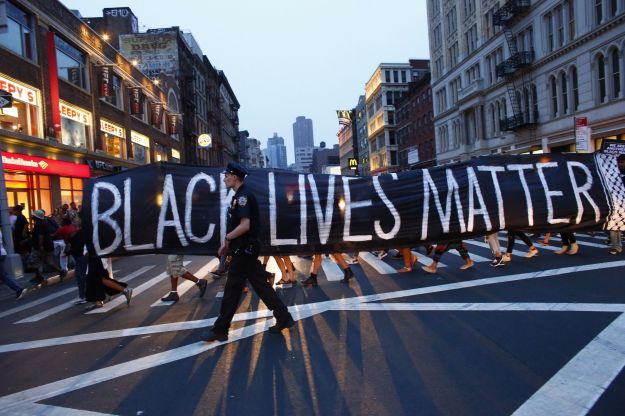
I’m sure most liberal Jews wouldn’t find this question all that controversial. After all, American Jewry has a long and venerable history of standing up for racial equality, particularly when it comes to our participation in the civil rights movement. But I’d suggest this question presents an important challenge to the Jewish community of the 21st century. And it was actually put to the test this past summer, when a the Movement for Black Lives released their policy statement, “Vision for Black Lives.”

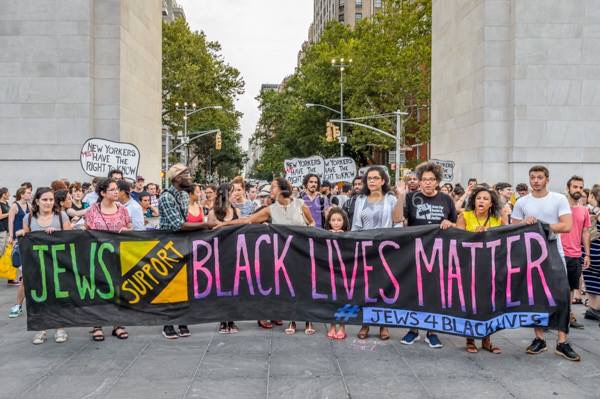
I’m sure many of you are very familiar with Movement for Black Lives. It’s a coalition of over 50 organizations from around that country that focus on issues of concern to the black community. One year ago, their Policy Table began an extensive process, convening national and local groups, and engaging with researchers and community members. This summer they published their Vision for Black Lives: a comprehensive policy platform that focuses on six main areas: Ending the War on Black People, Reparations, Invest/Divest, Economic Justice, Community Control and Political Power.

I will say unabashedly that I believe the Vision for Black Lives platform is one of the most important American policy statements of our time. It’s both an unflinching analysis of the institutional racism against black people in country as well as a smart policy statement about what can be done (and in some cases already being done) to dismantle it.

What makes Vision for Black Lives platform particularly unique is that it wasn’t produced by the usual method, namely by a think tank or special interest group. Rather, it was developed by a coalition of national and grassroots organizations that reflect the communities most directly affected by these particular issues. Moreover, it serves both as an ideological manifesto as well as a practical hard-nosed policy statement that lays out a path toward achieving very specific legislative goals. In so doing, as many have observed, it is moving Black Lives Matter from a structureless network of local organizations toward becoming a genuine political movement.

To quote from their introduction:

We want this platform to be both a visionary agenda for our people and a resource for us. We take as a departure-point the reality that by every metric – from the hue of its prison population to its investment choices – the U.S. is a country that does not support, protect or preserve Black life. And so we seek not reform but transformation…

Our hope is that this is both an articulation of our collective aspirations as well as a document that provides tangible resources for groups and individuals doing the work. We recognize that some of the demands in this document will not happen today. But we also recognize that they are necessary for our liberation.

This platform is also important because it doesn’t limit its concern to issues facing the black community alone. It understands that the systemic racism impacting people of color in this country is but a part of many interlocking systems of oppression that affect communities the world over. As the platform puts it: “We are a collective that centers and is rooted in Black communities, but we recognize we have a shared struggle with all oppressed people; collective liberation will be a product of all of our work.”

If you haven’t read Vision for Black Lives yet, I highly recommend it. I’ll warn you it’s not easy. It’s very long and heavily referenced, so really reading and integrating it will take commitment. I’ve read it three times now and every time I did, I discovered something new and challenging that I hadn’t considered before. But in the end, I found it profoundly inspiring – and that is not something you often say about policy platforms. I would go as far as to call it a prophetic document. As I quoted earlier, it seeks “not reform but transformation.”

Like me, I’m sure many of you have read innumerable books and articles that analyze the institutional racism inflicted on people of color in this country. Usually they leave us pent up with frustration or else just a sense of abject hopelessness. The problem is just so vast and pervasive – how on earth can we ever hope to dismantle it?  But this is first time I’ve read such an analysis along with extensive prescriptions toward political solutions. It lays out the problems then it puts forth real solutions. But it has no illusions about the daunting task ahead. As the report says. “We recognize that some of the demands in this document will not happen today. But we also recognize that they are necessary for our liberation.” (When I read this, I can’t help but recall the famous ancient dictum by Rabbi Tarfon: “It is not up to you to complete the work, but neither are you free to desist from it.”)

Is Jewish community ready to observe anti-racism as a sacred value? I think one important test would be to judge by its response to the release of the Vision for Black Lives platform. And in this regard, I’m sorry to say that the American Jewish establishment failed the test miserably.

Almost immediately after its release, every mainstream Jewish organization responded with statements that ranged from critical to outright hostility. Why? Because in the Invest/Divest section there is one section that advocates diverting financial resources away from military expenditures and investing in “domestic infrastructure and community well being.” And in that section there were some brief references to Israel – one that referred to “the genocide taking place against the Palestinian people” and another that called Israel “an apartheid state.” And as you might expect from a section entitled Invest/Divest, there was a statement of solidarity with the nonviolent Palestinian call for Boycott, Divestment and Sanctions (BDS) against Israel.

The first official Jewish response to Vision for Black Lives came from the Boston Jewish Community Relations Committee, just two days after it was released. The Boston JCRC said it was “deeply dismayed” by the report and denounced the use of the word genocide and its support for BDS. It had nothing more to say about this voluminous, wide-ranging platform. It spent seven paragraphs on this one issue – and most of that was devoted to this one word.

Over the next few weeks, one Jewish organization after another denounced the platform for its statements about Israel with only a glancing nod to its analysis, its conclusions and its policy recommendations. Jonathan Greenblatt, the National Director of the Anti-Defamation League called its reference to Israel “repellent” and added patronizingly, “let’s work to keep our eyes on the prize.” Even liberal Jewish organizations such as J St., the Religious Action Center of Reform Judaism and T’ruah, an American rabbinical organization devoted to human rights, responded with criticism and chastisement.

These responses tell us all we need to know about the Jewish communal establishment’s commitment to the value of anti-racism. But it really shouldn’t come as a surprise. The Jewish institutional community hasn’t been in real solidarity with black Americans and people of color for decades. Most of what we call solidarity is actually nostalgia. For far too long we’ve been championing the role of Jews in the American civil rights movement, invoking the memory of Jewish martyrs such as Michael Schwerner and Andrew Goodman and Jewish heroes such as Rabbi Abraham Joshua Heschel. But those days are over – and it is disingenuous of us to wield its memory as some kind of entitlement when it comes to issues of racism in the 21st century.

There was a time that being a Jew in America meant being part of a discriminated minority, but that has no longer been the case for generations. Today, white Jews are part of the white majority – and as I mentioned on Rosh Hashanah, since white Jews are racialized as part of the majority, we enjoy all of the privileges that come along with it.

I know for many American Jews, particularly young Jews, it might seem downright silly to ask whether or not white Jews are white. But it is actually a subject of debate – at least among white Jews. In fact it’s become a something of a cottage industry. (If you doubt me, just Google “are Jews white?” and see how many hits you get.)

There’s actually a very simple way to answer this question: ask a Jew of color. Let Lina Morales, a Mexican-American Jew, who recently wrote a powerful article on the subject explain it to you:

With all due respect to my white Jewish friends and colleagues, people of color in the United States don’t need to take a course on critical race theory to understand the nuances of race. Anti-Semitism exists, and I’ve received a fair amount of it from fellow people of color, but its impact and extent doesn’t compare to the systematic racism of American society. White Jews simply don’t face the criminalization that black and brown people in this country do. They are not locked up or deported in record numbers. Nor is their demographic growth or struggle to not be capriciously murdered by police considered a threat by a large and reactionary part of our population.

It should be mentioned that thankfully, there were some Jewish organizations that did in fact welcome and endorse the Visions for Black Lives. Not surprisingly, all of them came from outside the Jewish institutional establishment – organizations such as Jewish Voice for Peace, IfNotNow, and Jews for Economic and Racial Justice. For me, the most trenchant and powerful response came from the Jews of Color Caucus, which works in partnership with JVP. Among the many important points made in their statement was this one that was sent directly to the Jewish communal establishment:

Recent statements by the Boston JCRC, Truah: the Rabbinic Council for Human Rights, and The Union for Reform Judaism condemning the BLM Platform also send the message that the lives of Black Jews (along with Black gentiles) directly affected by US police brutality are less important than protecting Israel from scrutiny. We reject this message and call on these groups to commit themselves to honor the leadership of Jews of Color, including those critical of Israel…

We are appalled at the actions of the white US institutional Jewish community in detracting and distracting from such a vital platform at a time when Black lives are on the line, simply because the organizers chose to align their struggle with the plight of Palestinians. US Black relationships to Palestine and Israel have never been monolithic, but there are deep historical ties between Black and Palestinian struggle that go back to the Black Power Era. Any attempt to co-opt Black struggle while demeaning these connections, is an act of anti-Black erasure.

Their reference to the Black Power movement of the late 1960s is critically important. This marks the time in which white Jews were leaving cities for the suburbs to become part of the white majority. It also marks the time, following the Six Day War, in which Israel began to become central to American Jewish identity. For many white American Jews, this new relationship between Black and Palestinian liberation movements was experienced as a betrayal of former allies. Many American Jews looked to Zionism as the “liberation movement of the Jewish people” and considered it downright anti-Semitic to claim that Israel was actually a settler colonial project that militarily expelled and displaced indigenous people.

Of course, many American Jews still identify deeply with Israel. And that is why the Jewish institutional responses to the Vision for Black Lives resonate with a strong sense of betrayal. That is why the ADL’s Jonathan Greenblatt wrote we must “keep our eyes on the prize.” There is this yearning for a coalition that no longer exists – and a refusal to accept, as the Movement for Black Lives does, that Israel is part of this system of oppression.

So many otherwise liberal American Jews will insist: Israel is different. Don’t compare Israel to the racist system that oppresses blacks and people of color in this country. Don’t compare Israel to apartheid South Africa or any other state where one ethnic group wields power over another. It’s not the same thing.

Of course every nation is different in many ways from one another – but it’s time to admit that when it comes to systems of oppression, Israel is not different. And this is precisely the place that so many in the Jewish community, even those who are otherwise progressive in every other way, are simply unwilling to go. To admit that in the end, Israel is by its very nature an oppressor state: a system that privileges one ethnic group over another. And that this system is fundamentally connected to a larger system of oppression.

In fact it plays a very integral role in that system. The very same tear gas canisters that are used daily against Palestinians are the ones that were used against protesters in Ferguson. The same security apparatus that is used on the West Bank separation wall is the one that is used on the border wall that the US is building on our southern border with Mexico. The same stun grenades that Israeli soldiers use against demonstrators in Bil’in or Nabi Saleh are the very same ones used by American SWAT teams in Cincinnati and Oakland and St. Paul.

Here in Chicago, as in so many cities around the country, there is a new recognition of how the militarization of police departments is being used in ways that target communities of color. Those who say that we can’t compare this systemic racism to Israel should know that Chicago’s Jewish Federation regularly sponsors “police exchange programs” – trips that take the CPD to go to Israel to learn the latest military techniques from the IDF.

Regarding these exchange programs, the JUF’s Executive VP Jay Tcath has said this:

Helping connect and thereby improve the work of both Israeli and Chicago police is a natural role for JUF, committed as we are to the safety of the entire Chicago community and the Jewish State. From advising us on ways to enhance the physical security of our Jewish community’s institutions to helping us ensure the safety of JUF events – everything from dinners to pro-Israel rallies – we are grateful for the extraordinary commitment of CPD, Cook County’s Homeland Security and Emergency Management and our other public law enforcement partners. These missions to Israel both reflect and help deepen these valued relationships.

So we can’t have it both ways. The Jewish establishment cannot simultaneously empower the systems that oppress people of color in this country and at the same time say we stand in solidarity with them. If we are going to be anti-racist, we can’t make an exception for Israeli militarism or rationalize away its critical place in these systems.

Some of us have already made it clear where we stand. But sooner than later all of us in Jewish community will have stop dancing around this issue and make a decision. When it comes to Israel, we cannot continue to cling to a two state solution that Israel has already made impossible. As I’ve said before, the real choice we will have to face is a choice between two one-state solutions: one apartheid state in which a Jewish minority rules the non-Jewish majority or a state where all have equal rights and citizenship, regardless of their ethnicity or religion.

But on still deeper level, we must also reckon with the separatist assumptions behind the “two state solution.” What are we really doing when we advocate for a Jewish state that must have a demographic majority of Jews in order to exist? The same liberal Jews who cling to the notion of a two state solution would recoil at the suggestion of solving Jim Crow by separating black Americans from white Americans. That the only way two peoples living in the same country can co-exist is to physically segregate them from one another.

So to return once again to my original question: how can we, as Jews, embrace anti-racism as a sacred Jewish value? I’d like to offer a few suggestions in conclusion:

1. It would mean that the white Jewish establishment must embrace the concept of solidarity. Specifically, that means we cannot make it about us. The objects of oppression are the ones who must dictate the terms of their struggle. If we have issues with how they articulate their vision, we must raise these issues with them face to face in genuine relationship – not through public chastisement.

2. It would mean letting go of our reverence of a civil rights era that is long past and take an honest look at our complicity in the current reality in which white Jews are part of the privileged white majority. Anti-Semitism does exist in the US today, but it is not institutionally imposed upon us the way it is upon communities of color.

3. It would mean letting go of the old paradigm of “Black-Jewish relations” – a term that utterly erases the presence of black Jews from our community. Any new anti-racist paradigm we formulate must reject Jewish white supremacy and center the experience of Jews of color.

4. It would mean subjecting Israel to the same analysis we use when it comes to our own country. Israel is not separate from the systems that oppress people of color at home and abroad. We must be willing to identify these connections and call them out as we would any other aspect of institutional racism.

Finally, and perhaps most difficult, it would mean to letting go of a Zionist dream that never really was. To recognize that the Zionist dream was realized on the backs of Palestinians – just as the American Dream was realized on the backs of indigenous peoples and blacks who were brought to this country in chains. Yes, it painful to give up on dreams, but it is even more painful to hold onto them until they turn into a nightmare for all concerned.

After all, on Yom Kippur we vow to let go of the dreams of what might have been, but have led us down the wrong path. But it is also the day in which we can dream new dreams. We can dream of a world in which systems of exploitation and oppression are no more. As Sarah Thompson reminded us in her guest sermon last night, we must begin the year by focusing on the end – even if we know that by the end of the year we will not have arrived at the ultimate end we seek. To paraphrase the Vision for Black Lives, we recognize that some of these dreams will not happen today – or even in our lifetime. But we also recognize that they are necessary for our liberation.

May we realize this dream bimheyra beyameynu – speedily in our day.

Amen.
Guest Post: Observations on the Jewish Response to the Movement for Black Lives Platform from a Self Loving Antiracist White Jew

imageA guest post from my friend Martin Friedman:
For the purpose of this piece I will be referring to Blacks who are for the most part gentile and white Jews (Jews who have come to get the racial designation of White in the context of the US regardless of self identification).

This particular piece is really written for Jews who have come to be called White. Jews who are also people of color are writing excellent pieces from their unique perspective. I will not attempt to speak from that perspective.

What a(nother) crucial time for relationships between “Blacks” and “Jews”! What will we choose? Will we, as we have done so many times in the past, choose whiteness and the perceived safety that we feel goes with that in the US or will we choose to align ourselves with those that are most oppressed in a given society? This is a very familiar spot for the Ashkenazi (and occasionally Sephardi) Jew who now gets a racial designation as white in the US.

Let’s get this out of the way right now. Jewish, in the United States, isn’t a race. It is a culture that includes both spirituality and religion and also includes non religious ways of life. Jewish is also, arguably, an ethnicity based on being a cultural marker that has traveled with us and defined us. In this country Jewish is not a race.

So please, Ashkenazi Jews, just stop saying, “I’m not white. I’m Jewish.” Yes we are Jewish and we will also be assigned a race based on how we are commonly perceived by institutions and systems. How we see ourselves or how we self identify does not matter in this race-constructed and race-constitutionalized country. A Jewish person who is also Black, Latino, Asian, Native American or mixed race will be identified first by their race even as they self identify as a Jew.

OK, let’s get something else out of the way too. I am a self loving Jew (who is also white). I love my Jewishness. I am unapologetically Jewish. So let’s just wipe out the whole, “Oh, he must be a self hating Jew because he isn’t mortally offended that the Movement for Black Lives platform used the terminology of genocidal and apartheid policies in relationship to Israel.” Or, “Oh, we don’t have to listen to Martin because he went to Israel and visited the West Bank and East Jerusalem and has been critical of Israeli policy on his Facebook page”. Not true! On my grand and great grandparents! On my great Aunt Leah from whom I got my middle name. I love my Jewishness! I love the connection I feel to my Eastern European Jewish heritage.

I am also in love with an ideal of Jewishness that isn’t rooted in whiteness and domination. A Jewish ideal of true Tikkun Olam; of Repairing the world. All the world! Not just a world defined by whiteness or Europeanness. Not a world where we get to control the conversation.

The world is broken. Does our refusing to engage with BLM help repair it? Can we repair it if we don’t engage with people who criticize current Israeli policy and US financial and Military support for the government that developed and enforces those policies?

It’s time for White Jews to stop choosing whiteness and align ourselves with those most oppressed in the US because that is what true Jewishness is about. And why wouldn’t we? The point of the Movement for Black Lives Platform was to speak truth to all power, not to use pleasing language. It is our duty to sit across the table from people who have been most oppressed in our country and hear what they have to say about what they perceive to be genocidal policy that’s connected to Institutional, Systemic and Structural Racism in the US.

What are we afraid of? Why are we, of all people, afraid of conversation about oppression? If the policies of the Israeli government really are leading to a fair two or one state solution, why can’t we sit at a table and discuss it? Remember, the one piece of the platform we are so hyped up about is about governmental policy both here and in Israel not about hating or oppressing Jews? Remember that Egypt was mentioned at the same time as Israel? I hope we are not forgetting those things because this is just an easy reason to disengage.

We are a people who have such a long history of debate and multiple interpretations of the same text (or in this case policies) so why are we shutting this conversation down? Because of multigenerational historical trauma from the European Holocaust? All the more reason to sit down with people who have multigenerational historical trauma from the Trans-Atlantic slave trade and US chattel slavery. Multigenerational trauma from lynchings and Jim Crow. From a Eugenics narrative that was studied here in the US by German Nazis. My people, we share roots in our historical trauma.

We, White Jews, have confused comfort with safety. And the root of that confusion is the root of the problem, power. Power is defined (by the People’s Institute for Survival and Beyond) as legitimate access to institutions and systems sanctioned by the state. Power that is equivalent to Whiteness. People that have strong access to institutional and systemic power confuse discomfort with safety all the time.

I put forth, vehemently, that the wording of one section of the Movement for Black Lives platform makes us uncomfortable, not unsafe. We must be willing to engage. It’s pure privilege to get to pick and choose when and with whom we engage on this subject. It’s extreme privilege to just say no, I’m done. Extreme privilege to be able to shut someone down.

This is another in a long line of moments in history where we as white Jews get to chose alignment with whiteness or with People of Color. And what’s even crazier this time is that it feels like it’s our Jewishness that is at stake. It’s even crazier because it feels like this is anti Semitism. Again, being anti-Israeli policy and anti-US government policy is not the same thing as being anti-Semitic.

Historically, we’ve chosen the perceived safety of whiteness. Our ability to become fully White was due to governmental policy, the GI bill plus redlining which gave us our whiteness while excluding Blacks and Latinos who such a short time earlier had been our partners and friends. But they couldn’t access it in the same way as we could due to racism.

Yes, many of us were in the civil rights movement. Yes, many of us marched side by side. But we let ourselves get coopted so soon after. We chose whiteness because it got us out of the ghetto (named because of us by the way!) It was our literal ghetto pass. We need to understand that we left our brothers and sisters behind.

What are the costs of choosing Whiteness over Jewishness? One of the costs of our comfort and our privilege is Black and Brown lives. As long as we align ourselves with whiteness we contribute to the deaths of Black and Brown people at the hands of institutions. Their deaths are part of the the cost of our comfort, safety and privilege.

The other loss is the loss of what it really means to be Jewish. That it means to not stand idly by our neighbor’s blood. That it means true Tikkun Olam. We are at such a(nother) crucial time of choice.

Let’s choose our Jewishness over Whiteness this time. Let’s choose life.

Standing Down Legal Segregation on Yom Hashoah

bibleinjail21 Today marks Yom Hashoah – Holocaust Remembrance Day – and as it turns out, this year it falls on a serendipitous milestone: namely the 52nd anniversary of Dr. Martin Luther King’s “Letter from a Birmingham Jail.” Although MLK wrote his letter to respond to the reality of Jim Crow in the American South, I do believe his words have much to offer us as we remember those who perished at the hands of the Nazis during World War II – in particular, King’s insistence on the moral imperative to break unjust laws and the inherent immorality of legal segregation:

(There) are two types of laws: just and unjust. I would be the first to advocate obeying just laws. One has not only a legal but a moral responsibility to obey just laws. Conversely, one has a moral responsibility to disobey unjust laws…

Now, what is the difference between the two? How does one determine whether a law is just or unjust? A just law is a man made code that squares with the moral law or the law of God. An unjust law is a code that is out of harmony with the moral law. To put it in the terms of St. Thomas Aquinas: An unjust law is a human law that is not rooted in eternal law and natural law. Any law that uplifts human personality is just. Any law that degrades human personality is unjust.

All segregation statutes are unjust because segregation distorts the soul and damages the personality. It gives the segregator a false sense of superiority and the segregated a false sense of inferiority. Segregation, to use the terminology of the Jewish philosopher Martin Buber, substitutes an “I it” relationship for an “I thou” relationship and ends up relegating persons to the status of things. Hence segregation is not only politically, economically and sociologically unsound, it is morally wrong and sinful.

In light of King’s words, it is worth noting that the rise of Nazism in Germany was facilitated by largely “legal” means – through myriad laws and regulations that successfully segregated Jews from the rest of German society.  King himself pointed this out in his letter when he wrote:

We should never forget that everything Adolf Hitler did in Germany was “legal…” It was “illegal” to aid and comfort a Jew in Hitler’s Germany. Even so, I am sure that, had I lived in Germany at the time, I would have aided and comforted my Jewish brothers.

In this regard, Dr. King’s insight might well inspire us to commemorate this sacred day by redoubling our resolve to eradicate laws that segregate peoples on the basis of their national, ethnic or religious identities.

Hebron_shuhada

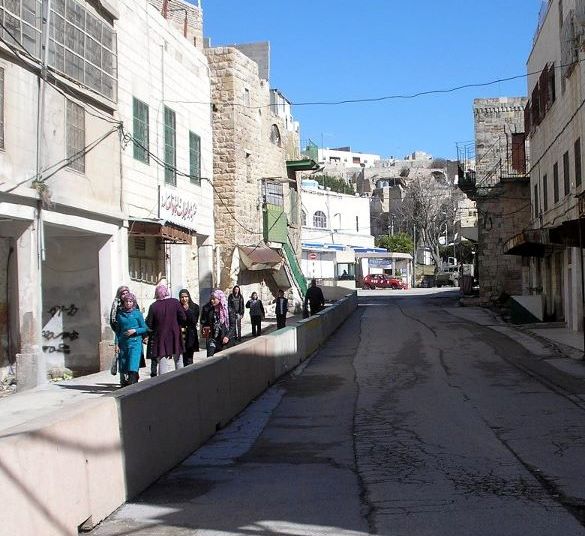
Segregated Shuhada street in Hebron, February 2012 (photo: Hithabrut-Tarabut)

While it pains me to say it, I cannot help but note that the very country that first established Holocaust Remembrance Day itself enforces its own form of legal segregation between Jews and non-Jews. As one Israeli observer wrote in Ha’aretz five years ago, “Segregation of Jews and Arabs in Israel…is almost absolute.” In the West Bank, Jews and non-Jews are segregated by separate legal systems, separate roads, separate transportation systems, and in some cases, separate sidewalks. And in Gaza, Palestinians are segregated from the outside world entirely.

I have no doubt that there will be those who consider it unseemly of me – or worse – to point this out on Yom Hashoah of all days. To this inevitable criticism, I can only respond, how can we purport to take the lessons of the Shoah to heart while ignoring realities such as these? How long will we, as Jews, look way from these unjust laws in Israel that “distort the soul and damage the personality?” On this, of all days, shouldn’t we, as King suggested in his letter, “bring to the surface the hidden tension that is already alive?”

May the memory of the fallen be for a blessing.

For Yom Hashoah: A Palestinian Meditation on the Holocaust

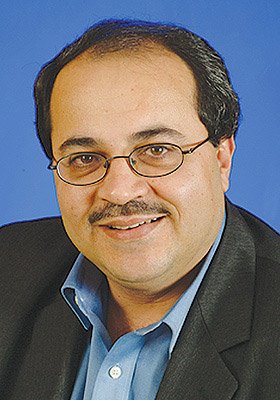
In recognition of Holocaust Remembrance Day, please read these words of Ahmed Tibi, a Palestinian citizen of Israel and member of Knesset, who offered the following words before the Israeli Parliament in 2010:

This is the place and the time to cry out the cries of all of those who were and are no longer with us, the cries of those who have remained and who are struggling, justifiably so, to unburden themselves from the scenes of death and horror. I will once again repeat that I am full of empathy for the families of the victims of the Holocaust wherever they may be around the world, including those with whom I live on the same land, in the same country.

This is the moment in which every individual must relieve oneself of all of his nationalist or religious hats, relieve oneself of the otherness and wear just one robe: the robe of humanity. One must look at himself, look around him, and be human. Only human.

Full speech here.

Yom Hashoah: A Day to Affirm Universal Human Rights

I can think of no more powerful meditation for Yom Hashoah 5770 than this Huffington Post piece written by Steven Gerber and Rabbi Michael Schwartz, both of Rabbis for Human Rights.

An excerpt:

It is interesting to note how two very different sets of “responses” to the Shoah are heard frequently amongst Jews here in Israel and around the world. These two different responses reflect a shared sense of urgent necessity in responding here today because of what happened there then. At the same time they demonstrate almost opposite worldviews and understandings of Israel’s purpose, and lead toward totally inverse political perspectives and often contradictory activist involvements.

One response is that, essentially, Israel must do anything it wants or needs to do in order to defend itself from hateful enemies set on perpetrating a second holocaust by destroying both the Jewish State and the Jewish People along with it.

The other response is that precisely because of our experience as Jews in the Holocaust and through our history littered with injustice and tragedy, we ourselves must make sure that Israel of all places is a nation that stringently safeguards human rights even in the most difficult of circumstances and establishes, in the words of Israel’s Declaration of Independence, a nation that “foster[s] the development of the country for the benefit of all its inhabitants; [a nation] based on freedom, justice and peace as envisaged by the prophets of Israel.”

Indeed, both the physical and spiritual security of the Jewish People and the State of Israel is best guaranteed by the strength of Israel’s democracy and the rule of just law, its commitment to human rights, and – ultimately – to the achievement of peace.

On this day in which we recall the Jewish people’s loss of human rights, let us ensure that the Jewish state embodies these rights on behalf of all its citizens.

On this day in which we remember the tragedy of our people, may we redouble our efforts on behalf of all people who dwell on earth…

Elie Wiesel Can’t Have it Both Ways

Elie Wiesel has long walked the tightrope between pious pronouncements of universal Jewish conscience and unabashed political advocacy. He’s been trying to have it both ways for years, but it seems to me that his balancing act is becoming more and more transparent.

Last week, as Wiesel unveiled an anti-Ahmadinejad ad with other Nobel Prize laureates, he blasted the Goldstone report, calling it “a crime against the Jewish people.”  Leaving aside the issue that he took this opportunity once again to speak on behalf of the entire Jewish people, I’m still somewhat staggered that Wiesel, of all people, would use such charged Holocaust rhetoric in such a patently political manner. (I think Richard Silverstein at Tikun Olam hit it right on the head when he asked, “What was the last event in world history you can recall being a ‘crime against the Jewish people?'”)

If this wasn’t enough, now I read on Max Blumenthal’s blog that Wiesel’s foundation received $500,000.00 for one speech he delivered at the church of fundamentalist Christian Zionist John Hagee (whom he referred to as “my dear pastor.”) Yes, this is the same John Hagee who publicly sermonized that Hitler was sent by God to create the Holocaust so that Jews would emigrate to Israel.  It’s simply astonishing to me that so many Jewish leaders are perfectly willing to cozy up to the likes of Hagee even after it has become so patently clear that his views are way off the rails. (That’s Wiesel, above, with Hagee, right, and Israeli minister Uzi Landau, left).

As far as I’m concerned, Justice Richard Goldstone is precisely the kind of courageous Jewish moral hero that Wiesel himself purports to be: someone committed to advocating for universal human rights even when doing so might mean holding our own community painfully to account.  As for Wiesel, I’m finding his words and actions increasingly craven. No one begrudges him his opinions – but it’s time he dropped the pretense that he’s somehow beyond the political fray.

Playing Politics at Yad Vashem

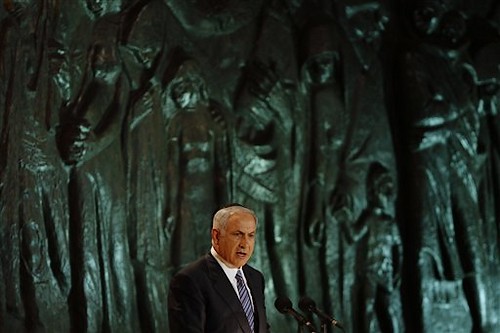
This is what I call cynically using the Holocaust for political purposes: Netanyahu recently used the opening of a new exhibit at Yad Vashem as an opportunity to denounce the Iranian regime, saying:

There is a new call to destroy the Jewish state, it’s our problem, but not only our problem. This is a crime against the Jews, and a crime against humanity, and it is a test of humanity. We shall see in the following weeks whether the international community deals with this evil before it spreads.

When I read this report, it sounded vaguely familiar – then remembered blogging about a similar comment Netanyahu made three years ago. Here’s what I wrote at the time:

Clearly Ahmadinejad’s murderous rhetoric toward Israel cannot and should not be taken lightly, and we should never minimize the threat posed by Iran’s nuclear ambitions. But we must also be very clear about what we are suggesting when we compare Ahmadinejad to Hitler and present day Iran to Nazi Germany. For what it’s worth, consider me to be one member of the organized Jewish community that finds this comparison unhelpful – and the prospect of an American or Israeli attack on Iran truly horrifying to contemplate.

Apropos of Netanyahu’s most recent comments: Ahmadinejad’s rhetoric toward Israel is definitely hateful, and is clearly designed to bait Israel and the West – but I can’t see how it possibly constitutes a “crime against humanity.”

Netanyahu’s Yad Vashem rhetoric certainly seems to indicate he’s itching to take the bait. Let’s hope the international community will see past his dangerous, wrongheaded invoking of a “second Holocaust” and deal with this crisis with intelligence and moderation.

Iran: Setting the Record Straight

brant-ayatollah1

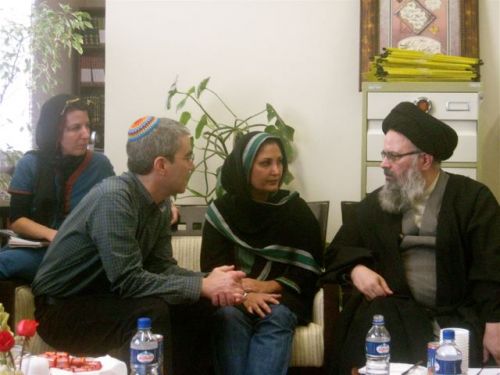
I’ve read and heard about some silly misinformation being spread around regarding my trip last year to Iran – and I’m thinking it might behoove me to set the record straight.

I will say at the outset that I gave a Yom Kippur sermon on this topic and I blogged extensively from Iran. If you haven’t read these posts yet, please do so. They will give you a pretty good sense of the why, what and how of my Iran experiences.

Right off the bat: I did not meet with Mahmoud Ahmadinejad.

Now that I’ve gotten that straightened out, I’d like to address one particular quote of mine that’s being bandied about out of context:

While I prefer not to weigh in on the rhetorical hairsplitting debate on [President Mahmoud] Ahmadinejad’s notorious 2005 threat to wipe Israel off the map, I’ll only suggest that our attitudes and foreign policy must be based on real intelligence and understanding, and not fear-based, knee-jerk assumptions.

I still think this quote should pretty well speak for itself, but apparently I need to explain further.  I know of at least two instances in which this quote was used to somehow imply traitorous intentions on my part – i.e., that I prefer not to “weigh in” on the serious threats posed by Iran toward the Jewish state.

To those who doubt where my ultimate loyalties lay, I was actually referring with this quote to the rhetorical debate over the actual Farsi meaning of Ahmadinejad’s words from this oft-quoted speech. There has been an important ongoing debate as to whether these words were intended as a threat of genocide against the Jewish state or a predication of the eventual dissolution of the “Zionist regime” from within.

A recent blog post by Juan Cole represents this point of view well:

President Mahmoud Ahmadinejad did quote Ayatollah Khomeini to the effect that “this Occupation regime over Jerusalem must vanish from the page of time” (in rezhim-e eshghalgar-i Qods bayad as safheh-e ruzgar mahv shavad). This was not a pledge to roll tanks and invade or to launch missiles, however. It is the expression of a hope tha the regime will collapse, just as the Soviet Union did. It is not a threat to kill anyone at all.

As I myself am not a scholar of Farsi, I don’t consider myself qualified to weigh in on this debate, but I do believe that “our attitudes and foreign policy must be based on real intelligence and understanding, and not fear-based, knee-jerk assumptions.” I continue to stand by this assertion – I’m simply not a fan of fear-based foreign policy.  I am well aware that there are those who will say, “maybe Iran does intend to destroy Israel or maybe it doesn’t, but can we really take that chance?” I’m more inclined to say it this way: “when we jump to conclusions and base our reactions on fear rather than true understanding, we may ultimately cause our deepest fears to actually come true.”

By the way,  I encourage you to read Cole’s entire post, entitled “Top Things You Think You Know About Iran That Are Not True.” Whether or not you agree with his analysis, I believe his perspective provides a thought-provoking corrective to so many of the fear-based assumptions currently being bandied about regarding Iran.

Here are a few excerpts:

Belief: Iran is a militarized society bristling with dangerous weapons and a growing threat to world peace.

Reality: Iran’s military budget is a little over $6 billion annually. Sweden, Singapore and Greece all have larger military budgets. Moreover, Iran is a country of 70 million, so that its per capita spending on defense is tiny compared to these others, since they are much smaller countries with regard to population. Iran spends less per capita on its military than any other country in the Persian Gulf region with the exception of the United Arab Emirates.

Belief: Isn’t the Iranian regime irrational and crazed, so that a doctrine of mutually assured destruction just would not work with them?

Actuality: Iranian politicians are rational actors. If they were madmen, why haven’t they invaded any of their neighbors? Saddam Hussein of Iraq invaded both Iran and Kuwait. Israel invaded its neighbors more than once. In contrast, Iran has not started any wars. Demonizing people by calling them unbalanced is an old propaganda trick. The US elite was once unalterably opposed to China having nuclear science because they believed the Chinese are intrinsically irrational. This kind of talk is a form of racism.

PS: By the way, did I mention I didn’t meet with Ahmadinejad?