Category Archives: Human Rights

Casino Workers to Neal Bluhm: “Keep Your Promises”

1653730_10152201655757305_384378986_n

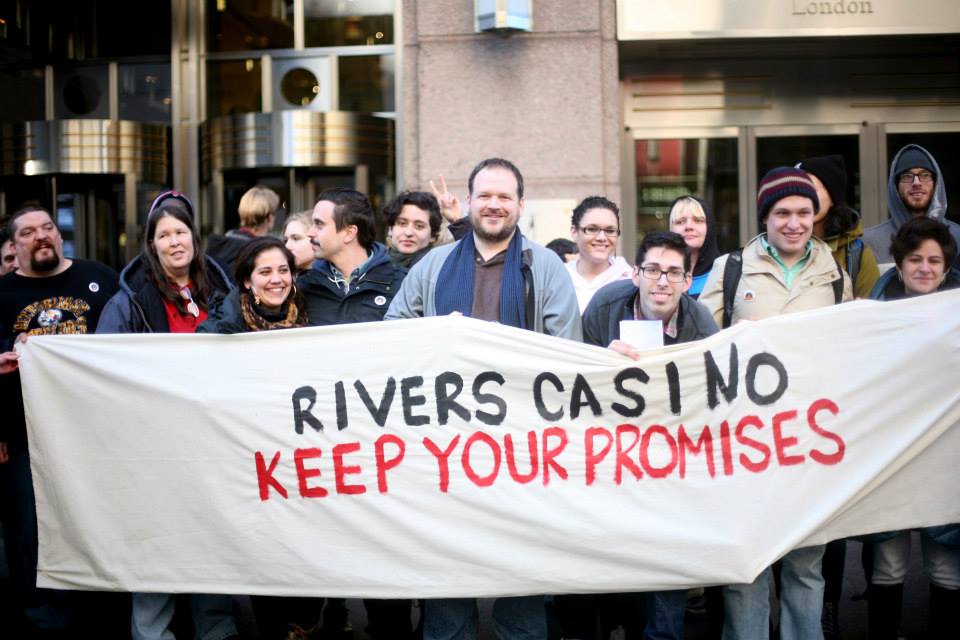
This past Wednesday I stood together with workers from Rivers Casino in Des Plaines, IL, Rivers Casino Pittsburgh, and SugarHouse Casino in Philadelphia who demanded that owner Neal Bluhm stop his draconian campaign against their organizing efforts.

Our action began as we marched down Michigan Avenue to Mr. Bluhm’s offices located at the exclusive mall, 900 North Michigan. When we entered the building, we were stopped by security – and when we requested to speak to Mr. Bluhm, we were told to leave immediately.

photo

Can you spot the rabbi in this picture?

We then gathered outside on the sidewalk, pulled out our cell phones, and left messages for Mr. Bluhm and his CEO partners, asking them why his casino’s employees were making far less in wages and benefits than those doing comparable jobs at his (unionized) Ritz-Carlton Hotel.  We also asked why these workers, who were helping Bluhm’s casino’s rake in record profits, were facing harassment and intimidation from management for legally seeking to organize themselves into a union.

1653934_10152201656687305_1693308441_n

Refused entry to 900 North Michigan Ave, we hit the cell phones

Bluhm and his casino’s management are hoping they can win this one by hiring expensive anti-union firms to forcefully dissuade workers from organizing into a union. The courageous workers I met on Wednesday, however, show sign of backing down. It was my honor to stand together with them as they demand Neal Bluhm keep his promise for a fair process for them as they decide whether or not to unionize.  So far it’s been anything but fair: as I’ve previously reported, the casino’s actions have prompted 55 unfair labor practice charges to be submitted to the NLRB.

As always, I’ll continue to report on the progress of this growing organizing effort. Stay tuned.

1798800_10152201655862305_133254444_n

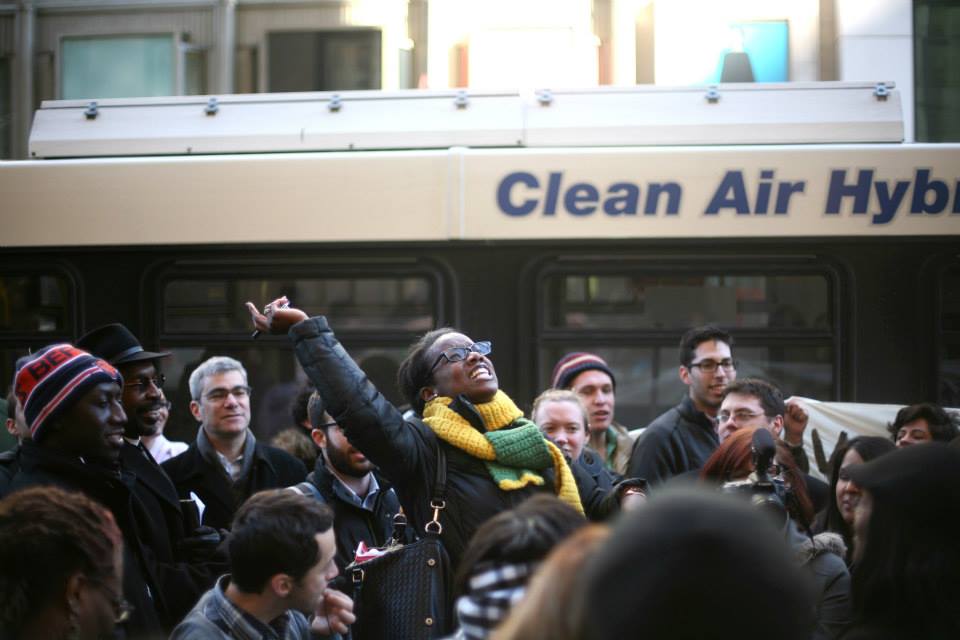
Unite Here Local 1 President Karen Kent addresses the crowd

1013519_10152201655762305_607878627_n

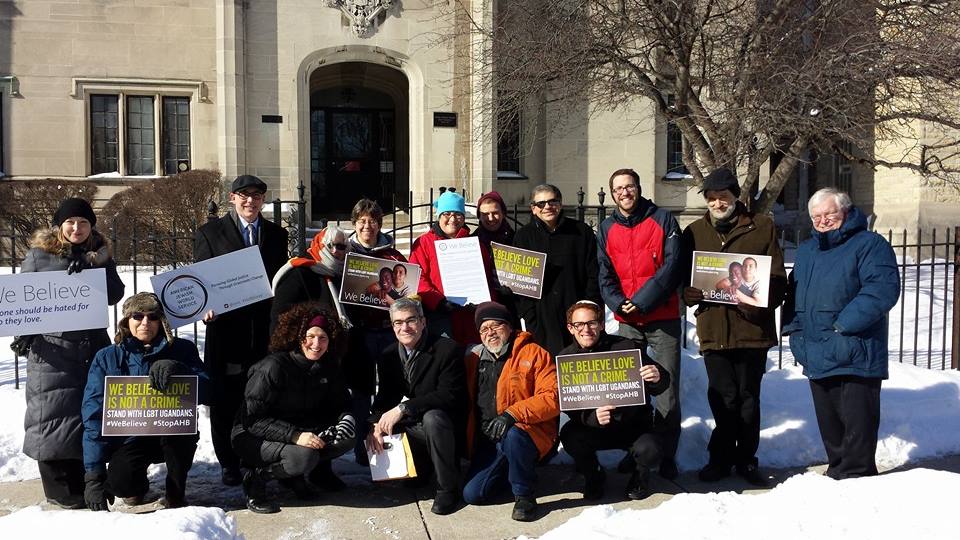
Chicago Jewish Delegation Stands Up for LGBT Rights in Uganda

1240376_10152190526038257_795601751_n

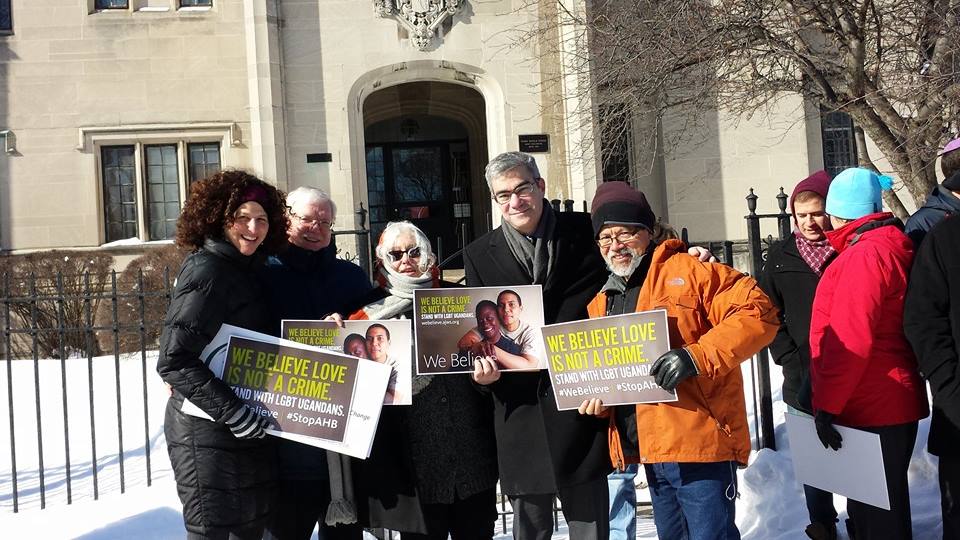
Members of the AJWS Chicago delegation delivering letter to the Ugandan Consulate

Today marked a day of global action of protest against the Ugandan Parliament’s so-called “Anti Homosexuality Bill.” It was my honor to participate by delivering a rabbinic letter to the Ugandan consulate in Chicago along with 15 other members of the the Jewish community, including five rabbis.

This bill, which was passed in December 2013, is a hate-filled piece of legislation that threatens the health and lives of LGBT Ugandans and is a grave violation of human rights. First introduced in 2009, the bill seeks to strengthen existing penalties in Ugandan law against homosexuality. Among the bill’s many cruel and unconscionable provisions is life imprisonment for “repeated homosexual behavior.” It also criminalizes what it describes as “the promotion of homosexuality,” which includes funding organizations that provide basic services such as healthcare to LGBT people.

Our action today was a sponsored by American Jewish World Service, who responded to a call from its partners in Ugandan Human Rights NGO by organizing in communities throughout the US. In addition to Chicago, similar actions took place in New York, Washington DC, Los Angeles and San Francisco.

Here’s the text of the letter we delivered to the Ugandan consul in Chicago:

Dear President Museveni,

I am writing to implore you, respectfully, to veto Uganda’s Anti-Homosexuality Bill that was recently passed by the Ugandan Parliament.

As a rabbi, I honor the inherent dignity of each and every person. Jewish theology, tradition and history compel me to uphold the values of kavod habriyot, respect for all of creation, and btzelem elohim, the notion that all people–including lesbian, gay, bisexual and transgender (LGBT) people–are created in the Divine image. Tragically, I know from our history that the stripping away of human rights from specific minorities is often a precursor to targeted destruction.

If this bill is signed into law, it would be a grave violation of human rights and would be one of the most abhorrent manifestations of discrimination against LGBT people worldwide.

My LGBT friends and colleagues in Uganda are frightened–and I believe they have every reason to be. I do not believe they should live in fear just because of who they are or who they love. I hope you share the same view.

I urge you, Mr. President, to use the power of your position to uphold the human rights and human dignity of all Ugandan citizens. Please stand on the right side of history by vetoing this bill.

I encourage you to click here to sign a similar letter currently being distributed by AJWS. (If you are a rabbi and you have not yet signed the rabbinic letter, click here.)

It’s time to stand with LGBT Ugandans – and all who are targeted by hate-legislation.

1798178_10152190525723257_1237770972_n

Members of my congregation, JRC, in front of the Ugandan consulate: (left to right: AJWS-Chicago Executive Director Taal Hasak- Lowy, Michael Sehr, Tina Escobar, me, Gonzalo Escobar)

John Kerry Says “Boycott” – Cue the Outrage

131023100453-kerry-and-netanyahu-story-top

We learned yesterday that Netanyahu and his senior ministers are all astir by remarks made by John Kerry at a recent security conference in Germany. Echoing similar warnings he’s made in the past, Kerry noted that the failure of talks would only increase Israel’s isolation in the international community:

Today’s status quo absolutely, to a certainty, I promise you 100 percent, cannot be maintained. It’s not sustainable. It’s illusionary … You see for Israel, there’s an increasing delegitimization campaign that has been building up. People are very sensitive to it. There are talks of boycotts and other kinds of things.

Responding quickly, Netanyahu criticized the remarks during a subsequent cabinet meeting. Yuval Steinitz, Israel’s minister of strategic affairs, told Israel Radio on Sunday that Mr. Kerry’s comments were “hurtful,” “unfair” and “intolerable” and added, “Israel cannot be expected to negotiate with a gun to its head.” Not to be outdone, Knesset member Motti Yogev, of the Bayit Hayehudi party said Kerry’s “obsessive pressure” had “anti-Semitic overtones.”

There’s much to be said about the escalation of a war of words between Israeli politicians and the US Secretary of State. For my part, however, I’m less interested in a diplomatic pissing match over a moribund peace process than the way the issue of boycott has now firmly become entrenched in official discourse. Can their be any surer sign that the Boycott, Divestment and Sanctions movement has become a force to be reckoned with?

In this regard, I couldn’t help but be struck by Netanyahu’s comments in response:

Attempts to impose a boycott on the state of Israel are immoral and unjust. Moreover, they will not achieve their goal.

Of course, Kerry made no such claim that boycotts were “moral” or “just” (as a defensive State Department spokesperson hastened to point out). He was simply noting their very existence. And Netanyahu’s apoplectic reaction over this harmless comment makes it clear that he takes their existence very, very seriously indeed.

As well he should. With the recent American Studies Association announcement that it is honoring the academic boycott of Israeli universities – and the even more recent attention over Scarlett Johansson’s ill-fated agreement to shill for SodaStream – BDS is increasingly moving into the mainstream media spotlight. And more importantly, it is increasingly gaining adherents.

Anecdotally speaking I can attest to the growth of this movement by the growing number of conversations/debates I’ve been having on the issue of BDS. Generally they retread over the same territory: “Is BDS anti-semitic?” “Is BDS a double-standard?” “Is BDS effective?” “Will BDS lead to the destruction of Israel?”

I’m not interested in addressing these questions here – I’ve explored them at length in numerous blog posts dating back to 2009. Besides, it seems to me that right now the most important thing we can say about the BDS movement is that it is here to stay  – and as long as Israel’s intolerable treatment of Palestinians continues, it promises to be chalking up even greater successes in the near future.

That’s why Kerry’s comments – candid though they were – smacked to me of a very real disingenuousness.   After all, what is the real “delegimization campaign” here: the BDS movement or Israel’s oppressive policies toward Palestinians?  If our government is unable or unwilling to hold Israel to account, we should not be surprised by the growth of a popular movement that does.

Clergy Delegation Meets With Rivers Casino Management

131218 Clergy and Rivers Casino Workers before Clergy Casino Delegation

Chicagoland clergy and Rivers Casino Workers before the clergy delegation to Rivers management, Dec.18, 2013

As promised, here’s an update on the workers’ campaign to organize a union at Rivers Casino in Des Plaines, IL. (For background, click here to read my post from last November).

On December 18, I was part of a clergy delegation that met with workers then visited Rivers Casino to demand a meeting with General Manager Bill Keena. The head of security arrived almost immediately and told us to leave the premises. After some back and forth, we finally were granted a meeting with him two days later.

We returned on December 20 and met with Mr. Keena and told management to immediately halt its illegal intimidation campaign against the organizing workers.  We also asked to meet with Neil Bluhm, Chairman of Midwest Gaming, the company that owns Rivers Casino.

Mr. Keena and casino’s Head Counsel did not respond to us other than to refuse to accept a letter of support for the workers signed by numerous members of the Chicagoland clergy community.  A week later, we received a response from Mr. Keena stating that “After further consideration, we have decided that no further meetings between our two organizations are necessary.”

Since the meeting, the Rivers Casino management has resumed its illegal anti-union campaign, having security personnel escort members of the organizing committee from the dining room, where they were having conversations with their coworkers about the union.  Several members of the organizing committee have been disciplined by the casino after talking to their coworkers in the dining room.  These actions prompted 25 additional unfair labor practice charges against the casino, bringing the total number of pending charges to 55.

Neil Bluhm and his management have clearly opted for a heavy handed, draconian response to the workers’ reasonable – and legal – efforts to organize themselves into a union. As those of us who were involved in the long and painfully drawn Hyatt boycott struggle would surely attest: it shouldn’t have to be this way.

In the meantime, the number of workers signing on to support unionization at Rivers is increasing – and the clergy are continuing to organize as well. This story has yet to be written – stay tuned.

Sharon’s Legacy: Survival at All Costs

aptopix-midease-israel-ariel-sharon.jpeg-1280x960

From Vice President Joe Biden’s remarks at the funeral of Ariel Sharon today:

Like all historic leaders, Prime Minister Sharon was a complex man about whom, as you’ve already heard from his colleagues, who engendered strong opinions from everyone.  But like all historic leaders, all real leaders, he had a North Star that guided him — a North Star from which he never, in my observation, never deviated.  His North Star was the survival of the State of Israel and the Jewish people, wherever they resided.

In talking about his spiritual attachment to the land of Israel back in an interview in the late ‘90s, he said, and I quote, “Before and above all else, I am a Jew…”

As a Jew – and as a human being of conscience – I submit that this myopic obsession with Jewish physical survival “before and above all else” has led the Jewish people down a very dark road indeed. In so many ways, Ariel Sharon represents the embodiment of this obsession – and I for one recoil at the suggestion that he might in any way be held up as a Jewish exemplar.

As the tributes of world leaders continue to roll in, please consider the life’s work of a man Joe Biden quite mistakenly claimed is “loved by the Jewish people:”

– In the early 1950s, as a young major in the Israeli army, Sharon led the infamous Unit 101, which carried out numerous cross-border “pre-emptive” and “retaliatory” attacks into the West Bank, deliberately killing and wounding Palestinian civilians.  In the most notorious incident involving Unit 101, between October 14 and 16, 1953, soldiers under Sharon’s command massacred 69 Palestinian civilians, most of them women and children, in the West Bank town of Qibya. Sharon’s orders included “total destruction of the village and maximum harm to the villagers, again forcing them to flee.”

– On October 29, 1956, Israel attacked Egypt, part of an invasion in conjunction with Britain and France. During the resulting hostilities, soldiers under Sharon’s command committed a series of massacres of POWs, including more than 100 civilians. In one incident, Israeli soldiers shot and killed 49 Egyptian prisoners of war, including civilians, after binding their hands and forcing them into a quarry. In another, 56 Egyptian civilians were murdered while sheltering in the back of a truck. In a third incident, some 50 Egyptian civilian workers were murdered by Israeli soldiers near the town of Ras Sudar.

– Following Israel’s surprise attack against Egypt in June 1967, which resulted in Israel’s occupation of the Gaza Strip, West Bank, East Jerusalem, the Egyptian Sinai peninsula, and Syrian Golan Heights, Ariel Sharon, by now a general responsible for Israel’s southern command, was tasked with “pacifying” Gaza. In his efforts to crush resistance, Sharon ordered his soldiers to execute without trial any Palestinians suspected of involvement in the resistance, resulting in the killing of more than 1000 Palestinians.

– On June 6, 1982, Israel launched a massive invasion of Lebanon, masterminded by then-Defense Minister Sharon. Between June and September, the Israeli army killed between 18,000 and 20,000 Lebanese and Palestinian civilians, bombarding and laying siege to the western half of the capital of Beirut.

– On September 16, 1982, under Sharon’s direction, Israeli soldiers surrounded the Sabra and Shatila refugee camps and sent in about 150 of their local Christian Phalangist militia allies, even though the long and bloody history between Palestinians and Phalangists in Lebanon was well known to the Israelis. Over the next three days, between 800 and 3500 Palestinian refugees and Lebanese, mostly women, children, and the elderly, were butchered by the Phalangists, who sexually assaulted, tortured and mutilated many of their victims, in one of the worst atrocities in the modern history of the Middle East.

For more details on these facts – and other aspects of Sharon’s legacy that were likely not recounted at his funeral today, click here.

Some Thoughts as the BDS March Continues

PGGM-logo-BE9F491EDE-seeklogo.comStep by step, the BDS movement inexorably marches on. Now the news has just come down that PGGM, the largest pension fund management company in the Netherlands, has decided to withdraw all its investments from Israel’s five largest banks (Bank Hapoalim, Bank Leumi, Bank Mizrahi-Tefahot, the First International Bank of Israel and Israel Discount Bank) because they have branches in the West Bank and/or are involved in financing construction in the settlements.

I’m struck that whenever we hear this kind of news, BDS opponents invariably claim that this is “one isolated incident” that will not have any real effect or influence. But of course, this is not one isolated incident – it is but a part of a growing pattern occurring throughout the world. This latest news is but one more indication that the BDS movement is quickly gaining momentum.

And there is every indication that Israel’s leaders understand this. In the wake of the PGGM decision, Knesset member and Bayit Hayehudi party chairwoman Ayelet Shaked called for an Israeli response to the BDS movement, adding that “it was the greatest threat faced by the country.”

I’m also struck by one paragraph from the Ha’aretz report on the PGGM move:

The Israeli banks responded that Israeli law doesn’t allow them to cease providing service to entities connected to the settlements. Nor, given the daily reality in which the banks operate, would this even be feasible, they added.

This is an enormously telling comment – particularly as a response to those who advocate for BDS within the Occupied Territories only but not in Israel proper. Perhaps the most prominent advocate of this approach is Peter Beinart, who has long spoken of a difference between “Good Israel” and “Bad Israel:”

(We) should call the West Bank “nondemocratic Israel.” The phrase suggests that there are today two Israels: a flawed but genuine democracy within the green line and an ethnically-based nondemocracy beyond it. It counters efforts by Israel’s leaders to use the legitimacy of democratic Israel to legitimize the occupation and by Israel’s adversaries to use the illegitimacy of the occupation to delegitimize democratic Israel.

Having made that rhetorical distinction, American Jews should seek every opportunity to reinforce it. We should lobby to exclude settler-produced goods from America’s free-trade deal with Israel. We should push to end Internal Revenue Service policies that allow Americans to make tax-deductible gifts to settler charities. Every time an American newspaper calls Israel a democracy, we should urge it to include the caveat: only within the green line.

But a settlement boycott is not enough. It must be paired with an equally vigorous embrace of democratic Israel. We should spend money we’re not spending on settler goods on those produced within the green line. We should oppose efforts to divest from all Israeli companies with the same intensity with which we support efforts to divest from companies in the settlements: call it Zionist B.D.S.

This is, of course, an utterly artificial distinction, as the recent comment by the Israeli banks makes clear. The “daily reality” is that the Occupation is facilitated and fed by Israel itself. They are, quite simply, inseparable from one another – as Israel’s own economic establishment openly admits.

As the BDS movement inevitably amasses more gains, we will likely hear louder and and louder calls to “take this threat seriously.” But I believe the inexorable growth of this movement suggests something more fundamental: the world is increasingly taking Israel’s oppression of Palestinians seriously.

NGO Report: Palestinian Children Kept in Outdoor Cages

Ramle Prison (photo: Nir Keidar)

Ramle Prison (photo: Nir Keidar)

Earlier this week, the Public Committee Against Torture in Israel (PCATI) published a report that claimed children suspected of minor crimes were subjected to a variety of human rights abuses, including threats and acts of sexual violence and “public caging”, in which minors were held for extended periods of time in outdoor cages.

According to a group of public defenders making an official visit to Ramle prison, children were caged outside and exposed to severely cold weather during Israel’s recent winter storm. In a statement to the Israel Prison Service (IPS), the lawyers reported that “they spent several hours in the freezing cold and rain, until the transport arrived to take them to court around 6:00 am.”  The statement said that the practice had been going on for months, a fact “verified during other official visits and not denied by IPS.”

I read a number of news reports on the incident, and was particularly struck by this one from the Jerusalem Post (pay particular attention to the second paragraph):

The practice of placing the children in outdoor cages was halted when Justice Minister Tzipi Livni learned of it and immediately telephoned Public Security Minister Yitzhak Aharonovitch, telling him to end the practice…

It was unclear who within the Prisons Service initiated the practice, why it was initiated or who decided to continue it despite the adverse weather conditions, but the service responded that since it had received criticism the situation had been improved.

Livni’s attempts at fig-leaf PR notwithstanding, the issue of child detention issue far transcends this one particularly horrifying revelation. Last March, I reported on a UNICEF report that concluded the ill-treatment of Palestinian minors held within the Israeli military detention system is “widespread, systematic and institutionalized.” The 22 page report carefully examined the Israeli military court system for holding Palestinian children and found evidence of “cruel, inhuman and degrading treatment or punishment.”

A Huffington Post feature on the report noted:

In a step-by-step analysis of the procedure from arrest to trial, the report said the common experience of many children was being “aggressively awakened in the middle of the night by many armed soldiers and being forcibly brought to an interrogation centre tied and blindfolded, sleep deprived and in a state of extreme fear.”

Many were subjected to ill-treatment during the journey, with some suffering physical or verbal abuse, being painfully restrained or forced to lie on the floor of a vehicle for a transfer process of between one hour and one day.

In some cases, they suffered prolonged exposure to the elements and a lack of water, food or access to a toilet.

During my recent visit to the West Bank, our delegation spoke with Gerard Horton (formerly of Defence of Children International – Palestine and currently founder/director of Military Court Watch), who described for us this process in shocking detail. Much of what he had to tell us can be found in his article on the subject here.

As a Jew and a human being of conscience, I am sickened by Israel’s practice of child detention. Please join me in contacting Tzipi Livni (zlivni@knesset.gov.il) to tell her you agree – to let her know this is not a problem that cannot be solved with one face-saving phone call.

Why I Support the ASA Boycott of Israeli Academic Institutions

ASA-logo-tiff-1-copy

The recent decision of the American Studies Association (ASA) to endorse the academic boycott of Israel has engendered increasingly intense press coverage and social media conversation over the past several days. I’ve already engaged in more than a few of them via Facebook –  but now I’m ready now to weigh in and offer some thoughts in a more systematic fashion.

First, some background:

The ASA is according to its website, “the nation’s oldest and largest association devoted to the interdisciplinary study of American culture and history.” According to a released statement, the ASA has been discussing and debating whether or not to endorse an academic boycott since 2006. On December 4, the ASA National Council announced its support of the academic boycott. Then this past Monday, the ASA membership endorsed the boycott resolution by a two to one margin. 1252 voters participated in the election – the largest number of participants in the organization’s history.

Because there is so much misinformation regarding the precise nature of the boycott, I think it’s important to quote the ASA statement at length:

The Council voted for an academic boycott of Israeli institutions as an ethical stance, a form of material and symbolic action. It represents a principle of solidarity with scholars and students deprived of their academic freedom and an aspiration to enlarge that freedom for all, including Palestinians.

We believe that the ASA’s endorsement of a boycott is warranted given U.S. military and other support for Israel; Israel’s violation of international law and UN resolutions; the documented impact of the Israeli occupation on Palestinian scholars and students; the extent to which Israeli institutions of higher education are a party to state policies that violate human rights; and the support of such a resolution by many members of the ASA.

Our resolution understands boycott as limited to a refusal on the part of the Association in its official capacities to enter into formal collaborations with Israeli academic institutions, or with scholars who are expressly serving as representatives or ambassadors of those institutions, or on behalf of the Israeli government, until Israel ceases to violate human rights and international law.

The resolution does not apply to individual Israeli scholars engaged in ordinary forms of academic exchange, including conference presentations, public lectures at campuses, or collaboration on research and publication. The Council also recognizes that individual members will act according to their convictions on these complex matters.

For all of the concern over the resolution’s attack on academic freedom, it is important to note, as the ASA statement does, that Israel actively curtails and denies the academic freedom of Palestinian academics and students on a regular basis. Palestinian universities have been bombed, schools have been closed, scholars and students have been deported and even killed. Palestinian scholars and students have their mobility and careers restricted by a system that limits freedoms through an oppressive bureaucracy. Many Palestinian scholars cannot travel easily, if at all, for conferences or research because they are forbidden from flying out of Israel.

Though many are excoriating the Association’s decision as a denial of Israeli academic freedom, their resolution does not endorse a blanket boycott of individual academics and institutions – as was the case with the academic boycott of South Africa, for instance. The ASA endorsement responds to the call from the Palestinian Campaign for the Academic & Cultural Boycott of Israel (PACBI), which explicitly targets institutions, not individuals.  It does not endorse limiting the academic freedom of individual Israeli scholars to participate in conferences, lectures, research projects, publications etc.

Why is the ASA refusing to collaborate with Israeli academic institutions? Because it knows that every major Israeli university is a government institution that is intimately tied to the Israeli military, furnishing it with scientific, geographic, demographic and other forms of research that directly supports Israel’s human rights abuses of Palestinians.

This 2009 report by the Alternative Information Center cites a myriad of such collaborations. For example, Haifa University and Hebrew University have special programs for military intelligence and training for the Shin Bet (the Israeli security service) and members of the military and Shin Bet have served on administrative boards of Israeli universities. The Technion – Israel Institute of Technology has strong ties to Israeli military and arms manufacturers such as Elbit Systems.  And as of the date of the report, Tel Aviv University had conducted 55 research projects with the Israeli army.

Many criticize the ASA boycott endorsement by asking why, of all the odious regimes in the world, are they singling out and targeting Israel? This is probably the most commonly heard refrain against the Boycott, Divestment and Sanction movement in general, and I’ve addressed it numerous times in previous posts.

I’ll repeat it again: this accusation is abject misdirection. The academic boycott is part of a larger call for BDS that was sent out in 2005 by over 170 Palestinian political parties, organizations, trade unions and movements – the overwhelming majority of Palestinian civil society – to support their resistance against Israeli oppression through classic, time honored methods of civil disobedience.  The ASA did not initiate this boycott – it made a principled, good faith decision to respond to the Palestinian call for support. Thus the real question before us when addressing BDS is not “what about all of these other countries?” but rather “will we choose to respond to this call?” To miss this point is to utterly misunderstand the very concept of solidarity.

One of the most widely read criticisms of the ASA boycott endorsement came from Open Zion’s Peter Beinart, who wrote that the “real problem” with the boycott was the problem with BDS as a whole:

BDS proponents note that the movement takes no position on whether there should be one state or two between the Jordan River and the Mediterranean Sea. But it clearly opposes the existence of a Jewish state within any borders.  The BDS movement’s call for “respecting, protecting and promoting the rights of Palestinian refugees to return to their homes and properties” denies Israel’s right to set its own immigration policy. So does the movement’s call for “recognizing the fundamental rights of the Arab-Palestinian citizens of Israel to full equality”, which presumably denies Israel’s right to maintain the preferential immigration policy that makes it a refuge for Jews. Indeed, because the BDS movement’s statement of principles makes no reference to Jewish rights and Jewish connection to the land, it’s entirely possible to read it as giving Palestinians’ rights to national symbols and a preferential immigration policy while denying the same to Jews.

This is the fundamental problem: Not that the ASA is practicing double standards and not even that it’s boycotting academics, but that it’s denying the legitimacy of a democratic Jewish state, even alongside a Palestinian one.

This is classic Beinart: while he writes in the reasonable tones of a liberal Zionist, when you actually deconstruct his analysis, it’s really quite draconian. Beinart condemns the majority of Palestinian civil society for asking that their right of return be respected – a right that is enshrined in international law. Then he goes on to criticize Palestinians for not respecting Israel’s “right” to create preferential immigration policies that keep them from their own ancestral homes (a right that is enshrined nowhere in particular.)

As ever, Beinart seems galled that the BDS movement is not J St. No, the BDS National Committee does not respect preferential treatment for Jews. No, it is not actively lobbying for a two-state solution. While Beinart remains imprisoned in the vagaries of national rights, the BDS call is grounded in the values of universal human rights.

From the BDS National Committee Website:

The campaign for boycotts, divestment and sanctions (BDS) is shaped by a rights-based approach and highlights the three broad sections of the Palestinian people: the refugees, those under military occupation in the West Bank and Gaza Strip, and Palestinians in Israel. The call urges various forms of boycott against Israel until it meets its obligations under international law by:

1. Ending its occupation and colonization of all Arab lands occupied in June 1967 and dismantling the Wall;

2. Recognizing the fundamental rights of the Arab-Palestinian citizens of Israel to full equality; and

3. Respecting, protecting and promoting the rights of Palestinian refugees to return to their homes and properties as stipulated in UN Resolution 194.

This call takes no stand on the final political parameters of the conflict, nor should it. As a rights based call, it recognizes that the first order of business is to pressure Israel to end its violations of human rights and to adhere to international law. If at the end of the day, a two-state solution is made impossible, it will not be because of the Palestinian people’s desire for their legal right of return to be respected and recognized – rather it will be due to Israel’s ongoing colonization and Judaization of the Occupied Territories.

I’ve heard many say that this one little resolution by one American academic organization is really no big deal and doesn’t really amount to much at the end of the day. But if this was truly the case, why are so many people talking about it so often and so fervently?  Yes, the ASA is but one humble scholarly institution. But by endorsing this boycott, it is clearly becoming part of a movement – and one that is gaining in strength. Just last April, the Association for Asian American Studies broke the ice to be the first American academic institution to endorse the boycott. And immediately on the heels of the ASA, the Native American and Indigenous Studies Association has now signed on as well.

I realize that it is painful for many to see Israel isolated in such a fashion. But in the end, as long as the US government remains unwilling to use its leverage to end its oppressive behavior, this movement will only gain in strength and influence. For those who doubt its effectiveness, we have only to look at the way the international BDS campaign against apartheid South Africa eventually reached a tipping point until the Pretoria regime had no choice but to dismantle apartheid.

As the world mourns Mandela’s death, we would do well remind ourselves of the ways popular movements can help bring institutional systems of oppression to an end.

Prawer Plan Scrapped – How Will the “Bedouin Problem” be Solved?

Children flying kites to the demonstration against the Prawer Plan during November 30 "Day of Rage" protest outside Hura in the Negev Desert.

Children protest against the Prawer Plan during a “Day of Rage” demonstration in the Negev town of Hura.

Received the wonderful news yesterday that Israel’s Prawer-Begin Plan – a bill which would forcibly relocate over 40,000 Israeli Bedouin from their ancestral lands – was just scrapped by the Knesset.

This is huge on a number of levels. Most importantly, it’s very welcome news for the tens of the thousands of Bedouin who were facing an unjust eviction and transfer from their homes. Up until relatively recently, in fact, the passage of Prawer seemed virtually assured. But as I mentioned in my last post, Knesset support began to unravel when Benny Begin, the co-sponsor of the bill, revealed that he had never even shown the plan to the Bedouin – putting to lie the widespread claims of government officials that the majority of Bedouins had approved of it.

After revealing a map of the actual plan, the Knesset’s right wing attacked it, claiming it actually allocated too much land to the Bedouin (even though it would have taken 61,700 acres from them and resettled them in a compound totaling 42,000 acres.) Feeling the pressure from both sides, the government was forced to scrap their plan entirely.

As I’ve followed this issue, I’ve found it utterly infuriating whenever I read supporters of the bill invoke a “Bedouin Problem” that needed to be solved, as if the economic and social issues facing the Bedouin were somehow of their own making. In truth, there is no need for a special government relocation bill to “solve” this “problem.” What the Bedouin need is for the Israeli government to officially recognize the areas in which they live so that they can finally receive basic infrastructure such as water, sewage, and electricity. They need Israel to treat them them as equal citizens, offering them full government services, to allow them to vote or run in local government elections.

But they can’t, of course, because Israel desires to create more facts on the ground in the Negev. In other words, the real “Bedouin Problem” stems from the fact that the Bedouin are not Jewish.

Of course the scrapping of this bill does not mean that the fate of the Bedouin is by any means assured. There is every possibility that the government will resubmit the plan in an even more draconian fashion. As Mairav Zonszein pointed out yesterday in +972mag:

While today’s news will at the very least delay the State’s plan to implement the largest displacement a Palestinian population since 1967, there is little reason for celebration. It it will only be the end of the current version, which  was in jeopardy mostly due to concerns from right-wing MKs that it was “too generous” to the Bedouin.  It is probable a revised bill will be drafted that will in all likelihood not be any better as far as Bedouin claims.

While this may well come to pass, it is fair to say that a more restrictive bill will undeniably be met with fierce opposition from a powerful and widespread movement of solidarity that has now coalesced to support the Bedouin’s cause. And this is another reason why the scrapping of Prawer-Begin is so significant: it speaks to the growing power and influence of the Palestinian solidarity movement.

Indeed, over the past several months, this movement was galvanized by Prawer-Begin, bringing together a wide coalition of organizations in Israel/Palestine and abroad. The tipping point was reached two weeks ago during the “Days of Rage” protests, in which hundreds of Palestinians and solidarity activists staged demonstrations in the Negev town of Hura as well as Haifa, East Jerusalem, Ramallah and Jaffa. Simultaneous protests took place throughout the world in London, Berlin, Rome, Istanbul, Cairo and in the US. There is a very real movement growing, and it is slowly but surely chalking up significant victories for the cause of justice in Israel/Palestine.

Still, while there is every reason for this movement to celebrate this latest legislative success, the need for vigilance ever continues. Many Bedouin homes and villages are still slated for demolition – and the village of Al-Araqib has already been demolished over 60 times. As this press release from Jewish Voice for Peace aptly puts it:

We can exhale for now, with relief the Prawer Plan is no more, and then take a new breath and get ready to continue the work to ensure that the Negev Bedouin, and all people in the region, have what they need to thrive.

The Horrifying Scope of Israel’s Prawer Plan

stop-prawer-plan-israel-Bedouin

By now i’ve written more than a few blog posts about Israel’s Prawer-Begin Plan which, if approved by the Knesset would displace tens of thousands of Bedouin from their ancestral home in the Negev desert.  Up until now, many defenders of the plan have claimed that this “relocation” was developed for the benefit of the Bedouin. In recent weeks, Israeli government spokespeople have responded to anti-Prawer protests by claiming 80 percent of the Bedouin population actually support the plan.

The patent falsehood of such claims have now been laid bare. A map of the project has just been released to the Knesset Interior Affairs Committee and the massive extent (and injustice) of the plan has now been brought into the light of day.

Ironically enough, according to Michael Omer-man of +972mag, the map was prepared by the Prime Minister’s Office for Housing Minister Uri Ariel, in an attempt to assuage his party’s fears that too much land would be given to the Bedouin.  (That’s right – apparently the far right Jewish Home party opposes the Prawer Plan because they believe it is too lenient to the Bedouin.)

According to the report, the bill’s co-sponsor Benny Begin has admitted Bedouin leaders have never even seen the plan until now:

Begin on Monday refuted that he ever made such statements, writing, “I have never said to anyone that the Bedouin accept my plan.”

He couldn’t have made such a claim, he explained, because he never even presented the Bedouin community with his plan, “and therefore I could not have heard their reactions to it.”

“[Because] I was not able to know their level of support for the law, it therefore follows that I couldn’t say that I know anything about their support for the law.”

According to the new map, the state of Israel will take over 250,000 dunams (61,700 acres) currently populated by Bedouins, while the Bedouins will be resettled in an area totaling 170,000 dunams (42,000 acres). Around 40,000 people will be forced to leave their homes.

I don’t know any other way to say it: if implemented, this plan would result in a crime that is truly staggering to contemplate. It will lead to the uprooting and forcible eviction of dozens of villages. Tens of thousands of residents will be stripped of their property and their historical land rights. Thousands of families will be condemned to poverty and unemployment. The communal life and social fabric of these villages will be destroyed.

This plan is decidedly not about the best interests of the Bedouin. If it is about anything, it is about a large swath of land in the south of Israel that government leaders have been attempting to “Judaize” since the days of Ben-Gurion. The only reason the Bedouin are slated for removal, quite frankly, is because they are not Jews. By any other name, such an act would be called ethnic cleansing and I am not hesitant to say so.

If you haven’t yet, please join me and the growing number of Jews and people of conscience who are voicing their opposition to the Prawer-Begin plan in no uncertain terms.