Category Archives: Human Rights

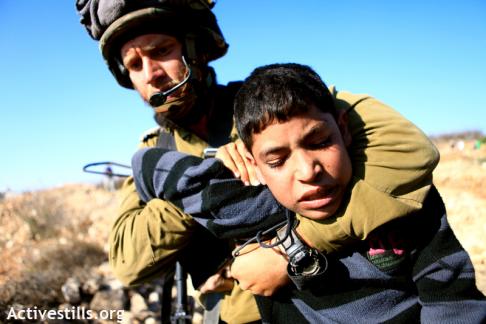
IDF Arrests/Detains Thirteen Children in Beit Ommar

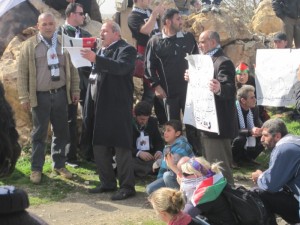
Demonstration in Beit Ommar 1/19/11

To continue from my last post regarding the arrest and detention of Palestinian children on the West Bank, please read the press release below that was sent out yesterday by the Palestine Solidarity Project.  I will soon be posting a piece from my friend Father Cotton Fite, who is currently in Israel/Palestine and has dear friends in Beit Ommar.

Here is an excerpt from a post Cotton wrote about the family during his visit to the area last year:

Jamal told us the story of his 15 year old nephew, Ibrahim, who was recently awakened in his bed at home at 2 AM by Israeli soldiers and taken for questioning. While in prison he was severely beaten and had electrodes attached to his genitals with the threat he would “become like his sister” and never marry. Jamal and his brother finally gained Ibrahim’s release with a fine of 500 shekels and their signature on an agreement that Ibrahim would be returned for questioning within an hour of notification by the IDF.

It is profoundly painful to read about Israel’s state abuse of children. The pain is all the more when you consider that none of us in the Jewish community seem ready to say anything about it.

13 Boys Arrested From Playground after Army Represses Beit Ommar Demonstration

On Saturday the 19th of February at 1 pm, the Beit Ommar National Committee held a large demonstration to protest the Israeli government’s decision to expand settlements, with support from the United States. They were joined by Palestinian Popular Committees from Hebron, Al-Masar’a, Beit Ola, Tuwani, Surif, and Wadi Rahal, as well as members from the Beit Ommar municipality. The gathered Palestinian activists were also supported by a large number of Israeli and International solidarity activists.

The army arrived in several jeeps from Karmei Tsur settlement and immediately began shooting tear gas to disperse the demonstrators. Israeli Forces also threw sound bombs at the crowd, hitting a few people directly. A minister from the Beit Ommar municipality was injured in his leg, and a member of the National Committee was injured after a sound bomb exploded on his back. The army continued their attacks, while a group of settlers gathered behind the Karmei Tsur fence to watch the repression. After an hour and half, the demonstrators successfully delivered their message to the soldiers and media and returned to the village with no arrests.

At around 3pm, half an hour after the demonstration had ended, an undercover military vehicle came into the village near Karmei Tsur and soldiers attacked the residence of Husni Za’qiq. Soldiers occupied the house and prevented anyone from leaving. Other soldiers, accompanied by special units, invaded a park full of children between the ages of 12 and 15 years. The Israeli Forces attacked and shot rubber bullets and sound bombs at the children so they could not run away, and then proceeded to arrest 13 of them. Several army vehicles came into the area for support, attacking houses and cars to frighten people so they could not come to the children’s defense. The army shot tear gas and sound bombs toward women who attempted to rescue the youth, and then beat the group of women, including Mona Abu Maria. The army succeeded in taking the arrested children, all of whom are under the age of 18, out of the village. Their families do not yet know where they are being held.

Children are Disappearing in Nabi Saleh

http://vimeo.com/19782878

Over the past month, Israeli activist Joseph Dana has been chronicling Israel’s practice of arrest and detention of Palestinian children in the West Bank village of Nabi Saleh. I don’t know what to say except that his reports have left me numb:

“They come for our woman and our children,” Bassem Tamimi, the leader of the Popular Committee of Nabi Saleh recently told me, “they [the Israeli army] know that woman are half our population and half our strength and so they target them along with the children.” Tamimi, a gentle man with a warm smile spoke to me about the repression of his village as we sat in his home overlooking the settlement of Halamish. “They know where to apply pressure on our resistance. It has become really difficult since the last wave of arrests.”

Israel is devoting maximum effort to the repression of Nabi Saleh’s determination to demonstrate against the Occupation. The specific method of repression has been in development for the past eight years and is not only designed to break the demonstrations but to leave permanent psychological scars on the next generation of Nabi Saleh villagers. In short, children are used to implicate the leaders of the Popular Committee for incitement in demonstrations, providing evidence for their long term incarceration. In the last month, six children have been arrested or detained in Nabi Saleh by the army.

The video above shows the capture of eleven year old Kareem Tamimi who is chased down and grabbed by Israeli border police before he is shoved into a police van. The voice you hear screaming in the background is his mother.

Other videos on Dana’s site are no less disturbing. Two clips document late night home raids by the IDF, who go from from house to house photographing children and recording their names and ID numbers. As Dana explains:

14 year old Islam Tamimi, one of the children seen being photographed in a night raid, has been in jail for the past three weeks. Days after the video was shot he was arrested and detained for a number of hours at the Halamish military base. Two days after he was detained, the army raided his home at 02h00 and arrested him. He was left in the cold, blindfolded and bound for the rest of the night and then taken imminently to interrogation without lawyer or parents present. The interrogation lasted eight hours. Incidentally, the day that Tamimi was arrested the IDF Spokespersons office tweeted that ‘a wanted suspect was arrested overnight and taken for security questioning.’

In another post, Dana reported that fourteen year old Islam had a hearing on February 14 (in which he was brought before a judge while wearing an over sized adult prison uniform). While he originally was held in a cell with his 24 year old brother (who was jailed on stone throwing charges), he was subsequently moved away to another prison.  His trial is scheduled to take place next week.

This is not only an issue for Nabi Saleh. According to the Middle East Children’s Alliance, thirty two Palestinian children were arrested by Israeli authorities in the first two weeks of February alone. A recent report by Defense for Children International (Palestine Section) has concluded:

Each year approximately 700 Palestinian children are arrested, interrogated and detained in the Israeli military court system, and reports of torture and ill-treatment are common.

My friend Father Cotton Fite, who is currently visiting Israel/Palestine, has dear friends in the village of Beit Ommar. Shortly before he left, he heard from them that the IDF had come to their home and was targeting one of their young sons. The family was understandably terrified.

Cotton is visiting the family now and is also meeting with B’tselem field workers to find out exactly what is happening on the ground. He promised to send in a post about his experiences. (In the meantime, you can read this report from last summer that claims that over a dozen youth from Beit Ommar were arrested in less than a month’s time.)

Nelson Mandela is famously quoted as saying,

There can be no keener revelation about a society’s soul than the way in which it treats its children.

Bear these words in mind as you watch the film clip above…
Celebrate and Take Action This Tu B’shvat!

It’s utterly frigid here in Chicago. As I lose feeling in my toes, however, the Jewish calendar tells me it’s Tu B’shvat: the Birthday of the Trees, and the first harbinger of Spring.

And so my Tu B’shvat offerings for you:

An email I wrote on behalf of Jewish Voice for Peace: this Tu B’shvat, please take action to save trees and uprooted communities in Israel/Palestine;

– From the Velveteen Rabbi: a lovely two-page Tu B’shvat Haggadah that covers all the bases quite gracefully. (Mazel Tov to the Velveteen Rabbi, who recently received her smicha and is now, as she puts it, “running and playing with the real rabbis.” Rabbi Rachel: don’t you know you’ve been a “real” rabbi to many of us for quite some time now…)

– For Tu B’shvat reading material, I encourage you to read this inspiring piece on “Spiritual Environmentalism” by Wangari Maathai, Kenyan tree-planter extraordinaire:

Human beings have a consciousness by which we can appreciate love, beauty, creativity, and innovation or mourn the lack thereof. To the extent that we can go beyond ourselves and ordinary biological instincts, we can experience what it means to be human and therefore different from other animals. We can appreciate the delicacy of dew or a flower in bloom, water as it runs over the pebbles or the majesty of an elephant, the fragility of the butterfly or a field of wheat or leaves blowing in the wind. Such aesthetic responses are valid in their own right, and as reactions to the natural world they can inspire in us a sense of wonder and beauty that in turn encourages a sense of the divine.

That consciousness acknowledges that while a certain tree, forest, or mountain itself may not be holy, the life-sustaining services it provides — the oxygen we breathe, the water we drink — are what make existence possible, and so deserve our respect and veneration. From this point of view, the environment becomes sacred, because to destroy what is essential to life is to destroy life itself.

I feel my toes warming up already…

Illinois Senate Abolishes the Death Penalty!

Amidst all of the talk of our nation’s violent political rhetoric, here’s a ray of light:  the Illinois senate voted yesterday to abolish the death penalty in our state!  In other words, they took a stand against “state-sponsored” violence.

The bill now goes to Governor Pat Quinn, who has not indicated yet whether or not he intends to sign. Illinois residents: contact Governor Quinn now and let him know you want Illinois to be the 16th state to strike down the death penalty!

JRC Israel-Palestine Trip Featured on Chicago Public Radio

Our JRC Israel/Palestine Study Tour was featured today on the Chicago Public Radio program, “Worldview.” I was interviewed along with trip participants Marge Frank and Michael Deheeger for an extensive and quite wide-ranging conversation about our experiences.

The first half of the program featured an powerful interview with Israeli Palestinian solidarity activist Joseph Dana, whose important work I’ve cited on this blog on several occasions. All told, a pretty important hour of radio.

Click here to give a listen. I strongly encourage you to tune in for the entire program; if you choose to listen to our interview alone, click here.

Lessons In Humility – A Guest Post From Palestine

Photo by Mike Okrent

Here’s a guest post by Lynn Pollack, another participant from our JRC trip to Israel/Palestine:

I was one of the people on the recent JRC trip to the West Bank and Israel, but having visited three times before in the last few years I didn’t think I had that much to learn.  After all, I had devoted much of the last decade to advocating for a just peace for Israelis and Palestinians – a peace that includes an end to occupation and a beginning of real equality.  What could possibly move me on another visit?   Arrogant, huh?  Well, yes, and on this trip I was humbled many times.

Continue reading

Initial Impressions and Later Reflections: A Guest Post From Palestine

Photo by Rich Katz

Here’s a guest post by Michael Shapiro, another participant from our JRC trip to Israel/Palestine:

Let me first thank Rabbi Brant Rosen for his vision and leadership in organizing this trip and for his astuteness in working with Aziz and Kobi.  They were articulate, deeply knowledgeable, warm and witty guides, but through their life histories and their relationship modeled the struggle for mutual understanding between their communities.  I am also grateful to Rabbi Rosen for the invitation to post on his blog.

The trip gave me a deeper understanding of the way the conflict burdens the lives of Palestinians.  It was no surprise to me that the weight of military occupation could be oppressive, but I now have a more acute sense of what it is like for those whose daily lives include humiliation and harassment at checkpoints or for those separated from farms, jobs, schools, and families by a wall built on their own land.

I will not forget hearing Marge Frank translate our Jenin host’s anguished and angry account of being made, more than once, to strip to his underwear at a checkpoint he had to pass through on his way to work in Israel. Nor will I forget the head of the Budrus Popular Committee, who led his village in a successful non-violent protest that resulted in a rerouting of the wall.  These and other equally indelible memories have deepened my understanding of the conflict and of the unconscionable injustice and suffering inflicted on the Palestinian people by the occupation and settlements.

In some instances, however, I have found that distance and reflection have placed initial impressions in a wider context and introduced  “complications,” a word that can sometimes mask moral callousness if not moral cowardice, but can sometimes challenge simplistic thinking by focusing  on  thorny realities. I would offer three examples.

Continue reading

Illinois Death Penalty On Brink of Abolition!

Opponents of capital punishment got some rare good news yesterday when the Illinois House voted to approve legislation that would abolish the death penalty in our state.

It ain’t law yet, though. With the days ticking down on the lame duck session of the General Assembly, the bill now goes to the State Senate, where its approval is by no means assured.

If you are an Illinois resident, please check out the website of the Illinois Coalition to Abolish the Death Penalty, to learn how you can take action to help pass SB 3539 at this critical juncture.  Legislators will only be in session for a few more days so we really do have little time to spare.

And if you’re so inclined, here’s a post I wrote on Judaism and Capital punishment back in 2008.

Aziz Blogs: “My Brother’s Kippah”

You might remember my post last week from Palestine, in which I described how Aziz Abu Sarah, our Palestinian tour guide, put on my kippah in order to enter the Jewish-only section of Hevron.

Now Aziz himself has just written a moving piece in +972 about his experience:

As we approached Shuhada Street I was thinking of a way to stay with the group. I wanted to show them Abu Seneineh neighborhood, where my ancestors came from before moving to Jerusalem 80 years ago.  I wanted them to see my aunt’s house and share with them my childhood memories about Hebron. So, I found myself devising a plan that would allow me to pass through without raising the soldiers’ suspicions.

Before arriving to the street, I asked Brant, the congregations’ rabbi, for his “kippah” (skullcap). I put it on my head and walked straight up to the Israeli soldier at the entrance of the street. I told him (in Hebrew) that I have a  Jewish group touring from Chicago that wants to walk through. He only had one question: “do you have any Arabs with you?”  I answered confidently, “No, they are all Jews,” and that was all we needed to get inside the “Jewish area.”

I was amazed by what a kippah could do. Suddenly, I was not suspicious and was transformed for the soldiers from an enemy to a friend.  The kippah became my entry visa, my access papers. I felt like it was my “shibboleth” into an elite club and the kippah was like the card I swipe to get in.

JRC in Israel/Palestine: My Final Thoughts

JRC Israel/Palestine Study Tour Participants 12/21/10 (Photo: Rich Katz)

My turn:

Our JRC Israel/Palestine Study Tour has been over for almost a week now, but I think I speak for everyone when I say it was a transformative experience for us all. I’ll also say that I am bursting with pride and admiration for my fellow JRC travelers.

I don’t know for sure, but I’m fairly certain this was an unprecedented Jewish congregational Israel tour. Most trips of this kind generally offer what I’d call a “hermetically-sealed” experience of Israel: an itinerary that remains largely west of the Green Line, offering participants a decidedly Jewish-centric perspective. I think most would agree it’s unusual for a rabbi to bring nineteen of his congregants on a trip that focused almost exclusively on East Jerusalem and the West Bank, spending the night in refugee camps, meeting with Palestinians, and learning from Palestinian civil society activists.

If I ever had any doubt, the reaction we encountered from those we met along the way drove this point dramatically home for us. Whenever we introduced ourselves and explained what we were doing, we’d invariably get the same open-mouthed reaction from our hosts. As the Israeli reporter Orly Halpern wrote me immediately after meeting with our group:

It was great meeting your open-minded and courageous congregation, Brant. Courageous because they were willing to hear the Other.

So yes, I’m very proud. Proud that we could take such a trip, and particularly proud of the congregational members who stepped forward to participate in it. Each and every one of them was willing to be deeply challenged – to lower their their ingrained defenses enough to face very real and painful truths – a reality that often directly contradicted the image of Israel with which they were raised.

Jewish Settlement in the heart of the Muslim Quarter (Photo: Rich Katz)

To be sure, it’s one thing to read about Israel’s oppression of Palestinians in the newspaper or hear about it second-hand; it’s quite another to witness it right in front of you where it’s impossible to rationalize or explain away. These congregants were willing to go places – literally and figuratively – where most American Jews remain resolutely unwilling to go. They were ready to let down their guard and be touched and transformed by what they saw.

And they were. Over and over and over again.

There will undoubtedly be those who will criticize us for taking a trip such as this, who will claim that our tour was “not balanced,” that is was unduly “biased,” that we didn’t take time to hear from the “other side.” I can’t help but be struck that these kinds of concerns are never raised when Jewish congregations organize Israel trips that pay scant attention to Palestinians and Palestinian life. And I don’t believe I’ve ever heard anyone in the American Jewish establishment criticize Birthright trips for being too “one-sided.”

I also believe that in our obsessive need to achieve balance, we conveniently ignore the fact that this is an inherently unbalanced conflict. As trip participant Marge Frank so eloquently put it in her previous guest post, “When one people is being oppressed and occupied by another, there is only one side to the story: that of the oppressed.” For most American Jews, it seems to me, the truth of Israel’s oppression of Palestinians is impossibly difficult to admit – and so we habitually explain it away, rationalize it, or deflect it in the name of balance.

With Daoud Nasser in one of the natural caves on his family farm, Tent of Nations (Photo: Rich Katz)

At the end of the day, the experiences I wrote about on my blog this past week weren’t mere isolated examples of Israeli bad behavior. The home demolitions in Silwan, the attempted expropriation of Daoud Nasser’s family farm, the dehumanizing checkpoints, the racial separation and settlers’ harassment in Hevron – in the end I believe these are all part of a larger fabric of persecution. As painful as this might be for us to admit, these are not merely exceptional blemishes on the face of an otherwise healthy state. If any of us had any doubt about this, it became painfully difficult for us to deny once we saw it with our own eyes.

Kobi and Aziz, Hevron (photo: Rich Katz)

While our group experienced some profoundly dark truths, however, we also bore witness to very real signs of hope: the resilience and dignity of the Palestinian people and the inspiring example of those Israelis who stand in solidarity with them. In this regard we had no more powerful example of than Aziz and Kobi, our Palestinian and Israeli tour guides – two very courageous men who have transcended their own painful pasts and are now devoting their lives to reconciliation, justice and peace. As every member of our group will agree, they were truly our guides in every sense of the word.

For myself, I’m irrevocably committed to this journey now – and I am heartened beyond measure to know that there are American Jews who are willing to take it with me.

Busy Hevron street, (H1) (Photo: Rich Katz)

Shehadeh St. in Hevron (H2), now rendered completely off-limits to Palestinians

Demonstration at Silwan Peace Tent, E. Jerusalem 12/24/10 (Photo: Rich Katz)

Translation: "There is no holiness in an occupied city." Silwan demonstration, 12/24/10 (Photo: Rich Katz)