Category Archives: Israel

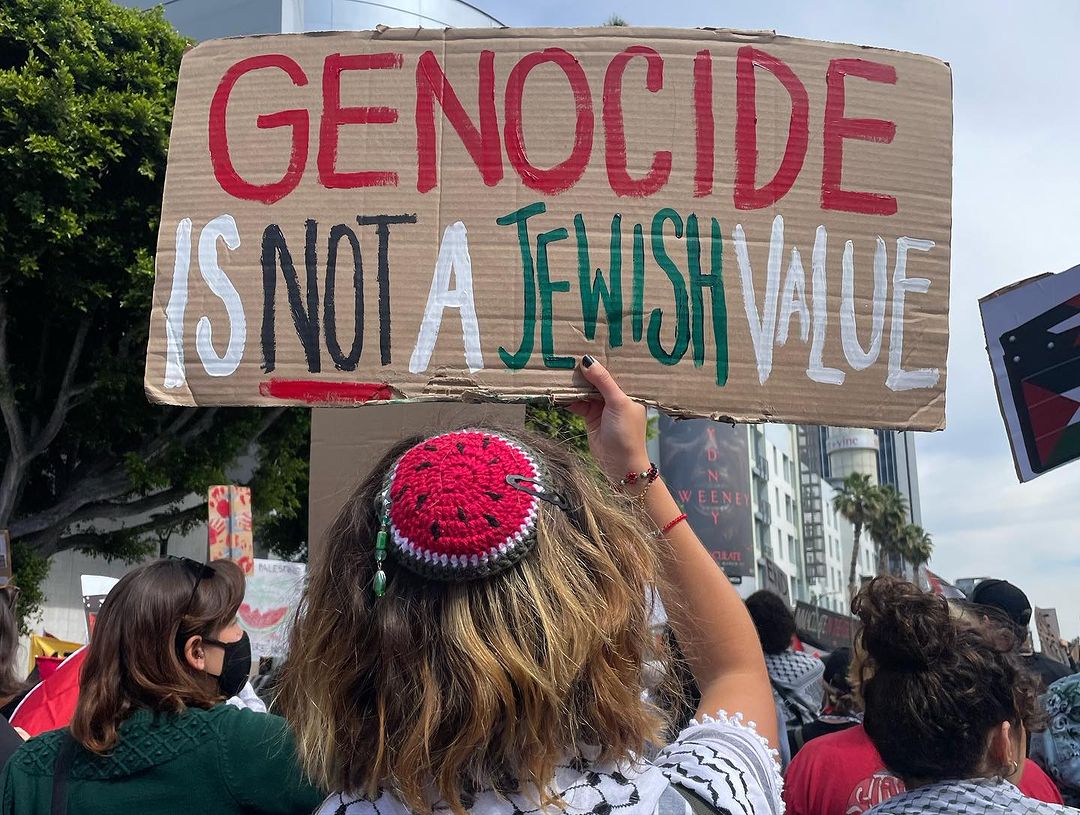
Protesting Genocide at the DNC in Chicago: Beyond “One Issue”

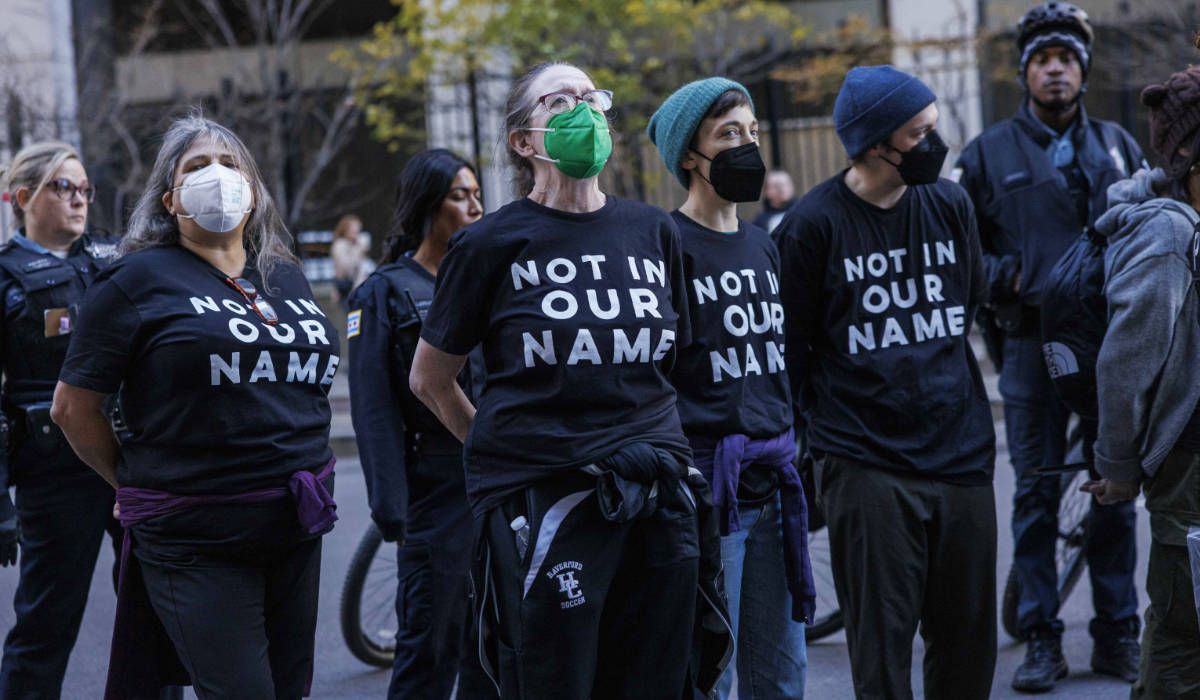
(photo by Keeton Holder)

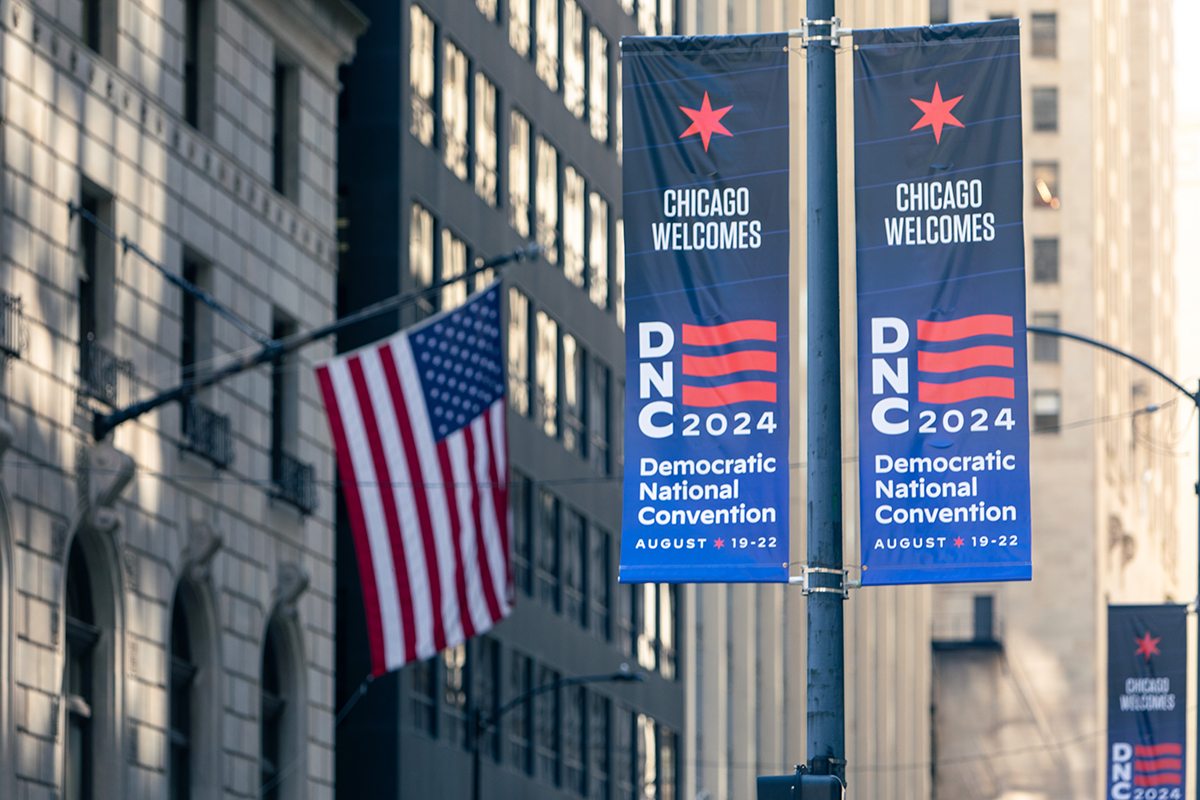
As I’ve written previously, a large coalition of leftist groups has been preparing to take to the streets when the Democratic National Convention comes to Chicago next week. Although there will be a variety of different demands leveled at the DNC during the course of the convention, one key issue clearly stands out as a central common thread through them all – namely, an immediate US arms embargo and a permanent ceasefire to end Israel’s genocide in Gaza.

To name but one example: a rally and march for reproductive justice (of which my congregation, Tzedek Chicago, is a co-sponsor) will take place this Sunday, on the eve of the convention. As “Bodies Outside of Unjust Laws” organizers have made clear, however, the demands of this protest are not limited to issues of domestic reproductive justice alone:

Reproductive justice inherently includes ending the reproductive genocide in Palestine. As U.S. citizens, it is our duty to call on our own government to end the funding of weapons to Israel that enable this nightmare to continue and robs us of funds at home. As feminists and reproductive justice activists, we must also highlight a horrific aspect of the war on Palestinians: it is a war against women and children, who suffer in uniquely cruel ways. 

Likewise, the Coalition to March on the DNC, a group of over 200 national and local organizations is calling for an “End to US Aid to Israel” along with demands on immigrant justice, police crimes, healthcare, housing and the environment. Here again, justice for Palestinians is not viewed in isolation from other issues. As protest organizers correctly understand, these issues are irrevocably interlinked and intertwined.

During the course of this election cycle, those of us who have been demanding an arms embargo and ceasefire in Gaza have become all too familiar with one recurrent criticism in particular: that we are “one issue voters.” I find this to be a dangerous attitude for a number of reasons. More than anything, it’s an egregiously dismissive stand to take in an age of genocide, smacking of “it’s not my problem” American isolationism during the 1940s. For the Palestinian people, of course, Israel’s genocide in Gaza is not simply one issue – it’s the issue.

Witness, for instance, the news from this past weekend:

Officials in Gaza say more than 100 people were killed Saturday in an Israeli attack on a school and mosque where thousands of displaced Palestinians had sought shelter. The attack on the al-Tabin school in Gaza City was one of the deadliest individual attacks since Israel’s war on Gaza began over 10 months ago. Rescue workers said they did not find a “single full body” among the deceased — just body parts often destroyed beyond recognition. Survivors said Israel attacked the school during morning prayers…

CNN has confirmed a US-made GBU-39 small diameter bomb was used in the Israeli strike on the school. The attack came two days after the Biden administration notified Congress that it was preparing to provide Israel with an additional $3.5 billion to spend on US weapons and military equipment. Congress had approved the money as part of a $14 billion package for Israel in April. Zeteo reports part of the new US package includes a direct sale of 6,500 joint direct action munitions to Israel.

First and foremost, the genocide in Gaza is a crime against humanity that should concern us all. But as citizens of the nation that is funding and abetting this genocide, we Americans cannot look away from the blood that is surely on our collective hands. Nor can we ignore the shock waves that resonate far outside the borders of Palestine/Israel: the threat of an all-out regional war, the profits enjoyed by the arms and surveillance industry at taxpayer expense, the devastating environmental impact – the list goes on and on. Palestinian human rights lawyer and activist Noura Erakat put it perfectly on Twitter/X recently: “PSA: ending a genocide is not ‘a single issue’ it is an entire universe of issues.”

Another refrain I’ve been hearing repeatedly is the critique that protesting at the DNC “will only help Trump.” Harris herself leveled this argument at a campaign rally in Detroit when she sternly admonished pro-Palestinian protesters: “If you want Donald Trump to win, then say that. Otherwise, I’m speaking.” To be sure, it was an astonishingly tone-deaf and dismissive response to make in Michigan, the very birthplace of the Uncommitted Campaign. But on a more fundamental level, Harris’s response denied the very real impact of her own administration’s policies. As one of the protesters later put it, “When people are demanding a ceasefire and arms embargo and an end to the genocide and you say that we want Donald Trump to step in—it just shows a lack of accountability. It shows a lack of leadership, a lack of responsibility and a lack of ownership.”

In essence, Harris’s comment was just the latest version of the “shut up and vote” message that the Democratic party routinely sends progressives during every election cycle. In an age of US-supported genocide, however, the cynical emptiness of this message has become patently, painfully obvious. As journalist Masha Gessen has rightly pointed out. “These voters are not choosing between Harris and Trump. They are choosing between their sense of themselves as moral beings if they vote for Harris and their sense of themselves if they vote for a third-party candidate or for no one at all.”

Of course those who will be protesting at the DNC next week do not want to see Trump elected in November. But even from a purely strategic point of view, what has a better chance of helping the Democrats fortunes in November? We know that a strong majority of American voters across the political spectrum support a permanent ceasefire in Gaza. What would be the more winning strategy: telling those who want to end a genocide to shut up, or exert real leadership that will bring about a ceasefire and an end to the threat of a devastating regional war?

While party conventions function largely as candidate-coronations, they still function as places where parties express their collective vision and finalize their political platforms. On this score, I’m not at all optimistic that an arms embargo to Israel and a permanent ceasefire will find any purchase at the DNC. There are a mere 30 Uncommitted delegates out of 4,600 – and while they are pushing for a voice at the convention (they’ve asked that Dr. Tanya Haj-Hassan, a pediatric intensive care doctor who has volunteered in Gaza, speak from the convention floor), they have still not been offered a slot. Harris’s national security advisor has also made it clear that she opposes an arms embargo to Israel. By every indication, it certainly feels like “shut up and vote” will be the dominant Democratic party message coming out of the convention next week.

I have enormous respect for the Uncommitted delegates who will engage within the convention, particularly co-founder Layla Elabed, who has said even if they are not given a speaking slot, delegates will make their presence known with “news conferences, candle light vigils, tables to distribute literature and, they hope, guest testimonies about life in war-torn Gaza.” When it comes to political advocacy, however, there is always an inside game and an outside game. That’s why those of us who are not delegates will (quite appropriately) be making our presence known outside the walls of the convention hall as well.

Protest organizers have no illusions about the overwhelming militarized presence that will greet us when we gather next week. Federal authorities have divided the area surrounding the United Center, where the main speaking events of the convention will take place, into “soft” and “hard” zones – the latter being off limits to cars and non-credentialled delegates. But even in the soft zones, movement has been heavily restricted. The main protests have been given approved routes far from the convention site, and at one point goes through narrow residential side streets, that will be completely inadequate to handle thousands of protesters. While organizers have appealed the march route, as of this writing there has been no response from the city of Chicago.

When we talk about the potential for police violence next week, of course, the specter of the 1968 Democratic convention in Chicago looms very large. A great deal of ink has been spilled analyzing the differences and similarities between Chicago 1968 and Chicago 2024 – and while I’m loath to venture too far into this rabbit hole, there is one point of commonality I believe bears noting. In general, the mythos around the 1968 DNC protests tend to lay the blame for the Democrats’ defeat on the protest movement that “divided the party.” Often lost in this discussion is the fact that in 1968, those protests were directed toward a political party that had been prosecuting an increasingly unpopular war in Vietnam. Today, as then, I find it deeply misguided to blame protesters and not the immoral policies of the Democratic party itself.

While it’s not particularly helpful to use Chicago 1968 to heighten hysteria over the DNC, protestors are certainly justified in being vigilant over the very real possibility of police violence. I’m not the only one who finds it ominous that the city is doubling down on armed presence in the city. In advance of the convention, the Secret Service agent in charge of “security” has commented that “Chicago has a proven track record when it comes to putting on huge events” – citing the city’s response to Lollapalooza, the NASCAR Chicago Street Race and the Chicago Air & Water Show – as if the DNC is just another tourist event to showcase to the public.

No, we cannot deny of the very real moral and political reality that will be at stake in Chicago next week. We cannot deny that state violence directed against Palestinians is one and the same with so many other forms of state violence that are routinely normalized as “necessary.” And we must resist the call to dismiss any form of systemic violence as just “one issue.” As my friend and comrade, organizer Kelly Hayes has so wisely written:

We have to recognize victims of police brutality, Palestinians, our disabled and unhoused neighbors, and so many others who are subject to forgetting as worthy of grief, outrage and action. Everyday people who are fleeing violence, hunger, and militarism, everyday people whose cites are running out of water or are in danger of disappearing beneath rising flood waters, everyday people who are dying right now because they lack air conditioning amid heat waves – these are the people whose plights and fates should shape our politics. If we are going to fight for any semblance of human decency, we need to reclaim and reassert the value of our lives.

Confronting Tisha B’Av and Gaza: Ten Years Later

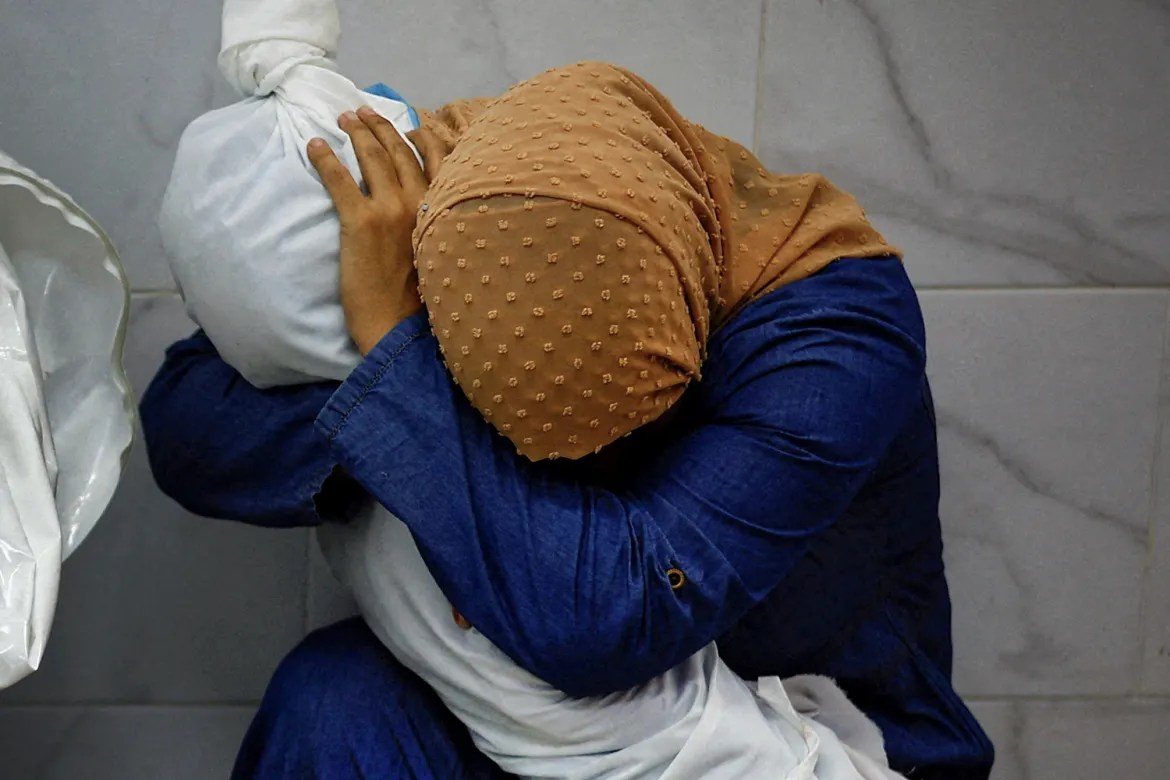
 [photo: Mohammed Salem/Reuters]

Exactly ten years ago, the Jewish fast day of Tisha B’Av arrived as Israel was winding down “Operation Protective Edge” – it’s deadly two-month military assault on Gaza. By the end of the summer of 2014, it would eventually leave more than 2,000 Palestinians dead and more than 10,000 wounded. I remember thinking at the time how the scale of human loss was utterly incomprehensible, which of course, it was.

With Tisha B’Av 2014 approaching, I met with a small group of Jewish friends and activists who had been active in the Palestine solidarity movement to plan an observance. Tisha B’Av (literally, the 9th of the month of Av) is a day of mourning for the destruction of the 1st and 2nd Temples in Jerusalem – and by extension the myriad of other tragedies that have befallen the Jewish people throughout the centuries. In addition to a day-long fast, the traditional Tisha B’Av observance includes the chanting Biblical book of Eicha (Lamentations), which vividly and painfully describes the fall of Jerusalem to the Babylonians.

Given the violence Israel had been unleashing on Palestinians in Gaza that summer, we just couldn’t bear to observe the festival in the traditional manner, i.e., as a day of mourning exclusively for Jewish loss. And so, when the festival arrived, we gathered in a home in Evanston to share our fears, our grief, our outrage, over what had transpired over the course of that tragic summer. In a sense, we were mourning the loss of Judaism itself as we had known it. Though it was obviously far from a traditional Tisha B’Av observance, those who attended will never forget that gathering – and would agree it was a turning point in our Jewish lives and identities.  

Among the readings shared at the ceremony, was a new poetic translation of the first chapter of Eicha that I had written for the occasion, entitled “A Lamentation for Gaza.” This is how it began:

Gaza weeps alone.
Bombs falling without end
her cheeks wet with tears.
A widow abandoned
imprisoned on all sides
with none willing to save her.

We who once knew oppression
have become the oppressors.
Those who have been pursued
are now the pursuers.
We have uprooted families
from their homes, we have
driven them deep into
this desolate place,
this narrow strip of exile.

It’s fair to say that none of those who attended that ceremony could ever have imagined the scale of the genocidal carnage that Israel would unleash on Gaza ten years later. To date, nearly 40,000 Gazans have been killed, though the actual number will almost surely climb far higher. The Israeli military has indiscriminately killed random civilians, relief workers, journalists and health care workers. Israel has wiped out the bloodlines of entire families. The Gaza strip is now gripped by spreading famine and polio epidemics. And unlike ten years ago, this current violence has now brought the entire region to the brink of all-out war.

In anticipation of Tisha B’Av this year, I recently re-read my “Lamentation for Gaza” – and while it’s an accurate snapshot of my feelings at the time, I don’t think it fully expresses my heart and soul now the way it did during the summer of 2014. Most fundamentally, I no longer relate to the essential perspective of the lamentation itself, which I wrote in the first-person plural:

We have become Gaza’s master
leveling neighborhoods
with the mere touch of a button
for her transgression of resistance.
Her children are born into captivity
they know us only as occupiers
enemies to be feared
and hated.

When I read this now, it is jarring to realize how I – a diaspora Jew living in the United States – wrote from the perspective of “Gaza’s master” and an “occupier.” When I wrote those words, I still maintained a personal connection to Zionism and reflexively adopted Israel’s perspective. At the same time, however, I clearly expressed deep anguish over what “we” had wrought – as if I didn’t know fully where I stood anymore.

Ten years later, I’m fully secure in my identity as an anti-Zionist Jew. Tzedek Chicago, is (yes) almost ten years old – and avowedly lifts up core values that express diasporist-focused Judaism beyond Zionism. I’m part of a Jewish community that is unabashed about taking a stand in the face of genocide.

I don’t believe it’s an exaggeration to say that as Tisha B’Av falls this year, the Jewish communal fissures over Palestine/Israel have become an abyss – perhaps even a schism. We are facing a deep and profound divide between those who place political nationalism at the center of their Jewish identity and those who refuse to associate settler colonialism, apartheid – and now genocide – with their Judaism. And though it pains me to say so, I don’t think there will be any bridging this gap. Contrary to the final line of Lamentations, “chadesh yameinu ke’kedem” (“renew our days as they were before”), there is no going back to the days of old. There will be no putting the pieces back together the way they were.

According to classical Jewish theology, the cataclysmic fall of the Second Temple in Jerusalem occurred as a result of “sinat chinam” – the baseless internecine hatred in the Jewish community that allowed the Romans to come breach the walls of the city and conquer Jerusalem. There is deep division in the Jewish community in the current moment as well, but now our Jewish trauma and hatred is directed outward rather than inward. Now, it is the Palestinian people – not we – who are bearing the full brunt of violent dispossession and collective loss.

While it would be hubris to predict what the future will hold for our tradition, I fervently believe that the Judaism of the future must be universalist in nature. Just as I suggested this past April that Passover cannot commemorate Jewish liberation exclusively, so too Tisha B’Av can no longer focus on Jewish mourning alone. Our cries of grief must include the Palestinian people – and all who are targeted, othered, and singled out for oppression through state violence.

This year, Tisha B’Av eve falls on Monday night August 12 – and this time, I know where I belong. I encourage local members of Tzedek Chicago to join us at Federal Plaza in downtown Chicago, where we will collaborate with Higaleh Nah, a local non-Zionist havurah, to chant the entire book of Eicha. It feels absolutely fitting that we will gather at the seat of state power to send forth our lamentations toward the nation that is arming and enabling this ongoing genocide in our name.

May our cries pierce the highest heavens, and may our mourning be expansive enough to include all who are oppressed in our midst.

Assassinating Haniyeh has Devastated Hopes for a Ceasefire – and has Brought the Region to the Brink

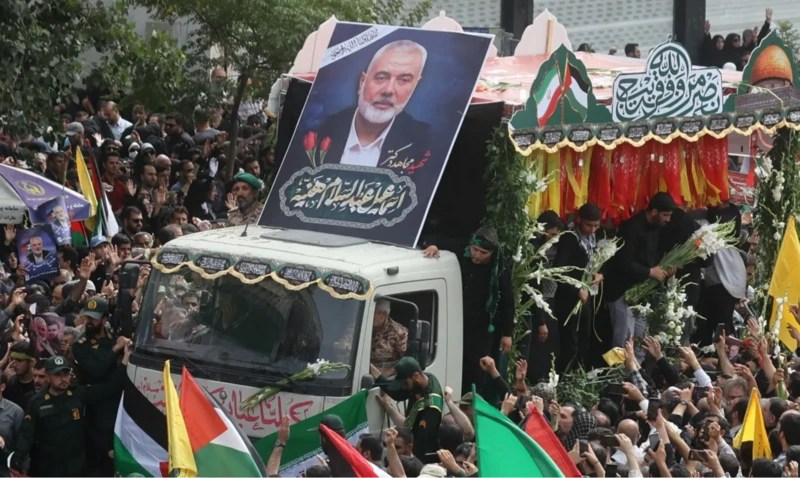
photo: Getty Images

Among the myriad of news items jostling for our attention this past week was the assassination of Ismail Haniyeh, a top political leader of Hamas, who was killed by a bomb in Tehran on Wednesday. Israel is almost surely behind this act, even if it hasn’t publicly acknowledged it. While I realize that there are many in the Jewish community and around the world who are not mourning Haniyeh’s death, it’s difficult to overstate the damaging impact of Israel’s actions on the prospects for a ceasefire in Gaza.

Ismail Haniyeh may have been a leader of Israel’s sworn enemy, but he was also one of the primary figures in ongoing ceasefire negotiations. By killing its own negotiating partner, Israel has made it substantively more difficult to realistically imagine an end to its genocidal violence, a return of Israeli hostages and a Palestinian prisoner exchange any time soon. The Prime Minister of Qatar, who has been a central figure in brokering ceasefire talks put it bluntly: “How can mediation succeed when one party assassinates the negotiator on the other side?”

Why would Israel assassinate Haniyeh, knowing that it might fatally damage ceasefire talks? Many are suggesting that it is in Netanyahu’s personal/political interest to prolong this violence as long as possible – even as it endangers the lives of his own nation’s citizens. While this is no doubt true, I think there is a deeper reason: these latest targeted killings were rooted in Israel’s historic – and fatal – belief that the use of its relentless, overwhelming military force will inevitably force their enemies to submit. It’s worth noting that Haniyeh’s assassination follows the targeted killing of his three sons last April, as well as his sister and nine other members of his family in June. These actions certainly track with Netanyahu’s vow to exact a “mighty vengeance” following Hamas’ October 7 attack.

In fact, Israel has had a long history of assassinating Palestinian leaders, knowing full well that these actions ultimately serve no strategic purpose other than a satisfying show of force. The Israeli military has been assassinating Hamas’ leaders for decades – and Hamas has consistently replaced them. For all its efforts, Israel has succeeded only in increasing the number of Palestinian martyrs and strengthening Hamas’ resolve to resist all the more. In this most recent instance, many observers have pointed out that the killing of Haniyeh will now leave a vacuum to be filled by more radical leaders such as Yahya Sinwar, among others.

Meanwhile, Israel’s genocidal onslaught in Gaza continues with impunity – and nary a protest from the international community. Yesterday, Israel killed at least 15 people – including two children – and injured 40 others in an airstrike that targeted a school-turned-shelter in Gaza’s Shejaiya neighborhood. On Wednesday, the Israeli military killed two journalists from Al-Jazeera, Ismail Al-Ghoul and cameraman, Rami Al-Rifi, with an airstrike on their car. Their colleague Hind Khouri broke down as she reported on their killings, which brings the current number of journalists killed in Gaza to 113.

Israel’s most recent actions have also brought the region, terrifyingly, that much closer to all-out war. On the same day as Ismail Haniyeh’s killing, the Israeli government confirmed that it had assassinated a top Hezbollah leader, Fuad Shukr, in Beirut. The leadership of both Iran and Lebanon, and their proxies in the region are now vowing to retaliate – and the Israeli military is reportedly on “high alert.” Even more ominously, the US intelligence community reports it has received “clear indications” that Iran is planning an attack. One official said the Pentagon and US Central Command are making preparations to help defend Israel militarily, “(involving) US military assets in the Gulf, the Eastern Mediterranean and the Red Sea.”

In times such as these, we are reminded how unbearably high the stakes of a just peace in the region truly are. I understand the palpable sense of powerlessness in the current moment: it sometimes feels as if there is nothing left to do but to pray that leaders on all sides ultimately take a breath and a step back from the brink. In the end, however, we cannot be content to passively hope that the leaders who have brought us to this unthinkable moment will do the right thing.

As has often been said, hope is a discipline. We must find the wherewithal to continue the struggle: to demand a US arms embargo to Israel, an immediate ceasefire in Gaza – and a redoubling of our commitment to a just and equitable peace for all. We must advocate in no uncertain terms that the alternative is utterly unacceptable.

Why I’ll Still be Participating in the Protests at the DNC Next Month

 (photo: AP/Jose Luis Magana)

By all accounts, the Democratic Party is closing ranks at lighting speed. As of this writing, Vice-President Harris now has more than enough delegates to clinch the party’s nomination, with a virtual roll-call planned prior to the convention in Chicago next month. The endorsements from powerful Dems continue to roll in, including from virtually all of those who might be considered viable as her potential opponents. Just two days after Biden’s withdrawal from the race, her coronation as the Democrats’ candidate is now all but assured.

I fully understand the euphoria of this moment. With Biden as the Democratic candidate, the prospect of another Trump presidency was becoming more terrifyingly real by the day. But make no mistake, Biden’s downfall was not the product of one horrible debate. On this point, I am in total agreement with Palestinian-American community organizer Linda Sarsour, who recently posted on her Facebook page:

They will never admit this but Joe Biden became a political liability for the Democratic Party on Gaza. Period. The media won’t say this. The pundits will talk around it and the party will say it’s not the case as not to offend their pro-Israel donors – but they knew that they could not win states like Michigan, Georgia, Wisconsin and they had lost big chunks of important constituencies like young people, Arab and Muslim voters, and many progressives. The fact that anyone thinks we are going to believe that one dismal debate performance was the reason they pushed Biden out is just ludicrous.

Absolutely. While the doubts over his age may have motivated his donors to abandon him in the end, Biden was fatally weakened as a candidate by his unabashed support for Israeli genocide – and the solidarity movement that held him to account. As was reported as far back as January, “It’s not just the major prime-time rallies that are now attracting the anti-Gaza war crowd’s wrath. Everywhere Biden goes he is being dogged, whether it is outside the church he attends near his home in Delaware or along the route of his presidential motorcade.”

Many are noting that Harris has been marginally better on the issue of Palestine/Israel than Biden. Last December, it was reported that she was pushing the Biden administration to “to show more concern publicly for the humanitarian damage in Gaza.” During a speech in Selma last March she called for a temporary ceasefire, adding that “too many innocent Palestinians have been killed.” In the same speech, she spoke empathetically about Gazans seeking aid who “were met with gunfire and chaos.”

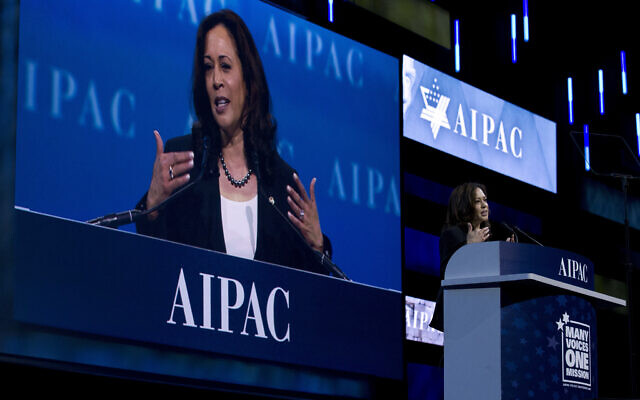
At the same time, we should have no illusions about Harris’ record of unconditional support for Israel. During a speech at the 2017 AIPAC conference, she offered the requisite oath of fealty, ““Let me be clear about what I believe. I stand with Israel because of our shared values, which are so fundamental to the founding of both our nations.”  And during her 2019 Presidential campaign, she was praised by the lobbying group Democratic Majority for Israel for running to the right of Obama on the Iran deal. Indeed, despite her softer tone, Harris has been in lockstep with the Biden administration – indeed with, the entire Democratic Party leadership – on this issue.

For the past several months I’ve been actively involved in the Palestine solidarity movement holding the Biden administration to account for enabling and support Israel’s genocidal violence in Gaza. Along with scores of others, I’ve made plans to participate in the protests planned at the Democratic National Convention next month. Even with Kamala Harris now leading the ticket, I have no intention of changing those plans.

Those of us who are part of this movement have not forgotten the essential reason for our organizing: we are living in a time of genocide – one that is being aided and abetted by a Democratic government. Whether it is Biden or Harris at the top of the ticket, nothing has changed in this regard. Moreover, conventions are the place where party policy and platforms are decided. Those of us who have been holding our government to account all year have a solemn responsibility to continue to do so: to demand that the governing party enact an arms embargo on the Israeli government and to establish a foreign policy centered in human rights.

Though news of Gaza has been swept off the front pages, Israel’s carnage against the Palestinian people has continued with impunity. It was reported today that “at least 84 Palestinians were killed over the past day in (Khan Yunis), with more than 300 others wounded. Medical staff at the Nasser Medical Complex report they are completely overwhelmed and have been forced to treat patients on hospital floors.” Yesterday, the World Health Organization revealed there is now a high risk of the polio virus spreading across Gaza – and beyond its borders – due to the dire health and sanitation situation there. The Israeli military has just announced that it will start offering the polio vaccine to its soldiers though there are not enough vaccines – or the distribution capacity – to reach the 2.2 million Palestinians in Gaza.

In other words, now is not the time to let up. In the words of Linda Sarsour, “no matter what, our work doesn’t change.” Or as Waleed Shahid of the Uncommitted Movement has correctly said:

We are making clear that we think that Biden and the White House’s disastrous policy on Gaza makes it harder for them to defeat Trump. In fact, having a campaign based on democracy, having a campaign fighting far-right authoritarianism, while sending bombs to one of the world’s biggest far-right authoritarians in Netanyahu, who is now visiting Washington, DC, makes a mockery of that party’s claim to be fighting on the right side of history, fighting on the behalf of democracy. And we want to see that party change course.

That’s why, no matter who is heading the ticket, I plan to be on the front lines with my friends and comrades when the DNC comes to town next month.

Don’t Normalize the Political Violence in Gaza

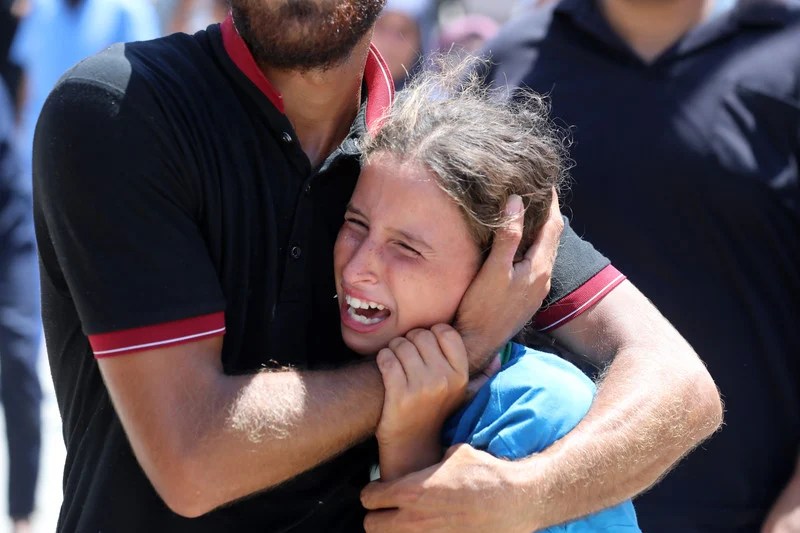
Israel killed at least 90 people in Al-Mawasi in several airstrikes on an area the military had designated as a “safe zone.” Here a child reacts as bodies are salvaged from the site on July 13. 
 Omar AshtawyAPA images

Warning: this post contains descriptions of extreme violence.

On Saturday, while the world was riveted to the news about the assassination attempt on Donald Trump, Israel unleashed airstrikes on Al-Mawasi in Central Gaza – in an area previously designated as a “humanitarian safe zone.” Gazan health officials reported that approximately 90 people were killed and at least 300 injured in this attack. Eyewitness testimonies attested to unspeakable carnage. According to 16 year old Gazan Shaima Farwameh:

A leg hit me, and I saw dismembered bodies a few meters away. I saw a young child screaming. He lost his lower limbs and was crawling on his hands and screaming. The bombs didn’t stop, and suddenly the boy disappeared. I saw how he vanished before me while we ran and lowered our eyes to the ground, unable to do anything but run…What a life we ​​live in these tents that we have to see the dismembered bodies of our siblings and families fly over our heads.

Yesterday, Israel bombed Southern and Central Gaza once again, killing more than 60 Palestinians. Among the targets was a UN school in Nuseirat where families were sheltering. Other strikes in Khan Younis and Rafah killed 12 people, according to medical officials and AP journalists. According to AP, “footage showed the school’s yard covered in rubble and twisted metal from a structure that was hit. Workers carried bodies wrapped in blankets, as women and children watched from the classrooms where they have been living.”

Given the reality of such hideous violence, it was difficult to ignore the irony in the rhetoric following the attempted assassination attempt last Saturday. For me, the most egregious example occurred when Biden said, In his speech to the nation, “There is no place in America for this kind of violence or for any violence ever.  Period.  No exceptions.  We can’t allow this violence to be normalized” (emphasis mine).

This statement is truly breathtaking in its hypocrisy. The genocidal violence Israel has been unleashing on Gazans for the past ten months has long been been normalized for most, save the Palestinian people and their allies. Even as the death toll has now reached nearly 40,000. Even as a new report in the British medical journal Lancet estimates that the actual death toll in Gaza could eventually reach 186,000 or even higher — roughly 8% of Gaza’s population.

It truly takes a special kind of moral gall for Biden to say “we can’t allow violence to be normalized” when it is his very administration that is unconditionally providing Israel with the very bombs that have killing and maiming Gazans on a daily basis. In terms of sheer numbers, President Biden is enabling the deadliest political violence in the world at this very moment.

There has been a chorus of condemnation of “political violence” from across the political spectrum over the past several days. As I’ve listened to the robotic sameness of these responses, it’s occurred to me that they are all unified over one common assumption: political violence is worthy of condemnation when Americans kill other Americans for political purposes – but when the US government commits or enables political violence around the world, it amounts to mere background noise.

Of course, the US itself was created by means of political violence – through the genocide of indigenous inhabitants and the stolen labor of black slaves. This country engages in political violence every day through deadly systems of mass incarceration and policing. And of course, the US has historically expanded its imperial power and influence throughout the world by fomenting the political violence of regime change. MLK famously made this point in his speech A Time to Break Silence when he excoriated “the greatest purveyor of violence in the world today – my own government.”

So please don’t stop raising your voice about Gaza. Please don’t allow this political violence be normalized. Please heed the words of my friend and colleague Jehad Abusalim (who comes from Deir Al-Balah in Gaza):

This is annihilation. There are no words left to capture the horror. Gaza is being obliterated—people are being murdered, starved, and displaced for months on end. Repeating these words feels like a hollow echo and a useless endeavor. But we have no choice but to persevere and keep pushing for an end to the genocide, for accountability, for justice, for healing, for rebuilding, and for liberation. We on the outside have no excuse. As long as Gaza’s defenders, doctors, nurses, first responders, and volunteers keep working and pushing, we have no choice but to keep working and pushing. Gaza needs your activism, your courage, your dedication, your boycott, your presence on the streets, and your donations now more than ever. This is a battle for hope, and hope is the last thing we’ve got. Let’s not let them take it away from us.

On Gaza: Religion, Politics and Solidarity

Here are my remarks from, “Gaza: Religion, Politics and Solidarity,” a program sponsored by Bright Stars of Bethlehem on May 5, held at the First Presbyterian Church in Evanston. It was my honor to speak in conversation with Palestinian liberation theologian Rev. Dr. Mitri Raheb (founder and President of Dar al-Kalima University College of Arts and Culture in Bethlehem), Dr, Rami Nashashibi, (founder and Executive Director of the Inner-City Muslim Action Network) and Dr. Iva E. Carruthers, (General Secretary of the Samuel DeWitt Proctor Conference).

To view the entire program, click here.

Safety in Abundance: Remembering Wadee Alfayoumi

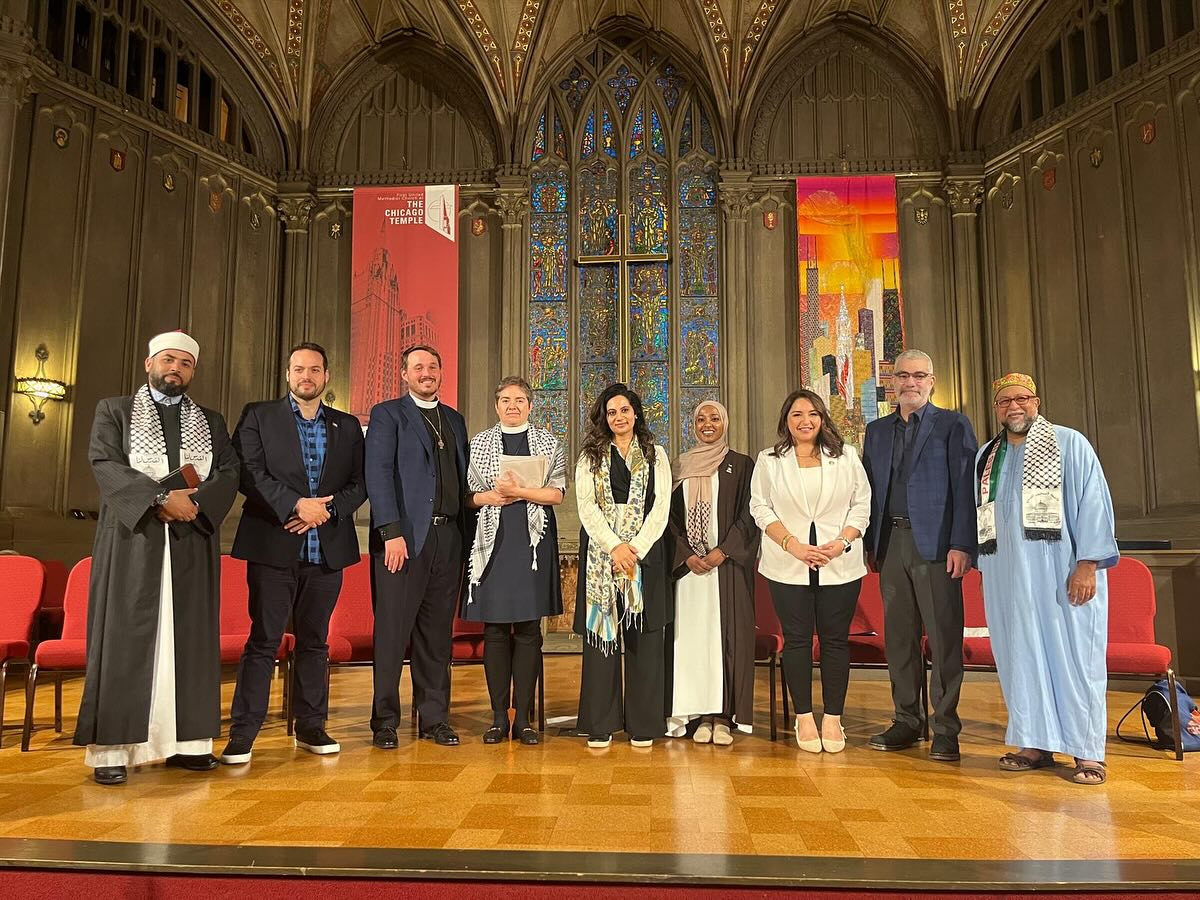
left to right: Sheikh Hassan Ali, Tarek Khalil, Rev. Michael Wolff, Rev. Anna Piela, Maaria Mozaffar, Deena Habbal, Rep. Delia Ramirez, Rabbi Brant Rosen, and Imam Hassan Aly.

My remarks from last Sunday, delivered at an interfaith memorial in Chicago for Wadee Alfayoumi, a six year old Palestinian-American boy from Plainfield, IL, who was murdered in a hate crime on. October 14. Our service also included words from IL Rep. Delia Ramirez, who is co-sponsoring a House resolution affirming that “the United States has zero tolerance for hate crimes, Islamophobia, anti-Semitism, and anti-Palestinian and anti-Arab discrimination.” 

When precious lives are unjustly taken from the world, the most essential way we can honor their memory is to ensure that they have not died in vain. Wadee’s young life was cruelly taken from us through a heinous and unjust act. While it is true that his murderer has been caught and will be tried by our legal system, our work is by no means over. We must continue to demand justice for Wadee Alfayoumi. 

While it is true that Wadee’s life was taken by one hateful, hate-filled individual, those who view this was a random, isolated incident are gravely mistaken. Wadee’s murder did not occur in a vacuum. It occurred in the toxic context of Islamophobia and anti-Palestinianism that has long been rising throughout this country and around the world. It was inspired by an ideology emanating from the state of Israel that has routinely and regularly dehumanized Palestinians for decades – a state that is, even as we speak, unleashing genocidal violence against a captive Palestinian population in Gaza. 

How can we honor the life of Wadee Alfayoumi? How can we ensure his death will not be in vain? By speaking out as loudly and unabashedly as possible against anti-Muslim, anti-Arab and anti-Palestinian hatred – and the systems that support it. By demanding that the safety and security of some groups cannot be upheld at the expense of others. By affirming the most essential of moral truths: that all people – and peoples – are equally precious in the eyes of God, and equally worthy of human dignity and respect. 

In a celebrated Talmudic debate, two rabbis, Rabbi Akiba and Rabbi Ben Azzai argued over what is the most central precept in Torah. Rabbi Akiba claims it is the famous verse from Leviticus: “Love your neighbor as yourself.” Ben Azzai disagrees, and cites the verse from Genesis: “When God created humankind, God created humankind in God’s image.” Why does Ben Azzai disagree? Some commentators suggest that while “love your neighbor as yourself” is a powerful moral imperative, it is somehow incomplete. It potentially limits our love to our immediate neighbors, to members of our community, religious or ethnic group. However when we lift up the Biblical precept that all humanity is created in the divine image, we assert our love and care for all who dwell on earth. Likewise, when we dehumanize or diminish the humanity of others, God’s presence is diminished in the world.

In other words, this divine precept is rooted in a vision of abundance. Human safety and security cannot be a zero-sum game: in the end, it must be all of us or none. There are many of us in the American Jewish community who are deeply, profoundly dismayed by the cynical accusations of antisemitism wielded by right wing political leaders who have made it abundantly clear they do not, to put it mildly, have my community’s well-being at heart. We know that the charge has less to do with Jewish safety than punishing those who stand in solidarity with Palestinians. 

We would do well to ask: why does the ignorant conflation of anti-Zionism with antisemitism merit so many hearings on Capitol Hill? Why is antisemitism being politically exceptionalized over other forms of bigotry and hatred? Why has the murder of Wadee Alfayoumi – and the shooting of three Palestinian college students in Burlington, Vermont – met with nothing but abject silence from the representatives holding these hearings? In this time of growing hatred, we must stand down this privileging of one group of people over others for cynical political gain. We must demand that our politics be leveraged to protect the safety and security for all groups targeted by hate. 

Unfortunately – tragically – we live in an age in which right-wing, white supremacists are strategically targeting their hate at Muslims, Jews, people of color, immigrants, gay, trans and disabled people, among others. Yes, as a Jewish person, I feel genuinely threatened by the rise of antisemitism in this country and around the world – but I also know full well that Christian nationalist hatred is equal opportunity in nature. I understand full well that my safety and security is inseparable from the safety and security of all. 

As remember the precious life of Wadee Alfayoumi, whose was taken from the world so unjustly, let us demand justice. Let us, as affirm, as the House Resolution introduced by Rep. Delia Ramirez and her colleagues states so plainly, that it is “the duty of elected officials and media to tell the truth without dehumanizing rhetoric when informing the public of factual information.” And that “the United States has zero tolerance for hate crimes, Islamophobia, anti-Semitism, and anti-Palestinian and anti-Arab discrimination.” 

In Jewish tradition, when we invoke the name of someone who has died, we traditionally follow with “may their life be for a blessing.” This is not only a statement of respect to the dead: it is also a moral imperative for the living. If their memories are to be a blessing, it is we that must make it so. 

I’d like to end my remarks now with the traditional Jewish prayer for the dead, El Male Rachamim (“God Full of Compassion”). We offer it now in memory of Wadee Alfayoumi, whose precious life was unjustly taken from us. Let it’s resonance be a blessing to all whose lives have been ended by bigotry – and an inspiration to us all to dismantle the systems that enable hate and oppression once and for all:

Oh God filled with compassion, whose loving presence ever surrounds us, bring final rest to the soul of Wadee Alfayoumi, who has returned to his source. May the memory of his life shine forth like the brilliance of the skies above, as it brightens our own lives and even now. Source of mercy, please shelter him beneath the softness of you wings, that he may be protected in your presence for eternity, that he may rest in peace and power.

Amen.

The World as it Should Be: Reflections on the DePaul Student Encampment

Early yesterday morning, the Chicago Police Department raided and destroyed the student encampment at DePaul University. The DePaul Liberation Zone was the last remaining student encampment in the Chicago area and had been ongoing for seventeen days. Here are my remarks from the student-called press conference at the DePaul student center that took place last night:

My name is Brant Rosen – I’m the rabbi of the congregation Tzedek Chicago and the co-founder of the Jewish Voice for Peace Rabbinical Council, and I’m here today representing the rapidly growing section of the Jewish community that is actively protesting Israel’s genocidal violence against the Palestinian people. As part of this protest, we stand with the student movement across the country – and around the world – that demand their schools divest from Israel’s war crimes in Gaza and throughout Palestine.

It has been my personal honor to visit the DePaul Liberation Zone numerous times over the past two weeks. Together with members of my congregation, we led two Havdalah services – the ceremonies that mark the end of the Jewish Sabbath. We were invited and scheduled to lead Shabbat services at the student encampment tomorrow evening – and are deeply saddened that this will now not be possible.

When I led Havdalah, I made the observation that Jewish tradition views Shabbat as a foretaste of Olam Haba – the World to Come. I added that this is exactly what the students were creating in their encampment. The students of DePaul created for themselves the World-As-It-Should-Be in real time. 

In truth, it was less a political protest encampment than a mindfully organized, genuine grassroots community. There was a planning committee to schedule ongoing events. There was a food tent and a first aid center. There were tutoring sites. There was training in nonviolent resistance and de-escalation. The students supported one another. They took care of one another. And they celebrated together as a truly multi-faith, multi-ethnic community. Last Saturday, our Jewish service was preceded by a Muslim call to prayer. Afterwards, a dance and music ceremony was performed by a local Aztec indigenous troupe.

I want it to be known, for the record, that Jewish students – many of them members of Jews 4 Justice at DePaul, were an integral part of the DePaul Liberation Zone community. And I want to say as clear as I possibly can that the cynical characterization of this encampment – and others like it across the country – as bastions of Jew hatred could not be farther from the truth. As a Jewish person, I was welcomed into this community as an honored guest.

Last week, after leading Havdalah, I was approached by scores of students – many of them Palestinian – who expressed their appreciation for our presence there. There were also many Jewish students who thanked us for giving them a spiritual Jewish context for their solidarity. To my mind, this was the safest possible place I could be as a Jew: at a place where security was a shared and mutual concern. If there was any threat to safety, it came from the state violence that was unleashed on this community by DePaul and the Chicago Police Department.

As a faith-based university, DePaul should have respected the deep moral conviction at the heart of the student community. They could have followed the example of Rev. Serene Jones, the President of Union Theological Seminary, who had this to say about the students at the Columbia University encampment:

I’ve had the chance to see the protests up close, where the simple message of the demonstrators can still be heard: Stop the war, now. And I’ve learned a lot about who these protesters really are…

First and foremost, these encampments are filled with students from different religious traditions — Jews, Muslims, Christians, Buddhists, unaffiliated as well as spiritual but not religious students. They are finding solace and courage among themselves.

These spontaneous, interreligious communities happened organically, with the strikingly easy flow of connection different from self-consciously manufactured “interfaith moments.” It is simply who these protesters are: a community bound by a greater common cause to stop the mass killing of besieged Palestinians.”

But shamefully, tragically, the DePaul administration chose a different course. It chose to negotiate in bad faith. They never seriously engaged with students’ deeply held, conscience-based convictions. They egregiously demanded that student leaders attend meetings during the Muslim and Jewish Sabbaths. Rather than responding honestly to the students’ counter proposals, they abruptly declared that the negotiations were at a stalemate, unlilaterally bringing the process to a halt. And then, early this morning, they brought in the CPD, clad in full riot gear, to violently overturn and destroy a peaceful student community.

Let me be clear – what DePaul did to its students this morning was a shandeh: for shame. It represents a moral stain on a university that purports to uphold Vincentian religious values of peace and justice. It represents a failure of leadership and imagination by responding violently to a good faith, conscience-driven action of students who were challenging their school to behave morally and to divest from genocidal violence. 

That their demand has occasioned such vicious state violence clearly demonstrates the truth of the students’ essential point for all the world to see. Their acts of solidarity and mutual support are a clear and direct threat to state power. There can be no better example of this truth than the travesty we witnessed at DePaul this morning.

But make no mistake, this violence will not break the will of these students, nor will it slow the progress of a solidarity movement that is breaking wide open across the country and around the world. We are all – as I speak to you now – living in a very real moment of truth. We are all being challenged to answer the question: where do I stand? Will I remain silent or will I speak out? Will I be complicit, or will I demand accountability? Will I enable the oppressive status quo, or will I call I find the courage to say out loud, “From the river to the sea, Palestine will be free!”

These students know the answers to these questions. We would do well to listen and learn from them. We would do well to follow their example. No matter how cynically they are characterized, no matter how violent the response to their moral challenge, they will not be deterred until liberation. And until that moment comes, it will be my honor – and the honor of so many others – to stand right alongside them.

“All Who are Hungry Come and Eat:” A Report from a Passover Action at the Gaza Border

Cross-posted with The Nation

In 2017, I spent several days in Gaza as a staff person for the American Friends Service Committee. Although I took away many powerful and vivid memories from that trip, some of the most indelible involved the delicious food that was continuously served to us by our Gazan hosts. Gazans are famously proud of their cuisine, and rightfully so, as it provides them with a palpable connection to Palestinian history and life outside that small 140 square mile strip – to communities in Palestine that their ancestors used to live. As journalist Laila El-Haddad has observed, Gazan food is “a sort of treasure map to a largely invisible, or invisibilized, world of Palestinian history going back well before the 1948 Nakba.”

During the course of our visit, Ali, a member of the AFSC Gaza staff, mentioned more than once that Gazan knafeh (a traditional Arabic dessert) was by far the best in Palestine. When our staff group gathered at a restaurant in Gaza City for our final meal, Ali was chagrined to learn that there was no more knafeh left in the kitchen. Determined, Ali got up, ran down the street to another restaurant, and returned with a huge round plate of the sticky, golden pastry for our table. It was indeed more delicious than any knafeh I have eaten before or since.

I’ve recalled that sweet memory often over the past seven years. When I think of it now, however, I find its sweetness has curdled into horror. As far back as December, human rights agencies determined that Israel “was using starvation as a weapon of war.” According to the World Food Program, Gaza’s food system was on the brink of collapse and the population was facing a “high risk of famine.”

This past March, the mainstream media published shocking, heartbreaking pictures of Yazan Kafarneh, a 10 year old Gazan boy reduced to skin and bones from starvation. To date, it has been estimated that 28 children have died of malnutrition and starvation in northern Gaza. By all accounts, starvation in Gaza has now reached “catastrophic” proportions. Knowing about the Gazan people’s deep pride in their food culture, I’m experiencing deep heartbreak as I read reports that Palestinians in Gaza are now forced to eat grass just to survive.

As a congregational rabbi, I’ve spoken with many people have told me that they are not sure how – or even if – they will celebrate Passover this year. With the genocide and forced starvation of the people of Gaza deepening with no end in sight, they say, it just feels beyond challenging to celebrate a festival of Jewish liberation. To make the moral dissonance even more dissonant, many in the Jewish communal establishment are framing Passover by focusing exclusively on the Israeli hostages in Gaza and call for their liberation from Hamas, with nary a mention of the 35,000 Gazans who have been destroyed in the process through Israel’s genocidal war of vengeance.

More than once I’ve been asked, “How can I partake of this festive meal while Israel has been starving Palestinians in the name of the Jewish people?” How can I read about Pharaoh’s oppression of Israelite children when I’ve just read the latest death count of Palestinian children dying increasingly things from forced starvation?

As a political-spiritual response to this unprecedented Passover moment, Rabbis for Ceasefire mobilized and began to organize as action at the Gaza border, to literally bring food supplies with us and demand to that Israel allow us to pass through the Erez Crossing, motivated by Passover’s central imperative, “All who are hungry come and eat!” Our action would include 10 American rabbis, writer/essayist Ayelet Waldman and 30 other Israeli activists – including Israeli rabbis – who have been tirelessly protesting both at the Gaza border and organizing protective presence for West Bank communities targeted by settler violence.

Our action was originally planned for the week leading up to Passover; but when Iran’s missile attack caused the country to go on alert and airlines cancelled their flights to Israel, we almost had to cancel our action. As we read the news, Israel’s escalating hostilities with Iran took front and center The US and the West were rearming Israel and focusing on the threat from Iran – even as Israel continuingly maintained its policy of starvation and bombardment of Gaza. Most alarming were the reports that an Israeli agreement to retaliate lightly against Iran would give them leeway to move ahead with a potentially disastrous ground invasion of Rafah.  We bought plane tickets for the next week, determined to make a collective Passover statement that felt more critical than ever.

During our action, we gathered at a preplanned meet-up location, with a truck filled with half a ton of flour. We each shouldered backs of rice and, carrying banners and flags, march in the direction of the Erez Crossing. The Israeli police quickly drove up to intercept us. During that initial stand-off, several of us offered statements. I began with an opening prayer, an adaptation of the “Magid” section of the Passover Haggadah:

“This is the bread of affliction, the bread and food systemically, cruelly denied the people of Gaza. Let all who are hungry come and eat. Let all who are oppressed be liberated this Pesach. Now we are here – tomorrow let there be bread for Gaza. Now we are here – next year may there be liberation from the river to the sea!”

Other speakers included Israeli Rabbi Avi Dabush of Rabbis for Human Rights, a resident and survivor of a kibbutz that was attacked on October 7 and Noam Shuster-Eliassi, a well-known Israeli activist, writer and comedian. When our program was over, we pushed forward toward the border. When the soldiers violently attempted to break us up, several of us sat down in the road. During the course of the protest seven of our group: four Americans and three Israelis were arrested.

All of the arrested were fully prepared for this eventuality – the Israelis were in fact veterans at protest-arrests and had previously briefed us on protocol. They were taken to two dentention centers and interrogated for eight to nine hours. The American were told, perversely, that they were being held for “attempting to bring food into Gaza.” All the arrested were released that evening; thankfully the food we attempted to bring into Gaza was not confiscated; as we have previously planned, it was donated to the community of Masafer Yatta – an area in the South Hebron Hills were almost 3,000 residents are resisting the daily threat of demolitions, evictions and dispossession.

While we are satisfied with the attention our action has received, we have no illusions about the current moment in Gaza. Nearly 2.2 million Palestinians in Gaza currently face mass starvation and encroaching famine, these words have resonated with unbearably profound force during Passover this year. Hundreds of trucks filled with humanitarian goods have been sitting idle on roads leading into the Rafah crossing on the border with Egypt, blocked from entering Gaza by a draconian inspection process that severely limits the number of trucks that can pass through. Inside Gaza, the Israeli has been attacking efforts aid efforts with tragic results. According to the UN, the Israeli military has killed 196 relief workers; soldiers have also shot and killed hundreds of Gazans who venture out to seek food.

Amidst it all, the one agency that has the capacity and infrastructure to effectively distribute relief to the people of Gaza, the United Nations Relief and Works Agency (UNRWA), has been defunded by the Biden administration. This past January, the Israeli government leveled the still-unsubstantiated claim that 12 UNRWA employees were involved in Hamas’ October 7 attacks in Israel. Though UNRWA immediately fired the employees in question and launched an investigation, the US immediately withdrew their financial support of the agency, which was founded in 1949 to provide support to the hundreds of thousands of refugees created by the establishment of the state of Israel.

In its spending bill this past March, the US government extended its defunding of UNRWA for a year. Though the agency reports it has sufficient funds to operate until the end of May, its ability to operate in Gaza has already been gutted. Last month, Israel announced it would no longer approve UNRWA food convoys to the north of Gaza, where famine is the most. According to its report this month, the agency noted that “a total of 420 trucks food trucks were denied or impeded by Israeli authorities (during the month of March) …Gaza is on the brink of famine, with 1.1 million people—half of its population—experiencing catastrophic food insecurity due to the intense conflict and severe restrictions on humanitarian access.”

Most ominously, Israel continues to amplify its threats to invade Rafah, which would almost certainly result in massive human tragedy and the complete ethnic cleansing of Palestinians from Gaza. And yet, in the wake our action on the border, I continue to hold out hope. It is clear to me that our border-protest was part of something much larger: the dramatic rise in student resistance on college campuses throughout the US and unprecedented popular Palestine solidarity increasing around the world. For me, this moment expresses the core meaning of Passover powerfully than I have every experienced in my lifetime: in every generation, the cry of the oppressed demands to be heard.

This Passover, I also hold out hope from my own memory of meals in Gaza back in 2017. To be sure, AFSC’s Gaza staff has suffered terribly during this genocidal onslaught – and I’m sure the restaurants and neighborhoods where we enjoyed such delicious meals with our Gazan friends are no more. But I will never forget the tastes of the food that were so graciously served, as well as the communities in Palestine that they represent. And I am more convinced than ever that Israel cannot, try as it may, starve, bomb, or shoot away the Palestinian people’s love for their culture that is so deeply, fragrantly rooted in their homeland: In the words of El-Haddad:

Lately, I’ve been thinking about what I would go back to, and what I would find, if I returned to Gaza. Most of the landmarks have been destroyed. Gone too are many of the people I cherished. But … it feels like I am the torchbearer now, the family’s keeper of treasured recipes. Like Um Hani (Leila’s aunt, who was killed in an Israeli airstrike), I will cook and I will teach, connecting the next generation of Palestinians to our homeland.

How Do We Celebrate Passover this Year?

(AP Photo/Tsafrir Abayov)

So many people have told me that they are not sure how – or even if – they will celebrate Passover this year. With the genocide and forced starvation of the people of Gaza deepening with no end in sight, they say, it just feels beyond challenging to celebrate a festival of Jewish liberation. To make the moral dissonance even more dissonant, many in the Jewish communal establishment are framing Passover by focusing exclusively on the Israeli hostages in Gaza and call for their liberation from Hamas, with nary a mention of the 34,000 Gazans who have been destroyed in the process through a terrifying war of vengeance.

I personally understand this dissonance – and I certainly don’t begrudge those who choose to scale back or forgo Passover this year. Personally speaking, I’ve chosen to lean in to the festival nonetheless. Despite all the challenge and pain this Passover, I believe the festival can offer us a deeper understanding of what is really transpiring in Gaza at the moment, and how we might respond to it.

In some ways, it seems to me that Passover is a kind of lens that reveals the inner nature of Jewish identity itself, through the deep dialectic between the particular and the universal. For many Jews, Passover is first and foremost about us. This approach identifies deeply with the servitude and liberation of the Jewish people throughout our history, refracting the Exodus story against centuries of anti-Jewish oppression and Jewish survival.

However, this is certainly not the only way to read the Exodus narrative. This is, after all, a mythic story, and one that has been universally embraced by a myriad of spiritual, political and social liberation movements throughout history. Oppressed people and peoples other than Jews have long identified with the experience of the Israelites: MLK, for instance, would routinely frame the civil rights movement in the context of the Israelites’ struggle against the tyranny of Pharaoh in more than a few of his sermons and speeches.

As a Jew who cherishes the value of universalism, this is how I’ve come to understand the Exodus story and the festival of Passover: as a commemoration of Jewish struggle and liberation alongside so many others past and present. On every Passover in every generation, we must ask the question out loud: who is Pharoah and who are the Israelites? Indeed, in the age of Zionism, I believe this question resonates with deep moral reckoning. As I wrote in an article during Passover 2016 (with words I could have easily written in this very moment):

As I watch this tragic process unfold this Passover, I find myself returning to the universal lesson this festival imparts on the corrupt abuse of state power. Although the Exodus story is considered sacred in Jewish tradition, it would be a mistake to assume that the contemporary state of Israel must be seen as equivalent to the biblical Israelites.

On the contrary, any people who suffer under oppressive government policies are, in a sense, Israelites. And any state — even a Jewish state — that views a people in its midst as a demographic threat can become a Pharaoh.

In Tzedek’s seder supplement for this year, we make this universal moral assertion clear in our opening reading when we proclaim, If we read the Passover story as a story of Jewish liberation alone or – God forbid – Jewish liberation at the expense of others, we will not have fulfilled the requirements of the Passover seder. Through this approach to Passover, we reject the view that casts the Jewish people as eternal victims. We affirm that Jews are among a myriad of peoples who have struggled for liberation throughout history. And we reject the zero-sum mindset that other peoples’ freedoms must be swept aside in order to make way for ours.

I realize that this approach to Passover may feel a bridge too far for many Jews: either those who vehemently reject viewing Palestinians as Israelites, or those for whom it is just too painful to gather around the seder table at such a particularly tragic time. But I can’t help but believe that Passover – and Jewish spiritual tradition itself – is creative and resilient enough to give our community a way forward with moral courage, commitment and grace.

Sending blessings for a liberating Passover.