We’ve just finished the first full day of JRC’s Israel/Palestine study tour – which we devoted to understanding and experiencing Jerusalem as a “shared holy city.” While this might sound like an obvious fact, many Jews today (including myself) have been raised and socialized to regard Israel, if you will, as a “Jewish city that just happens to be important to some other faiths as well.”
To this end we made a point of visiting and spending time at the three main holy sites of the city: the Western Wall, the al-Aqsa Mosque and the Church of the Holy Sepulchre. Afterwards we met with two Shaykh Yusuf Abu Sneina, Imam of the al-Aqsa mosque and Rabbi Yechiel Grenimann of Rabbis for Human Rights. Tomorrow morning we’ll be meeting with Revered Naim Ateek of the Sabeel Institute to round out our visits with faith leaders.
Our tour is being led by Aziz Abu Sarah and Kobi Skolnick – who are Palestinian and Israeli respectively. Both Aziz and Kobi are remarkable individuals with powerful personal stories. Aziz is a native of Jerusalem who became radicalized at a young age after the death of his older brother at the hands of the IDF. He became active in the youth movement of Fatah and participated extensively in Palestinian resistance actions during the First Intifada.
Aziz has since become actively involved in Israeli-Palestinian coexistence work. He was one of the original staff members of the Bereaved Parents Circle and works with Rabbi Marc Gopin at the Institute for Conflict Resolution at George Mason University. Aziz and Rabbi Gopin have also founded Mejdi, a business that promotes coexistence through educational tourism and small business cooperation. (You can read an extensive interview with Aziz here.)
Kobi’s story is no less amazing. Born into a Chabad family in Israel, he moved to a settlement in the West Bank during his high school years. There he become a member of Kach – the Jewish extremist movement founded by Rabbi Meir Kahane that actively promotes violence against Palestinians. During his service in the Israeli army Kobi went though a personal transformation as he confronted the reality of the conflict.
Today, Kobi is highly involved in the Israeli-Palestinian peace movement – he was one of the original members of Breaking the Silence and now studies conflict resolution. He travels widely as a trained mediator and facilitator.
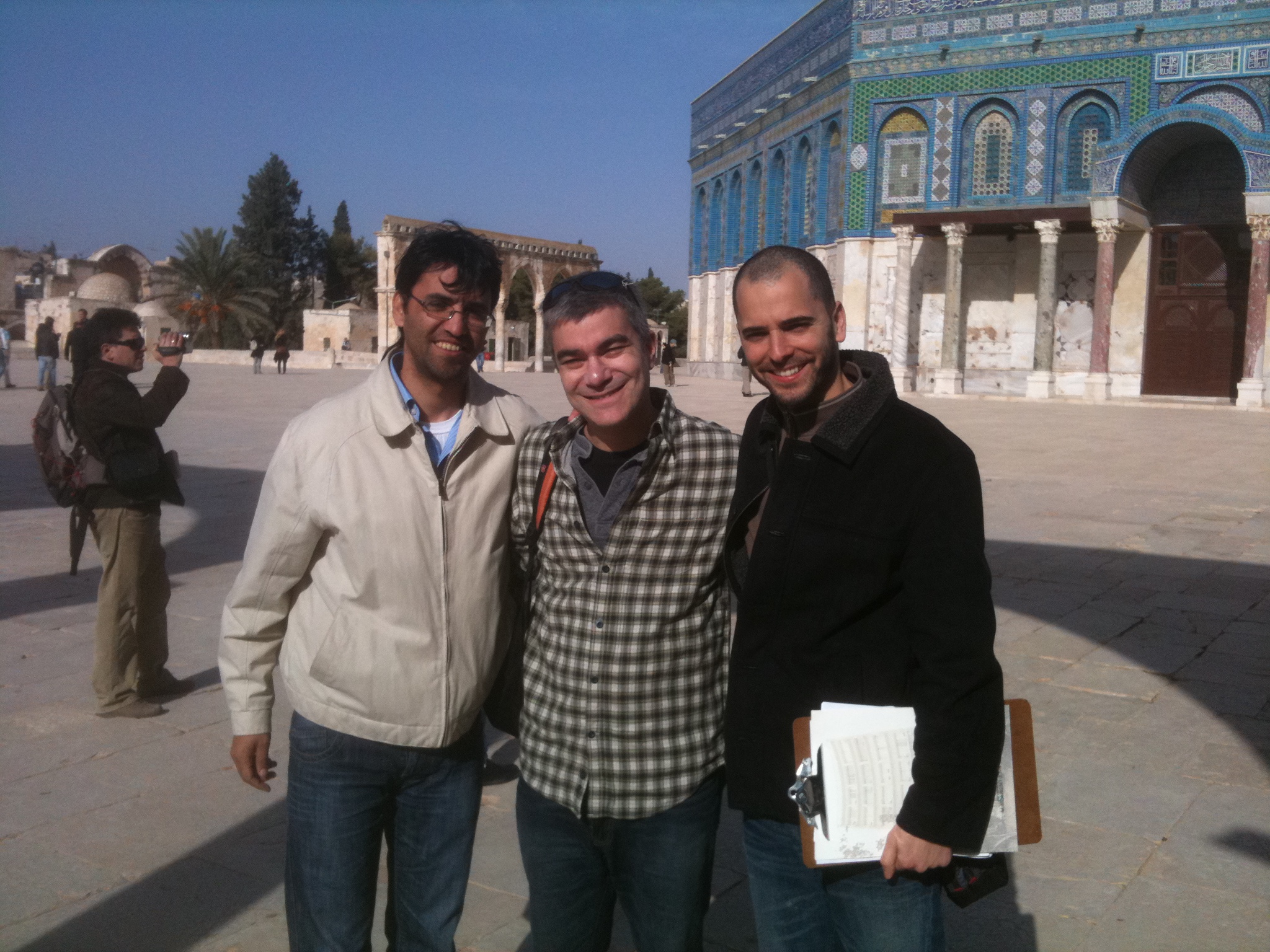
Among other things, the genuine friendship between Aziz and Kobi has powerfully affected the members of our group. Considering their respective backgrounds and personal journeys, their working relationship and very obvious affection for one another is moving and inspiring indeed. (The picture above was taken this morning at next to the Dome of the Rock. That’s me in the middle, with Aziz on the left and Kobi on the right.)
Tomorrow we’re off to tour East Jerusalem and Bethlehem before spending two nights in the Deheishe refugee camp. Stay tuned.
My next several posts will come from Israel/Palestine, where I will be traveling with 17 members of my congregation. Our itinerary has been designed so that we can explore I/P from a decidedly different vantage point than your average synagogue trip. I plan to blog as much as I can so please check in regularly for updates!
This past summer, Sara Smith, a young Jewish woman from Chicago, visited Israel/Palestine with two Palestinian-American friends. Sarah had never been and was interested in seeing for herself what life was like for Israelis and Palestinians. As she would later put it, “I went there so I could make up my own mind and talk about what I saw.”
On Friday, December 3, Sarah received a phone call from an FBI agent, who asked her if she could come in to answer some questions. When she asked what this was about, he said he “was not at liberty to discuss it.” She asked if she would need a lawyer present; the agent said it was up to her but that she was not in any trouble and that they just wanted to ask her a few questions.
Understandably alarmed, Sarah told the agent that she wanted to consult a lawyer and get back to him. She repeated that it would be easier for her if she knew what this was all about. He replied that it had to deal with the trip she had taken over the summer, adding ominously, “I think you know which one I’m talking about.”
I don’t think I need to speak in defense of her character. While she was in high school, Crain’s Chicago Business had a special edition called the “100 Most Influential Women in Chicago” and they chose my daughter as being one of Chicago’s six most influential and up-and-coming women high school students. Crain’s Chicago Business chose her partly because they saw she was willing to travel to different parts of the world and see for herself and to make up her own mind about what was happening over there. Evidently, the FBI thinks that there is something criminal in doing that.
I myself have done similar trips as Sara more than once. So have many of my friends and colleagues. This Sunday, I’m going to leave with 20 members of my congregation to visit Israel/Palestine so we can, yes, learn about “what life is like for Israelis and Palestinians.” (More on that very soon.) Is this now standard operating procedure in our country: visit Israel/Palestine to get a real look at the conflict, expect a subpoena from the FBI?
If this all sounds sadly familiar, you might remember that back on September 24, the FBI raided the homes of anti-war activists in Minnesota, Chicago and Michigan and issued subpoenas to 14 of them. To date, they have all refused to testify and US Attorney Patrick Fitzgerald has since withdrawn the summons. However, he recently reissued subpoenas to three Minnesota women who are facing “indeterminate imprisonment” if they continue refusing to testify.
It’s beyond egregious. Back in September, it looked like freedom of dissent was now a potentially punishable crime. This definition of “crime” has now apparently been extended to include honest curiosity about the world around us.
Please visit the website of the Committee to Stop FBI Repression to learn more and for details about how you can take action. Click here to sign a petition that tells President Obama, Attorney General Holder, US Attorney Fitzgerald, et al to stop this growing FBI campaign of repression now.
A number of leading rabbis who signed on to a religious ruling to forbid renting homes to gentiles – a move particularly aimed against Arabs – defended their decision on Tuesday with the declaration that the land of Israel belongs to the Jews.
Dozens of Israel’s municipal chief rabbis signed on to the ruling, which comes just months after the chief rabbi of Safed initiated a call urging Jews to refrain from renting or selling apartments to non-Jews.
Needless to say, the reaction to this noxious ruling has been nothing short of thunderous throughout Israel and the Jewish world. Israeli politicians from Netanyahu on down have publicly called out the rabbis on their racism. The New Israel Fund is disseminating “Rabbis Against Religious Discrimination” a statement that calls upon Israeli rabbis to “take a strong public stand” against “this painful distortion of our tradition.” At last count, 880 rabbis from around the world have signed on. Even the ADL has joined the fray in denouncing the ruling.
It’s been heartening to hear such an immediate and powerful Jewish communal response. Still, for all of the brouhaha, I’m struck – and fairly troubled – that there has been very little discussion of the fact that these rabbis are on the government payroll at all.
Indeed, it’s very easy to criticize rabbis such as this, but in truth, the mere existence of racist rabbis in Israel shouldn’t come as much of a shock to us. Truth be told, prominent Israeli rabbis have been disseminating xenophobia for some time now. Every religion has its religious extremist “spokespeople” – and Judaism is certainly no different on this score.
No, the real problem here is not the horrid personal beliefs of a handful of individual rabbis – the core issue is a political system that sees no problem in granting state authority to them – or to any clergy, for that matter. For me, this is the most disturbing aspect of this whole sorry episode: at the end of the day, these rabbis are ultimately part of a larger infrastructure of intolerance that inevitably results from wedding religion to nation-statism.
I was very happy to read that some left-wing Israeli politicians have gone as far as to call for the firing of the rabbis in question, but in the end, I’m just not convinced that this problem ultimately stems a few “rogue employees.” The real problem, I fear, has to do with a nation that claims to be both Jewish and democratic – but is finding it increasingly difficult to square that circle.
I first learned about these simultaneous events through Dana’s numerous tweets from the ground. Here’s a sampling:
– While the Human Rights March gets underway in Tel Aviv, I am on my to Ni’ilin/Nabi Saleh
– Ni’ilin demo underway while tel aviv marches
– While tel aviv marches for human rights, palestinians are attacked with tear gas
– Human rights day is underway, tel aviv is talking peace while ni’ilin and bil’in are under cover tear gas. I am on the way to nabi saleh
– 10000 people march in tel aviv for human rights and we could not get 20 israelis in ni’ilin. Upsetting
Dana later made the point explicitly in his blog post: for those interested in human rights, the real struggle is not occurring in the streets of Tel Aviv but in the villages of the West Bank, where Palestinian nonviolent activists are regularly brutalized by Israeli military forces. How differently things might have turned out if these thousands of Israelis had saw fit to demonstrate alongside Palestinians in Ni’ilin and Nabi Saleh?
The (Tel Aviv march) brought together various Israeli NGO’s and thousands of concerned citizens in the spirit of presenting a face of Israel that supports human rights and progressive values. Placards were carried through the streets supporting gay rights, woman’s rights, African refugees rights and, also, coexistence between Jews and Arabs. Police lined the streets of the demonstration to ensure the safety of the protesters and keep confrontation with the right wing counter protesters at bay (one has to hand it to the right in Israel, a counter protest to human rights?!). If the Tel Aviv Human Rights Day march wanted to have more authenticity in terms of Palestinian/Israeli coexistence, it should have had more connection with the human rights struggle happening simultaneously in the West Bank.
I’m in complete agreement. Those who seek human rights in Israel/Palestine would do well to support the cause of justice in the Occupied Territories – and in particular, the popular Palestinian committees whose demonstrations are regularly broken up by the IDF with violence and whose leaders are regularly imprisoned without cause.
I often wonder what Israeli leaders think they will achieve if they succeed in their goal of suppressing the Palestinian popular struggle? Is it possible that they believe that our people can sit quietly and watch as our land is taken from us? Do they think that we can face our children and tell them that, like us, they will never experience freedom? Or do they actually prefer violence and killing to our form of nonviolent struggle because it camouflages their ongoing theft and gives them an excuse to continue using us as guinea pigs for their weapons?
My eldest daughter Luma was nine years old when I was arrested. She is now ten. After my arrest she began going to the Friday demonstrations in our village. She always carries a picture of me in her arms. The adults try to look after her but I still worry for my little girl. I wish that she could enjoy her childhood like other children, that she could be studying and playing with her friends. But through the walls and barbed wire that separates us I hear my daughter’s message to me, saying: “Baba, they cannot stop us. If they take you away, we will take your place and continue to struggle for justice.” This is the message that I want to bring you today. From beyond the walls, the barbed wire, and the prison bars that separate Palestinians and Israelis.
Click here to send a letter to Secretary of State Clinton requesting that she advocate the release of Abdallah Abu Rahmah and demand that Israel cease its targeting of the Palestinian popular resistance.
This Thursday, December 16, at 12:00 pm (EST), Ta’anit Tzedek – Jewish Fast for Gaza will present a conference call, “Operation Cast Lead: Two Years Later” featuring American journalist Jared Malsin.
Call-in info:
Access Number: 1.800.920.7487
Participant Code: 92247763#
Jared Malsin served as the chief English editor of the Palestinian news agency Ma’an. He spent two and a half years reporting from the West Bank, based in Bethlehem.
In January 2010, while returning from a vacation in Prague, the Israeli government detained Malsin at Ben-Gurion airport after questioning him about his allegedly “anti-Israeli” political views, Palestinian contacts, and news articles authored “inside the territories.” Malsin spent a week in jail before he was deported to the US. His deportation was condemned by the head of the International Federation of Journalists as “an intolerable violation of press freedom.”
If you’re living in the West Bank or Gaza, your water gets shut off for a week or ten days at a time, in the summer, routinely. Which means that if you live in a refugee camp in Bethlehem, for a week or ten days in the summer you can’t wash yourself; you can’t wash your children. You can’t take a shower. You can’t cook food. It’s incredibly dehumanizing, but it’s one of these issues you just don’t hear about because there are no explosions going on. It’s one of these daily lived ways that people live occupation. And that’s what I think the real meaning of it is… Those are the stories I’m interested in.
The New York Times tells us that Israeli-Palestinian peace talks have fallen through because the Palestinians are “refusing to resume direct negotiations absent a (settlement) moratorium.”
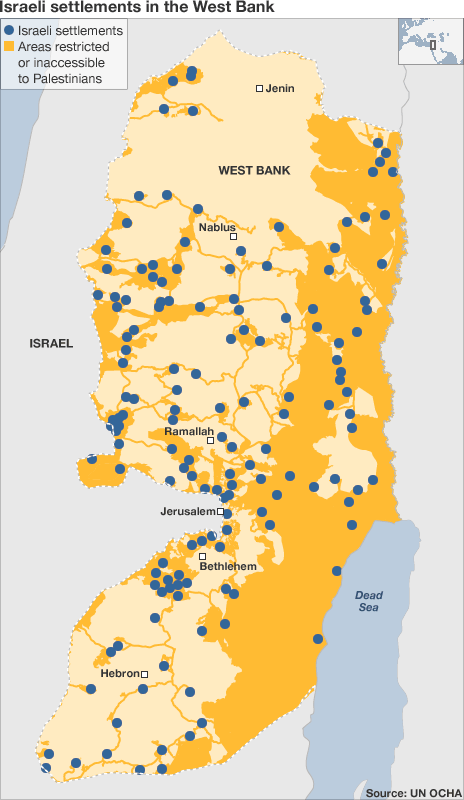
I’d say the map below (from a BBC article on the “settlement row”) explains everything you need to know about why the peace process has failed – and why a viable two state solution is well nigh impossible at this point.
We in post-Katrina America know a thing or two about a how a country can spend obscene amounts of resources on weapons of war while its basic home front preparations are left to languish. I well remember how back in 2005, even while the causalities in NOLA mounted, painful readiness issues were being publicly debated.
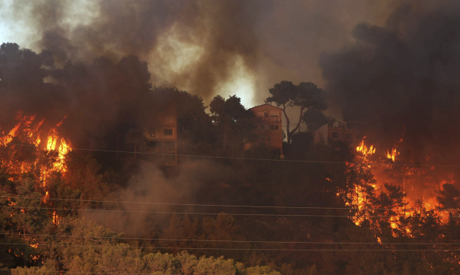
Now they’re asking the same questions in Israel. Israeli blogger Noam Sheizaf has placed direct blame at the feet of the Ministry of Interior, who may turn out to be the the Israeli equivalent of our Michael (“You’re doin’ a heck of a job, Brownie”) Brown:
By yesterday evening the supply of chemicals used in fighting flames ran out, and the firefighters had to settle for water. Israel issued an urgent request for help form other European countries, but for the casualties and their families it was too late…
Eli Yishai is the Interior Minister. Yesterday, when PM Netanyahu did the right thing and showed up at the emergency command center in Haifa, Yishai was nowhere to be found. Earlier, he tried to spin the story, blaming the finance ministry for the budget cuts.
Reuters pointed out that for all of its high tech military aircraft, Israel lacked even one even one water bombing plane:
Israel could buy three state-of-the-art Bombardier Superscooper firefighting planes for the price of just one of the F-35 stealth fighters it has on order.
The highly specialized amphibious aircraft, costing $28.5 million each, can scoop and drop six tones of water up to 10 times per hour on a fire that is near a big body of water. The Israeli blaze is only a few km (miles) from the sea.
But Israel does not have any. Instead it has to rely on Mediterranean neighbors who also face a constant wildfire risk and were prudent enough to buy the water-bomber aircraft. Greece has 21 of them, Croatia 6.
Israel instead has chosen to “improvise,” critics said. On Thursday night, airforce mobile water cannon designed to operate on flat tarmac could be seen trundling warily into position on steep earthen slopes, their range still quite inadequate.
By contrast, Israel has 360 F-16 fighters, far more than most countries outside the United States that have bought the world’s best-selling attack plane, not to mention many F-15s and the whole panoply of costly, advanced military aviation.
Under such circumstances, it is best for Israel not to embark on war against Iran, which will involve thousands of missiles being fired on the home front.
After the Second Lebanon War, which exposed how pathetic the civil defense system was, reports were written, exercises were held, but everything broke down under the stress of a real emergency on the Carmel range − an area that already experienced the trauma of Hezbollah missiles.
Yesterday Israel asked for help from Cyprus and Greece, and the air force traveled to France to bring fire retardants to make up for the material that had run out. In war time, it is doubtful whether Israel will be able to rely on the generosity and largess of its neighbors.
We can expect more recrimination and accounting in the days to come. In the meantime, however, I know our hearts and prayers are with all whose lives have been torn by this horrible tragedy that, as of this writing, continues to rage on.
As a Jew, I will also say without hesitation that I reject the view that I must choose between standing with Jews or standing with Palestinians. This is a zero-sum outlook that only serves to promote division, enmity and fear.
For me, the bottom line is this: the cornerstone value of my religious tradition commands me to stand in solidarity with all who are oppressed. It would thus be a profound betrayal of my own Jewish heritage if I consciously choose not to stand with the Palestinian people.
In other words, I believe my Jewish liberation to be intrinsically bound up with Palestinian liberation. It’s really that simple.
But of course, there is nothing simple or uncomplicated about it. To take such a step it is deeply painful in many ways. It means, among other things, facing down my peoples’ own potential for oppression; to admit that the state of Israel, born in the wake of persecution, has itself become a persecutor.
However, I must also admit that this pain, uncomfortable though it is, is nothing compared to the pain felt that is being experienced by the Palestinian people on a daily basis. Anyone person of privilege who stands in solidarity with the oppressed would do well to bear this in mind: while must we explore our own guilt and culpability, we must also bear in mind that it is not ultimately about us.
Solidarity…is a long-term participation in the struggle, understanding the part you play and how the issues affect you personally. As well, solidarity may very well mean not being the center of the solution, but just a small part. It may mean deferring your sense of authority and leadership. It can also mean dropping your own agenda for how change should be achieved. It can be very problematic when the leadership in an organization is people from the dominant culture. When people from the dominant culture define the issues or strategies for oppressed people it can be condescending and ineffective. So, an example of solidarity is being part of community organizing efforts led by people of color, womyn, etc in an active, but non-leadership role. Being in solidarity means seeing how you will benefit from the liberation of others.
And so today I’ll take this opportunity to say I stand in solidarity with the Palestinian people. But I’m not taking it to assuage my Jewish pain and guilt, nor to claim I personally know how this liberation must eventually be achieved.
In the end, I stand here because I know in my heart it is where I must be.
Just saw “Budrus” last night. (Why it takes independent films forever and a day to get to Chicago is beyond me. Aren’t we even considered a movie market any more? Sheesh…)
My two cents:
I think it’s a brilliant film in so many ways. I simultaneously experienced it as a compelling “how-to textbook” on grassroots organizing, an honest portrait of real nonviolent resistance in action, an up-close document of the human impact of the Occupation and a compassionate profile of life in one West Bank village.
It is also a masterfully constructed film that often transcends the documentary genre itself. Filmmakers Julia Bacha, Ronit Avni and Rula Salameh present us with a true story that has a genuine dramatic arc.
The story in short: in 2003, Ayed Morrar a remarkable Palestinian community leader, organized a nonviolent resistance movement to save his village Budrus from being destroyed by Israel’s Separation Barrier. He brought together an impressive coalition of local Fatah and Hamas members along with Israeli and international solidarity activists to resist the wall’s construction.
After some initial success, Budrus was put under military curfew and their resistance effort threatened to come apart. In the end, however, after ten months of steadfast resistance, the Israeli government relented and redrew the route of the fence, saving the village.
There is no question that “Budrus” is a profound and authentic document of what well-organized nonviolent resistance can truly achieve. It’s the kind of story that would move you even if it wasn’t actually true. And I won’t deny the story of these villagers’ courage left me deeply inspired.
And yet…
…and yet I must also confess to having a nagging feeling that there was one critical puzzle piece left out of the story. The film is essentially the document of one village and it more or less takes place within the bubble of this village’s exclusive universe. But I was somewhat disappointed that “Budrus” failed to explore the overall context of institutional oppression in which this one village’s story took place.
The film does indeed explain how the barrier cut significantly into Palestinian lands rather than simply follow the route of the Green Line. The filmmakers, however, never address the reasons why Israel chose to do this. There are many references to Israel’s security needs, but notably, no one ever asks the critical question: why, if security was the only reason for the barrier, didn’t Israel build it along the internationally recognized border between the West Bank and Israel proper?
The answer, of course, is that this wall is not just about security. It is also very much about about the settlements and about Israel’s desire to create its own unilateral border in advance of a final negotiated settlement. To wit: it is ultimately about taking land away from Palestinians.
If the film had included but one talking head to address this reality, viewers would understand the true stakes of Budrus’ struggle. But by leaving this context unexamined, the filmmakers essentially document one village’s travail without really explaining how it fits into a much larger injustice.
In truth, it must also be admitted that Budrus’ victory was and continues to be notably exceptional. While the film mentions briefly at the end that this kind of nonviolent resistance is ongoing in other West Bank villages, none of these villages have experienced anything near the level of Budrus’ success.
In fact, the exact opposite is happening. The Israeli military is brutally clamping down on the leaders of the popular committees that organize nonviolent campaigns. And although this repression is not regularly reported in the mainstream media, it is in fact unfolding on an almost daily basis.
Adeeb, by the way, was sentenced to one year but also remains in jail beyond his release date as the military prosecutors appeal his sentence. He will stay imprisoned “indefinitely” – which likely means for a long, long time. (That is Adeeb Abu Rahmah in the clip above. I encourage you to watch this incredible video document in its entirety if you can).
These kinds of actions, tragically, are taking a huge toll on local nonviolent resistance campaigns. With many of their leaders in jail or targeted for imprisonment, local committees (with the notable exception of Sheikh Jarrah) are reporting fewer numbers at their demonstrations. Those of us who are justifiably inspired by Budrus’ story should find these developments deeply, deeply troubling.
Bottom line? Please see “Budrus” and encourage your friends to do the same. Buy copies when it comes out on DVD and give them to anyone you know that needs to know that despite media portrayals to the contrary, there is a significant and important nonviolent resistance movement in the Palestinian community.
But after you see it, please don’t leave the film with the impression that this movement is experiencing the kind of success you’ve just witnessed. Israel is quite rightly threatened by Palestinian nonviolent resistance, and is currently doing its level best to crush this movement under its military heel. Alas, it is too often succeeding.
To learn more about these campaigns, you should regularly visit the blog of activist Joseph Dana, who has been indefatigably reporting from the ground in the West Bank and East Jerusalem. (He’s probably uploaded enough video onto his site to make hundreds of documentary films on the subject.)


 Shalom Rav
