Category Archives: Israel

Why I Support the Berkeley Student Divestment Resolution

I’m sure many of you have been following the huge communal dust up that has been swirling around a resolution recently passed by the Associated Students of UC Berkeley. Known as SB118, it calls for the ASUC to divest its holdings in General Electric and United Technologies because of “their military support of the occupation of the Palestinian territories.”

The bill further resolves:

(That) the ASUC will further examine its assets and UC assets for funds being invested in companies that a) provide military support for or weaponry to support the occupation of the Palestinian territories or b) facilitate the building or maintenance of the illegal wall or the demolition of Palestinian homes, or c) facilitate the building, maintenance, or economic development of illegal Israeli settlements on occupied Palestinian territories (and)

(That) if it is found that ASUC and/or the UC funds are being invested in any of the abovementioned ways, the ASUC will divest, and will advocate that the UC divests, all stocks, securities, or other obligations from such sources with the goal of maintaining the divestment, in the case of said companies, until they cease such practices. Moreover, the ASUC will not make further investments, and will advocate that the UC not make futher investments, in any companies materially supporting or profiting from Israel’s occupation in the above mentioned ways.

On March 18, after eight hours of dialogue and deliberation, the resolution passed by a vote of 16-4. After a barrage of criticism from Jewish community and Israel advocacy groups, the resolution was vetoed by the President of the ASUC on March 24. As things currently stand, the veto can be overridden by 14 votes. The final decision will be made on Wednesday April 14 at 7:00 pm (PST).

The most prominent Jewish statement of condemnation against the resolution came in the form of a letter co-signed by a wide consortium of Jewish organizations (including J Street, the ADL and The David Project) that called the bill “anti-Israel,” “dishonest” and “misleading.” Supporters of the resolution have mobilized as well: Jewish Voice for Peace recently responded to the consortium’s letter with a strong public statement and other prominent public figures, including Archbishop Desmond Tutu and Naomi Klein have voiced their support of the Berkeley resolution.

As I’ve written in the past, I do believe that the longer Israel’s intolerable occupation continues, the more we will inevitably hear an increase in calls for boycott, divestment and sanctions (BDS). I’m certainly mindful of what these kinds of calls mean to us in the Jewish community – and I know all too well how the issue of boycott pushes our deepest Jewish fear-buttons in so many ways. Despite these fears, however, I personally support the ASUC resolution.

While I understand the painful resonance that boycotts historically have had for the Jewish community, I truly believe this bill was composed and presented in good faith – and I am troubled that so many Jewish community organizations have responded in knee-jerk fashion, without even attempting to address to the actual content of the resolution.

It is also unfair and untrue to say that this resolution is “anti-Israel.” The bill makes it clear that it is condemning a crushing and illegal occupation – and not Israel as a nation. The wording of the resolution leaves no doubt that its purpose is to divest from specific companies that aid and abet the occupation – and not to “demonize” Israel itself. If a group of students oppose the occupation as unjust, then why should we be threatened if they ask their own organization to divest funds that directly support it? This is not demonization – this is simply ethically responsible investment policy.

Why, many critics ask, are the Berkeley students singling out Israel when there are so many other worse human rights abusers around the world? To answer this, I think we need to look at the origins of the BDS movement itself. This campaign was not hatched by the Berkeley students, or even by international human rights activists. It was founded in 2005 by a wide coalition of groups from Palestinian civil society who sought to resist the occupation through nonviolent direct action.

In other words, BDS is a liberation campaign waged by the Palestinian people themselves – one for which they are seeking international support. By submitting this divestment resolution, the Berkeley students were not seeking to single out Israel as the world’s worst human rights offender – they are responding to a call from Palestinians to support their struggle against very real oppression.

The JVP statement (see above) makes this point very powerfully:

Choosing to do something about Israel’s human rights violations does not require turning a blind eye to other injustices in the world as these groups suggest; but refusing to take action because of other examples would indeed turn a blind eye to this one. Now is the time to support Palestinian freedom and human rights. Berkeley students have done the right thing. Others should follow suit and divest from the occupation, as part of their general commitment to ethical investment policies.

I believe that the actions of these Berkeley students represent an important challenge to those of us who believe that Israel’s occupation equals oppression. Quite simply, we cannot stay silent forever. Sooner or later we will have to ask ourselves: when will we be willing to name this for what it really and truly is? When will we find the wherewithal to say out loud that this policy of home demolitions, checkpoints, evictions, increased Jewish settlements, and land expropriations is inhumane and indefensible? At the very least, will we be ready to put our money where our moral conscience is?

I know that this debate is enormously painful. And I respect that there are members of the Jewish community who disagree with this campaign. But I must say I am truly dismayed when I witness the organized Jewish community responding to initiatives such as these by simply crying “anti-Semitism.” For better or worse, we are going to have to find a better way to have these conversations. Because whatever happens with the ASUC resolution tomorrow, we haven’t heard the end of this movement by a longshot.

This summer, in fact, the Presbyterian Church General Assembly will be taking up a number of resolutions related to Israel/Palestine, including one that recommends divestment from Caterpillar because the company knowingly supplies Israel with bulldozers that are used for illegal (and deadly) home demolitions in the West Bank and Gaza. I’m sad to see that the organized Jewish community is already gearing up for another major confrontation…

If you would like to write a letter to the UC President and UC Berkeley Chancellor before the April 14 vote, click here.

Addendum (April 14): UC Berkeley Professor Judith Butler has written an incredibly eloquent defense of the resolution that she will reportedly read today to the ASUC Student Senate before their override vote. Click here to read it in full.


Ashley Bates Dispatches from Gaza

For an in-depth eyewitness view of life in Gaza, you’ll do no better than, Dispatches from Gaza, a new blog just launched by a young journalist named Ashely Bates.  Ashley has been in Israel/Palestine on on a three month internship for Ha’aretz and in late March she entered Gaza to write free-lance. She’s pitching her articles to various publications – in the meantime her extensive reportage is available via her blog.

Ashley is an amazing and accomplished young woman. Before getting her journalism degree from Northwestern University, she spent two years working for the Peace Corps in Jordan (where she became fluent in Arabic.) She currently works as the Program Director for the Chicago area co-existence program Hands of Peace, which is where I originally had the pleasure of meeting her.

Bookmark her blog. It offers the kind of on-the-ground reportage from Gaza that you will never, ever find in the mainstream media.

An example:

I met today with a soft-spoken village man named Abu Ala’a who is suffering from a serious but treatable spinal condition which is causing him to slowly loose sensations in his limbs. He walks with a limp and can barely feel his left leg. His condition has reached a critical point, and if does not get emergency surgery within the month, he could suffer permanent paralysis, according to his doctor. The Gazan health ministry has requested permission from the Israeli, Egyptian and Jordanian authorities to have him treated abroad, because doctors in Gaza do not have the skills and equipment necessary for the delicate and dangerous operation.

Abu Ala’a wanted me to print his story in an Israeli newspaper because he hoped Israeli civilians might read my article and press the Israeli government to grant him a medical visa. He’s also considering one final, desperate option. “If there’s no other way, I’ll go through the tunnels,” he said, looking at the ground. “I know it’s dangerous, but not more dangerous than the danger of being disabled for the rest of my life.”

Yom Hashoah: A Day to Affirm Universal Human Rights

I can think of no more powerful meditation for Yom Hashoah 5770 than this Huffington Post piece written by Steven Gerber and Rabbi Michael Schwartz, both of Rabbis for Human Rights.

An excerpt:

It is interesting to note how two very different sets of “responses” to the Shoah are heard frequently amongst Jews here in Israel and around the world. These two different responses reflect a shared sense of urgent necessity in responding here today because of what happened there then. At the same time they demonstrate almost opposite worldviews and understandings of Israel’s purpose, and lead toward totally inverse political perspectives and often contradictory activist involvements.

One response is that, essentially, Israel must do anything it wants or needs to do in order to defend itself from hateful enemies set on perpetrating a second holocaust by destroying both the Jewish State and the Jewish People along with it.

The other response is that precisely because of our experience as Jews in the Holocaust and through our history littered with injustice and tragedy, we ourselves must make sure that Israel of all places is a nation that stringently safeguards human rights even in the most difficult of circumstances and establishes, in the words of Israel’s Declaration of Independence, a nation that “foster[s] the development of the country for the benefit of all its inhabitants; [a nation] based on freedom, justice and peace as envisaged by the prophets of Israel.”

Indeed, both the physical and spiritual security of the Jewish People and the State of Israel is best guaranteed by the strength of Israel’s democracy and the rule of just law, its commitment to human rights, and – ultimately – to the achievement of peace.

On this day in which we recall the Jewish people’s loss of human rights, let us ensure that the Jewish state embodies these rights on behalf of all its citizens.

On this day in which we remember the tragedy of our people, may we redouble our efforts on behalf of all people who dwell on earth…

Join a Conversation With Young Gazans

Ta’anit Tzedek’s next monthly fast day is Thursday, April 15. To mark the occasion we’ll be sponsoring the second monthly phone conference of our new initiative, Resisting the Siege: Conversations with Gazans.

This month our call will spotlight the Popular Achievement Program in Gaza – a project of the American Friends Service Committee.  This remarkable program works with 14-17 year old Gazan children, instilling values of civic engagement and empowerment to achieve positive social transformation and sustainable development in their communities.  As you can see from the clip above, these kinds of programs demonstrate the critical importance of strengthening Palestinian civil society. Initiatives such as the Popular Achievement Program – not blockades and bombs – are the true key to security for Gazans as well as Israelis.

On our call we will be joined by Popular Achievement director Amal Sabawi and two teenage program participants, Sarah and Roba Salipi, who will discuss how they live with the daily challenges of life in Gaza.

Here’s the call info:

Thursday, April 15, 12:00 pm EST

Toll Free Number: 1-800-868-1837
Direct Dial Number: 1-404-920-6440
Conference Code: 775326#

For those of you who live in the Chicagoland area, Ta’anit Tzedek will also be sponsoring a program, “Dignity Under Siege,” an evening of interfaith reflection, conversation and action on behalf of the citizens of Gaza. Our featured speaker will be Mark Braverman, a longtime advocate for peace and justice in Israel/Palestine and author of the recently published “Fatal Embrace: Christians, Jews, and the Search for Peace in the Holy Land.”

The gathering will take place at the Evanston Galleria, 1702 Sherman Avenue, Evanston, at 7:30 pm. Check the Ta’anit Tzedek website for more info.

Bearing Witness to Collateral Murder

If you ever needed a reminder of the utter obscenity that is war, just watch this clip.

On July 2007, two American Apache helicopters fired on a group of people in the Iraqi suburb of New Baghdad, killing approximately a dozen and wounding many others, including two children. The background of most of the dead are unknown but we do know that among the dead were two Reuters news employees named Saeed Chmagh and Namir Noor-Eldeen.  Following the incident, Reuters demanded an investigation; US military authorities eventually concluded that the soldiers and pilots involved acted in accordance with the law of armed conflict and their Rules of Engagement.

Wikileaks has now obtained and decrypted a video of the entire incident.  After watching it there can be no doubt that the US military acted counter to its own rules – and that its “investigation” was an utter sham. According the Rules of Engagement, soldiers may only “engage the enemy” after hostile fire – but it is quite evident from the video that this firefight was clearly unprovoked.  At worst some of the men walking in the streets appeared to be carrying weapons. Potentially threatening, perhaps, but not in and of itself cause to open fire without warning.

The images in this video are graphic and disturbing enough, but what I found to be most devastating were the offhand, casual, even mocking comments of the soldiers as they mowed down these individuals in the streets. They might as well have been been playing a video game – and perhaps that is just the point. Among other things, this clip provides sobering testimony to the profoundly dehumanizing effects of war. (For me one of the most sickening moments in the video occurs when you hear one soldier chortling as another drives a  Bradley Fighting Vehicle over a dead body in the street.)

“Collateral damage,” of course, is the euphemistic term for the killing of innocents. Those who advocate for war consider the killing of civilians in wartime to be a regrettable but necessary part of the bargain. No doubt we will hear this justification all the more as modern militaries increasingly utilize drones and other forms of high tech military hardware. The more we turn war into a video game, the more we create an artificial distance between ourselves and the ones with whom we wage war. But rarely do we stop to consider the ripple effects of this “collateral damage:” the untold sorrow and grief it creates, the anger and hatred it unleashes in a population.

I encourage you, after watching the video, to read Israeli blogger Yaniv Reich’s piece in Hybrid States, in which he makes the unavoidable connection between this incident and Israel’s war in Gaza and the Goldstone Report:

Those ideologues who supported Israel’s onslaught against the imprisoned population in Gaza need to spend a few extra minutes watching and digesting this video. What this video shows is the massacre of about a dozen people in Iraq, and it shows how very easy it is for even the mightiest and most technologically advanced military in the world to butcher innocents. But we miss thousands of other such videos, which did not make it to Wikileaks.

The images in this video are extremely graphic and unsettling. But I think we at least owe it to ourselves to bear witness to the carnage we ourselves are enabling through our tax dollars – and our silence.

Next Year in a Jerusalem for All its Citizens

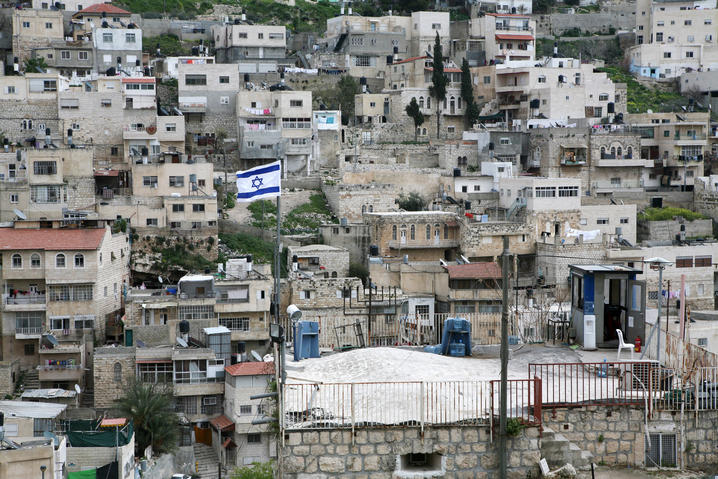
Jewish settlement in Silwan, East Jerusalem (photo from Activestills)

The words “Next Year in Jerusalem”  seriously stuck in my throat at seder this year.

I know that these words are largely a spiritual metaphor.  I know that for centuries of Jewish history these words referred to a messianic vision of the future and not literal immigration. Still, given the political realities of the day, it’s just so very to difficult to separate spiritual metaphor from literal facts on the ground.

It was enormously difficult for me to proclaim “Next Year in  Jerusalem” together with Jews the world over knowing that right now in Yerushalayim Shel Mata (“earthly Jerusalem”), non-Jewish residents are being evicted from their homes and the construction of Jewish residences are increasing with utter impunity. By any other name this would be called “ethnic cleansing,” and I have no trouble saying so.

Many will claim that Jews have a right to build houses anywhere that they please. That is not the issue. This issue, of course, is that Palestinians in Israel do not. Others will say that the government is only building in parts of Jerusalem that “everyone knows” will be always be part of Israel anyway.  This is, in fact, exactly what Netanyahu claimed in his address at the recent AIPAC Policy Conference:

Everyone knows that these neighborhoods will be part of Israel in any peace settlement. Therefore, building them in no way precludes the possibility of a two-state solution.

This claim is hogwash. If you would like to know why, please read this article by Danny Seidemann and Lara Friedman, who understand the recent history and politics of Jerusalem better than just about anyone:

What Netanyahu really means is that East Jerusalem land falls into two categories: areas that “everybody knows” Israel will keep and where it can therefore act with impunity, and areas that Israel hopes it can keep, by dint of changing so many facts on the ground before a peace agreement is reached that they move into the first category.

It is an approach that can be summed up as: “what’s mine is mine, and what you think is yours will hopefully be mine, too.” It discloses with stark clarity the underlying principle of Netanyahu’s Jerusalem policies: the status of Jerusalem and its borders will be determined by Israeli deeds rather than by negotiations. More bluntly, who needs agreement with Palestinians or recognition of the international community when “everybody knows”?

And it is an approach that we see today on the ground, where Israel is doing its best — through construction, demolitions, changes in the public domain — to transform areas of East Jerusalem that have always been overwhelmingly Palestinian into areas that everybody will soon recognize as Israeli, now and forever. This is happening in the area surrounding the Old City, in the heart of Palestinian neighborhoods like Ras al Amud and Jebel Mukabber, and it is now starting to target areas like Shuafat and Beit Hanina.

The notion that a peace process can survive such an Israeli approach in Jerusalem is not rational.  The notion that Israel can be taken seriously as a peace partner while acting this way is farcical.  And the notion that the United States can be a credible steward of peace efforts while tolerating such behavior is laughable.

Next year in a Jerusalem for all of its citizens…

“Iran May Be Radical, But It’s Not Meshugeneh…”

Orly Halpern’s very wise piece in Foreign Policy:

For years now, official Israel has been scaring its people into believing Iran is near the ‘point of no return’ and the day it reaches it will be doomsday for Israel (of course, Israel’s estimated ‘point of no return’ dates continuously pass, prompting it to make new ones). But the Israeli establishment knows that there is no existential threat, that the Iranian regime is radical, but not suicidal; that if it is building weapons of mass destruction (WMD), it is in self-defense.

So why all the hype?  Why the deception?  The reasons are many, but they come down to money, politics, and security.

In other words:

Money: Israel’s military establishment is inflating Iran’s existential threat in order to obtain a bigger military budget.

Politics:  Israeli politicians are using Iran to divert attention away from “thorny domestic problems at home.”

Security: Israel claims that Iran might share its nuclear know-how with “non-state actors.”

On this last point, Halpern concludes:

If Israel really does fear this prospect it needs the help of its allies, either to pressure or persuade Iran. So when Vice President Biden comes to town it is best not to embarrass him with the announcement of settlement expansions and then insist on making more announcements that deepen the rift; when Turkish television broadcasts a television series depicting Israel in an ugly manner, best not to humiliate the Turkish ambassador on Israeli television; when the Secretary General of the UN visits, best to send someone to greet him at the airport, and not just the security guards; and when Israel wants to make a revenge assassination for the killing of Israeli soldiers, best to let it go, rather than use fake passports of your allies (or don’t get caught).

Israel’s recent behavior is not conducive to achieving its stated goals. It must reassess its priorities and decide whether a settlement in the West Bank, the humiliation of diplomats, and the killing of an arms smuggler are more important than its security.

At the end of the day, Israel needs help if it wants to remain the only kid on the block with a big stick.

Passover Supplements Galore!

The Passover 2010 seder supplements are arriving fast and furious. In my last post I shared my JVP supplement – here are a few more you can download and use to spice up your seder meal:

– The “Moral Voices” initiative of Penn Hillel has published “From Chains to Change” – a supplement that connects the lessons of Pesach to the contemporary scourge of human trafficking;

– Workingman’s Circle’s “10 Modern Plagues” demonstrates how our contemporary bounty is diminished by the suffering of others;

– J Street’s supplement asks “Four More Questions” about the prospects for the peace process in the coming year;

Tikkun Magazine’s supplement, thoughtful as ever, is so verbose that it could be its own haggadah…

The new supplement created by American Jewish World Service focuses on disaster relief:  “Dayenu: Supporting the Long Journey from Disaster to Recovery;”

– Jewish Funds for Justice highlights immigration reform with “For We Were Strangers;”

A print-out placemat from Mazon asks a 5th question: “Why On This Night are Millions of People Going Hungry?”

A zissen Pesach – all the best for a sweet and liberating Passover…

Father Cotton Blogs From Israel/Palestine

My dear friend and colleague Father Cotton Fite of St. Luke’s Episcopal Church in Evanston has been traveling in Israel/Palestine these past few weeks and has been blogging about his experiences. Anyone who knows Cotton knows his gentle, compassionate spirit and his rock solid commitment to fairness and justice. I’m sure you will agree that all of these qualities come through in abundance on his recent posts.

Before Cotton left, I hooked him up with Rabbi Brian Walt, my other dear friend and colleague who happens to be sojourning in I/P. Here’s Cotton’s report of their experiences in Jenin a few days ago:

On Sunday I traveled to Jenin with Rabbi Brian Walt, the co-founder Ta’anit Tzedek – Jewish Fast for Gaza, to visit the Palestinian Fair Trade Association and Canaan Fair Trade facility that produces the wonderful olive oils, Za’atar, olives and couscous now available in the US through Whole Foods. After a tour of the facility we visited one of the farmers who is a member of the cooperative. As we introduced ourselves our host said (through a translator) “I do not understand how a people who have suffered so much can turn around and inflict that same suffering on others.” Later, after coffee and apricot nectar had been served, Brian responded to our host. I’m sure I don’t have his exact words, but he told our host that he shares his sadness at the suffering of the Palestinian people and wants him to know there are other Jews who are deeply sorry for the suffering they experience. It was a privilege to be present at a moment of such honesty and compassion…

(Later) we were driven…to the Khalandia check point through which we would reenter Israel and catch a bus to Jerusalem. I had walked through this check point before so was accustomed to the routine. Brian, however, had not, and was stunned. At one point there is what can only be described as a cattle chute through which everyone must pass waiting to be admitted to the x ray machine and the soldier to whom permits and visas are presented. We passed without incident, but with a painful reminder of the humiliation Palestinians experience daily.

Brian and I talked the following day. We acknowledged the emotional impact the experience had on both of us and and our decision to give ourselves a day “off” to recover. Our Palestinian brothers and sisters never get a day off from an occupation that is now at 42 years and counting.