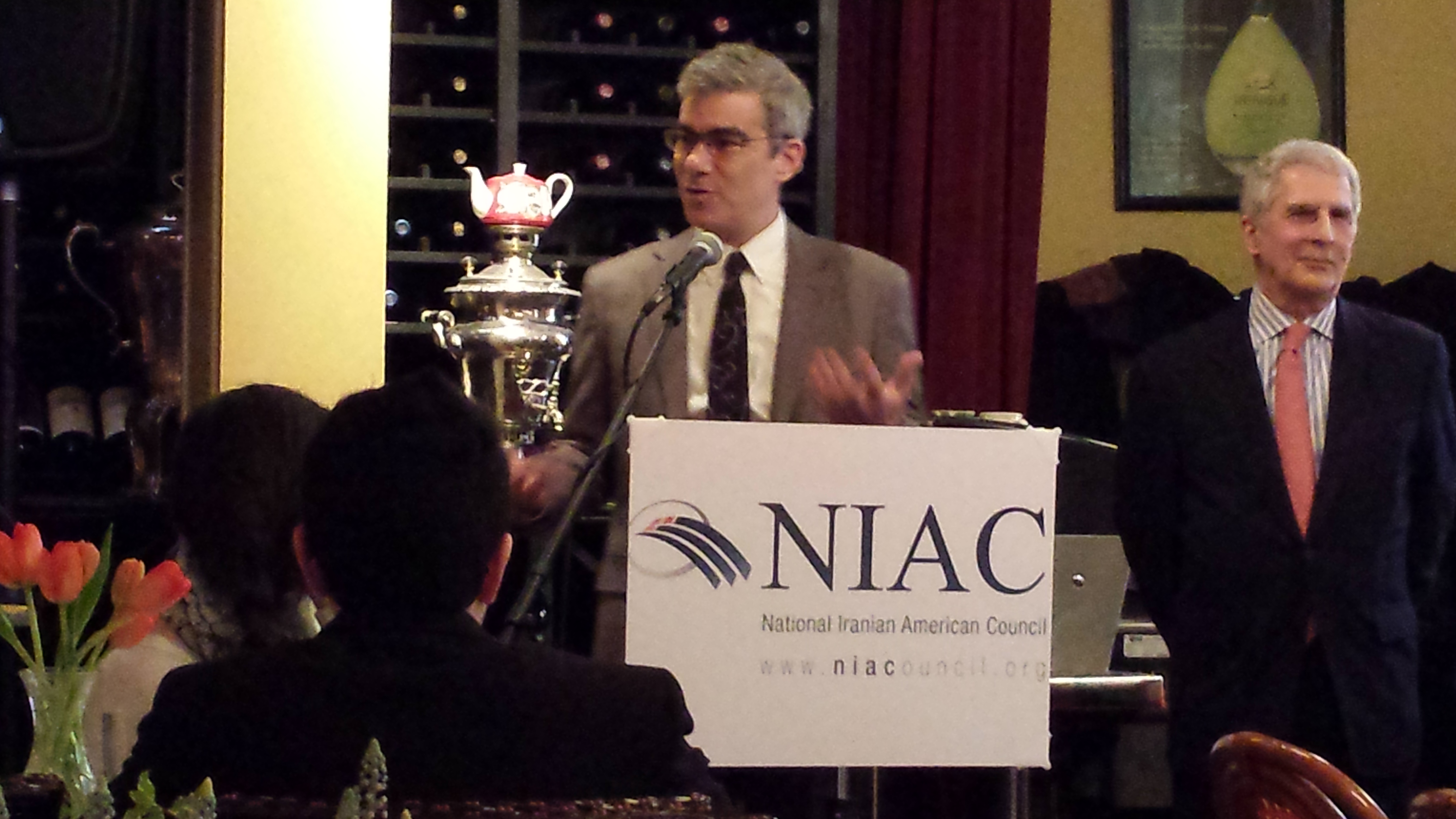
Addressing the NIAC Chicago Nowruz Celebration, March 16, 2014 (photo: Roxane Assaf)
Like many American rabbis around the country, I spent the most of the day yesterday leading my congregation’s noisy, joyously raucous Purim celebration, complete with a carnival and a family Megillah reading. As per usual, we read a somewhat watered-down version of the Book of Esther – one that characteristically kept the sexual hijinx and violence to a minimum. Even with our PG version, however, there was no getting around the decidedly darker aspects of the Purim story – particularly the infamous ninth chapter in which we read that the Jews of Persia slew 75,000 Persians then celebrated the day after with a festival of “feasting and merry making.”
As always, this part of the story stuck seriously in my throat. While we adults can intellectualize the more disturbing parts of the Purim narrative (“it’s irony,” “it’s a revenge fantasy,” “it’s cathartic,” “it’s not meant to be taken seriously, after all…”) I’m just not sure we do any favors to our children when we read these kinds of stories to them, even in censored form. I’m fast coming to believe it’s time to tell a fundamentally different version of the Purim story to our children – one that celebrates the venerable Persian-Jewish experience rather than cynically telling a Persian version of “when push comes to shove, all the world really just wants the Jews dead.”
I’m also mindful that there are all too many adults who are willing to take the Purim story literally. I’ve written before about the disgusting Purim violence annually inflicted against the non-Jewish population in Israel. And on a geopolitical level, leaders of the state of Israel (and many in the American Jewish establishment) have openly and unabashedly used the Purim story to frame our relationship to Iran – presenting present day Ayatollahs and Mullahs as nothing less than Haman incarnate and promoting all out war as the only way to settle the current nuclear impasse.
For all this, however, I’m happy to report that Purim ended for me on something of a redemptive note this year.
As it turns out, the Persian New Year known as Nowruz is fast approaching and last night, I was thrilled to attend a Nowruz party sponsored by the Chicago chapter of the National Iranian American Council (NIAC). So after I got home from my congregation’s Purim carnival, I took off my clown costume, put on a suit, and drove to a suburban restaurant where I celebrated the coming of spring with Chicago’s Persian community and supported the important work of NIAC, which among other things supports a “policy of persistent strategic engagement with Iran that includes human rights as a core issue.”
When I addressed the gathering (above), I thanked them for reaching out to me and explained that ever since I returned from a visit to Iran in 2008, I’ve always hoped to score a Nowruz party invitation from my Persian friends. I also explained why celebrating Nowruz with NIAC was for me the perfect, redemptive coda to Purim. And I added that contrary to the impression created by some Israeli politicians and Jewish institutional leaders, there were many in my community who believed that the current crisis should be settled through diplomacy and engagement and not an inexorable march to war.
Now I’m thinking there might well be something to this Nowruz/Purim celebration. Can’t think of a better way to, in words of the Book of Esther, “turn grief and mourning into festive joy….”



 Shalom Rav