In my Yom Kippur sermon I revealed that I considered Rabbi Yohanan Ben Zakkai, a 1st century Jewish sage, to be my personal Jewish hero – and that I considered his story to be a defining Jewish story.
Click below for more:
In my Yom Kippur sermon I revealed that I considered Rabbi Yohanan Ben Zakkai, a 1st century Jewish sage, to be my personal Jewish hero – and that I considered his story to be a defining Jewish story.
Click below for more:
From my Yom Kippur eve sermon last Sunday night:
If the Torah teaches us that human beings are made in the image of God, which image of God will we proclaim? The God of fear or the God of forgiveness? The God of hatred or the God of compassion? The God of xenophobia or the God of justice? And if our answer is indeed the latter, then we must affirm it. We must bear witness to this image of God in no uncertain terms. History teaches all too well what the God of hatred can do in our world. Those of us who reject this theology must be ready to do so without hesitation – to actively promote the God of compassion.
Click below to read the entire sermon:
From my op-ed in this morning’s Sunday Chicago Tribune:
The actions of the Jewish State ultimately reflect upon the Jewish people throughout the world. We in the Diaspora Jewish community have long taken pride in the accomplishments of the Jewish State. As with any family, the success of some reflects a warm light on us all. But pride cannot blind us to the capacity for error on the part of the country we hold so dear. We cannot identify with the successes, but refuse to see the failures.
As we approach Yom Kippur, I call on America’s Jews to examine the Goldstone findings, and consider their implications. In the spirit of the season, we must consider the painful truth of Israel’s behavior in Gaza, and understand that we must work, together, to discover the truth — and then urge on all relevant parties in the search for peace.
During my Rosh Hashanah sermon, I asked the following questions:
Is there a place in Judaism for pacifism? Is it in fact possible – or desirable – as a Jew, to walk the path of nonviolence?
Click below to read my answers…
From my sermon this past Rosh Hashanah eve:
How do we discover the true meaning of spiritual commitment in our lives? Perhaps the first step is simply taking a closer look at our lives themselves. Maybe, just maybe, the source of our emunah is much closer than we think. On Rosh Hashanah we say in our liturgy “Hayom Harat Olam” – on this day the world is born. Your entire life has been leading up to this moment. Take the time to look back. What has led you here to this place tonight? Who are the people who have helped to guide you on your journey? What are the memories and experiences that you continue to hold sacred? And, finally, how will you transform them into faithful action? How will you commit to them honor them in the coming year and the years after that?
Click below for the entire sermon:
Learn to do good, seek justice; relieve the oppressed. Uphold the orphan’s rights; take up the widow’s cause. (Isaiah 1:17)
This classic verse comes from the Haftarah portion for this Shabbat. It is the final so-called “Haftarah of affliction” coming annually on the Shabbat before the festival of Tisha B’Av. Beginning next week our prophetic portions will offer messages of consolation, reminding us that the path of return to righteousness is always open to us. Indeed, it is this very message that will guide us into the High Holiday season itself – the season of our return.
As I read this passage this year, I was mindful of a very similar passage that will appear in the Haftarah of Yom Kippur, also from the book of Isaiah:
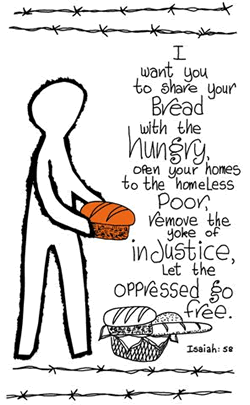
No, this is the fast that I desire: to unlock fetters of wickedness and untie the cords of lawlessness; to let the oppressed go free and break off every yoke. It is to share your bread with the hungry, and to take the wretched poor into your home; to clothe when you see the naked, and never forget your own flesh (Isaiah 58:6-7).
In a way, these two similar Isaiah passages seem to represent spiritual bookends to the High Holiday season. These characteristically prophetic calls to justice and repentance guide us through our High Holiday journey, reminding us not only of our seemingly chronic hypocrisy but also of the eternally simple route to return: “learn to do good, free the oppressed, feed the hungry…”
As many of you know, our recently organized Fast for Gaza has cited Isaiah 58 as a kind of spiritual prooftext to our initiative. As it turns out, ever since we’ve launched this project I’ve been in a kind of dialogue with more than one correspondent over this particular verse. Several people have already written to me that we’ve misinterpreted Isaiah. It appears that for some, calling a Jewish fast in support of Gazan Palestinians rather than Jewish Israelis represents a betrayal of this prophetic imperative (not to mention the Jewish people.) As one writer put it, “never forget your own flesh” means “charity begins at home.”
This criticism motivated me to do a bit of digging into the source material. As it turns out the Hebrew word for “your flesh” – b’sarcha – can indeed refer to blood relations or kin. But interestingly, according to the Brown, Driver, Briggs Biblical Dictionary (p. 142), this term can also mean “all living beings” (occurring in this usage at least 13 times throughout the Bible.)
So, in fact, there is good, solid linguistic evidence to reject this narrow, tribal reading of Isaiah. Now I’m certainly willing to admit that this passage might have referred only to fellow Israelites when it was originally written. But today we live in a fundamentally different time than the ancient Israelites. In our globalized, post-modern world, the Jewish community has become inter-dependent with others in profound and unprecedented ways. Whether we are prepared to admit it or not, our Jewish security, our Jewish destiny is now irrevocably bound up with the destiny of all peoples and nations of the world.
I am well aware that this viewpoint represents a distinctly 21st century Torah. I also have no illusions that it will be a simple matter for the Jewish community to heed this call. Having only recently emerged from the ghetto, still living with a collective memory of anti-Semitism, still reeling from the trauma of the Holocaust, it will necessitate a radical shift in consciousness to understanding our place in the world in such a way.
It will not be easy, but I believe it will be essential. It can no longer be us against them. At the end of the day, we are all one flesh.

Since we launched the Jewish Fast for Gaza, we’ve received all kinds of feedback, some supportive, some critical, some utterly unprintable. (My personal favorite from the latter category: “You should all get severe stomach ailments.”)
On occasion, however, our effort has offered us the opportunity for genuinely respectful dialogue. Below is one such exchange – an email I received from a rabbinic colleague, followed by my response:
Dear Ta’anit Tzedek,
Having cares and concerns of the plight of humanity is a most noble cause. That you are willing to extend effort is most commendable. Your organization, however, is extending its efforts in a manner which is not only counterproductive, but can be harmful as well.
How can you look into the face of a 12 year old girl from Sderot who suffers from post traumatic syndrome as for most of life she has been awakened on a nightly basis by sirens and rocket fire? What do you say to the families of victims killed by suicide bombers who killed their teenagers who were casually enjoyed a slice of pizza? What do you say to an organization whose very goal is the annihilation of our people?
You may answer, “Had we been better, they may have liked us more.” or some such configuration thereof. It’s not plausible. Since 1948, the goal of the Arab world has been the removal of a Jewish presence in the middle east. Our interference with their dream of a Pan-Arabic state stretching from Morocco to Iraq is sullied by our very presence.
It would better for your organization to spend is resources on ideals that truly further the continuity of Jews and Judaism.
I await your response,
Rabbi X
Dear Rabbi X,
I want to thank you for taking the time to reach out and respond to our initiative. I’m glad to have the opportunity for this dialogue.
You ask what I would say to the 12 year old girl from Sderot or the families of terror victims. I believe I would say that as a fellow Jew that their pain is my pain as well. I would say that I could not begin to comprehend the realities they must face. But I would also share my belief that that Israel’s current treatment of the people of Gaza will bring them neither safety nor security – and that the only true way out of these traumas is a lifting of the blockade and the negotiation of a settlement by all parties involved.
As regards Hamas “whose very goal is the annihilation of our people:” though I have no love lost for Hamas, the reality is that Israel will have to deal with them if any true peace will be achieved. And in truth, Israel has already dealt with Hamas through any number of channels over the years already. Making peace is a sacrosanct Jewish value – and as difficult as it is, the truth is that we make peace with our enemies. In the past, Israel has made peace with former enemies whom we once believed sought nothing but our “annihilation.” To surrender this value means to doom the people of this region to endless violence and tragedy.
Thus we do indeed believe that this effort furthers the resources of Jews and Judaism. We do not hold that the only Jewish path is the one that addresses Jews and Jewish “needs” alone. In the case of Jews and Palestinians in particular, our fates are fundamentally intertwined: we will either live together or else we will die together. The Jewish path has always been to choose life – this sacred imperative is at the core of our initiative.
Thank you again for sharing your thoughts with us. Even as we may disagree, I hope you will share my conviction that our conversation is a “machloket l’shem shamayim” (“argument for the sake of heaven.”) I also know that you join with me in prayers for peace for this tortured region that is so dear to both of us.
Kol Tuv,
Rabbi Brant Rosen

In response to the dire humanitarian crisis in Gaza, my dear friend and colleague Rabbi Brian Walt and I have organized a new initiative, Ta’anit Tzedek – Jewish Fast for Gaza.
See below for the press release about the project, which is already attracting increasing numbers of supporters, including many rabbis. Click the link above to visit the website and sign up yourself…
RABBIS ANNOUNCE MONTHLY FAST FOR GAZA
Seeking “to end the Jewish community’s silence over Israel’s collective punishment in Gaza,” an ad-hoc group of American rabbis has called for a communal fast. Known as Ta’anit Tzedek – Jewish Fast for Gaza, this new initiative will organize a series of monthly fasts beginning on July 16.
The project was initiated by a group of thirteen rabbis representing a spectrum of American Jewish denominations. The group’s website explains the religious meaning of the campaign: “In Jewish tradition a communal fast is held in times of crisis both as an expression of mourning and a call to repentance. In this spirit, Ta’anit Tzedek – Jewish Fast for Gaza is a collective act of conscience initiated by an ad hoc group of rabbis, Jews, people of faith, and all concerned with (this) ongoing crisis…”
The fast has four goals: to call for a lifting of the blockade, to provide humanitarian and developmental aid to the people of Gaza, to call upon Israel, the US, and the international community to engage in negotiations with Hamas in order to end the blockade, and to encourage the American government to “vigorously engage both Israelis and Palestinians toward a just and peaceful settlement of the conflict.”
The water-only fast will take place every third Thursday of the month, from sunrise to sunset. In addition to signing on to the fast statement, participants have been asked to donate the money they save on food to the Milk for Preschoolers Campaign sponsored by American Near Eastern Refugee Aid, a relief campaign that combats malnutrition among Gazan preschool children.
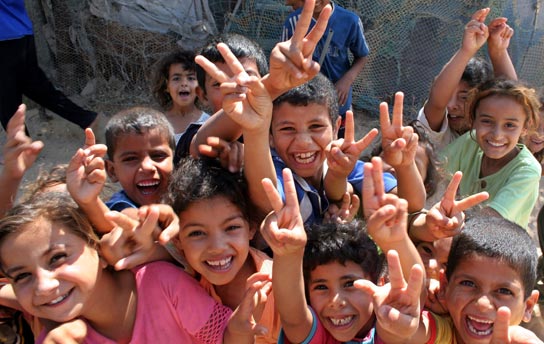
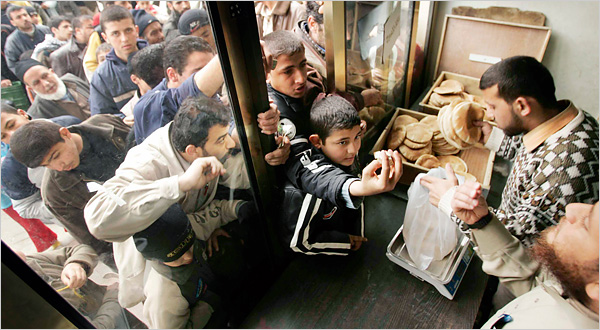
Since the electoral victory of Hamas in January 2006, Israel has imposed a blockade that has severely restricted Gaza’s ability to import food, fuel and other essential materials. As a result, the Gazan economy has completely collapsed and it suffers from high levels of unemployment and poverty and rising levels of childhood malnutrition.
“Israel’s treatment of the Palestinian people in Gaza amounts to nothing less than collective punishment. While we condemn Hamas’ targeting of Israeli civilians, it is immoral to punish an entire population for the actions of a few,” said Rabbi Brant Rosen, who serves Jewish Reconstructionist Congregation in Evanston, IL. “This blockade has only served to further oppress an already thoroughly oppressed people. As Jews and as human beings of conscience, we cannot stand idly by.”
“We’ve been enormously encouraged by the initial response we’ve received from the Jewish community thus far,” said fast organizer Rabbi Brian Walt, former Executive Director of Rabbis for Human Rights – North America, who noted that the initiative has signed up numerous supporters prior to the launch of the project. “We truly believe this effort is giving voice to a significant number of people who been looking for a Jewish voice of conscience on this issue.”
Here’s a nice piece that ran on Chicago’s ABC affiliate last January: a feature on JRC’s green building as well as a local mosque that incorporated energy-saving features into their recent renovation. Especially nice that they highlighted two “Abrahamic environmental efforts.” (One snarky correction: it’s Jewish Reconstructionist Congregation, not Center).
Kudos to the British Jewish community for mobilizing big time in support of Fair Trade!
Check out their impressive new Jewish Guide to Fair Trade – it has to be the most comprehensive resource of its kind. It’s even more remarkable when you consider that it is the product of a wide-ranging coalition that includes every major British-Jewish denomination.
This campaign is but one project of Tzedek, a British org that self-describes itself as
…a voluntarily led Non-Governmental Organisation that draws upon the skills and resources of the Jewish Community to better the lives of those less fortunate. Tzedek aims to nurture and empower open-minded Jewish community leaders to promote the fight against extreme poverty.
Their new guide is much more than just Jewish lip-service to Fair Trade. It’s filled with lots of substantive info, including Jewish sources and curricula.
Any chance that the large Jewish community on the other side of the pond might follow their lead?