Category Archives: Judaism

Jewish Fast for Gaza

gazapic

In response to the dire humanitarian crisis in Gaza, my dear friend and colleague Rabbi Brian Walt and I have organized a new initiative, Ta’anit Tzedek – Jewish Fast for Gaza.

See below for the press release about the project, which is already attracting increasing numbers of supporters, including many rabbis. Click the link above to visit the website and sign up yourself…

RABBIS  ANNOUNCE MONTHLY FAST FOR GAZA

Seeking “to end the Jewish community’s silence over Israel’s collective punishment in Gaza,”  an ad-hoc group of American rabbis has called for a communal fast.  Known as Ta’anit Tzedek – Jewish Fast for Gaza, this new initiative will organize a series of monthly fasts beginning on July 16.

The project was initiated by a group of thirteen rabbis representing a spectrum of American Jewish denominations. The group’s website explains the religious meaning of the campaign: “In Jewish tradition a communal fast is held in times of crisis both as an expression of mourning and a call to repentance. In this spirit, Ta’anit Tzedek – Jewish Fast for Gaza is a collective act of conscience initiated by an ad hoc group of rabbis, Jews, people of faith, and all concerned with (this) ongoing crisis…”

The fast has four goals: to call for a lifting of the blockade, to provide humanitarian and developmental aid to the people of Gaza, to call upon Israel, the US, and the international community to engage in negotiations with Hamas in order to end the blockade, and to encourage the American government to “vigorously engage both Israelis and Palestinians toward a just and peaceful settlement of the conflict.”

The water-only fast will take place every third Thursday of the month, from sunrise to sunset. In addition to signing on to the fast statement, participants have been asked to donate the money they save on food to the Milk for Preschoolers Campaign sponsored by American Near Eastern Refugee Aid, a relief campaign that combats malnutrition among Gazan preschool children.

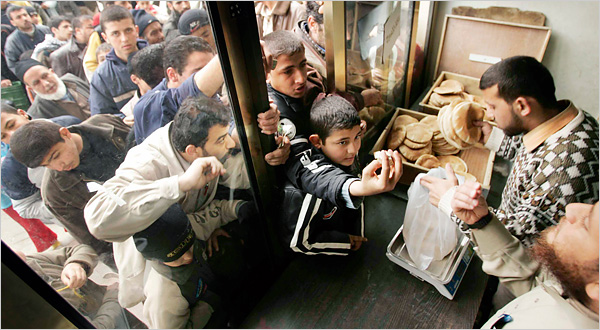
Since the electoral victory of Hamas in January 2006, Israel has imposed a blockade that has severely restricted Gaza’s ability to import food, fuel and other essential materials. As a result, the Gazan economy has completely collapsed and it suffers from high levels of unemployment and poverty and rising levels of childhood malnutrition.

“Israel’s treatment of the Palestinian people in Gaza amounts to nothing less than collective punishment. While we condemn Hamas’ targeting of Israeli civilians, it is immoral to punish an entire population for the actions of a few,” said Rabbi Brant Rosen, who serves Jewish Reconstructionist Congregation in Evanston, IL. “This blockade has only served to further oppress an already thoroughly oppressed people.  As Jews and as human beings of conscience, we cannot stand idly by.”

“We’ve been enormously encouraged by the initial response we’ve received from the Jewish community thus far,” said fast organizer Rabbi Brian Walt, former Executive Director of Rabbis for Human Rights – North America, who noted that the initiative has signed up numerous supporters prior to the launch of the project. “We truly believe this effort is giving voice to a significant number of people who been looking for a Jewish voice of conscience on this issue.”

Green Mosque, Green Shul

Here’s a nice piece that ran on Chicago’s ABC affiliate last January: a feature on JRC’s green building as well as a local mosque that incorporated energy-saving features into their recent renovation. Especially nice that they highlighted two “Abrahamic environmental efforts.”  (One snarky correction: it’s Jewish Reconstructionist Congregation, not Center).

Jewish Brits Organize for Fair Trade

fairtradeKudos to the British Jewish community for mobilizing big time in support of Fair Trade!
Check out their impressive new Jewish Guide to Fair Trade – it has to be the most comprehensive resource of its kind.  It’s even more remarkable when you consider that it is the product of a wide-ranging coalition that includes every major British-Jewish denomination.

This campaign is but one project of Tzedek, a British org that self-describes itself as

…a voluntarily led Non-Governmental Organisation that draws upon the skills and resources of the Jewish Community to better the lives of those less fortunate. Tzedek aims to nurture and empower open-minded Jewish community leaders to promote the fight against extreme poverty.

Their new guide is much more than just Jewish lip-service to Fair Trade. It’s filled with lots of substantive info, including Jewish sources and curricula.

Any chance that the large Jewish community on the other side of the pond might follow their lead?

The Contradictions of Ethnic Nationalism

610x

It’s the last day before the Israeli elections, and there seems to be widespread agreement that Yisrael Beiteinu party chairman Avigdor Lieberman is going to win big – perhaps as much as 19-20 seats. They’ve already pulled ahead of the Labor party and by now it’s virtually a foregone conclusion that Lieberman will emerge from these elections with considerable political influence.

It’s also fair to say that those of us who cherish the values of liberal democracy are recoiling at the prospect of a politically ascendant Avigdor Lieberman, whose most notorious campaign promise is a requirement for all Arab citizens of Israel to sign a loyalty oath to the Jewish state:

(Lieberman’s) loyalty oath would require all Israelis to vow allegiance to Israel as a Jewish, democratic state, to accept its symbols, flag and anthem, and to commit to military service or some alternative service. Those who declined to sign such a pledge would be permitted to live here as residents but not as voting citizens.

Currently Israeli Arabs, who constitute 15 percent to 20 percent of the population, are excused from national service. Many would like to shift Israel’s identify from that of a Jewish state to one that is defined by all its citizens, arguing that only then would they feel fully equal.

Mr. Lieberman says that there is no room for such a move and that those who fail to grasp the centrality of Jewish identity to Israel have no real place in it.

These are disturbing ideas to be sure, and it’s even more troubling that they seem to finding traction with increasing numbers of the Israeli electorate.

And yet…

…and yet in the wee hours of the night, I just can’t shake the nagging feeling that the real reason Lieberman makes us squirm is that he shines a bright light on the logical contradictions of political Zionism: an ethnic nationalist movement that has always sought to create a Jewish state in a land that also happens to be populated by millions of non-Jewish inhabitants.

Take, for example, Israel’s Declaration of Independence, which refers specifically to Israel as a “Jewish state” committed to the “ingathering of the exiles” but also promises complete equality of political and social rights for all its citizens, irrespective of race, religion, or sex.  Therein lies the tension: the first principle emphasizes the creation of a state that privileges the Jewish people and the latter promises equal rights for all its citizens.

I don’t say this easily: I’m not sure this is a nut that Israel will ever fully be able to crack.  It is indeed notable that Israel has repeatedly tried and failed to create a constitution that legally guarantees equality for all citizens of this exclusively Jewish state. In the meantime, Israel’s Arab citizens suffer from what we Americans would consider significant institutional discrimination with only limited recourse to the rule of law.

So as a nice liberal American Jew fully prepared to voice my outrage at Lieberman’s likely Tuesday morning success, here are some questions I feel compelled to ponder:

– As proud citizens and beneficiaries of a secular multi-cultural nation, are we ready to face the deeper implications of Israel’s ethnic nationalism?

– Will it ever truly be possible, in a country defined as exclusively Jewish, for its Arab citizens to be considered as anything but second class citizens (or at worst, traitors)?

– If  it does indeed come down to a choice between a Jewish or a democratic state, which will we ultimately support?

I’d love to hear your responses…

Dialogue in Qom

iran5-0021

We’re in Esfahan now (unquestionably one of the most stunning cities I’ve ever visited) but I want to tell you first about our day yesterday, which we spent at Mofid University in the city of Qom.

Qom is considered a holy city for Shia Islam and is the largest center for Shia scholarship in the world. In addition to traditional Islam, most of the seminaries also offer courses in social sciences, Western thought and comparative religion. Mofid is considered one of the more liberal universities in Qom and is notable in particular for its interfaith research.

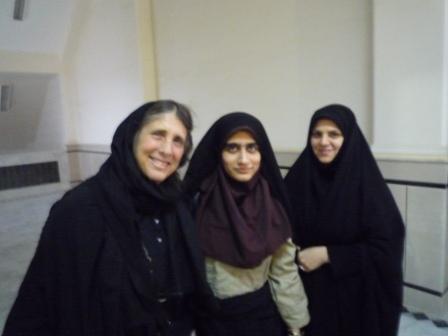
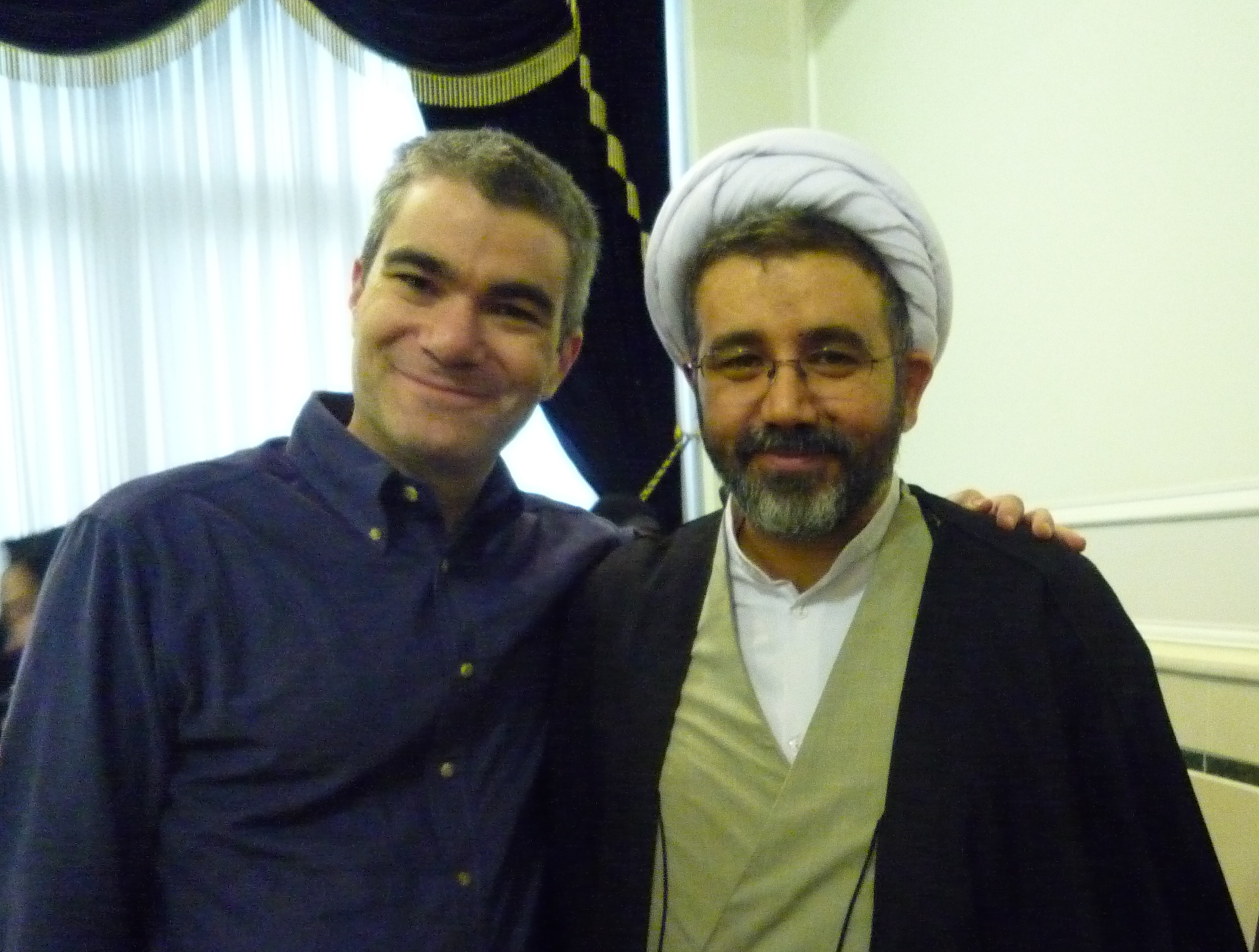
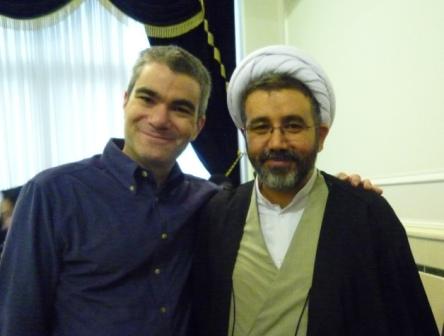
We spent the better part of the day at Mofid, visiting and dialoguing with professors and students. Any preconceptions we may have had about an Islamic university in Iran went out of the window almost immediately. We introduced ourselves to our host and the professors introduced themselves to us – they included scholars who were versed in a remarkable variety of subjects including Jewish law, contemporary feminism and Western philosophy. That’s me above with Dr. Masoud Adib, who among other things has translated a book by Dr. Jacob Neusner (a prominent American Jewish scholar) into Farsi. In the pic below Rabbi Lynn (left) poses with Fatima (center) a graduate student who is currently studying Rashi’s commentary on the Torah and has translated the Book of Mormon into Farsi. On the right is Haydeh Rostam Abadi, who works with the Center for Interreligious Dialogue and has been traveling with us for the past few days. Her research, among other things, focuses on a comparison of the Catholic and Islamic concepts of revelation.

iran5-003

Our discussion took the better part of two hours. The professors discussed their study of the relationsip between Islam and the other religious traditions and their research in the fields of comparative religious philosophy and law. The theological validity and spiritual worth of all Abrahamic religions was a common and recurring theme . Members of our group also spoke about Jewish and Christian attitudes toward Islam. Our discussion was relatively brief in the scheme of things, but it was enough to give us all the sense that these Islamic scholars were deeply engaged in a wide spectrum of religious and philosophical ideas and that they had an abiding desire to meet and learn from others.

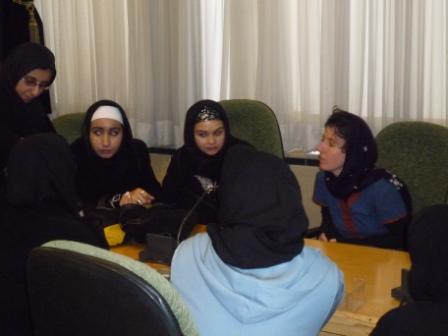
After our meeting we shared lunch with teachers and students and continued our conversation in a more informal manner. This was followed by a longer conversation with the thoughtful and enthusiastic students of Mofid. In the pic below, one of our younger delegation members, Ariel Vegosen (right) is chatting up a group of young students.

iran5-001

What can I say? Another day for smashing assumptions and preconceived notions to smithereens. I’m off to sleep now, but I’ll come back soon and tell you about our first day in ravishing Esfahan…

JRC Comes Home

bread.jpg

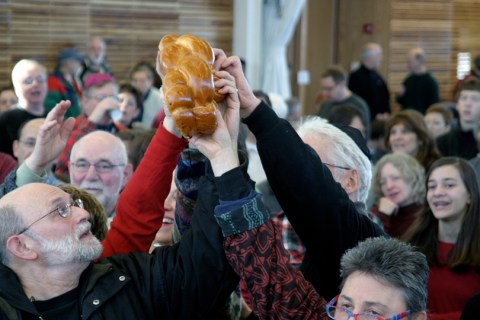
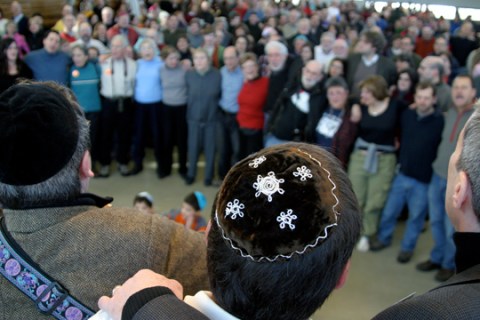
Yesterday was a day of celebration that JRC will never forget. On the coldest day of the winter, (6 degrees, wind chill of -21) several hundred JRC members generated abundant warmth together as we moved into our new synagogue home at 303 Dodge, Evanston. That’s us above, making our first motzi in our new building. But I’m getting ahead of myself…

img_0817.jpg

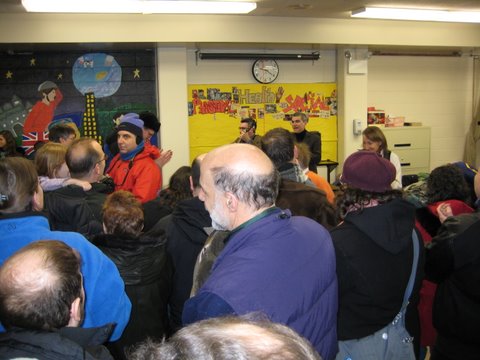
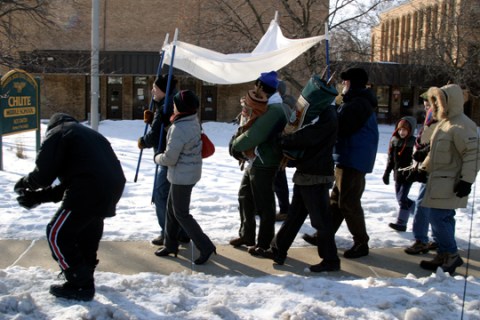
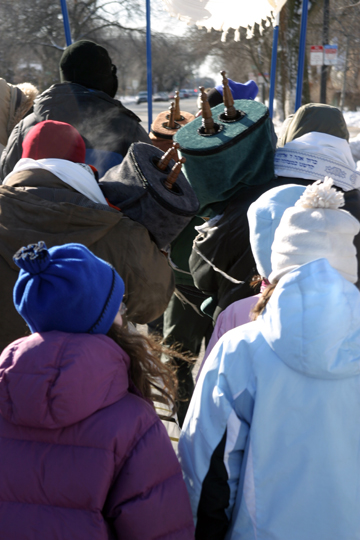
We first gathered in the cafeteria of Chute Middle School, (site of one of JRC’s earlier temporary locations in the 1970s) and took out our Torah scrolls with a brief service. Then, covered with many fleecy layers, carrying our four Torah scrolls under a huppah, we processed out into the frozen Evanston streets to walk some six blocks to 303 Dodge. (Earlier in the morning, several brave JRC souls actually carried two of the scrolls nearly four miles from our most recent temporary location, Sha’arei Tikvah!)

march.jpg

in-the-procession.jpg

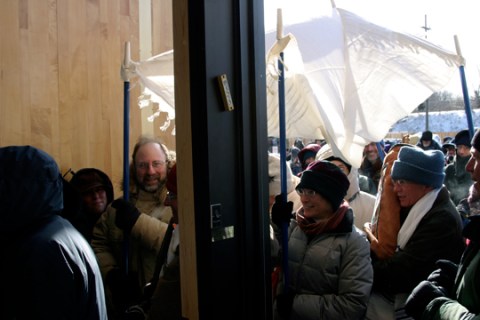
When we arrived at JRC, we found several hundred more JRCers waiting for us at the building. We stopped at the entrance, sang “Pitchu Li” (“Open for me the gates of righteousness…”), affixed our mezuzah with a blessing, and entered our new home for the first time.

entrance.jpg

img_0819.jpg

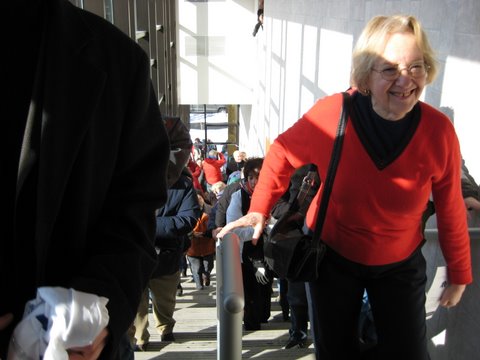
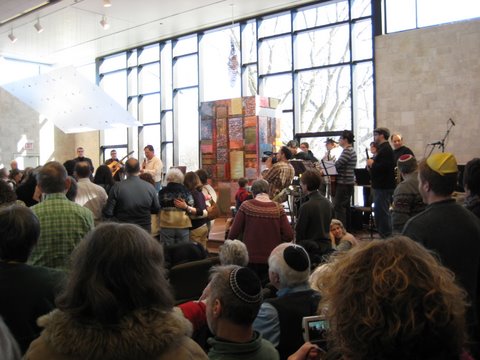
We ascended to the third floor, and sang and danced together for what seemed like an eternity to live music provided by JRC’s house klezmer band, Heavy Shtetl. We then placed the Torah scrolls in our new ark (see pix at the bottom – more on that in a bit.) After hearing heartfelt words from JRC president David Pinzur, I addressed the crowd, then we did our first communal kiddush and motzi together in our new home (after which the Cantor and I dropped the challah and spilled the wine on the bimah…) We then spent the rest of the afternoon, sharing food, going on self-guided tours of our new green facility, and just spending great quality time together.

welcome.jpg

img_0827.jpg

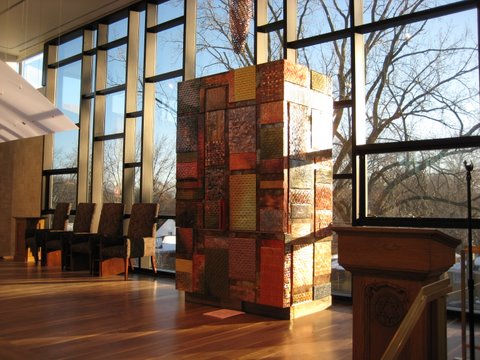
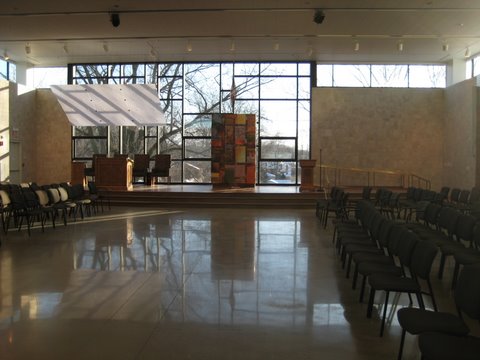
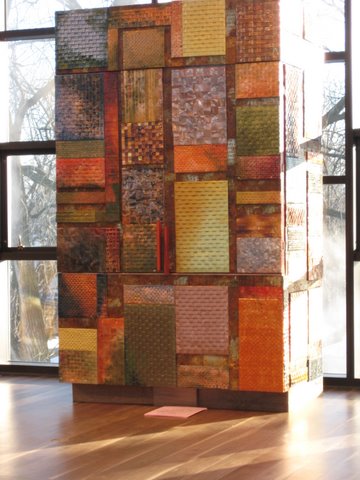
Below you’ll find some pix of our beautiful new ark which was installed in our sanctuary late Saturday evening, just in time for the celebration. It was designed and constructed by Maryland-based metalsmith/craftsman David Bacharach. We were delighted that David was able to join us for the festivities (as were architects Carol Ross-Barney and Michael Ross.)

Words cannot describe the level of joy our JRC family felt on this day. It was, without question, a once in a lifetime experience for us all. But the sweetest part is knowing what is yet to come. Up until now, this has only been a building – now that it has been filled with our bodies and souls it is truly sacred sacred space. We are all so humbled at what we have accomplished and so profoundly excited about the many sacred memories that will fill these four walls in the years ahead.

Thus ends my last official JRC Construction Diary post. Of course, it is really only just the beginning…

(For a nice Fox News Chicago report on JRC’s gala move-in day, click here.)

img_0806.jpg

img_0807.jpg

img_0805.jpg

That I May Dwell Among Them

p2080295.jpg

“And let them build Me a sanctuary that I may dwell among them.” (Parashat Terumah, Exodus 25:8)

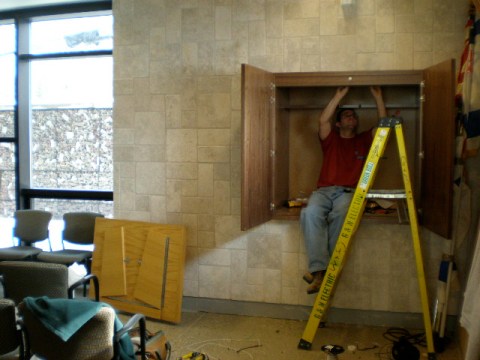
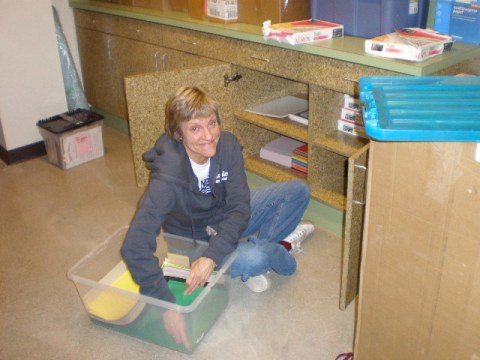
This week’s Torah portion has incredible resonance as our congregation puts the final touches on our new spiritual home in preparation for our return home this Sunday. That’s a worker above finishing the ark in the chapel; below, JRC member Kate Spector helps fill the Religious School cabinets with school supplies.

Countless devoted JRC members have worked tirelessly to prepare our new synagogue building for this long-awaited day. Just as the ancient Israelites constructing the tabernacle in the wilderness, we have learned that it is not the building, but the process of building that creates sacred community. During the course of this process, we have truly discovered what it means to have God dwell in our midst.

p2080297.jpg

What Makes a Green Shul Green?

img_0321.jpg

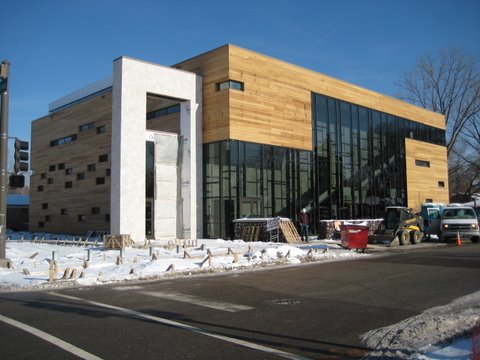
JRC will be moving home this Sunday! If you’ve been reading my JRC Construction Diary updates over this past year and a half, you must surely know what a long, powerful trip this has been for our congregational community. And you will also know that our new synagogue building is a green shul, having been built according to sacred Jewish values of environmental sustainability.

What makes a green shul green, you may ask? Click below for your own personal tour…

Continue reading

JRC Construction Diary #30

img_0410.jpg

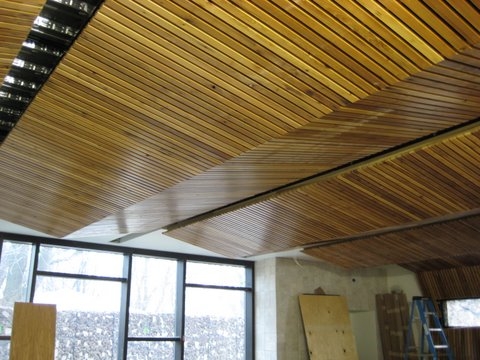
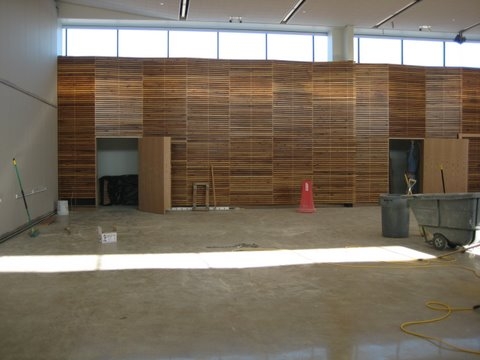
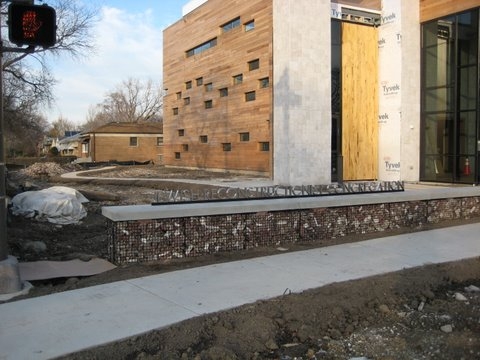
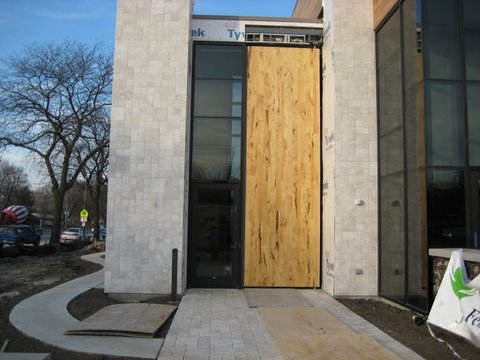
Things are getting exciting as the contractor puts the final touches on JRC’s new home. They are looking to finish the bulk of the work this week so that we can get ready for an upcoming indoor air quality test, a requirement of LEED certification by the US Green Building Council.

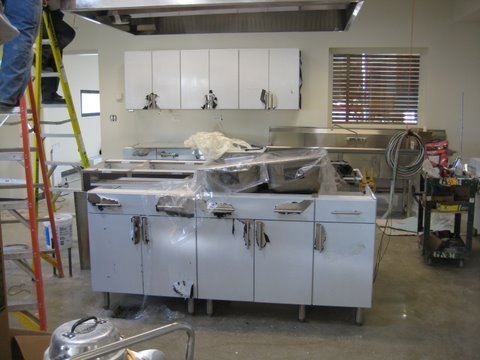
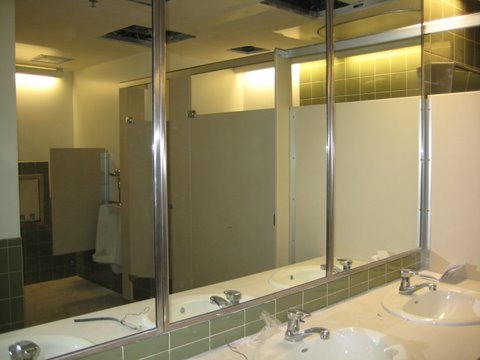
The picture above shows the cypress that wraps along the ceiling of our first floor chapel. The shot below shows the cypress slats that have installed along the sanctuary wall. Just to make things official, our name went up on one of the gabion walls in front of the building (second pic down) and beneath this you can see our front entryway. It features a ceremonial door made of reclaimed maple trees from our former site. The last two pix offer views of the kitchen and of a men’s room respectively.

The big move will take place during the first week in February. On 2/8-9 we will hold our final Shabbat services in our temporary site (Shaarei Tikvah in Chicago) then on Sunday, February 10, we will joyfully process with JRC Torah scrolls as we bring them to our new home!

Stay tuned for more…

img_0444.jpg

img_0457.jpg

img_0458.jpg

img_0446.jpg

img_0463.jpg

JRC Construction Diary #28

img_0128.jpg

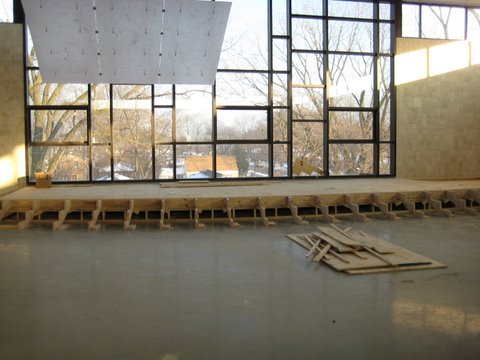
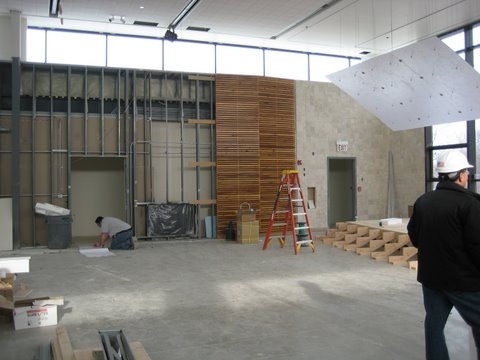
While there is still a bit of final exterior work to be done, the majority of the work now is primarily interior finish. The pic above shows a lovely view of the bimah construction. You can see how the steps have been cut out and run along the periphery. When finished, the bimah floor will be made of dark walnut.

A radically different kind of picture can be found below. Now why would I possibly be showing you a close-up shot of a toilet handle? This is a feature of JRC’s water saving “dual flush” toilets: you pull the handle up for liquid waste (which needs less water) and push down for solid waste (which uses more water). Our toilets will clearly necessitate a new consciousness raising effort for bathroom usage in our new building. (JRC members: consider yourselves on alert!)

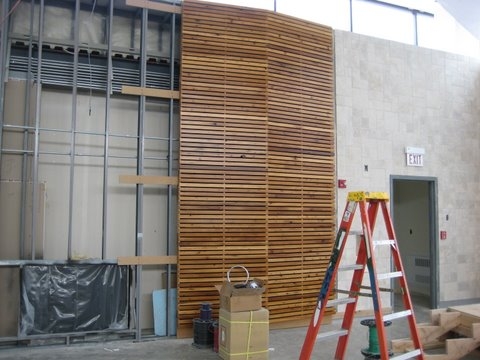
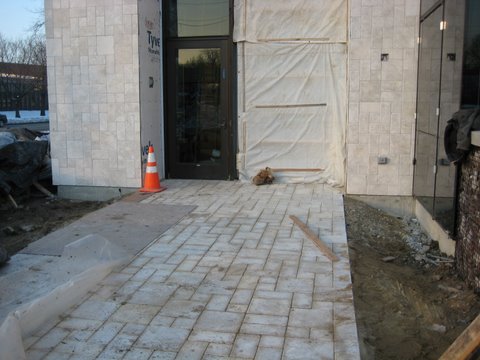
Below this are two views of the reclaimed cypress which is now being installed along the sanctuary walls. The final pic is a view of the Jerusalem stone walkway that leads to the building’s main entrance.

We’re kicking to the finish!

img_0133.jpg

img_0144.jpg

img_0150.jpg

img_0138.jpg