Category Archives: Judaism

“Cursed Be He That Keepeth Back His Sword From Blood.”

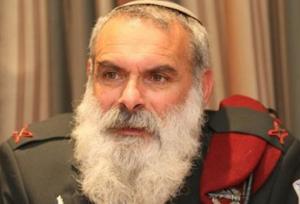
Rabbi-Avi-Ronzki_From yesterday’s Ha’artez:

The Israel Defense Forces’ chief rabbi told students in a pre-army yeshiva program last week that soldiers who “show mercy” toward the enemy in wartime will be “damned.”

Brig. Gen. Avichai Rontzki also told the yeshiva students that religious individuals made better combat troops.  Speaking Thursday at the Hesder yeshiva in the West Bank settlement of Karnei Shomron, Rontzki referred to Maimonides’ discourse on the laws of war. That text quotes a passage from the Book of Jeremiah stating: “Cursed be he that doeth the work of the Lord with a slack hand, and cursed be he that keepeth back his sword from blood.”

In Rontzki’s words, “In times of war, whoever doesn’t fight with all his heart and soul is damned – if he keeps his sword from bloodshed, if he shows mercy toward his enemy when no mercy should be shown.”

Whatever else we might think about Maimonides’ (or Jeremiah’s) words, we are certainly free to debate their academic meaning. But when they are uttered by the Chief Rabbi of the IDF to future Israeli soldiers, words such as these are much, much more than merely academic.

You may remember that Rabbi Rontzki (above) was in the news following Israel’s military operation in Gaza, when soldiers alleged that he gave them a religious booklet entitled “Go Fight My Fight.”  This publication includes extensive quotes by Rabbi Shlomo Aviner, head of the Ateret Cohanim yeshiva in Jerusalem, who ruled that Palestinians were the equivalent of the Biblical Philistines and that cruelty can sometimes be a “good attribute.”

You may also remember that Israeli soldiers from the organization Shovrim Shtika (“Breaking the Silence”) brought this issue to light following the war in Gaza.  Though they have been attacked mercilessly by the Israeli political establishment, these young soldiers have continued to speak out. Last September, Gal Einav and Shamir Yeger, two reserve infantry soldiers who fought in Gaza wrote a powerful editorial in the Israeli press about what they considered to be an unwelcome “messianic” religious influence into the IDF:

There is a problem with the growing tendency to provide religious elements with a monopoly on values and fighting spirit, and particularly with the legitimacy granted to organizations with a missionary and messianic character to operate amongst the soldiers. Most of the commanders in our division are religious, yet up until the last war there was complete separation between their private world and their military position.

If we fail to clearly draw the line right now, in a few years we shall find ourselves shifting from wars of choice or no-choice to holy wars.

In a September BBC report, Reserve General Nehemia Dagan had this to say about the issue:

We (soldiers) used to be able to put aside our own ideas in order to do what we had to do. It didn’t matter if we were religious or from a kibbutz. But that’s not the case anymore.

The morals of the battlefield cannot come from a religious authority. Once it does, it’s Jihad. I know people will not like that word but that’s what it is, Holy War. And once it’s Holy War there are no limits.

(You can watch the BBC report in its entirety here and here. Highly recommended).

What explains the growth of this right-wing religious influence in the IDF? I tend to agree with blogger Zachary Goelman, who points out an larger demographic trend in Israeli society:

With conscription rates dropping annually, especially among secular Jews, and a simultaneous increase in the country’s religious population, Yeger and Einav are part of a shrinking minority. No doubt they know many who ducked their conscription call. If they have draft-age children, they’ve certainly heard them discuss the myriad ways of obtaining a deferral.

This trend is reversed in the dati-le’umi sector, the category of Israeli Jews broadly classified as “national religious.” In one way or another the men and women woven from this cloth see military and national service as a form of religious duty, and their ranks in uniform and civil society will increase in the coming decades. Coupled with the consistent growth of ultra-orthodox families, secular Israel may be in the final throes of its götterdämmerung.

Whatever the explanation, I personally find the implications of this trend to be beyond troubling. How will we, as Jews, respond to the potential growth of Jewish Holy War ideology within the ranks of the Israeli military?  How do we  feel about Israeli military generals holding forth on the religious laws of warfare? Most Americans would likely agree that in general, mixing religion and war is a profoundly perilous endeavor.  Should we really be so surprised that things are now coming to this?

I do not ask these questions out of a desire to be inflammatory. I ask them only because I believe we need to discuss them honestly and openly – and because these kinds of painful questions have for too long been dismissed and marginalized by the “mainstream” Jewish establishment.

For myself at least – as a Jew and as a rabbi – I will take this opportunity to register my personal offense at statements such as those made last week by Rabbi Rontzki.
On Jewish Hearts and Minds: A Response to Daniel Gordis

Just read Rabbi Daniel Gordis’ recent op-ed in the Jerusalem Post, one of several articles that have given some free publicity to Ta’anit Tzedek.  But it wasn’t Gordis’ offhand slam on TT that really bothered me – it was the decidedly patronizing way he analyzed the gulf between the American Jewish community and Israel – or as he termed it, American Jewry’s “growing abandonment of Israel.”

Gordis’ main premise: American Jewry’s newest generation is essentially self-centered (tainted “with the ‘I’ at the core of American sensibilities”) and simply cannot relate to the national sense of duty embodied by Israel:

In America, the narratives of immigrant groups are eroded, year by year, generation after generation.  In America, we are oriented to the future, not to the past, and if we cling to some larger grouping, it is to a human collective whole rather than to some “narrow” ethnic clan…

Similarly, the recreation of the State of Israel is truly powerful only against a backdrop of centuries of Jewish experience, and is spine-tingling only if my sense of self is inseparable from my belonging to a nation with a past and a people with a purpose.

In today’s individualistic America, the drama of the rebirth of the Jewish people creates no goose bumps and evokes no sense of duty or obligation. Add the issue of Palestinian suffering, and Israel seems worse than irrelevant – it’s actually a source of shame.

It’s not clear to me if Gordis is interested in winning over the hearts and minds of young American Jews, but if he is, I’d suggest that talking down to them from an Israeli ivory tower is not the way to do it.  I’m afraid that record just doesn’t play any more.

Gordis is correct when he posits that the old narratives simply aren’t working on American Jews the way they used to.  But that’s only because a new, more complex narrative is now being written by the current generation. It’s compelling in its own right, though this may be difficult to understand when viewed from the conventional Israeli vantage point.

I work with a great number of American Jews – particularly the 35 and younger demographic that Gordis cites – and from where I sit they look nothing like narcissistic, self-obsessed Americans he describes. On the contrary, most are engaged, seriously seeking Jews.  Yes, it’s true, unlike previous generations they don’t necessarily understand their Judaism in traditionally tribal terms anymore. But that doesn’t make them self-centered. Rather, they are increasingly viewing their Jewishness against a larger, more universal global reality.  In short, to be a Jew and a global citizen is what gives them “goose bumps.”

If, as Gordis suggests, American Jews are abandoning Israel, I’d suggest it’s not due to the lack of a sense of Jewish “duty or obligation” – I believe it’s because they are left cold by an Israeli national culture that appears to them to be overly tribal and collectively self-centered.

Indeed, while most young people today seem to be interested in breaking down walls between peoples and nations, Israel often appears determined to build higher and higher walls between itself and the outside world. It’s a poignant irony of Jewish history: while Zionism was ostensibly founded to normalize the status of Jewish people in the world, the Jewish state it spawned seems to view itself as all alone, increasingly victimized by the international community.

Gordis himself exemplifies this “it’s us Jews against the rest of the world” ethos in the opening paragraphs of his article:

About one thing, at least, the world seems to be in agreement: Israel is the primary culprit in the Middle East conflict, the cause of relentless Palestinian suffering and the primary obstacle blocking the way to regional peace.

The international chorus of opprobrium is growing by the day…It’s relentless, this ganging up, but it’s also not terribly new. The momentum has been building for years, and though we may not like it, we cannot honestly claim to be surprised.

While I understand the psychology of this world view, I don’t think it helps make Israel’s case for young Jews today – nor do I think it promotes a particularly healthy Jewish identity. It seems to me to be the product of self-pity, more than pride – a victim mentality that’s not likely to get us anywhere with newer generations of Jews who are feeling increasingly comfortable with the “outside world” and who don’t particularly identify with the claim that when push comes to shove, all the world really does just hate the Jews.

I will also predict that Gordis’ two cynical references to “Palestinian suffering”  will not resonate for growing numbers of Jews who are legitimately troubled by Israel’s treatment of Palestinians.  I understand full well that our criticism sounds galling to most Israeli ears. And no, I don’t believe that we American Jews can even begin to understand how Israelis feel – on so many levels.

But whether Israelis like it or not, there is a steadily growing demographic in the American Jewish community: proud, committed Jews who are deeply troubled when Israel acts oppressively, who feel implicated as Americans and as Jews in these actions, and who are galled at being labeled as traitors when they choose to speak out.

At the very least, I hope that Gordis will understand that if American Jews are identifying with organizations that protest Israel’s oppressive policies (organizations, yes, such as Ta’anit Tzedek) their affiliation does not come from a shame-filled desire to “bash” Israel. It comes from a deeper and much more Jewishly authentic place than that.

I realize that all of this may be too much to ask for. It’s long been clear that the American Jewish and Israeli Jewish communities are two very different animals with two decidedly different ways of understanding what it means to be a Jew in a rapidly changing world.  (Sociologists Steven Cohen and Charles Liebman pointed this out with great insight in their book “Two Worlds of Judaism” twenty years ago).

But it seems to me if we truly want to facilitate the Jewish future, we’re going to have to do it together. And to do that, we’ll  need to meet one another with openness and understanding, not dismissal and judgment.

Feeding the God of Compassion: A Sermon for Kol Nidre

From my Yom Kippur eve sermon last Sunday night:

If the Torah teaches us that human beings are made in the image of God, which image of God will we proclaim? The God of fear or the God of forgiveness? The God of hatred or the God of compassion? The God of xenophobia or the God of justice? And if our answer is indeed the latter, then we must affirm it. We must bear witness to this image of God in no uncertain terms. History teaches all too well what the God of hatred can do in our world. Those of us who reject this theology must be ready to do so without hesitation – to actively promote the God of compassion.

Click below to read the entire sermon:

Continue reading

On Gaza and Yom Kippur: A Call to Moral Accounting

From my op-ed in this morning’s Sunday Chicago Tribune:

The actions of the Jewish State ultimately reflect upon the Jewish people throughout the world. We in the Diaspora Jewish community have long taken pride in the accomplishments of the Jewish State. As with any family, the success of some reflects a warm light on us all. But pride cannot blind us to the capacity for error on the part of the country we hold so dear. We cannot identify with the successes, but refuse to see the failures.

As we approach Yom Kippur, I call on America’s Jews to examine the Goldstone findings, and consider their implications. In the spirit of the season, we must consider the painful truth of Israel’s behavior in Gaza, and understand that we must work, together, to discover the truth — and then urge on all relevant parties in the search for peace.

Judaism as Nonviolence: A Sermon for Rosh Hashanah

During my Rosh Hashanah sermon, I asked the following questions:

Is there a place in Judaism for pacifism? Is it in fact possible – or desirable – as a Jew, to walk the path of nonviolence?

Click below to read my answers…

Continue reading

Faith and Faithfulness: A Sermon for Erev Rosh Hashanah

From my sermon this past Rosh Hashanah eve:

How do we discover the true meaning of spiritual commitment in our lives? Perhaps the first step is simply taking a closer look at our lives themselves. Maybe, just maybe, the source of our emunah is much closer than we think.  On Rosh Hashanah we say in our liturgy “Hayom Harat Olam” – on this day the world is born.  Your entire life has been leading up to this moment. Take the time to look back. What has led you here to this place tonight? Who are the people who have helped to guide you on your journey? What are the memories and experiences that you continue to hold sacred? And, finally, how will you transform them into faithful action? How will you commit to them honor them in the coming year and the years after that?

Click below for the entire sermon:

Continue reading

Flesh of Our Flesh?

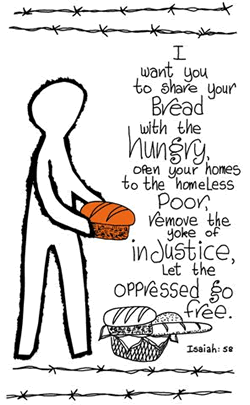
isaiah_58Learn to do good, seek justice; relieve the oppressed. Uphold the orphan’s rights; take up the widow’s cause. (Isaiah 1:17)
This classic verse comes from the Haftarah portion for this Shabbat. It is the final so-called “Haftarah of affliction” coming annually on the Shabbat before the festival of Tisha B’Av. Beginning next week our prophetic portions will offer messages of consolation, reminding us that the path of return to righteousness is always open to us. Indeed, it is this very message that will guide us into the High Holiday season itself –  the season of our return.

As I read this passage this year, I was mindful of a very similar passage that will appear in the Haftarah of Yom Kippur, also from the book of Isaiah:

No, this is the fast that I desire: to unlock fetters of wickedness and untie the cords of lawlessness; to let the oppressed go free and break off every yoke. It is to share your bread with the hungry, and to take the wretched poor into your home; to clothe when you see the naked, and never forget your own flesh (Isaiah 58:6-7).

In a way, these two similar Isaiah passages seem to represent spiritual bookends to the High Holiday season. These characteristically prophetic calls to justice and repentance guide us through our High Holiday journey, reminding us not only of our seemingly chronic hypocrisy but also of the eternally simple route to return: “learn to do good, free the oppressed, feed the hungry…”

As many of you know, our recently organized Fast for Gaza has cited Isaiah 58 as a kind of spiritual prooftext to our initiative. As it turns out, ever since we’ve launched this project I’ve been in a kind of dialogue with more than one correspondent over this particular verse. Several people have already written to me that we’ve misinterpreted Isaiah. It appears that for some, calling a Jewish fast in support of Gazan Palestinians rather than Jewish Israelis represents a betrayal of this prophetic imperative (not to mention the Jewish people.)  As one writer put it, “never forget your own flesh” means “charity begins at home.”

This criticism motivated me to do a bit of digging into the source material.  As it turns out the Hebrew word for “your flesh” – b’sarcha – can indeed refer to blood relations or kin. But interestingly, according to the Brown, Driver, Briggs Biblical Dictionary (p. 142), this term can also mean “all living beings” (occurring in this usage at least 13 times throughout the Bible.)

So, in fact, there is good, solid linguistic evidence to reject this narrow, tribal reading of Isaiah.  Now I’m certainly willing to admit that this passage might have referred only to fellow Israelites when it was originally written. But today we live in a fundamentally different time than the ancient Israelites. In our globalized, post-modern world, the Jewish community has become inter-dependent with others in profound and unprecedented ways.  Whether we are prepared to admit it or not, our Jewish security, our Jewish destiny is now irrevocably bound up with the destiny of all peoples and nations of the world.

I am well aware that this viewpoint represents a distinctly 21st century Torah. I also have no illusions that it will be a simple matter for the Jewish community to heed this call. Having only recently emerged from the ghetto, still living with a collective memory of anti-Semitism, still reeling from the trauma of the Holocaust, it will necessitate a radical shift in consciousness to understanding our place in the world in such a way.

It will not be easy, but I believe it will be essential.  It can no longer be us against them. At the end of the day, we are all one flesh.

Gaza: A Rabbinical Exchange

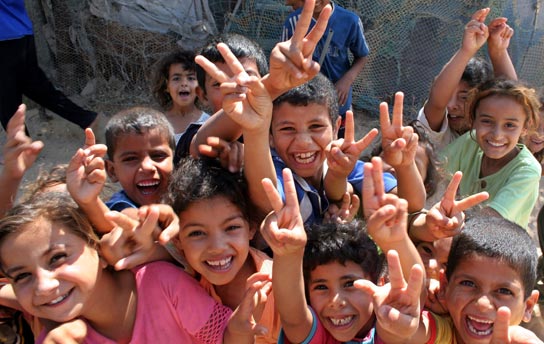
GAZA_SCHOOL_One

Since we launched the Jewish Fast for Gaza, we’ve received all kinds of feedback, some supportive, some critical, some utterly unprintable. (My personal favorite from the latter category: “You should all get severe stomach ailments.”)

On occasion, however, our effort has offered us the opportunity for genuinely respectful dialogue. Below is one such exchange – an email I received from a rabbinic colleague, followed by my response:

Dear Ta’anit Tzedek,

Having cares and concerns of the plight of humanity is a most noble cause. That you are willing to extend effort is most commendable. Your organization, however, is extending its efforts in a manner which is not only counterproductive, but can be harmful as well.

How can you look into the face of a 12 year old girl from Sderot who suffers from post traumatic syndrome as for most of life she has been awakened on a nightly basis by sirens and rocket fire? What do you say to the families of victims killed by suicide bombers who killed their teenagers who were casually enjoyed a slice of pizza? What do you say to an organization whose very goal is the annihilation of our people?

You may answer, “Had we been better, they may have liked us more.” or some such configuration thereof. It’s not plausible. Since 1948, the goal of the Arab world has been the removal of a Jewish presence in the middle east. Our interference with their dream of a Pan-Arabic state stretching from Morocco to Iraq is sullied by our very presence.

It would better for your organization to spend is resources on ideals that truly further the continuity of Jews and Judaism.

I await your response,

Rabbi X

Dear Rabbi X,

I want to thank you for taking the time to reach out and respond to our initiative. I’m glad to have the opportunity for this dialogue.

You ask what I would say to the 12 year old girl from Sderot or the families of terror victims. I believe I would say that as a fellow Jew that their pain is my pain as well. I would say that I could not begin to comprehend the realities they must face. But I would also share my belief that that Israel’s current treatment of the people of Gaza will bring them neither safety nor security – and that the only true way out of these traumas is a lifting of the blockade and the negotiation of a settlement by all parties involved.

As regards Hamas “whose very goal is the annihilation of our people:” though I have no love lost for Hamas, the reality is that Israel will have to deal with them if any true peace will be achieved. And in truth, Israel has already dealt with Hamas through any number of channels over the years already. Making peace is a sacrosanct Jewish value – and as difficult as it is, the truth is that we make peace with our enemies. In the past, Israel has made peace with former enemies whom we once believed sought nothing but our “annihilation.” To surrender this value means to doom the people of this region to endless violence and tragedy.

Thus we do indeed believe that this effort furthers the resources of Jews and Judaism. We do not hold that the only Jewish path is the one that addresses Jews and Jewish “needs” alone. In the case of Jews and Palestinians in particular, our fates are fundamentally intertwined: we will either live together or else we will die together. The Jewish path has always been to choose life – this sacred imperative is at the core of our initiative.

Thank you again for sharing your thoughts with us. Even as we may disagree, I hope you will share my conviction that our conversation is a “machloket l’shem shamayim” (“argument for the sake of heaven.”)  I also know that you join with me in prayers for peace for this tortured region that is so dear to both of us.

Kol Tuv,

Rabbi Brant Rosen