Category Archives: Nonviolence

The Varieties of Palestinian Resistance: Some Final Thoughts

al maasra (1)

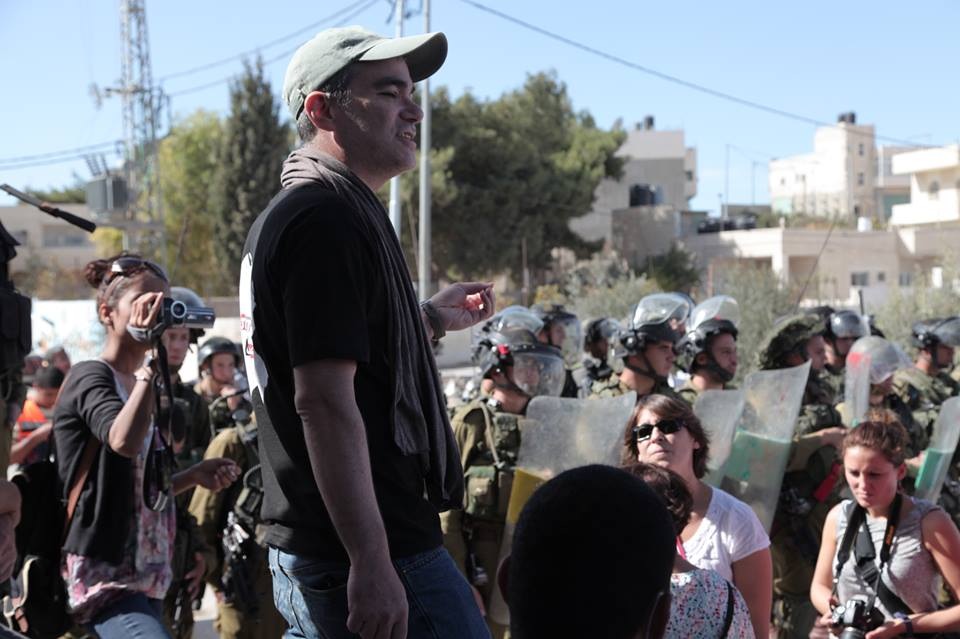
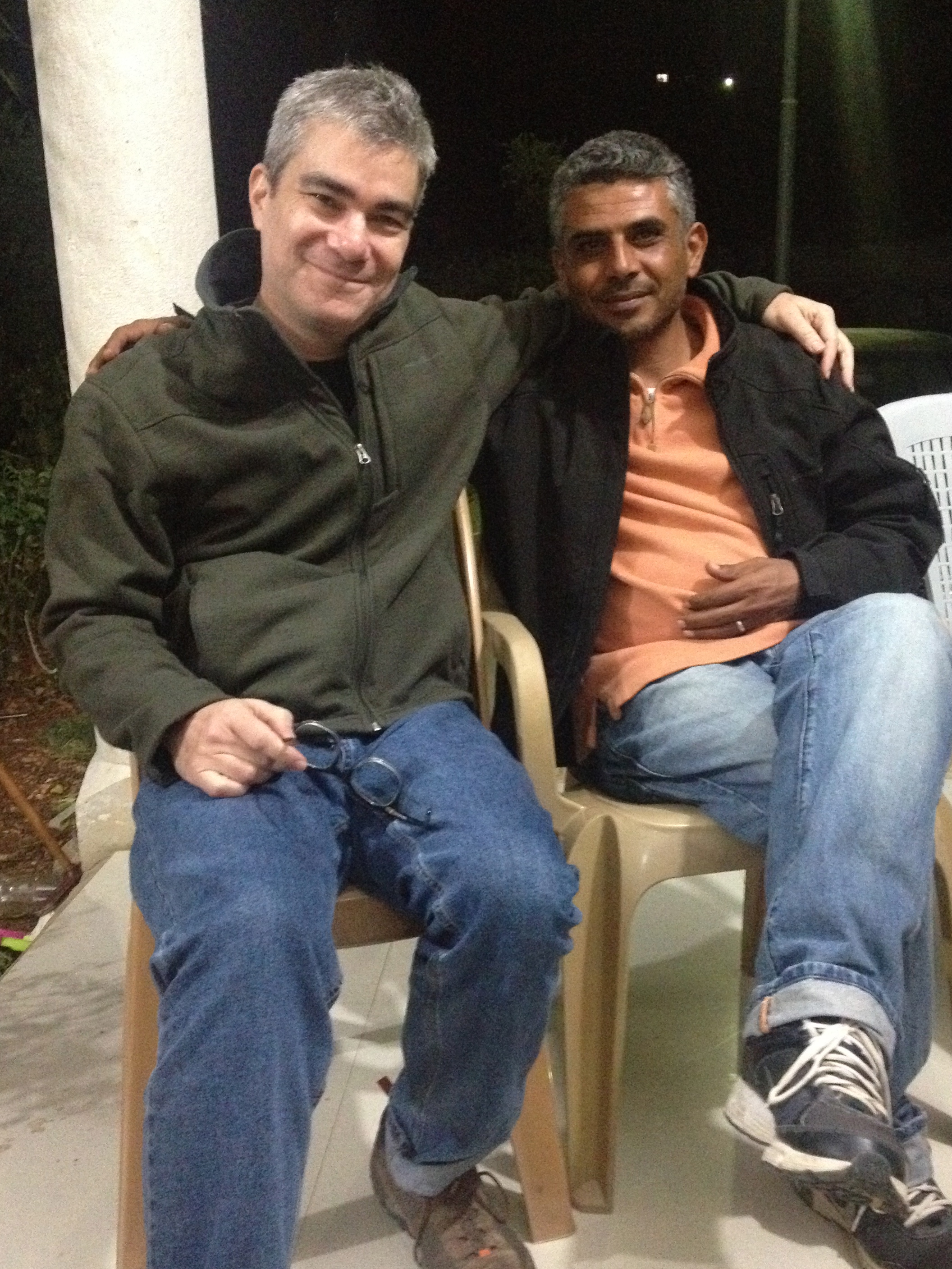
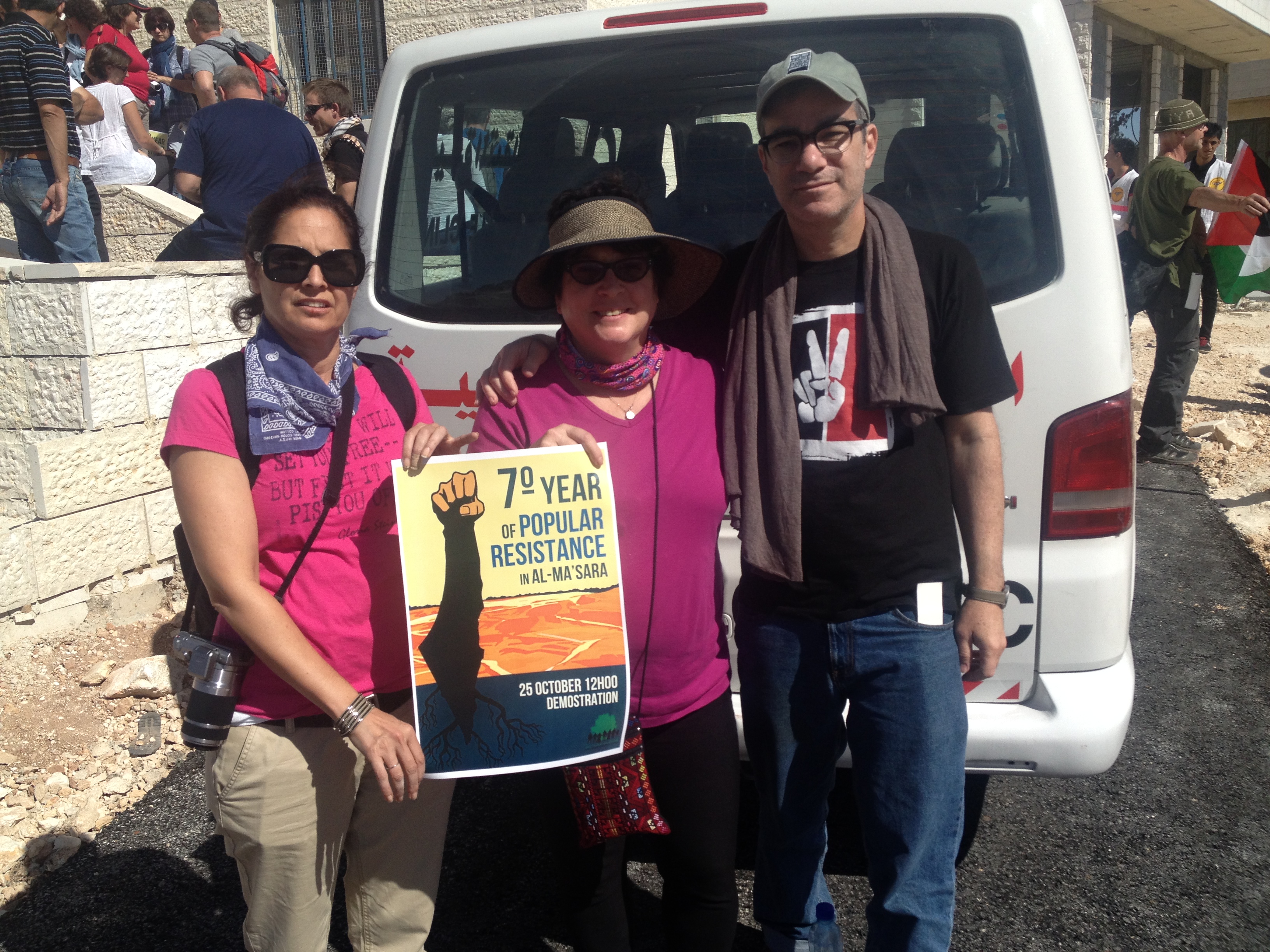
Demonstration in Al Ma’asra (left to right: Estee Chandler, Lynn Pollack, me)

I’ve been home for a few days now and am sorting through a myriad of emotions and experiences from our delegation to the West Bank and Israel. I’m not sure I will do them all justice, but I know I promised some concluding thoughts, so here goes:

The essential mission of our delegation of American Jews and Palestinians was to show solidarity with the burgeoning Palestinian popular resistance movement to the Israeli occupation. We wanted to experience this movement first hand: to live in their homes, to meet with their rank and file as well as their leaders, to march together with them in their weekly demonstration.

In the end, we did all this and more. During the course of our short sojourn, we created new friendships and connections with fellow activists on the ground – and we also strengthened our relationships with one another all the more. I do believe this kind of joint Jewish/Palestinian delegation is a model that can and should be emulated. If the goal is a better future for Jews and Palestinians, I believe it makes eminent sense to travel toward it together.

One of the most important lessons we learned on our trip is that Palestinian resistance is a multifaceted phenomenon.  Thanks to the images relentlessly portrayed by the mainstream media, too many in the West assume Palestinian resistance exclusively takes the form of armed resistance.  But in fact we we discovered (and I hope my blog posts reflected) the Palestinian people have been resisting decades of injustice through a myriad of means: through cultural expression, through education, through familial ties, through remembrance and through nonviolent direction action, to name but a few.

This point was underlined powerfully by Palestinian academic and activist Dr. Mazin Qumsiyeh, with whom we met in Bethlehem.  Dr. Qumsiyeh, who is well known in the Palestinian civil society world (and the author of the recent book, “Popular Resistance in Palestine: A History of Hope and Empowerment“) pointed out to us that in fact, Palestinian popular resistance long predated the establishment of the State of Israel. (One such example he cited was the Arab Palestinian Women’s Union, founded in Jerusalem in 1921, a proto-feminist group that protested against British support of the Zionist colonization of the Palestine – but also advocated for a myriad of women’s issues such as family planning, forced marriage, etc.)

mazin

Left to right: Aaron Cahan, Dr. Mazin Qumsiyeh, Dima Budron (at Bethlehem University)

I’ve long believed that the current incarnation of the Palestinian popular resistance is eminently worthy of our attention and support – and I was so grateful for this opportunity to experience it and write about it from within. Too often we hear the oft-repeated shibboleths: “the Palestinians want to push the Jews into the sea,”  “Palestinians are terrorists” and “where are the Palestinian Ghandis?” I hope that my last several posts have helped you to understand the fallacies of knee-jerk comments such as these.

Where are the Palestinian Ghandis?  We met them over and over again: in Bil’in, in Nabi Saleh, in Bethlehem, in Ramallah and so many places in between. Granted, this movement currently lacks a singular unifying leader – and on this issue, Dr. Qumsiyeh made an important point.  He told us he once heard a presentation by a prominent biographer of MLK, who was asked if the American civil rights movement would have existed if Dr. King had never been born. The biographer had no doubt that it would have, pointing out that leaders do not create movements – but rather, it is movements that create leaders. We can only hope that sooner than later, this will be the case regarding the Palestinian popular resistance as well.

This is not to underestimate the daunting challenges facing this movement. A number of Palestinian activists spoke to us about their hope for a “Global Intifada” – a worldwide movement that might leverage a variety of tactics of nonviolent resistance in popular support of justice for the Palestinians. While this movement is indeed taking shape, Iyad Burnat, Bassem Tamimi and others made it clear to us that they have no illusions. Yes, the weekly demonstrations continue, but they still occur in only semi-coordinated fashion in isolated villages throughout the West Bank. Popular movement leaders are struggling in so many ways to maintain momentum and morale, given that the ongoing reality of these Palestinian communities remains so oppressive and so dire.

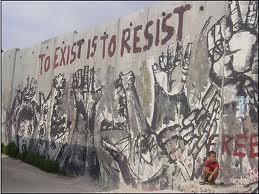
downloadAnd it is an oppression we saw for ourselves quite literally on a daily basis.  It is difficult to do justice to the stifling atmosphere in these West Bank communities that are struggling so hard to live a semblance of normalcy amid the separation wall, the checkpoints, the ever-growing settlements, the night raids and the tear gas.  As we saw for ourselves, their very steadfastness represents their purest form of resistance.  As it is written in various points along the separation wall: “To Exist is to Resist.”

I want to thank my colleagues and on this delegation, who have become dear friends all the more. My love and respect to Shafic Budron, Dima Budron, Rich Cahan, Aaron Cahan, Estee Chandler, Lisa Kosowski, Lynn Pollack, Emman Randazzo, Isobel Randazzo, Kalman Resnick. Stay tuned for their guest posts yet to come. Although I will let their words speak for themselves, I think I can safely say we are united in our conviction that this was only the beginning of a much, much longer journey.

To be continued…

“Beautiful Resistance” in Aida Refugee Camp

Our trip is winding down, but I’m going to try and slip in a few more posts before I head stateside…

As I mentioned in an earlier post, Palestinian resistance takes many different forms. On Thursday, we received a profound tutorial in cultural resistance courtesy of the educational and theatre training center, Alrowwad.

Alrowwad (in Arabic: “Pioneers for Life”) is located in the Aida refugee camp adjacent to Bethlehem and refers to its mission as “Beautiful Resistance.” As their vision statement eloquently articulates:

(We seek to create) an empowered Palestinian Society on educational and artistic level, free of violence, respectful of human rights and values, (with special focus on children and women) based on the spirit of social entrepreneurship and innovation in self-expression and respect of human values.

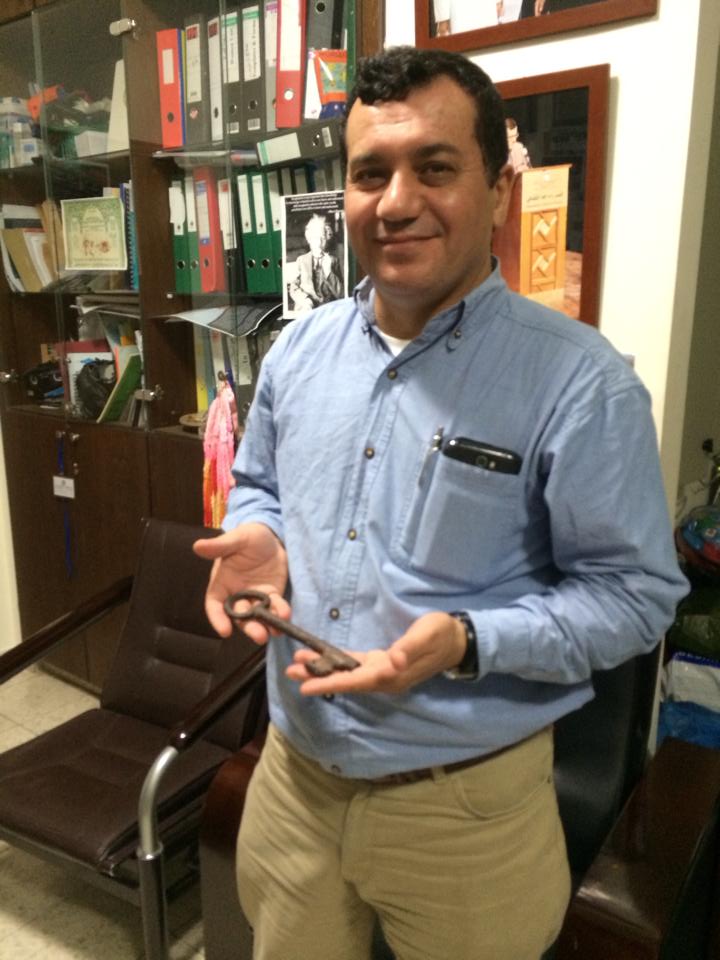
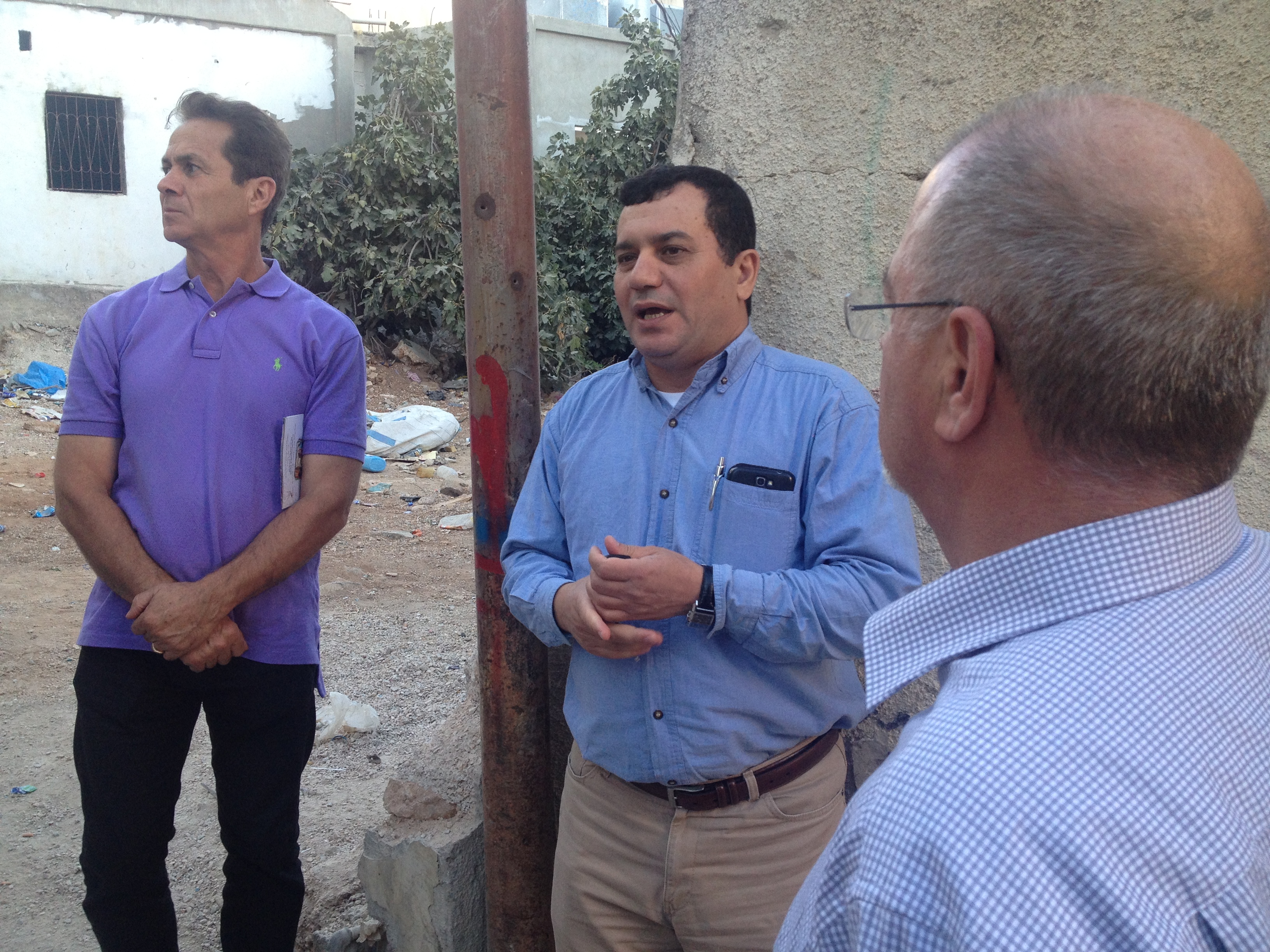
We spent the afternoon with Alrowwad’s founder and director, the inspiring and visionary Dr. Abdelfattah Abusrour (below), who gave us a tour of the center and the Aida refugee camp itself.  Abdelfattah was born and raised in Aida, but went to Paris to study Biological and Medical Engineering at Nord University. While in France, he also nurtured a passion for theater and painting and he quickly became involved in the educational/cultural life of Paris. He told us that he could easily have “married a French woman” and lived a comfortable life in France, but he eventually felt compelled to return to Aida and utilize his cultural training in his home community.

Dr. Abdelfattah Abusrour with the key to his family's home (it is a well-known custom for Palestinian families to keep the keys to the homes they lost during the Nakba as a sign of their hope for return.

Dr. Abdelfattah Abusrour with the key to his family’s ancestral home (it is a well-known custom for Palestinian families to keep the keys to the homes they lost during the Nakba as a sign of their hope for return.)

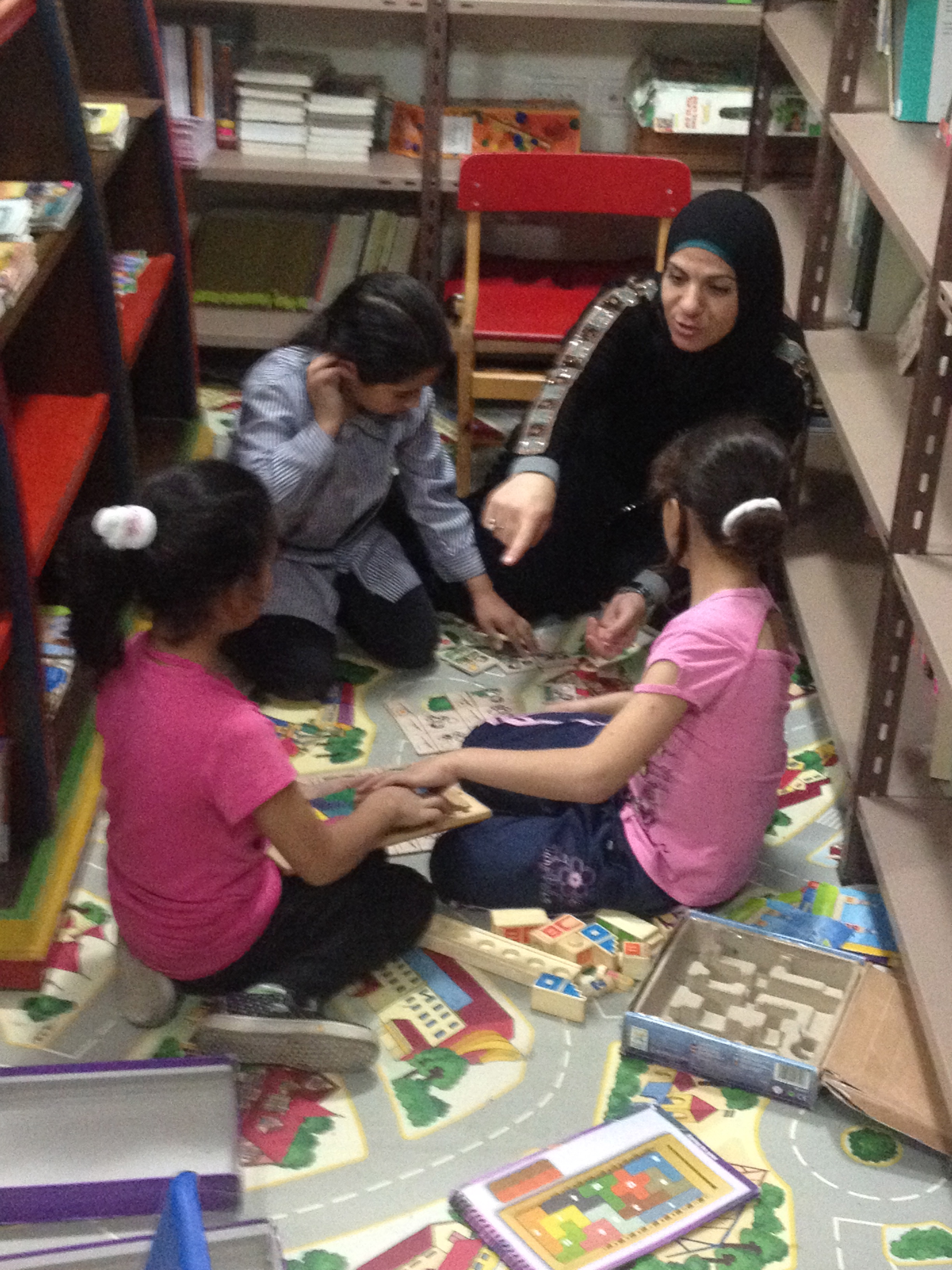
Abdelfattah established Alrowwad in 1998, and it very quickly became an anchor in the Aida community.  It has also become a model of cultural resistance for Palestinian society at large. Their concept of “Beautiful Resistance” uses culture as a therapeutic method to encourage and promote creativity and non-violence, and to teach peace and respect for others.

Abdelfattah and Alrowwad has now introduced a future generation of Palestinian youth to this a new method of self-expression and resistance. They believe their work increases the spirit of collaboration between children as well as their sense of belonging in the community. Their hope is that given the chance to be creative and to set their own priorities, children can provide a bridge for a democratic and independent Palestinian society — to build a better future even amidst a dire present.

IMG_0826

In many ways, touring Alrowwad reminded me the Jenin Freedom Theatre, which I visited with my congregational delegation in 2010. Adelfattah told me that his center does indeed collaborate with the Freedom Theatre, as well as other similar Palestinian cultural projects throughout the West Bank. Adelfattah also travels abroad to promote his work – and this spring will be directing a performance of “The Diary of Anne Frank” in North Carolina!  Just another reminder that there is an extensive and powerful grassroots movement of Palestinian cultural resistance that is relatively unknown to the West, but is eminently worthy of our support.

IMG_0831

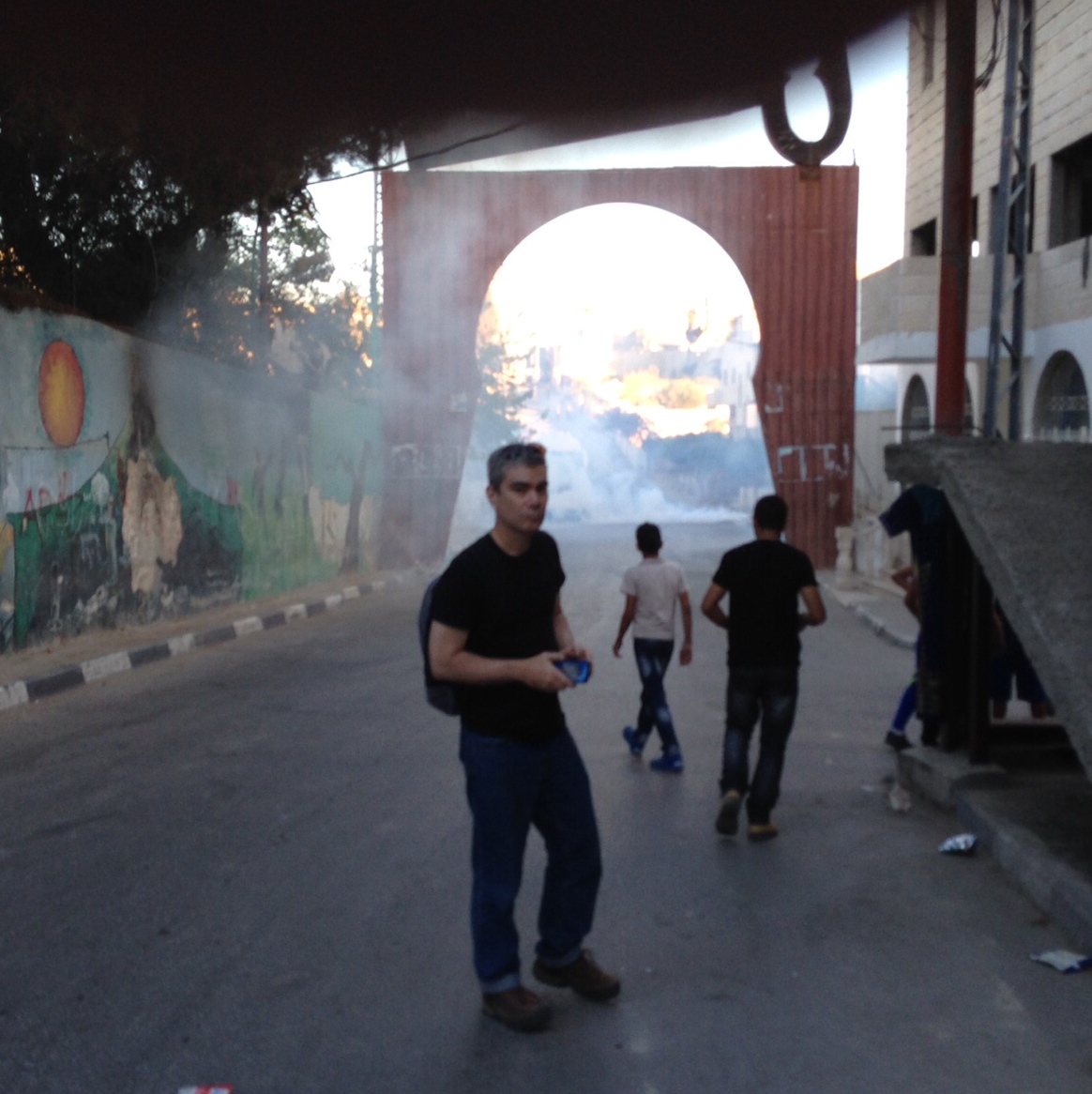
During our tour of Aida (above), Abdelfattah gave us a glimpse of the life of his community – explaining its history and illuminating life amidst the ever-present reality of military incursions, night raids, etc. At one point, our group actually witnessed this reality up close: near the gate to the camp, several IDF soldiers shot tear gas at some children who were a few meters in front of us. (We did not witness the incident that precipitated this violence.) Though we were not in the immediate vicinity of the tear gas clouds, it carried toward us downwind – and though it was only a vestige of the gas, several of us experienced its powerful, lingering sense of burning in our eyes and throats. (I can’t begin to imagine what it must feel like to sustain a direct hit.)

teargas

We continued our way down the streets of Aida, along the separation wall that butts up directly against Bethlehem. As we walked, a women called to Adelfattah from a third story window and invited us up for tea. We sat together on the roof of her home, sipping our tea and looking out over the wall toward the wide open spaces that led toward greater Jerusalem. Our hostess told us that she and Aida owes their very lives to Abdelfattah and it was an honor to have us in her home.

Please join us in supporting the work of Alrowwad through Friends of Alrowward USA. Our delegation can personally attest to the power of their “Beautiful Resistance.”

An Anniversary of Popular Struggle in Al-Ma’asra

IMG_0883

Al-Ma’asra Popular Committee Leader Hassan Brijeh

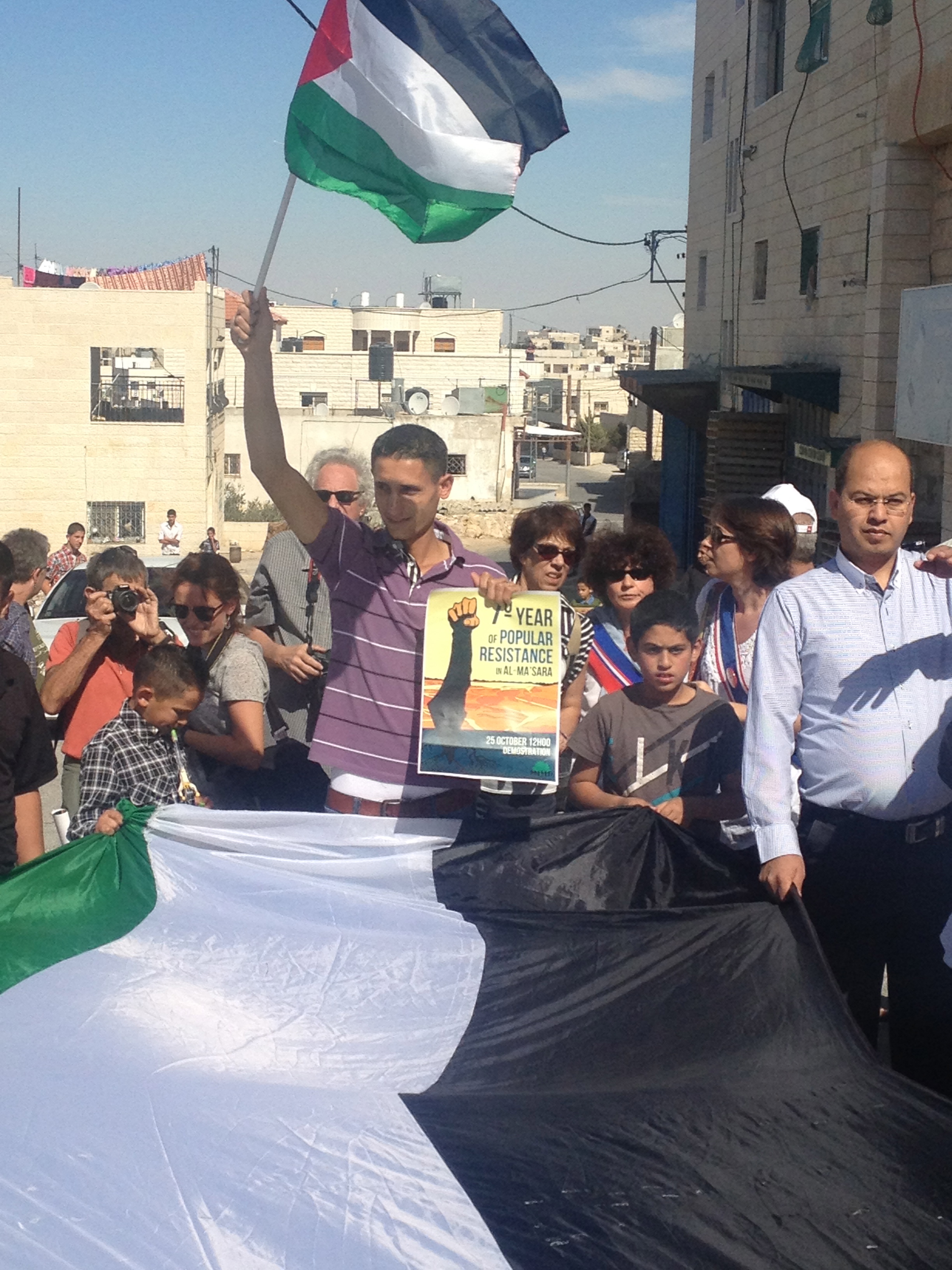
Earlier in the week, our Bil’in host Iyad Burnat told us that a neighboring village, Al-Ma’sara, was celebrating the 7th anniversary of its popular resistance against the occupation – and was inviting other village communities involved in the movement to march join them for their weekly Friday demonstration. Although our original plan was to march in the weekly demonstration in Bil’in, this turned out to be a rare opportunity to see the wider movement in action. So on Friday, our delegation traveled with Iyad to show solidarity with the people of Al-Ma’asra.

Al-Ma’asra is located in the Southern Bethlehem area, with a population of approximately 950 residents, 50 of whom are between the ages of 6 and 18. Like many villages in this location – near Israel’s coveted Gush Etzion settlement region – the construction of the separation wall is cutting off Al-Ma’asra from accessing more than half of their land and the main water supply.

About 90% of the houses in Al-Ma’asra are located in Area C – a region in which Israel is rapidly demolishing houses and moving out its Palestinian residents. (I’ve written extensively about this issue here, among other places).  Like Bil’in, Nabi Saleh and so many other villages, Al-Ma’asra has turned to popular resistance – including weekly nonviolence demonstrations – to protest the theft of their land and devastation of their livelihood. And like these other villages, they have been subject to the Israeli military’s devastating use of tear gas, sound bombs, coated steel bullets etc. Since the beginning of their demonstrations, more than 30 of their inhabitants have been arrested.

IMG_0886

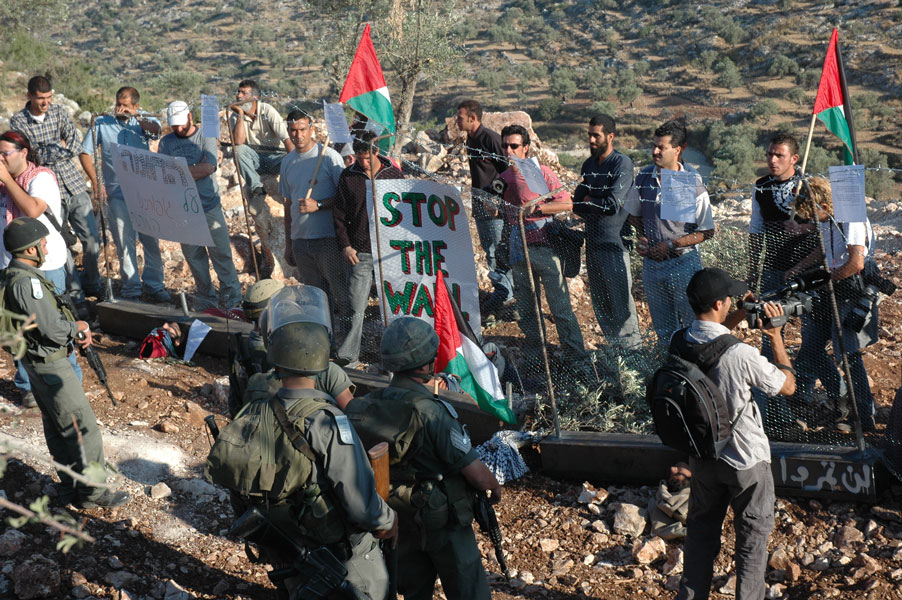
After we arrived in Al-Ma’asra, we received a briefing/update from Mohammed Brijeh (above, later at the rally), after which we joined the growing ranks of villagers, Israeli solidarity activists and internationals who were quickly pouring into the village’s main street.  Then at 12:00 pm we gathered together and began marching. The street was filled with approximately 300 individuals: young and old, representing a myriad of nationalities and ethnicities. But it was clearly the people of Al-Ma’asra who were leading the way: leading us in chants, singing songs and waving to their neighbors,

IMG_0874

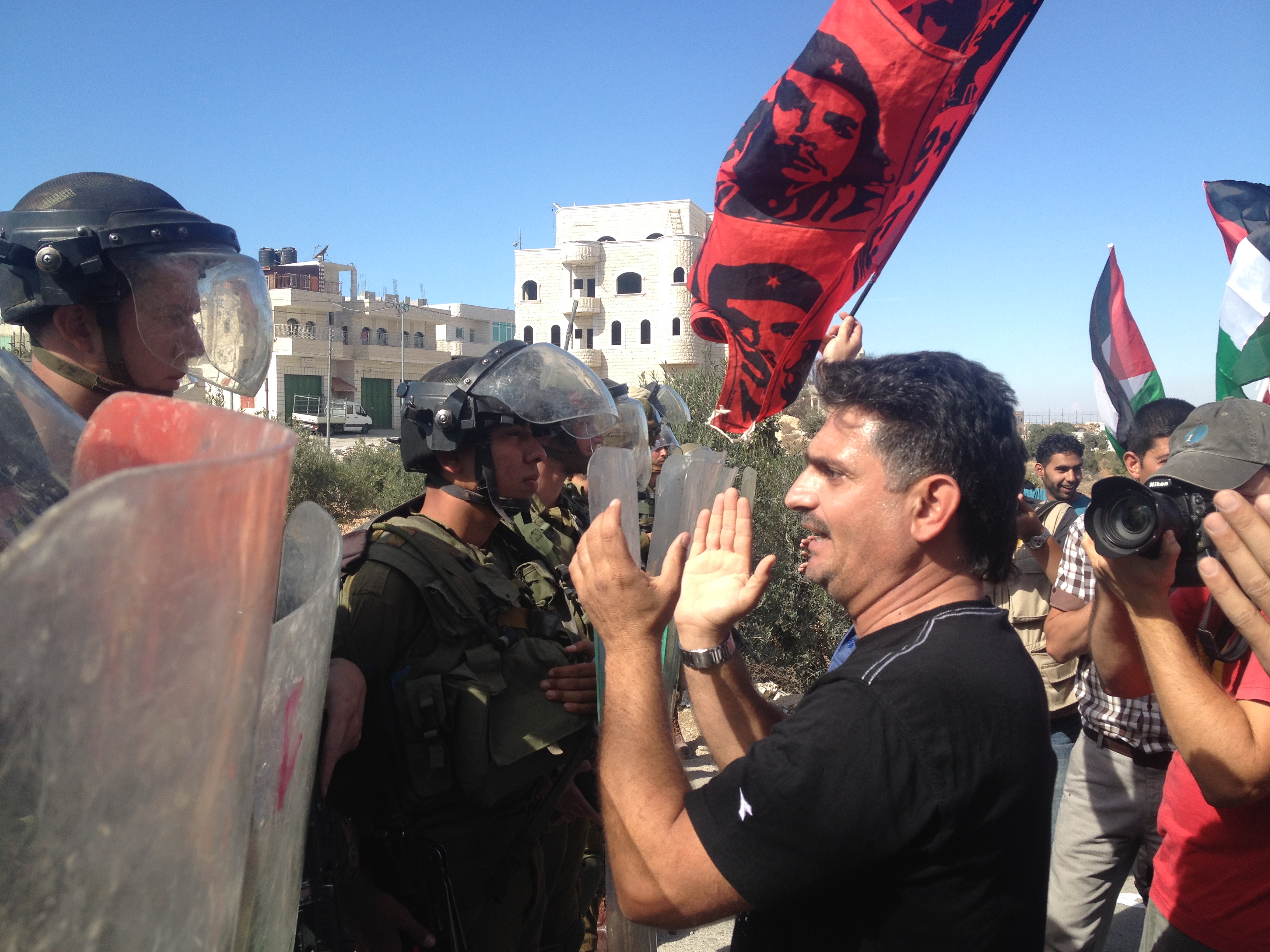
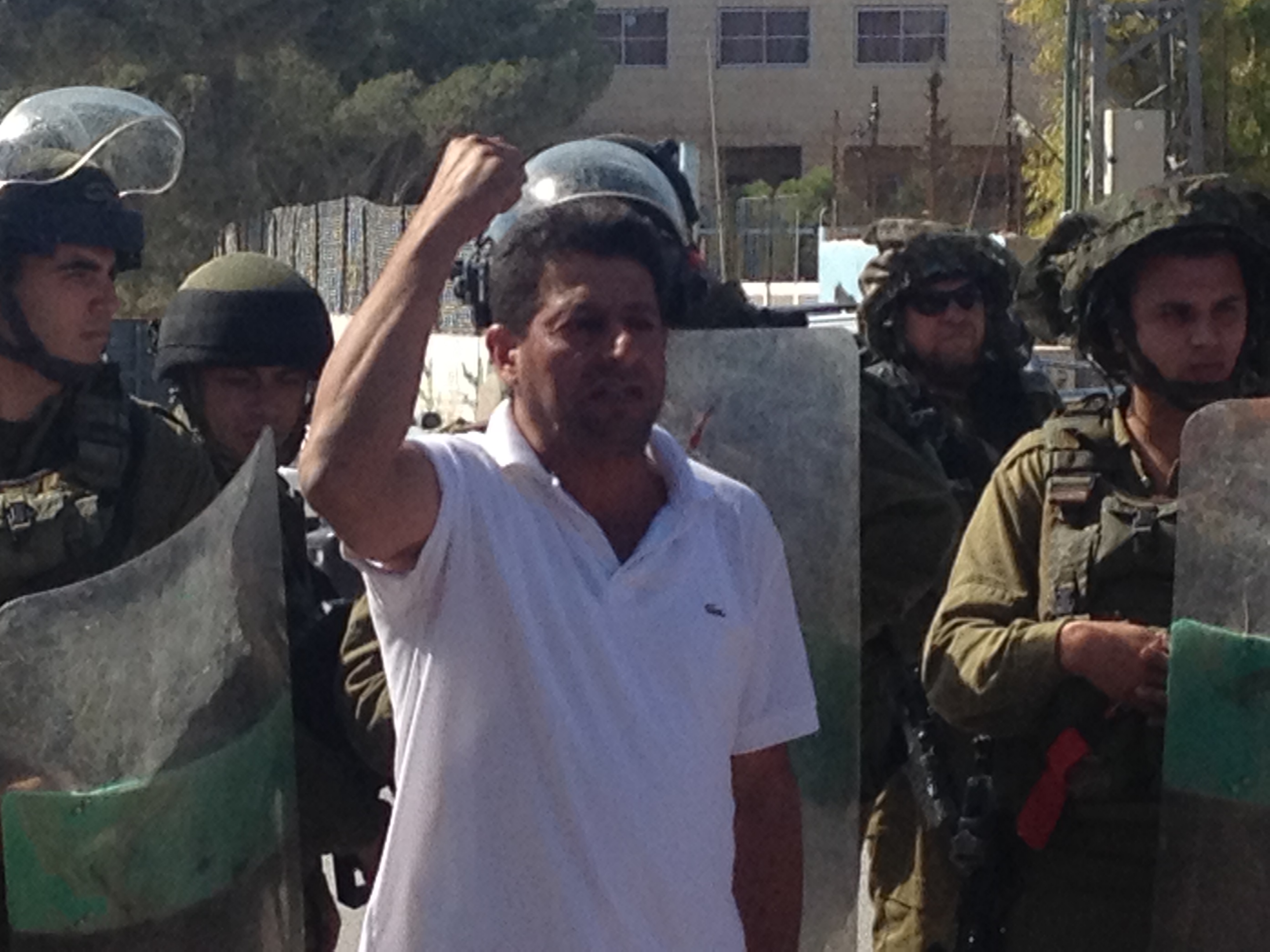
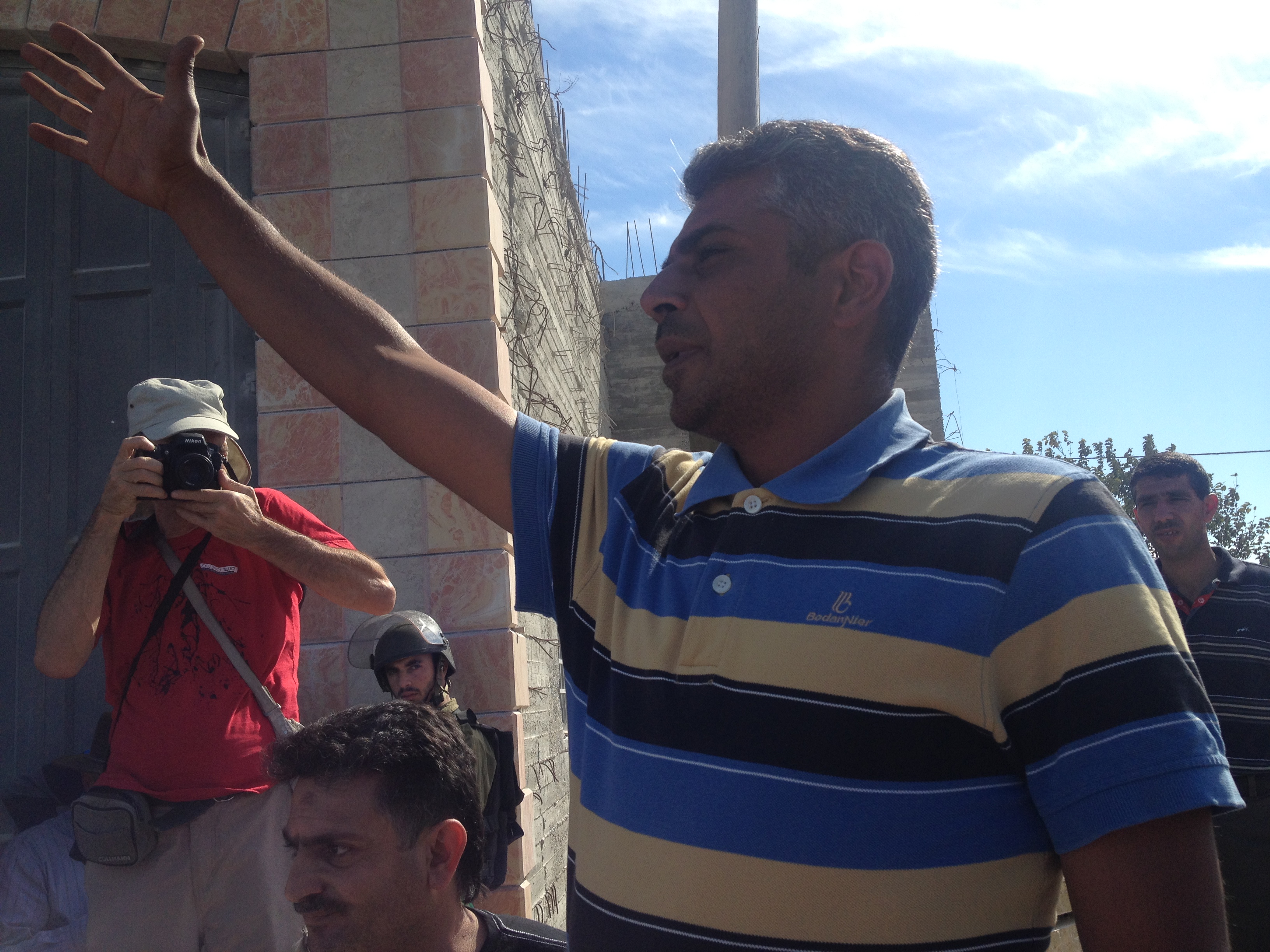
After 15 minutes or so, we noticed a long line of Israeli soldiers in riot gear, standing in formation across the street, blocking our way to the wall. The crowd pressed up close against the soldiers and standoff commenced. When the villagers were told they were denied passage, Mahmoud stepped forward and starting chastising the soldiers in English. Careful not to use any physical violence or overly incendiary rhetoric, he asked the soldiers why they were not allowed the right to live and assemble freely in their own village.

He explained to them they could oppress them all the wanted, but that one day, like all oppressed people, they would be free. Pointing to their extensive riot gear, their bullet-proof vests, their M-16s, their helmets, he told them that none of this expensive equipment would ever bring them peace – then pointing to his head, he said “it’s not what you wear, it’s what’s in here that you need to change.”

Perhaps the most powerful moment for me came when he said to one soldier, “What would your mother think – would she want you to bully the people of this village, to oppress them, to take their land away from them? Shame on you!” The chant spread quickly through the crowd: “Shame on you! Shame on you!”

About 20 minutes or so into the standoff, there was a roll call of participants, a myriad of countries were called out with the obligatory hometown cheers. (Among those represented: the US, Great Britain, Ireland, Germany, Scandinavia, France, Spain, and more). A succession of speakers then got up on a raised area to the right of the soldiers to give speeches. They introduced Iyad, and he offered greetings (below) from their brothers and sisters in Bil’in.

IMG_0882

After Iyad spoke, one of our delegation participants, Estee Chandler, called out “We have a rabbi here!” Then one of the organizers shouted, “We have a rabbi here! Let’s here from the rabbi!”  And before I could even think about what I might possibly say, I got up and started to address the crowd (below).

I told them that the Torah teaches us – as all spiritual traditions do – that God stands with the oppressed and demands that we do the same. Thus, I said, this demonstration was a sacred act for all of us – a mitzvah. And that it was all the more sacred because it contained such a diversity of nationalities and religions. I told them we were honored to stand together with our Palestinian brothers and sisters who were struggling for justice and dignity and that we would take this message back with us when we returned home to the US.

IMG_0895

After the speakers, something of a waiting game began. The demonstrators sat down in the street in front of the solders, singing and chanting as the soldiers were obviously conferring on their next move. Eventually, the commander told us we have 5 minutes to disperse before they opened fire on us. Little by little, the crowd got up and walked back down the street. Some of the younger villagers went to another main street where we later could see some kind of skirmish in the distance.

In the end, all the demonstrators dispersed; I felt a myriad of emotions at that moment. I had no doubt that the decision to disperse came from the organizers, who understandably wanted to avoid violence in the streets. Still, I admit it felt galling that in the eyes of the IDF, this was a just another “successful” job of unruly crowd control . On the other hand, the message of solidarity and defiance had been delivered – as it had been every week for the previous seven years in Al-Ma’asra and would for many more years to come. And in so doing, new relationships were created, new coalitions built – and the movement was that much stronger for having come together that day.

During our standoff in the street with the IDF, it occurred to me that this was precisely the same circumstance that occurred on the Edmund Pettus Bridge in Selma in 1965. The demand for justice was the same, the solidarity was the same, the message of nonviolence was the same, as was the  show of force by a brutal and overmiltarized gauntlet. Though that particular standoff ended violently, I was all too mindful that, in a sense, there is a reenactment of Bloody Sunday every week in villages throughout the West Bank.

PS: Upon our return, we learned to our dismay that the village of Bil’in was tear-gassed during their demonstration that day.  We were told that several canisters actually landed near Iyad’s house and at one point most of the village was shrouded in choking white smoke.

This is life on the front lines of the Palestinian popular resistance – just a small sample of the regular crimes committed against a people who are literally choking on an unjust and illegal occupation.

Morning in Nabi Saleh

IMG_0767

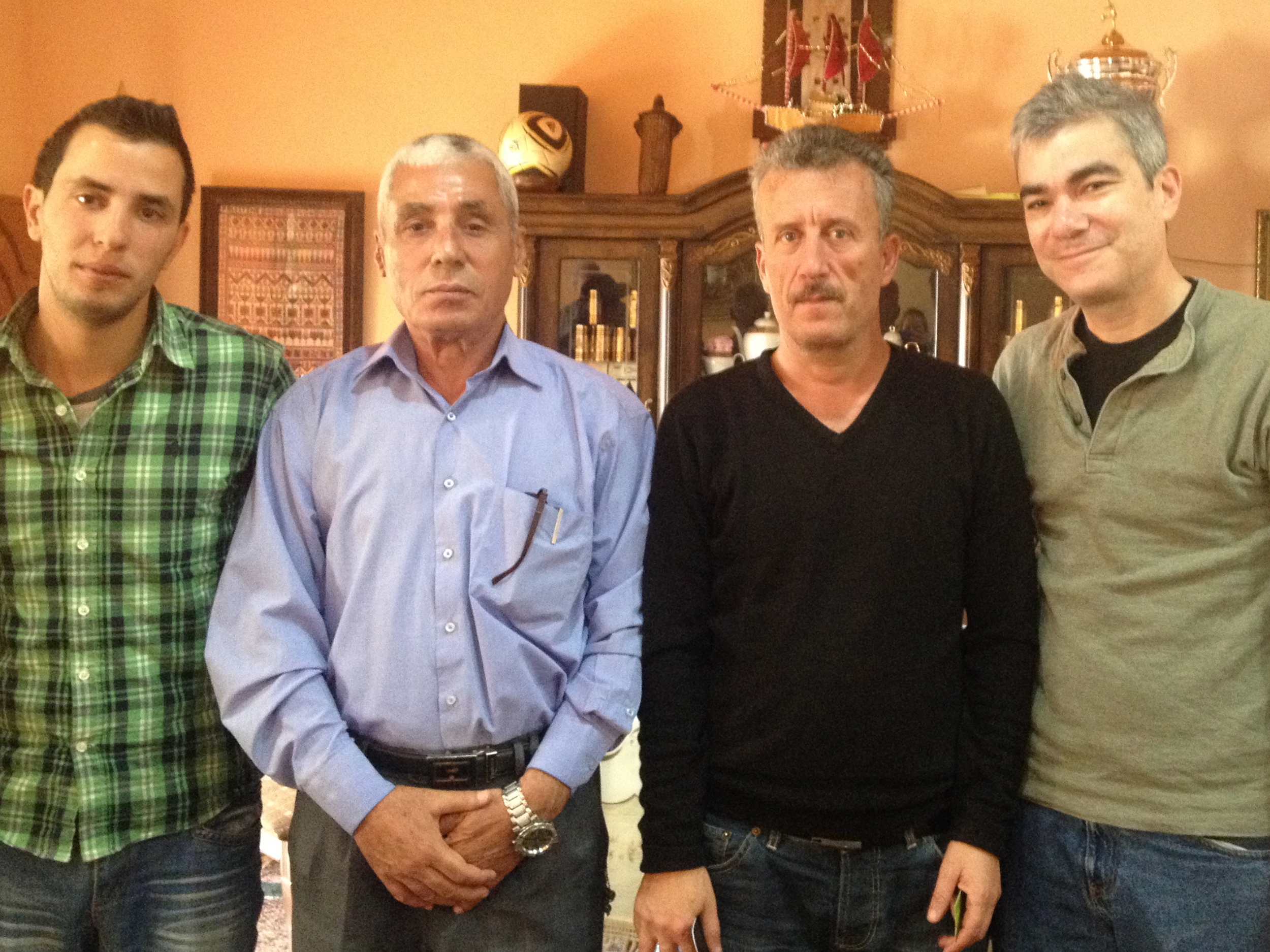
Mohammed Tamimi, Abu Hussam Tamimi, Bassem Tamimi, me (left to right)

On Monday morning our group traveled to the nearby village of Nabi Saleh, another prominent community in the Palestinian nonviolence resistance movement. You may have heard recently about Nabi Saleh from this New York Times Magazine cover story by Ben Ehrenreich last March. If you haven’t read it, I highly recommend it – I believe it is by far the most thoughtful consideration of this movement by the mainstream media.

Although this was my first time in Nabi Saleh, I met Bassem Tamimi, one of its most prominent leaders briefly in Ramallah on our congregational trip to the West Bank in 2010. That’s me above with Bassem, his cousin Abu Hussam Tamimi and nephew Mohammed Tamimi.

Our group spent several hours in Abu Hussam’s home learning about the history of Nabi Saleh and its place in the greater popular movement. Bassem explained to us that unlike other villages, Nabi Saleh’s protest is not directed toward the separation wall, but rather the confiscation of the village’s lands and the takeover of its spring by the nearby Israeli settlement Halamish.

The protest movement in Nabi Saleh began when Bassem and other village members met with and learned from leaders of similar demonstrations in Budrus and Bil’in. Rejecting the violent resistance of suicide bombers in the Second Intifada, they consciously sought a return to the approach of the First Intifada – a nonviolent popular grassroots resistance that evolved into a coordinated mass movement.  The village leaders of Nabi Saleh studied the work of Ghandi, King and Mandela – knowing at the same time that the Palestinian nonviolent movement had its own unique context and would have to have its own unique characteristics as well.

Nabi Saleh launched its first demonstration on December 9, 2009 – the anniversary of the First Intifada – and since that time, it has been an critical link the chain of the Palestinian popular resistance. Like Bil’in and other villages that hold weekly demonstrations, their protests have been met with visceral force from the Israeli military. Protesters have been regularly met with tear gas, shot with coated steel bullets and sound grenades and sprayed with skunk water. These “crowd-dispersal” weapons invariably cause painful, often grievous, physical distress – and almost all of these armaments are manufactured in the US.

Bassem and the other leaders of the Nabi Saleh resistance have suffered profoundly for their efforts. Bassem has been arrested twelve times by the Israeli military – at one point spending more than three years in administration detention without trial. His most recent arrest took place on March 2011 and led to a year-long prison term. He was released one year later. Tragically, like other villages Nabi Saleh now has its own martyrs: Mustafa Tamimi was killed when he was shot in the face with a tear gas canister at point blank range in December 2011. And on November 2012, Rushdi Tamimi was killed after being shot in the head while protesting the Israel’s military attacks on Gaza in November 2012.

When I asked Bassem about the status of the Palestinian popular movement, he responded that while it is still growing, and despite the ongoing weekly demonstrations of ten to fifteen villages every week and the proliferation of popular committees, they are still far from the “Third Global Intifada” that he and other Palestinian nonviolence are advocating. Bassem and his fellow leaders seek nothing less than a worldwide movement that seeks to leverage the power of nonviolent resistance – including Boycott, Divestment and Sanctions – to eventually shift this unjust balance of power. Still it is clear that they these leaders are settling in for the long haul. And the fact that Israel reacts so strongly and violently to these efforts that it takes such a prospect very seriously indeed.

During our visit, enjoyed a sumptuous lunch graciously served to us by the Tamimi family. They also showed us several YouTube videos of significant Nabi Saleh demonstrations over the past few years. Our consensus favorite was the video, below, of Bassem’s thirteen year old daughter Ahed and her young friends confronting the Israeli military after the arrest of her mother, Neriman. By the end of the video, this little amazing girl was, quite simply, our hero. Please watch and see for yourself (Ahed is the little blond girl with the red pants):

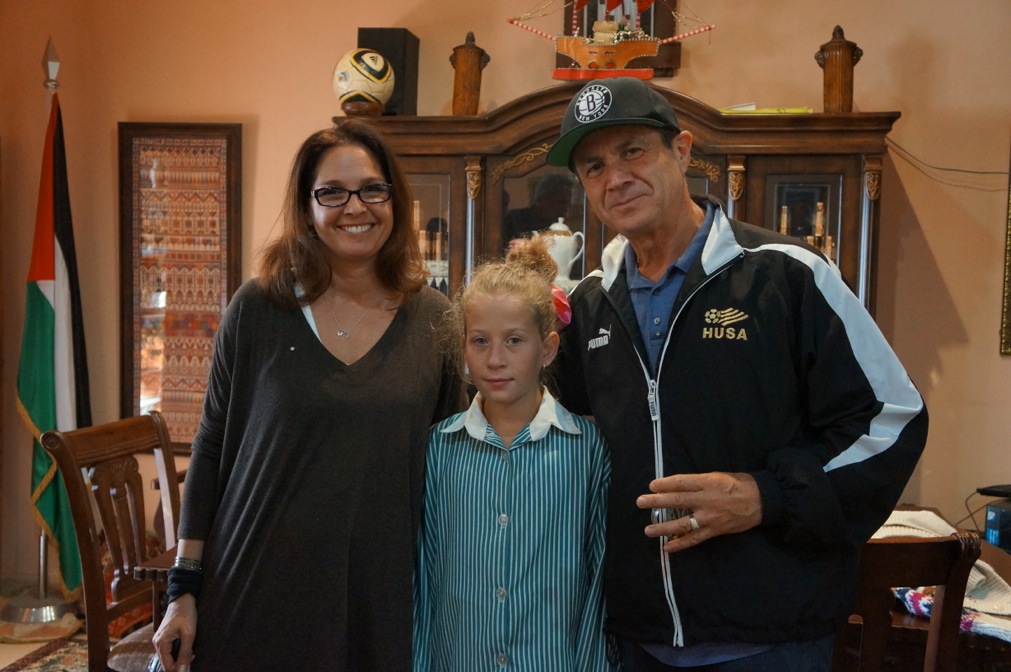
We were so thrilled to actually get to meet Ahed when she came home from school.  Somehow, the quiet, shy girl we met seemed to bear little resemblance to the ferocious, courageous girl speaking her truth to overwhelming military power – yet another example of how the battle for justice is being waged by ordinary people and families who find themselves living in extraordinary times. (That’s her below, with delegation participants Estee Chandler (left) and Shafic Budron (right):

DSC01639

We’re actually meeting and spending time with many amazing children growing up in activist families during our stay here. I will be writing more about this subject – among many others – in upcoming posts. Please stay tuned.

American Jews and Palestinians Showing Soliarity with Bil’in

IMG_0752

Just finished my first full day with our delegation to Bil’in – I think I speak for all our participants when I say we are honored and thrilled to be here.

As I mentioned in my previous post, our group is made up of Chicago-area Jews and Palestinians, with one participant from Los Angeles. We are longtime friends and fellow activists for a just peace in Palestine and we organized this trip to show solidarity with the Palestinian nonviolence resistance movement on the West Bank.  While individual members of the delegation have different personal opinions on the politics of the Israeli/Palestinian conflict and might differ on how a solution should politically be achieved, we are united in the conviction that full equality and civil rights should be enjoyed by all the people – Jews and Palestinians alike.

IMG_0753

With Iyad Burnat

Our “home base” for the trip is Bil’in; our host is Iyad Burnat, a prominent leader in this movement. Iyad serves as the head of the Bil’in Popular Committee Against the Wall, which has led weekly demonstrations against Israel’s separation barrier for the past nine years and has been one of the leading communities in the Palestinian popular resistance. I’ve written a great deal about Bil’in over the years and I’ve closely followed the news out of this small but mighty West Bank village. And like many, I was transfixed by the Oscar nominated documentary, “5 Broken Cameras,” directed by Iyad’s brother Emad, which movingly documented Bil’in’s ongoing struggle.

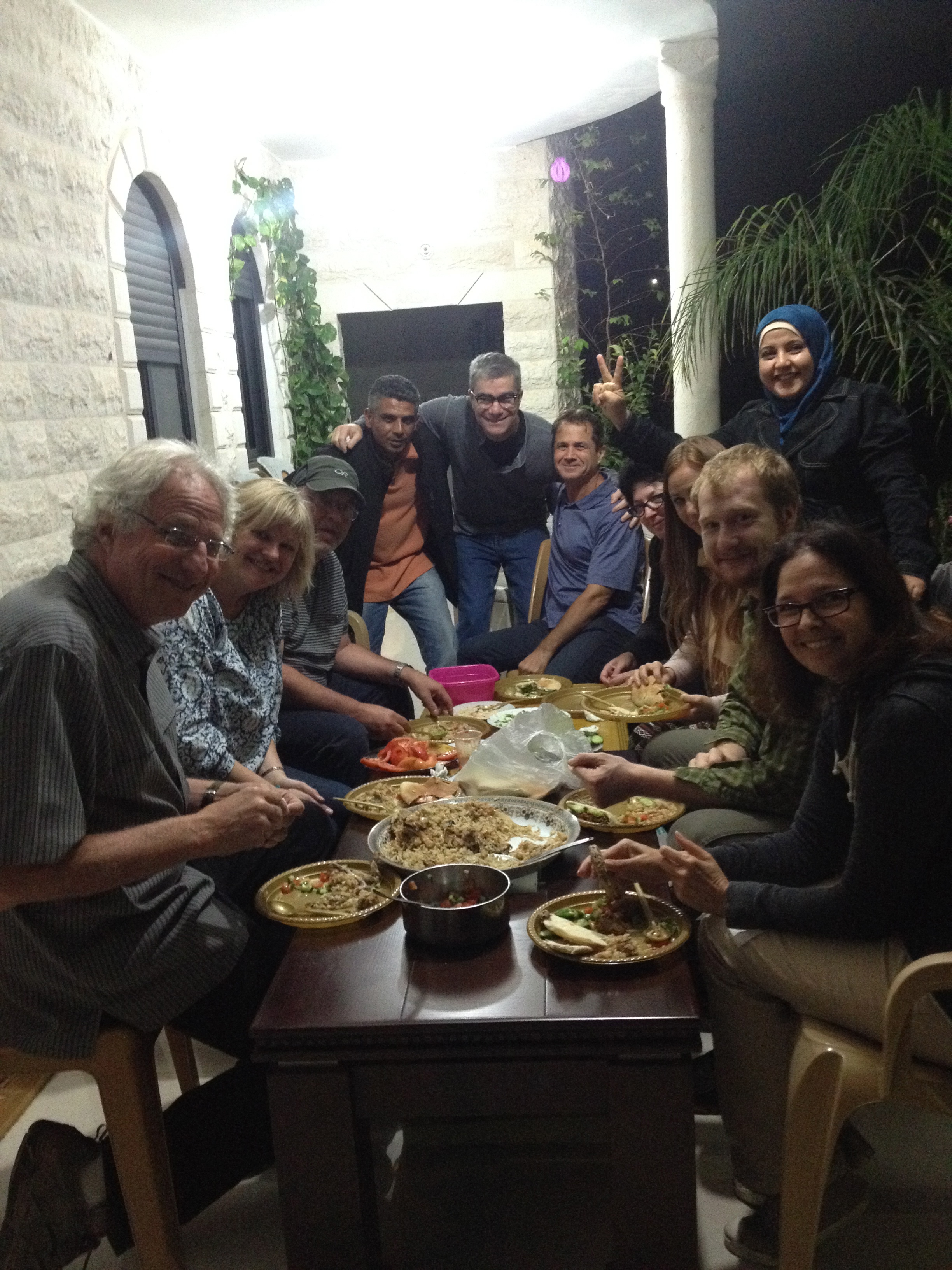
Our hosts here have been gracious and wonderful – Iyad (in the orange shirt, top pic) and his wife Tasaheel (in the blue hijab)  and his cousin Mustafa and his wife Sabrin have joyfully welcomed us into their homes and their families. This is clearly much more than a chance to learn about a movement – it is an opportunity to share in a way of life, to forge new relationships, to make dear new friends.

In our introductory tour, Iyad explained that Bil’in was one of the early West Bank villages to organize regular nonviolent demonstrations against the wall that was cutting the village off from a significant portion of agricultural land in order to create a buffer around the nearby settlement of Mod’in Ilit. Bil’in’s efforts have borne fruit – in September 2007, the Israeli Supreme Court ruled that the wall should be moved back 500 meters. The ruling was finally carried out by the military on June 2011, which restored 1,100 dunams of farmland back to the village (almost half of their of their originally confiscated land.)

And yet the struggle continues: the wall continues to choke off the people of Bil’in from their livelihood and the occupation continues to take a major toll on the life of the village. Our group will be participating the demonstration at the wall at Bil’in’s weekly demonstration this Friday – at which time similar demonstrations will take place in villages across the West Bank. This act of solidarity will be, without question, the most important aspect of our itinerary.

IMG_0764

One of the newest additions to the village is a new garden dedicated to the memory of Bassem (“Pheel”) Abu Rachme, a much beloved and very charismatic leader in Bil’in who was killed in 2009 when a tear gas canister struck him in the torso. His killing was captured on camera in “5 Broken Cameras” in one particularly heart-rending moment.

Last month, the IDF officially announced it was closing the investigation into his death. According to a report in +972:

The military prosecution claims it was unable to determine the identity of the Israeli soldiers and border policemen involved or whether open-fire regulations were breached. This, despite the fact that as B’Tselem and Yesh Din pointed out in a joint press release condemning the decision, three video segments filmed during the demonstration show that Abu Rahmeh was situated to the east of the barrier, did not act violently and did not endanger the soldiers in any way…

Late last year, a soldier who served in the same unit that killed Abu Rahme gave testimony about the incident to Breaking the Silence. “…(T)his one time, one of the soldiers simply aimed at someone directly, and [the tear gas canister] hit his chest and he got killed. .. The guy who shot him … was kind of pleased with the whole thing, he had an X on his launcher,” the former soldier continued. An X on a weapon indicates a “kill.”

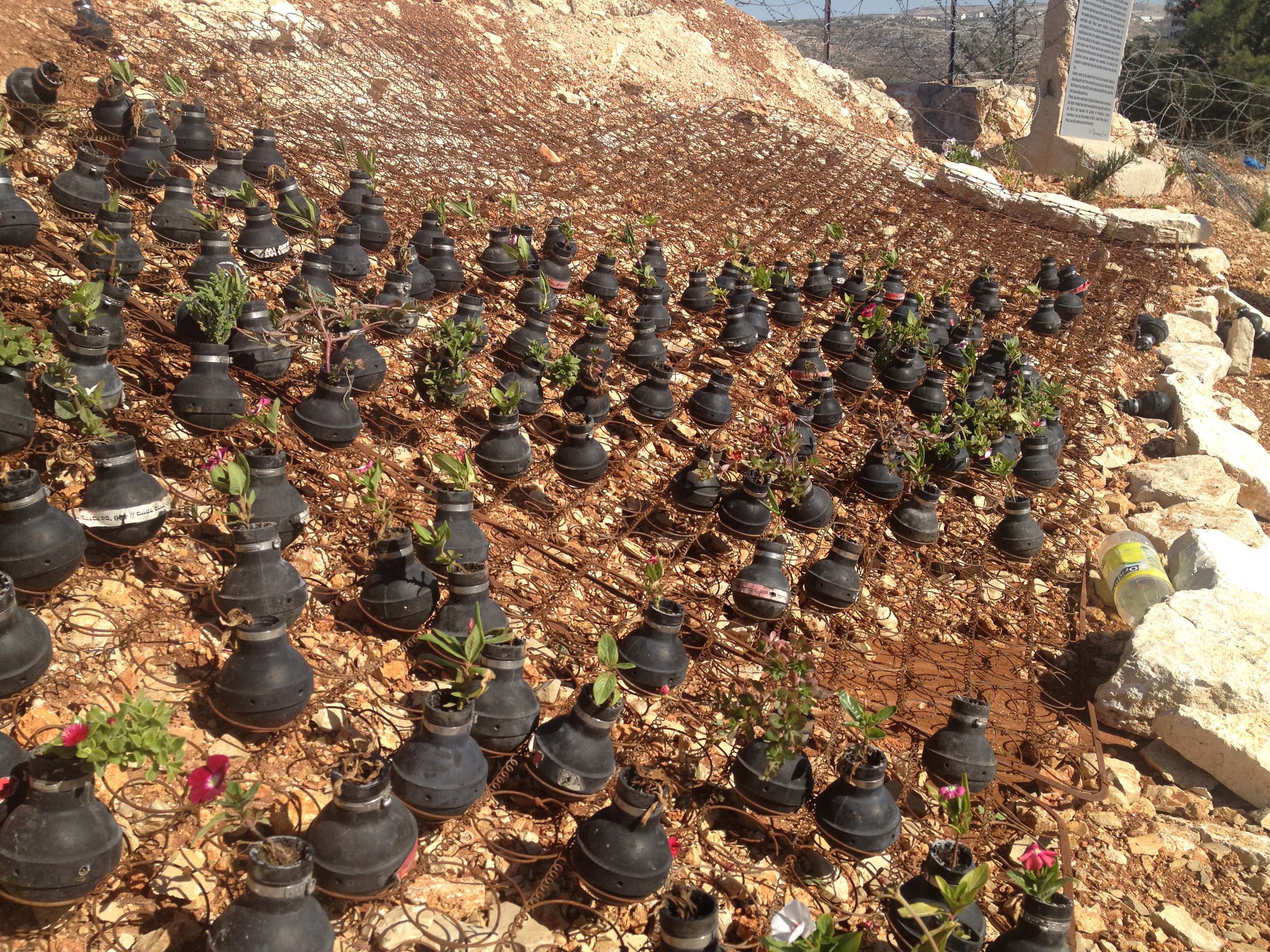
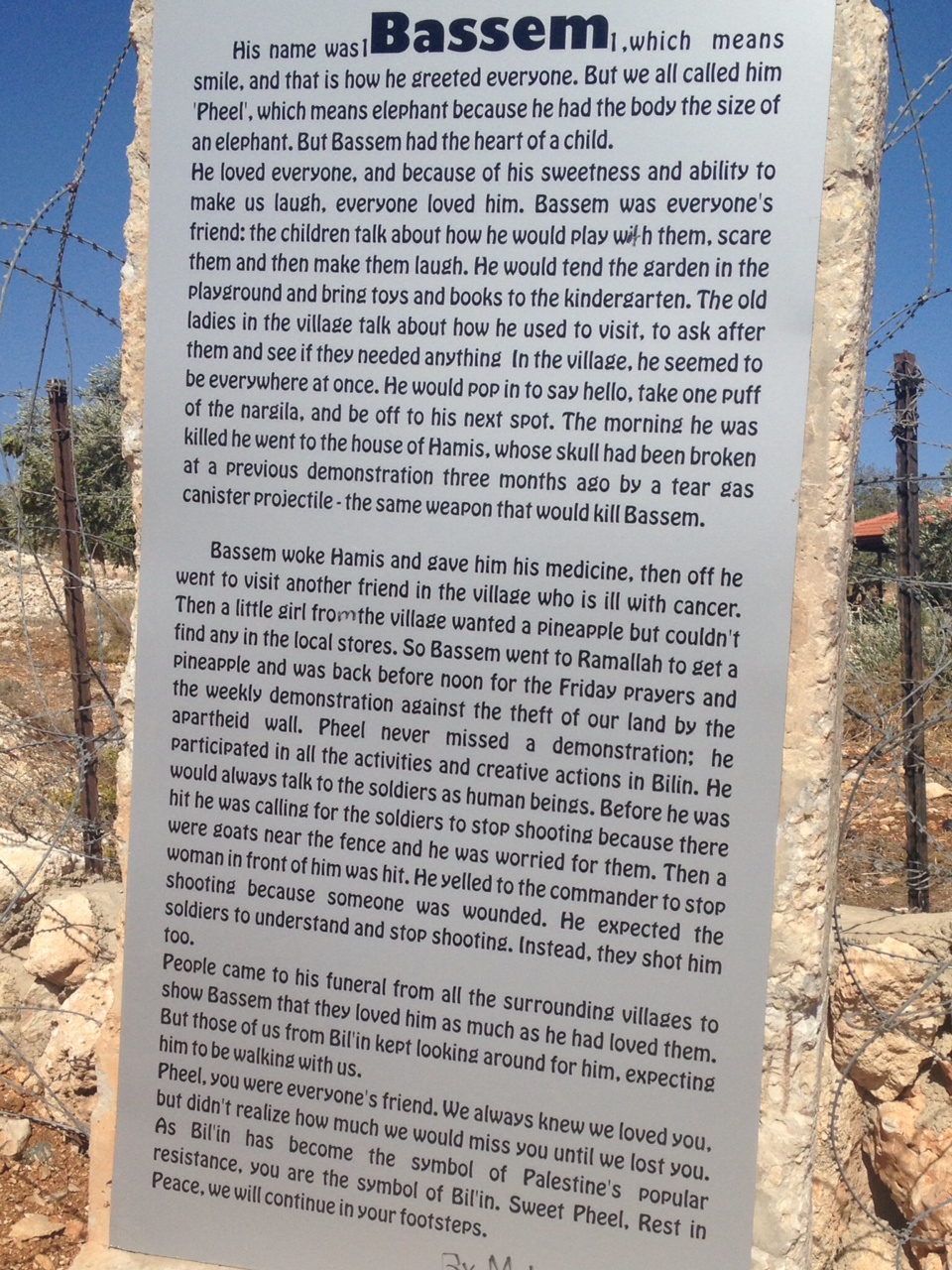
Bassem’s memorial garden (above) lies in the land that was recently reclaimed from the relocation of the wall. The myriad of small black planters are made of tear gas canisters. Please read the long tribute from the plaque at the garden, below, to get a sense of this man who will always occupy a dear place in the hearts of the villagers of Bil’in.

In my next post I’ll write about our memorable visit to Nabi Saleh, another prominent village involved in the Palestinian nonviolent resistance. Back soon.

photo

Coming Soon: A Solidarity Delegation to Bil’in

bilin

My next several posts will come from the West Bank, where I will be traveling as part of a group of Chicago-area Jews and Palestinians to learn from and show solidarity with Palestinians who are engaged in nonviolent resistance to the Israeli occupation. Our delegation will be hosted in the village of Bil’in, where, for the past several years, residents have been protesting the construction of the Separation Wall that has separated the village from its farming land – land that Israel is using to expand its settlement of Modi’in Illit, which lies immediately to the west. (You may recall the story of Bil’in is the subject of the great documentary, “5 Broken Cameras.”)

Our group will also be traveling to sites throughout the West Bank and Israel to visit with leaders of the Palestinian nonviolent movement and Israelis who show solidarity with them. I am thrilled to be taking this trip together with dear friends who I have long known though our activism for a just peace in Israel and Palestine.

I will blog as much as I can about my experiences from the ground and upon my return. Please stay tuned!

In Memory of our Voting Rights Martyrs: A Sermon for Kol Nidre 5774

Jimmie Lee Jaskson

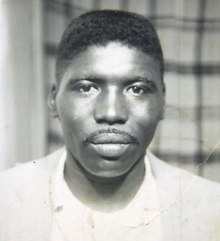
Jimmie Lee Jackson

I’d like to begin tonight by telling you the stories of three heroes of the civil rights era. I’d wager most Americans have never heard of them – but as far as I’m concerned, they deserve to be at least as well known as Emmett Till, Medger Evers and Rosa Parks.

The first is Jimmie Lee Jackson, an African-American farmer and woodcutter from in Marion, Alabama. Jackson grew up in poverty, but planned to move North for a better life after graduating from high school. After his father’s early death however, he spent his the remainder of his life on his small family farm in Marion, where he lived together with his sister, mother, and grandfather.

Jackson was an army veteran and a deeply faithful man; he became the youngest deacon in the history of Marion’s St. James Baptist Church. He also turned into a political activist at an early age after unsuccessfully attempting to register to vote for four years. Jackson spearheaded his church’s voter registration drive and eventually became a prominent civil rights leader in Merion.

On the night of February 18, 1965, Jackson participated in a demonstration in which 500 people peacefully marched from a church in Marion to the county Jail about a half a block away to protest the imprisonment of a young civil rights worker. On their way, the marchers were met and beaten by a line of Marion City police officers, sheriff’s deputies, and Alabama State Troopers. Among the injured were two United Press International photographers. A NBC News correspondent was so badly beaten that he was later hospitalized.

The marchers quickly turned and scattered back towards the church. Pursued by the state troopers, Jackson, his sister, mother, and 82-year-old grandfather ran into a café. The troopers followed them in and clubbed his grandfather to the floor. When Jackson’s sister and mother attempted to pull the police off and they began to beat them as well. Jackson went to protect them and a trooper threw him against a cigarette machine. A second trooper moved in and shot Jackson twice at point blank range in the abdomen.

Jackson staggered outside, was clubbed again and fell wounded in the street, where he lay for half an hour. Later that night, Jackson, his mother and grandfather were transported to a hospital in Selma. His mother and grandfather suffered head wounds but were treated and released – Jimmie Lee remained in the hospital where his condition grew steadily worse. Four days later, an Alabama state trooper walked into and hospital room and charged Jackson with assault and battery with intent to murder a peace officer. Eight days later, on Friday, February 26, Jimmie Lee Jackson died from his wounds.

His funeral took place on March 3. Dr. Martin Luther King was among the speakers at the service, after which a thousand people followed Jackson’s casket through the rain to a local cemetery. Four days later, several hundred marchers left Brown Chapel in Selma, formed a long column, and began walking up the steep incline of the Edmund Pettus Bridge, which spans the Alabama River. Their goal was to walk 54 miles to the state capitol in Montgomery to protest Jackson’s death and petition the governor and legislature to open the state’s voting rolls to all citizens. The march ended violently on a day we would all come to know as “Bloody Sunday.” It was a galvanizing moment in the fight for voting rights in this country.
Reverend James Reeb

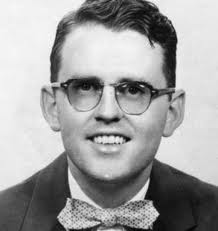
Reverend James Reeb

The second person I’d like to profile for you now is Reverend James Reeb. Reeb was raised in Caspar, Wyoming, served in the Army during World War II, and was later ordained by the Princeton Theological Seminary. Soon after, however, he left the Presbyterians and joined the Unitarian Universalist church. As a white man who believed in civil rights, he was particularly drawn to the UU’s strong emphasis on social justice.

Reverend Reeb was fully ordained as a Unitarian Universalist minister in 1962. After serving for a few years at All Souls Church in Washington DC, he became the director of the American Friends Service Committee Metropolitan Boston Low Income Housing Program in 1964. With his wife and four children, he moved to Boston and purchased a home in Roxbury, a predominantly African-American area of the city. His daughter Anne later recalled that her father “was adamant that you could not make a difference for African-Americans while living comfortable in a white community.”

Following Bloody Sunday, Reeb went down to Selma with 45 Unitarian ministers and 15 laypeople to participate in the voting rights demonstrations that arose in the wake of Bloody Sunday. On March 9, he joined 2,500 marchers for a second march from Selma to Montgomery. As on previous attempts they were stopped by the police – and so the marchers returned to Browns Chapel for an evening of speeches, singing and prayers.

Later that night, Reeb and two other Unitarian ministers had dinner in a local black restaurant. Although he had planned to return to Boston that night, he called his wife and told her he had decided to stay for one more day. Upon leaving the cafe, the trio was set upon by four men brandishing clubs and yelling racist slurs. They attacked and beat the three men – wounding his two colleagues and severely injuring Reeb with a blow to his skull. Needing a neurosurgeon, he was driven ninety miles by ambulance to University Hospital in Birmingham. He died two days later.

Reverend James Reeb’s death sparked mourning event throughout the country – tens of thousands held vigils in his honor, including a ceremony in Selma, where he, like Jimmie Lee Jackson, was eulogized by Dr. King. That evening, on March 15, President Johnson spoke to a joint session of Congress on behalf of the Voting Rights Act. It was his famous “We Shall Overcome” speech, in which he urged Congress to outlaw all voting practices that denied or abridged “the right of any citizen of the United States to vote on account of race or color.” Six months later, Johnson signed the Voting Rights Act into law.

Viola Liuzzo

Viola Liuzzo

And finally, let me tell you now about Viola Liuzzo – born in 1925 to a poor white family that moved constantly throughout the Deep South. During the early months of World War II, her family moved to Michigan, where she worked in a bomber factory. Eager to contribute to the war effort herself, Viola moved to Detroit, where she married and had two daughters. They divorced shortly after and she eventually married Anthony James Liuzzo, a union organizer for the Teamsters. Anthony adopted her daughters and they had three more children together.

Though she was a high school dropout, Liuzzo trained as a medical laboratory assistant and later took classes at Wayne State University. There she was exposed to political ideas of the time, including debates about the Vietnam War, education reform, and economic justice. This period marked the beginning of her political activism. She was arrested twice in demonstrations and both times she insisted on a trial in order to publicize her causes.

In 1964 Liuzzo, a former Catholic, joined the First Unitarian Universalist Church of Detroit – attracted, like Reverend Reeb, by its commitment to civil rights. She also became active in the Detroit chapter of the NAACP. Like so many others, Liuzzo was galvanized by events in Selma. Following Reverend Reeb’s murder she attended a memorial service for him and soon after, she decided to go down to Selma herself to volunteer for a week. As she explained to her husband, she believed there were “too many people who just stand around talking.” She asked her closest friend, an African-American woman named Sarah Evans, to explain to her children where their mother had gone and to tell them she would call home every night. When Evans warned her that she could be killed, she replied simply, “I want to be part of it.”

So on March 21, Liuzzo joined 3,000 other marchers as they marched across the Edmund Pettus Bridge attempting to reach Montgomery. She stayed on to volunteer over the next few days, driving shuttle runs from the airport to the marchers’ campsite and helping at a first-aid station.

On March 25, she joined the marchers for the final four miles to Montgomery, where she joined the thousands that demonstrated at the Alabama State House. When the march was over, Liuzzo and African-American civil rights worker named Leroy Moton drove five marchers back to Selma. After they were dropped off, Viola volunteered to return Moton to Montgomery. On their way back, four Ku Klux Klan members pulled up alongside their car. Liuzzo tried to outrun them, but they caught up with her car and opened fire. Viola was shot twice in the head and died instantly.

Following her murder, President Johnson publicly demanded that the arrest of Liuzzo’s murderers be a top priority. In just 24 hours, the FBI arrested the four Klan members, one of home was an FBI informant. Johnson appeared personally on national television to announce their arrest.

The FBI would later attempt to publicly discredit Liuzzo – most likely to cover up the fact that their agent was a KKK member and may have actively participated in her murder. J. Edgar Hoover personally spread rumors that Liuzzo was a member of the Communist party and a drug addict and that she had traveled to Selma to have sexual relations with black men. Viola’s family was also targeted by hate groups – after crosses were burned in front of their home. Anthony Liuzzo had to hire armed guards to protect his family.

However, as in the case of Jimmie Lee Jackson and Revered James Reeb, Viola Liuzzo’s death had a powerful impact on the voting rights movement across the country. On March 27 hundreds of protesters marched to the Dallas County courthouse in Selma in her memory. The next day Dr. King eulogized her at San Francisco’s Grace Episcopal Cathedral. The NAACP also sponsored a memorial service for Liuzzo at a Detroit church that was attended by fifteen hundred people including Rosa Parks. A Roman Catholic Church in Detroit celebrated a high requiem mass that was broadcast on TV. Dr. King was among the 750 people in attendance.

As with Jackson and Reeb, Viola Liuzzo’s murder played a critical role in the eventual passage of the Voting Rights Act. According to historians, Johnson invoked her death repeatedly as he lobbied Congress. Five months after she died, he signed it into law.

Why am I telling you the stories of these three individuals tonight? One simple reason is that I believe they deserve to be told. We owe Jimmie Lee Jackson, Reverend James Reeb and Viola Liuzzo at least that much. And we owe it to ourselves. I took the time to tell you about them because so few really know the stories of these American heroes. And we should. We should know who they were, how they lived and the significance of their sacrifice.

I also have a specifically liturgical reason for telling you their stories tonight of all nights. The traditional  Yom Kippur service includes a section known as the Martyrology (or as we call it in Hebrew, “Eleh Ezkarah,” meaning “These I Remember.”) The centerpiece of Martyrology is a long liturgical poem that recounts the death of ten rabbis – including the famous Rabbis Akiba, Ishmael and Shimon ben Gamliel – who were executed for their support of the failed revolt against Rome in the year 132.

We traditionally read these accounts on Yom Kippur because of the classical Jewish belief that blood atones.  Our Torah portion tomorrow will, in fact, describe an ancient sacrificial rite of atonement, in which the High Priest sacrifices a goat on behalf of the entire Israelite people. Though the sacrificial system is no more, we ask for God’s forgiveness by invoking the deaths of those who made the ultimate sacrifice. And so on Yom Kippur, we beseech God: even if we are unworthy of God’s mercy in the coming year, we ask for forgiveness us on account of those who made the supreme sacrifice on our behalf.

Whether or not we buy into such a theology, I believe the Martyrology has an additional function as well: on Yom Kippur we  pose the question honestly: what have we done in the past year to prove ourselves worthy of these profound sacrifices? What have we done to affirm that these courageous people did not die in vain? Have we honored their memories by transforming these lost lives into justice, hope and healing for our world?

When we ask these questions as 21st century American Jews, I believe they resonate for us on multiple levels. When we invoke those Jews who died for practicing their faith, we must ask: have we done what we can to ensure that this Judaism – this exquisite spiritual tradition of ours – will be passed on to future generations? And as Americans, when we remember those who died in furtherance of justice in our country, we are challenged: how have we honored their sacrifice? What to have we done in the past year to ensure that they did not die in vain?

Indeed, at the heart of this liturgy is a refusal to accept that our martyrs have died for nothing. I’ve just recounted for you the stories of three lesser-known martyrs of the American civil rights movement – but this Sunday, as a matter of fact, we will commemorate the 50th anniversary of four others who are much better-known: Addie Mae Collins, Denise McNair, Carole Robertson, and Cynthia Wesley – the four little girls who were killed by a KKK bomb in Birmingham’s 16th St. Baptist Church on September 15, 1963.

At the funeral for three of the girls, Dr. King gave a famous address that has since come to be known as the “Eulogy for the Martyred Children.” At one point in his eulogy, King said as follows:

So they did not die in vain. God still has a way of wringing good out of evil. History has proven over and over again that unmerited suffering is redemptive. The innocent blood of these little girls may well serve as the redemptive force that will bring new light to this dark city … The spilt blood of these innocent girls may cause the white citizenry of Birmingham to transform the negative extremes of a dark past in to the positive extremes of a bright future. Indeed, this tragic event many cause the white South to come to terms with its conscience

Amongst the many religious texts I’ve read on the meaning of martyrdom, I personally find King’s words to be among the most spiritually meaningful and profound. I am particularly moved by his hope, by his realism, but most of all, by his refusal to surrender to the possibility that these four little girls died for nothing. Even in the midst of this wretched tragedy, he was determined to find a spark of spiritual meaning in their loss.

In his eulogy, King also described of blood of the martyrs as redemptive – but he did so in a way that affirmed goodness and justice in the face of an evil, unjust act. As horribly tragic as their deaths were, King could not help but affirm that their deaths would, as he put it, “serve as a redemptive force” that would eventually bring new light during those very dark days. And perhaps most important: his theology was not limited to mere words. As soon as he finished speaking, he continued to lead a movement that would ensure these sacrifices would bring social and political transformation to the American South.

In the end, I’m taking the time to tell you about Jimmie Lee Jackson, Reverend James Reeb and Viola Liuzzo because I believe their stories are utterly appropriate to this day. On Yom Kippur, as we bear witness to their lives, their work and their sacrifice, we are the recipients of a direct spiritual challenge. Now that we’ve heard their stories, it’s time to ask ourselves: have what have we done to carry on the work that they have left unfinished? Have we done all that we can to give their lives and their deaths meaning? Have we done everything in our power to ensure their deaths were not in vain?

Well my friends, we have a very real opportunity to find out, because these are not merely academic questions. Just three months ago, the US Supreme Court dealt a devastating blow to the very cause for which these three individuals sacrificed their lives. As I’m sure everyone here tonight knows, on June 25, the Supreme Court ruled 5-4 to invalidate a key element of the Voting Rights Act – the section that required states with the worst history of voting discrimination to seek preclearance from federal government before implementing new voting changes.

Indeed, there have been numerous attempts to weaken or gut the Voting Rights Act over the past 50 years. Only a month after it was enacted, in fact, it was constitutionally challenged by South Carolina. Over the years, the Voting Rights Act has been challenged in the Supreme Court four separate times – in 1966, 1973, 1980 and 1999 – and each time, the Court has voted to uphold it. Meanwhile, the US Congress has voted to reauthorize the Voting Rights Act on four separate occasions; each and every time it was signed back into law by a Republican president.

In his ruling for the majority last June, Chief Justice John Roberts argued that there is no longer a need for the federal government to actively ensure voting rights:

Nearly 50 years later, things have changed dramatically. Largely because of the Voting Rights Act, (voter) turnout and registration rates in covered jurisdictions now approach parity. Blatantly discriminatory evasions of federal decrees are rare. And minority candidates hold office at unprecedented levels. The tests and devices that blocked ballot access have been forbidden nationwide for over 40 years.

According to this reasoning, voter suppression is simply not the problem it was back in 1965. As Justice Roberts put it, “the Nation is no longer divided along those lines yet the Voting Rights Act continues to treat it as it were.”

Justice Ruth Ginsberg,in a brave and blistering dissent to the majority, stated the patently obvious: the reason things have changed since 1965 because the Voting Rights Act has been in place since 1965. As she wrote:

Throwing out preclearance when it has worked and is continuing to work is like throwing away your umbrella in a rainstorm because you are not getting wet.

If there could be any doubt to Justice Ginsberg’s argument, her point has since been driven home with brutal clarity. Two hours after the ruling, officials in Texas announced that they would begin enforcing a strict photo identification requirement for voters, which had been blocked by a federal court on the grounds that it would disproportionately affect African-American and Hispanic voters. And as we speak, state officials in Mississippi, Alabama, North Carolina and Florida, among others, are now moving to change voter identification laws – laws that had previously been rejected as discriminatory by the federal government.

Make no mistake: this Supreme Court ruling has struck a devastating blow to voting rights in our country. And in so doing, it has reinforced a hard truth: it challenges us with a reminder that the struggle for justice is not a one-time moment but an ongoing process. Indeed, we are so very good at commemorating the victories of the past – but too often, it seems to me, we do it at the expense of the present. I do believe as King has famously said that the arc of freedom bends toward justice – but it doesn’t do so all by itself. Justice will only prevail if we remain vigilant. It is not enough to commemorate and teach our children about the heroes of the civil rights movement in ages gone by. On the contrary, we must teach that we ourselves must consistently do what we must to honor their achievements – and most importantly, their sacrifices.

On Yom Kippur, we ask: who has paid the ultimate sacrifice in the cause of righteousness – and what will we do in the coming year to honor their sacrifice? And on this Yom Kippur, I can think of no better spiritual gesture than to lend our support to the political efforts currently underway to restore the hard fought laws that ensure voting rights for all in our country.

At the moment, these efforts are taking many forms. Given the current reality in Washington, it is clear that our bitterly divided Congress is unable to legislatively address this issue. But there are other efforts ongoing that are eminently worthy of our attention and support. This past July, the Obama administration asked a federal court in Texas to restore the preclearance requirement there. In a speech to the Urban League, Attorney General Eric Holder said that this action is only the first of many different moves the Justice Department will make on behalf of voting rights throughout the country. A more ambitious effort: a Constitutional Amendment that would guarantee the right to vote, is currently being advocated by Wisconsin Congressman Mark Pocan and Minnesota’s Keith Ellison, among others.

In fact, there is no explicit right to vote spelled out in the US Constitution – and as a result, individual states continue to set their own electoral policies and procedures. At present, our electoral system is divided into 50 states, more than 3,000 counties and approximately 13,000 voting districts, all, in sense, separate and unequal. As Rep. Ellison has put it, “It’s time we made it clear once and for all: every citizen in the United States has a fundamental right to vote.”

Obviously passing a Constitutional amendment is a daunting prospect, but this campaign certainly has the potential to build a broad movement that would keep this issue front and center of our national consciousness. And such a movement could well create space for more immediate action at the congressional and state levels to address the devastating fallout from the Supreme Court’s ruling.

I frankly can think of no political actions more appropriate this Yom Kippur than this: actions that will bring redemption to the lives and deaths of Jimmie Lee Jackson, Reverend James Reeb and Viola Liuzzo. I hope you found meaning in their stories – and I fervently hope that we will all come to see ourselves as participants in their stories that continue to unfold even now.

I’d like to conclude with words from Reverend Reeb’s final sermon. They clearly have a heartbreaking significance when you hear them today – but I do believe they speak to us with as much urgency as the day he spoke them in All Souls Church in July 1964: At the very end of his sermon, Reverend Reeb said:

If we are going to be able to meet their need, we are going to have to really take upon ourselves a continuing and disciplined effort with no real hope that in our lifetime we are going to be able to take a vacation from the struggle for justice. Let all who live in freedom won by the sacrifice of others, be untiring in the task begun, till every man on earth is free.

This and every Yom Kippur, may we be worthy of his words.

(Click here to sign a petition that urges the Justice Department to block discriminatory voter ID laws in our country.  Click here to contact your representative and demand Congress act now to pass a constitutional amendment guaranteeing the right to vote.)

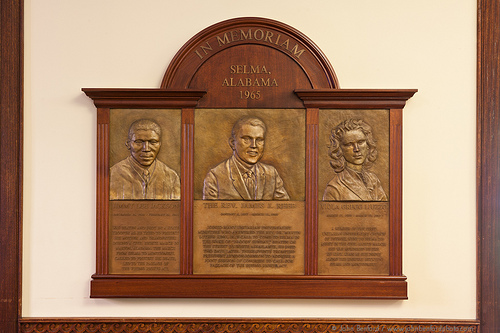
Memorial for Jimmie Lee Jackson, Reverend James Reeb and Viola Liuzzo, UU Headquarters, Boston
Memorial for Jimmie Lee Jackson, Reverend James Reeb and Viola Liuzzo, UU Headquarters, Boston
Stand in Sacred Solidarity with Imprisoned Hunger Strikers

This year, the Islamic fast of Ramadan (which began Monday night and will last until August 7) will serendipitously coincide with the Jewish fast of Tisha B’Av (Monday night July 15 to Tuesday, July 16). Given this harmonic interfaith convergence, I’ve been thinking more about the function of fasting as a time honored tactic of sacred protest – and in particular as a powerful act of civil disobedience. And so in honor of both of these sacred fasting festivals, I’d like to spotlight several ongoing fasts/hunger strikes that I believe are profoundly worthy of our attention and solidarity:

At Guantanamo Bay, many prisoners have been engaged in a longtime hunger strike to protest their conditions and their indefinite confinement. Lawyers for prisoners say the most recent strike began in February; according to the military, 106 of the 166 detainees met criteria to be declared hunger strikers (a definition that includes missing nine consecutive meals):

Prison medical officials have determined that 45 of the prisoners have lost enough weight that they can be fed liquid nutrients, by force if necessary, with a nasogastric tube to prevent them from starving themselves to death. The U.S. military intends to feed all prisoners, including those on hunger strike, before dawn and after sunset during the Muslim holy period of Ramadan to accommodate the men’s religious practices. Military officials have said the feeding process is not painful and only done to prevent any of the men from dying, not as punishment.

A recently released video (above) certainly belies the military’s claims.  In an act of what can only be called deeply courageous solidarity, rapper/actor/activist Yasiin Bey (aka Mos Def) subjected himself to the force-feeding to demonstrate the grievous nature of this procedure. I will warn you that it’s not at all easy to watch. I’ll let you judge for yourself as to whether this act constitutes torture or cruel/unusual punishment, but as far as I’m concerned, this video is worth a thousand words.  On this point, it’s worth nothing that a US federal judge ruled yesterday the practice appears to violate international law – and that President Obama can resolve the issue.

Click here to sign a petition that condemns the use of force-feeding, and demand that President Obama help end the hunger strike by addressing the legitimate grievances of detainees.

Here at home, 30,000 prisoners in California prisons began a hunger strike yesterday in what has been described as possibly “the largest prison protest in state history.”  The protest, organized by a group of inmates held in segregation at Pelican Bay State Prison demands an end to state policies that allow inmates to be held in isolation indefinitely, in some cases for decades.  While the UN has determined solitary confinement for longer that 15 days constitutes torture, many prisoners in California state prisons have languished in solitary for 10 to 40 years.

In California, there are nearly 12,000 prisoners who spend 23 of 24 hours living in a concrete cell smaller than a large bathroom. The cells have no windows, no access to fresh air or sunlight. People in solitary confinement exercise an hour a day in a cage the size of a dog run. They are not allowed to make any phone calls to their loved ones or talk to other prisoners.  They are denied all educational programs, and their reading materials are censored.

Yesterday, the Prisoner Hunger Strike Solidarity Coalition released a lengthy statement that details the history of this issue and explains why the decision was made to begin a hunger strike:

Family members, advocates, and lawyers will announce their support for the peaceful hunger strike and job actions beginning today throughout the California prisons starting on Monday July 8.   Prisoners have been clear since January that they are willing to starve themselves unless the California Department of Corrections and Rehabilitation (CDCR) agrees to negotiate honestly about their demands.

Click here to support the California prison hunger strikers and to sign a personal “Pledge of Resistance.”

I’ve also written extensively in the past about Palestinian prison hunger strikers who have long been engaged in nonviolent resistance to Israel’s illegal practice of administrative detention. While these protests consistently and egregiously fly under the radar of the mainstream media, they demand our attention – particularly as a response to the chronic question “where are the Palestinian Ghandis?”

Click here to learn more about the most current Palestinian hunger strikers. This link also includes the names/addresses of Israeli government, military and legal authorities to whom you can write to protest the prisoners’ treatment and demand their release.

May our respective fasts bring us closer to empathy and solidarity. As we say in my spiritual tradition: Baruch matir asurim – Blessed is the One who liberates the imprisoned.

Daoud Nassar and His Message of Hope

If you’ve been reading my blog for a while, you how I feel about my friend Daoud Nassar, founder of Tent of Nations (and if you haven’t, you can read those posts here, here and here). It’s been my honor to serve on the Advisory Board of Friends of Tent of Nations – North America – and when they told me Daoud was coming to the US for speaking engagements, I jumped at the chance to add Chicago to his itinerary.

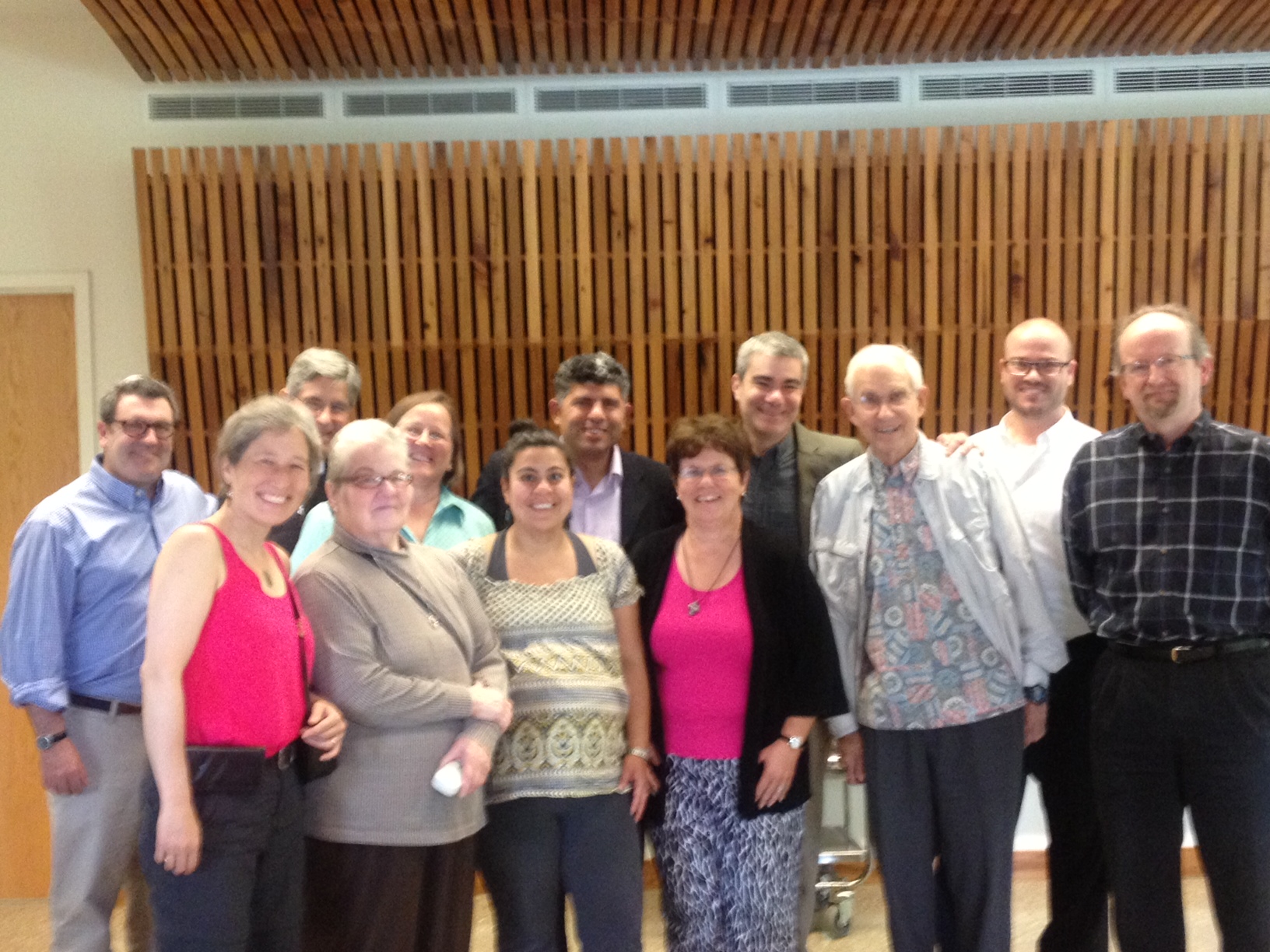
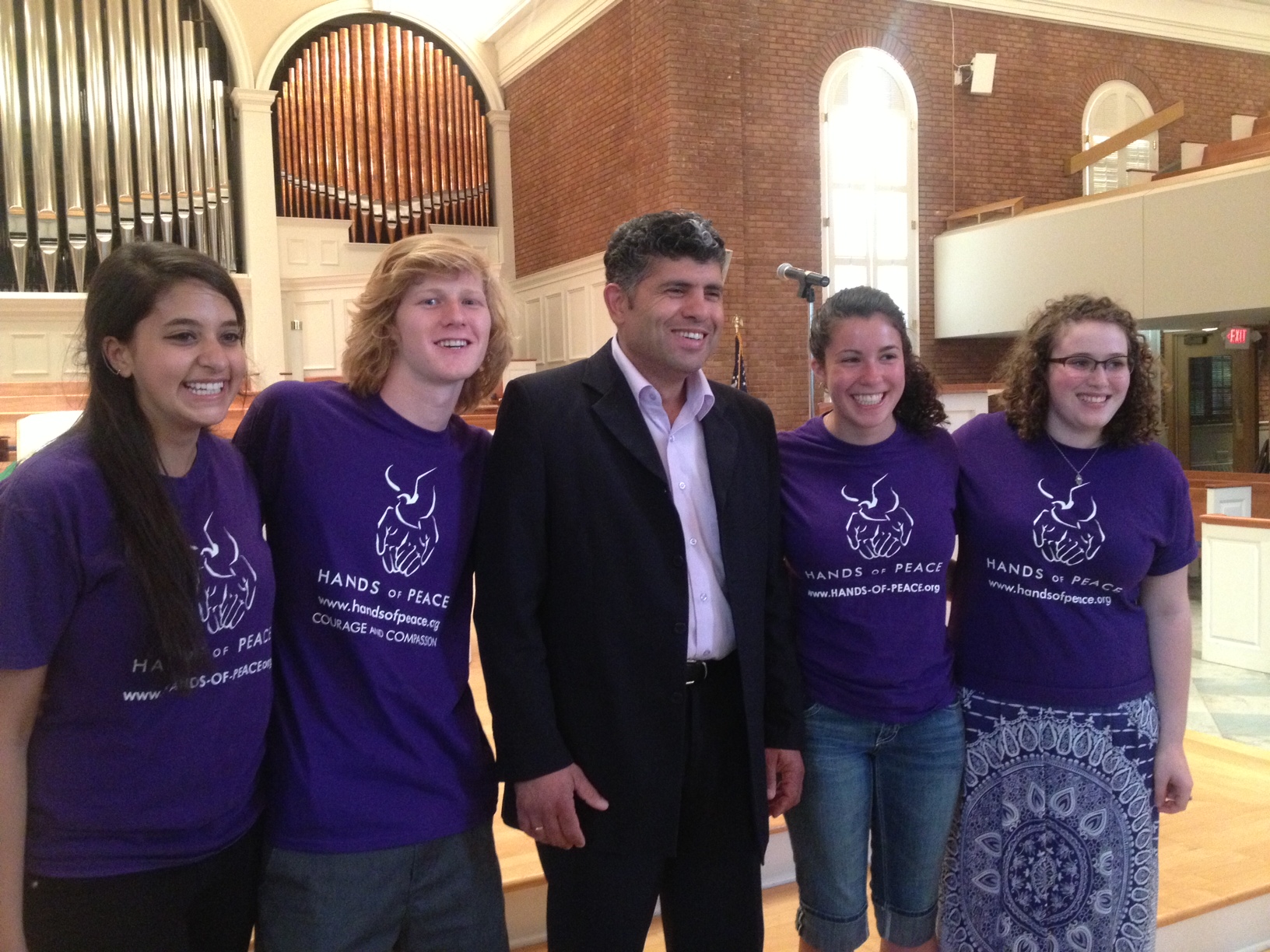
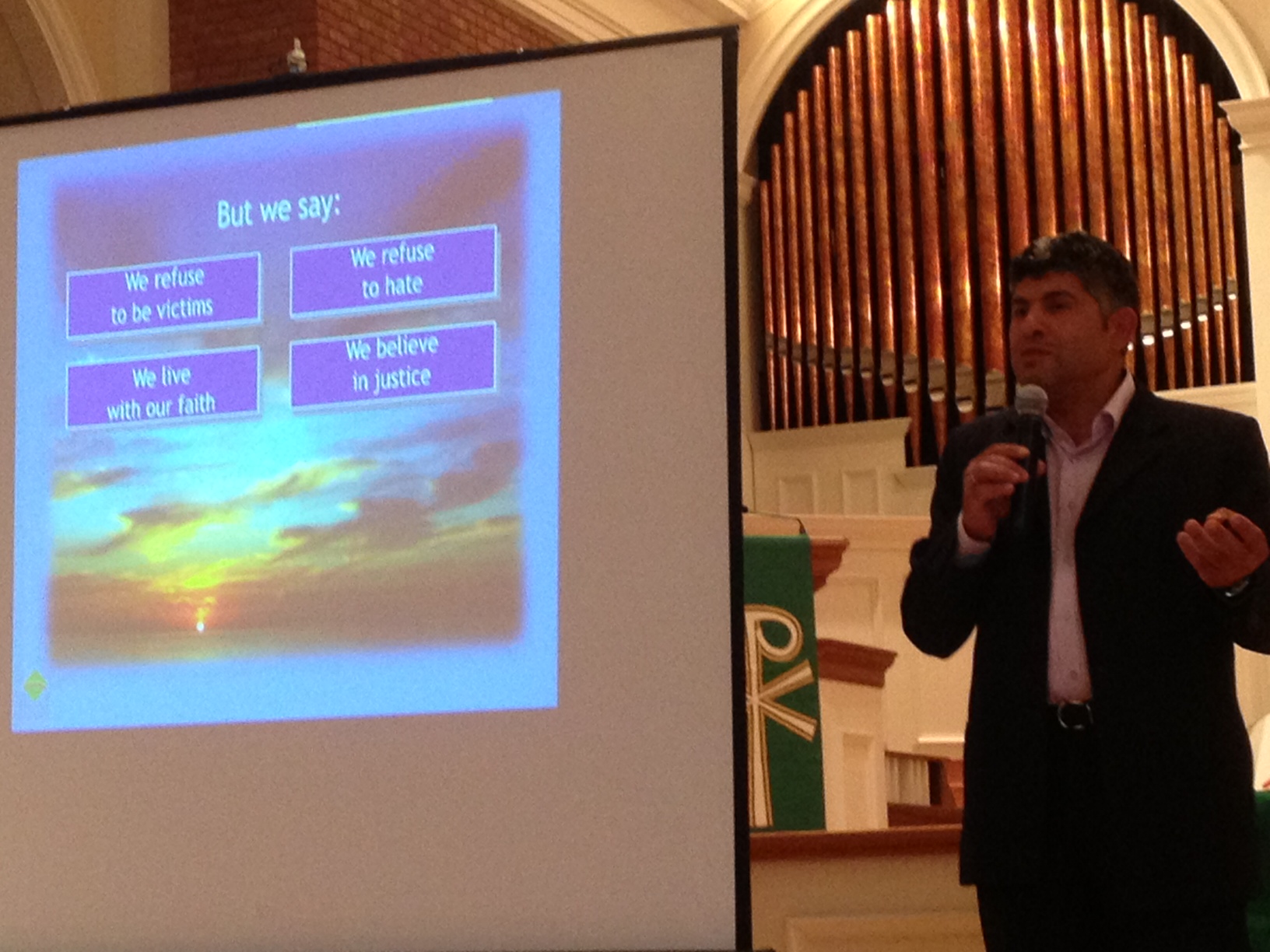
Among his stops here was a meeting with local interfaith clergy (below) and a presentation last night at Glenview Community Church for a program co-sponsored by Hands of Peace, a Chicago-area coexistence initiative on whose Advisory Board I also serve (bottom two pix).  At every stop, it was my pleasure see so many new friends and supporters inspired by Daoud’s message of steadfastness and hope.

Last Sunday, Daoud gave the sermon at the prestigious Riverside Church in New York City. I’ve just watched the video (above) and I was deeply moved by his words. I’ve listened to Daoud present many times, but I’ve never heard him speak in the unique context of his Christian faith.  As a Jew, I found his sermon to be deeply resonant, spiritually profound – grounded both in the truth of his own personal testimony as well as universal values of hope and human dignity. I encourage you to watch it in its entirety.

daoud clergy

daoud and hands

daoud.glenview

For Yom Hashoah: A Tribute to Pacifist Heroes André and Magda Trocmé

Andre Trocme

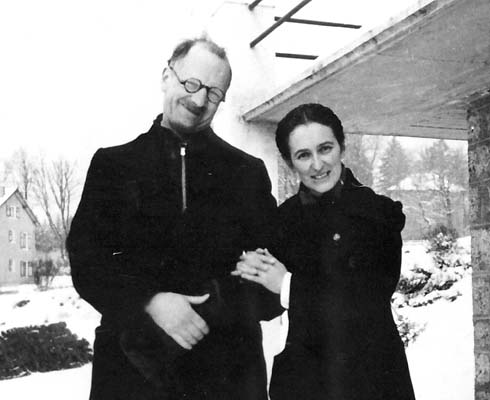
In honor of Yom Hashoah, please read about the sacred work of Pastor André and Magda Trocmé, the courageous pacifist Christians who saved 3,000-5,000 Jews from certain death in South Central France. May their memory be for a blessing.

The biography below is reposted from the Swarthmore College Peace Collection:

André and Magda Trocmé are perhaps best known for their work in the small French town of Le Chambon-sur-Lignon where, during World War II, they inspired the villagers to help protect and sometimes to assist in the escape of Jews and other poltiical refugees. This quiet and courageous assistance was given without resorting to violence. Historians estimate that about 3,500 Jews were harbored in the area in and around Le Chambon.

André Trocmé (1901-1971) was born in St. Quentin in the north of France to Huguenot parents. After seminary in Paris and graduate work at Union Theological Seminary in New York, he was ordained into the French Reformed Church and served for eight years among the coal miners and steel workers of Maubeuge and Sin-le-Noble, two small towns in the north of France. He preached nonviolence at a time when such views were unpopular in France. In 1934 André Trocmé accepted a call to be pastor in the remote Huguenot village of Le Chambon-sur-Lignon on the Plateau Vivarais-Lignon in South Central France. These parishioners were more sympathetic to his views on nonviolence.

Magda Trocmé (1901-1996) was born in Italy to an Italian father and a Russian mother. She graduated from the University of Florence with a degree in literature and earned further degrees in French. She and André Trocmé met in the United States while she was attending the New York School of Social Work, and they were married in 1926. The couple had four children, Nelly, Jean-Pierre, Jacques, and Daniel.

In 1938, André Trocmé, and his pacifist colleague Édouard Theis, founded L’Ecole Nouvelle Cévenol in Le Chambon, a Protestant, co-educational secondary school. In addition to the usual French secondary school curriculum, tolerance, honesty, and nonviolence were taught as well. L’Ecole Nouvelle Cévenole soon gained an international focus, and after World War II the name of the school was changed to Collège Cévenol. Magda Trocmé taught Italian at this school which is still in operation today.

During the first part of World War II Le Chambon was located in the “free”( unoccupied) zone of France. By 1942 the Germans had occupied the entire country. However, the population of the Plateau Vivarais-Lignon continued to aid an increasing number of refugees. In 1943, André Trocmé, Édouard Theis, and the head of the public school, Roger Darcissac were interned in a camp by the Vichy police. These men were arrested for their part in assisting the refugees of the area. Trocmé, Theis, and Darcissac were released from prison after one month, but Trocmé and Theis went into hiding for the next ten months.

In the late 1940s André and Magda Trocmé traveled as European Secretaries for the International Fellowship of Reconciliation (IFOR). After their move to Versailles (France) in 1950, the Trocmé’s founded La Maison de la Réconciliation. The Maison de la Reconciliation became an international peace center and the headquarters of the French and Continental Secretariat of the IFOR. During travels in the United States, under IFOR auspices, André Trocmé delivered the Robert Treat Paine lectures which became the basis for his book The Politics of Repentance, published in 1953. During the strife between France and Algeria, André Trocmé helped start Eirene (International Service for Peace), located in Morocco, which provided alternative service for conscientious objectors. He was also active in the movement against atomic weapons, becoming president of the French Federation Against Atomic Armaments in 1959. In 1960, André Trocmé accepted a call to become one of the ministers of the Saint-Gervais Church in Geneva, Switzerland. Many of the sermons he preached at Saint-Gervais were broadcast. His book, Jésus-Christ et la Revolution Non Violente was published in French in 1961 and subsequently in other languages (Orbis Books edition, 2004). In 1965, André Trocmé accompanied a peace mission to Vietnam.

After World War II André Trocmé was awarded the Rosette de la Résistance by the French government. The story of the Trocmé’s pacifist leadership inspired Philip P. Hallie, a professor at Wesleyan University, to write the book Lest Innocent Blood by Shed, published in 1979. Eleven years later Pierre Sauvage produced the documentary Weapons of the Spirit (1988), explaining how his family survived Word War II, through the efforts of the people of Le Chambon.

André Trocmé died in Geneva on June 5, 1971, just a few weeks after he had been scheduled to receive the Médaille des Justes from the government of Israel. As more and more people were recognized as “Righteous Gentiles,” the Yad Vashem honored all the residents of Le Chambon-sur-Lignon and the surrounding area. In their memory an engraved stele and rock garden were installed in the park of Yad Vashem (Israel).

After the death of her husband Magda Trocmé moved to Paris with Alice Reynier (“Jispa”), a close family friend who had lived with the Trocmé family since 1942. Alice Reynier shared their family life and their work. Magda Trocmé received an honorary degree from Haverford College in 1981 in the name of the people of Le Chambon and the surrounding area She died in Paris in 1996. André, Magda, their sons Jean-Pierre and Daniel, and Jispa, are all buried as a family in the cemetery of Le Chambon-sur-Lignon.