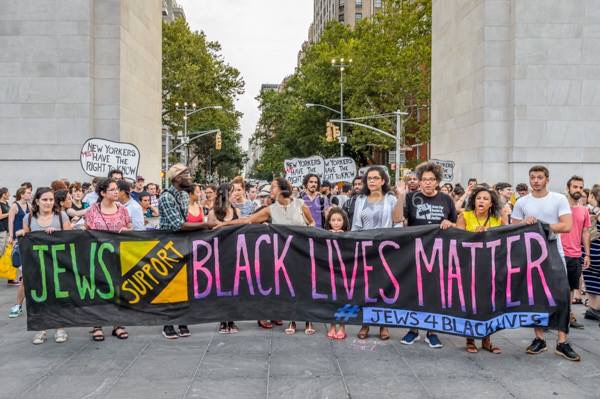
Category Archives: Palestine

Anti-Racism as a Sacred Jewish Value: A Sermon for Yom Kippur 5777

img_2616

I’d like to begin my remarks today where I left off on Rosh Hashanah:

Because of our diverse, multi-racial nature, Jews must necessarily embrace anti-racism as a sacred value. The Jewish Diaspora is a microcosm of the world we seek to create. If the term Ahavat Yisrael means love of your fellow Jew, it must also affirm that love crosses all lines and borders and boundaries.

“Jews must embrace anti-racism as a sacred value” – it must be a mitzvah if you will. At Tzedek Chicago, we’ve actually articulated this as one of our congregation’s core values. If you go to our website, you will read: “We promote a Judaism rooted in anti-racist values and understand that anti-Semitism is not separate from the systems that perpetuate prejudice and discrimination.”

Like all of our other values this one has very practical implications. It will necessarily guide the choices we make as a community: the issues we work on, the groups we stand with, the public statements we make. And in general it will mean we must always foreground the question: “what does it mean, as a Jewish congregation observe anti-racism as a sacred value?”

I’m sure most liberal Jews wouldn’t find this question all that controversial. After all, American Jewry has a long and venerable history of standing up for racial equality, particularly when it comes to our participation in the civil rights movement. But I’d suggest this question presents an important challenge to the Jewish community of the 21st century. And it was actually put to the test this past summer, when a the Movement for Black Lives released their policy statement, “Vision for Black Lives.”

I’m sure many of you are very familiar with Movement for Black Lives. It’s a coalition of over 50 organizations from around that country that focus on issues of concern to the black community. One year ago, their Policy Table began an extensive process, convening national and local groups, and engaging with researchers and community members. This summer they published their Vision for Black Lives: a comprehensive policy platform that focuses on six main areas: Ending the War on Black People, Reparations, Invest/Divest, Economic Justice, Community Control and Political Power.

I will say unabashedly that I believe the Vision for Black Lives platform is one of the most important American policy statements of our time. It’s both an unflinching analysis of the institutional racism against black people in country as well as a smart policy statement about what can be done (and in some cases already being done) to dismantle it.

What makes Vision for Black Lives platform particularly unique is that it wasn’t produced by the usual method, namely by a think tank or special interest group. Rather, it was developed by a coalition of national and grassroots organizations that reflect the communities most directly affected by these particular issues. Moreover, it serves both as an ideological manifesto as well as a practical hard-nosed policy statement that lays out a path toward achieving very specific legislative goals. In so doing, as many have observed, it is moving Black Lives Matter from a structureless network of local organizations toward becoming a genuine political movement.

To quote from their introduction:

We want this platform to be both a visionary agenda for our people and a resource for us. We take as a departure-point the reality that by every metric – from the hue of its prison population to its investment choices – the U.S. is a country that does not support, protect or preserve Black life. And so we seek not reform but transformation…

Our hope is that this is both an articulation of our collective aspirations as well as a document that provides tangible resources for groups and individuals doing the work. We recognize that some of the demands in this document will not happen today. But we also recognize that they are necessary for our liberation.

This platform is also important because it doesn’t limit its concern to issues facing the black community alone. It understands that the systemic racism impacting people of color in this country is but a part of many interlocking systems of oppression that affect communities the world over. As the platform puts it: “We are a collective that centers and is rooted in Black communities, but we recognize we have a shared struggle with all oppressed people; collective liberation will be a product of all of our work.”

If you haven’t read Vision for Black Lives yet, I highly recommend it. I’ll warn you it’s not easy. It’s very long and heavily referenced, so really reading and integrating it will take commitment. I’ve read it three times now and every time I did, I discovered something new and challenging that I hadn’t considered before. But in the end, I found it profoundly inspiring – and that is not something you often say about policy platforms. I would go as far as to call it a prophetic document. As I quoted earlier, it seeks “not reform but transformation.”

Like me, I’m sure many of you have read innumerable books and articles that analyze the institutional racism inflicted on people of color in this country. Usually they leave us pent up with frustration or else just a sense of abject hopelessness. The problem is just so vast and pervasive – how on earth can we ever hope to dismantle it?  But this is first time I’ve read such an analysis along with extensive prescriptions toward political solutions. It lays out the problems then it puts forth real solutions. But it has no illusions about the daunting task ahead. As the report says. “We recognize that some of the demands in this document will not happen today. But we also recognize that they are necessary for our liberation.” (When I read this, I can’t help but recall the famous ancient dictum by Rabbi Tarfon: “It is not up to you to complete the work, but neither are you free to desist from it.”)

Is Jewish community ready to observe anti-racism as a sacred value? I think one important test would be to judge by its response to the release of the Vision for Black Lives platform. And in this regard, I’m sorry to say that the American Jewish establishment failed the test miserably.

Almost immediately after its release, every mainstream Jewish organization responded with statements that ranged from critical to outright hostility. Why? Because in the Invest/Divest section there is one section that advocates diverting financial resources away from military expenditures and investing in “domestic infrastructure and community well being.” And in that section there were some brief references to Israel – one that referred to “the genocide taking place against the Palestinian people” and another that called Israel “an apartheid state.” And as you might expect from a section entitled Invest/Divest, there was a statement of solidarity with the nonviolent Palestinian call for Boycott, Divestment and Sanctions (BDS) against Israel.

The first official Jewish response to Vision for Black Lives came from the Boston Jewish Community Relations Committee, just two days after it was released. The Boston JCRC said it was “deeply dismayed” by the report and denounced the use of the word genocide and its support for BDS. It had nothing more to say about this voluminous, wide-ranging platform. It spent seven paragraphs on this one issue – and most of that was devoted to this one word.

Over the next few weeks, one Jewish organization after another denounced the platform for its statements about Israel with only a glancing nod to its analysis, its conclusions and its policy recommendations. Jonathan Greenblatt, the National Director of the Anti-Defamation League called its reference to Israel “repellent” and added patronizingly, “let’s work to keep our eyes on the prize.” Even liberal Jewish organizations such as J St., the Religious Action Center of Reform Judaism and T’ruah, an American rabbinical organization devoted to human rights, responded with criticism and chastisement.

These responses tell us all we need to know about the Jewish communal establishment’s commitment to the value of anti-racism. But it really shouldn’t come as a surprise. The Jewish institutional community hasn’t been in real solidarity with black Americans and people of color for decades. Most of what we call solidarity is actually nostalgia. For far too long we’ve been championing the role of Jews in the American civil rights movement, invoking the memory of Jewish martyrs such as Michael Schwerner and Andrew Goodman and Jewish heroes such as Rabbi Abraham Joshua Heschel. But those days are over – and it is disingenuous of us to wield its memory as some kind of entitlement when it comes to issues of racism in the 21st century.

There was a time that being a Jew in America meant being part of a discriminated minority, but that has no longer been the case for generations. Today, white Jews are part of the white majority – and as I mentioned on Rosh Hashanah, since white Jews are racialized as part of the majority, we enjoy all of the privileges that come along with it.

I know for many American Jews, particularly young Jews, it might seem downright silly to ask whether or not white Jews are white. But it is actually a subject of debate – at least among white Jews. In fact it’s become a something of a cottage industry. (If you doubt me, just Google “are Jews white?” and see how many hits you get.)

There’s actually a very simple way to answer this question: ask a Jew of color. Let Lina Morales, a Mexican-American Jew, who recently wrote a powerful article on the subject explain it to you:

With all due respect to my white Jewish friends and colleagues, people of color in the United States don’t need to take a course on critical race theory to understand the nuances of race. Anti-Semitism exists, and I’ve received a fair amount of it from fellow people of color, but its impact and extent doesn’t compare to the systematic racism of American society. White Jews simply don’t face the criminalization that black and brown people in this country do. They are not locked up or deported in record numbers. Nor is their demographic growth or struggle to not be capriciously murdered by police considered a threat by a large and reactionary part of our population.

It should be mentioned that thankfully, there were some Jewish organizations that did in fact welcome and endorse the Visions for Black Lives. Not surprisingly, all of them came from outside the Jewish institutional establishment – organizations such as Jewish Voice for Peace, IfNotNow, and Jews for Economic and Racial Justice. For me, the most trenchant and powerful response came from the Jews of Color Caucus, which works in partnership with JVP. Among the many important points made in their statement was this one that was sent directly to the Jewish communal establishment:

Recent statements by the Boston JCRC, Truah: the Rabbinic Council for Human Rights, and The Union for Reform Judaism condemning the BLM Platform also send the message that the lives of Black Jews (along with Black gentiles) directly affected by US police brutality are less important than protecting Israel from scrutiny. We reject this message and call on these groups to commit themselves to honor the leadership of Jews of Color, including those critical of Israel…

We are appalled at the actions of the white US institutional Jewish community in detracting and distracting from such a vital platform at a time when Black lives are on the line, simply because the organizers chose to align their struggle with the plight of Palestinians. US Black relationships to Palestine and Israel have never been monolithic, but there are deep historical ties between Black and Palestinian struggle that go back to the Black Power Era. Any attempt to co-opt Black struggle while demeaning these connections, is an act of anti-Black erasure.

Their reference to the Black Power movement of the late 1960s is critically important. This marks the time in which white Jews were leaving cities for the suburbs to become part of the white majority. It also marks the time, following the Six Day War, in which Israel began to become central to American Jewish identity. For many white American Jews, this new relationship between Black and Palestinian liberation movements was experienced as a betrayal of former allies. Many American Jews looked to Zionism as the “liberation movement of the Jewish people” and considered it downright anti-Semitic to claim that Israel was actually a settler colonial project that militarily expelled and displaced indigenous people.

Of course, many American Jews still identify deeply with Israel. And that is why the Jewish institutional responses to the Vision for Black Lives resonate with a strong sense of betrayal. That is why the ADL’s Jonathan Greenblatt wrote we must “keep our eyes on the prize.” There is this yearning for a coalition that no longer exists – and a refusal to accept, as the Movement for Black Lives does, that Israel is part of this system of oppression.

So many otherwise liberal American Jews will insist: Israel is different. Don’t compare Israel to the racist system that oppresses blacks and people of color in this country. Don’t compare Israel to apartheid South Africa or any other state where one ethnic group wields power over another. It’s not the same thing.

Of course every nation is different in many ways from one another – but it’s time to admit that when it comes to systems of oppression, Israel is not different. And this is precisely the place that so many in the Jewish community, even those who are otherwise progressive in every other way, are simply unwilling to go. To admit that in the end, Israel is by its very nature an oppressor state: a system that privileges one ethnic group over another. And that this system is fundamentally connected to a larger system of oppression.

In fact it plays a very integral role in that system. The very same tear gas canisters that are used daily against Palestinians are the ones that were used against protesters in Ferguson. The same security apparatus that is used on the West Bank separation wall is the one that is used on the border wall that the US is building on our southern border with Mexico. The same stun grenades that Israeli soldiers use against demonstrators in Bil’in or Nabi Saleh are the very same ones used by American SWAT teams in Cincinnati and Oakland and St. Paul.

Here in Chicago, as in so many cities around the country, there is a new recognition of how the militarization of police departments is being used in ways that target communities of color. Those who say that we can’t compare this systemic racism to Israel should know that Chicago’s Jewish Federation regularly sponsors “police exchange programs” – trips that take the CPD to go to Israel to learn the latest military techniques from the IDF.

Regarding these exchange programs, the JUF’s Executive VP Jay Tcath has said this:

Helping connect and thereby improve the work of both Israeli and Chicago police is a natural role for JUF, committed as we are to the safety of the entire Chicago community and the Jewish State. From advising us on ways to enhance the physical security of our Jewish community’s institutions to helping us ensure the safety of JUF events – everything from dinners to pro-Israel rallies – we are grateful for the extraordinary commitment of CPD, Cook County’s Homeland Security and Emergency Management and our other public law enforcement partners. These missions to Israel both reflect and help deepen these valued relationships.

So we can’t have it both ways. The Jewish establishment cannot simultaneously empower the systems that oppress people of color in this country and at the same time say we stand in solidarity with them. If we are going to be anti-racist, we can’t make an exception for Israeli militarism or rationalize away its critical place in these systems.

Some of us have already made it clear where we stand. But sooner than later all of us in Jewish community will have stop dancing around this issue and make a decision. When it comes to Israel, we cannot continue to cling to a two state solution that Israel has already made impossible. As I’ve said before, the real choice we will have to face is a choice between two one-state solutions: one apartheid state in which a Jewish minority rules the non-Jewish majority or a state where all have equal rights and citizenship, regardless of their ethnicity or religion.

But on still deeper level, we must also reckon with the separatist assumptions behind the “two state solution.” What are we really doing when we advocate for a Jewish state that must have a demographic majority of Jews in order to exist? The same liberal Jews who cling to the notion of a two state solution would recoil at the suggestion of solving Jim Crow by separating black Americans from white Americans. That the only way two peoples living in the same country can co-exist is to physically segregate them from one another.

So to return once again to my original question: how can we, as Jews, embrace anti-racism as a sacred Jewish value? I’d like to offer a few suggestions in conclusion:

1. It would mean that the white Jewish establishment must embrace the concept of solidarity. Specifically, that means we cannot make it about us. The objects of oppression are the ones who must dictate the terms of their struggle. If we have issues with how they articulate their vision, we must raise these issues with them face to face in genuine relationship – not through public chastisement.

2. It would mean letting go of our reverence of a civil rights era that is long past and take an honest look at our complicity in the current reality in which white Jews are part of the privileged white majority. Anti-Semitism does exist in the US today, but it is not institutionally imposed upon us the way it is upon communities of color.

3. It would mean letting go of the old paradigm of “Black-Jewish relations” – a term that utterly erases the presence of black Jews from our community. Any new anti-racist paradigm we formulate must reject Jewish white supremacy and center the experience of Jews of color.

4. It would mean subjecting Israel to the same analysis we use when it comes to our own country. Israel is not separate from the systems that oppress people of color at home and abroad. We must be willing to identify these connections and call them out as we would any other aspect of institutional racism.

Finally, and perhaps most difficult, it would mean to letting go of a Zionist dream that never really was. To recognize that the Zionist dream was realized on the backs of Palestinians – just as the American Dream was realized on the backs of indigenous peoples and blacks who were brought to this country in chains. Yes, it painful to give up on dreams, but it is even more painful to hold onto them until they turn into a nightmare for all concerned.

After all, on Yom Kippur we vow to let go of the dreams of what might have been, but have led us down the wrong path. But it is also the day in which we can dream new dreams. We can dream of a world in which systems of exploitation and oppression are no more. As Sarah Thompson reminded us in her guest sermon last night, we must begin the year by focusing on the end – even if we know that by the end of the year we will not have arrived at the ultimate end we seek. To paraphrase the Vision for Black Lives, we recognize that some of these dreams will not happen today – or even in our lifetime. But we also recognize that they are necessary for our liberation.

May we realize this dream bimheyra beyameynu – speedily in our day.

Amen.
Celebrating a New Jewish Diasporism: A Sermon for Rosh Hashanah 5777

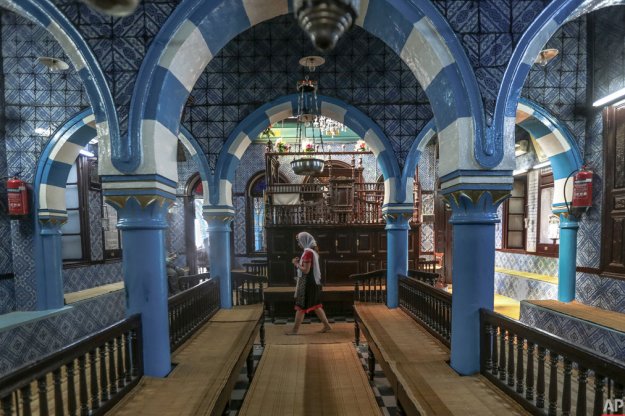
tunisia

A synagogue in Djerba, Tunisia

As I’m sure you know, Tzedek Chicago has received a great deal of attention – some might call it notoriety – for calling ourselves a “non-Zionist” congregation. But contrary to what our most cynical critics might say, we didn’t choose this label for the publicity. When we founded Tzedek Chicago last year, used this term deliberately. We did so because we wanted to create an intentional community, based on specific core values. Our non-Zionism is not just a label. It is comes from our larger conviction to celebrate “a Judaism beyond nationalism.”

This is how we explain this particular core value:

While we appreciate the important role of the land of Israel in Jewish tradition, liturgy and identity, we do not celebrate the fusing of Judaism with political nationalism. We are non-Zionist, openly acknowledging that the creation of an ethnic Jewish nation state in historic Palestine resulted in an injustice against its indigenous people – an injustice that continues to this day.

I think it’s important that we named this value out loud. We need Jewish congregations that refuse draw red lines over the issue of Zionism, or at best to simply “tolerate” non or anti-Zionists in their ranks as long as they stay quiet. We need congregations that openly state they don’t celebrate a Jewish nation built on the backs of another people. That call out – as Jews – a state system that privileges Jews over non-Jews.

However, I realize that this core value begs another question – and its one I get asked personally from time to time. It’s usually some variant of: “Saying you are non-Zionist only tells me what you’re not. But what is it that your Judaism does celebrate?”

It’s a fair question – and I’d like to address it in my words to you this morning.

Continue reading

Guest Post: Observations on the Jewish Response to the Movement for Black Lives Platform from a Self Loving Antiracist White Jew

imageA guest post from my friend Martin Friedman:

For the purpose of this piece I will be referring to Blacks who are for the most part gentile and white Jews (Jews who have come to get the racial designation of White in the context of the US regardless of self identification).

This particular piece is really written for Jews who have come to be called White. Jews who are also people of color are writing excellent pieces from their unique perspective. I will not attempt to speak from that perspective.

What a(nother) crucial time for relationships between “Blacks” and “Jews”! What will we choose? Will we, as we have done so many times in the past, choose whiteness and the perceived safety that we feel goes with that in the US or will we choose to align ourselves with those that are most oppressed in a given society? This is a very familiar spot for the Ashkenazi (and occasionally Sephardi) Jew who now gets a racial designation as white in the US.

Let’s get this out of the way right now. Jewish, in the United States, isn’t a race. It is a culture that includes both spirituality and religion and also includes non religious ways of life. Jewish is also, arguably, an ethnicity based on being a cultural marker that has traveled with us and defined us. In this country Jewish is not a race.

So please, Ashkenazi Jews, just stop saying, “I’m not white. I’m Jewish.” Yes we are Jewish and we will also be assigned a race based on how we are commonly perceived by institutions and systems. How we see ourselves or how we self identify does not matter in this race-constructed and race-constitutionalized country. A Jewish person who is also Black, Latino, Asian, Native American or mixed race will be identified first by their race even as they self identify as a Jew.

OK, let’s get something else out of the way too. I am a self loving Jew (who is also white). I love my Jewishness. I am unapologetically Jewish. So let’s just wipe out the whole, “Oh, he must be a self hating Jew because he isn’t mortally offended that the Movement for Black Lives platform used the terminology of genocidal and apartheid policies in relationship to Israel.” Or, “Oh, we don’t have to listen to Martin because he went to Israel and visited the West Bank and East Jerusalem and has been critical of Israeli policy on his Facebook page”. Not true! On my grand and great grandparents! On my great Aunt Leah from whom I got my middle name. I love my Jewishness! I love the connection I feel to my Eastern European Jewish heritage.

I am also in love with an ideal of Jewishness that isn’t rooted in whiteness and domination. A Jewish ideal of true Tikkun Olam; of Repairing the world. All the world! Not just a world defined by whiteness or Europeanness. Not a world where we get to control the conversation.

The world is broken. Does our refusing to engage with BLM help repair it? Can we repair it if we don’t engage with people who criticize current Israeli policy and US financial and Military support for the government that developed and enforces those policies?

It’s time for White Jews to stop choosing whiteness and align ourselves with those most oppressed in the US because that is what true Jewishness is about. And why wouldn’t we? The point of the Movement for Black Lives Platform was to speak truth to all power, not to use pleasing language. It is our duty to sit across the table from people who have been most oppressed in our country and hear what they have to say about what they perceive to be genocidal policy that’s connected to Institutional, Systemic and Structural Racism in the US.

What are we afraid of? Why are we, of all people, afraid of conversation about oppression? If the policies of the Israeli government really are leading to a fair two or one state solution, why can’t we sit at a table and discuss it? Remember, the one piece of the platform we are so hyped up about is about governmental policy both here and in Israel not about hating or oppressing Jews? Remember that Egypt was mentioned at the same time as Israel? I hope we are not forgetting those things because this is just an easy reason to disengage.

We are a people who have such a long history of debate and multiple interpretations of the same text (or in this case policies) so why are we shutting this conversation down? Because of multigenerational historical trauma from the European Holocaust? All the more reason to sit down with people who have multigenerational historical trauma from the Trans-Atlantic slave trade and US chattel slavery. Multigenerational trauma from lynchings and Jim Crow. From a Eugenics narrative that was studied here in the US by German Nazis. My people, we share roots in our historical trauma.

We, White Jews, have confused comfort with safety. And the root of that confusion is the root of the problem, power. Power is defined (by the People’s Institute for Survival and Beyond) as legitimate access to institutions and systems sanctioned by the state. Power that is equivalent to Whiteness. People that have strong access to institutional and systemic power confuse discomfort with safety all the time.

I put forth, vehemently, that the wording of one section of the Movement for Black Lives platform makes us uncomfortable, not unsafe. We must be willing to engage. It’s pure privilege to get to pick and choose when and with whom we engage on this subject. It’s extreme privilege to just say no, I’m done. Extreme privilege to be able to shut someone down.

This is another in a long line of moments in history where we as white Jews get to chose alignment with whiteness or with People of Color. And what’s even crazier this time is that it feels like it’s our Jewishness that is at stake. It’s even crazier because it feels like this is anti Semitism. Again, being anti-Israeli policy and anti-US government policy is not the same thing as being anti-Semitic.

Historically, we’ve chosen the perceived safety of whiteness. Our ability to become fully White was due to governmental policy, the GI bill plus redlining which gave us our whiteness while excluding Blacks and Latinos who such a short time earlier had been our partners and friends. But they couldn’t access it in the same way as we could due to racism.

Yes, many of us were in the civil rights movement. Yes, many of us marched side by side. But we let ourselves get coopted so soon after. We chose whiteness because it got us out of the ghetto (named because of us by the way!) It was our literal ghetto pass. We need to understand that we left our brothers and sisters behind.

What are the costs of choosing Whiteness over Jewishness? One of the costs of our comfort and our privilege is Black and Brown lives. As long as we align ourselves with whiteness we contribute to the deaths of Black and Brown people at the hands of institutions. Their deaths are part of the the cost of our comfort, safety and privilege.

The other loss is the loss of what it really means to be Jewish. That it means to not stand idly by our neighbor’s blood. That it means true Tikkun Olam. We are at such a(nother) crucial time of choice.

Let’s choose our Jewishness over Whiteness this time. Let’s choose life.

A Prayer for the Global Shabbat Against Home Demolitions

The very sad news came yesterday that Israel had demolished Palestinian homes throughout the West Bank, including five in Umm al-Kheir – the village I visited last month with a delegation from the Center For Jewish Nonviolence.  Susiya, another village we visited is also under threat of immanent demolition. Please join me in signing this petition to urge Secretary of State Kerry to “to use the leverage the United States has, as Israel’s biggest supporter, to put real pressure on Israel to stop displacing Palestinian families from their homes.”

This Friday night August 12, will mark the Global Shabbat Against Home Demolitions – an international show of solidarity with Palestinians who live with daily possibility that their homes will be destroyed and their families uprooted. Click here to see if there is a gathering near you. If not, please consider organizing one.

A Prayer for the Steadfast

This is a prayer for the steadfast,
the ones who stand firm,
the ones who say:
you can destroy my house
but you will never destroy my home.

This is a prayer for the ones
who lose their fields
only to clear new ones,
uprooting weeds, moving stones,
planting zatar seedlings
in the hot summer sun.

This is a prayer for the ones
who sift through the rubble of their homes
and find dolls, blankets, tea canisters,
photos of ancestors gazing at them
through shattered glass.

This is a prayer for the ones
who live in tents
next to twisted steel and broken concrete
knowing they will have to rebuild
before winter comes again.

This is a prayer for the ones
who issue appeals
and stays and petitions
to courts that issue no justice.

This is a prayer for the ones
who put their children to bed at night
in huts of corrugated metal,
praying they will not awaken
to the sounds of bulldozers.

This is a prayer for the ones
who stand amidst the ruins
once the soldiers have gone
and silently vow:
demolish our houses again
if you choose
but we will never leave.

We will rebuild, we will replant,
we will remain.

Our very existence
is resistance.

Jewish Solidarity with Black Lives Matter: We Can’t Have it Both Ways

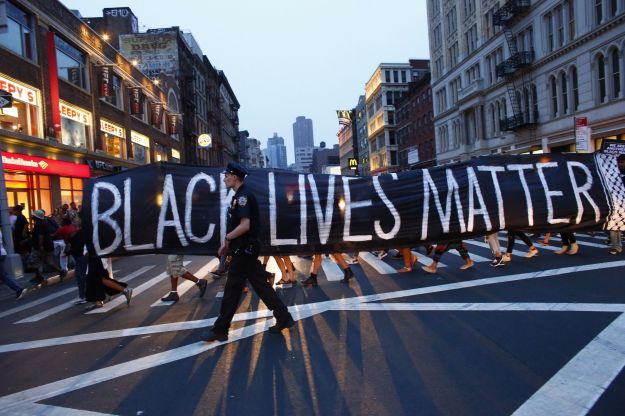
lives

The Black Lives Matter movement has just taken a huge and important step. A new coalition called Movement 4 Black Lives recently released “Vision for Black Lives,” a powerful, comprehensive policy statement released by thirty grassroots organizations and endorsed by sixty others.

“Vision for Black Lives” is the product of a collaborative research and writing process that took more than a year by an eight person team – and is intensely relevant to the current political moment.  Team member Marbre Stahly-Butts summed up the purpose of the statement this way: “Democrats and Republicans are offering anemic solutions to the problems that our communities face… We are seeking transformation, not just tweaks.”

In contrast to the hollow posturing that counts for political discourse in the US, the M4BLM platform offers an important alternative vision: a deep analysis of how systems of oppression intersect and the devastating impact they have on people/communities of color. It’s particularly vital because it doesn’t come from a political party, think tank or special interest lobby, but rather directly from the grassroots communities most impacted by racism and oppression. In so doing, it represents a huge step toward the creation of a real movement for social and political change in our country.

As journalist Collier Myerson recently wrote in Fusion:

This is a really, really big deal. By shedding its previous identity as a largely reactionary, structureless movement, Black Lives Matter seeks to definitively lead the national discussion on the safety, health, and freedom of black people. Painting the movement with a broad brush is a seismic shift. And it’s a shift that Occupy Wall Street never put in motion, a failure which many point to as the reason for the movement’s eventual dissolution. The list of demands set forth by M4BL explicitly unifies organizations across the United States—and though the goals are purposefully lofty, it’s a significant move towards harnessing the power of local groups into something bigger.

Vision for Black Lives has been welcomed enthusiastically by many allies in this growing movement (such as those fighting for immigrant justice for instance). And as for the Jewish communal establishment?  For its part, the Jewish Community Relations Council of Greater Boston angrily “disassociated” itself from the statement, calling it “false” and “malicious”. Why?  Because in the midst of this vast and extensive platform, the M4BLM statement referred to Israel’s “genocide” against the Palestinian people and expressed its support for the Boycott, Divestment and Sanctions movement.

Actually, I wouldn’t expect anything else from an organization such as the Boston JCRC. Earlier this year, in fact, David Bernstein, the President and CEO of the Jewish Council on Public Affairs (the parent organization of JCRCs around the country), wrote an op-ed in which he thoroughly denounced “the solidarity between the Black Lives Matter and Palestine movements” and made a strong pitch for finding allies that will help them drive a wedge into Black-Palestinian solidarity. (Notably the Boston JCRC statement referred to its “friends and neighbors in the African-American community” who share their views on Israel and Zionism.)

I was very disappointed however, to read a statement released by Tru’ah – a progressive rabbinical organization that advocates for human rights that has in the past articulated strong support of BLM. Yet in their immediate response to the M4BLM platform, T’ruah spent almost all of its wordage decrying the genocide reference and BLM’s support for BDS.

Though I have many friends and colleagues in T’ruah whose work I respect greatly, I find this statement much more disturbing than the one released by the Boston JCRC. While the latter group openly vilifies the BLM movement, T’ruah purports to stand in solidarity with them. As opposed to more conservative Jewish establishment institutions, I’ve always had the impression that T’ruah truly “got it” when it came to the BLM movement.

On T’ruah’s website, for instance, you will find a powerful “Prayer for Black Lives Matter“. You will also find a post written by Rabbi Susan Talve and Sarah Barasch-Hagans entitled “10 Rules for Engagement for White Jews Joining the Black Lives Matter Movement,” a smart and insightful document that appears to grasp the complex issue of allyship. Among the rules listed are “Practice Deep Listening and Less Talking;” “Do Your Own Communities’ Work” and “Hold Yourself Accountable”.

In the rule, “Go outside of your comfort zone while staying in your lane,” the authors write:

Pay attention. Don’t hide when it gets messy. We all have a role to play and we will all make mistakes. Accept guidance. Remember this is a movement to awaken compassion. No name calling. “Call people in” rather than calling them out. Give the benefit of the doubt whenever possible. We are all sad and scared (or should be). Faith communities can be bridge builders, healers, and witnesses in this movement to make Black and Brown lives matter.

Sadly, T’ruah itself has broken its own rule by releasing this statement. If they truly purport to stand in solidarity with BLM, they cannot publicly “call them out” because their new platform lands outside their comfort zone. If they were to be true to their own articulated values, T’ruah should have reached out to them, engaged with them and tried to understand where they were coming from, thus opening a real dialogue. T’ruah does not give the BLM “the benefit of the doubt” when it issues an immediate counter-statement such as this; tantamount to a group in a position of power saying to an oppressed group, “we will stand in solidarity with you but only on our terms.”

The claim that Israel is committing “genocide” against the Palestinians undeniably pushes all kinds of buttons for many Jews. But there are also Jews and Israelis who feel it is not an inappropriate word to use, particularly in regard to Israel’s regular military assaults against Gaza. Likewise, while the BDS call is extraordinarily controversial for many Jews, there are also Jews who respect it as a legitimate call for nonviolent resistance from over 150 Palestinian civil society organizations. And it is simply not true to claim, as T’ruah does, that “the BDS movement (rejects) Israel’s right to exist.” On the contrary, the goal of the BDS call is equal rights for Palestinians as well as Jews.

But even if T’ruah feels it is wrong for BLM to refer to Israel in this manner, it can’t claim to stand in solidarity with them while publicly calling them out over the parts that make them uncomfortable. Rather, they should hold themselves to their own standard by “calling BLM in,” engaging with them and be “bridge builders” – especially in the places where there is pain or disagreement.

At the end of the day however, I don’t think this is T’ruah’s issue alone – it’s a challenge for the entire progressive Jewish community at large. If we claim to ascribe to a power analysis that views systems of oppression as intersectional and interrelated, we simply constantly cannot make an exception when it comes to Israel. The black community is increasingly finding common cause with Palestinians – and for good reason. Both are oppressed by the same systems, the same weapons, and the same security companies. It is not by coincidence that American police departments around the country are increasingly trained by the Israeli military.

If we truly seek to be to relevant this undeniably growing movement, we need to make these connections as well. No matter how uncomfortable it might make us.

“Occupation is Not Our Judaism” – Some Final Thoughts


video by A. Daniel Roth

Even though I’ve been back from the Center for Jewish Nonviolence delegation for almost a week now, I’ll take this opportunity to end this series with some final closing thoughts. There’s so much I wasn’t able to cover – and so much more to say about what I did – but I do at least want to highlight some of my major takeaways from this amazing experience.

To start: I have no doubt in my mind now that a genuine diaspora-based Jewish movement for Palestinian solidarity is rapidly growing. It’s real, it’s broad based and its gaining some serious traction. When I was first invited by CJNV founder Ilana Sumka to join this delegation, I went to their website and read that the trip would include Jews who come from a wide spectrum of organizations such as Jewish Voice for Peace, J Street, Open Hillel, If Not Now and Students for Justice in Palestine. I will admit I was dubious. It was simply unprecedented for a Jewish organization to bring such an ideologically diverse array of Jews together to stand in solidarity with Palestinians.

But I also knew that if anyone could build such a Jewish coalition together, it was an organizer such as Ilana, who invests her head and her heart in creative and inspiring ways. The mission and values of CJNV are powerfully straightforward: the conviction that all individuals are equal based on our shared humanity and therefore have the right to be treated equally under the law; a commitment to principles and practices of nonviolent resistance; and unwavering opposition to Israel’s unjust occupation.

In our group there were obviously real political differences (i.e. BDS, the specific meaning of “occupation” and one state vs. two) but in the end we weren’t there to debate our issues – we were there to stand in solidarity with Palestinians. Because of our diversity we had a real strength in numbers; indeed it’s hard to dismiss 40 diaspora Jews openly responding to a call from Palestinians to stand with them in their struggle. It will be even harder next year, when CJNV organizes 200 diaspora Jews to answer the call. I have no doubt in my mind that there will be at least that many participants – if not more.

I also believe that this movement is the real deal because the majority of participants on this delegation were Jewish millennials. I’ve seen this coming for a while now: back in 2010 I wrote that there was a growing generation of young proud Jews who were openly rejecting the Jewish establishment’s orthodoxy on Israel. And I noted that they were “growing in number (and) rapidly finding their voice.”

Well, I’ve believe they’ve found their collective voice. Journalist Peter Beinart, who has also been warning the Jewish establishment about this phenomenon for some time, attended our action and later wrote in Ha’artez that after talking with these young activists, he “realized how formidable a challenge they’re likely to pose to the American Jewish establishment in the years to come.”

Another takeaway from this experience for me was the critical importance of solidarity as a discipline as well as a value. Far too often, leftist activists approach this kind of work using what I would call a “liberal benevolence” paradigm – i.e. helping oppressed people on their own terms rather than taking their lead from those who are most directly affected by this oppression. It was very clear to us through the course of this delegation that the leadership of CJNV had cultivated genuine, longtime relationships with Palestinians activists and Palestinian resistance groups on the ground. And every step of the way, we were reminded that the actions we undertook were at the request of our Palestinian partners.

It was crucial for us to understand that in the end, this is not ultimately our struggle – and that as diaspora Jews we have real power and privilege that we cannot take for granted. On the contrary, we were there to leverage our privilege to support the Palestinian struggle and to shine a light on a system that privileges one group of people over another in such blatant and immoral ways. In Susiya, the only reason the Palestinian villagers could return to visit their original homes was because as Jews, we could purchase tickets to an archaeological park for our entire group. In Hebron, we were well aware that as diaspora Jews, we could garner publicity about Tel Rumeida to an extent that would never be afforded to Palestinians alone. We were also we aware that as diaspora Jews, we were treated far better than the Palestinian activists from Youth Against the Settlements, who were arrested virtually on the spot by the IDF and Israeli police as we continued to work and sing.

It is our hope that through our privilege, we were be able to spotlight the courageous leadership of Palestinian nonviolent leaders such as Aziz and Eid Hathaleen of Umm al-Kheir, Nasser Nawaja of Susiya, Issa Amro of Hebron and Zuheir Elrajabi of Batan al-Hawa and so many others who engage in resistance every single day in their communities. It has been our honor to get to know them, to support their struggle and to do what we can to bring their work to the attention of the world so that many more might stand with them as well.

Yet another gift from this delegation: the opportunity to get to know the Israeli members of the Palestine solidarity community. It is too often said that there is “no longer such a thing as the Israeli left.” While this may be true politically, there is a small but thriving movement of Israeli grassroots activists who actively support the Palestinian struggle and are themselves worthy of our support. I’m referring to groups such as Tayush, All That’s Left, Rabbis for Human Rights and Breaking the Silence among others, who join direct actions, document abuses, help rebuild homes and provide legal support with their Palestinian partners. These Israeli activists are intensely stigmatized and marginalized by Israeli society – and are too often physically harmed in the process. To my mind, however, they are all that remains of the Jewish ethical soul in Israel. As the far right continues its inexorable political ascendance, I do believe these activists are among only ones left standing between sanity and the abyss. It was such an honor to work alongside them as well.

One final takeaway:

I mentioned in an earlier post that our Cinema Hebron action took place at an old factory owned by Jawad Abu Aisha. The Abu Aisha family is in fact, a venerable family in the Tel Rumeida neighborhood of Hebron. Like many families there, they originally had amicable relations with the Jewish communities up until the late 19th/early 20th centuries.  This relative peace was tragically rent asunder in 1929 when growing Arab-Jewish tensions resulted in the brutal murder of 67 Jews in Hebron. The trauma of this moment remains fixed in the memory of many Jewish Israelis. What is lesser known is that many more Jews would have been killed had they not been saved by their Palestinian neighbors.

The Abu Aisha family were among those neighbors. And to this day they keep a sacred record of their family’s redemptive act in 1929:

The paper that (Muhammad) Abu Aisha keeps in his pocket … is a faded photocopy of a page of “The Hebron Book,” a deluxe album that was published at the start of the 1970s in order to perpetuate the memory of the Jewish community that lived in the town until the massacre in 1929. Even though he does not read Hebrew, he knows very well what is written on the page, an account of those among the Arabs of Hebron who risked their lives to save their Jewish neighbors. At the bottom of the page is a blurred photograph of two men embracing. “This is Ya’akov Ezra and this is my father, Hamed Abu Aisha,” says the elderly man.

As radical Jewish settlers began to move back into the heart of Hebron in the 1980s, the Abu Aisha family, like many other Palestinian families in that area, became targets of harassment and abuse. For at least two decades now the Abu Aisha family lives in what is known as the “caged house” in Tel Rumeida, with iron bars across their windows to protect them from settler violence. Their house and its adjoining properties are considered prime real estate by the extremist settler community who has been gradually encroaching on their property with the tacit permission of the Israeli civil authority.

But as our group worked alongside Palestinians from Tel Rumeida to clear garbage and weeds from the Abu Aisha’s property that Friday morning, I couldn’t help but think of the time not so long ago when the Jews and Palestinians lived together, side by side, not separated by “sterile roads” and caged windows.

And I couldn’t help but think that in some small redemptive way, our action might somehow be bringing Hebron that much closer to such a time once again.


Breaking Ground at Cinema Hebron

This past Friday, I had the honor to participate in an incredible, unprecedented mass action of civil disobedience in the H2 section of Hebron – in the heart of Israel’s unjust and illegal occupation.

I’ll start with a little bit of history:

In 1968, a year after Israel conquered the West Bank, a group of radical religious settlers led by Rabbi Moshe Levinger, led a group of followers to a hotel in Hebron – with the government’s support – to observe a Passover seder. When it was over, they refused to leave; and following a negotiation with the government, they were allowed to create a settlement to the east of Hebron that they named Kiryat Arba  Since that time, Jewish settlers gradually moved into Hebron proper. Over the years tension gradually increased in Hebron. Things changed drastically in 1995 after Baruch Goldstein murdered 29 Muslim worshippers in the Ibrahimi mosque. Fearful of reprisals, the IDF imposed increasing curfews and restriction of movement on the Palestinian population.

In 1996, as part of the Oslo agreement, Hebron was divided into two sections: H1 and H2. H1 is locally governed by the Palestinian Authority and is home to approximately 120,000 Palestinians. Tens of thousands of Palestinians live in H2 along with 600 Jewish settlers. Since the Second Intifada, Israel increased their security crackdown on this part of the city, blocking off major streets to Palestinians – most notably the main commercial road, Shuhadah Street. (The army refers to them as “sterile roads”).

Virtually every Palestinian shop in H2 has been closed and their doors welded shut by the army. Because the Palestinian residents of Shuhadah St. are not allowed to walk on the road, they must enter and exit through the rear of homes because they cannot leave their own front doors. Because of these measures – and the ongoing harassment and violence at the hands of Jewish settlers – what was once the busting commercial center of Hebron has become a ghost town. 42% of its Palestinian homes are empty and 70% of its Palestinian business have been shut down.

We visited Hebron earlier this week and it was a truly chilling experience. Our group went on a tour led by Breaking the Silence, an organization of Israeli army veterans who are speaking out about the abuses the IDF are committing in Hebron. I did a BTS tour in 2008 during my first real foray into the reality of contemporary Hebron. Today, the situation there is even more dire if such a thing is possible.

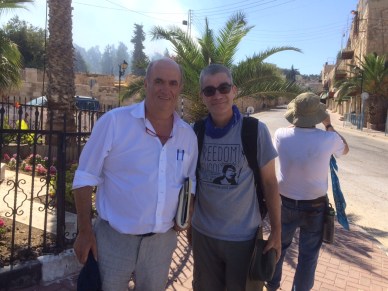
IMG_2490

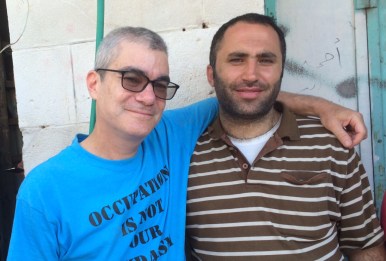
With Colm Toibin in Hebron

Before we started our tour, we witnessed an incident in which a settler attacked an Israeli photographer and damaged his camera. As it turned out the photographer was the celebrated photojournalist Oren Ziv. who was accompanying a private BTS tour for Irish author Colm Tóibín. The incident was captured on film by a member of our delegation. He gave a copy of the video to Ziv so he could press charges against the settler for damages. (We never found out whether or not he actually succeeded).

As we walked down Shuhadah St., the intimidating presence of the settlers was impossible to ignore. At one point we saw Tóibín and his tour guide on the side of the road. A car with two settlers drove up and the driver proceeded to scream obscenities at them for ten minutes.

Hebron’s settlers are truly the most brutal, ideologically extreme and heavily armed of the entire settler movement. They walk and drive the streets with impunity and full protection of the IDF.  As is the case throughout the West Bank, Jews are governed by Israeli civil law – and as a result the army cannot and does not intervene when settlers harass Palestinians. However, since Palestinians are subject to military law, they face dual oppression from soldiers and settlers alike.

After our BTS tour we walked to the Tel Rumeida neighborhood of Hebron to meet with Issa Amro, founder/director of Youth Against the Settlements. YAS is an increasingly powerful and important Palestinian nonviolent organization; among other things, it sponsors the annual Open Shuhadah Street campaign and regularly organizes/empowers the youth of Hebron.

Issa is truly a visionary leader in the Palestinian popular resistance movement. He has been arrested and detained countless times for his activism but has clearly become well known throughout Hebron as force to be reckoned with. Palestinian activists such as Issa tend to infuriate the Israeli military because their principled commitment to nonviolence cannot be quelled militarily. Although he and his comrades have been arrested and detained numerous times, YAS has come to represent a ray of hope for the Palestinian residents of Hebron.

We met Issa in the YAS center, which has an interesting history all its own. Originally Palestinian-owned, the building was taken over by settlers several years ago. But through a methodical campaign of legal pressure and nonviolent resistance, the settlers were eventually evicted and it was turned into YAS’s central headquarters. Last November, the center was raided by the IDF and temporarily declared a “closed military zone” (I’ll get back to this term later). Still, Issa and YAS remain steadfast.

FullSizeRender

With Issa Amro of Youth Against the Settlements

On Thursday we prepared to return to Hebron for our nonviolent direct action, which had been almost two years in the planning by YAS and the Israeli anti-occupation collective All That’s Left. The Center for Jewish Nonviolence was invited to be part of this action as well so that its message could be strengthened through the solidarity of diaspora Jewry. CJNV has cultivated a strong relationship with both YAS and ATL and other Israeli/Palestinian partners on the ground. It is truly a sign of the times that diaspora Jews are joining this increasingly broad-based solidarity movement.

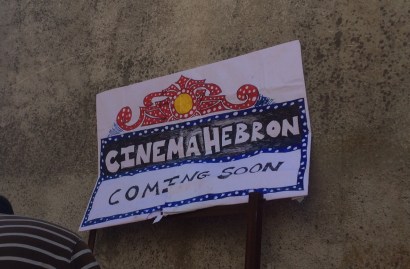
The goal of the action was to begin the process of turning an old metal factory in the Tel Rumeida neighborhood of Hebron into a movie theater: Cinema Hebron.YAS chose to build a movie theater so that the isolated, segregated Palestinian residents of H2 could have a place to come together in community – to experience even a little slice of normalcy in this intensely abnormal, unjust environment. It was also designed to be a statement to the settler community that the Palestinian residents of Hebron will continue to resist the theft of their property – and that Jews from around the world are ready to stand in solidarity with them.

The factory is owned by Jawad Abu Aisha, the patriarch of a prominent family in Tel Rumeida. As was the case with the YAS center, Jewish settlers were gradually encroaching toward this particular property – and based on past history, it seemed it was only a matter of time before it was taken it over completely. Tel Rumeida is heavily desired by settlers and has long been one of the tensest areas of Hebron. (This past March, Tel Rumeida made the news after a solider was filmed shooting a wounded Palestinian in the head while he was lying in the street.)

We spent all day Thursday preparing for the action, which was prepared down to the most minute detail. Our plan was to go to the old, cluttered site, begin the process of cleaning it up and announce our intention to turn it into Cinema Hebron to the press. Inevitably the IDF and police would show up and eventually declare it a “closed military zone” – their standard operating procedure when dealing with protests.

Legally speaking, the military needs to get a signed order to declare a closed military zone, but they often dispense with that pretense. Our plan was to keep cleaning up the site until the soldiers returned with their order. In the meantime, we would put up a mock marquee, pass out Cinema Hebron popcorn, give interviews to press, chant and sing, and do our best to clean up the site before they soldiers and police ordered us out.

There were 60 participants all told – 40 from CJNV and another twenty from Youth against the Settlements and All That’s Left. Our group split up into three “pods” – Green (those who would work until the soldiers returned but would not take an arrest), Yellow (those who would would be willing to be arrested if it was deemed necessary by our leaders) and Red (those who would stay until they were arrested.)

cinemahebronAs an extra precautionary measure, we drove to the site in separate vans to the site. Unfortunately, the military was somehow tipped off that there was some kind of action being planned for Hebron that day – and the van coming with ATF activists from Jerusalem was stopped en route. Our CJNV delegation all made it in safely, however. We gathered in an old metal warehouse until we were given the word that our tools had arrived. Then we put up the marquee and got to work.
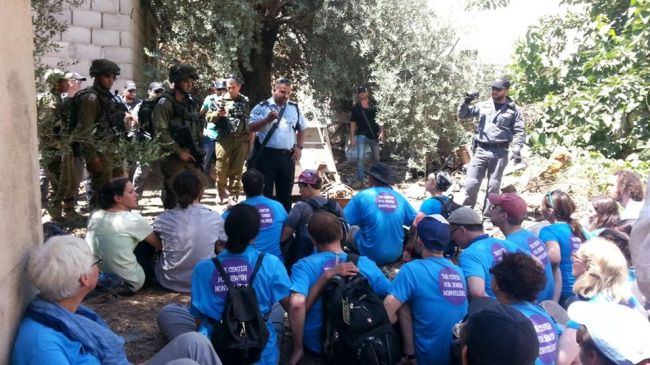
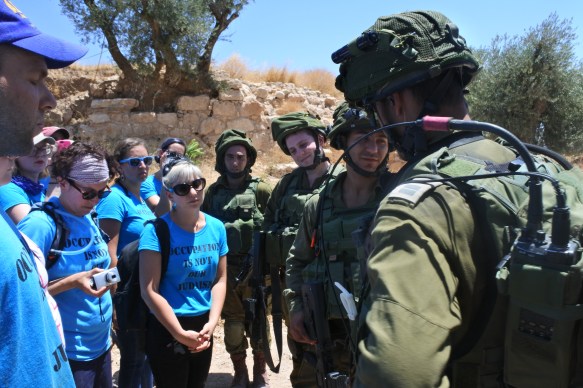
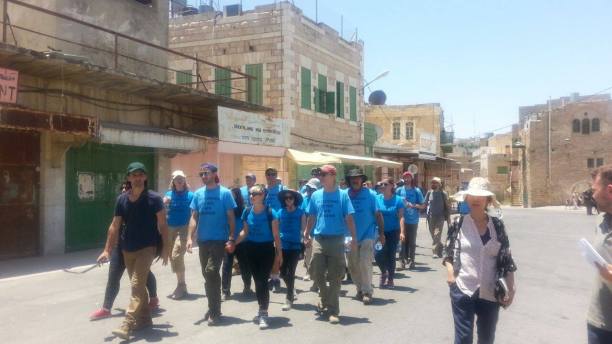
The site was heavily overgrown with high weeds and all kinds of scrap metal everywhere. As we started raking, hauling, piling junk we sang a every Jewish song and civil rights chant we knew. In short order settlers started to gather, peering at us through the front gate. The IDF and police arrived soon as well – we worked for about an hour or an hour and a half before they actually entered the site. They began arguing with the Palestinian owners and after some back and forth, they eventually fell back and we continued with our work.

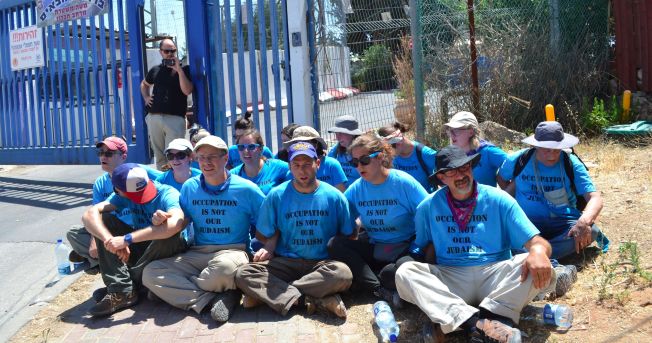
After another hour or so, they returned and announced that the area was closed military zone. At this point, the some members of our delegation left and the rest of us sat down in the middle of the site, continuing to chant and sing. A police officer came up to us and told us that our presence on the site was illegal and if we did not leave in two minutes, we would be arrested (below). When our two minutes were up, they started to physically remove us (see the clip at the top of this post). They shoved us to the back of the site, gathered us together and ordered to take out our passports. They then asked the six Israelis from our delegation to take out their identity cards and led them away. We were sent out in the other direction and told to leave the site.

13730785_1728357484103891_5709147705551236607_o

Photo: A. Daniel Roth – http://allthesedays.org

At that point we gathered together and discussed what to do next. It seemed clear to us that the Israelis were targeted because they were easier to process – and that the authorities likely wanted to avoid the bad publicity of arresting internationals. When we received word from our lawyers that our six friends had been taken to the police station in Kiryat Arba, we decided to walk there together and demand their release.

After walking for only ten minutes or so we were stopped by five soldiers who told us we couldn’t continue because the area was (you guessed it) a closed military zone. We refused to leave and said we simply wanted to visit our friends in the police station. Thus began a stand off, during which the lead soldier called his commander four or five times. They clearly had never dealt with a group like ours and were somewhat bewildered that we wouldn’t leave when ordered. Finally Issa arrived and argued loudly with the soldiers. I’m not sure how he managed it but we were finally told we could continue along a detoured route.

DSC_1320 copy

We eventually made it to Shuhadah St., continued down the road, passed the Ibrahimi Mosque and headed up a hill that led us in the direction of Kiryat Arba. As we walked in, we were joined by soldiers who silently walked alongside us. It quickly became clear to me that they weren’t there to impede us but rather to protect us from angry settlers. (I’m fairly sure this was the first time the residents of Kiryat Arba had ever witnessed a group of singing diaspora Jews walking down the street wearing “Occupation in Not Our Judaism” T-shirts ).

13710599_1728365224103117_2611826575131292990_o

Photo: A. Daniel Roth – http://allthesedays.org

We finally arrived at a gated area and faced yet another gauntlet of soldiers. After yet another round of back and forth, we were sent around to the front gate. Then we walked down a residential community to the end of the street where the police station was located. We talked to the guard at the front gate and explained we wanted to see our friends inside. After other policemen gathered we were told that our six friends were indeed inside but that we would not be allowed to see them. At this point, increasing numbers of residents from the neighborhood had come to mock and taunt us. Many of them filmed us with their cell phones. Eventually we sat down on the ground in front of the station gate and began to sing and chant once more.

The leaders of our delegation were in cell phone contact with the lawyers and our friends inside, who told us they could actually hear us singing and calling out their names. They were in the process of being interrogated by the police one by one but were otherwise fine. By this point quite a crowd had started to gather around us. We kept on singing as more police cars arrived. The original officer came back to us and told us that this was an illegal assembly – and that we had two minutes to disperse before they arrested us.

activists-1468604402

Photo credit: Jewish Forward

After talking with our lawyers, we decided against taking an arrest. They told us they believed our friends would likely be released in several hours, adding that our arrest would not help their cause and might even hinder it. So after spending an hour at the station we got up, walked together down the street and gathered near the front gate. As Shabbat was getting closer, we sang Shalom Aleichem and Lecha Dodi together with our other songs. Then together, we walked to a YAS home in H1 to meet up with the rest of our crew, eat a late lunch, debrief, share stories and nap after our physically/emotionally exhausting experience. Eventually we boarded our bus and returned to Susiya, in the South Hebron Hills where we would spend our Shabbat.

That evening just after a gorgeous sunset, we made a circle on a rocky hill and I began to lead our Shabbat service. As I prepared to lead Lecha Dodi, the prayer that welcomes the Shabbat bride, I heard someone shout. I looked up and saw two cars pulling up. Our six friends got out, grinning ear to ear as we cheered their arrival. After lots of hugs and laughter, we all continued with our service.

Shabbat had arrived.

(PS: You can read about our Cinema Hebron action here and here and our Shabbat in Susiya here).

The People of Susiya Return

DSC_1007 copy

photo: Shlomo Roth

This morning the Palestinians of Susiya returned to their original home, if only for a brief moment.

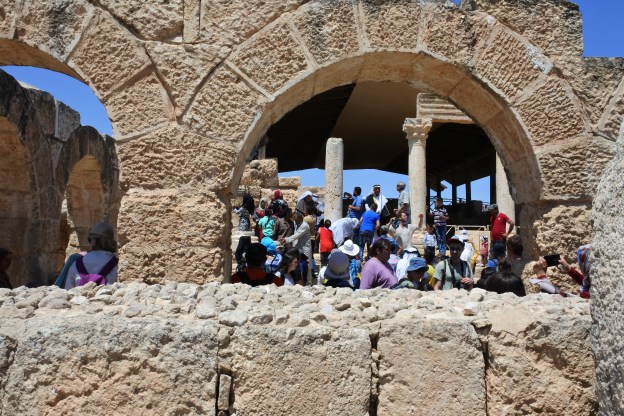
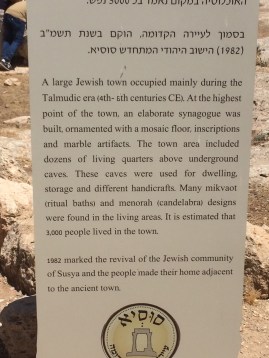
Khirbet Susiya is a village in the South Hebron Hills where until recently, Palestinians lived for at least a century. The people of Susiya originally lived in caves and maintained a simple agrarian life, cultivating fields and shepherding their flocks. Everything changed when Israel began to archaeologically excavate their land in the 1970s, eventually uncovering an ancient synagogue underneath a mosque on the land. In 1983 a new Jewish settlement, also called Susiya was established nearby. In 1986, Israel expelled Palestinian villagers and expropriated their land. They moved to an area close to the settlement of Susiya and the original site of the village; in 1991 they were expelled from this site as well. They eventually went to live elsewhere on their cultivated farmland, where they still live today.

The people of Susiya have been engaged in a constant fight to remain on their land where, like the Bedouin residents of Umm al-Kheir, they under the constant threat of demolition and expulsion. Their struggle has gained the attention of solidarity activists in Israel and around the world – and their cause has now even reached the EU and the US State Department.

IMG_2502

The Juedeo-centric sign at the entrance to the archaeological park.

This morning, our delegation went to Susiya to help them briefly return to the site of their original homes. It is now located in an archaeological park; as is the case in so many other sites around the country Israel uses archaeology to lay claim to the land – and highlight its Jewish history in a manner that erases the memory of any people who might have lived there before.

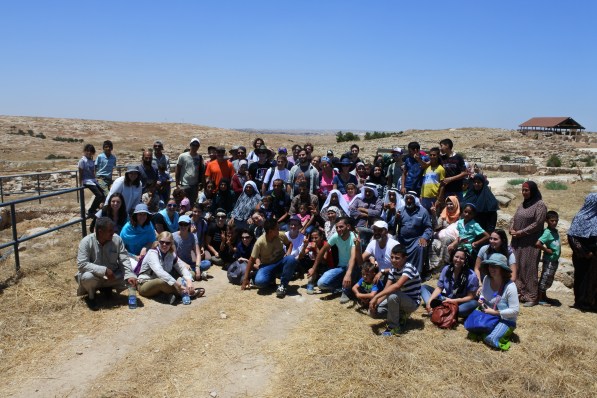
Today’s action was undertaken by the Center for Jewish Nonviolence along with the Israeli anti-occupation collective, All That’s Left.  The plan was fairly simple. We met the villagers in Susiya and walked down the road to the entrance of the archaeological park. We then bought tickets for Jews and Palestinians alike and just entered the site.

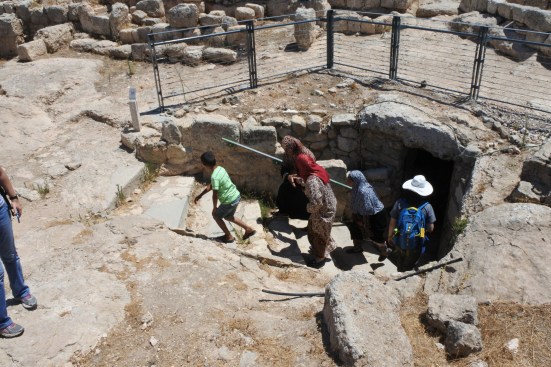
At least three generations were represented, including adults and elders who remembered their life before the expulsion as well as children who were seeing their families’ original home for the very first time. The children ran ahead immediately, peering down into wells, running up and down the stairs of the ruins. It’s hard to describe the emotions we felt as we watched parents and grandparents showing their children their place where they played as when they were young.

IMG_2512

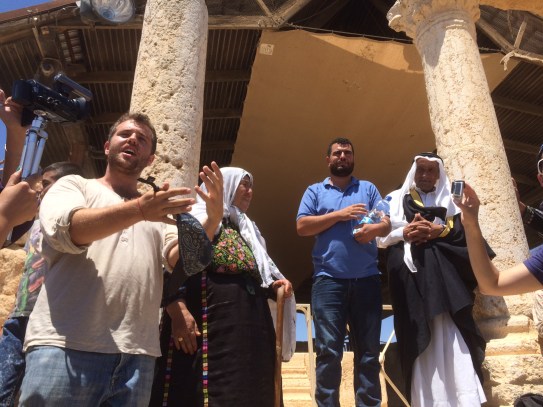
We gathered at the site of the synagogue and heard from village leaders who told us stories about their life in their village before the expulsion. In the picture above you can see Nasser Nawaja (in the blue shirt) and his father and mother speaking to our group, with CJNV leader Isaac Kates Rose interpreting their words for us. We also heard from Fatma Nawaja, who related to us in depth her memories of when Israeli archaeologists first came to their village. At first their relations were quite friendly she said, and they would often offer the workers food and drink. They had no idea, said Fatma, that this project would one day cause them to be expelled them from their homes.

She also told us about the village midwife Haji Sara, who delivered many of the young people who were present at our gathering. Haji Sara was no longer alive, but Fatma made a point of telling us how much this moment would have meant to her. Later, when we toured the site, we were shown the cave that was Haji Sara’s home (below). It is now used to house a multi-media presentation on the archeological site.

DSC_1000 copy

While we were fully prepared for the IDF to interrupt our visit (and had a nonviolent contingency plan in place), thankfully this did not occur. It was truly a blessing to be able to experience this visit without the traumatic presence of soldiers to remind the villagers of the brutal reality of their life under occupation. As it turned out, as we walked back to Susiya, we saw a green bus filled with soldiers roaring toward the archaeological park. About ten minutes later it passed us, heading back in the opposite direction. (Mission accomplished).

It seemed to me that there was something very Jewish about this witness of the exiled returning to their homes. Of course I was also aware that it was our own Jewish privilege in an ethnocentric nation-state that allowed this to brief return to happen at all. We can only hope that this moment offered us all a glimpse of a future when all Palestinians will be able to return to their homes

Tomorrow we’re going back to Hebron, then back to Susiya for Shabbat. I will be reporting on something very special in my next post.

DSC_1104 copy

Umm al-Kheir: Rebuilding Beauty out of Destruction

IMG_2482

Today we spent a second morning/afternoon in Umm al-Kheir. While one half of our group continued to clear the field for zatar planting, the rest of us went to the other side of the village to rebuild one of the thirty five homes that was destroyed this past April.

Our group was led by a village leader named Eid Suleiman Hathaleen, who did his best to explain the complex, Kafka-esque bureaucracy behind the IDF’s practice of home demolitions and land confiscation. The IDF’s Civil Authority relies on an arcane mix of land laws from the Ottoman, British and/or Jordanian administrations – the three legal systems that once governed what is called today the West Bank. One such law states that those who claim rights in rocky land must prove that they cultivated at least 50 percent of the entire parcel – otherwise, the entire parcel will be deemed state land and Palestinians will be left with no rights whatsoever. For this reason, we are helping the villagers expand their tillable land.

As I mentioned in my last post, the Bedouin residents of Umm al-Kheir purchased their land from the Palestinian town of Yatta over 6o years ago after their expulsion from the Arad region of the Negev desert. In the picture below Eid and his father Suleiman Hathaleen the patriarch of village, shows us the original document that gives his family their rights to the land.

IMG_2468

Despite their clear legal right, Eid and his fellow villagers are constantly on the verge of eviction and the regular reality of home and structure demolitions. The Civil Authority can demolish homes and structures for any number of reasons: it can claim the area to be a military “firing zone,” it will deem a house over 35 meters to be unlawfully high, or it might respond with demolition orders for any structure based on complaints from settlers.

The neighboring settlement of Carmel has lodged several such complaints against the people of Umm al-Kheir; once, for instance they sued the village over the smell of manure, which resulted the demolitions of their chicken coops and sheep/goat pens. Perhaps the most bizarre complaint occurred over the aroma of baking bread from the village’s communal taboun (oven). Yes, they were actually forced to go to court to keep the Israeli army from demolishing their stove.

IMG_2470

The infamous taboun of Umm al-Kheir

As we prepared to our work rebuilding the home, Eid explained that it was being constructed in different location than the original since demolition orders still apply to any homes or structures built on the same sites. By rebuilding in another spot, the entire bureaucratic process would have to be started from the beginning, and could take up to a year or more to be completed.

There are several new temporary structures donated by the European Union in different locations throughout the village. They are simple metal boxes, essentially four walls without floors. Our job was to take the rubble from the demolished homes and haul them to the new sites to create a floor for one of the new structures. In the picture below, a few of us are shoveling rubble into wheelbarrows to bring over the new home. The picture beneath it shows the final product of our work – not a complete floor yet, but hopefully a good start:

IMG_2472

IMG_2474

On our way back to the fields, Eid took us on a short detour to show us his art studio. Among other things, Eid is a talented self-taught artist who makes miniature trucks, bulldozers and helicopters from scraps he finds from his village, most of them from demolished structures (see pic below). As he explained it to us, these models (which are so intricate that the steering wheels of the vehicles actually move their tires) constitute a form of artistic resistance – i.e. making something constructive out of acts of destruction. There is of course a profound irony that Eid creates for instance, the very Caterpillar bulldozers that regularly come to destroy his village. Of course this is an intrinsic part of his artistic intention. (You can see more of Eid’s work, contact him or order items from his website here).

IMG_2476

Our group then returned to newly cleared field to plant hundreds of zatar plants (pic at the top of this post). While summer is not the traditional time for planting, it was important for the people of Umm al-Kheir to get the plants into the ground as soon as possible for the above mentioned legal reasons. After the planting, the villagers quickly installed irrigation pipes to keep the ground well watered.

I’m sure that some reading these words might be asking why they are working so hard to rebuild homes or sow plants that were all too likely to be demolished or uprooted by the IDF?  The answer of course, is that this work is a very disciplined and steadfast form of resistance. The goal of Israel’s draconian military/legal bureaucracy is ultimately to make things so intolerable for the people of Umm al-Kheir – and so many other Palestinian communities throughout the West Bank – that they will eventually be driven from their homes. However, it is all too clear to us that their connection to their land, their homes and their communities is unshakeable. As Sulieman Hathaleen, the patriarch of Umm al-Kheir recently said to a reporter,

We went through so many catastrophes: 1948, 1967 and now the settlements, which have taken most of our land. They left us with nothing. And now they want to expel us. But we will not leave.

I believe him.

After lunch, we traveled to Hebron to tour Area H2 with a guide from the Israeli organization, Breaking the Silence. I’ve written about Hebron and BTS several times before (here and here, for instance.) For now I will only say that the situation in Hebron is even more appalling than ever – if such a thing is even possible. After the tour however, we met with Palestinian non-violent activist Issa Amro (below), the inspiring founder of direct action group Youth Against the Settlements. YAS is truly one of the bright lights in the dark reality that is Hebron and is becoming most well known for its Open Shehudeh Street campaign.

I will have more to say about Hebron, Issa and Youth Against the Settlements in future posts.  Stay tuned.

IMG_2498


Our Afternoon in Umm Al-Kheir

IMG_2464For our delegation’s first day in the field we traveled to the Bedouin village of Umm al-Kheir in the South Hebron Hills.The Bedouin residents of Umm al-Kheir came to this region over 60 years ago, after they were expelled from Tel Arad (in the Negev desert) by the Israeli military. After coming north, they purchased this land from the Palestinian village of Yatta and lived there peacefully until the mid-1980’s, when the Jewish settlement of Carmel was built directly next to it.

Since that time every structure in Umm al-Kheir has endured a series of home and structural demolitions. Meanwhile, since Umm al-Kheir is not officially recognized by the Civil Authority of IDF, it has no access to electricity or water and must depend on solar panels and trucked-in water to survive. The entire town is essentially remains under demolition order; the reality of this constant threat has become a part of daily reality for the people of Umm al-Kheir. The latest occurred this past April, when the IDF destroyed six homes and left 35 villagers homeless.

The village looks as you might expect, with small metal homes and pens for their sheep and goats. They have also constructed a larger structure to serve as a community center and have begun to clear out land for agricultural use. For the people of Umm al-Kheir, existence is resistance.

As I wrote in my previous post, the village of Umm al-Kheir asked the Center for Jewish Nonviolence to help them finish clearing out their land and to plant grow zatar (thyme). This agricultural work is itself an act of defiance – and a statement by the villagers to the military Civil Authority that they intend to remain on their land even as they live under the constant threat of expulsion.

After we arrived, our group was warmly welcomed by our host Aziz and were given a brief history of the village and the current state of their struggle with the military and the settlers who regularly harass them. We then spent the morning clear out their field of rocks and weeds to make the ground viable for planting:

13626630_10208132830612073_8288311936024060602_n

Take a close look at the picture above. Just behind the three members of our delegation you can see the proximity of the village to Carmel, which lies just beyond the chain link fence. As we worked, it was impossible to ignore the presence of this settlement, filled with beautiful homes and green lawns literally looming over the village. At one point a soldier drove up on the Carmel side of the fence, got out of his car, and watched us for the duration of the afternoon.

During our rest breaks, we had the chance to talk with several of the villagers and play with the children. At one point, we were joined by a small group of young people celebrating, carrying one of their friends on their shoulders. We were told that he had just passed his High School matriculation test (the equivalent of the SAT in the United States) and was now eligible to apply to University. They joyfully taught us a Bedouin song so we could join in the celebration with them.

As has always been the case whenever I’ve visited Palestinian villages or refugee camps, our hosts showed us profound and gracious hospitality. After work, we shared a delicious lunch together, after which there was more singing and an awesome dance performance by the children of the village.  Needless to say, it was a day of many mixed emotions for our delegation. We return tomorrow to finish clearing out the field and start the planting of hundreds of zatar plants.

13600217_10208132832172112_2489410648258233304_n

CJNV staff person Erez Bleicher hard at work in Umm al-Kheir

After lunch our delegation visited the village of Susiya, where will working later this week (stay tuned.) We also visited Al-Twani – the largest village in the South Hebron Hills. There is much to say about this remarkable place, which is the center of the Palestinian nonviolent movement in the region and also the home to a notable archaeological site. I’ll write more about Al-Twani in a future post.

For more on the struggles of Umm al-Kheir, I highly recommend this 2011 article from Ha’aretz. For now, it’s off to bed after a long full day.