Category Archives: Palestine

Untold Stories from Gaza: A Conversation with Ayman Qwaider and Sameeha Elwan

1970760_685811398124958_1228021371_n

I’ve written before about the wonderful Chicago initiative “Untold Stories,” which features Palestinians sharing their personal stories of their lives under occupation. While it began as a project of my congregation, it has since expanded to become an interfaith community effort. I’m so gratified by the success of this program, which draws upon the unique power of narrative rather than political rhetoric. As ever, the simple sharing of stories has an uncanny ability to cut through the convoluted complexities of political issues like little else.

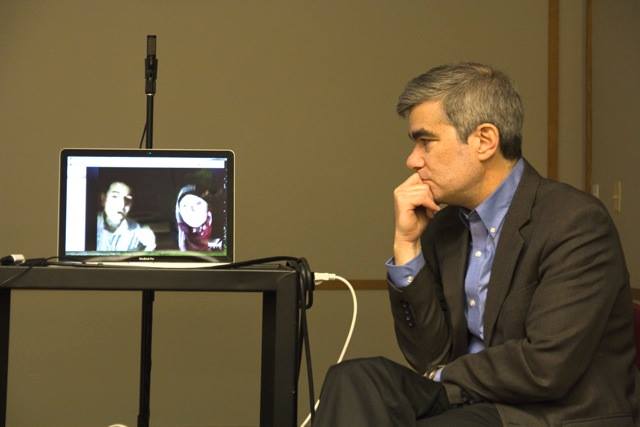
Up until now, “Untold Stories” has featured Palestinian-Americans (and recently, the addition of Israelis as well.)  This past Sunday, however, for the first time participants were able to hear from Palestinian presenters speakers speaking to us directly from Palestine. I was honored to serve as the facilitator of a Skype conversation between attendees at the Evanston Public Library and a young Palestinian couple in Gaza: Ayman Qwaider, a community educator and peace activist and his wife Sameeha Elwan – a blogger/student/activist.

For well over an hour, Ayman and Sameeha shared details of life inside the Gaza blockade.  Ayman, 26, received his degree from the Islamic University of Gaza in 2008, after which he worked for two years as an international humanitarian aid worker. In 2010, he was granted a scholarship to travel to Spain, where he received his master’s degree in Peace, Conflict and Development Studies. He currently works for a non-governmental organization in Gaza.

Sameeha is a talented writer and blogger who, like Ayman, received her BA at the Islamic University, then received a scholarship to earn an MA in Culture and Difference at Ustinov College in Durham, UK. Her work is featured in the important new anthology, “Gaza Writes Back,” recently published by Just World Books. Sameeha has received a scholarship to pursue a Phd in English literature but it is as yet unclear if she will receive permission to travel once again pursue her studies.

It was clearly important for Ayman and Sameeha to be able to share their stories with us, particularly since the plight of Palestinians in Gaza is the chronically forgotten story in the Palestinian-Israeli conflict. Now six years into this blockade, Gazans still live in a virtual open-air prison with severely curtailed access to the most basic necessities of living.  As Ayman and Sameeha told us, 80% of the population is dependent on international aid, the economy has all but collapsed, the percentage of children suffering from malnourishment is rising, unemployment is at 60%, there is a shortage of drinkable water and access to electricity is limited to several hours a day.

1902074_685811491458282_1311275468_n

To drive this point home, Ayman told us at the beginning of the program that we should expect their electricity to go down in one hour. At that point, we would need to wait for a few minutes while they hooked their computer up to a reserve battery. When we reconnected, they were sitting in the darkness of their Gaza City flat, their faces illuminated only by the light from their computer. (Compare top pic with the pic above).

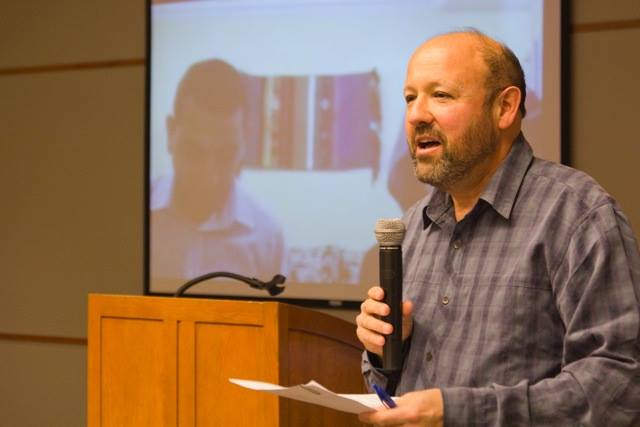
I’ve written extensively about the politics dimensions of the Gaza crisis so I won’t belabor the point here. I will only say that I am deeply grateful to “Untold Stories” (and its coordinators, Sallie Gratch and Mark Miller) for enabling us to hear Ayman and Sameeha’s story – and help us bear witness to this injustice with a unique kind of power.

It’s truly difficult to describe how it felt to converse with a young couple who were sitting in the darkness of their apartment from inside a blockaded strip of land while we sat in the comfort and freedom of an Evanston library. It is so very, very important to hear these untold stories and to create real relationships with those who are living them out day after day. I’d add it is even more important to view ourselves as an integral part of these stories, so that we might somehow participate in their just resolution.

Some links I encourage you to read: click here to read Ayman’s blog and here to read Sameeha’s. Click here to read an excellent article by journalist Ruth Pollard which describes the current reality under the Gaza blockade and prominently features Ayman and Sameeha’s story.

And finally, click here to donate to ANERA – a heroic NGO that has long been endeavoring to provide sustainable support to the people of Gaza.

"Untold Stories" co-coordinator Mark Miller

“Untold Stories” co-coordinator Mark Miller

My Conversation with Rabbi Leonard Beerman

brantandleonard2

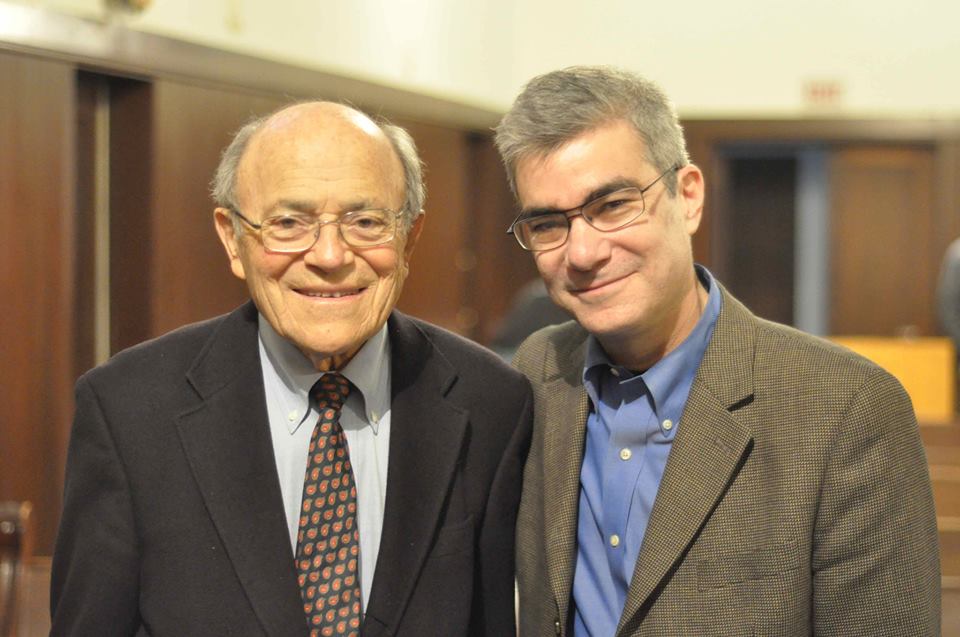
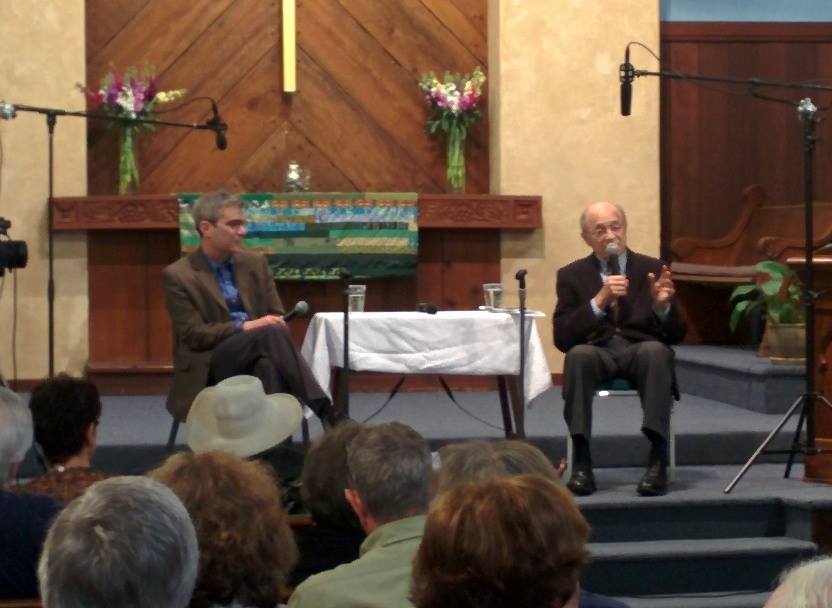
This past Sunday I had the great pleasure and honor to participate in a open conversation with Rabbi Leonard Beerman in “Progressive Politics from the Pulpit,” a program sponsored by Jewish Voice for Peace – Los Angeles. As Rabbi Beerman has been one of my true rabbinical heroes for so many years, it was truly a thrill for me to share a podium with him as we shared our thoughts on the challenges facing congregational rabbis who engage in progressive social justice activism.

As a Los Angeles native myself, I’ve long known of Rabbi Beerman’s inspired work during the years he served as the Senior Rabbi of LA’s Leo Baeck Temple. He was the founding rabbi of Leo Baeck in 1949 and stayed there for the next 37 years until his retirement in 1986. During that time, he challenged his congregants – and the Jewish community at large – to awaken to some of the most critical socio-political issues of the late 20th century.

Rabbi Beerman was a maverick in his day – and in many ways still is. He is a self-described pacifist who came by his stance honestly, after serving in the Marines in World War II and in the Haganah in 1947 while attending the newly founded Hebrew University. He was a student of Rabbi Judah Magnes, the great Reform leader who advocated for a bi-national state for Jews and Arabs – and he remains a passionate advocate for a just peace in Israel/Palestine to this day.

Rabbi Beerman came to Leo Baeck fresh from Hebrew Union College in Cincinnati during the height of the Cold War and quickly became an outspoken and visionary peace activist. In one of my very favorite stories, he described his anguish at the execution of Julius and Ethel Rosenberg, which took place on a Friday afternoon in 1953. During Shabbat services that evening, he decided to add their names to the end of the yahrtzeit list (the list of names read before the recitation of the Kaddish) much to the dismay of some of his congregants.

Rabbi Beerman was also one of the first rabbis in the country to publicly condemn the US war in Vietnam and later instituted draft counseling in his congregation. He invited such figures as Daniel Ellsberg (who spoke on Yom Kippur afternoon while he was awaiting trial) and Cesar Chavez to speak at his synagogue. Rabbi Beerman was also a visionary leader for civil rights and worker justice and during the nuclear arms race was one of the leading Jewish voices in the disarmament movement.

I’ve particularly admired Rabbi Beerman’s fearlessness when it came to the subject of Israel/Palestine – clearly the issue that has earned him the angriest criticism from the Jewish establishment. He was a consistent and faithful advocate for justice for the Palestinian people long before such a thing was even countenanced in the Jewish community. Literally going where few other rabbis would dare to tread, he met with Palestinian leaders such as Yasser Arafat and Fatah founder Abu Jihad. That he was able to do all of this while serving a large, established Los Angeles synagogue speaks volumes about his integrity – and the abiding trust he was able to maintain with the members of his congregation.

brantandleonard3

Now in his 90s, Rabbi Beerman is still deeply engaged in the issues of our day. During our conversation together, we spoke about the current state of the Israel/Palestine conflict, the languishing peace process and the rise of the Boycott, Divestment and Sanctions movement. I mentioned to those present that in 2008, during the height of Operation Cast Lead, when Rabbi Brian Walt and I were calling rabbinical colleagues to sign on to a Jewish Fast for Gaza, Rabbi Beerman was one of the first to sign on without hesitation. He did the same when we were forming the Jewish Voice for Peace Rabbinical Council and his presence there is truly an inspiration to our members.

I’m still feeling so happy and proud to have been able to share the stage with Rabbi Beerman. Heartfelt thanks to Estee Chandler, the head of JVP – LA for her masterful stewardship of this wonderful event. Thanks also to Eliyahu and Pennie Ungar-Sargon for filming the program – I’ll post the finished video of our talk when it is complete.

PS: After the program was over, I had the pleasure of meeting Rabbi Beerman’s wife, children and grandchildren, who were sitting in the front section. As we chatted I mentioned to them how wonderful it felt to get such a nice reception, adding that Leonard and I were worried there might be “troublemakers” in attendance. His daughter smiled and said, “The only troublemakers were up on the stage…”

More Heat Than Light: My Response to Rev. Chris Leighton

RNS-Zionism-Unsettled-study-guide

Dear Reverend Leighton,

Thank you for your response to my open letter. While I’m also not particularly interested in turning our dialogue into a debate to be “won” or “lost,” I do take exception to much of what you wrote and feel compelled to respond in kind. I agree with you that our differences are worthy of ongoing dialogue. I can only hope that the airing of our disagreement might somehow be helpful to those who struggle with an issue that is of such critical importance to our respective faith communities.

I’d like to start with your observation:

(To) deny…Zionism and Judaism do not share deep historical and religious roots…strikes me as a serious error. You work with a very limited conception of Zionism as a 19th century political movement that breaks from Jewish tradition. I work with a much broader understanding of Zionism and see this movement as driven by yearnings for a Jewish homeland with deep biblical underpinnings. The blending of peoplehood, land and Torah strikes me as integral to Jewish tradition.

In writing this statement, you’ve chosen to sidestep my point that for thousands of years, the Jewish connection to the land was expressed as a spiritual yearning – not as a desire to create a sovereign Jewish nation.  “Homeland” and “political nation” are two intrinsically different concepts, and as I’ve already written, Jewish tradition consistently regarded the notion of Jewish political nationhood to be an anathema. Political Zionism was never “integral to Jewish tradition” and this concept was not even introduced into Jewish life until the 19th century.

By insisting on this point, your analysis of Jewish tradition and history betrays a characteristically Zionist bias that assumes the centrality of sovereign statehood. That is fine – you are certainly welcome to your biases. But you should at least be prepared to own them for what they are and not attempt to present them as normative.

The very concept of nation-statehood itself is a fundamentally modern notion. Like all modern forms of nationalism, Zionism arose to consciously create a sense of seamless continuity to the past through recourse to an ancient mythic history. But of course, this is an artificial “continuity;” one that owes more to modern political ideology than Jewish religious tradition.

It also has little to do with actual “history” as we know it today. As “Zionism Unsettled” notes, it is extremely problematic to use the Bible as a history book to lay claim to particular piece of land. In the first place, the Bible is a profoundly ahistorical document, as we have long since learned from literary scholars and archaeologists.  Moreover, the Bible was certainly never intended to be “history” according to our current understanding of the term. The authors of the Bible did not purport to create a literal history of the events of their day – rather, it is a religiously inspired narrative that reflects ideas and values unique to the world of the ancient Near East.

This is more than just an academic point. As “Zionism Unsettled” points out, the use of the Bible as a historical justification for a modern nationalist movement is not merely historically problematic – it has had tragic consequences for the inhabitants of historic Palestine, particularly when you consider Biblical passages that express entitlement to the land, a religious intolerance of the “foreign nations of Canaan” and commandments that require nothing short of their total dispossession – and in some cases, even annihilation.

So in one sense we are in complete agreement when you write “even the more secular strains of Zionism that became predominant in the 19th century were suffused with Biblical imagery.” Perhaps we only disagree on the dark outcome of this phenomenon.  We should not be unmindful of the ways that the Biblical land traditions were used by early Zionist ideologues and the political founders of the state – and are currently wielded by Israeli politicians, settler leaders and ultra-religious rabbis alike.  This use of Biblical imagery must not be dismissed as mere religious rhetoric – these theological linkages have enormous power, particularly when we consider the expulsion of Palestinians from their homes in 1947-48 and policies of displacement and transfer that continue to this very day.

You go on to ask:

Do you want to uncouple Zionism from Judaism altogether, or do you want to critique its more militant and “colonial” manifestations? Can all expressions and forms of Zionism be accurately placed into an ideological lump and legitimately condemned as a movement that leads “inexorably” to the displacement and mistreatment of the Palestinians, as the IPMN guide indicates? Do you think that Jews do not belong or have a legitimate claim to the land of Israel?

It is true that there are many different forms of Zionism – a fact that is extensively explored in “Zionism Unplugged” (see Chapter 2).  I would argue, however, that since the establishment of the state of Israel, the existence of these various “Zionisms” has largely become an academic point. In a very real way, the birth of Israel represents the ultimate victory of the values of political Zionism that were promoted by the founders of the state.

As someone who identified as a Zionist for most of his adult life, it is with no small measure of sadness that I acknowledge the ways political Zionism has “inexorably led to the displacement and mistreatment of the Palestinians.”  Perhaps most critically, I have come to painfully reckon with the ethnic nationalism at the core of political Zionism’s raison d’etre – and its insistence upon the maintenance of a demographic Jewish majority in the land to safeguard the “Jewish character of the state.”  In the end, no matter how vociferously Israel might insist that it is, in fact, “Jewish and democratic,” I do not believe it is ultimately possible to establish a demographically Jewish state without regarding the presence of non-Jews to be a problem.

In this regard, I do believe that “Zionism Unsettled” bravely shines a light on the tragic legacy of the Zionist idea, a concept that ultimately resulted in the forced depopulation of Palestinians from their homes in 1947/48 (a phenomenon by now well attested to by Israeli historians) as well as the policies of dispossession that continue to be enacted by the Israeli government even today. These events and policies do not exist in a vacuum – they are the logical end-product of a very specific nationalist ideology that privileges the rights of one particular group over another.

You ask me if I believe Jews “do not belong” or “have a legitimate claim to the land of Israel.” Of course I believe that Jews have every right to live in the land. I’m not sure, however, what you mean by a “legitimate claim.” If you mean can we Jews rightly maintain a religious connection to the land, then my answer is certainly yes. If you mean do we have some kind of intrinsic right to exert our political sovereignty over this land, then my answer is most certainly no. When it comes to nation-statism, it has historically been the case that “might makes right.”  The real question, it seems to me, is not “who has the right to this land?” but rather “how can we extend full rights to all who live on this land?”

You write that you “have yet to see efforts to undo the establishment of the State of Israel produce constructive results.”  I’m struck that you equate an insistence upon equal rights for all to be tantamount to Israel’s “undoing.”  But when it comes to a choice between a Jewish and democratic state, as increasingly seems likely, what should be our choice?  My community is fast approaching a reckoning: which kind of state will ultimately be more “Jewish,” one that unabashedly places Jewish rights above Palestinian rights or one that allows full and equal rights for all?

I also find your statement about “Israel’s undoing” to be more than a little incendiary. By projecting nefarious designs onto an entire movement, this kind of rhetoric only exploits the deepest and darkest of Jewish fears. I will tell you that I have been participated in the Palestinian solidarity movement for some years now and have yet to encounter the kind of anti-Semitic anti-Zionists you speak of. Are there anti-Semites in this movement? Undoubtedly. There are odious types on the margins of every political movement. But I can say without hesitation that the Palestinians and pro-Palestinian activists I have met and worked with have nothing but the deepest respect for Jews and Judaism at large and consistently endeavor, as I do, to draw a scrupulous differentiation between Zionism and Judaism.

I don’t disagree with you that  “the quest for home is deeply woven into the tissue of our humanity” and that this concept is deeply woven into the fabric of Jewish collective consciousness. But I must disagree with you strongly when you insist that “the search for homeland aim(s) at sovereignty.” To me, this is an astonishingly narrow and reductionist reading of the notions of home and homeland.

You write that “a national identity is difficult to construct and preserve without the power and freedom that is exercised by the state.” But in fact, that is precisely what the Jewish people have done for centuries.  Judaism as we know it was born in the wake of the destruction of the Second Temple, as a profound and spiritually courageous response to the reality of dispersion and exile. As such, Jewish tradition is replete with teachings that respond to this trauma with a message of spiritual hope and renewal.

In one of my favorite rabbinic midrashim, for instance, Rabbi Akiba teaches, “Wherever the people of Israel were exiled, the Divine Presence was exiled with them.”  In other words, Judaism arose to assert that despite the experience of exile, the Jewish people would always be “home.” God was no longer geographically specific to one particular land – spiritual meaning and fulfillment could be found throughout the diaspora wherever the Jewish people might live.  (The midrash ends, notably, on a messianic note: “And when they return in the future, the Divine Presence will return with them.”)

In so doing, the rabbinic Judaism transformed a land-based cultic practice to a global religion, enabling Jewish life to flourish and grow widely throughout the Diaspora. This, I believe represents the intrinsic beauty and genius of the Jewish conception of peoplehood: in a time of profound upheaval and crisis we spiritualized the concept of homeland and redefined ourselves as a globally based, multi-ethnic, multi-cultural nation that viewed the entire world as its “home.” The concept of exile became, in a sense, a spiritual prism through which we viewed the world and our place in it. It might well be claimed that centuries of Jewish religious creativity resulted from this profound existential mindset.

As a Jew I do not need you to tell me that this conception of Judaism is somehow “exceptionalist” because it “refuses the rights and conditions that every other nation claims for itself.”  With all due respect, it is not for you to take it upon yourself to define my Jewish rights and claims, particularly when it runs counter to centuries of Jewish tradition and experience. I understand that you have chosen to adopt the Zionist narrative of my history and that is certainly your right. But you do not have the right to preach to a Jew that his understanding of “homeland” must ipso facto be expressed through sovereign statehood.

Moreover, there are numerous stateless peoples throughout the world. Would you go on to suggest that they too have the intrinsic right to “the opportunities and burdens of an independent state?” If so, where does this right come from and how might it possibly be implemented? If not, then why are you granting this unique right to the Jewish people?  Quite frankly, I find your conflation of the concepts of “homeland” and “nation-state” to be hopelessly confused, creating a myriad more problems than it purports to solve.

On the concept of exceptionalism, you write:

I have yet to encounter a nation or religion that does not fuse religion and politics – and overtly or implicitly make a claim to being exceptional. The challenge is how to identify and respond when the mixture turns toxic.

Like the authors of “Zionism Unsettled” I would go much farther than this. I believe that challenge is to identify and respond to those aspects of our respective religious traditions that assume our superiority over others – and to thoroughly disavow them.

It is all well and good to “support and sustain our nations, our religious communities, and families with financial and psychological investments that give them priority.”  I’m even willing to admit that it is natural for a person or group to feel “chosen” in a way that doesn’t automatically denote superiority.  The problem occurs, as ZU rightly points out, when exceptionalism “exempts the chosen from the need to conform to normal rules, laws, or general principles that we use to hold other people accountable.” (p. 8)

As the study guide notes, religious exceptionalism has historically been at its most dangerous when it is wedded to state power. In illuminating this point, ZU actually devotes a significant amount of analysis to post-Constantinian Christianity and its legacy of anti-Semitism over the centuries. In so doing, it identifies the ultimate problem as the merging of religion and empire – not Zionism per se. You misrepresent the guide egregiously when you accuse it of treating Zionism as “an exceptional and inherently evil manifestation of nationalism.” In fact, “Zionism Unsettled” repeatedly places political Zionism within the larger context of religious and national exceptionalism – a phenomenon that has historically proven to be, to paraphrase your words, a uniquely toxic mixture.

Finally, you bemoan the lack of a more “comprehensive and balanced account” in “Zionism Unsettled.” I would suggest that this lack of balance does not originate in the guide but rather the Israel-Palestine conflict itself.  To be sure, this conflict does not and has never constituted a level playing field. Rather, it has pitted one of the most militarized nations in the world – one that enjoys the near unconditional support of the world’s largest superpower – against a people it has dispossessed from its land; a people whose yearning for home now reflects, as you so eloquently put it, “a quest…that is woven into the very tissue of (its) humanity.”

I do believe this is the most critical place where you and I part company. You express your religious faith through your work in the world of interfaith dialogue – an arena that assumes balance and equity on two equal “sides.” I view my faith as refracted through my work as an activist who stands in solidarity with a people that is seeking its liberation. As such I do not view this conflict in any way as a balanced equation. On the contrary, I seek to re-right what I believe to be an inherently unbalanced situation.

I realize full well that by saying such things I leave myself open to further accusations of “polemical excess that does not do justice to what needs to be said.” So be it. I would only ask you to consider that rhetoric has a fundamentally different function in the world of dialogue than in the arena of political transformation. I understand that in your world, words are typically wielded in the furtherance of creating “more light than heat.” But when there is very real oppression occurring, as I truly believe is the case here, it is not at all inappropriate to turn up the heat, no matter how upsetting it may be for Israel and its advocates.

I do not know if you have ever visited Palestinians in the West Bank or Gaza and have witnessed first hand the deeply oppressive reality of their daily existence. If you haven’t, I encourage you to do so. I encourage you to talk to Palestinians who live in villages whose livelihood has been choked off by a wall that separates them from their agricultural lands in order to make way for the growth of Jewish settlements.  I encourage you to meet with Palestinians whose weekly nonviolent demonstrations against the wall are met regularly with brutal force by the Israeli military. Speak to Palestinians mothers and fathers whose children have been abducted in the middle of the night by the IDF and subjected to interrogation in Israeli prisons. Get to know Palestinians who have had their residency rights revoked and/or their homes demolished so that Jewish demographic facts can be created on the ground. Talk with Palestinians in Gaza who are being collectively punished by a crushing blockade and subjected to life inside what has essentially become one of the largest open air prisons in the world.

I believe if you take the time to do so you will invariably come to find that these men and women represent spiritual teachers just as compelling as the American Jews and Christians which whom you regularly engage in dialogue. At the very least, I hope they might somehow challenge your views on “what needs to be said” about this conflict.

While you may well consider the above to be just another example of my “polemical excess,” I would only say that my convictions come from a faithful place – and from a religious tradition that exhorts me to stand with the oppressed and call out the oppressor. I also believe these same religious convictions inform the very heart of “Zionism Unplugged” and whatever its specific flaws, I find it to be an enormously important and courageous resource.  You claim that the “vast majority of Presbyterians will not align themselves with a project that aims to disassemble the State of Israel.” Of course the guide does nothing of the kind. It does, however, call for the dissembling of an inequitable system that privileges one group over another and replacing it with one that guarantees full rights for all. For this it makes no apology, nor should it.

You certainly know the Presbyterian community better than I, but I will say that I have met and spoken with many Presbyterians – and members of other Protestant denominations – who have expressed gratitude for this new guide and are eager to use it in their churches. As with my own faith community, I do sense that we are currently in the midst of a paradigm shift on the issue of Zionism and I am not anywhere near as certain as you that the “vast majority” of Christians or Jews are so ready as you to denounce such ideas as abject anti-Semitism.

Again, thank you for taking the time to respond to my open letter. I agree with you that there is much more to be discussed. Whether or not we engage in further exploration together, I hope and trust that our conversation might still be helpful to those who have read our exchange.
Guest Post: Rev. Chris Leighton Responds to My Open Letter

zionism_unsettledRev. Chris Leighton has responded to my open letter of February 19, in which I addressed what I considered to be his troubling and unfounded attack on the newly released study guide, “Zionism Unsettled.” I have posted his words below. I genuinely appreciate his desire to enter into dialogue and will post my own response in several days.

I appreciate the time and thought that you directed to my critique of “Zionism Unsettled.” I am not particularly interested in entering a debate that yields winners and losers and that drives combatants more deeply into their entrenched positions. I am interested in conversation that might enable people with deep disagreements to learn from one another, and I am acutely aware of how much more I have to learn in the ongoing struggle to understand and respond to the complexities of the Palestinian-Israeli impasse. Colleagues such as Nancy Fuchs Kreimer, A.J. Levine, Peter Ochs, Tikva Frymer Kensky (of blessed memory) and even your former havrutah partner and now staff member at the ICJS, Ilyse Kramer (among others including folks at the Hartman Institute) continue to rattle me out of my complacency and remind me constantly that mahloket is a rabbinic discipline desperately needed in these tempestuous times.

You make a number of observations that I want to ponder more deeply. You also indulge in some polemical excess that does not do justice to what needs to be said. At the end of the day, you believe that this congregational guide can prove a helpful resource. I think that it is so riddled with historical and theological flaws, and so dismissive of the Jewish community that it will do much more harm than good. We disagree, and the most immediate question whether our differences might prove worthy of some ongoing dialogue.

I wonder if we might begin more productively by examining some arguments that you make that I find puzzling. They may clarify our divergent readings of ZU and enable us to better understand when and where we speak past one another.

You make a strong case for the separation of Judaism from Zionism, and I think rightly note the mistakes that arise when the two are collapsed. At the same time to deny that Zionism and Judaism do not share deep historical and religious roots also strikes me as a serious error. You work with a very limited conception of Zionism as a 19th century political movement that breaks from the Jewish tradition. I work with a much broader understanding of Zionism and see this movement as driven by a yearning for a Jewish homeland with deep biblical underpinnings. The blending of peoplehood, land and Torah strikes me as integral to Jewish tradition. Even the more secular strains of Zionism that became predominant in the 19th century were suffused with biblical imagery and so this movement was not as radical a rupture from the Jewish tradition as the more secular Zionists imagined.

So here is where I found your account confounding. Do you want to uncouple Zionism from Judaism altogether, or do you want to critique its more militant and “colonial” manifestations? Can all expressions and forms of Zionism be accurately placed into an ideological lump and legitimately condemned as a movement that leads “inexorably” to the displacement and mistreatment of Palestinians, as the IPMN guide indicates? Do you think that Jews do not belong or have a legitimate claim to the land of Israel? Do you want to trace the problem to the UN’s 1947 resolution to partition the land and to establish the State of Israel? Or do want to focus on the problems that emerge in the wake of the Six Day War of 1967?

I have yet to see efforts to undo the establishment of the State of Israel produce constructive results. I have seen efforts to de-legitimize the State, to brand it as “an apartheid nation,” and to punish Israel economically and politically polarize and fragment our communities. This is not to say that all anti-Zionists are anti-Semites. Yet it would be a terrible blunder not to acknowledge that many of them are. At another time we can circle back to clarify what constitutes “antisemitism” and its relationship to “anti-Judaism” before exploring who decides when it is fair and accurate to apply these categories. I do want to note that I did not throw around the term, indeed I used it only once and quite specifically in my critique.

Back to the issue of a Jewish homeland. I believe that the quest for a home is deeply woven into the tissue of our humanity, and you would not deny that this yearning has occupied a prominent, if not central role among Jews over the centuries. My impression is that you would not annul the longing to establish a Jewish homeland nor characterize this desire as intrinsically pernicious. Does the problem then take hold when Jews move from claims to a homeland to making their bid to establish a sovereign state? Homeland is OK. Sovereign State for Jews is not (unless divinely implemented).

When a Frenchman speaks of his homeland, or an Irishman, or American, or a Palestinian, or a Tibetan are they designating an attachment to a specific land independent of the sovereignty on which the messy business of governments depend? Does not the search for a “homeland” aim at “sovereignty?” A national identity is difficult to construct and preserve without the power and freedom that is exercised by the state. One of the truly remarkable achievements of the Jewish people has been the ability to endure and even flourish over a remarkable span of history without the powers of a sovereign state. Yet to acknowledge the claims to homeland while denying Jews the opportunities and burdens of an independent of state enshrines the status of Jews as “exceptional” and refuses them the rights and conditions that every other nation claims for itself. Your line of thinking seems to me to end up creating the very phenomenon that you and the guide condemn, albeit it is a different form of “exceptionalism.”

Finally, I do not know of a nation, a religion, or even a family that does not hold to some kind of exceptionalism. Our national, religious, and familial identities are constructed on the basis of stories that distinguish us from others. Even when we insist that we are not superior to others (and hopefully we regard this task as a moral imperative), we support and sustain our nations, our religious communities, and families with financial and psychological investments that give them priority. We live our lives treating our own with greater levels of time, energy, and resource—even as we strive to respond to the legitimate claims of those who need and demand our active engagement. Furthermore, I have yet to encounter a nation that does not fuse religion and politics—and overtly or implicitly make a claim to being exceptional. The challenge is how to identify and respond when the mixture turns toxic. I suspect that we agree that this is a vital responsibility of our religious leaders.

While keenly aware that your movement has for the most part rejected the notion of “chosenness,” I do not think that this category invariably generates a sense of superiority. The rejection of “exceptionalism” strikes me as a thinly veiled rejection of a concept that remains prominent in much, if not most of the Jewish world. The step from a condemnation of “exceptionalism” and “Chosenness” to an indictment of Israel and the larger Jewish community as ethnocentrically racist is made without qualification.

The concept of “exceptionalism” (at least as it is defined and applied in this guide) strikes me as a problematic. Are not the real problems to which you point a manifestation of “nationalism?” And if every country must be vigilant about the dangerous directions in which nationalism can move, why would the guide not acknowledge this challenge within Palestinian nationalism? It certainly would not be an arduous task to illustrate the problematics by offering a brief overview from George Antonius to the Hamas Charter.

One example of dishonesty that I find troubling in the study guide is the unwillingness to offer a more comprehensive and balanced account. If the problem is that Jewish nationalism is different from other kinds of nationalism and deserving of condemnation, then the guide once again becomes guilty of the very error that it impugns. In other words, Zionism becomes an exceptional and inherently evil manifestation of nationalism. At best I think that the analytic methods used in this guide are intellectually shoddy and the terminology reinforces the tendency to use confused and confusing generalizations—thereby reinforcing the polemical discourse that generates plenty of heat and a shortage of light.

These flaws point to a more serious issue, namely the unwillingness of the study guide to come clean on what it really believes is the necessary end game. Is the goal to help Israel achieve the democratic ideal embodied in its May 14, 1948 Declaration of the Establishment of the State of Israel, or to reject this national project, work to dismantle the current State of Israel, and create a new and different national entity? What do the authors really think necessary to overcome the plight of the Palestinians? It is essential to own up to the vision that animates this study guide, because the tools that are being deployed need to be appraised on the basis of ends that they serve.

In my opinion, the vast majority of Presbyterians will not align themselves with a project that aims to disassemble the State of Israel. I think that the authors and editors of the guide know this and therefore have strategically decided to conceal the objectives for which they strive. Again this strikes me as dishonest.

There is of course much more to be discussed. Perhaps these reflections will at the very least open up some points for further exploration.

The Reverend Christopher Leighton is a Presbyterian minister and the Executive Director of the Institute for Christian & Jewish Studies in Baltimore, Maryland.

Reconsidering “Zionism Unsettled:” An Open Letter to Reverend Chris Leighton

zionism_unsettled-618x330

Dear Reverend Leighton,

I read with dismay your recent “Open Letter to the Presbyterian Church,” in which you referred to the Israel Palestine Mission Network of the Presbyterian Church (USA) as “extremist” and called to their newly-published study guide, “Zionism Unsettled” a “dishonest screed.” As a rabbi who works actively alongside the IPMN – and whose words are quoted extensively in the guide – I am saddened by your words and feel compelled to respond.

As you might imagine, I take exception to your characterization of me as an “(accomplice) to sweeping denunciations of the Jewish people and their sacred traditions.” Needless to say,  if I felt for a moment that “Zionism Unsettled” represented an attack on Jews and Judaism I obviously would never have agreed to be quoted in the guide.

Granted, ZU is not a perfect document – but while I might disagree with some of its characterizations and specific points of rhetoric, I do believe it shines a courageous and important light on the ideological roots of the political reality in Israel-Palestine. It certainly bears little resemblance to the “anti-Semitic,” “ignorant” tome you so thoroughly excoriate in your letter.

I am tempted to respond point by point to your specific criticisms of the guide – and perhaps some day we will have the opportunity to debate them more thoroughly. For now, however, I’d like to address a paragraph in your letter that I found to be particularly troubling:

Even a cursory study of history reveals the varied and complex forms that Zionism has taken over the centuries. The yearning for their national homeland has been woven into the Jewish community’s daily life for millennia. The Torah (Deuteronomy) and the Tanakh (2 Chronicles) both end with images of yearning to return to the land; synagogues face Jerusalem; the Passover seder celebrated annually concludes with the prayer, “Next year in Jerusalem.” To suggest that the Jewish yearning for their own homeland—a yearning that we Presbyterians have supported for numerous other nations—is somehow theologically and morally abhorrent is to deny Jews their own identity as a people. The word for that is “anti-Semitism,” and that is, along with racism, sexism, homophobia, and all the other ills our Church condemns, a sin.

I believe your characterization of my sacred tradition is incorrect – and dangerously so. It is prejudicial in the extreme to equate Zionism with Judaism itself.  Zionism – that is, the movement to create a Jewish nation-state in historic Palestine – is in fact a political movement that was born in 19th century Europe. As such, it was a conscious and radical break with centuries of Jewish tradition that strongly cautioned against the establishment of an independent Jewish state in the land.

While it is certainly true, as you write, that the yearning for a “return to Zion” is suffused throughout Jewish tradition, it is important to note that this yearning was pointedly directed toward a far off messianic future. The rabbinic sages repeatedly and forcefully forbid the “forcing of God’s hand” through the creation of a humanly-established, independent Jewish state in the land, which they believed would occasion disaster for the Jewish people. Throughout the centuries, the Jewish return to Zion functioned as a symbolic expression of hope – not as a political call to action.

Contrary to your assertion, “Zionism Unsettled” never makes the claim that the Jewish yearning for return “is somehow theologically and morally abhorrent.” It simply makes the correct distinction between a centuries-old religious tradition that spiritualized the notion of return and the politicization of this idea by a modern nationalist movement.

In this regard, I find your use of the term “anti-Semitism” to slur those who oppose Zionism to be particularly pernicious. In fact, as I point out in the guide, before the establishment of the state of Israel, the political Zionist idea was hotly debated within the Jewish community itself. Many reputable Jewish figures such as Rabbi Judah Magnes and Hannah Arendt warned that the establishment of an exclusively Jewish state in a historically multi-religious and multi-ethnic land would inevitably result in conflict and a permanent state of war. It was certainly not “anti-Semitic” of them to suggest such a thing. On the contrary, they – and many others like them – were motivated by their concern for the security of the Jewish people and as well as for the well-being of all peoples who lived in the land.

While it is true that Jewish anti-Zionism has become a dissident voice in our community since the establishment of the state of Israel, as a rabbi who works actively in the Jewish community, I can attest that there are growing numbers of Jews – particularly young Jews – who refuse to tie their Jewish identity so thoroughly to the highly militarized ethnic nation-state that Israel has become.

At the very least, there is a growing desire to allow non-Zionist voices to be part of the Jewish communal debate once more. One notable bellwether of this phenomenon may be found in the Swarthmore Hillel student board’s recent unanimous decision to defy the guidelines of Hillel International and declare itself an “Open Hillel.” In a statement accompanying their resolution, these Jewish students noted:

All are welcome to walk through our doors and speak with our name and under our roof, be they Zionist, anti-Zionist, post-Zionist, or non-Zionist. We are an institution that seeks to foster spirited debate, constructive dialogue, and a safe space for all, in keeping with the Jewish tradition.

I trust you would never suggest that these Jewish students are driven by “anti-Semitism.” On the contrary, they are clearly motivated by sacred Jewish values and a courageous refusal to reduce Jewish identity to one political ideology. It is particularly notable that a number of prominent liberal Zionist voices are publicly voicing their support for the students of Swarthmore Hillel, indicating that our community may well be ready to return to a truly wide-tent debate on the role of Zionism in Jewish life.

For all of this, however, “Zionism Unsettled” does not, as you suggest, “(attribute) the plight of the Palestinians to a single cause: Zionism.” On the contrary, the study guide repeatedly points out that the political strife in Israel/Palestine is rooted in religious exceptionalist attitudes that are embedded within Judaism, Christianity and American culture alike.

For many of us, these are the critical – and too often ignored – questions for interfaith dialogue: what will we do with those aspects of our religious traditions that value entitlement over humility? Do we believe that this land was promised by God to one particular group of people, or will we affirm a theology that promises the land to all who dwell upon it?  Will we lift up the fusing of religion with state power and empire or will we advocate a religious vision that preaches solidarity with the powerless, the disenfranchised and the downtrodden?

There is much more I would like to say in response to your letter – and again, I hope that we might have the opportunity to debate the specifics more thoroughly. For now, I will only encourage you to reconsider your claim that “Zionism Unsettled” represents “a theological delegitimization of a central concern of the Jewish people.”

As a Jew, I can only respond that it is not for you – or anyone – to blithely conflate the tenets of a modern nationalist movement with a venerable and centuries-old religious tradition. And it is certainly not “anti-Semitic” to say so.

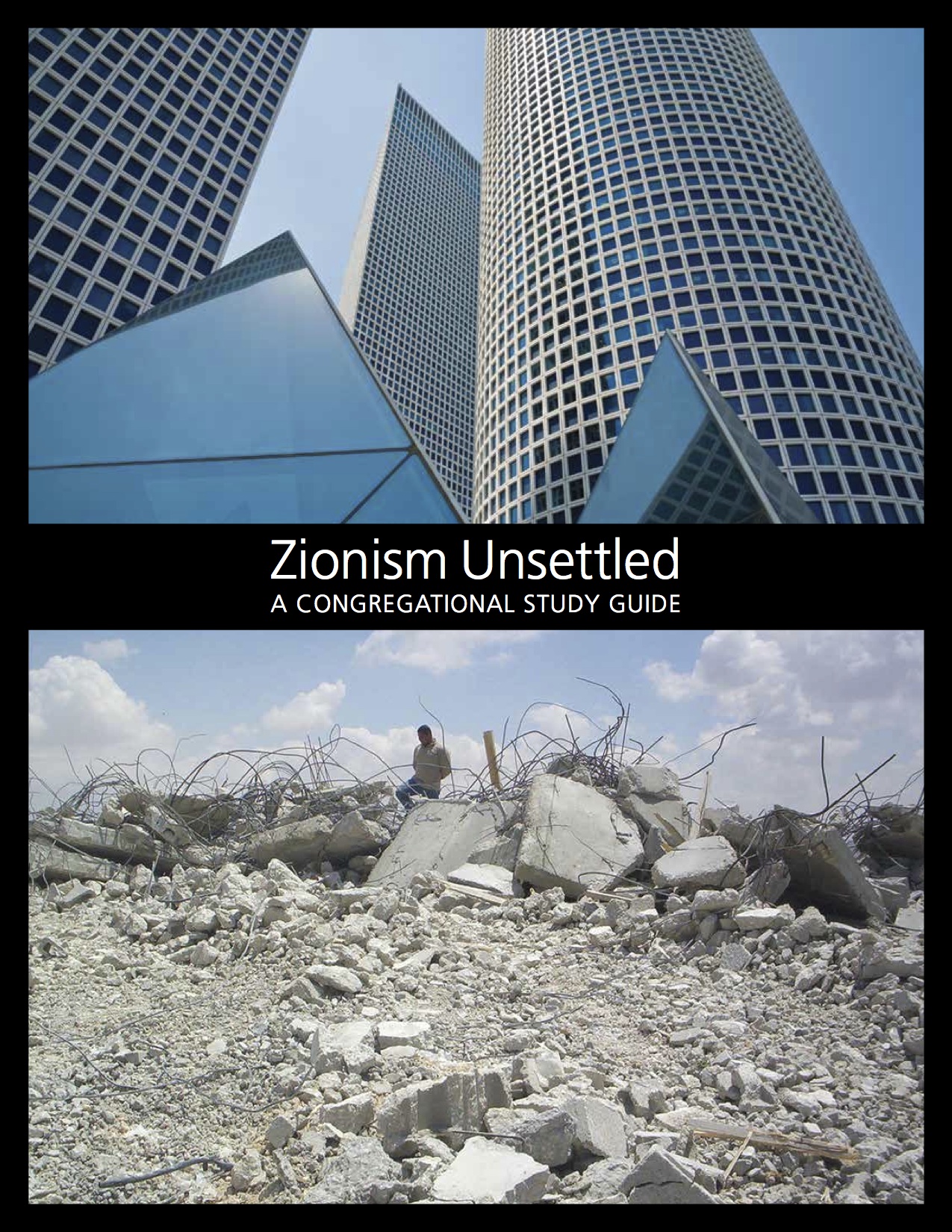
“Zionism Unsettled” – A Smart and Gutsy New Church Study Guide

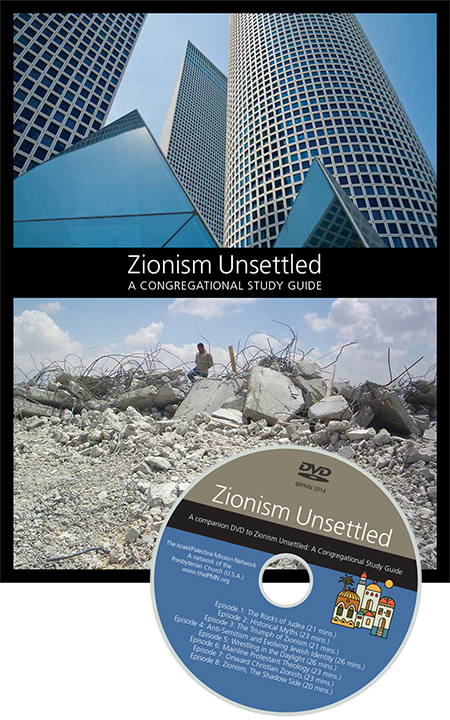
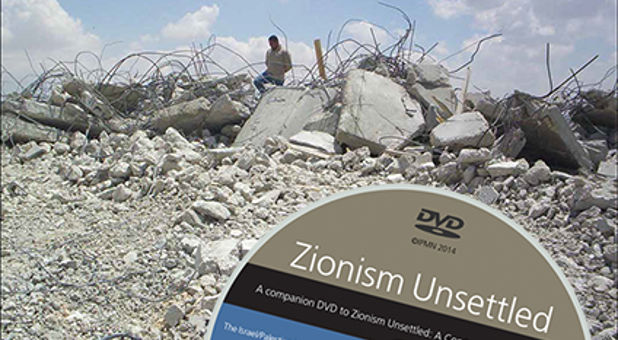
ZU-cover_DVDSo great to receive my copy of “Zionism: Unsettled” – an exciting new church study guide published by the Israel/Palestine Network of the Presbyterian Church (USA). As someone who has been collaborating with Protestant church denominations on the issue of Israel/Palestine for a number of years now, I can say without hesitation that this is a much-needed resource: smart and gutsy and immensely important.

“Zionism Unsettled” is based on the upcoming anthology, “Zionism and the Quest for Justice in the Holy Land,” to be published this summer by Wipf and Stock. While the anthology will be fairly academic in tone, “Zionism Unsettled” has digested its contents into a book and DVD for use by laypeople in congregational study settings. I’m thrilled that the IPMN has made this resource available to reach a much wider audience. (It was my honor to contribute an essay to that book, which has been adapted for a chapter in this study guide.)

ZU unsparingly examines Jewish and Christian forms of Zionism – with special attention to the way they have historically provided theological and ideological “cover” for the the dispossession of the Palestinian people. It’s a critical emphasis; indeed while there are no lack of political analyses on this subject, far less attention has been paid to the ways in which religious ideology has shaped the political context in Israel/Palestine.

This guide fills that void powerfully with careful, impressively researched chapters on the history of political Zionism as well as examinations of evangelical and mainline Protestant Zionism. My own chapter, “A Jewish Theology of Liberation” proposes a Jewish alternative to land-based nationalism – namely, a Judaism based in values of universal values of justice and dignity for all who live in the land.

As a Jew, I’m especially appreciative that while ZU is strongly critical of Zionism, it doesn’t flinch from extensive Christian self-criticism. The guide is particularly candid in its examination of the oppressive legacy of the post-Constantinan Church, replacement theology – and Christian anti-Semitism in general. In fact, throughout the guide there is a strong and palpable critique of exceptionalism of all stripes. In the end, the most basic criticism of “Zionism Unsettled” is leveled against triumphalist claims of every empire that has conquered and colonized this land throughout the centuries:

Exceptionalism is not unique to Zionism; rather it is present whenever exceptionalist religious ideology is fused with political power. Christian exceptionalist beliefs and actions contributed to the Nazi Holocaust, the genocide of Native Americans, and countless other instances of tragic brutality. Exceptionalist doctrines and behaviors within Islam have contributed to grievous human rights abuses such as the massacres during the closing days of the Ottoman Empire which crescendoed with the Armenian genocide in 1915.

I will say I do not personally agree with everything in this guide. In particular I’m at all comfortable with the theological analysis of Dr. Gary Burge, who rightly criticizes Christian replacement theology (the belief that the Jewish covenant with God has been “replaced” by the new covenant in Christ), yet seems to reaffirm it when he suggests a concept of a “’suspended blessing’ that will be restored at the end of history when ‘all Israel will be saved’”(p. 47).  It’s not at all clear to me how this conception differs fundamentally from the Christian “one covenant” theology he purports to disavow.

I was also disappointed by the chapter entitled “A Palestinian Muslim Experience with Zionism,” which does not at all apply kind of critical pedagogy to Islam that characterizes the chapters on Christianity and Judaism. While this chapter rightly spotlights “the inclusive theology of the Qur’an,” it fails to explore the exceptionalist manifestations of Islam in the same unsparing manner that pervades the rests of the book. As a result, this chapter feels to me somewhat tacked-on and represents a bit of a missed opportunity.

Despite my issues with “Zionism Unsettled,” however, I nonetheless find it to be a courageous work that has the potential to be a genuine game changer in interfaith conversations over Israel/Palestine. While I have no doubt it will be enormously controversial in many liberal religious circles, I believe it is an essential resource that boldly reframes the terms of interfaith encounter in ways that are long overdue.

I deeply admire its bravery and look forward to the conversations it will most certainly inspire.

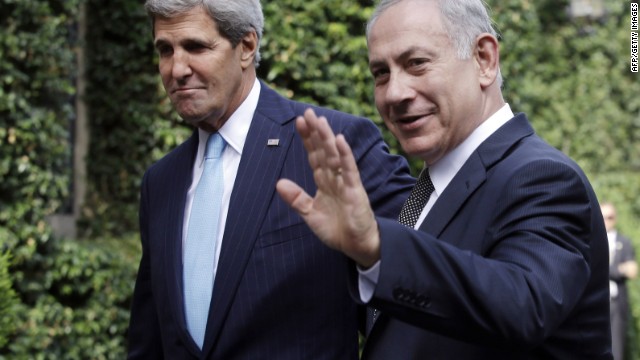
John Kerry Says “Boycott” – Cue the Outrage

131023100453-kerry-and-netanyahu-story-top

We learned yesterday that Netanyahu and his senior ministers are all astir by remarks made by John Kerry at a recent security conference in Germany. Echoing similar warnings he’s made in the past, Kerry noted that the failure of talks would only increase Israel’s isolation in the international community:

Today’s status quo absolutely, to a certainty, I promise you 100 percent, cannot be maintained. It’s not sustainable. It’s illusionary … You see for Israel, there’s an increasing delegitimization campaign that has been building up. People are very sensitive to it. There are talks of boycotts and other kinds of things.

Responding quickly, Netanyahu criticized the remarks during a subsequent cabinet meeting. Yuval Steinitz, Israel’s minister of strategic affairs, told Israel Radio on Sunday that Mr. Kerry’s comments were “hurtful,” “unfair” and “intolerable” and added, “Israel cannot be expected to negotiate with a gun to its head.” Not to be outdone, Knesset member Motti Yogev, of the Bayit Hayehudi party said Kerry’s “obsessive pressure” had “anti-Semitic overtones.”

There’s much to be said about the escalation of a war of words between Israeli politicians and the US Secretary of State. For my part, however, I’m less interested in a diplomatic pissing match over a moribund peace process than the way the issue of boycott has now firmly become entrenched in official discourse. Can their be any surer sign that the Boycott, Divestment and Sanctions movement has become a force to be reckoned with?

In this regard, I couldn’t help but be struck by Netanyahu’s comments in response:

Attempts to impose a boycott on the state of Israel are immoral and unjust. Moreover, they will not achieve their goal.

Of course, Kerry made no such claim that boycotts were “moral” or “just” (as a defensive State Department spokesperson hastened to point out). He was simply noting their very existence. And Netanyahu’s apoplectic reaction over this harmless comment makes it clear that he takes their existence very, very seriously indeed.

As well he should. With the recent American Studies Association announcement that it is honoring the academic boycott of Israeli universities – and the even more recent attention over Scarlett Johansson’s ill-fated agreement to shill for SodaStream – BDS is increasingly moving into the mainstream media spotlight. And more importantly, it is increasingly gaining adherents.

Anecdotally speaking I can attest to the growth of this movement by the growing number of conversations/debates I’ve been having on the issue of BDS. Generally they retread over the same territory: “Is BDS anti-semitic?” “Is BDS a double-standard?” “Is BDS effective?” “Will BDS lead to the destruction of Israel?”

I’m not interested in addressing these questions here – I’ve explored them at length in numerous blog posts dating back to 2009. Besides, it seems to me that right now the most important thing we can say about the BDS movement is that it is here to stay  – and as long as Israel’s intolerable treatment of Palestinians continues, it promises to be chalking up even greater successes in the near future.

That’s why Kerry’s comments – candid though they were – smacked to me of a very real disingenuousness.   After all, what is the real “delegimization campaign” here: the BDS movement or Israel’s oppressive policies toward Palestinians?  If our government is unable or unwilling to hold Israel to account, we should not be surprised by the growth of a popular movement that does.

Reclaiming a Tu B’shvat of Liberation

central-park-snow-snow-covered-trees-and-benches---central-park-new-york-city-a-6sa3zgb0

Tonight is the eve of Tu B’shvat, the Jewish festival that celebrates the “New Year of the Trees.” According to the Talmud, Tu B’shvat marks the dividing point for the tithing of the fruit from trees for the year to come. Throughout the centuries, this festival has been announced by the blossoming of the white almond blossoms that proliferate throughout the central and northern parts of the land of Israel.

As a celebration of the natural world and the tentative beginnings of spring, Tu B’shvat has been celebrated in different ways during different eras of Jewish history and through a variety of Jewish cultural contexts around the world. But with the rise of the Zionist movement and the establishment of the state of Israel, Tu B’shvat has become, for many Jews, almost exclusively associated with the Jewish National Fund’s fund raising efforts to plant pine forests throughout modern-day Israel.

In a recent blog post, my friend and colleague Cantor Michael Davis underlined the darker legacy of this particular Tu B’shvat observance, noting that the JNF’s mission to create Jewish facts on the land has led to tragedy for the Palestinian people:

My first home in Israel was in a little village in the Jerusalem hills. On the bus to school in Jerusalem, I could see the pine forests stretching from the crest of the hilltops down to the dirt trail at the base of the slopes. Sometimes, I would go on hikes along these trails, passing through the deserted stone buildings of Lifta at the entrance to Jerusalem. Close up, I could see the man-made stone terraces hidden by the trees.

Occasionally, you would come across broken stone walls tracing the shape of a ruined house. The pines blurred the lines of previous ownership and concealed the destruction of Palestinian civilization that happened with the birth of the State. (Over) 80% of the forests were planted after the birth of the State of Israel, many of them on land vacated by the departing indigenous population. Some 80% of the Palestinian population left in 1948, never to return. And this project continues with JNF’s focus on land in the Palestinian areas of the State of Israel in the Galilee and Negev and the secretive planting of trees in the West Bank. (In a call-in interview that JNF just posted on YouTube, the organization’s CEO, Russell Robinson, does not answer a caller’s question about JNF tree planting over the Green Line.)

I was particularly struck by Cantor Davis’ observation that the forests of the Jewish National Fund forests are not fruitbearing, but pine:

It is deeply symbolic then that the early 20th century Eastern European settlers chose a non-native, barren tree. Symbolically and in a real sense, this foreign tree displaced the olive trees of the indigenous population.

Might there be a way to decouple Tu B’shvat from this destructive legacy of colonialism and disenfranchisement? I’d like to suggest one possibility:

I’ve long noticed the power of celebrating this “harbinger of spring” in the colder climates of the northern-hemisphere diaspora, where we are barely one month into winter and the landscape is filled not by the white of newly-budding almond blossoms, but by the white of snow-covered trees.

While some might think this would be an unlikely setting to celebrate Tu B’shvat, I actually find it quite profound to contemplate the coming of Spring in the midst of a Chicago winter. It comes to remind us that even during this dark, often bitterly cold season, there are unseen forces at work preparing our world for renewal and rebirth. Deep beneath the ground, the sap is beginning to rise in the roots of our trees. In the chilly diaspora, we can celebrate the invisible forces of liberation reborn underground even as the prison of winter seems to reign above.

Thus we observe Tu B’shvat as a welcome reminder that spring will always follow winter; that even in the coldest and darkest of times, the unseen power of liberation will inexorably rise up.

I encourage you to reclaim Tu B’shvat as a celebration of liberation: seasonal, spiritual, political, or all of the above.

Click here for more information on how you can support tree-planting for justice, not disenfranchisement.

Sharon’s Legacy: Survival at All Costs

aptopix-midease-israel-ariel-sharon.jpeg-1280x960

From Vice President Joe Biden’s remarks at the funeral of Ariel Sharon today:

Like all historic leaders, Prime Minister Sharon was a complex man about whom, as you’ve already heard from his colleagues, who engendered strong opinions from everyone.  But like all historic leaders, all real leaders, he had a North Star that guided him — a North Star from which he never, in my observation, never deviated.  His North Star was the survival of the State of Israel and the Jewish people, wherever they resided.

In talking about his spiritual attachment to the land of Israel back in an interview in the late ‘90s, he said, and I quote, “Before and above all else, I am a Jew…”

As a Jew – and as a human being of conscience – I submit that this myopic obsession with Jewish physical survival “before and above all else” has led the Jewish people down a very dark road indeed. In so many ways, Ariel Sharon represents the embodiment of this obsession – and I for one recoil at the suggestion that he might in any way be held up as a Jewish exemplar.

As the tributes of world leaders continue to roll in, please consider the life’s work of a man Joe Biden quite mistakenly claimed is “loved by the Jewish people:”

– In the early 1950s, as a young major in the Israeli army, Sharon led the infamous Unit 101, which carried out numerous cross-border “pre-emptive” and “retaliatory” attacks into the West Bank, deliberately killing and wounding Palestinian civilians.  In the most notorious incident involving Unit 101, between October 14 and 16, 1953, soldiers under Sharon’s command massacred 69 Palestinian civilians, most of them women and children, in the West Bank town of Qibya. Sharon’s orders included “total destruction of the village and maximum harm to the villagers, again forcing them to flee.”

– On October 29, 1956, Israel attacked Egypt, part of an invasion in conjunction with Britain and France. During the resulting hostilities, soldiers under Sharon’s command committed a series of massacres of POWs, including more than 100 civilians. In one incident, Israeli soldiers shot and killed 49 Egyptian prisoners of war, including civilians, after binding their hands and forcing them into a quarry. In another, 56 Egyptian civilians were murdered while sheltering in the back of a truck. In a third incident, some 50 Egyptian civilian workers were murdered by Israeli soldiers near the town of Ras Sudar.

– Following Israel’s surprise attack against Egypt in June 1967, which resulted in Israel’s occupation of the Gaza Strip, West Bank, East Jerusalem, the Egyptian Sinai peninsula, and Syrian Golan Heights, Ariel Sharon, by now a general responsible for Israel’s southern command, was tasked with “pacifying” Gaza. In his efforts to crush resistance, Sharon ordered his soldiers to execute without trial any Palestinians suspected of involvement in the resistance, resulting in the killing of more than 1000 Palestinians.

– On June 6, 1982, Israel launched a massive invasion of Lebanon, masterminded by then-Defense Minister Sharon. Between June and September, the Israeli army killed between 18,000 and 20,000 Lebanese and Palestinian civilians, bombarding and laying siege to the western half of the capital of Beirut.

– On September 16, 1982, under Sharon’s direction, Israeli soldiers surrounded the Sabra and Shatila refugee camps and sent in about 150 of their local Christian Phalangist militia allies, even though the long and bloody history between Palestinians and Phalangists in Lebanon was well known to the Israelis. Over the next three days, between 800 and 3500 Palestinian refugees and Lebanese, mostly women, children, and the elderly, were butchered by the Phalangists, who sexually assaulted, tortured and mutilated many of their victims, in one of the worst atrocities in the modern history of the Middle East.

For more details on these facts – and other aspects of Sharon’s legacy that were likely not recounted at his funeral today, click here.

Some Thoughts as the BDS March Continues

PGGM-logo-BE9F491EDE-seeklogo.comStep by step, the BDS movement inexorably marches on. Now the news has just come down that PGGM, the largest pension fund management company in the Netherlands, has decided to withdraw all its investments from Israel’s five largest banks (Bank Hapoalim, Bank Leumi, Bank Mizrahi-Tefahot, the First International Bank of Israel and Israel Discount Bank) because they have branches in the West Bank and/or are involved in financing construction in the settlements.

I’m struck that whenever we hear this kind of news, BDS opponents invariably claim that this is “one isolated incident” that will not have any real effect or influence. But of course, this is not one isolated incident – it is but a part of a growing pattern occurring throughout the world. This latest news is but one more indication that the BDS movement is quickly gaining momentum.

And there is every indication that Israel’s leaders understand this. In the wake of the PGGM decision, Knesset member and Bayit Hayehudi party chairwoman Ayelet Shaked called for an Israeli response to the BDS movement, adding that “it was the greatest threat faced by the country.”

I’m also struck by one paragraph from the Ha’aretz report on the PGGM move:

The Israeli banks responded that Israeli law doesn’t allow them to cease providing service to entities connected to the settlements. Nor, given the daily reality in which the banks operate, would this even be feasible, they added.

This is an enormously telling comment – particularly as a response to those who advocate for BDS within the Occupied Territories only but not in Israel proper. Perhaps the most prominent advocate of this approach is Peter Beinart, who has long spoken of a difference between “Good Israel” and “Bad Israel:”

(We) should call the West Bank “nondemocratic Israel.” The phrase suggests that there are today two Israels: a flawed but genuine democracy within the green line and an ethnically-based nondemocracy beyond it. It counters efforts by Israel’s leaders to use the legitimacy of democratic Israel to legitimize the occupation and by Israel’s adversaries to use the illegitimacy of the occupation to delegitimize democratic Israel.

Having made that rhetorical distinction, American Jews should seek every opportunity to reinforce it. We should lobby to exclude settler-produced goods from America’s free-trade deal with Israel. We should push to end Internal Revenue Service policies that allow Americans to make tax-deductible gifts to settler charities. Every time an American newspaper calls Israel a democracy, we should urge it to include the caveat: only within the green line.

But a settlement boycott is not enough. It must be paired with an equally vigorous embrace of democratic Israel. We should spend money we’re not spending on settler goods on those produced within the green line. We should oppose efforts to divest from all Israeli companies with the same intensity with which we support efforts to divest from companies in the settlements: call it Zionist B.D.S.

This is, of course, an utterly artificial distinction, as the recent comment by the Israeli banks makes clear. The “daily reality” is that the Occupation is facilitated and fed by Israel itself. They are, quite simply, inseparable from one another – as Israel’s own economic establishment openly admits.

As the BDS movement inevitably amasses more gains, we will likely hear louder and and louder calls to “take this threat seriously.” But I believe the inexorable growth of this movement suggests something more fundamental: the world is increasingly taking Israel’s oppression of Palestinians seriously.