As the prospects for a viable two-state solution for Israel/Palestine grow more and more unlikely, we are witnessing a tentative but growing discussion of a one-state solution in the Jewish community.
In light of the ongoing deadlock in Israeli-Palestinian peace talks, leaders such as U.S. Secretary of State Hillary Clinton and Israeli opposition leader Tzipi Livni have raised the specter of a one-state solution. Their intention, of course, is to scare some sense into Israeli Prime Minister Benjamin Netanyahu and his intransigent coalition partners. But, as this once-taboo idea becomes a legitimate part of political discussion in the region, some Israeli intellectuals are making the case that this is not something to fear, but a path toward a viable resolution to the region’s long-running crisis.
Here in the American Jewish community, however, this sort of discussion is considered to be naive at best and heresy at worst. But as difficult and painful as it might be for us to contemplate, I believe that sooner or later (and probably sooner than later) it is a conversation we will inevitably have to have – regardless of where we might personally stand on the issue.
To this end, I am proud to announce the next conference call sponsored by Ta’anit Tzedek – Jewish Fast for Gaza: “Conceiving of a One-State Solution” with Palestinian-American journalist Ahmed Moor on Thursday, December 15 at 12 noon EST.
Ahmed Moor was born in Gaza and raised in the US, graduated from University of Pennsylvania in 2005 and spent several years as a freelance journalist based in Lebanon and Cairo. His work as been published in numerous publications, including Al Jazeera, Huffington Post, and the Los Angeles Times. He is currently a graduate student of Public Policy at Harvard University.
During our conversation, Moor will share his views on the need and the prospects for one secular democratic state in which Jews and Palestinians live together as equal citizens. Can we conceive of such a solution and what would such a state look like practically speaking? What are the political realities that mitigate against it and how could they ever be shifted? What are the prospects that these two peoples could live and govern a state together?
Call Info:
Thursday, December 15 at 12 noon EST
Access Number: 1.800.920.7487
Participant Code: 92247763#
As always, there will be opportunities for questions and answers during the call.
We are looking forward to an informative and respectful conversation. I encourage you to join us.
I first read Professor Marc Ellis’ book “Toward a Jewish Theology of Liberation” as a rabbinical student back in the mid-1980s – and suffice to say it fairly rocked my world at the time. Here was a Jewish thinker thoughtfully and compellingly advocating a new kind of post-Holocaust theology: one that didn’t view Jewish suffering as “unique” and “untouchable” but as an experience that should sensitize us to the suffering and persecution of all peoples everywhere.
And yet further: Ellis had the courage to take these ideas to the place that few in the Jewish world were willing to go. If we truly believe in the God of liberation, if our sacred tradition truly demands of us that we stand with the oppressed, then the Jewish people cannot only focus on our own oppression – we must also come to grips with our own penchant for oppression, particularly when it comes to the actions of the state of Israel. And yes, if we truly believe in the God of liberation this also means that we must ultimately be prepared to stand with the Palestinians in their struggle for liberation.
When I first read Ellis’ words, I didn’t know quite what to make of them. They flew so directly in the face of such post-Holocaust theologians as Elie Wiesel, Rabbi Irving Greenberg and Emil Fackenheim – all of whom viewed the state of Israel in quasi-redemptive terms. And they were certainly at odds with the views of those who tended the gates of the American Jewish community, for whom this sort of critique of Israel was strictly forbidden.
Over the years, however, I’ve found Ellis’ ideas to be increasingly prescient, relevant – and I daresay even liberating. As a rabbi, I’ve come to deeply appreciate his brave willingness to not only ask the hard questions, but to unflinchingly pose the answers as well. And it is not at all surprising to me that we are now witnessing a new generation of rabbis and young Jewish leaders starting down the road he has paved for us.
All this to say I am profoundly sorrowed to learn that Ellis is currently under threat of losing his job at Baylor University due to an investigation led by new university president Ken Starr.
By every appearance, Ellis has had a distinguished academic career, having taught at Maryknoll School of Theology, Harvard Center for the Study of World Religions and Florida State University. Thirteen years ago, he was appointed Professor of American and Jewish Studies at Baylor, where he founded Baylor University’s Center for American and Jewish Studies and currently serves as its director.
Marc Ellis was brought to Baylor in 1998 and all previous presidents supported his dissident voice. After Ken Starr (nemesis of Clinton in the White House) became president in 2010 the attacks started. During the last year Baylor lawyers were instructed to communicate with many of Marc’s colleagues, past students and staff. The objective was to request all of them to report all “abuse of authority.” Most of us explained to the lawyers that was a lost cause because Marc has been an exemplar colleague, professor and mentor.
But starting this Fall he was separated from his classes, his center closed and a hearing scheduled to take place some time in this academic year. As far as we know the accusations are about abuse of authority but we are not aware of the details because they are part of the internal legal process. Obviously it is about something else: Marc’s dissident voice. We will inform all of you as soon as we know more information.
In a statement released yesterday, Ellis commented thus:
Given what I currently understand of the rules of the Baylor process I will, for now, honor the process by not discussing the specifics, except to say that I believe this is a pretext to silence an independent voice at the place for which I have had deep appreciation.
I write now to ask you to please join me in signing this petition in support of Ellis – an important Jewish dissident thinker and (as his many academic colleagues are now attesting) a truly distinguished scholar. I would add: even if you don’t personally agree with all of his ideas, I urge you to support his cause. It is high time for us to stand down those who would trample academic freedom, shun open discourse and debate, and muzzle those with whom they simply disagree.
I’ll end with Professor Ellis’ own words, all too sadly apt under the circumstances:
Prophetic Jewish theology, or a Jewish theology of liberation, seeks to bring to light the hidden and sometimes censored movements of Jewish life. It seeks to express the dissent of those afraid or unable to speak. Ultimately, a Jewish theology of liberation seeks, in concert with others, to weave disparate hopes and aspirations into the very heart of Jewish life.
(“Toward a Jewish Theology of Liberation,” p. 206)
If you’d like to participate in our dialogue, first read the op-ed, then click here and read Gail’s post, then go ahead and read my response below. Respectful comments – on her blog or mine – are always welcome.
Dear Gail,
Thanks for an eloquent post. I’m happy to discover your blog and am grateful that you’re willing to publicly consider these kinds of tough issues.
Re your first response: I couldn’t help but detect a very palpable alienation, isolation and overall spirit of “it’s us against the world” in your and your friend Rich’s words. I know that this feeling of growing isolation from the international community is widespread among Israelis across the political spectrum. There’s no small sorrow in all this, especially considering that Zionism arose in part to solve the problem of Jewish “otherness” in the world. Nothing else to say about this except that politics aside, it’s just so sad to consider the extent to which the Jewish political/national project only seems to have exacerbated Jewish isolation on an international scale.
In your second response, you agree that there is something unjust about the fact that as a gay couple, you and your partner can take advantage of laws in Israel that privilege you as Jews. You add, however, that
The reality is the every country that surrounds Israel has human rights issues. Nothing is black and white, and every country lives with a messy reality. Because Israel is subject to an organized media campaign of de-legitimization, and because Israel cares about its image in the eyes of the western world, for self-serving reasons no doubt, we have people out there making the case for what’s good about the reality here.
With respect, Gail, try though I might, I just can’t accept this argument. Of course nothing is black and white and of course every country lives with a messy reality. But there is messy and there is messy. And I simply cannot agree with the claim that Israel is essentially a healthy Western liberal democracy with some “human rights issues.” I have come to believe that there is a much more fundamental form of oppression going on here.
I respect and celebrate the fact that, as you put it, “the reality of gay rights is directly impacting the lives of many people in Israel – for the good.” But if we’re truly going to calculate the greater good here, it’s difficult for me to weigh the benefits enjoyed by LGBTQ Israelis against the massive injustices Israel committed – and continues to commit – against millions of Palestinians in Israel, the occupied territories and throughout the Palestinian diaspora. It’s just not a level playing field. And unless these inherent injustices are dealt with fairly and directly, I don’t think it’s honest to speak of Israel as an essentially healthy, if blemished, democracy.
I was taken – and somewhat surprised – by your reference to “an organized media campaign of de-legitimization” against Israel. In the first place, I’m just not convinced that the media has nefarious designs on the state of Israel. If there is any “campaign,” I’d say it’s less a media conspiracy than a growing movement of activists throughout the world who are responding to the Palestinian call for solidarity with their struggle. I think it demeans the motives of those of us who are publicly holding Israel to account on very real and serious issues of human rights by saying we are trying to “de-legitimize” the state. This is a term wielded wantonly by Israel’s hasbara machine, and I believe it’s only real purpose is to muzzle honest and open debate on this issue.
You write that “none of us knows where this is all leading.” While this is true, of course, I think we can certainly predict certain general trends. And in this regard, I am truly frightened that in Israel, the direction is moving directly away from democracy and toward the greater influence of the ultra-right and the ultra-religious. (I think you know what I’m talking about, so I’ll spare you’re the links to the op-eds – most of them from Ha’aretz and Israel’s increasingly embattled progressive blogosphere). Unlike you, I’m less sanguine about “the intertwining of Jewish tradition and politics.” I genuinely fear that this particular marriage is leading us all down a very dark road.
Gail, I understand the reality that because you and your partner and are a bi-national same sex couple, your family cannot live together in the US. I realize that for you, this is your life we are talking about. And I deeply respect the courage it took you to publicly air the ways this reality impacts on you and your family. I think I know you well enough to know that you did not raise this point to in any way shut down debate with those outside Israel who don’t share your reality – only that you wanted to sensitize your readers to the deeper human truth of this issue.
I have faith that we can continue to keep this conversation going, as difficult and painful as it is. Thank you for putting yourself and your feelings out there. I hope you know that I offer mine in the same spirit of dialogue and friendship.
While many of us will be gathering with our loved ones to celebrate Thanksgiving, the Sumarin family will be anxiously sitting on suitcases and wondering whether they will have a home in another week.
The Sumarins, a Palestinian family of twelve, including five children, a pregnant mother, and a grandfather on dialysis, have lived in their home for more than forty years in the East Jerusalem neighborhood of Silwan.
We’re deeply troubled that a wholly-owned subsidiary of the Jewish National Fund in Israel, called Himnuta, is behind this move.
To expel this family is a violation of both Jewish and human rights law. And it risks inflaming Arab-Jewish tensions in Jerusalem, further undermining the hope for Israeli-Palestinian peace.
The Silwan neighborhood has long been a flash point in the struggle over land in and around the Old City of Jerusalem and the site of clashes between Jews and Palestinians.
Twenty years ago, an ultra-nationalist Israeli government bent on expanding Jewish control in East Jerusalem took legal possession of the Sumarin home, along with other Arab properties in Silwan. The government transferred the Sumarins’ home to JNF’s Himnuta, along with seven other houses in Silwan.
Himnuta then turned its other East Jerusalem properties over to ELAD, a group whose explicit political agenda is to expropriate Palestinian homes and land in Silwan and transfer them to the control of Jewish settlers. There is every reason to expect that the Sumarins’ home will also end up in ELAD’s hands.
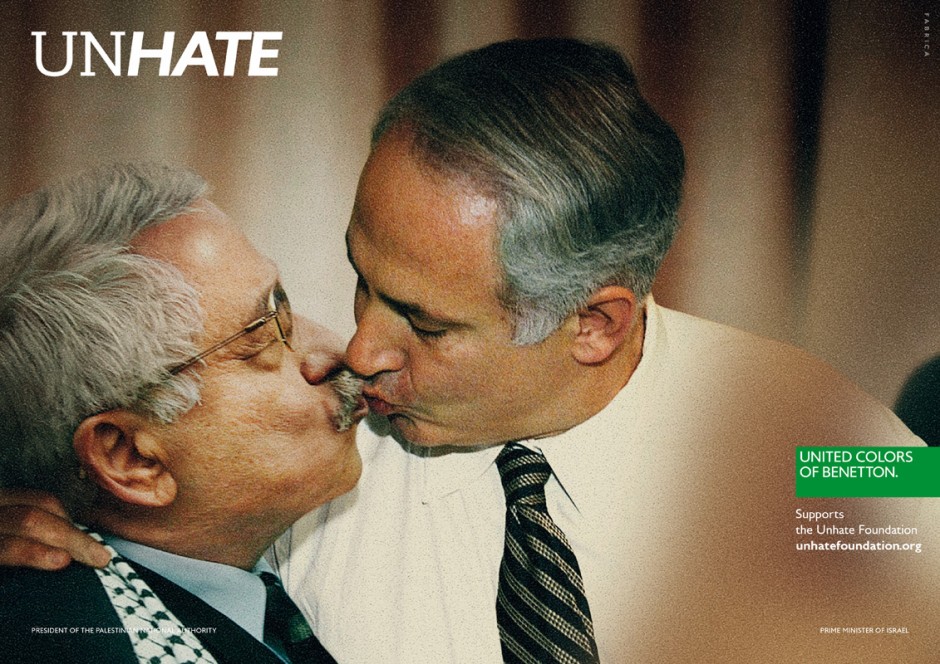
The UNHATE Foundation, desired and founded by the Benetton Group, seeks to contribute to the creation of a new culture of tolerance, to combat hatred, building on Benetton’s underpinning values. It is another important step in the group’s social responsibility strategy: not a cosmetic exercise, but a contribution that will have a real impact on the international community, especially through the vehicle of communication, which can reach social players in different areas.
The Foundation will organise initiatives involving different stakeholders, from the new generations to the institutions, international organisations and NGOs, through to civil society.
The Foundation also aims to be a think tank, attracting personalities and talents from the fields of culture, economy, law and politics, and people who have gone from simple citizens to leaders of movements, distinguishing themselves through their ideas and actions against the causes and effects of hatred.
If the pairing of Abu Mazen and Bibi aren’t your cup of tea, the campaign also includes other pix of unlikely political smooching partners…
Michael grew up in my congregation and has worked for several years as in Chicago as a political activist and a community organizer. His most recent job, from which he has just resigned, was as Program Director for AVODAH: Jewish Service Corps in Chicago.
On October 26, I resigned from my position as Chicago Program Director for AVODAH: The Jewish Service Corps. Each day I have spent in this job has been a blessing, but I have no choice in light of AVODAH’s decision to co-sponsor a 10-day “service-learning” trip to Israel with the American Jewish World Service through their joint initiative Pursue: Action for a Just World.
AVODAH and AJWS agreed to this trip as a grant stipulation for funding from the Charles and Lynn Schusterman Family Foundation, a prominent donor in the Jewish nonprofit world, major supporter of pro-Israel causes, and Pursue’s principal funder.
I believe it is irresponsible for social justice organizations to organize a trip that focuses on “diversity, poverty and social integration” without meaningfully, and publicly, addressing Israel’s military occupation of Palestinian land, systematic oppression of Palestinians across “Israel proper” and the Occupied Territories, and enforced exile of Palestinian refugees.
I believe doing so contributes to the “normalization” of a deeply abnormal oppressive situation – presenting Israel as a liberal democracy with nothing more than the usual challenges rather than a state which imposes an ethnicity-based military regime on millions of people. It perpetuates the idea that it is acceptable to ignore Israel’s daily abuses of Palestinians in the pursuit of cultural, religious, financial or other interests.
Similar Jewish “social justice”, artistic, LGBTQ and environmental trips are often used to mount a facade of democracy over Israel’s state-sponsored human rights abuses. It is well known that Israeli government ministries and American Jewish organizations have been collaborating on an extravagantly funded “Brand Israel” project designed to improve the country’s image abroad by “avoiding any discussion of the conflict with the Palestinians.” Arye Mekel, former Deputy Director-General for Cultural Affairs with Israel’s Foreign Ministry, has described this strategy as a way to “show Israel’s prettier face.” I have no doubt that the Schusterman Foundation has a similar agenda for this Pursue trip.
Through this trip, AVODAH and AJWS become active participants in covering up oppression, whether that is their intention or not. They publicly lend their organizations’ names and reputations to injustice, violating the social justice principles enshrined in their missions which inspired me to join AVODAH’s staff in the first place.
My decision to resign is informed by my support of the Palestinian call for Boycott, Divestment and Sanctions (BDS) against Israel. Initiated in 2005, BDS is a call endorsed by the great majority of Palestinian civil society groups as a nonviolent strategy to pressure Israel into ceasing its systematic oppression of Palestinians.
I believe in listening to people fighting their own oppression when they lay out a strategy to achieve their human rights. For the overwhelming number of Palestinians, BDS is that strategy. Being strong allies and taking our lead from people directly impacted by oppression is, in fact, a philosophy deeply held by organizations such as AVODAH and AJWS.
I decided to write about my decision in the spirit of Tokhecha, or sacred rebuke, a central value of Torah:
Reprove your kinsman but incur no guilt because of him” (Leviticus 19:17)
Rashi’s interpretation of “incur not guilt” is “Do not embarrass [them] in public.” My goal is not to embarrass or shame AVODAH or AJWS. I love and respect AVODAH, which is staffed by dedicated and thoughtful individuals, and which remains committed to open discussion on this and other issues among its participants and alums.
However, this trip communicates a public message – that these organizations are willing to overlook Israel’s oppression of Palestinians in exchange for funding. It therefore requires a public response.
My understanding of Tokhecha is that it includes the responsibility to help those to whom it is directed make amends. I echo the call put out by AVODAH alums and current Corps members that AVODAH and AJWS commit publicly to “never sponsor an Israel trip in this way again.”
We in the Jewish social justice community have a choice. On the one hand, we can stay silent and try to avoid provoking the ire of powerful donors like the Schusterman Foundation. On the other hand, we can publicly oppose, or at least not cover up, the oppression Israel commits directly in our name.
I have faith that our community, increasingly, will choose the latter, and that as BDS continues to gain traction among young Jews, there will be a growing cost in staff and participants for organizations that allow themselves to be used as cover for the oppression of Palestinians.
Apparently our administration feels that Palestine’s membership in an organization committed to “the building of peace, the eradication of poverty, sustainable development and intercultural dialogue” is “reckless,” “anti-Israel and anti-peace.”
Is there anything at all the US will not do for Israel?
The irony of the decision to cut funding is that UNESCO is one of the few United Nations groups where the U.S. finds a sympathetic ear on issues related to Israel. UNESCO is actively working with America to promote tolerance and is working to deepen understanding of the Holocaust in countries where people don’t even believe it existed.
Even more important U.S. interests will be at stake if the World Intellectual Property Organization grants Palestinians membership, which as an affiliate of UNESCO they are almost certain to do. That is where you start directly encountering obvious and significant interests to American business.
To my mind, the best commentary on the absurdity of all this came when AP reporter Matthew Lee questioned State Department spokeswoman Victoria Nuland during a press conference yesterday. You can watch the whole thing above or read a full transcript on Sami Kishawi’s blog.
Here’s my favorite part – Kafka couldn’t have written it better:
Reporter: Okay, and how does it undermine exactly the prospect of where you want to go?
Victoria Nuland: The concern is that it creates tensions when all of us should be concerting our efforts to get the parties back to the table.
Reporter: The only thing it does is it upsets Israel and it triggers this law that you said will require you to stop funding UNESCO. Is there anything else? There’s nothing that changes on the ground, is there?
Victoria Nuland: Our concern is that this could exacerbate the environment which we are trying to work through so that the parties will get back to the table.
Reporter: How exactly does it exacerbate the environment if it changes nothing on the ground unlike, say, construction of settlements? It changes nothing on the ground. It gives Palestine membership in UNESCO, which was a body the US was so unconcerned about for many years that it wasn’t even a member.
Victoria Nuland: Well, I think you know that this administration is committed to UNESCO, rejoined UNESCO, wants to see UNESCO’s work go forward.
Reporter: Actually, it was the last administration that rejoined UNESCO, not this one. But I need to have some kind of clarity on how this undermines the peace process — other than the fact that it upsets Israel.
Victoria Nuland: Again, we are trying to get both of these parties back to the table. That’s what we’ve been doing all along. That was the basis for the President’s speech in May, basis of the diplomacy that the Quartet did through the summer, the basis of the statement that the Quartet came out with in September. So in that context, we have been trying to improve the relationship between these parties, improve the environment between them, and we are concerned that we exacerbate tensions with this, and it makes it harder to get the parties back to the table.
Reporter: Since the talks broke off last September until today, how many times have they met together, with all your effort?
Victoria Nuland: How many times have the parties met?
Reporter: Yes.
Victoria Nuland: I think you know the answer to that question.
On the subject of the Gilad Shalit prisoner exchange, I can’t put it any better than blogger Emily Hauser, who has written a number of eloquent posts on this subject over the years. Click here and here to read her latest reactions.
Also highly recommended: this recent op-ed by journalist Rachel Shabi:
But meanwhile, the terms of the Israel-Hamas brokered prisoner swap – one Israeli, whose name the world knows, for 1027 faceless Palestinians – has generated some absurd comments on the value each side places on human life. In reports of how much Israelis care about the soldier Shalit – all true – there is somehow the inference that Palestinians don’t cherish their loved ones in the same way. But it is clearly more approachable a task to keep one soldier’s name in people’s hearts and in the headlines, than it is with countless thousands of Palestinian men. And the undertaking is smoothed by a media skew on the subject: taking part in a panel discussion on reporting the conflict last year, I heard a European journalist explain that Shalit was an easier pitch because he seemed innocent and blameless, while Palestinian prisoners didn’t generate the same assumptions. Meanwhile, the cold exchange rate of a thousand prisoners to one Israeli obviously doesn’t mean that Palestinians morally agree with this equation; it just points to the brutal asymmetry of forces and capacity in this struggle.
There is, however, one setting in which the two sides stand on level ground. When the prisoner deal was announced this week, there were jarringly rare images of both Israelis and Gaza strip Palestinians joyously celebrating the same news story. There it was, in that moment: an equality borne of shared humanity.
Last week I received an email request from the New Israel Fund (NIF) to sign a rabbinical statement condemning the recent desecration of a mosque in the Bedouin village of Tuba-Zangariya in the north of Israel. Of course I signed without hesitation. It was a sick, racist act that deserved to be condemned from every quarter.
Thus my deep dismay when I did not receive any similar request when the Israeli army demolished a mosque this week in West Bank village of Kherbet Berza – for the third time. (An incident, btw, that was scarcely covered by the western media.)
As per usual, the administration claims additions to the mosque were built “without a permit.” Naturally no such permits are issued when the Israeli government is interested in creating facts on the ground – this case being the northern Jordan Valley. (The news item above was released last year following the first demolition.)
Of course it’s easy to condemn racist acts of individuals – apparently it’s more difficult (or “complicated”) when this kind of thing is carried out by a government. I have no such difficulty: terror is terror whether perpetrated by one person or by the state.
So for the record (and using the same language as the NIF statement) I’d like to take this opportunity to:
express my deep sadness and outrage at the destruction of a mosque in the West Bank village of Kherbet Berza. I condemn this act as an affront to God, the values of our Torah and the international standards of basic human rights.
I extend a hand in friendship and solidarity to the leaders and residents of this small village, a prayer for their safety and peace in the days to come, and a hope that the government that perpetrated this despicable act will be held to account.
And while we’re expressing concern for the welfare of Bedouins, this recent announcement offers some cause for deep dismay as well:
The Civil Administration (CA) is planning to expel the Bedouin communities living in Area C in the West Bank, transferring some 27,000 persons from their homes. In the first phase, planned as early as January 2012, some 20 communities, comprising 2,300 persons, will be forcibly transferred to a site near the Abu Dis refuse dump, east of Jerusalem.
More government terror. I express my deep sadness and outrage…
“How do we reach Jewish young people?” has long been one of the central mantras of the organized Jewish community, as those of us who work as Jewish professionals can surely attest. But while we wring our hands over at the state of the Jewish future, a remarkable new generation of Jews has been knocking insistently at our door.
Young Jews say the settlements delegitimize Israel!
Young Jews say the Occupation delegitimizes Israel!
Young Jews say the siege of Gaza delegitimizes Israel!
Young Jews say the loyalty oath delegitimizes Israel!
Young Jews say silencing dissent delegitimizes Israel!
With each successive interruption the shouts from the crowd grew louder and angrier. As security attempted to safely walk them out, one protester was put in a choke hold by a convention attendee and wrestled to the floor. Another conventioneer grabbed a banner and tore it in half with his teeth.
At the very same moment, “Young, Jewish, Proud” launched its website, featuring the “Young Jewish Declaration” — an astonishing statement of purpose that seemed to come directly from the collective heart, mind and gut of this newly formed youth movement:
We exist. We are everywhere. We speak and love and dream in every language…
We remember how to build our homes, and our holiness, out of time and thin air, and so do not need other people’s land to do so…
We refuse to have our histories distorted or erased, or appropriated by a corporate war machine. We will not call this liberation…
We commit ourselves to peace. We will stand up with honest bodies, to offer honest bread…
We are young Jews, and we get to decide what that means.
Predictably, the Jewish establishment wasted no time in excoriating the protesters. Some chided them condescendingly for their “misguided” behavior. Others angrily criticized them for “aiding the enemy.”
As for me, I watched these events unfold with genuine hope for our Jewish future.
After all, weren’t these young people claiming and proclaiming their Jewishness in classic Jewish fashion? Like young Abraham destroying his father’s icons, they stood up to the hypocrisy and corruption of their elders. In the heart of the the largest gathering of American Jewish leaders, these proud young Jews called out their community on its most sacred of sacred cows: namely, the unquestioning, unconditional support of the state of Israel.
In all honesty, I can’t say I’ve ever witnessed as authentic an act of young Jewish self-expression as I did that afternoon at the New Orleans General Assembly.
Yes, as a professional Jew, I’ve participated in the “how can we inspire young people?” conversation more times than I care to admit. I’ve watched a myriad of Jewish community-sponsored initiatives come and go. And invariably, all of them focused on what we believed was best for Jewish young people.
But while the Jewish establishment has been excellent at creating and funding expensive projects, we seem to be chronically incapable of actually listening. We love to tell young people how we think they should express their Jewishness, but rarely do we stop long enough to really, truly learn what drives and inspires them.
Taglit-Birthright Israel, the Jewish establishment’s signature youth initiative, is the most obvious case in point. For well over a decade, we have invested literally hundreds of millions of dollars in providing free, all-expense-paid trips to Israel. The essential goal of these trips, as Birthright’s Marketing Director puts it plainly, is to make Israel “an integral part of every Jew’s identity.”
It’s well known that Birthright was born in response to growing reports that American Jewish young people were becoming increasingly disconnected to the state of Israel. But by rushing to address this issue through a massive multimillion dollar community initiative, we successfully avoided asking the deeper questions.
Could it be that we were afraid to know the answers?
Could it be that young people are becoming disenchanted with Israel because they are becoming increasingly troubled by its treatment of Palestinians? Could it be that growing numbers of young Jews regard Israel more as an oppressive colonial project than a source of Jewish pride? Could it be that in the 21st century world, the identities of young Jews are tied less to Jewish ethno-nationalism than to a more universal vision of liberation?
“Young, Jewish, Proud” is decidedly not the product of a Jewish communal initiative. On the contrary it is a grass-roots, self-organized effort of young Jews who seek to express their Jewish identity in a time-honored Jewish manner: by speaking truth to power, by advocating unabashedly for peace, justice and liberation, by standing up to oppression, racism and persecution in Israel/Palestine and throughout the world. They simply aren’t buying what the Jewish establishment has been selling them. They are finding their own voices.
We are young Jews, and we get to decide what that means…
I am well aware that it is not easy for a Jewish community so thoroughly focused on Zionism to hear it challenged in such a fundamental way. But aren’t these young Jews doing precisely what they were raised to do? They are taking a good, educated look around them, thinking critically about what they see and are taking a stand for what they believe in as Jews. Are we really prepared to disown them because their conclusions make us uncomfortable?
In the Torah portion for the first day of Rosh Hashanah, we read that when God saves the life of young Ishmael in the wilderness, “God heeded the cries of the boy where he is” (Genesis 21:17). In other words, God was able to find Ishmael by truly listening to him. Not where God wanted him to be or where God thought he should be, but where he was.
This New Year, I fervently hope our community can do the same with our newest adult generation. These young people certainly have every reason to be disenchanted with the organized Jewish community, but for some reason they refuse to go away. They’re here, and they’re knocking loudly at our door.
Do we, the gatekeepers of the Jewish community, have the vision, the faith and the courage to open it up and let them in?
 As the prospects for a viable two-state solution for Israel/Palestine grow more and more unlikely, we are witnessing a tentative but growing discussion of a one-state solution in the Jewish community.