Special Forces of the Israeli Army attacked the Freedom Theatre in Jenin Refugee Camp at approximately 03:30 this morning. Ahmad Nasser Matahen, a night guard and technician student at the theatre woke up by heavy blocks of stone being hurled at the entrance of the theatre.
As he opened the door he found masked and heavily armed Israeli Special Forces around the theatre. Ahmed says that the army threw heavy blocks of stone at the theatre, “they told me to open the door to the theatre. They told me to raise my hands and forced me to take my pants down. I thought my time had come, that they would kill me. My brother that was with me was handcuffed.“
The location manager of The Freedom Theatre, Adnan Naghnaghiye was arrested and taken away to an unknown location together with Bilal Saadi, a member of the board of The Freedom Theatre. When the general manager of the theatre Jacob Gough from UK and the co-founder of the theatre Jonatan Stanczak from Sweden arrived to the scene they were forced to squat next to a family with four small children surrounded by about 50 heavily armed Israeli soldiers.
Jonatan says: “Whenever we tried to tell them that they are attacking a cultural venue and arresting members of the theatre we were told to shut up and they threatened to kick us, I tried to contact the civil administration of the army to clarify the matter but the person in charge hung up on me.“
The Freedom Theatre is still reeling from the murder of its director, Juliano Mer Khamis last April – and now this. It’s heartbreaking to contemplate that an institution whose only mission is to give hope and courage to the children of Jenin is physically under attack by both fundamentalist Muslims and the Israel Defense Forces.
Please click on the clips above and below to learn about the Jenin Freedom Theatre and why so many of us are inspired by its work. Then click here and please support them with a donation.
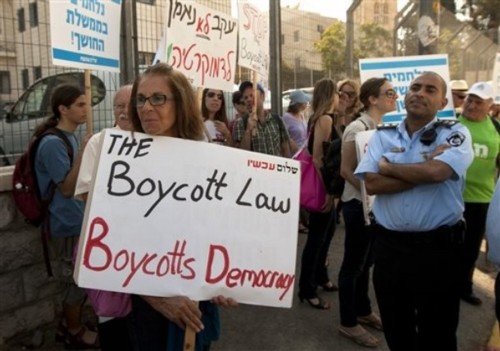
According to the law, a person or an organization calling for the boycott of Israel, including the settlements, can be sued by the boycott’s targets without having to prove that they sustained damage. The court will then decide how much compensation is to be paid. The second part of the law says a person or a company that declare a boycott of Israel or the settlements will not be able to bid in government tenders.
The upshot? For comparison purposes, consider this: if this law had been passed by the US Congress, the city of Montgomery could have legally sued MLK for leading a boycott against its bus system.
My two cents? Israel, a country that repeatedly claims the mantle of “the only democracy in the Middle East” is fast dismantling its own democracy. Knesset member Nitzan Horowitz put it about as well as it could be put, I think:
We are dealing with a legislation that is an embarrassment to Israeli democracy and makes people around the world wonder if there is actually a democracy here.
Here’s the thing: Israel and its “right or wrong” advocates have been working overtime fighting what it considers to be “delegitimization” of the Jewish state. But for all the effort exerted, in the end it is Israel that delegitimizes itself by passing increasingly anti-democratic legislation such as this. It’s not the first time we’ve seen the Knesset pass such a bill, and although it pains me to say so, I believe we’re going to see similarly odious laws coming down the pike in the future.
Among the many reactions to this law from throughout Israeli society, I found it extremely notable that Peace Now – an organization that has resolutely refused to support boycotts – has now called for a boycott of settlement products in reaction to the legislation.
Hear, hear. If you believe that the Occupation is immoral and unjust, then boycotting products produced in the Occupied Territories is a moral and just thing to do.
Even if you’re queasy about a full-blown boycott of all Israeli products, please consider boycotting products produced in West Bank settlements. Click here for a full list of settlement products as well as companies that engage in West Bank construction and services. If you’d like to sign on to a public settlement boycott effort, I encourage you to join Code Pink’s “Stolen Beauty” campaign of Ahava beauty products, which come from the Occupied West Bank settlement of Mitzpe Shalem.
The US boat to Gaza, The Audacity of Hope, is dead in the water. Its captain, an American citizen who goes only by the name Captain Jack, will be brought before a judge on felony charges on Tuesday in Athens. Passengers on the ship have been given the freedom to leave the military port where the boat is currently detained but crew members have been forced to stay on board. Many passengers are choosing to stay with the ship and its captain out of solidarity for their plight. Some passengers have begun a hunger strike to protest the Greek government and its handling of the US boat captain…
Saturday night, charges against the US captain were elevated to felony charges for which he could face jail time. This has generated guilt among the passengers of the US boat split between leaving the boat and standing in solidarity with their captain. Some passengers have already left Athens, including the Pulitzer Prize winning author Alice Walker. Other passengers have begun a hunger strike in protest of the Greek government.
Please join me in voicing your protest over the Greek government’s unjust treatment of Capt. Klusmire and the passengers of Flotilla II. Here is some contact info:
– Call the State Department at (202) 647-4000. Ask for the Overseas US Citizen Services Duty Officer and you can speak to a live State Department official.
– Please also try to call, fax or email your members of Congress.
When you call, I recommend focusing on US to Gaza’s three key requests:
– That the State Department fulfill its duty to advocate on behalf of Captain Klusmire and insist that Greek authorities drop the charges against him.
– That the State Department demand the immediate release of the US boat, The Audacity of Hope, and allow it to sail to Gaza.
– That the State Department demand the Greek Government stop the harassment of all boats involved in a nonviolent action and to let the entire Freedom Flotilla go.
It isn’t just a matter of humanitarian cargo being brought into Gaza. It’s a matter of people having been subjected to a state of siege, isolated, 45 percent unemployment, inability to reconstruct after the terrible assaults in Operation Cast Lead, people being trapped, young people not being able to get out to avail themselves of education. There are so many reasons why this siege is wrongful. And so, I think it’s misleading to think that we’re people that are trying to be charitable. We’re people who are trying to say that it’s wrong to impose collective punishment on a civilian population because you want to affect their governance.
(Click here for a full transcript of the interview.)
Joseph Dana will be aboard “The Audacity of Hope” and will report on his experiences for The Nation, blog on +972, and, as usual, send out his ubiquitous tweets via @ibnezra. Medea Benjamin will also be on the boat and will be posting reports on the Code Pink Blog. Other American passengers include Gabriel Schivone, a young Jewish Voice for Peace member, and novelist Alice Walker. (Click here for her essay, “Why I’m Sailing to Gaza.”)
Readers of my blog know how I feel about Israel’s immoral, illegal blockade of Gaza. I also remain firm in my agreement with the UN Human Rights Council report findings that the Israeli military attack on Mavi Marmara passengers amounted to “extra-legal, arbitrary and summary execution.” (Among those killed was an American, Furkan Dogan, who was shot while videotaping the attack. The US has thus far refused to hold Israel accountable for killing an American citizen in international waters.)
The IDF is already holding military exercises in anticipation of Flotilla II. We can only hope and pray for a peaceful conclusion to this peaceful act of civil disobedience.
For their part, the American passengers of “The Audacity of Hope” have sent the following letter to President Obama:
As U.S. citizens we expect our country and its leaders to help ensure the Flotilla’s safe passage to Gaza – as our country should support our humanitarian demand that the Gaza blockade be lifted. This should begin by notifying the Israeli government in clear and certain terms that it may not physically interfere with the upcoming Flotilla of which the U.S. boat—The Audacity of Hope — is part. We—authors, builders, firefighters, lawyers, social workers, retirees, Holocaust survivors, former government employees and more—expect no less from our President and your administration.
Our boat will sail from the eastern Mediterranean in the last week of June. We shall be grateful to you for acting promptly and decisively to uphold the rights of civilians to safe passage on the seas.
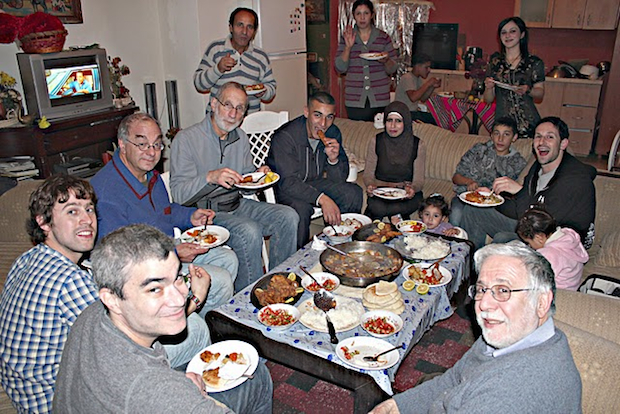
To my knowledge this is unprecedented, a delegation of Jewish congregants sleeping in Palestinian refugees homes, eating from their food, playing games with their children and grandchildren—a few even smoking hookah all night long with the youth of the camp. They talked about music, life, culture, romance, and–against my advice–even politics. The host families were the average Palestinian families and not the elite Palestinians. Some family members did not speak English, yet they did not have a problem communicating. They proved that the language of humanity transcends any linguistic boundaries…
Some Jewish extremists claim that if a Palestinian state is to be created, the Jews will not be able to visit their holy sites in the West Bank. They argue that Palestinians would not grant them the freedom to worship there. This argument is the basis for many settler justifications of the Occupation.
Nineteen Jews proved that this notion is not necessarily true. The Palestinian families in Deheisheh Refugee Camp did not mind hosting Jews, not just in hotels but rather in their homes. They stayed under the same roof, with no protection, no weapons or checkpoints. They were safe because they came as friends, not as enemies. They came with flowers and gifts, not with guns.
We’ve just uploaded the transcript of our conference call with Nadia Hijab last month – the Ta’anit Tzedek website now contains a recording as well as a full text of the call. I encourage you to read and/or listen to this amazing conversation. (Click here for the audio/transcript.)
Nadia covered a wide range of issues during the call, from the one state vs. two state, to human rights, to the Arab Spring, to the evolving Palestinian grassroots leadership. Listening to the conversation again, I was reminded of her impressively clear-headed, rights-based approach to the conflict – often challenging the conventional liberal American Jewish mindset in important ways.
When we ourselves challenged Nadia to state where she was on the one state vs. two state question, this was her eloquent response:
I believe the Palestinian people have the right to self-determination. I don’t care if that is exercised in one state or two states. I believe that whether it’s one state or two states, they should both be states that guarantee equality for all their citizens.
Now, separately from that, I do believe the Palestinians – and this is an individual right – have a right of return. (They) have a right to say if they would like to go back to what is now Israel and live as equal citizens in that state or if they would like to – we have the individual right to say if we’d like to stay in the countries where we’ve landed up and have rights there as citizens or if we’d like to go back to the new state of Palestine and be a citizen there, etc. Each Palestinian needs to be asked how each one wants to fulfill his or her right of return.
Another highlight from the call:
Rabbi Brian Walt: How do you, as a Palestinian, relate to Jews who feel quite attached to Israel or very attached to Israel and what it offers for Jews? And how do you feel about that sort of liberal Zionist argument that is perhaps portrayed best by J Street and other organizations like Americans for Peace now, that strongly support a two-state solution but don’t want to deal with the questions of 1947-48?
Nadia Hijab: Let me answer that in two parts. First, let me assume, just for the sake of argument that not a single Palestinian refugee returns to Israel. Let’s just assume that. There are 1.2 million Palestinian citizens of Israel and that is a challenge to Israel’s current attempt to present itself as a democratic state. It’s not. It is by law discriminatory to the Palestinians who are not even recognized as citizens. They have passports, they’re called Israelis, but they don’t actually have citizenship. And there are about twenty or thirty laws on the books, and more being added every day, to make sure that they are kept down and, hopefully some day, also out.
There’s a very racist discourse in Israel, a very openly racist discourse, that says: to the extent that we can maybe reshape the borders and get rid of some of these Palestinian Israelis, then we can keep Israel “pure,” ethnically “pure.” Well, in the 21st century that’s nonsense. And in fact, it’s been nonsense since 1948, because 1948 was not only the year that Israel was created but 1948 was the adoption of the Universal Declaration of Human Rights. Humanity had been moving towards that after one horror after another during the World Wars and other wars. So humanity has been trying to define how people deal with each other and how they relate to each other, whether as individuals or as communities or as states.
And in this day and age, it’s no longer acceptable – it’s universally seen as immoral and illegal – to discriminate against people on the basis of their religion or their race or their color, and now growing (on the basis of) their sexuality. You know, discrimination is abhorrent.
And what Israel is doing, even if you don’t take into account any of what’s going on with the occupation…what Israel is doing within its country is abhorrent. So therefore, Israel as it’s currently defined: as a state for Jews, by Jews, of Jews – that’s not a modern state, nor is it, by the way, as many states define themselves in the Arab world, (i.e.) by Muslims, for Muslims.
People have to have equal rights, whether Muslim or Christian or Jewish or men or women. A state is simply a construct in this day and age. It’s a construct for how to manage resources in a way that is fair and equitable and guaranteeing the rights of its citizens. That is what a state is. So Israel faces that challenge irrespective of whether there’s a two-state solution or a one-state solution.
Then I wanted to touch on the other part of your question, which is very important, how Jews feel about Israel or how I feel about Jews and what they feel about Israel. I work a lot with Jews who uphold a human rights approach, no matter what. And these are people who are my friends and I work extremely closely with them. And they struggle for justice for Palestinians as well as human rights for everybody, whether they’re Israelis or Palestinians, in the same way that I do.
I respect the work of many, let’s say, American Jews or liberal Zionists or whatever who stand up for some freedoms and some rights. But then when it comes to a question of Israel’s security they are less clear about where their loyalties lie. That’s problematic for me.
But I recognize that there is now a Jewish attachment to Israel and I think that over time it will be okay, because Israel exists – it was created. It was created in a way that was immoral and unjust to the Palestinians, but it was created. And eventually the attachment and the sense of belonging will be a cultural one, a social one, and maybe of family ties.
And then those attachments can be built across the Arab world as well. They don’t have to be restricted to Israel. And Israel will become a state of all its citizens, in which Palestinians and Jews and Arabs and Muslims and Christians are all equal and just one of the many states of the region.
Apparently Rabbi Shmuley was two seats away from her at the time and witnessed the entire episode. In his piece, he explained why he decided not to “intervene” during the incident. He also made some rather colorful observations about the Israel-Palestine conflict, including:
It’s not the ’67 borders that separate the Palestinians and Israelis. Rather, the conflict is all about values, specifically the Palestinians’ growing culture of death versus the Israeli culture of life.
My good friend and colleague Rabbi Lynn Gottlieb wrote an awesome response to Rabbi Shmuley and agreed to let me post it here below:
Dear Shmuley,
Thank you for your Shabbat hospitality the other night. Your family is beautiful. I appreciate your wife’s efforts to feed us and make us welcome in your home. Your hosting of conversations that explore the dimensions of a variety of issues is representative of the finest in our tradition. Critical thinking is crucial to the work of peace. Therefore, I feel empowered to address the issues your raised in your newsletter, especially since I know Rae Abileah personally and she ended up in the hospital.
1) She was not uttering curses. A curse is wishing for destruction or harm of another person or people. This was not the case. “End Occupation” is not a curse, it is a political statement. Great lovers of Israel including Jewish parents in the Bereaved Parent’s Circle support this position.
2) Whether you agree or disagree with her statement, Rae was physically assaulted which is against the law. “Do not envy a man of violence nor follow any of his ways.” “Do not follow the majority to do evil.” “Do not hate your brother in your heart.” “Do not seek revenge…”
Physical assault is a crime. Period. Interrupting a speech may not be well received but it is not physical assault.
3) By becoming a bystander and watching a physical assault without intervening and making an effort to stop the assault, you committed a sin of omission. You became a bystander.
4) By polarizing the conflict with your words in this newsletter, you are creating new enemies. The mitzvah is “to turn an enemy into a friend.” Our tradition asks religious leaders to rise above the fray and to stand against violence of any sort. That is why we are commanded to help an enemy before a friend in the question of relieving a donkey of his load. Or take the example of Aaron, running between two enemies to make friends.
As someone who has a following I urge you not to promote more hatred by creating a category of “Israel haters.” Rather, seek to understand their concerns, open a dialogue, become a Rodef Shalom (“Pursuer of Peace”) and not someone who fuels feelings that violence and revenge are justified.
By making the deeply distorted and uneducated statement about “the Palestinian culture of death and the Israeli culture of life” you are contributing to hate mongering which is a violent act according to our tradition. You have obviously not been in Palestine, nor do you seem to know about the very widespread movement for nonviolence that has been part of the Palestinian struggle for freedom for several decades. Yes, there are forces of violence in Palestine, just as there are in Israel. How do we pursue peace?
The kind of advice and opinion that appears in this newsletter puts you outside the circle of traditional Jewish sensitivities and commitments to peacemaking. As people in leadership, we have a great responsibility to Torah as a path of peace. Just as you urge Rae to use her words wisely, I urge you to do the same. I would be happy to continue this discussion with you at your convenience.
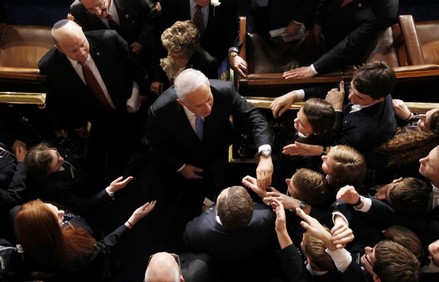
Netanyahu’s peace plan, if that is the right phrase for the collection of unrealistic terms he presented to Congress yesterday, leads straight to the burial of the Israeli-Palestinian peace process, an international crisis and a UN declaration of a Palestinian state.
Netanyahu today essentially returned to the policies that Israel pursued before Yitzhak Rabin and Yasir Arafat agreed on mutual recognition and the joint pursuit of peace.
And the worst part is not the appalling things Netanyahu said, but how Congress received them. Even Netanyahu’s declaration that there is no Israeli occupation was met with thunderous applause with the Democrats joining the Republicans in ecstatic support. Every Netanyahu statement, no matter how extreme, was met with cheers.
How can an Israeli prime minister dare to say his country “fully supports the desire of Arab peoples in our region to live freely” without spitting out the entire bitter truth – as long as they aren’t Palestinian. Suddenly Netanyahu marvels at the Arab Spring, but where was he when it began? He was on his standard scare campaign, warning of the dangers of an extremist Islamic regime and rushing to build a fence along our border with Egypt. And yesterday, suddenly, it’s “the promise of a new dawn.” Apparently there is no end to hypocrisy.
And finally, please read Justin Elliot’s invaluable piece in Salon, where he counts 29 standing ovations for Bibi (more than Obama got in his State of the Union Address) providing important commentary for each and every one.
At this point, I’d usually urge you to call your senators and congresspeople, but I really don’t see the point any more. Today the overwhelming majority of Congress – Republicans and Democrats alike – have made it embarrassingly clear that they are utterly irrelevant to the search for a just peace in Israel/Palestine.
If there were any redemptive words uttered in that chamber at all today, they came from my friend Rae Abileah – a courageous young Jewish activist – who interrupted Bibi’s speech from the gallery with “No more occupation, stop Israeli war crimes, equal rights for Palestinians, occupation is indefensible.” Rae was immediately assaulted by spectators who caused serious injuries to her neck and shoulders. She was then taken to George Washington Hospital where she was promptly arrested.
Said Rae from her hospital bed:
I have been to Gaza and the West Bank, I have seen Palestinians homes bombed and bulldozed, I have talked to mothers whose children have been killed during the invasion of Gaza, I have seen the Jewish-only roads leading to ever-expanding settlements in the West Bank…
As a Jew and a U.S. citizen, I feel obligated to rise up and speak out against stop these crimes being committed in my name and with my tax dollars.
Amidst the abject hypocrisy demonstrated in Congress today, Rae’s courage should be an example for us all.
For me, Obama’s speech at AIPAC yesterday was on the same level of rhetorical and political brilliance as his much-vaunted 2008 “race speech.” I’m really not sure quite how he did it, but he managed to strike an impossibly perfect balance between statements of political necessity:
The bonds between the United States and Israel are unbreakable and the commitment of the United States to the security of Israel is ironclad.
hard-nosed reality:
There’s a reason why the Palestinians are pursuing their interests at the United Nations. They recognize that there is an impatience with the peace process, or the absence of one, not just in the Arab World — in Latin America, in Asia, and in Europe. And that impatience is growing, and it’s already manifesting itself in capitals around the world.
political courage:
I know very well that the easy thing to do, particularly for a President preparing for reelection, is to avoid any controversy. I don’t need Rahm to tell me that. Don’t need Axelrod to tell me that. But I said to Prime Minister Netanyahu, I believe that the current situation in the Middle East does not allow for procrastination.
and moral conviction:
The Talmud teaches us that, “So long as a person still has life, they should never abandon faith.” And that lesson seems especially fitting today.
For so long as there are those across the Middle East and beyond who are standing up for the legitimate rights and freedoms which have been denied by their governments, the United States will never abandon our support for those rights that are universal.
And all this while repeatedly bringing the AIPAC audience to their feet in applause.
Wow.
If I had any doubts about the power of this one speech, the reaction of the leftist blogosphere – where the criticism of Obama’s efforts in Israel/Palestine has been witheringly critical of late – was the ultimate indicator.
Today’s speech by Barack Obama to AIPAC was a historic speech, maybe the most remarkable speech he has ever given. For a masked and calculating man, it was incredibly sincere. For just below the politically-hogtied phrases and praises for the Israel lobby that controls his future, it was filled with rage. When he spoke over and over of a Jewish democratic state and then said that the world was changing, and spoke about that Jewish state upholding universal values that Americans also share, I heard vicious irony: You want a religious state, you have the power to demand it of me, because you are the Israel lobby, well time is running out on you.
Yes, he gave AIPAC the usual Israel boilerplate. He’ll veto a unilaterally declared Palestinian state, etc. But all that stuff is standard and subject to change as situations change. However, the overarching message was the necessity for two states and the unsustainability of the occupation.
And AIPAC applauded. Strongly.
The President did a masterful job. The neocons are outraged. And I expect that Netanyahu, seeing AIPAC’s reaction to their President, will cut his losses and back down.
Bravo, Mr. President. You even brought out the best in AIPAC.
Even Ali Abunimah, in a post that otherwise excoriated US policy in Israel/Palestine, grudgingly admitted that Obama’s speech contained “a number of interesting elements” and “a hard-headed realism about the deep trouble Israel is in.”
Now, however, the real test begins. I’ve made no secret that I believe we’ve passed the point of no return on a two state solution – and I continue to fear that for all of his political courage, Obama’s efforts are arriving too late. As I write, Israel’s settlement juggernaut continues apace, making a mockery of Obama’s stated hope for a “sovereign and contiguous Palestinian state.” Meanwhile, Netanyahu’s political strategy is patently obvious: keep building settlements, stall Obama as long as possible, cozy up to his personal congressional friends, and do what he can to stoke the fires for a Republican victory in 2012 that will make all this unpleasantness just go away.
No matter how impossible the odds, however, I remain in awe of Obama’s speech, if only that he proved a sitting President does not need to roll over for the Israel Lobby. Could we venture to hope that AIPAC’S financially-driven stranglehold on American foreign policy, its craven bullying of politicians, and its “Israel right or wrong” myopia is now being exposed for what it really and truly is?
Click on the clip above for the entire speech. The good stuff begins at about 14:00 or so.
There are many in the Jewish community who view the Nakba as simply a historical fait accomplis. The attitude goes something like this: “Yes, during the creation of the state of Israel, Palestinians were displaced. That’s how nations get created. Today the state of Israel is just a fact – it’s time to get over it.”
The problem with this attitude – beyond the sheer injustice of it – is that the Nakba isn’t actually over. In truth, government-sponsored displacement of Palestinians from their land has been continuing apace for the past 63 years.
One recent example: Ha’aretz recently revealed that Israel used a covert procedure to banish Palestinians from the West Bank by stripping them of their residency rights between 1967 and 1994:
(The) procedure, enforced on Palestinian West Bank residents who traveled abroad, led to the stripping of 140,000 of them of their residency rights. Israel registered these people as NLRs − no longer residents − a special status that does not allow them to return to their homes…
The sweeping denial of residency status from tens of thousands of Palestinians and deporting them from their homeland in this way cannot be anything but an illegitimate demographic policy and a grave violation of international law. It’s a policy whose sole purpose is to thin out the Palestinian population in the territories.
The ongoing Nakba was also evident in news last month of a new military order that will enable the military to summarily deport tens of thousands of Palestinians from the West Bank:
The order’s vague language will allow army officers to exploit it arbitrarily to carry out mass expulsions, in accordance with military orders which were issued under unclear circumstances. The first candidates for expulsion will be people whose ID cards bear addresses in the Gaza Strip, including children born in the West Bank and Palestinians living in the West Bank who have lost their residency status for various reasons.
Israel’s founders understood full well that the Arab population of Palestine was the most significant barrier to the creation of a Jewish state. At the beginning of the 20th century, the population of Palestine was around 4% Jewish and 96% Arab. Although the events of 1948 tipped that scale significantly, it’s common parlance in Israel to view the growing presence of Palestinians as a “demographic threat.” So it’s not difficult at all to understand why Israel continues to institute these kinds of “thinning out” policies.
The Palestinians won’t forget the Nakba. In many ways, it seems that with each year, the memory is just getting stronger.
It’s an interesting, counter-intuitive phenomenon: one would expect that the the memory of displacement would fade as the event itself recedes into the past and new facts in the ground take hold. In fact, the exact opposite seems to be happening. There are doubtless many explanations for this, but primary among them must be the fact that displacement continues to be the very real experience of succeeding generations of Palestinians.
This fact was very much on my mind as I read news reports that thousands of Palestinian refugees crossed Israel’s borders during Nakba Day demonstrations last Sunday. As I watched scores of unarmed Palestinians willing to face live ammunition as they jumped the border fences, it was clear to me that they weren’t simply commemorating a “long-past” event.
For them, as for Israel, the Nakba isn’t over yet.



 Shalom Rav