Category Archives: Passover

The Destroyer Unleashed: A Meditation on the Ten Plagues

The recitation of the Ten Plagues is one of the signature moments of the Passover seder – and for many, one the most morally problematic. At the apex of the Magid section – the telling of the Exodus story – seder participants read aloud the series of plagues that God inflicts on the Egyptians to coerce Pharaoh into liberating the Israelites. The tenth and final plague is the most terrifying of them all: the death of all Egyptian first-born. In the seder ritual, we act out this moment by taking ten drops out of our cups of wine, one for each of the plagues. 

While this story is integral to the narrative of the Israelites’ liberation, there’s no getting around it: this episode portrays God inflicting collective punishment on a population that results in the deaths of innocents, including children and even the Egyptians first born animals. If there could be any doubt about the abject vengeance behind God’s intentions, they were made plain earlier in the book of Exodus when God tells Moses:

“You shall say to Pharaoh, ‘Thus says God: Israel is My first-born son. I have said to you, “Let My son go, that he may worship Me,” yet you refuse to let him go. Now I will slay your first-born son.’” (Exodus 4:23)

There are different pedagogical approaches for dealing with this troubling story during the seder. In family settings, adults typically make light of this section by playfully acting out the different plagues with props and singing whimsical songs about “frogs jumping everywhere.” Although most children sense full well the moral problems at the heart of the plague narrative, I’m not sure this sort of friviolity effectively shields them from the more terrifying dimensions of the story. 

It’s also common to comment that taking drops from our wine symbolizes the “lessening of our joy” at the fall of our adversaries.  Many haggadot include a famous midrash that quotes God rebuking the angels for rejoicing at the fall of the Egyptians: “How can you sing songs of praise while my children are drowning?” Although the midrash is not part of the traditional seder service, it has become ubiquitous in most contemporary haggadot – so much so that it has become virtually canonical. In the end however, this commentary amounts to a kind of liberal hand wringing over God’s collateral damage: an apologetic that expresses regret, but stops short of outright condemnation. 

This moral problem posed by the Ten Plagues, of course, is not unique to the seder – it’s inherent to the source material itself. Yes, the God of the Torah is a God that demands liberation of the oppressed, but the text also portrays God at times as vengeful, destructive, misogynistic and xenophobic, if not downright genocidal. In the case of the Exodus story, God is not merely motivated by the liberation of the Israelites; God’s display of wonders and miracles (i.e., plagues) are also intended to serve as a display of superior divine power, which God repeatedly makes clear: 

“Then the Egyptians shall know that I am YHVH, when I stretch out My hand over Egypt and bring out the Israelites from their midst.” (Exodus 7:5) 

When we consider the moral issues with the Ten Plagues, then, we must directly confront the essential issues with Biblical theology itself: a theology rooted in a mythic world view dating back centuries that is light years away from our own. As I often comment to my Torah study students, when we read these difficult stories about God’s bad behavior we are not reading about God – we are reading what the Biblical writers living in the ancient Near East wrote about God. We might say that these narratives teach us less about the nature of the divine than they do the human attributes the writers have projected onto God. Still, whatever the Torah may lack in relatable theology, it does present us with a quintessential challenge: it invites us to engage in a sacred struggle with these texts – much the way that Jacob struggled with the divine night stranger in that famous story from Genesis. In other words, the time-honored Jewish pedagogy is not to simply read the Torah, but to wrestle with it. 

And we are not the first to wrestle with the problems inherent with the plague narrative. The Talmud, in fact, records a famous rabbinic debate about the evening of the first Passover, when the Israelites were instructed to sacrifice a lamb and daub their doorposts with blood to protect themselves and their households as the tenth plague unfolded. As described in the Torah:

God, when going through to smite the Egyptians, will see the blood on the lintel and the two doorposts, and God will pass over the door and not let the Destroyer enter and smite your home. (Exodus 12:23)

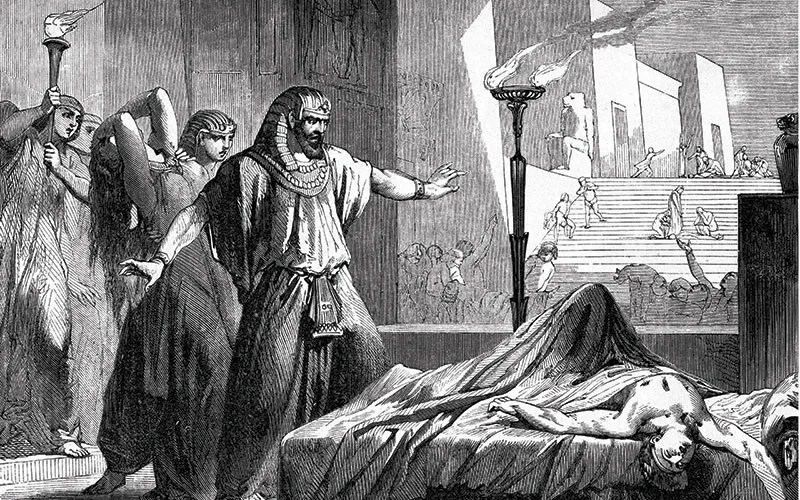
During a very complex consideration of this verse, the question is raised why the Israelites had to mark their doors and stay inside. Didn’t God know the difference between Israelite and Egyptian households? The answer lies with the figure of the “Destroyer” (in Hebrew, “Hamashchit,” sometimes rendered as the “Angel of Death.”) God apparently doesn’t slay the Egyptian first-born personally but relies on the Destroyer as a kind of hired assassin. But of course, this raises another, even more chilling problem. 

At one point in the debate, Rav Yosef offers this comment to explain why the Israelites needed to remain in their homes on that fateful evening:

“Once the Destroyer is given permission to destroy, it does not distinguish between the righteous and the wicked.” (BT Baba Kamma 60a)

Even for those of us who cannot countenance the view of a God utilizing the services of an amoral hit man over the people of Egypt, the power of Rav Yosef’s comment is still unbearably potent: when collective violence is unleashed upon a population, it does not discriminate between combatants and civilians, young and old, medical workers or first responders, reporters or press personnel. Moreover, once the Destroyer is let loose on its murderous rampage, it is very difficult, if not impossible, to hold it back. 

This Passover, we are all feeling this truth particularly keenly. As we sit down to seder, the Pharaohs of our world have given the Destroyer the permission to destroy – and we are witnessing the tragic results on the daily. In the US and around the world, authoritarian rule is sending armed militias into the streets to abduct and incarcerate residents and kill those who protest or resist. Israel’s genocide against the people of Gaza continues; the US and Israel has unleashed a senseless, murderous rampage on Iran that is rapidly turning into a regional war that threatens to upend the entire world economy. The violence symbolized by the Destroyer unleashed has become all too terrifyingly real.

This Passover, let us openly acknowledge the unmitigated mass murder that is unfolding outside the doors of our comfortable homes even as we gather for seder. As we take the ten drops out of our cups, let us understand them for what they truly are: the blood of innocents. As we count them off one by one, let them serve as signifiers of our solidarity with the slain and our resolve that when our seders are over, we will not huddle in fear behind our doorposts. Let us show up for all who are being cut down by the Destroyer – and commit to dismantling the systems that enable its violence once and for all. 
Next Year in Jerusalem?

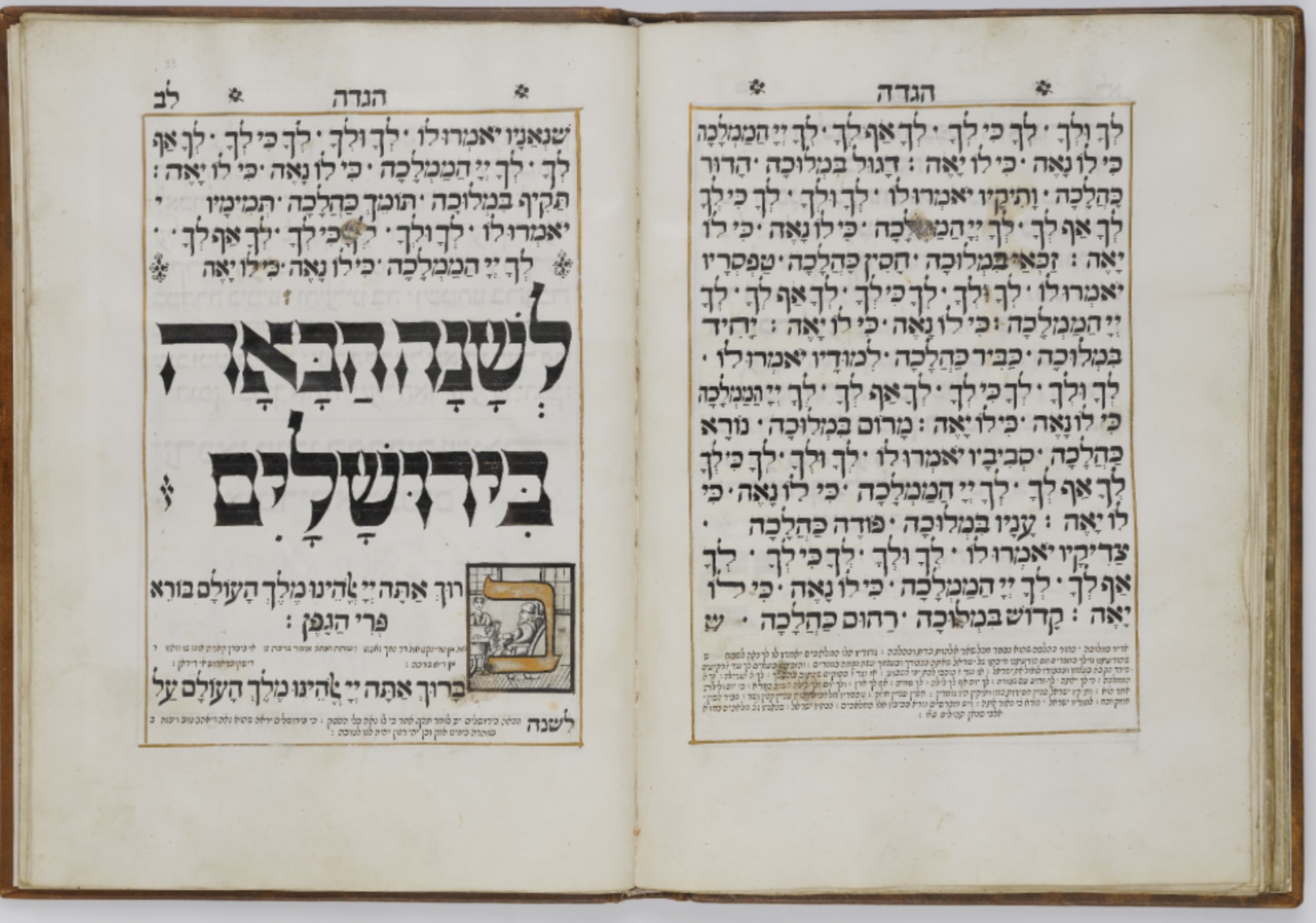
I’m sure I’m not the only anti-Zionist Jew who experiences cognitive dissonance when we get to the line that ends every Passover seder, “Next year in Jerusalem!” In the age of Zionism, what do these words really mean: when a Jewish person can fly to Jerusalem not next year, but tomorrow, and become an instant citizen upon arrival? How can we joyfully shout these words knowing that Israel ethnically cleansed half of Jerusalem in 1948 and militarily conquered and occupied the other half in 1967? What do they mean while scores of Palestinians who have deep generational ties to the land are forbidden from even setting foot in that city? 

Over the years, I’ve come to the conclusion that the only way I can say this line with moral integrity is to understand the word “Jerusalem” not as referring to a physical city but to a spiritual ideal. This ideal, in fact, is central to Jewish tradition. After the destruction of the Temple and the ruination of Jerusalem by the Romans, the rabbis posited the existence of two Jerusalems: Yerushalayim Shel Mata (“Jerusalem Below”) and Yerushalayim Shel Mala (“Jerusalem Above”). Earthly Jerusalem is the physical city we know while the Heavenly Jerusalem is the messianic Jerusalem: a mirror reflection of the city on high: the Jerusalem of our highest aspirations. 

In other words, while a small number of Jews always lived in the city after the destruction of the Temple, for the majority of Jews who lived throughout the diaspora, the concept of Jerusalem became a spiritualized symbol. I’ve often been struck that diaspora cities that were centers of robust Jewish life have typically been referred to as “Jerusalems.” In the late 16th and early 17th centuries, for instance, Amsterdam was referred to as the “Jerusalem of the West” following the immigration of Sephardic Jews from Spain and Portugal. Likewise, Vilna was known as the “Jerusalem of Lithuania” and Tlemcen, Algeria was called “Jerusalem of the Maghreb.” 

When the ideology of Zionism emerged, and this spiritual ideal was subsumed into a physical place, the words “Next Year in Jerusalem” became a literal battle cry. But when we limit our understanding of Jerusalem to one specific city, we do damage to the very idea of Jerusalem itself. It’s tragically ironic that while the Hebrew word Yerushalayim literally means “City of Peace,” it has rarely known a moment’s peace in its history. It certainly hasn’t since the establishment of the state of Israel. 

While the metaphor of Jerusalem still has a prominent place in Jewish tradition and liturgy – the words “Next Year in Jerusalem” mark the end of Yom Kippur as well as the Pesach seder – this ideal can be deeply meaningful even for those of us who do not ascribe to the messianic aspects of Jewish tradition. They can continue to be deeply aspirational, indicating our hope for a future of justice, equity, and peace throughout the world – and our commitment to the work it will take to make that future real. 

For anti-Zionist Jews, these words are not only a statement, but an affirmation of our opposition to the violence and dispossession that continues to be wrought in the name of the Jewish people in that city and throughout the land. “Next Year in Jerusalem” can mean “Next Year, a Jerusalem for all its inhabitants.” It means “Next Year in Jerusalem without Jewish Supremacy.” It can mean “Next Year, may there be a return for all who have been dispossessed from their homes.” When we affirm that Jerusalem is not only an earthly location, we affirm the true Jerusalem cannot be destroyed, conquered or reconquered: it continues to live in our hearts and motivate our actions. 

May it be so this and every Passover: “Next Year in Jerusalem!” 

This Passover, We Must Reckon With Israel’s Heinous Violence Against Children in Gaza

Majdi Fathi / NurPhoto via Getty Images

Cross-posted with Truthout

Content Warning: This article contains graphic descriptions of violence to children.

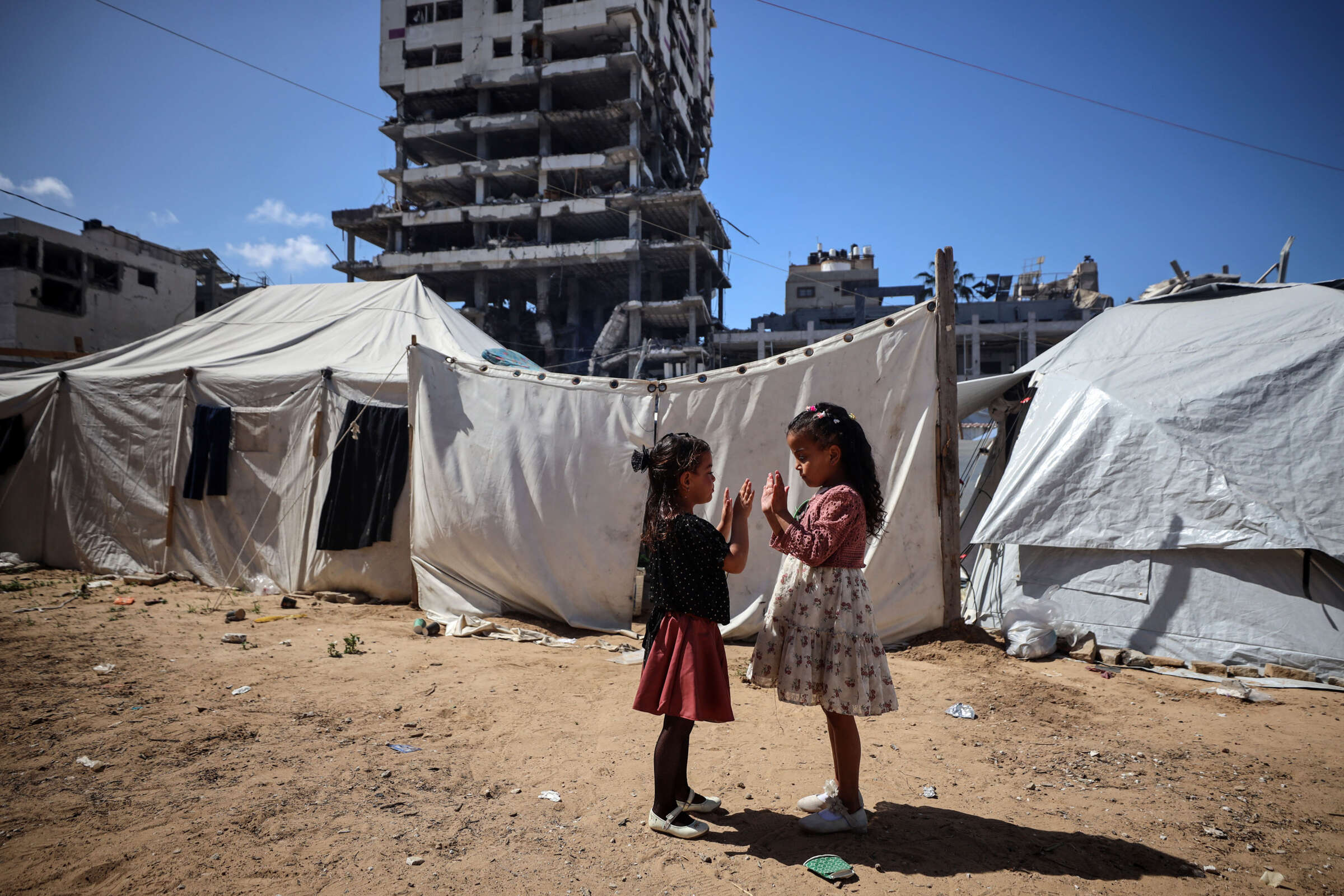
As the Jewish community prepares to observe Passover this year, I’m thinking a great deal about the centrality of children to the Exodus story we tell around the seder table. In particular, I’m struck that this narrative from the Torah begins with a terrifying description of atrocities committed against children. As Exodus opens, a new pharaoh arises over Egypt who openly dreads the demographic growth of the Israelite minority. After oppressing them with forced labor, he orders Hebrew midwives to kill newborn male children. When they resist his demand, he charges the Egyptians to throw all baby boys into the Nile. Shortly after, Moses is born and is saved from this decree of death by his mother, his sister and the pharaoh’s daughter, who adopts him.

Among other things, the Exodus story drives home the tragically familiar truth that children are not mere casualties of wartime atrocities, but are actually targeted by state violence. According to a 2014 report in The New Yorker, “The specific targeting of children is one of the grimmest new developments in the way conflicts have been waged over the past fifty years.”

Those who participate in the Passover seder are required not only to read the story of the Exodus, but to examine its relevance, as the Haggadah instructs us, “in every generation.” As such, the opening of the narrative presents us with all too disturbing parallels — and a critical moral challenge. This Passover — the second to come amidst the ongoing genocide perpetrated by Israel against Palestinians in Gaza, we would be grievously remiss if we failed to acknowledge the scores of children who have been killed, maimed and traumatized by Israel’s ongoing military onslaught.

The official death toll in Gaza has now broken the 50,000 mark, including more than 17,000 children. (The medical journal The Lancet has concluded that the total number of those killed is likely 40 percent higher.) On March 18, the day that Israel broke a two-month ceasefire, the Israeli military killed more than 400 Palestinians, including 183 children and 94 women — on what observers call the single bloodiest day of the genocide.

More recently, on April 3, Israel bombed the Dar al-Arqam School-turned-shelter in Gaza City, killing 29 people, 18 of whom were children. In its report on the attack, Al Jazeera quoted a spokesperson from Gaza’s emergency rescue workers: “What is going on here is a wake-up call to the entire world. This war and these massacres against women and children must stop immediately. Children are being killed with cold blood here in Gaza.”

For those who stand in solidarity with Palestinians, certain reports and images have become seared into our hearts and minds. For many, the tipping point moment into the abyss occurred in early 2024, with the phone recording of 6-year-old Hind Rajab, pleading with her mother for rescue before the Israeli military shot 335 bullets into her family’s car. One month later, the world was horrified by the image of Sidra Hassouna, a 7-year-old Palestinian girl from northern Gaza, hanging dead off the ledge of a destroyed house with half her body missing.

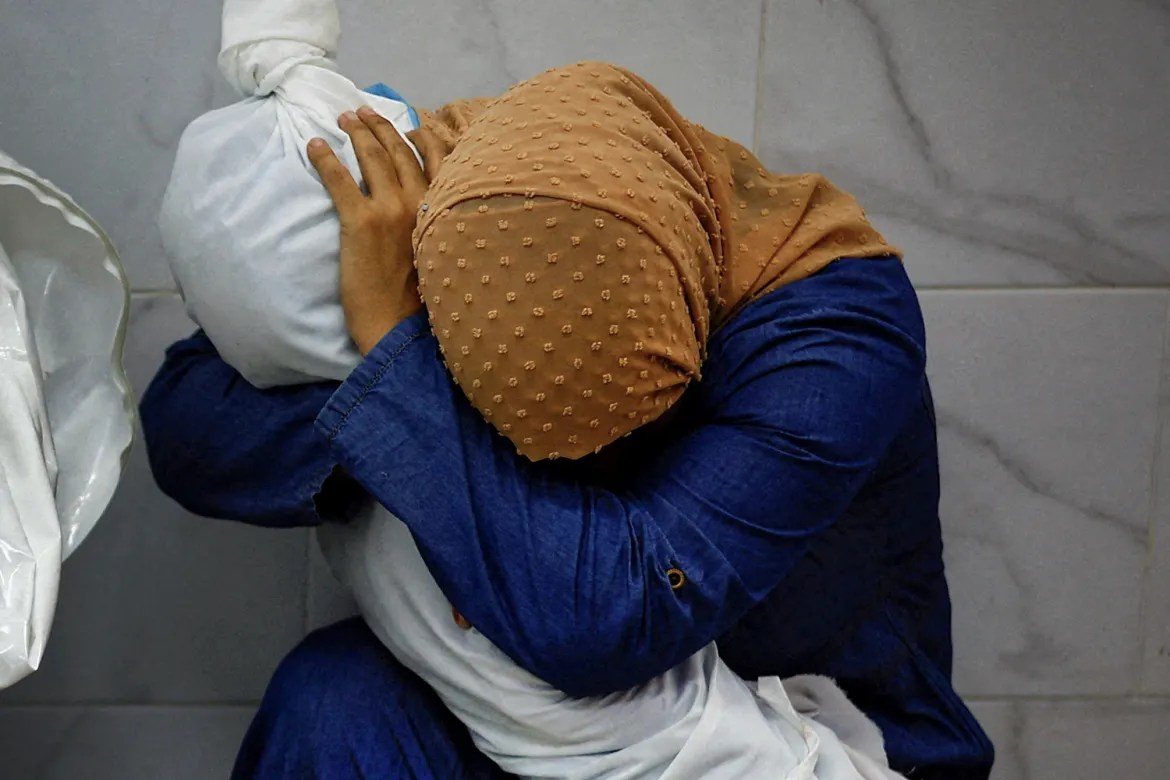
On May 26, 2024, a 1-year-old baby, Ahmad Al-Najjar, whose headless body was held aloft by a terrified, grief stricken man following what has come to known as the Rafah Tents Massacre — a night in which 45 Palestinians, most of them women and children, were killed, burned alive and beheaded. One doctor who witnessed the carnage commented, “In all my years of humanitarian work, I have never witnessed something so barbaric, so atrocious, so inhumane. These images will haunt me forever… And will stain our conscience for eternity.”

Denial can take many forms. For some, it is rooted in racist dehumanization of the other; others may be just too overwhelmed to allow themselves to comprehend the massive slaughter of children in such a heinous fashion; still others rationalize the truth of it away, dismissing mass murder as “collateral damage” or Hamas’s use of “human shields” (a cynical claim that has been consistently debunked by human rights observers).

For Israel’s supporters, it is even more unthinkable to face the increasing evidence that the Israeli military might well be intentionally targeting children for mass murder. A recent Al Jazeera “Fault Lines” documentary, “Kids Under Fire,” makes a compelling case for this claim, with extensive eyewitness interviews with volunteer American health care workers and human rights experts. Their accounts, corroborated across hospitals and over time, suggest a systematic pattern: increasing numbers of child victims were not injured as a result of bombing raids, but of direct gunshot wounds, often to the head. One of the doctors interviewed in the film, Tammy Abughnaim, an American emergency physician from Chicago, commented:

More and more, I started to see children with penetrating injuries like gunshot wounds. After five, six, seven, eight, I came to the realization that somebody is shooting children. I didn’t want to believe that children were being shot. Nobody wants to believe that. Nobody wants to think that other humans are capable of annihilating children in that way.

Abughnaim’s testimony is corroborated in the film by Mark Perlmutter, an orthopedic surgeon from North Carolina: “The target at the end of a scope is unmistakable. They are a young human being, and when that trigger gets pulled on that target, it is not by accident. At all. Ever.”

At one point, the interviewer asked Miranda Cleland of Defense for Children International – Palestine, “How you ever thought through ‘what’s the strategic reason to shoot a child? What message should we take from a military that would target children?’” Cleland’s reply: “I’ve thought about it a lot and the only conclusion I can come to is that Israeli soldiers are shooting Palestinian children because they want to. And I think they do it because they are allowed to and nobody has stopped them.”

Nabeel Rana, a vascular surgeon from Peoria, Illinois, put a finer point on it: “You’re wiping out a certain number, maiming a certain number and permanently mentally and emotionally disabling the rest. And that’s going to be passed down to the next generation. So, this is how you cripple a society.”

As centuries of state violence against oppressed communities have long demonstrated, the most direct way to undermine and even eradicate a society is to target its children. In December 2024, the Palestinian Centre for Human Rights (PCHR) released a report, “Generation Wiped Out: Gaza’s Children in the Crosshairs of Genocide,” examining Israel’s crime of genocide against Gazans, including the genocide of children. The PCHR report concluded:

The killing of children, infliction of serious physical and mental harm, and subjection to harsh living conditions that destroy their lives cannot be dismissed as mere collateral damage of military attacks. Instead, these actions are part of a systematic strategy aimed at erasing Palestinian identity and annihilating future generations.

There are ominous indications that this annihilation is well underway. A Reuters analysis of data from the Gaza Health Ministry revealed that at least 1,238 families — defined as married couples and any children they might have — have been totally erased, with no survivors. In an AP article on this issue last year, Omar Shabaan, a Gazan researcher and economist, observed that of Gaza’s 400,000 families, none have been spared, causing permanent harm to Gaza’s society, history and future. “It is becoming clear,” he said, “that this is a targeting of the social structure.”

This dramatic upsurge in the killing of Palestinian children is not limited solely to Gaza. According to a recent report on the “Gazafication” of the West Bank, the Israeli human rights group B’Tselem found that Israel is now using the military tactics of its assault on Gaza throughout the Occupied Territories, “where Palestinians face mass forced displacements, a surge in airstrikes and a sharp rise in attacks on children and other civilians.” B’Tselem reported that 180 children have been killed by Israeli forces in the West Bank since the Gazan genocide began, making it the deadliest period of Israel’s nearly 60-yearlong occupation for adults and children alike.

Reports of violence against children are indeed reminiscent of reports from Gaza. In an article entitled “Child Deaths Surge Amid ‘Gazafication’ of the West Bank,” the Guardian, interviewed Rigd Gasser, the father of 14-year-old Ahmad Rashid Jazar, who was shot in the chest in the village of Sebastia by an Israeli soldier while on an errand to get bread in January. Gasser was in a cafe when he heard the gunshots and rushed out when he heard calls for help. “I got closer and recognized my son. I knew him by his clothes, his body was all covered in blood,” he said.

The article also reports on the killing of cousins Reda Basharat (8) and Hamza Basharat (10) who were killed near home by an Israeli drone strike on January 8. The children were sitting outside with their 23-year-old cousin Adam when Hamza’s mother Eman heard the explosion. When she ran outside, she found Hamza injured and struggling to breathe. “He died in my arms,” she said. Eman added, “When I think about what happened to my son and remember the images of their bodies, and I see what is happening in Gaza on TV, I felt suddenly that they are doing the same thing.”

While these individual reports portray unspeakable cruelty, it’s important to bear in mind that it ultimately serves a larger purpose. Just like the violence inflicted by the pharaoh in the Exodus story, Israel’s violence toward children stems from the view of an entire people as a “demographic threat.” This view itself stems from Zionism: an ideology and movement that seeks to create and maintain a majority Jewish nation-state in historic Palestine. As such, the targeting of children is part of a larger effort to ethnically cleanse Gaza through a variety of means, including demolition of homes, population transfer and, as the PCHR report puts it, “erasing Palestinian identity and annihilating future generations.”

In this regard, Israel’s open fire policy toward Palestinian children is inseparable from other draconian actions that clearly seek the depopulation of Gaza and the West Bank. As of this writing, the AP has reported that Israel now controls 50 percent of Gaza as it enlarges its buffer zone, razing Palestinian homes, farmland and infrastructure to “the point of uninhabitability.” The military has also destroyed 90 percent of the southern city of Rafah, after issuing evacuation orders to its residents.

If there could be any doubt as to Israel’s intentions, Deputy Speaker of the Knesset Nissim Vaturi, of the Likud party, like so many other Israeli politicians and military leaders before him, recently made Israel’s end game all too clear. In a radio interview he said pointedly that Israel should “wipe Gaza off the face of the earth,” adding, “There are no innocents there.… I have no mercy for those who are still there. We need to eliminate them.” More recently he commented in a TV interview: “You can’t live with these creatures next to us.… There is no peace with anyone here.… Every child born now — in this minute — is already a terrorist when he is born.”

Notably, Vaturi has also made similar comments about the West Bank region of Jenin, where 40,000 Palestinians were displaced by Israel in the month of February alone. “Erase Jenin. Don’t start looking for the terrorists — if there’s a terrorist in the house, take him down, tell the women and children to get out.” While Israel’s apologists dismiss comments such as these as hyperbole, it is critical to note that these very clear statements of intent are being backed up by very clear action.

As a congregational rabbi, I’ve been asked recurring questions over the last two Passovers. How can I celebrate this holiday while a genocide is being committed in my name? How can I observe a festival of Jewish liberation while a Jewish nation-state is acting as a pharaoh over an entire people? While I understand the anguish behind these questions, I believe the Passover ritual actually offers us an important opportunity: to squarely face the way the Exodus narrative is playing out in a very real way in our own day, to ask hard questions and avoid the simple, pat answers.

In his searing book about Israel’s genocide, One Day, Everyone Will Have Always Been Against This, writer Omar El Akkad writes:

A woman’s leg amputated, without anesthesia, the surgery conducted on a kitchen table. A boy holding his father’s shoe, screaming. A girl whose jaw has been torn off. A child, still in diapers, pulled out of the tents after the firebombing, his head severed from his body.

Is there distance great enough, to be free of this? To be made clean?

This Passover, the season for asking questions, El Akkad’s challenge pounds insistently on the collective conscience of the world.

Tzedek Chicago’s New Seder Supplement: “Passover as Collective Liberation”

With Passover starting Saturday evening, April 12, Tzedek Chicago is honored to present our annual seder supplement, “Passover as Collective Liberation.”

As we witness fascism growing in the US and around the world, Passover arrives this year with a special urgency – and a sacred opportunity. As our supplement notes:

Merely telling the story is not enough. The seder requires us to interrogate this sacred narrative: to contemplate its meaning and to examine the questions it raises for us in our own day. Most critically, Passover demands that we connect the lessons of the Exodus story to Pharaohs that arise “in every generation.”

To that end, we encourage you to use the Passover narrative as a template to understand – and respond – to the stakes of the current political moment. First and foremost, we encourage you to universalize the Exodus narrative; to view our sacred liberation story in the context of collective liberation; to understand that the Jewish struggle and liberation is ultimately inseparable from so many other liberation struggles, past and present.

I believe it is more critical than ever to make these connections. As the Columbia grad student Mahmoud Khalil wrote in his “Letter from a Palestinian Political Prisoner in Louisiana.” (which we include in our supplement):

The Trump administration is targeting me as part of a broader strategy to suppress dissent. Visa-holders, green-card carriers, and citizens alike will all be targeted for their political beliefs. In the weeks ahead, students, advocates, and elected officials must unite to defend the right to protest for Palestine. At stake are not just our voices, but the fundamental civil liberties of all.

As another Palestinian American, Noura Erakat has noted (in an article that we quote in our supplement as well):

But resisting fascism is our collective goal. We just know that in order to resist it, we have to fight it on two fronts of U.S. state violence: at home and abroad. Because if the United States, together with Israel, manages to disembowel the ICJ, the ICC, the UN, and a broader global order built after the Holocaust and World War II, no one is safe… As Colombian President Gustavo Petro warned back in December 2023, ‘“What we are seeing in Gaza is a rehearsal of the future.’”

Yes, resisting fascism must be our collective goal. Those of us who have been advocating for Palestinian liberation must understand that their liberation is irrevocably connected to the liberation of all who are targeted by state violence. At this moment, the stakes could not be higher. Under the current regime, we are witnessing a terrifying state backlash about those who have publicly voiced their support for the Palestinian people. At the moment, activists of color with student visa are the primary targets. But as Mahmoud Khalil rightly noted in his letter, soon “visa-holders, green-card carriers, and citizens alike will all be targeted for their political beliefs.”

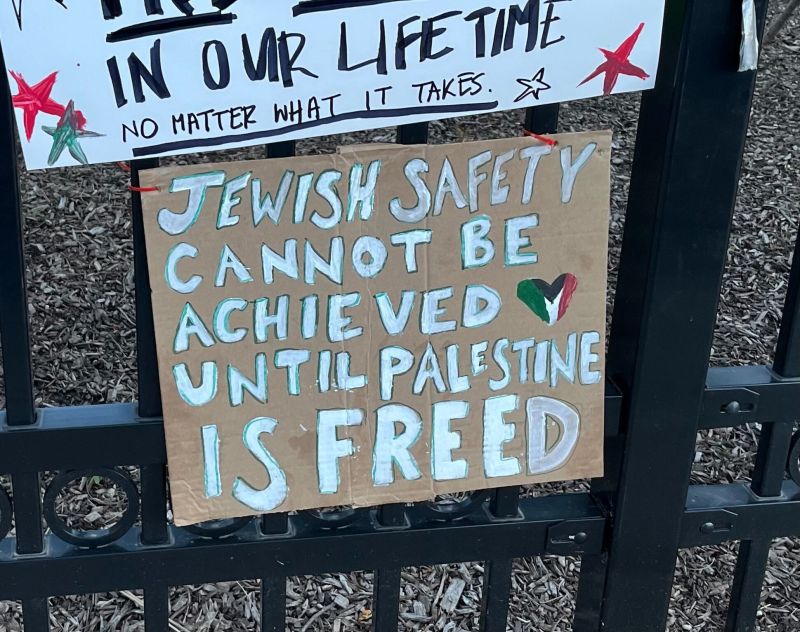
As Jews, we have a unique role in the current political moment. Indeed, we must fail to note that this state violence is being cynically carried out in our name, justified by concern for “Jewish security,” More than ever, we must to refuse to let our safety be used as a pretense to strengthen fascist state power. We must insist that this pretense will only endanger Jewish security all the more. We must affirm in no uncertain terms that Jewish safety and security is inseparable from the safety and security of all.

This Passover, let us insist that the Exodus story must be about the liberation of all who are oppressed by the contemporary Pharaohs of our day. This Passover, may we discover the true meaning of collective liberation – and find the inspiration to make it real in our world.

Click here for the supplement.

Confronting Tisha B’Av and Gaza: Ten Years Later

 [photo: Mohammed Salem/Reuters]

Exactly ten years ago, the Jewish fast day of Tisha B’Av arrived as Israel was winding down “Operation Protective Edge” – it’s deadly two-month military assault on Gaza. By the end of the summer of 2014, it would eventually leave more than 2,000 Palestinians dead and more than 10,000 wounded. I remember thinking at the time how the scale of human loss was utterly incomprehensible, which of course, it was.

With Tisha B’Av 2014 approaching, I met with a small group of Jewish friends and activists who had been active in the Palestine solidarity movement to plan an observance. Tisha B’Av (literally, the 9th of the month of Av) is a day of mourning for the destruction of the 1st and 2nd Temples in Jerusalem – and by extension the myriad of other tragedies that have befallen the Jewish people throughout the centuries. In addition to a day-long fast, the traditional Tisha B’Av observance includes the chanting Biblical book of Eicha (Lamentations), which vividly and painfully describes the fall of Jerusalem to the Babylonians.

Given the violence Israel had been unleashing on Palestinians in Gaza that summer, we just couldn’t bear to observe the festival in the traditional manner, i.e., as a day of mourning exclusively for Jewish loss. And so, when the festival arrived, we gathered in a home in Evanston to share our fears, our grief, our outrage, over what had transpired over the course of that tragic summer. In a sense, we were mourning the loss of Judaism itself as we had known it. Though it was obviously far from a traditional Tisha B’Av observance, those who attended will never forget that gathering – and would agree it was a turning point in our Jewish lives and identities.  

Among the readings shared at the ceremony, was a new poetic translation of the first chapter of Eicha that I had written for the occasion, entitled “A Lamentation for Gaza.” This is how it began:

Gaza weeps alone.
Bombs falling without end
her cheeks wet with tears.
A widow abandoned
imprisoned on all sides
with none willing to save her.

We who once knew oppression
have become the oppressors.
Those who have been pursued
are now the pursuers.
We have uprooted families
from their homes, we have
driven them deep into
this desolate place,
this narrow strip of exile.

It’s fair to say that none of those who attended that ceremony could ever have imagined the scale of the genocidal carnage that Israel would unleash on Gaza ten years later. To date, nearly 40,000 Gazans have been killed, though the actual number will almost surely climb far higher. The Israeli military has indiscriminately killed random civilians, relief workers, journalists and health care workers. Israel has wiped out the bloodlines of entire families. The Gaza strip is now gripped by spreading famine and polio epidemics. And unlike ten years ago, this current violence has now brought the entire region to the brink of all-out war.

In anticipation of Tisha B’Av this year, I recently re-read my “Lamentation for Gaza” – and while it’s an accurate snapshot of my feelings at the time, I don’t think it fully expresses my heart and soul now the way it did during the summer of 2014. Most fundamentally, I no longer relate to the essential perspective of the lamentation itself, which I wrote in the first-person plural:

We have become Gaza’s master
leveling neighborhoods
with the mere touch of a button
for her transgression of resistance.
Her children are born into captivity
they know us only as occupiers
enemies to be feared
and hated.

When I read this now, it is jarring to realize how I – a diaspora Jew living in the United States – wrote from the perspective of “Gaza’s master” and an “occupier.” When I wrote those words, I still maintained a personal connection to Zionism and reflexively adopted Israel’s perspective. At the same time, however, I clearly expressed deep anguish over what “we” had wrought – as if I didn’t know fully where I stood anymore.

Ten years later, I’m fully secure in my identity as an anti-Zionist Jew. Tzedek Chicago, is (yes) almost ten years old – and avowedly lifts up core values that express diasporist-focused Judaism beyond Zionism. I’m part of a Jewish community that is unabashed about taking a stand in the face of genocide.

I don’t believe it’s an exaggeration to say that as Tisha B’Av falls this year, the Jewish communal fissures over Palestine/Israel have become an abyss – perhaps even a schism. We are facing a deep and profound divide between those who place political nationalism at the center of their Jewish identity and those who refuse to associate settler colonialism, apartheid – and now genocide – with their Judaism. And though it pains me to say so, I don’t think there will be any bridging this gap. Contrary to the final line of Lamentations, “chadesh yameinu ke’kedem” (“renew our days as they were before”), there is no going back to the days of old. There will be no putting the pieces back together the way they were.

According to classical Jewish theology, the cataclysmic fall of the Second Temple in Jerusalem occurred as a result of “sinat chinam” – the baseless internecine hatred in the Jewish community that allowed the Romans to come breach the walls of the city and conquer Jerusalem. There is deep division in the Jewish community in the current moment as well, but now our Jewish trauma and hatred is directed outward rather than inward. Now, it is the Palestinian people – not we – who are bearing the full brunt of violent dispossession and collective loss.

While it would be hubris to predict what the future will hold for our tradition, I fervently believe that the Judaism of the future must be universalist in nature. Just as I suggested this past April that Passover cannot commemorate Jewish liberation exclusively, so too Tisha B’Av can no longer focus on Jewish mourning alone. Our cries of grief must include the Palestinian people – and all who are targeted, othered, and singled out for oppression through state violence.

This year, Tisha B’Av eve falls on Monday night August 12 – and this time, I know where I belong. I encourage local members of Tzedek Chicago to join us at Federal Plaza in downtown Chicago, where we will collaborate with Higaleh Nah, a local non-Zionist havurah, to chant the entire book of Eicha. It feels absolutely fitting that we will gather at the seat of state power to send forth our lamentations toward the nation that is arming and enabling this ongoing genocide in our name.

May our cries pierce the highest heavens, and may our mourning be expansive enough to include all who are oppressed in our midst.

On Gaza: Religion, Politics and Solidarity

Here are my remarks from, “Gaza: Religion, Politics and Solidarity,” a program sponsored by Bright Stars of Bethlehem on May 5, held at the First Presbyterian Church in Evanston. It was my honor to speak in conversation with Palestinian liberation theologian Rev. Dr. Mitri Raheb (founder and President of Dar al-Kalima University College of Arts and Culture in Bethlehem), Dr, Rami Nashashibi, (founder and Executive Director of the Inner-City Muslim Action Network) and Dr. Iva E. Carruthers, (General Secretary of the Samuel DeWitt Proctor Conference).

To view the entire program, click here.

“All Who are Hungry Come and Eat:” A Report from a Passover Action at the Gaza Border

Cross-posted with The Nation

In 2017, I spent several days in Gaza as a staff person for the American Friends Service Committee. Although I took away many powerful and vivid memories from that trip, some of the most indelible involved the delicious food that was continuously served to us by our Gazan hosts. Gazans are famously proud of their cuisine, and rightfully so, as it provides them with a palpable connection to Palestinian history and life outside that small 140 square mile strip – to communities in Palestine that their ancestors used to live. As journalist Laila El-Haddad has observed, Gazan food is “a sort of treasure map to a largely invisible, or invisibilized, world of Palestinian history going back well before the 1948 Nakba.”

During the course of our visit, Ali, a member of the AFSC Gaza staff, mentioned more than once that Gazan knafeh (a traditional Arabic dessert) was by far the best in Palestine. When our staff group gathered at a restaurant in Gaza City for our final meal, Ali was chagrined to learn that there was no more knafeh left in the kitchen. Determined, Ali got up, ran down the street to another restaurant, and returned with a huge round plate of the sticky, golden pastry for our table. It was indeed more delicious than any knafeh I have eaten before or since.

I’ve recalled that sweet memory often over the past seven years. When I think of it now, however, I find its sweetness has curdled into horror. As far back as December, human rights agencies determined that Israel “was using starvation as a weapon of war.” According to the World Food Program, Gaza’s food system was on the brink of collapse and the population was facing a “high risk of famine.”

This past March, the mainstream media published shocking, heartbreaking pictures of Yazan Kafarneh, a 10 year old Gazan boy reduced to skin and bones from starvation. To date, it has been estimated that 28 children have died of malnutrition and starvation in northern Gaza. By all accounts, starvation in Gaza has now reached “catastrophic” proportions. Knowing about the Gazan people’s deep pride in their food culture, I’m experiencing deep heartbreak as I read reports that Palestinians in Gaza are now forced to eat grass just to survive.

As a congregational rabbi, I’ve spoken with many people have told me that they are not sure how – or even if – they will celebrate Passover this year. With the genocide and forced starvation of the people of Gaza deepening with no end in sight, they say, it just feels beyond challenging to celebrate a festival of Jewish liberation. To make the moral dissonance even more dissonant, many in the Jewish communal establishment are framing Passover by focusing exclusively on the Israeli hostages in Gaza and call for their liberation from Hamas, with nary a mention of the 35,000 Gazans who have been destroyed in the process through Israel’s genocidal war of vengeance.

More than once I’ve been asked, “How can I partake of this festive meal while Israel has been starving Palestinians in the name of the Jewish people?” How can I read about Pharaoh’s oppression of Israelite children when I’ve just read the latest death count of Palestinian children dying increasingly things from forced starvation?

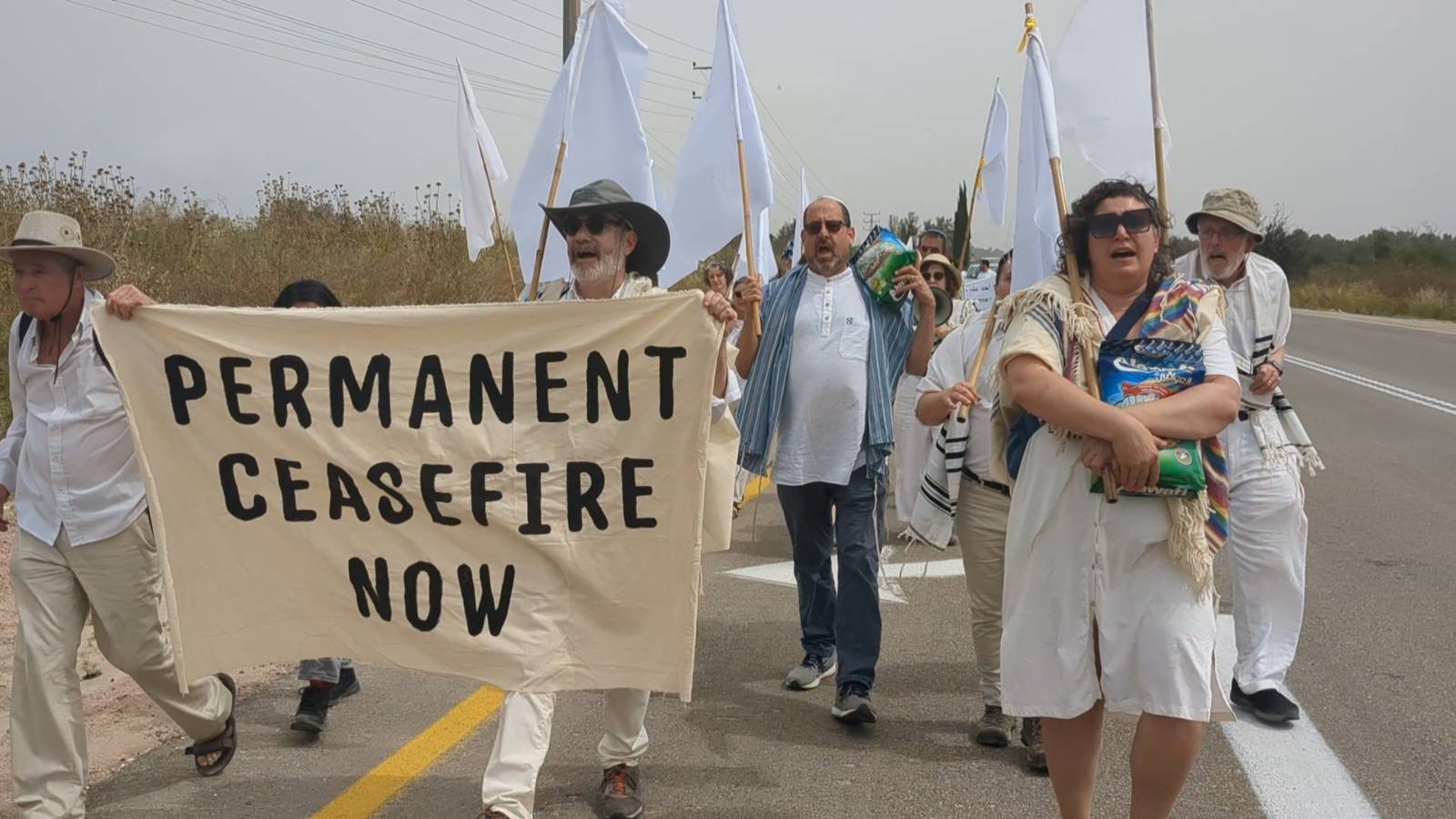
As a political-spiritual response to this unprecedented Passover moment, Rabbis for Ceasefire mobilized and began to organize as action at the Gaza border, to literally bring food supplies with us and demand to that Israel allow us to pass through the Erez Crossing, motivated by Passover’s central imperative, “All who are hungry come and eat!” Our action would include 10 American rabbis, writer/essayist Ayelet Waldman and 30 other Israeli activists – including Israeli rabbis – who have been tirelessly protesting both at the Gaza border and organizing protective presence for West Bank communities targeted by settler violence.

Our action was originally planned for the week leading up to Passover; but when Iran’s missile attack caused the country to go on alert and airlines cancelled their flights to Israel, we almost had to cancel our action. As we read the news, Israel’s escalating hostilities with Iran took front and center The US and the West were rearming Israel and focusing on the threat from Iran – even as Israel continuingly maintained its policy of starvation and bombardment of Gaza. Most alarming were the reports that an Israeli agreement to retaliate lightly against Iran would give them leeway to move ahead with a potentially disastrous ground invasion of Rafah.  We bought plane tickets for the next week, determined to make a collective Passover statement that felt more critical than ever.

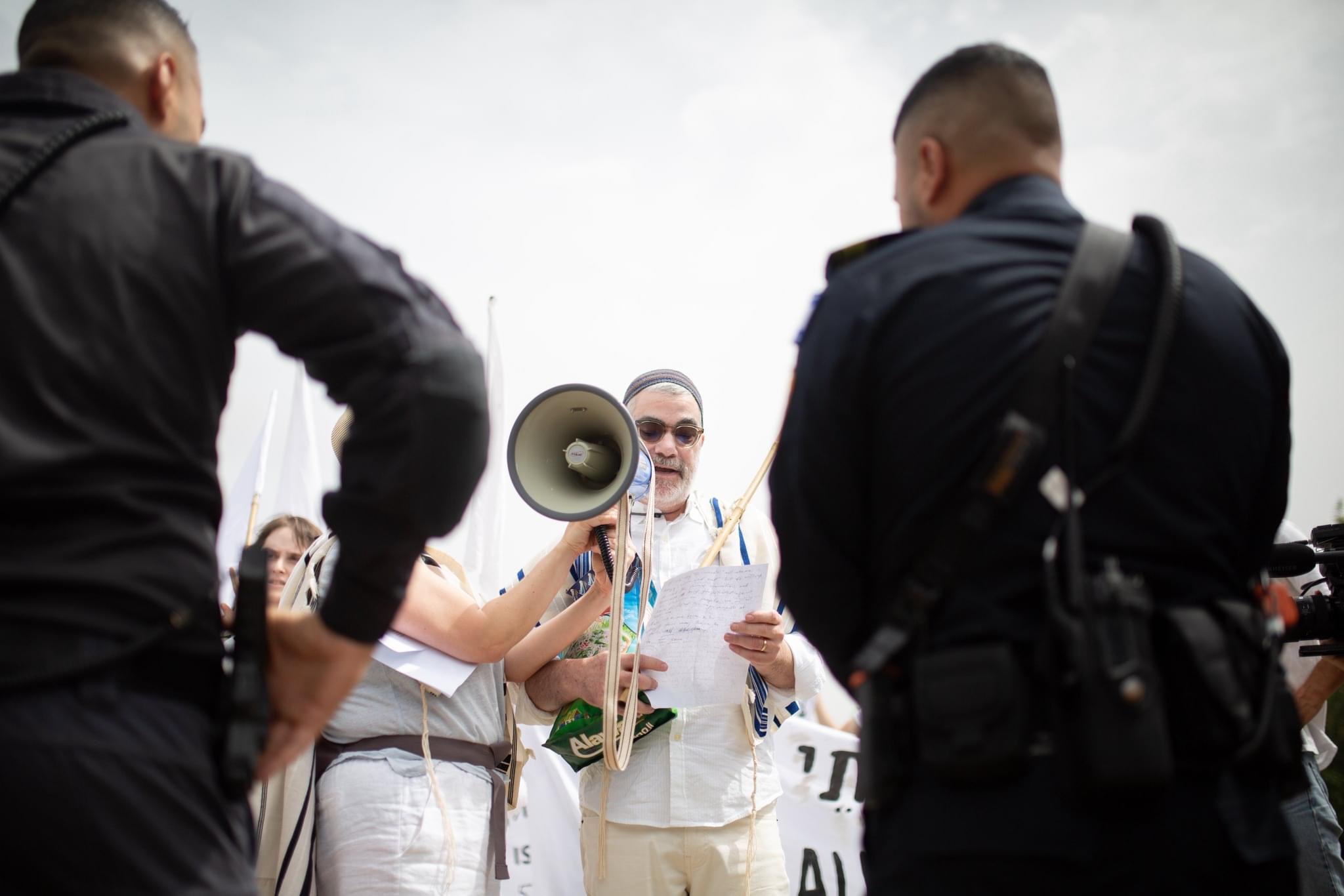
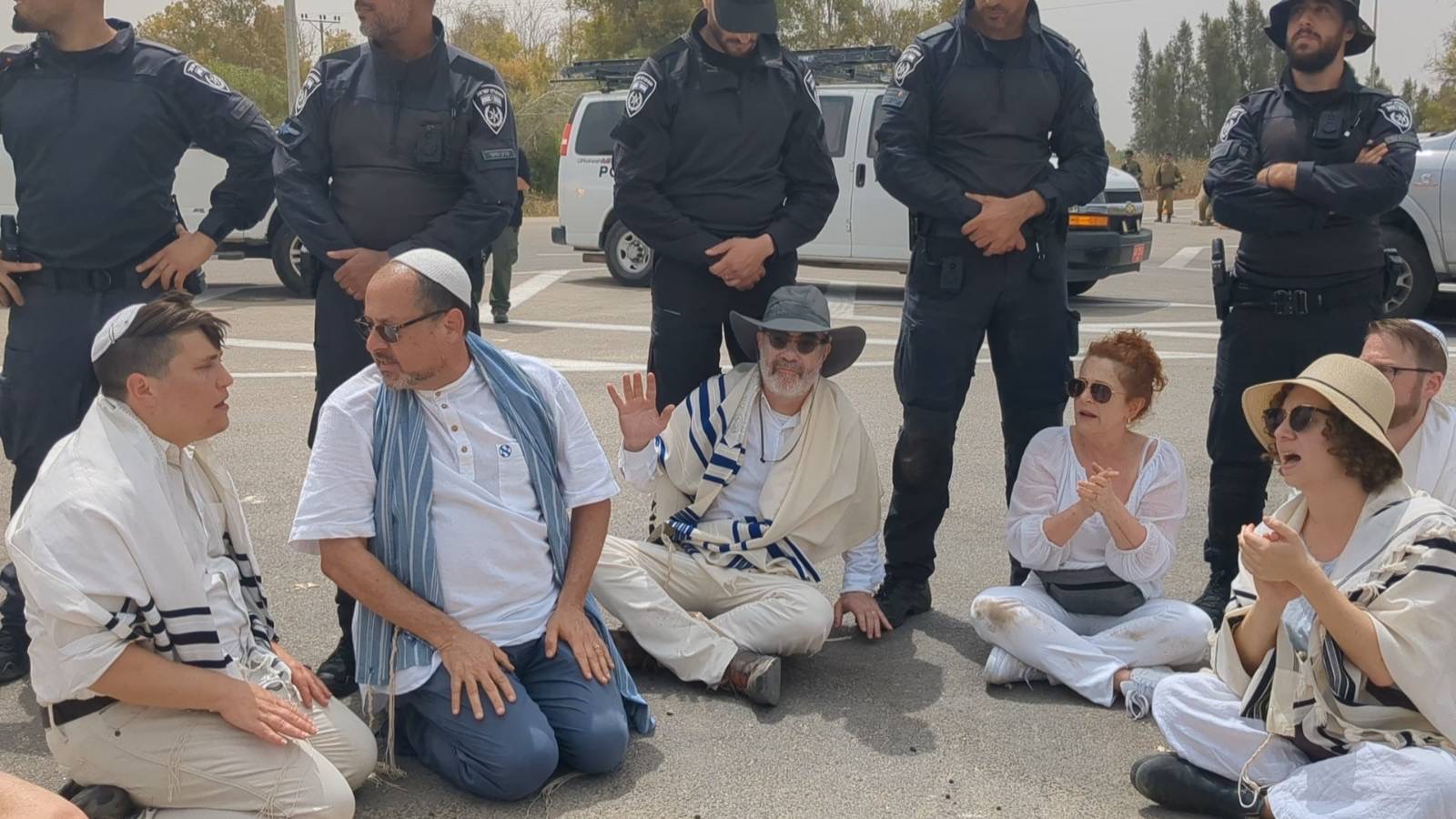
During our action, we gathered at a preplanned meet-up location, with a truck filled with half a ton of flour. We each shouldered backs of rice and, carrying banners and flags, march in the direction of the Erez Crossing. The Israeli police quickly drove up to intercept us. During that initial stand-off, several of us offered statements. I began with an opening prayer, an adaptation of the “Magid” section of the Passover Haggadah:

“This is the bread of affliction, the bread and food systemically, cruelly denied the people of Gaza. Let all who are hungry come and eat. Let all who are oppressed be liberated this Pesach. Now we are here – tomorrow let there be bread for Gaza. Now we are here – next year may there be liberation from the river to the sea!”

Other speakers included Israeli Rabbi Avi Dabush of Rabbis for Human Rights, a resident and survivor of a kibbutz that was attacked on October 7 and Noam Shuster-Eliassi, a well-known Israeli activist, writer and comedian. When our program was over, we pushed forward toward the border. When the soldiers violently attempted to break us up, several of us sat down in the road. During the course of the protest seven of our group: four Americans and three Israelis were arrested.

All of the arrested were fully prepared for this eventuality – the Israelis were in fact veterans at protest-arrests and had previously briefed us on protocol. They were taken to two dentention centers and interrogated for eight to nine hours. The American were told, perversely, that they were being held for “attempting to bring food into Gaza.” All the arrested were released that evening; thankfully the food we attempted to bring into Gaza was not confiscated; as we have previously planned, it was donated to the community of Masafer Yatta – an area in the South Hebron Hills were almost 3,000 residents are resisting the daily threat of demolitions, evictions and dispossession.

While we are satisfied with the attention our action has received, we have no illusions about the current moment in Gaza. Nearly 2.2 million Palestinians in Gaza currently face mass starvation and encroaching famine, these words have resonated with unbearably profound force during Passover this year. Hundreds of trucks filled with humanitarian goods have been sitting idle on roads leading into the Rafah crossing on the border with Egypt, blocked from entering Gaza by a draconian inspection process that severely limits the number of trucks that can pass through. Inside Gaza, the Israeli has been attacking efforts aid efforts with tragic results. According to the UN, the Israeli military has killed 196 relief workers; soldiers have also shot and killed hundreds of Gazans who venture out to seek food.

Amidst it all, the one agency that has the capacity and infrastructure to effectively distribute relief to the people of Gaza, the United Nations Relief and Works Agency (UNRWA), has been defunded by the Biden administration. This past January, the Israeli government leveled the still-unsubstantiated claim that 12 UNRWA employees were involved in Hamas’ October 7 attacks in Israel. Though UNRWA immediately fired the employees in question and launched an investigation, the US immediately withdrew their financial support of the agency, which was founded in 1949 to provide support to the hundreds of thousands of refugees created by the establishment of the state of Israel.

In its spending bill this past March, the US government extended its defunding of UNRWA for a year. Though the agency reports it has sufficient funds to operate until the end of May, its ability to operate in Gaza has already been gutted. Last month, Israel announced it would no longer approve UNRWA food convoys to the north of Gaza, where famine is the most. According to its report this month, the agency noted that “a total of 420 trucks food trucks were denied or impeded by Israeli authorities (during the month of March) …Gaza is on the brink of famine, with 1.1 million people—half of its population—experiencing catastrophic food insecurity due to the intense conflict and severe restrictions on humanitarian access.”

Most ominously, Israel continues to amplify its threats to invade Rafah, which would almost certainly result in massive human tragedy and the complete ethnic cleansing of Palestinians from Gaza. And yet, in the wake our action on the border, I continue to hold out hope. It is clear to me that our border-protest was part of something much larger: the dramatic rise in student resistance on college campuses throughout the US and unprecedented popular Palestine solidarity increasing around the world. For me, this moment expresses the core meaning of Passover powerfully than I have every experienced in my lifetime: in every generation, the cry of the oppressed demands to be heard.

This Passover, I also hold out hope from my own memory of meals in Gaza back in 2017. To be sure, AFSC’s Gaza staff has suffered terribly during this genocidal onslaught – and I’m sure the restaurants and neighborhoods where we enjoyed such delicious meals with our Gazan friends are no more. But I will never forget the tastes of the food that were so graciously served, as well as the communities in Palestine that they represent. And I am more convinced than ever that Israel cannot, try as it may, starve, bomb, or shoot away the Palestinian people’s love for their culture that is so deeply, fragrantly rooted in their homeland: In the words of El-Haddad:

Lately, I’ve been thinking about what I would go back to, and what I would find, if I returned to Gaza. Most of the landmarks have been destroyed. Gone too are many of the people I cherished. But … it feels like I am the torchbearer now, the family’s keeper of treasured recipes. Like Um Hani (Leila’s aunt, who was killed in an Israeli airstrike), I will cook and I will teach, connecting the next generation of Palestinians to our homeland.

How Do We Celebrate Passover this Year?

(AP Photo/Tsafrir Abayov)

So many people have told me that they are not sure how – or even if – they will celebrate Passover this year. With the genocide and forced starvation of the people of Gaza deepening with no end in sight, they say, it just feels beyond challenging to celebrate a festival of Jewish liberation. To make the moral dissonance even more dissonant, many in the Jewish communal establishment are framing Passover by focusing exclusively on the Israeli hostages in Gaza and call for their liberation from Hamas, with nary a mention of the 34,000 Gazans who have been destroyed in the process through a terrifying war of vengeance.

I personally understand this dissonance – and I certainly don’t begrudge those who choose to scale back or forgo Passover this year. Personally speaking, I’ve chosen to lean in to the festival nonetheless. Despite all the challenge and pain this Passover, I believe the festival can offer us a deeper understanding of what is really transpiring in Gaza at the moment, and how we might respond to it.

In some ways, it seems to me that Passover is a kind of lens that reveals the inner nature of Jewish identity itself, through the deep dialectic between the particular and the universal. For many Jews, Passover is first and foremost about us. This approach identifies deeply with the servitude and liberation of the Jewish people throughout our history, refracting the Exodus story against centuries of anti-Jewish oppression and Jewish survival.

However, this is certainly not the only way to read the Exodus narrative. This is, after all, a mythic story, and one that has been universally embraced by a myriad of spiritual, political and social liberation movements throughout history. Oppressed people and peoples other than Jews have long identified with the experience of the Israelites: MLK, for instance, would routinely frame the civil rights movement in the context of the Israelites’ struggle against the tyranny of Pharaoh in more than a few of his sermons and speeches.

As a Jew who cherishes the value of universalism, this is how I’ve come to understand the Exodus story and the festival of Passover: as a commemoration of Jewish struggle and liberation alongside so many others past and present. On every Passover in every generation, we must ask the question out loud: who is Pharoah and who are the Israelites? Indeed, in the age of Zionism, I believe this question resonates with deep moral reckoning. As I wrote in an article during Passover 2016 (with words I could have easily written in this very moment):

As I watch this tragic process unfold this Passover, I find myself returning to the universal lesson this festival imparts on the corrupt abuse of state power. Although the Exodus story is considered sacred in Jewish tradition, it would be a mistake to assume that the contemporary state of Israel must be seen as equivalent to the biblical Israelites.

On the contrary, any people who suffer under oppressive government policies are, in a sense, Israelites. And any state — even a Jewish state — that views a people in its midst as a demographic threat can become a Pharaoh.

In Tzedek’s seder supplement for this year, we make this universal moral assertion clear in our opening reading when we proclaim, If we read the Passover story as a story of Jewish liberation alone or – God forbid – Jewish liberation at the expense of others, we will not have fulfilled the requirements of the Passover seder. Through this approach to Passover, we reject the view that casts the Jewish people as eternal victims. We affirm that Jews are among a myriad of peoples who have struggled for liberation throughout history. And we reject the zero-sum mindset that other peoples’ freedoms must be swept aside in order to make way for ours.

I realize that this approach to Passover may feel a bridge too far for many Jews: either those who vehemently reject viewing Palestinians as Israelites, or those for whom it is just too painful to gather around the seder table at such a particularly tragic time. But I can’t help but believe that Passover – and Jewish spiritual tradition itself – is creative and resilient enough to give our community a way forward with moral courage, commitment and grace.

Sending blessings for a liberating Passover.

Our Vision of Liberation This Passover Must Include Palestinians

NASSER ISHTAYEH / SOPA IMAGES / LIGHTROCKET VIA GETTY IMAGES

Crossposted with Truthout

On Passover, when we gather at the seder table to tell the story of the Exodus, we are reminded by the haggadah (the seder text) that merely telling the story is not enough. We are asked to not only relate but to interrogate this sacred narrative, to contemplate its meaning and to discuss the questions it raises for us. Most importantly, we must connect the lessons of the Exodus story to liberation struggles “in every generation.”

This year, many have inevitably been making connections between the Passover story and the recent anti-government protests that have unfolded in Israel since January. In a widely read sermon last February, for instance, Rabbi Sharon Brous compared the protests to the “great birth story” of the Exodus. In a recent New York Times op-ed, Bret Stephens wrote that the protests were “as close to a revolution as the modern state of Israel has ever seen.” One Jewish leader commented to the press that he plans to read from the Israeli Declaration of Independence at his seder, particularly the passage that promises the “complete equality of social and political rights to all its inhabitants.”

On the surface, this framing might seem to make sense: Since late last year, thousands of Israelis have regularly been filling the streets to protest draconian policies proposed by the newly elected far right government of six-term Prime Minister Benjamin Netanyahu. The protests have largely focused on the “threat to democracy” posed by the government’s plans to drastically curtail the power of the judiciary. The demonstrations seem to have succeeded: late last month Prime Minister Netanyahu announced that he would seek a compromise with his political opponents in order to “avoid civil war.”

While this certainly seems like a “power to the people moment,” it’s worth asking: who exactly are the “people” who have taken back the “power?” Though it was not widely noted by the mainstream media, the protests were largely organized and attended by centrist and liberal Israeli Jews — Palestinians were notably absent. Indeed, it was difficult to ignore the sea of Israeli flags at these demonstrations, along with the drumbeat messaging over “saving Israeli democracy.” By the end, it had become clear that these protests were less about equal rights for Jewish Israelis and Palestinians alike than a desire to reclaim the patriotic Zionist mantle from a newly elected far right government.

In other words, before we’re tempted to connect the Israeli demonstrations to the festival of Passover, it’s worth investigating how we tell the story of liberation, who tells it, who we include, and who we leave out.

These questions are not, in fact, unique to this year. It is common for Zionists to refer to Zionism — the movement to build a political Jewish nation-state — as “the national liberation movement of the Jewish people.” Many might find this to be a curious use of the term, as it is typically used in regard to movements that struggle for liberation against colonial oppression — not settler colonial movements themselves. Such rhetoric belies the origins of an ideology inspired by 19th-century European nationalism and a movement that actively sought to transplant European Jews in historic Palestine.

However, even Zionists who view Jewish nation-statehood in liberative terms must ultimately admit that from the beginning, Zionism focused exclusively on Jewish liberation — and that this liberation most certainly did not extend to Palestinians. Quite the contrary, of course. As a nation-state whose identity was predicated on a demographic majority of Jews in the land, Palestinians were, through their very existence, viewed as an obstacle to Jewish liberation.

Israel’s Declaration of Independence makes it clear that this nation was created first and foremost for Jews. The 10 paragraph-long preamble essentially reads as a Jewish history lesson, ending with the line, “This right is the natural right of the Jewish people to be masters of their own fate, like all other nations, in their own sovereign State.” There is only one paragraph that pertains to the rights of non-Jews:

THE STATE OF ISRAEL will be open for Jewish immigration and for the Ingathering of the Exiles; it will foster the development of the country for the benefit of all its inhabitants; it will be based on freedom, justice and peace as envisaged by the prophets of Israel; it will ensure complete equality of social and political rights to all its inhabitants irrespective of religion, race or sex; it will guarantee freedom of religion, conscience, language, education and culture; it will safeguard the Holy Places of all religions; and it will be faithful to the principles of the Charter of the United Nations.

Note that the Declaration “ensures” social, political and religious — but not national — rights to its Palestinian citizens. This language is quite intentional: Israel considered Jews throughout the diaspora to be part of the “Jewish nation,” granting any Jew who immigrated to the state from anywhere in the world instant citizenship through its Law of Return. Conversely, the over 700,000 Palestinians refugees who were forcibly displaced from their homes and forbidden to return were decidedly not included as part of the newly established nation.

To this day, Israel has maintained a careful distinction between “nationals” and “citizens.” As non-Jews, Palestinians in Israel can be citizens, but they are not nationals, thus depriving them of rights and privileges enjoyed by Israeli Jews. As a result, to this day, there are more than 60 laws that discriminate against Palestinian citizens of Israel directly or indirectly, impacting virtually every aspect of their lives, including housing, employment, education, health care, and who they can marry.

The status of Palestinian citizens was compromised yet further in 2018 with Israel’s passage of the so-called Nation-State Law, which determined that “the right to exercise national self-determination” in Israel is “unique to the Jewish people,” established Hebrew as Israel’s official language, and established “Jewish settlement as a national value,” mandating that the state “will labor to encourage and promote its establishment and development.” According to Adalah:

This law – which has distinct apartheid characteristics – guarantees the ethnic-religious character of Israel as exclusively Jewish and entrenches the privileges enjoyed by Jewish citizens, while simultaneously anchoring discrimination against Palestinian citizens and legitimizing exclusion, racism, and systemic inequality.

Of course, the injustices facing the almost 3,000,000 Palestinians who live under military occupation in the West Bank — and the over 2,000,000 who live under a crushing blockade in Gaza — are dramatically worse than those experienced by Palestinian citizens of Israel. But it would be a mistake to draw a fundamental distinction between these different Palestinian populations. As the Israeli human rights organization B’Tselem puts it in its 2021 report, Israel maintains “a regime of Jewish supremacy from the Jordan River to the Mediterranean Sea.” Put simply, as a Jewish nation-state, Israel systemically denies basic civil and human rights to all non-Jews who live under its control.

It’s interesting to note that the “selective liberation” story we tell about Israel is not dissimilar from the story we tell about the establishment and history of another notable settler colonial state — namely, the United States. Indeed, I’m often struck that we typically use the term “American Revolution” to refer to what was essentially a political-economic secession by colonists from the British empire, whose nation was built on the genocide of Native peoples, enabled by the stolen labor of Black slaves.

Here too, it’s critical to interrogate how we tell the story of this national liberation, who tells it, who we include, and who we leave out. It has often been observed that the opening words to the American Constitution, “We the People,” is a radical misnomer as the founders originally defined “we” to be limited to white, property-owning males. This inherent inequity was already being openly challenged not long after the founding of the state. As Frederick Douglass famously declared in his 1852 speech, “What to a Slave is the Fourth of July:”

The rich inheritance of justice, liberty, prosperity and independence bequeathed by your fathers, is shared by you, not me. The sunlight that brought light and healing to you, has brought stripes and death to me. This Fourth of July is yours, not mine. You may rejoice, I must mourn.

When it comes to this legacy of American structural injustice, one can draw a direct line from Douglass to the words of Malcolm X, from his 1964 speech “The Ballot or the Bullet”:

No, I’m not an American. I’m one of the 22 million Black people who are the victims of Americanism. One of the 22 million Black people who are the victims of democracy, nothing but disguised hypocrisy. So, I’m not standing here speaking to you as an American, or a patriot, or a flag-saluter, or a flag-waver — no, not I. I’m speaking as a victim of this American system. And I see America through the eyes of the victim. I don’t see any American dream; I see an American nightmare.

At the same time, however, there remains a uniquely American tension between the “American nightmare” of Malcolm X and the “American Dream” referred to by Dr. Martin Luther King Jr. in his “I Have a Dream” speech, where he famously challenged the United States to be true to its stated intention to form a more perfect union: “I have a dream that one day this nation will rise up and live out the true meaning of its creed: We hold these truths to be self-evident, that all men are created equal.”

More recently, Nikole Hannah-Jones, author of the “1619 Project” has observed that “the United States is a nation founded on both an ideal and a lie.” Still, she concluded:

Despite being violently denied the freedom and justice promised to all, Black Americans believed fervently in the American creed. Through centuries of Black resistance and protest, we have helped the country live up to its founding ideals. And not only for ourselves — Black rights struggles paved the way for every other rights struggle, including women’s and gay rights, immigrant and disability rights.

Of course, we are currently witnessing a white supremacist backlash against those who seek to challenge the legacy — and reality — of American structural racism. As ever, Americans are struggling openly over how inclusive, extensive and complete our liberation will be. It is a tension that has been ongoing since the very founding of this country — it is at its core, a quintessentially American struggle.

In Israel, however, the struggle for democracy is far more complicated. As a Jewish state, Israeli democracy can only truly extend to its Jewish citizens. Unlike the U.S., where those who advocate equal rights for all can still be described as “believing fervently in the American creed,” those who call for one state with full citizenship for all are routinely accused of antisemitism, seeking nothing less than “the destruction of the Jewish state.”

Another important difference: unlike the U.S., Israel does not have a Constitution that, theoretically at least, ensures equal rights for its citizens. Noting Israel’s early, aborted attempts at creating a Constitution, journalist Joshua Leifer has recently commented:

America’s Constitution begins, “We the People.” One of the things that’s very striking when you read the drafts of the Israeli constitution that were written in 1950 is that the proposed version of Israel’s constitution began with “the Jewish people.” The ethnos was imagined as the demos from the beginning.

Like many Americans, I believe it is my responsibility to challenge my country to, as MLK put it, “live out the true meaning of its creed.” Among other things, this means actively supporting anti-racist struggles in the U.S. that demand full and equal rights for all its citizens. As an American Jew living in the age of Zionism, I can demand nothing less for all who live between the river and the sea.

As Aurora Levins Morales concludes in her classic poem “Red Sea:”

This time that country
is what we promise each other,
our rage pressed cheek to cheek
until tears flood the space between,
until there are no enemies left,
because this time no one will be left to drown
and all of us must be chosen.
This time it’s all of us or none.

This Passover, it is clearer than ever before that we need a new Jewish liberation story: one that is inseparable with the vision of liberation for all.

Resist Anti-Trans Legislation this Passover

Photo credit: Reuters/Brendan McDermid

This year, the Passover seder supplement I’ve composed for Tzedek Chicago highlights the rise of anti-trans hate legislation throughout the US. In addition to the reading, the supplement contains action components to help you participate in the resistance movement to the growing threat to the well-being of trans, non-binary, and gender non-conforming people.

As it concludes:

May the bitterness of this maror awaken us to resist and turn back all legislated hate directed toward trans, non-binary, and gender non-conforming people. Let us redouble our resolve to build a society that recognizes the tzelem elohim – the divine image – in all people – and a world that cherishes each and every one of us for all of who we are.

Here are a few more Passover resources that I’ve developed over the years – feel free to print out, share and use at your seders this week:

My 2010 Seder Supplement: “Four More Questions for Passover.”

My 2013 Seder Supplement: “The Four Children.”

My 2015 Seder Supplement: “Expanding the Telling.”

My 2017 Seder Supplement: “The Cry of the Canaanites.”

My 2018 Seder Supplement: “The 10 Sacred Acts of Liberation.”

My Passover prayer: “Your Child Will Ask.”

Chag Sameach – and may it be a liberating Pesach for us all.