
This past weekend JRC hosted a national conference for the regional organizers of Brit Tzedek v’Shalom. An eye-opening and informative two days concluded with a visit from Jeremy Ben-Ami, Executive Director of J Street (above, with outgoing BTVS Executive Director Diane Balser). Jeremy’s essential message, which resonated throughout our entire two day meeting, was that the peace process driven by the Obama administration currently has great momentum. He added, however, that realistically speaking, we have a 18-24 month window to produce meaningful results.
Jeremy used a football metaphor to describe the job of those in the Jewish community who currently advocate for the two-state solution: our job is to act as Obama’s front line, blocking for him and creating lanes through the opposition as he moves forward. To do this, he explained, we’ll have to consistently anticipate the opposition and stay two steps ahead of the administration in order to give him “room to run.”
One sobering example of this political tactic: Obama will eventually have to compromise on the settlements. There is clearly a stalemate between the US and Israel over this issue – and Jeremy explained that if the peace camp drew an unwavering line in the sand over the settlements, then the process would simply be dead at the starting gate. According to this view, it would be best for us to support a compromise on this issue now so that we can successfully maintain the momentum in the process.
As an active (if somewhat anguished) peace process advocate, I certainly grasp the wisdom of this approach. While my principled voice screams out, “What?!! Give up on the settlements? What kind of sham is this?!!” – my practical political voice responds, “Hey, that’s politics. It’s all well and good if you want to remain unsullied in your moral ivory tower, but if you really want to be part of the solution, you have to come down and get your hands a little dirty. If you want to play then you have to be part of the game. That’s just the way it works.”
I get this. I do. But I will confess that I haven’t truly been able to drown out either voice completely. While I do understand the art of political compromise, I also believe that there may well come a point in which some of us run up against a compromise that is simply unacceptable: one that essentially betrays the very ideals that compelled us to support this process in the first place.
Obviously, this point would be placed at different places by different people. And I’m well aware that there are those on both ends of the political spectrum who believe we’ve long since passed that point. But for for those of us somewhere in the murky middle, the reality is terribly complex – at times painfully so.
My friend Danielle Peshkin, in a comment to my last post, put it perfectly, I think:
It is always difficult, though necessary, to decide to when to sacrifice morality for strategic advantage in the long term advancement of your political goals. It’s equally difficult, though also necessary, to decide when sacrificing morality and justice for short term strategic gain will in fact harm the long term goal of establishing peace and justice.
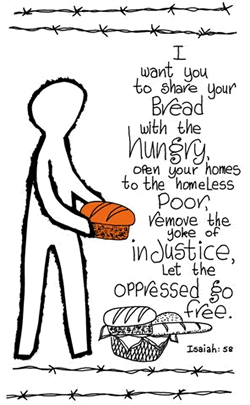 Learn to do good, seek justice; relieve the oppressed. Uphold the orphan’s rights; take up the widow’s cause. (Isaiah 1:17)

 It’s no longer speculation to imagine an Israeli military attack on Iran. Following his visit to Washington, Netanyahu
 This past Wednesday, JRC’s Peace Dialogue sponored a visit by longtime peace activist and nonviolence practitioner Kathy Kelly, who traveled to Gaza during the recent war.
 Shalom Rav