Category Archives: Peace

An Open Letter to Our Rabbinical Colleagues

This past week, rabbis across the country received a request from the Religious Action Center of Reform Judaism to sign a public rabbinic letter to Congress that urged our Representatives and Senators not to cut any foreign aid to Israel as part of the FY2012 budget. The request was co-signed by the rabbinical leaders of four major American Jewish denominations.

As rabbis who received these appeals for our endorsement, we would like to voice our respectful but strong disagreement to the letter. We take particular issue with the statement:

As Jews we are committed to the vision of the Prophets and Jewish sages who considered the pursuit of peace a religious obligation. Foreign Aid to Israel is an essential way that we can fulfill our obligation to “seek peace and pursue it”

We certainly agree that the pursuit of peace is our primary religious obligation.  Our tradition emphasizes that we should not only seek peace but pursue it actively.  However we cannot affirm that three billion dollars of annual and unconditional aid – mainly in the form of military aid – in any way fulfills the religious obligation of pursuing peace.

This aid provides Israel with military hardware that it uses to maintain its Occupation and to expand settlements on Palestinian land. It provides American bulldozers that demolish Palestinian homes. It provides tear gas that is regularly shot by the IDF at nonviolent Palestinian protesters. It also provided the Apache helicopters that dropped tons of bombs on civilian populations in Gaza during Operation Cast Lead, as well as the white phosphorus that Israel dropped on Gazan civilians, causing grievous burns to their bodies – including the bodies of children.

In light of Israel’s past and continuing military actions, how can we possibly affirm that our continued unconditional aid fulfills the sacred obligation of pursuing peace?

We also take exception to this assertion:

U.S. foreign aid reaffirms our commitment to a democratic ally in the Middle East and gives Israel the military edge to maintain its security and the economic stability to pursue peace.

In fact our ally, the Netanyahu administration, has even rebuffed mild pressure from the US government to comply with the longstanding US position against new settlements in the West Bank. If we believe that any peaceful settlement requires the end of the Occupation and Israel’s settlement policy, how will massive and unconditional foreign aid – and the support of hundreds of rabbis for this aid – promote a negotiated peaceful settlement of the conflict?

An Israeli government that continues to settle occupied territory with impunity will not change its policy as long as it is guaranteed three billion dollars a year.  With every other ally, our government pursues a time-honored diplomatic policy that uses “sticks” as well as “carrots.” We believe the cause of peace would be better served by conditioning support to Israel on its adherence to American and Jewish values of equality and justice.

We are also mindful that the Arab world itself feels under assault by the US when it witnesses Palestinians regularly assaulted with American-made weapons. With the vast and important changes currently underway in the Middle East, we are deeply troubled by the message that this policy sends to Arab citizens who themselves are struggling for freedom and justice.

We know that many of our colleagues who have signed this statement have taken courageous public stands condemning Israel’s human rights abuses in the past. We also know it is enormously challenging to publicly take exception to our country’s aid policy to Israel. Nonetheless, we respectfully urge our our colleagues to consider the deeper implications represented by their support of this letter.

Unconditional aid to Israel may ensure Israel’s continued military dominance, but will it truly fulfill our religious obligation to pursue peace?

In Shalom,

Rabbi Brant Rosen and Rabbi Brian Walt

In Memory of Juliano Mer Khamis

It is with great sadness that I note the murder of activist, actor, director Juliano Mer Khamis, the director of the Jenin Freedom Theater. Although there are currently conflicting press reports regarding the circumstances of his killing, Palestinian authorities have reported that he was shot five times by “Palestinian militants.”

Mer Khamis was a remarkable and inspiring man – the son of a Palestinian father and a Jewish mother who devoted his life to giving the young people of the Jenin refugee camp a healing, creative outlet in the midst of unbearably dire cirumstances.

From a powerful, heartbreaking tribute by Israeli journalist Dimi Reider:

Mer Khamis…has faced threats since forever: From conservatives in the camp who took a strong dislike to the theatre’s liberal repertoire and casting of both men and women, both boys and girls; from nationalists who saw him as an agent of the occupation, a promoter of normalization; and from just about every Israeli who commented on any news piece covering him and his activity.

There will be so much said and written about Juliano in the coming days. Friends and students will laud his tremendous bravery, his contempt for the walls and barriers – especially barriers of fear – that crisscross our country, his sense of stage, his talent. Enemies will pour mud on him, rejoicing in the death of one they see as a half-breed and a turncoat. Comrades will remember a complex and uneasy man, as famous for his rough temper as he was for his devotion to the cause.

I had the honor of visiting the Jenin Freedom Theater this past December with 20 members of my congregation. Although we didn’t get to meet Juliano personally, we can all attest to the inspiring fruits of his life’s work. May it live on forever. And may his memory be for a blessing.

I can think of no great honor to his memory that to watch “Arna’s Children” – an amazing 2003 documentary, co-directed by Mer Khamis, that profiles the history of the Freedom Theater. Please click on the clip above for the first installment. The following eight can be found on YouTube – search: “Arna’s Children.”

On Gaza and Jerusalem: The End of an Unsustainable Status Quo?

Like many, my heart just sank when I heard about the bus station bombing in Jerusalem today. Over the past two weeks we’ve witnessed the tragic, needless deaths of too many Palestinians and Israelis.

On this point I am in full agreement with MJ Rosenberg, who wrote today (in a post I strongly encourage you to read):

One thing is clear. Making reference to acts of violence by one side without reference to those inflicted by the other only perpetuates one side’s feelings of victimhood, reinforcing the sense of grief and grievance that leads to more violence.

Since I heard the news, I’ve been hoping and praying all day long that we aren’t witnessing the onset of a violent Third Intifada. I can only imagine what such a war might mean, not only for Israelis and Palestinians, but for the entire Middle East, which is several notches beyond tinderbox status already.

As yet, no one has claimed responsibility for the Jerusalem bombing and according to Ha’aretz, police don’t believe it was connected to the increase in rocket fire out of Gaza. Elsewhere in Ha’aretz, military analysts Amos Harel and Avi Issacharoff suggested that neither Israel nor Hamas want the Gaza confrontation to escalate into large-scale clashes. I can only hope their analysis is correct. (As I write, there are already reports that Israeli aircraft have struck at several targets, including a power station in Gaza City.)

Regardless of what happens in this latest round, it is clear that Israel is reaching the end of an unsustainable status quo. It was always a given that the current balance would not hold indefinitely. And now there are even larger, revolutionary changes occurring in the Middle East – whatever happens, Israel will certainly not be immune from this unprecedented upheaval.

Again from MJ Rosenberg:

Although Egypt still observes the terms of its treaty with Israel, that could change at any time. The Jordanian regime is shaky. Hezbollah now controls Lebanon. Syria grows ever closer to Iran. And Turkey, once Israel’s staunch ally, is so disgusted by Israel’s Gaza policy that it is a distant friend, at best. Even the Europeans are turning, with not even France, Germany, or the United Kingdom joining the United States in opposing a Security Council Resolution on West Bank settlements.

Israel’s best chance of surviving these dramatic changes is by resolving the conflict with the Palestinians. In fact, it is Israel’s only chance.

As he correctly concludes:

President Obama is the one person who can turn this situation around. History will not forgive him if, in the name of political expediency, he looks away.

Celebrate and Take Action This Tu B’shvat!

It’s utterly frigid here in Chicago. As I lose feeling in my toes, however, the Jewish calendar tells me it’s Tu B’shvat: the Birthday of the Trees, and the first harbinger of Spring.

And so my Tu B’shvat offerings for you:

An email I wrote on behalf of Jewish Voice for Peace: this Tu B’shvat, please take action to save trees and uprooted communities in Israel/Palestine;

– From the Velveteen Rabbi: a lovely two-page Tu B’shvat Haggadah that covers all the bases quite gracefully. (Mazel Tov to the Velveteen Rabbi, who recently received her smicha and is now, as she puts it, “running and playing with the real rabbis.” Rabbi Rachel: don’t you know you’ve been a “real” rabbi to many of us for quite some time now…)

– For Tu B’shvat reading material, I encourage you to read this inspiring piece on “Spiritual Environmentalism” by Wangari Maathai, Kenyan tree-planter extraordinaire:

Human beings have a consciousness by which we can appreciate love, beauty, creativity, and innovation or mourn the lack thereof. To the extent that we can go beyond ourselves and ordinary biological instincts, we can experience what it means to be human and therefore different from other animals. We can appreciate the delicacy of dew or a flower in bloom, water as it runs over the pebbles or the majesty of an elephant, the fragility of the butterfly or a field of wheat or leaves blowing in the wind. Such aesthetic responses are valid in their own right, and as reactions to the natural world they can inspire in us a sense of wonder and beauty that in turn encourages a sense of the divine.

That consciousness acknowledges that while a certain tree, forest, or mountain itself may not be holy, the life-sustaining services it provides — the oxygen we breathe, the water we drink — are what make existence possible, and so deserve our respect and veneration. From this point of view, the environment becomes sacred, because to destroy what is essential to life is to destroy life itself.

I feel my toes warming up already…

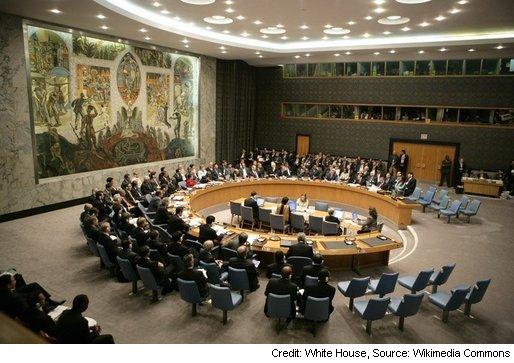
The Latest UN Resolution: Will Obama Do the Right Thing?

Will the Obama administration ever be ready to act as an honest broker in the Israeli-Palestinian peace process? Another test seems to be looming.

The following resolution, introduced by 120 co-sponsors, is currently pending the UN Security Council:

Israeli settlements established in the Palestinian Territory occupied since 1967, including East Jerusalem, are illegal and constitute a major obstacle to the achievement of a just, lasting and comprehensive peace.

On its face its not a particularly controversial claim. It more or less echoes long-held US policy on Israeli settlements. But of course when it comes to the UN, nothing is ever that simple.

What makes this situation a bit more interesting is that it is not only the usual suspects who are urging Obama to support the resolution. A letter signed by former US officials, prominent policy writers, academics and religious figures has just been released, calling upon the US to cast a yes vote.

An excerpt:

At this critical juncture, how the US chooses to cast its vote on a settlements resolution will have a defining effect on our standing as a broker in Middle East peace. But the impact of this vote will be felt well beyond the arena of Israeli-Palestinian deal-making – our seriousness as a guarantor of international law and international legitimacy is at stake.

America’s credibility in a crucial region of the world is on the line – a region in which hundreds of thousands of our troops are deployed and where we face the greatest threats and challenges to our security. This vote is an American national security interest vote par excellence. We urge you to do the right thing.

To be sure, the signators are not easily dismissible: they include former US Trade Representative and Council on Foreign Relations Chair Carla Hills, journalist and former New Republic editor Peter Beinart, former Under Secretary of State for Political Affairs Thomas Pickering, former Assistant Secretary of State James Dobbins, former Assistant Secretary of State Robert Pastor, former US Secretary of Defense Frank Carlucci and former US Ambassador to Israel Edward “Ned” Walker, among others.

It’s easy to be cynical about the UN, but it will still be interesting to see how this saga plays out. As Alex Spillius recently pointed out in The Telegraph, it may be Obama’s last chance to present himself as a fair dealer in this region.

If history is any indication, the final vote on this resolution will not be forthcoming any time soon. We can surely expect months of wordsmithing and back room dealing, and public posturing. Still, it certainly seems that there’s a bit more riding on this particular UN resolution than usual.

Stay tuned on this one.

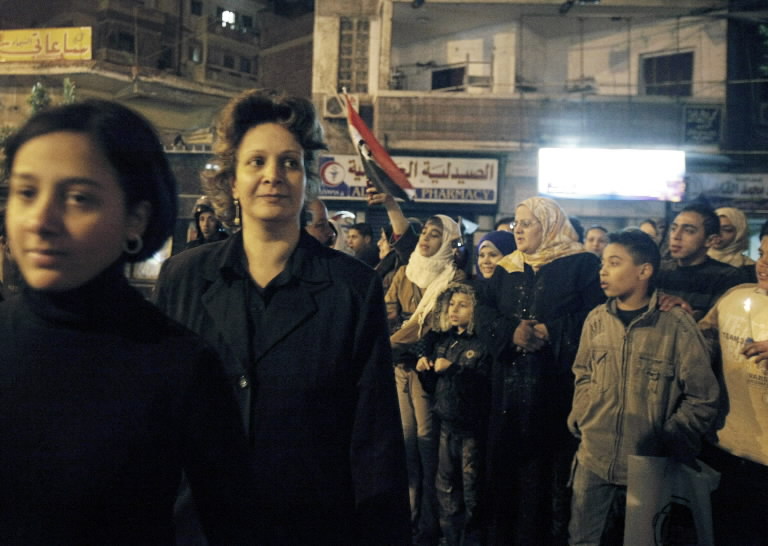
Not In Your Local Paper: Egyptian Muslims Protect Coptic Community With Their Bodies


Muslims protect and greet Orthodox Christians leaving the church where Alexandria bomb blast took place. (Photo: REUTERS/Asmaa Waguih)

An important and inspiring report out of Egypt. From AhramOnline:

Egypt’s majority Muslim population stuck to its word Thursday night. What had been a promise of solidarity to the weary Coptic community, was honoured, when thousands of Muslims showed up at Coptic Christmas eve mass services in churches around the country and at candle light vigils held outside.

From the well-known to the unknown, Muslims had offered their bodies as “human shields” for last night’s mass, making a pledge to collectively fight the threat of Islamic militants and towards an Egypt free from sectarian strife.

“We either live together, or we die together,” was the sloganeering genius of Mohamed El-Sawy, a Muslim arts tycoon whose cultural centre distributed flyers at churches in Cairo Thursday night, and who has been credited with first floating the “human shield” idea.

Among those shields were movie stars Adel Imam and Yousra, popular preacher Amr Khaled, the two sons of President Hosni Mubarak, and thousands of citizens who have said they consider the attack one on Egypt as a whole.

Sorry to see that this story has been virtually ignored by the mainstream media. It seems to have been broken by the Egyptian press, but other than a report on WaPo’s online edition, I could only see it covered via the blogosphere.

What else is new? When it comes to Islam, it seems, the actions of an extremist minority is considered newsworthy while the courage of the Muslim majority flies right off the radar screen.

Be sure to pass this one on…

JRC in Israel/Palestine: My Final Thoughts

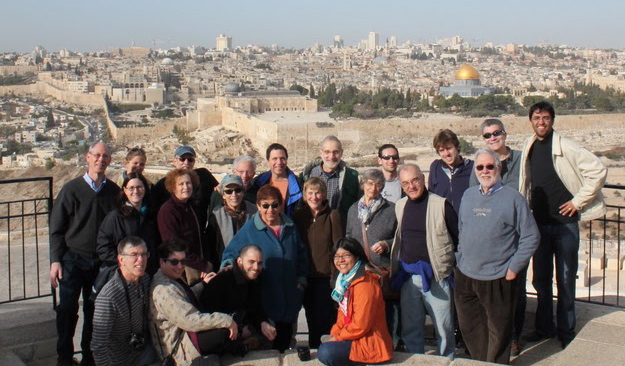
JRC Israel/Palestine Study Tour Participants 12/21/10 (Photo: Rich Katz)

My turn:

Our JRC Israel/Palestine Study Tour has been over for almost a week now, but I think I speak for everyone when I say it was a transformative experience for us all. I’ll also say that I am bursting with pride and admiration for my fellow JRC travelers.

I don’t know for sure, but I’m fairly certain this was an unprecedented Jewish congregational Israel tour. Most trips of this kind generally offer what I’d call a “hermetically-sealed” experience of Israel: an itinerary that remains largely west of the Green Line, offering participants a decidedly Jewish-centric perspective. I think most would agree it’s unusual for a rabbi to bring nineteen of his congregants on a trip that focused almost exclusively on East Jerusalem and the West Bank, spending the night in refugee camps, meeting with Palestinians, and learning from Palestinian civil society activists.

If I ever had any doubt, the reaction we encountered from those we met along the way drove this point dramatically home for us. Whenever we introduced ourselves and explained what we were doing, we’d invariably get the same open-mouthed reaction from our hosts. As the Israeli reporter Orly Halpern wrote me immediately after meeting with our group:

It was great meeting your open-minded and courageous congregation, Brant. Courageous because they were willing to hear the Other.

So yes, I’m very proud. Proud that we could take such a trip, and particularly proud of the congregational members who stepped forward to participate in it. Each and every one of them was willing to be deeply challenged – to lower their their ingrained defenses enough to face very real and painful truths – a reality that often directly contradicted the image of Israel with which they were raised.

Jewish Settlement in the heart of the Muslim Quarter (Photo: Rich Katz)

To be sure, it’s one thing to read about Israel’s oppression of Palestinians in the newspaper or hear about it second-hand; it’s quite another to witness it right in front of you where it’s impossible to rationalize or explain away. These congregants were willing to go places – literally and figuratively – where most American Jews remain resolutely unwilling to go. They were ready to let down their guard and be touched and transformed by what they saw.

And they were. Over and over and over again.

There will undoubtedly be those who will criticize us for taking a trip such as this, who will claim that our tour was “not balanced,” that is was unduly “biased,” that we didn’t take time to hear from the “other side.” I can’t help but be struck that these kinds of concerns are never raised when Jewish congregations organize Israel trips that pay scant attention to Palestinians and Palestinian life. And I don’t believe I’ve ever heard anyone in the American Jewish establishment criticize Birthright trips for being too “one-sided.”

I also believe that in our obsessive need to achieve balance, we conveniently ignore the fact that this is an inherently unbalanced conflict. As trip participant Marge Frank so eloquently put it in her previous guest post, “When one people is being oppressed and occupied by another, there is only one side to the story: that of the oppressed.” For most American Jews, it seems to me, the truth of Israel’s oppression of Palestinians is impossibly difficult to admit – and so we habitually explain it away, rationalize it, or deflect it in the name of balance.

With Daoud Nasser in one of the natural caves on his family farm, Tent of Nations (Photo: Rich Katz)

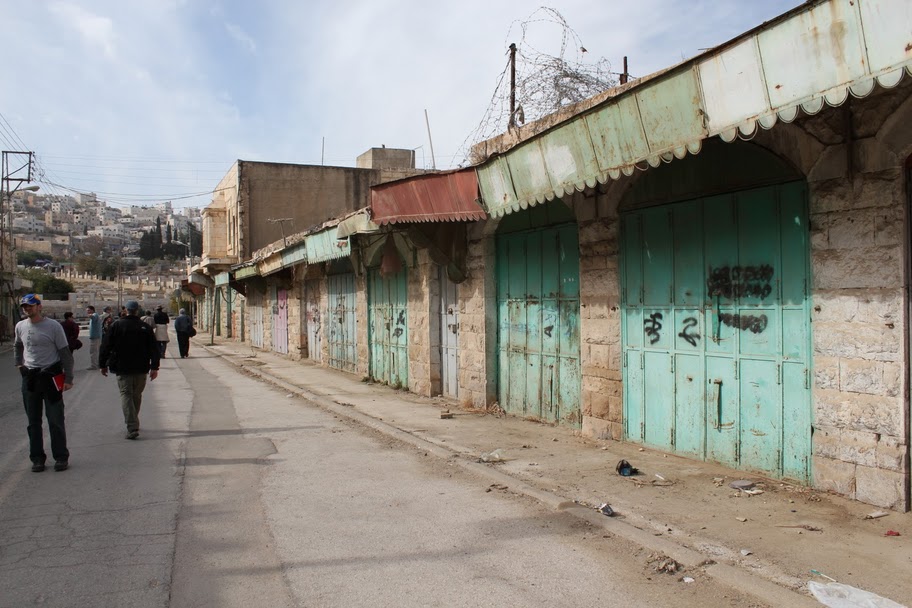
At the end of the day, the experiences I wrote about on my blog this past week weren’t mere isolated examples of Israeli bad behavior. The home demolitions in Silwan, the attempted expropriation of Daoud Nasser’s family farm, the dehumanizing checkpoints, the racial separation and settlers’ harassment in Hevron – in the end I believe these are all part of a larger fabric of persecution. As painful as this might be for us to admit, these are not merely exceptional blemishes on the face of an otherwise healthy state. If any of us had any doubt about this, it became painfully difficult for us to deny once we saw it with our own eyes.

Kobi and Aziz, Hevron (photo: Rich Katz)

While our group experienced some profoundly dark truths, however, we also bore witness to very real signs of hope: the resilience and dignity of the Palestinian people and the inspiring example of those Israelis who stand in solidarity with them. In this regard we had no more powerful example of than Aziz and Kobi, our Palestinian and Israeli tour guides – two very courageous men who have transcended their own painful pasts and are now devoting their lives to reconciliation, justice and peace. As every member of our group will agree, they were truly our guides in every sense of the word.

For myself, I’m irrevocably committed to this journey now – and I am heartened beyond measure to know that there are American Jews who are willing to take it with me.

Busy Hevron street, (H1) (Photo: Rich Katz)

Shehadeh St. in Hevron (H2), now rendered completely off-limits to Palestinians

Demonstration at Silwan Peace Tent, E. Jerusalem 12/24/10 (Photo: Rich Katz)

Translation: "There is no holiness in an occupied city." Silwan demonstration, 12/24/10 (Photo: Rich Katz)

From the Side of the Oppressed: A Guest Post From Palestine

Here is a guest post from Marge Frank, one of the participants from our trip:

Brant asked me to post on his blog, as the only Israeli-American on our tour, in order to add this perspective to the discussion.  I am honored to do so, albeit a bit overwhelmed as to how to choose what to share. This has been the most amazing, depressing, overwhelming, and transformative experience of my life and I’m still reeling from the multitude of emotions I’ve experienced.

Continue reading

Jerusalem From a Shared Perspective

We’ve just finished the first full day of JRC’s Israel/Palestine study tour – which we devoted to understanding and experiencing Jerusalem as a “shared holy city.” While this might sound like an obvious fact, many Jews today (including myself) have been raised and socialized to regard Israel, if you will,  as a “Jewish city that just happens to be important to some other faiths as well.”

To this end we made a point of visiting and spending time at the three main holy sites of the city: the Western Wall, the al-Aqsa Mosque and the Church of the Holy Sepulchre.  Afterwards we met with two Shaykh Yusuf Abu Sneina, Imam of the al-Aqsa mosque and Rabbi Yechiel Grenimann of Rabbis for Human Rights. Tomorrow morning we’ll be meeting with Revered Naim Ateek of the Sabeel Institute to round out our visits with faith leaders.

Our tour is being led by Aziz Abu Sarah and Kobi Skolnick – who are Palestinian and Israeli respectively. Both Aziz and Kobi are remarkable individuals with powerful personal stories. Aziz is a native of Jerusalem who became radicalized at a young age after the death of his older brother at the hands of the IDF. He became active in the youth movement of Fatah and participated extensively in Palestinian resistance actions during the First Intifada.

Aziz has since become actively involved in Israeli-Palestinian coexistence work. He was one of the original staff members of the Bereaved Parents Circle and works with Rabbi Marc Gopin at the Institute for Conflict Resolution at George Mason University. Aziz and Rabbi Gopin have also founded Mejdi, a business that promotes coexistence through educational tourism and small business cooperation. (You can read an extensive interview with Aziz here.)

Kobi’s story is no less amazing. Born into a Chabad family in Israel, he moved to a settlement in the West Bank during his high school years. There he become a member of Kach – the Jewish extremist movement founded by Rabbi Meir Kahane that actively promotes violence against Palestinians. During his service in the Israeli army Kobi went though a personal transformation as he confronted the reality of the conflict.

Today, Kobi is highly involved in the Israeli-Palestinian peace movement – he was one of the original members of Breaking the Silence and now studies conflict resolution. He travels widely as a trained mediator and facilitator.

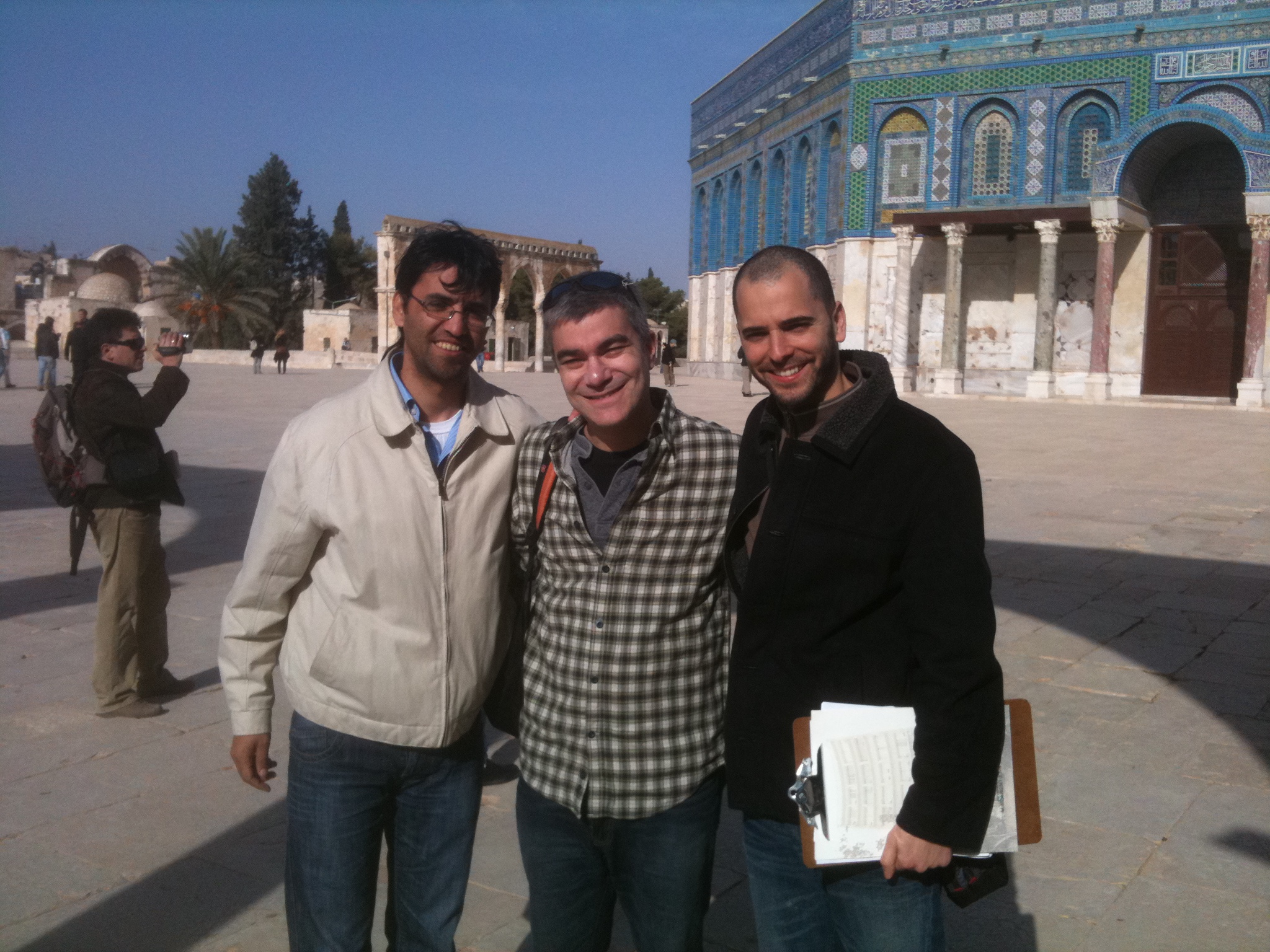
Among other things, the genuine friendship between Aziz and Kobi has powerfully affected the members of our group. Considering their respective backgrounds and personal journeys, their working relationship and very obvious affection for one another is moving and inspiring indeed. (The picture above was taken this morning at next to the Dome of the Rock. That’s me in the middle, with Aziz on the left and Kobi on the right.)

Tomorrow we’re off to tour East Jerusalem and Bethlehem before spending two nights in the Deheishe refugee camp. Stay tuned.

Tel Aviv, West Bank: A Tale of Two Demonstrations

Tear Gas in Nabi Saleh, Dec. 10, 2010 (Photo: Joseph Dana)

Please read this enormously important post by Israeli activist Joseph Dana, who attended nonviolent West Bank demonstrations in the Palestinian villages of Ni’ilin and Nabi Saleh yesterday. The twist is that these demonstrations happened to occur just as ten thousand Israelis were participating in a Tel Aviv march in honor of International Human Rights Day.

I first learned about these simultaneous events through Dana’s numerous tweets from the ground. Here’s a sampling:

– While the Human Rights March gets underway in Tel Aviv, I am on my to Ni’ilin/Nabi Saleh

– Ni’ilin demo underway while tel aviv marches

– While tel aviv marches for human rights, palestinians are attacked with tear gas

– Human rights day is underway, tel aviv is talking peace while ni’ilin and bil’in are under cover tear gas. I am on the way to nabi saleh

– 10000 people march in tel aviv for human rights and we could not get 20 israelis in ni’ilin. Upsetting

Dana later made the point explicitly in his blog post: for those interested in human rights, the real struggle is not occurring in the streets of Tel Aviv but in the villages of the West Bank, where Palestinian nonviolent activists are regularly brutalized by Israeli military forces. How differently things might have turned out if these thousands of Israelis had saw fit to demonstrate alongside Palestinians in Ni’ilin and Nabi Saleh?

The (Tel Aviv march) brought together various Israeli NGO’s and thousands of concerned citizens in the spirit of presenting a face of Israel that supports human rights and progressive values. Placards were carried through the streets supporting gay rights, woman’s rights, African refugees rights and, also, coexistence between Jews and Arabs. Police lined the streets of the demonstration to ensure the safety of the protesters and keep confrontation with the right wing counter protesters at bay (one has to hand it to the right in Israel, a counter protest to human rights?!). If the Tel Aviv Human Rights Day march wanted to have more authenticity in terms of Palestinian/Israeli coexistence, it should have had more connection with the human rights struggle happening simultaneously in the West Bank.

I’m in complete agreement. Those who seek human rights in Israel/Palestine would do well to support the cause of justice in the Occupied Territories – and in particular, the popular Palestinian committees whose demonstrations are regularly broken up by the IDF with violence and whose leaders are regularly imprisoned without cause.

To this end, I encourage you to this recent statement by Abdallah Abu Rahmah, a leader of the Bil’in popular demonstrations who was imprisoned by Israel a year ago (on, that’s right, International Human Rights Day). This past October, Abdallah was sentenced to an additional year in prison, with a six months suspended sentence for three years and a 5,000 NIS fine:

I often wonder what Israeli leaders think they will achieve if they succeed in their goal of suppressing the Palestinian popular struggle? Is it possible that they believe that our people can sit quietly and watch as our land is taken from us? Do they think that we can face our children and tell them that, like us, they will never experience freedom? Or do they actually prefer violence and killing to our form of nonviolent struggle because it camouflages their ongoing theft and gives them an excuse to continue using us as guinea pigs for their weapons?

My eldest daughter Luma was nine years old when I was arrested. She is now ten. After my arrest she began going to the Friday demonstrations in our village. She always carries a picture of me in her arms. The adults try to look after her but I still worry for my little girl. I wish that she could enjoy her childhood like other children, that she could be studying and playing with her friends. But through the walls and barbed wire that separates us I hear my daughter’s message to me, saying: “Baba, they cannot stop us. If they take you away, we will take your place and continue to struggle for justice.” This is the message that I want to bring you today. From beyond the walls, the barbed wire, and the prison bars that separate Palestinians and Israelis.

Click here to send a letter to Secretary of State Clinton requesting that she advocate the release of Abdallah Abu Rahmah and demand that Israel cease its targeting of the Palestinian popular resistance.