Category Archives: Pesach

Confessions of a Wicked Child: A Passover Reflection by Jay Stanton

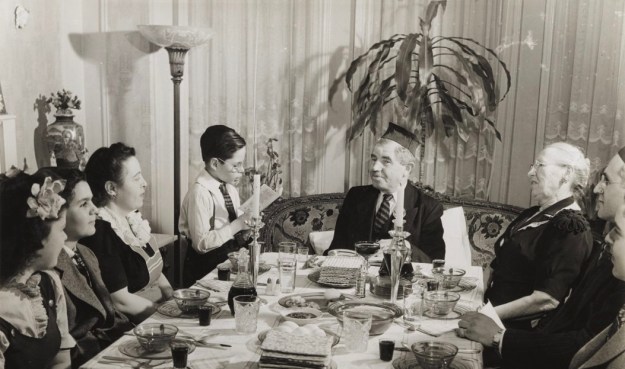
1930sArnold Eagle.jpegHere are the remarks that Jay Stanton offered at Tzedek Chicago’s Passover seder last night. Jay was formerly Tzedek’s rabbinical intern – and I’m delighted to announce we’ve just hired him to be part of our staff for the coming year:
In a traditional seder, four children are described: a wise child, who likes learning all the ins and outs of Jewish law, a wicked child, who pokes fun at the whole idea of a seder, a simple child who seeks basic information, and a child who does not know how to ask.  These archetypical children help us explore what it means to fulfill the mitzvah of telling our children about the Exodus from Egypt.

I have a confession to make; I am a wicked child.  Of course, there are the ways society and the Jewish community in general have cast me as the wicked child: being queer and trans and supporting Palestinian rights not least among them.  But I’m also a self-identified wicked child. I am personality-wise and ethically the kind of person that voices my disapproval of standard approaches and doesn’t care what you think of me in response.  I’m a contrarian by nature, and I like asking difficult questions. Last year at this time, I asked all of us what we were doing here when we could be somewhere else doing something to make the world better.  And here we are this year, doing this peculiar ritual yet again.

I’m a wicked child.  I want to know what this means to you and why you think this is the way we should celebrate liberation.  Wouldn’t it be better to hear directly from people who have escaped modern slavery and to have real conversations about global abolition of slavery and how to establish reparations to address the ongoing legacies of slavery in America?  Plus, the Exodus never happened; the seder is an exercise in remembering alternative facts, which is to say lies.

I told you I’m a wicked child.  And I’m guessing I’m not the only one here.  Despair not! Wicked children are valued by Jewish tradition.  Because the Talmud values contrarians. Because the seder itself values the wicked child.  After their question, “What does this ritual mean to you?”, the wicked child is not sent to bed without their supper.  Instead, the parent responds in kind.

“This is because of what God did for me when I went free from Egypt.  For me, and not for you, because if you had been there, you would not have gone free.”  It’s a contrarian response, not a real argument. In our Exodus narrative, more people than the Israelites left Egypt together.  In Hebrew this is called ‘erev rav, translated as a very diverse group or coalition.  I imagine the wicked children marched out of Egypt as part of the liberation coalition, where they found ample opportunity to critique the choices of the liberatory leaders, like leading the group directly to a body of water while being chased by the Egyptian military.  Maybe a frustrated wicked child yelled at Moses, “What are you going to do now? Hold up your staff and just wait for God?!”

Voices of critique and dissent have pushed our conversation toward progress, inclusion, and more ethical behavior for thousands of years.  They are enshrined in Talmud and indeed in the Haggadah. Judaism is enriched, not threatened, by a multiplicity of opinions and approaches.

To put it differently, the vital role of wicked children in our Passover seder exemplifies spiritual freedom.  Spiritual freedom, one of Tzedek Chicago’s core values, is more than active inclusion of atheists, agnostics, and non-Jews in our midst.  It is an affirmation of the ‘erev rav as a diverse, universalist community, and it is an elevation of critique from an obstacle to overcome to a necessary part of collective liberation.  We not only allow the wicked child to derail the Passover seder, we need them. Judaism needs its wicked children.

Just as political freedom provides a check against political tyranny, spiritual freedom provides a check against spiritual tyranny.  Both human and so-called divine spiritual authority have tendencies toward the coercive and oppressive. We could dismiss this problem as one that only affects the religious right. However, we are also at risk of spiritual tyranny here at Tzedek Chicago. We could give too much power to our spiritual leader and follow Brant even if and when he’s wrong, but spiritual freedom gives every one of us the tools to speak up if Brant starts leading us down the wrong path.  We are a community for people who share Tzedek’s specific values, and we say freely that people who object to them can find other Jewish communities. There’s not much distance between that and establishing some kind of review committee to determine whether you faithfully adhere to every line of each of our core values in every aspect of your life. Don’t worry; we’re not going to establish an Inquisition. Spiritual freedom ensures we are universalist not only in our outcomes but also in our process. When our leaders are wrong or when we feel excluded, we get to speak up and remain wicked children at the table.

As a wicked child, I wonder how the rest of the wicked child Passover conversation goes.  If I were continuing it, I would caution the parent, saying “Now you sound like the oppressor.  Do you want to be like Pharaoh?!”

Mah ha’avodah hazot lakhem?  What does this ritual mean to you?

Olives and Maror: A Seder Supplement in Honor of the Great Return March

636604238221814980-AFP-AFP-14D8ER

photo: AP

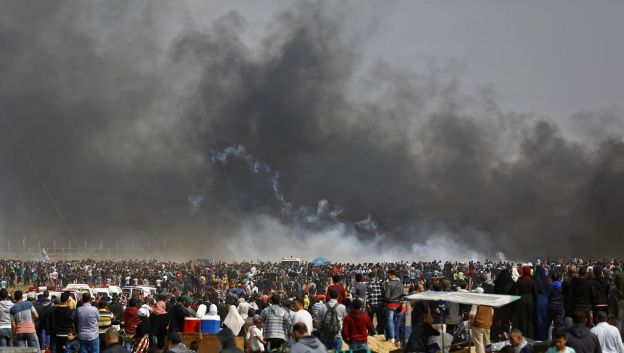
Here is an excerpt from my new Passover seder supplement, “Olives and Maror – The Great Return March:”

And so, on this night of Passover we affirm: we cannot gather to tell the Exodus story without acknowledging the liberation narrative that is currently unfolding at the Gaza border. We affirm further: if we remember our own persecution yet fail to call out Israel’s persecution of the Palestinian people, our seder will not be complete.

We now combine maror and olives, to acknowledge the bitterness of lives lost and dreams denied – together with the eternal hope of justice and return. Let us redouble our resolve to do our part to make these hopes and dreams a reality bimeirah be’yamneinu – speedily and in our own day.

Click here for the entire supplement to print out and read at your seder table this year. (Click here, here, here and here for supplements I’ve written in previous years.)

Celebrate Passover with Solidarity

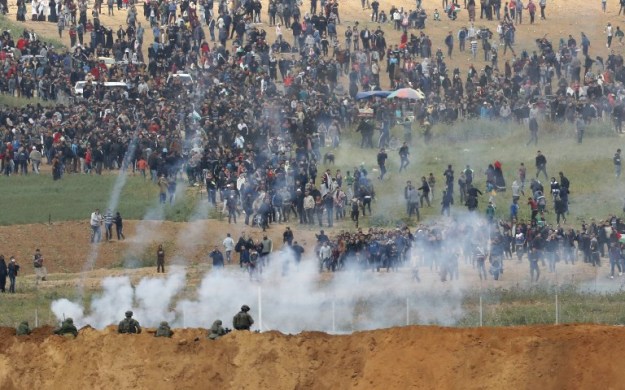
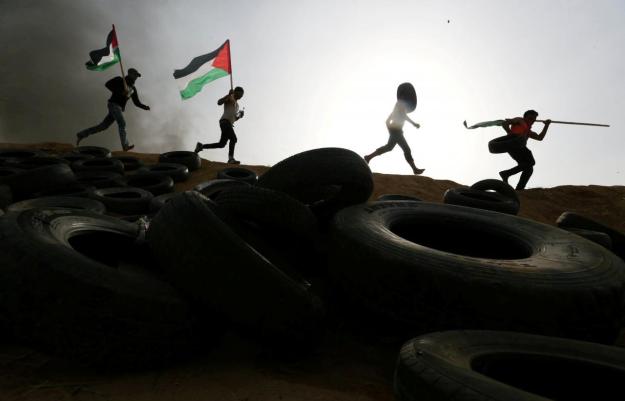
Palestinian protesters run during clashes with Israeli troops at Israel-Gaza border, in the southern Gaza Strip

As I write these words, there are reports that three Palestinian nonviolent protestors have been killed and scores more injured in the second week of protests at the Gaza border. By some perverse serendipity, both last week and this week’s massacres have occurred on Jewish holy days – the start and the end of Passover. For many of us, it has been difficult, if not impossible, to get into the spirit of the festival. How on earth do we remember our ancestors enslavement and celebrate our liberation amidst reports of Israeli snipers shooting down nonviolent protestors behind fences 15 kilometers away? How do we square the lessons of Passover with the Israeli prime minister’s cynical statement: “My respect goes to the Israeli soldiers who are guarding Israel’s borders, allowing Israelis to celebrate the holiday in peace.”

To those who are struggling to celebrate Passover amidst such sacrilege, I’ll quote from Tzedek Chicago’s core values:

We are inspired by prophetic Judaism: our tradition’s sacred imperative to take a stand against the corrupt use of power. We also understand that the Jewish historical legacy as a persecuted people bequeaths to us a responsibility to reject the ways of oppression and stand with the most vulnerable members of our society… As members of a Jewish community, we stand together with all peoples throughout the world who are targeted as “other.”

In other words, we assert the universal meaning of the Exodus story. This sacred narrative is not – and cannot – be about us alone. If we truly hold that God stands with the oppressed and calls out the oppressor, then Passover demands that we stand with the Palestinians of Gaza. Indeed, I wrote as much at the end of Passover 2016:

As I watch this tragic process unfold this Passover, I find myself returning to the universal lesson this festival imparts on the corrupt abuse of state power. Although the Exodus story is considered sacred in Jewish tradition, it would be a mistake to assume that the contemporary state of Israel must be seen as equivalent to the biblical Israelites.

On the contrary, any people who suffer under oppressive government policies are, in a sense, Israelites. And any state — even a Jewish state — that views a people in its midst as a demographic threat can become a Pharaoh.

I respect that the Passover spirit is not coming easily to many of us this year. I can only suggest that the most meaningful way we can observe the holiday – this year and every year – is to stand in solidarity with the Palestinian people.

Shabbat Shalom and Chag Sameach,

Rabbi Brant Rosen

Seder at the Mountaintop: A Guest Post by Jay Stanton

mking_mountaintop
Delivered by Rabbinic Intern Jay Stanton at the Tzedek Chicago Passover Seder, April 4, 2018.

I have been thinking about the legacy of Martin Luther King, Jr. Today marks 50 years since his assassination, and I have been thinking about how blessed we are by Dr. King. Although his dream of racial equity is not yet realized, King’s vision of a just world and of a beloved community benefits us all. Still on the march to freedom, we shall not be moved. In the words of Ella Baker, “We who believe in freedom cannot rest.”

So tonight bothers me. Why are we here? What are we doing here? We could be spending our time in so many immediately effective ways. We could be on the picket line with striking teachers in Oklahoma and Kentucky. We could be outside the Israeli Embassy protesting the shooting of unarmed Gazan civilians. We could be praying with our feet. Instead, we’re here, engaged in a ritual that involves praying with our taste buds. Why not abandon the traditional Passover rituals and observe the holiday by working for justice? In familiar words, why is this night different from all other nights?

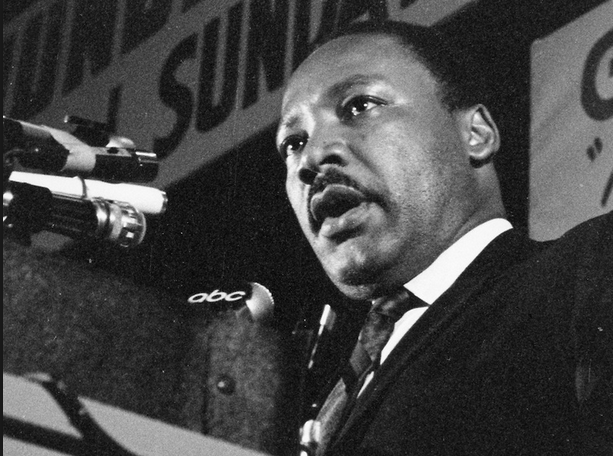
I found the beginnings of an answer in the speech Dr. King gave the day before he died. Often referred to as the “Mountaintop” or “I’ve been to the mountaintop” speech, the remarks he offered on April 3, 1968, on behalf of sanitation workers in Memphis are striking (pun intended). The most revisited part chronicles Dr. King’s prophetic sense of his imminent demise. But in the beginning, King imagines the extraordinary opportunity of standing with God.

In Dr. King’s imagination, God offers to take him to any point in time. Martin Luther King says:

I would take my mental flight by Egypt and I would watch God’s children in their magnificent trek from the dark dungeons of Egypt through, or rather across the Red Sea, through the wilderness on toward the promised land. And in spite of its magnificence, I wouldn’t stop there.

Though King’s choice is obvious, his purpose is not. Stopping in liberatory moments where freedom of thought and freedom of action expanded, he brings his listeners on his imagined journey through time. Finally, he arrives at the liberatory moment of the Poor People’s Campaign.

After acknowledging the injustices of his world, King continues:

Something is happening in our world. The masses of people are rising up. And wherever they are assembled today, whether they are in Johannesburg, South Africa; Nairobi, Kenya; Accra, Ghana; New York City; Atlanta, Georgia; Jackson, Mississippi; or Memphis, Tennessee – the cry is always the same: “We want to be free.”

Dr. King echoes a core aspect of the Passover seder. We say bejol dor vador jayyav adam lir’ot et ‘atzmo ke-ilu hu yatza mimitzrayim – in every generation, each person must see themselves as if they themselves went free from Egypt. This fulfills the verse “You shall tell your child on that day that God freed you from Egypt with a strong hand and an outstretched arm.”

We often take this as an echo of Torah’s most repeated rule. Having been strangers in Egypt, we must be kind to the stranger. But we don’t need a seder to have empathy for the stranger. Researchers at the Max Planck Institute have shown that the best way to cultivate empathy is habitual activation of a structure in the brain called the right supermarginal gyrus. We can activate our brain’s empathy structure by focusing on others. Increasing empathy cannot be the effect of telling our story.

Our seder tells us something different, tells us something Dr. King tells us in his Mountaintop speech. For King, humanity is always striving to become free, and God is always liberating the oppressed; today’s freedom marches are the same in sacred time as the Exodus from Egypt. When we see ourselves as if we went forth from Egypt, we live in that sacred moment.

Our seder allows us to live through the Exodus mythologically. Then, not only can we have empathy for the oppressed, we can share the joy of redemption and participate in liberation. For those of us currently experiencing oppression, the seder’s ritual journey allows us to memorize a feeling of having been liberated, which we will recognize when we get there.

In his Mountaintop speech, Dr. King details the ways demonstrators remained unfazed by Bull Connor’s violent tactics, stressing that liberation starts in the mind. Tonight, those of us facing oppression remember that Jews observed Passover even while oppressed – in the ghettos and shtetls of Europe and by the double standard of dhimmi status in the Middle East and North Africa. Black Jewish slaves in the American South also observed Passover, even while owned by Jews. (Yes, there were Jewish slaves and Jewish slave owners in America – feel free to ask me about it later. Can you imagine slaves serving at a Jewish master’s seder and then holding their own seder during the night?) Tonight, the oppressed among us, and those too oppressed to be here with us, assert that our liberation is God’s objective. Ain’t nobody can turn us ‘round.

For those of us currently experiencing freedom, the seder’s journey cultivates gratitude for our liberation and solidarity with the oppressed. Focusing on the Exodus story allowed Dr. King to emphasize solidarity with the striking workers in Memphis. Desegregation was an important step toward collective freedom for Black Americans, but desegregation did not solve the economic injustices of Black generational poverty and wage discrimination. As King points out in his journey through the history of liberation, our specific liberations, whatever they may be, are only pieces of a greater process of redemption. If we are free while others remain oppressed, we are still living in the bondage of a narrow place.

For most of us in this room, the reality is that we experience both oppression and freedom in different moments and in different ways. Some of us may experience sexual harassment at work but enjoy equal partnership at home. Some of us may be targeted by police because of the color of our skin but know simultaneously that Black is beautiful. Some of us may encounter hate from our family members concerning sexual orientation or gender identity, but enjoy the support of our queer beloved community. Some of us may encounter antisemitism from our Congressional candidates or in the newspaper, but benefit from white privilege.

We may be targets of oppression based on class, ability, immigration status, and religious affiliation, to name a few, but none of us are enslaved. We share the freedom of movement that allows us to be in this room tonight. We share the freedoms of religion and free association that allow us to have a seder here tonight. The seder, like our lives, reflects both our oppression and our liberation.

Right now, I invite you to step into this night of transformation. The root of the word “nishtanah” in mah nishtanah is change. What will change on this night, as opposed to other nights? I invite you to open your heart to be transformed by tonight. So that tomorrow when you take action for justice, you experience sacred time. So that tomorrow when you take action for justice, you know that you have been liberated. So that tomorrow when you take action for justice, you have gratitude for the freedom you enjoy. So that tomorrow when you take action for justice, you have a sense of history. So that tomorrow when you take action for justice, you stand on the shoulders of your elders. So that tomorrow when you take action for justice, you do so in a beloved community. So that tomorrow when you take action for justice, you are in solidarity with all the oppressed. So that tomorrow, when you take action for justice, you will not be moved.

Once we were slaves. Now we have been freed. How does that change you?

Passover in Gaza

ISRAEL-PALESTINIAN-CONFLICT-GAZA

Based on Exodus 14:1 – 11

they encamped at the edge
of the buffer zone
no pillar of cloud no pillar of fire
only the burning of their hearts
and a dream of return

pharaoh said do not worry
we’ve trapped them in the land
locked them inside the desert
now let us harden our hearts
that they may truly know
who is the lord

so they harnessed their chariots
amassed along the border
snipers took their positions
while officers and generals
waited to give the command

when their sacred day came
the people began their march
lifting their eyes
they could almost see their homes
just a few kilometers and
a lifetime away

when the order came down
the angel of death was unleashed
bullets hit bodies and
a pillar of tear gas descended
on the people as they
cried out to the lord

after the sun set
we sat down to our meal
but when the time came to
open the door of redemption
we were too caught up
in the joy of our song
to hear their voices:

Is it for want of graves
that you leave us here to die
in the desert?

A Seder Supplement for Passover 5778: “The 10 Sacred Acts of Liberation”

parting_waters

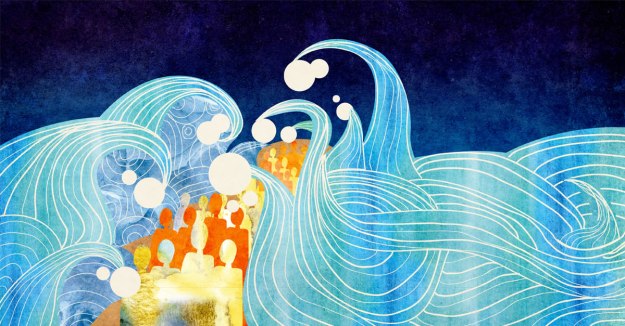
Here’s the introduction to my new Passover seder supplement, designed to be used alongside or instead of the 10 Plagues section. Click here for the entire text to print out and read at your seder table this year. (Click here, here, here and here for supplements I’ve written in previous years.)

In the traditional seder, we are instructed to take one drop of wine for our cups to “reduce our joy” over the pain God inflicted upon the Egyptian people through the 10 plagues. Tonight, we choose to increase our joy by taking a sip of wine as we acknowledge 10 sacred acts of liberation we learn from the Exodus story. May we heed these lessons in every generation!

Haifa, 1948: Sweeping Away the Chametz

unrwa-beach_2-1

Palestinians fleeing Haifa, April 22, 1948 (Photo: UNRWA)

Rabbi Yehuda said: There is no removal of leaven except by burning; but the Sages maintain: he may also crumble and throw it to the wind or cast it into the sea. (Mishnah Pesachim 2:1)

On the eve of Passover, April 21, 1948, leaflets and loudspeakers fell from the sky ordering the 75,000 Palestinian Arabs of Haifa to send their women and children away, promising terrible consequences if these warnings were disregarded.

At 6:30 pm a joint force of the Haganah and Irgun known as the Carmeli brigade opened fire on the lower regions of the city. The military called this “Operation Biur Chametz,” (“Operation Cleaning Out the Leaven”) a reference to a sacred Jewish tradition, commanding that leaven be swept out of Jewish homes before the onset of Passover.

This strange cacophony of loudspeaker voices and gunfire lasted until midnight. All night long, panic stricken civilians fled homes that lay in the path of the Jewish militias streaming into Wadi Nisnas and the areas nearest Hadar HaCarmel.

By Passover morning the Irgun forces were making progress. As Menachem Begin later remembered:

We proceeded to advance through Haifa like a knife through butter. The Arabs began fleeing in panic, shouting “Deir Yassin!”

By 6:00 am, the cacophony now included the cries of fleeing families and new loudspeaker voices – Arab leaders urging residents to gather in the old marketplace next to the port until an orderly evacuation by sea could be organized.

As Passover day unfolded, Haifa’s market and port turned into a scene of utter chaos: children in pajamas, men in old fashioned nightshirts, women carrying babies, all running desperately toward the water. Shortly thereafter, the Carmeli brigade stationed itself on the slopes of Mt. Carmel and launched three inch mortars on the fleeing crowd below. Eventually the people broke through the port and tried to climb aboard the boats moored in the harbor. One survivor later recalled:

Men stepped on their friends and women on their own children. The boats in the port were soon filled with living cargo. The overcrowding in them was horrible. Many turned over and sank with all their passengers.

When the week of Passover was concluded, scores of Palestinians had been killed and 50,000 expelled from their homes.

The cacophonies have long since receded and today a soft stillness hovers over the slopes of Mt. Carmel. But every Passover, if you listen closely to the water lapping back and forth across the the shores of Haifa you will surely hear a voice whispering softly:

How can you sing your songs of joy while my children are drowning?

(Sources: Benny Morris, “The Birth of the Palestinian Refugee Problem Revisited,” Ilan Pappe, “The Ethnic Cleansing of Palestine,” Menachem Begin, “The Revolt: The Inside Story of the Irgun,” Walid Khalidi, “All That Remains: The Palestinian Villages Occupied and Depopulated by Israel in 1948,” website: “Palestine Remembered.”)

All Pharaoh’s Must Fall: A Passover Reflection on Sean Spicer

2017_0412spicer

(Crossposted with Truthout)

White House Press Secretary Sean Spicer has suggested that Syrian President Bashar al-Assad is worse than Hitler, because, “Even Hitler didn’t sink to using chemical weapons.” He later added the “clarification” that “[Hitler] was not using the gas on his own people the same way that Assad is doing.”

There are so many things that are so horribly wrong about Spicer’s comments, it’s difficult to know where to start. I’ll limit myself to four points (and I’m not even going to touch his inscrutable reference to “Holocaust centers”):

#1: Our own allies have used US-supplied chemical weapons.

During its 2008-2009 military assault on Gaza, Israel dropped white phosphorous – a chemical that burns flesh down to the bone and can cause fatal damage to the liver, kidneys and the heart – on densely populated civilian centers.  Human Rights Watch (HRW) later issued a 71-page report, “Rain of Fire: Israel’s Unlawful Use of White Phosphorus in Gaza,” which provided numerous “witness accounts of the devastating effects that white phosphorus munitions had on civilians and civilian property.”

Israel initially denied its use of white phosphorous, but when faced with overwhelming evidence, it admitted it did indeed deploy this chemical, claiming it only used it as a smokescreen to protect its troops. This statement, too, was false. HRW’s Fred Abrahams pointed out:

In Gaza, the Israeli military didn’t just use white phosphorus in open areas as a screen for its troops. It fired white phosphorus repeatedly over densely populated areas, even when its troops weren’t in the area and safer smoke shells were available. As a result, civilians needlessly suffered and died.

HRW also noted that “all of the white phosphorus shells that Human Rights Watch found were manufactured in the United States in 1989 by Thiokol Aerospace, which was running the Louisiana Army Ammunition Plant at the time.”

More recently, it was reported that Saudi Arabia appears to be using US-supplied white phosphorous in its war on Yemen. When asked about this, the State Department responded that it was “aware of these reports” and is “looking into them.”

#2: Spicer doesn’t seem to believe that Jews were Germany’s “own people.”

Whether consciously or not, when Spicer noted that Hitler “was not using the gas on his own people,” he was suggesting that the 200,000 German Jews who were murdered by the Nazis were not Germany’s “own.” This is a time-honored anti-Semitic trope that stigmatizes Jews as alien elements in the nations in which they live.

It is also a meme that Donald Trump and his followers openly apply to immigrants, Muslims, people of color and any other group they deem “un-American.” As Michael Daly correctly observed in the Daily Beast:

When the Trumpians tell us that the president is only fulfilling his promises to The American People and doing what The American People want in the interest of The American People, you can be sure that they meant it in the same sense that Hitler spoke of The German People.

#3: We’ve heard this before.

Even if we chalk up Spicer’s comments to ignorance, this kind of insensitivity is part of a growing pattern of disturbing dog whistles Trump has repeatedly been sounding in relation to American Jews: his appointment of “alt-rightist” Steve Bannon as a close White House advisor; his reluctance to disavow his support from full-bore white supremacists, such as David Duke and Richard Spencer; his use of an anti-Semitic image in his campaign; his International Holocaust Day statement that made no mention of Jews; and his use of the “America First” slogan, which has historically anti-Semitic roots.

Some were hoping that given Trump’s fraught relationship with the American Jewish community, he would at least attend the White House Passover Seder, as Obama did on each of the eight years of his presidency. Alas, neither Trump, nor his daughter Ivanka and son-in-law Jared Kushner, chose to attend. (He did, however, issue a tweet wishing a happy Passover “to everyone celebrating.”)

#4: On Passover?!

Yes, it certainly added insult to injury that Spicer made these comments on the first day of Passover. However, let’s choose to make this a teachable moment. After all, one of the central themes of the Exodus story that is read on Passover is the danger of the Pharaohs who use xenophobia to single out Jews and other minorities for oppression.

So let’s take heart from the lesson that Exodus teaches us. As poet Kevin Coval so aptly puts it in his poem “all the pharaohs must fall”:

wake in this new day
look around
neighbors are allies
we don’t have to compete with
we can ally and fight with them
there are more of us
who don’t drill or bomb or legislate
more of us who 3rd shift and wash dishes
more of us who forge papers and sneak over fences
more of us worried about unlawful arrests
and whose worry arrests in the night without sleep

wake in this new day
we will all die soon
let us live while we have the chance
while we have this day
to build and plot and devise
to create and make the world
just
this time for us
this time for all
this time the pharaohs must fall

On Passover, Israel and Demographic Threats

2016_0427rrisr_

(Image: Jared Rodriguez / Truthout)

Crossposted with Truthout

The weeklong Jewish festival of Passover is coming to a close, but like many Jews around the world I’m still digesting the myriad questions, answers and discussions that ensued as we retold the biblical story of the Exodus at our seder. While it’s a story our community returns to over and over again, I’m continually astonished at the ways it provides a frame for understanding struggles for liberation past and present.

This year, I’ve been contemplating one aspect of the story in particular: when a new pharaoh arises over Egypt “who did not know Joseph.” We immediately learn in no uncertain terms that this new ruler was considerably more xenophobic than his predecessor:

And (Pharaoh) said to his people, “Look, the Israelite people are much too numerous for us. Let us deal shrewdly with them, so that they may not increase; otherwise in the event of war they may join our enemies in fighting against us.” (Exodus 1:8-9)

To use contemporary parlance, Pharaoh clearly views the Israelites as a “demographic threat” to the Egyptians.

The demographic threat meme, of course, has been played out countless times since the age of the pharaohs. It has certainly been a deeply woven thread in the fabric of American culture from our very origins. To cite but one example: Centuries before Donald Trump started railing against Mexican “criminals” and “rapists,” Benjamin Franklin wrote a 1751 essay in which he bemoaned the influx of “Palatine Boors” into the colonies who would “shortly be so numerous as to Germanize us instead of our Anglifying them, and will never adopt our language or customs, any more than they can acquire our complexion.”

So yes, as an American, I can’t read these words from the Exodus story without connecting it to an ignoble aspect of my own country’s legacy — one that is all too real even today.

And as an American Jew, I can’t help but connect it to another country that also purports to act in my name.

Indeed, ever since Israel’s establishment, Zionist leaders knew well that the future Jewish state would only be “viable” if it could create and maintain a demographic Jewish majority in historic Palestine. In the late 19th century, this must surely have seemed like a tall order, since Jews constituted but 2 to 5 percent of the population. By 1947, following decades of Zionist colonization and Jewish immigration, their number had swelled to 32 percent. Under the UN-sponsored partition plan, the percentage of Jews allotted to the new Jewish state would have been 55 percent.

During the 1948 war — known as the War of Independence by Zionists and the Nakba (“catastrophe”) by Palestinians — the issue of demographics was solved through the forced expulsion of Palestinians from their homes and Israel’s refusal to allow them to return. However, the demographic stakes were raised once again in 1967, when Israel conquered the West Bank and Gaza and began a military occupation that exists to this day.

In 2010, Jews officially become a minority population from the Jordan River to the Mediterranean Sea; around the same time, it was determined that the Jewish majority in Israel proper was slowly diminishing. For some time now, Zionists have been warning that the Palestinians’ birth rate poses a “demographic threat” to the future of the Jewish state.

Perhaps the most surprising aspect of this rhetoric is that it doesn’t only come from Israel’s far right, but from liberal Zionists, who use the demographic argument to advocate for a two-state solution. Witness, for instance, the words of J Street executive director Jeremy Ben-Ami:

When it comes to Israeli-Palestinian peace, the two-state solution and the inexorable demographic threat to Israel’s future as a democratic state that remains the homeland for the Jewish people, our position is the same as that of the Israeli government, the Obama administration and the vast bulk of the American Jewish community.

Leaving aside the issues of whether or not the two-state solution actually is the policyof the Israeli government, let’s unpack this statement for a moment. The liberal Zionist argument for a “democratic Jewish state” is predicated on a view of Palestinians as a “demographic threat.” As an American, if I referred to any other ethnic group in this country with such a term, I would surely be viewed as a bigot or a racist. But as a Jew, I can refer to Palestinians with this epithet and still remain a member in good standing of the liberal peace camp.

Thus the inherent contradiction of liberal Zionism: democracy and demographic engineering simply do not go hand in hand. At the end of the day, there is nothing liberal about supporting an ethno-national project predicated upon the identity of one group over another. The late Meir Kahane, revered by Israel’s ultra right, loved to make liberal Zionists squirm by repeatedly articulating this point: “A western democracy and Zionism are not compatible. You can’t have both.”

Kahane’s solution, of course, was “forced transfer” of the Palestinian population. The current government of Israel is accomplishing this goal through more subtle means:home demolitions, land expropriation and the revocation of Palestinians’ residency and citizenship. In truth, Israel has been dealing with its demographic threat under cover of US support for years, all the while claiming the mantle of “the only democracy in the Middle East.”

This, along with its massive settlement expansion has brought Israel’s demographic problem home to roost. The real decision before them is not between a one-state or two-state solution, but between two one-state solutions: an apartheid Jewish state or one state of all its citizens, regardless of religion or ethnicity.

As I watch this tragic process unfold this Passover, I find myself returning to the universal lesson this festival imparts on the corrupt abuse of state power. Although the Exodus story is considered sacred in Jewish tradition, it would be a mistake to assume that the contemporary state of Israel must be seen as equivalent to the biblical Israelites.

On the contrary, any people who suffer under oppressive government policies are, in a sense, Israelites. And any state — even a Jewish state — that views a people in its midst as a demographic threat can become a Pharaoh.

For Passover: “Your Child Will Ask”

europe-migrants-hungary

Photo:Marko Djurica/Reuters

Your child will ask
why do we observe this festival?

And you will answer
it is because of what God did for us
when we were set free from the land of Egypt.

Your child will ask
were we set free from the land of Egypt
that we might hold tightly
to the pain of our enslavement
with a mighty hand?

And you will answer
we were set free from Egypt
that we might release our pain
by reaching with an outstretched arm
to all who struggle for freedom.

Your child will ask
were we set free from the land of Egypt
because we are God’s chosen people?

And you will answer
we were set free from the land of Egypt
so that we will finally come to learn
all who are oppressed
are God’s chosen.

Your child will ask
were we set free from the land of Egypt
that we might conquer and settle
a land inhabited by others?

And you will answer
we were set free from the land of Egypt
that we might open wide the doors
to proclaim:

Let all who are dispossessed return home.
Let all who wander find welcome at the table.
Let all who hunger for liberation
come and eat.