Category Archives: Politics

JVP Rabbis Call Out: “Open Hillel!”

I’ve just returned from an inspiring sojourn at the Jewish Voice for Peace National Members’ Meeting in Berkeley, CA (you can read more about the event here.) While I was there, I took the opportunity to film a few of my colleagues on the JVP Rabbinical Council voicing their support for the Open Hillel campaign (a recent and very important student-run initiative about which I blogged not too long ago.)

Here ’em testify!  From top to bottom, Rabbis Brian Walt, Lynn Gottlieb, David Mivasair, Margaret Holub, David Bauer and Alissa Wise:

Chicago Teachers Union Prez Karen Lewis Teaches Torah in Evanston

karenlewisjrc

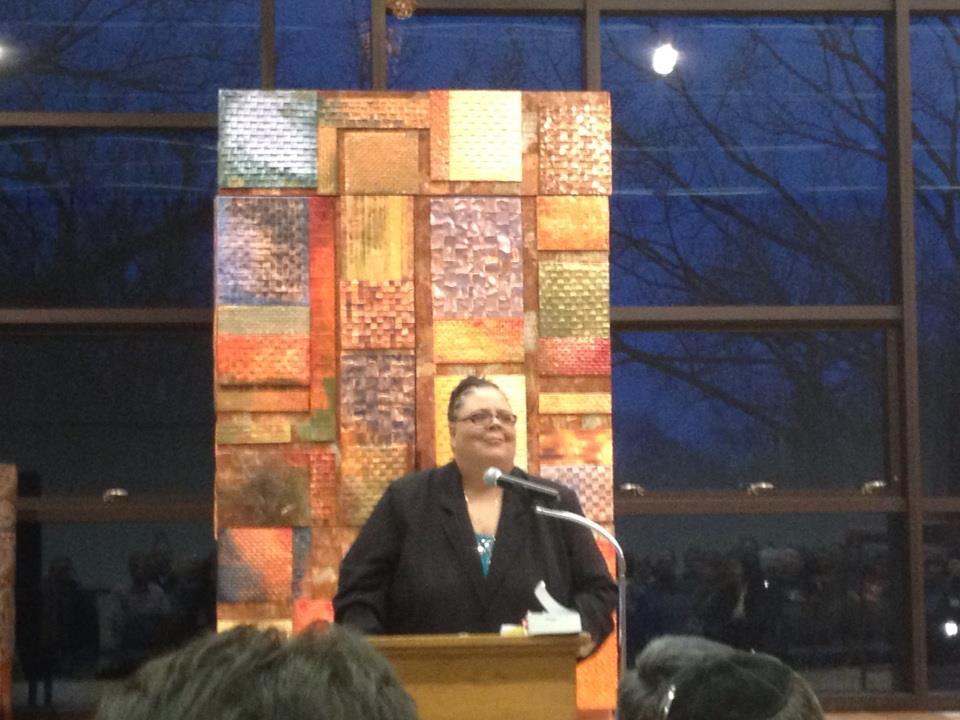
Last night, I had the very good pleasure and honor to welcome Chicago Teachers Union President Karen Lewis to my congregation. In recent years, Karen’s leadership has put her at the center of one of the most important labor struggles in the country – this past September the CTU teachers’ strike was a national news story, due in no small way to Lewis’ visionary and stalwart leadership. Now she’s leading the charge to resist plans by Chicago mayor Rahm Emanuel and the Chicago Public School board to close 54 Chicago schools – a decision which would affect 30,000 children, mostly in low-income, African-American neighborhoods on the city’s South and West sides.

When Karen first accepted our invitation to present at JRC, she told us she was particularly interested in talking about the Chicago schools crisis from a religious values point of view.  Many aren’t aware that Karen converted to Judaism twenty years ago – at a time in which she was on a personal spiritual search and was drawn to the Jewish tradition of questioning and debate.  As it turns out, she will be celebrating her Bat Mitzvah in June – so I encouraged her to use JRC appearance as a laboratory to explore some of the themes in her Torah portion.

Her portion, Shelach Lecha (Numbers 13:1-15:41) relates, among other things, the story of the twelve scouts send by by Moses to report on the Promised Land. Ten of them return with words of discouragement, reporting that they saw giants in the land. “We felt like grasshoppers to ourselves,” they said, “and so we must have looked to them!”

In her presentation, she pointed out that forces of domination in society can often have this effect on us.  In the case of Chicago schools, it is easy to feel cowed by the powerful political-corporate interests that are decimating public education in our city – and in fact, in cities around the nation. The key, Lewis said, is not to be daunted or to give in to a slave mentality that “idealizes Egypt.” The answer, as ever, is to organize and fight back.

Among the many important points Karen made in her presentation was her insight into the deeper issues around the school closings. While she did not disagree that there are problems in Chicago Public Schools (she likened it to a “mildly dysfunctional family”) she vociferously denied Mayor Emanuel’s claim that the system is “broken.” What’s truly broken, Lewis rightly pointed out, is our commitment to the most vulnerable communities in our city.

This was, for me, her most important point of the evening. “Rahm Emanuel says that closing these schools was ‘a difficult decision'” she said. “Make no mistake: closing schools in black and brown communities on the South Side is not a difficult decision. That was an easy decision. You know what a difficult decision would be? If Rahm Emanuel went to his good friends at the Chicago Board of Trade and the Chicago Mercantile Exchange and told them to pay their fair share. That would be a difficult decision!”

Amen. In a recent Chicago Sun-Times article, Chicago community organizer Amisha Patel pointed out, in fact, that claims by City Hall and CPS that schools must be closed to save money are simply not true. In fact, they are choosing to close schools while sending millions of dollars to Wall Street:

Every year, CPS pays approximately $36 million in toxically high interest rates, linked to so-called swap contracts, to banks like Bank of America and Goldman Sachs. These arrangements, in which CPS pays a fixed interest rate to the banks — typically between 3.5 and 5.25 percent — to protect itself against fluctuating interest rates in the bond market, were supposed to save CPS money.

But the arrangements backfired — and became morally reprehensible — when the banks crashed the economy and the Federal Reserve slashed interest rates to bail them out. Now the banks are profiting greatly from the federal bailout, but Chicago’s schools get nothing — no such relief for them from crippling high interest rates — even as the banks continue to extract millions of dollars from CPS.

Big banks were saved by public money, but many Chicago communities are besieged by record high unemployment and foreclosure rates. After jeopardizing our jobs and our homes, now these banks are coming for our children’s schools. We need a mayor who will stand up to Wall Street and fight for our communities.

But rather than demanding that these banks renegotiate the swap deals, as other cities successfully have done, Emanuel is choosing to close 54 schools. CPS claims the closures will save an average of $60 million a year for 10 years — numbers that many studies have shown are based on unrealistic assumptions, such as the district being able to sell 50 percent of shuttered schools. At the same time, CPS fails to account for the cost to the children who must cross new gang lines to get to school, the disruption of their stability and the creation of even more vacant buildings.

Renegotiating these swaps could save CPS tens of millions of dollars every year — money that could keep schools open. But that would mean putting the interests of poor, black children ahead of the banks, a difficult move for a mayor whose top campaign contributors come from the financial services industry.

Karen Lewis taught powerful Torah last night – and I’m happy to say that there is a Jewish organizing initiative growing in our city that is heeding her call to fight back against the corporate decimation of our public school system. Jewish Solidarity and Action for Schools (JSAS) has drafted a letter to Mayor Emanuel that states “these discriminatory school closings fly in the face of our Jewish and human values.” The letter will be delivered to the Mayor’s office by JSAS activists today.

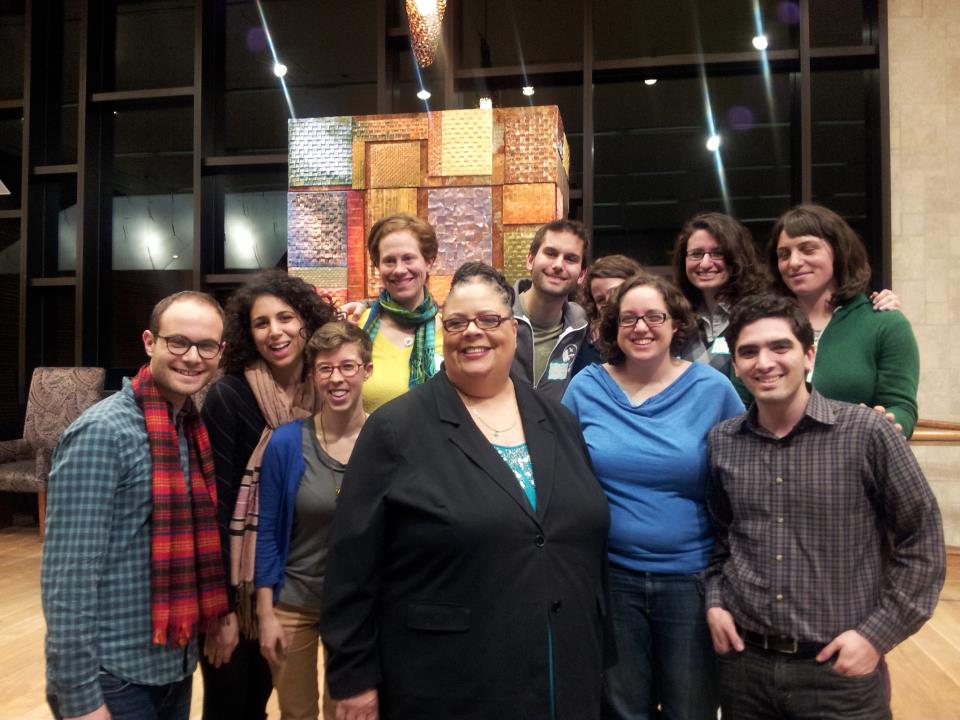
Here’s Karen with the leadership of JSAS after her talk:

Karen Lewis with JSAS organizers at JRC, 4/17/13

Karen Lewis with JSAS organizers at JRC, 4/17/13

Support “A People Without a Land” – New Documentary on Israel/Palestine

In 2007, Orthodox Jewish filmmaker Eliyahu Ungar-Sargon made “Cut,” a provocative and important film about circumcision. Now he’s poised to do the same with Israel/Palestine:

“A People Without a Land,” is a feature-length documentary that challenges the conventional wisdom about the Israeli-Palestinian conflict. (It) grew out of our frustration with the narrowness and lack of depth that characterizes so many discussions about the conflict. We wanted to make a film that would both broaden the conversation and articulate a vision for a real and lasting solution. Unlike many films about Israel/Palestine, we do not limit our field of vision to Israel’s 1967 occupation of the West Bank and Gaza Strip. A People Without a Land examines the questions that lie at the heart of the conflict: Why has the peace process failed? What does it mean that Israel is a Jewish State? What should happen to the millions of Palestinian refugees? How about the Palestinian citizens of Israel, or the West Bank settlers? We believe that by directly addressing these questions, we can jump-start a conversation that will ultimately lead to a just solution.

This project promises to be pretty special: among those interviewed are Ali Abunimah, co-founder of the Electronic Intifada, Eitan Bronstein, founder of Zochrot, Middle East scholar Ghada Karmi and Neta Golan, co-founder of the International Solidarity Movement. It will also feature the music of klezmer great Daniel Kahn and the Painted Bird as well as a score by Alan Sufrin of Stereo Sinai.

Ungar-Sargon is currently raising money for “A People Without a Land” through a Kickstarter campaign. It’s entered into its final week – click here to contribute.

My “Wrestling” Interview with Just World Books

mikeClick here to listen to a podcast interview I did with Just World Books last February.

In this podcast, Rabbi Brant Rosen, author of ‘Wrestling in the Daylight: A Rabbi’s Path to Palestinian Solidarity,’ shared his reflections on his book and how it has impacted his understanding of “what to do” with his beliefs and convictions as well as provided his insights about the effects of Operation Cast Lead, the Gaza flotilla incident, and other Israeli actions on both the views of young American Jews and the Arab Spring. He also offers his opinion on what President Obama should do in his second term about the Israeli-Palestinian conflict.

Zero Dark Thirty: My Shalom Rav Review

1163224_Zero-Dark-Thirty-2

Finally saw Zero Dark Thirty yesterday. Here’s my review:

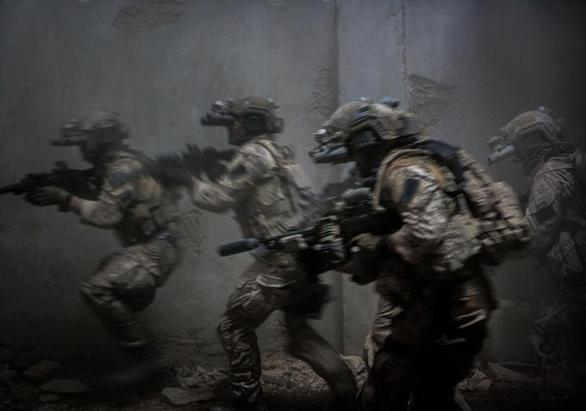
From an artistic point of view, I can say without hesitation that I was riveted by ZDT from beginning to end. Kathryn Bigelow is clearly one of our most talented American directors, particularly in her ability to construct a film with a palpable sense of documentary realism. In so many ways she, along with screenwriter Mark Boal, and her entire filmmaking team had me in the palm of their collective hand.

Which is why I also found ZDT to be a morally reprehensible piece of cinematic propaganda.

My experience of this film, among other things, was a profound reminder that movies have immense power to manipulate emotions and shape attitudes. I will readily admit that I found myself thoroughly caught up in the intensity of the CIA’s quest (embodied by character of the passionately driven agent “Maya”) to find and kill Usama Bin Laden. What can I say? For two and half hours, the film worked its magic on me. But when it was over, all I felt was dirty and ashamed. Sickened, actually, that I allowed myself to be seduced by what amounted to an insidious, if deeply sophisticated, revenge fantasy.

I use the word insidious very consciously here – particularly since the film purports to be a facts-driven portrayal of the CIA hunt for Bin Laden. In the very first frame, in fact, a title that tells us we are about to watch a film “based on firsthand accounts of actual events”. The next title we see are the words “September 11, 2001”. Then for at least a minute we listen to audio tapes of terrified 9/11 victims calling for help. One woman in the World Trade Center tells a 911 dispatcher that she is “burning up,” then says, crying, “I’m going to die aren’t I?” The dispatcher tells her to “stay calm” but there is no further answer. The last thing we hear is the dispatcher’s voice saying, “Oh my God…”

This is how the movie is framed from the outset: we are told we are watching a movie based on actual events, constructed from information gained from those who were there. We hear the very real voices of American citizens as they are being burned alive.  Then we watch the “real-life” account of how the man responsible for their deaths was hunted down and killed by the CIA.

Listening to those terrified voices unsettled me to my core – but it was only after the movie was over that I realized how obscene their usage actually was.  Why did the filmmakers choose to play these recordings? After all, aren’t the tragic events of 9/11 well-known to everyone in the world? If the filmmakers were really interested in making a dispassionate, non-fiction account of the hunt for Bin Laden, wouldn’t it have made more sense to start with the beginning of the hunt itself?

Indeed, Bigelow has been quoted as saying she used “a journalistic approach” to making this film and that “it doesn’t have an agenda, and it doesn’t judge.” This, of course, is hogwash.  If Bigelow and Boal were interested in presenting a “values-free” docudrama, they certainly wouldn’t have manipulated viewers with the voices of civilians being burned alive. After hearing the terrified voices of actual victims, how could we not cheer the CIA on as it uses any means necessary to find and kill Bin Laden?

Much has been written about the infamous scene in which one tortured Al-Qaeda operative gives up the name of Bin Laden’s courier after having been beaten, waterboarded, sexually humiliated and stuffed into a tiny wooden box. The inclusion of this scene – along with numerous references to information gained from tortured detainees – has been rightly condemned by many who point out it has already been conclusively determined that the information that ultimately led to Bin Laden’s execution was not gained through the use of torture. By including these scenes, ZDT conveys the incorrect – and dangerous – impression that torture “works.”  It’s a critical point to which I have nothing to add except to refer you to Glenn Greenwald’s excellent pieces on the subject.

Beyond this issue, ZDT is dangerous for an even more essential reason. As Peter Haas pointed out in a recent piece for the Atlantic, it represents a new genre of “entertainment” he calls “embedded filmmaking”:

The fundamental problem is that our government has again gotten away with offering privileged access to carefully selected individuals and getting a flattering story in return. Embeds, officially begun during the invasion of Iraq, are deeply troubling because not every journalist or filmmaker can get these coveted invitations (Seymour Hersh and Matt Taibbi are probably not on the CIA press office’s speed dial), and once you get one, you face the quandary of keeping a critical distance from sympathetic people whom you get to know and who are probably quite convincing. That’s the reason the embed or special invitation exists; the government does its best to keep journalists, even friendly ones, away from disgruntled officials who have unflattering stories to tell…

(The) new and odd rub in the case of Zero Dark Thirty is that the product of this privileged access is not just-the-facts journalism but a feature film that merges fact and fiction. An already problematic practice—giving special access to vetted journalists—is now deployed for the larger goal of creating cinematic myths that are favorable to the sponsoring entity (in the case of Zero Dark Thirty, the CIA). If the access that Boal and Bigelow received was in addition to access that nonfiction writers and documentarians received, I would be a bit less troubled, because at least the quotes in history’s first draft would be reliable, and that means a lot. But as it stands, we’re getting the myth of history before getting the actual history.

In other words, no matter how unsavory the protagonists behavior might be, no matter how “gritty” and “journalistic” the style, this is the CIA’s movie through and through.

In a more recent article, Greenwald pointed out the essential simplicity of ZDT’s world view:

All agents of the US government – especially in its intelligence and military agencies – are heroic, noble, self-sacrificing crusaders devoted to stopping The Terrorists; their only sin is all-consuming, sometimes excessive devotion to this task. Almost every Muslim and Arab in the film is a villainous, one-dimensional cartoon figure: dark, seedy, violent, shadowy, menacing, and part of a Terrorist network…

Other than the last scene in which the bin Laden house is raided, all of the hard-core, bloody violence is carried out by Muslims, with Americans as the victims. The CIA heroine dines at the Islamabad Marriott when it is suddenly blown up; she is shot at outside of a US embassy in Pakistan; she sits on the floor, devastated, after hearing that seven CIA agents, including one of her friends, a “mother of three”, has been killed by an Al Qaeda double-agent suicide-bomber at a CIA base in Afghanistan … Nobody is ever heard talking about the civilian-destroying violence brought to the world by the US.

The CIA and the US government are the Good Guys, the innocent targets of terrorist violence, the courageous warriors seeking justice for the 9/11 victims. Muslims and Arabs are the dastardly villains, attacking and killing without motive (other than the one provided by Bloomberg) and without scruples. Almost all Hollywood action films end with the good guys vanquishing the big, bad villain – so that the audience can leave feeling good about the world and themselves – and this is exactly the script to which this film adheres.

And in the end, that is what makes the technical and narrative brilliance of this film all the more pernicious. It creates the illusion of authenticity and truth when what we’re really watching is the CIA’s truth. One in which Bin Laden was never, once upon a time, an ally of the United States government. One in which “heroes” commit war crimes in secret locations in the furtherance of extra-judicial assassination. One that utterly ignores the realities of what the CIA’s civilian-destroying violence has wrought.

More than anything else, this is why I felt so very dirty after allowing myself to be entertained – and at times even moved – by Zero Dark Thirty.

Naftali Bennett and the Politics of Jewish Supremacy

By all accounts, Bibi Netanyahu will be the winner of the upcoming elections on January 22 – after which he will proceed to form the most right-wing/ultra-nationalist coalition in Israeli history. The only question that remains is by what degree.

Among new political figures on the scene, Naftali Bennett, the leader of the HaBayit HaYehudi (“Jewish Home”) party seems to be garnering the most attention. Even as Bibi’s Likud-Beiteinu party drops in the polls, HaBayit HaYehudi (a restructured version of the old National Religious Party) is growing in popularity – and will almost certainly become an important player in a new coalition.

If you’ve never heard of Bennett, you will soon. He’s the son of American immigrants, a successful hi-tech businessman, Bibi’s former chief of staff (they’ve since had a high profile falling out) and the former head of the West Bank settlers’ Yesha Council. Bennett raised some major dust last month when he told a television interviewer that he would personally refuse orders to evacuate settlements or outposts in the West Bank while on reserve army duty.  He also is on record as advocating the annexation of Area C of the West Bank. Under his plan, Palestinians already living there would be given the choice to accept Israeli citizenship or leave.

While he was roundly criticized from many political quarters for his remarks about army service, his party has become the most popular Israeli party with young Israelis under the age of 30. Clearly, Bennett and his views represent Israel’s future – one that seems to be skewing further and further away from democracy and ever closer to apartheid policies.

Take a look at HaBayit Hayehudi’s English language campaign video ad at the top of this post. As Don Futterman recently observed in Open Zion, it’s a canny attempt to gloss over the more odious aspects of Bennett’s ideology with a legit and cheerful veneer designed specifically to appeal to American immigrants to Israel:

This ad, which is part of a campaign to create different and more positive associations with the name HaBayit HaYehudi (the Jewish Home), is an invitation, not a polemic. It mentions buzzwords—Jewish values and Zionist ideals—and one issue from the party’s platform—Jewish education—but does not harp on any of them. You wouldn’t guess that HaBayit HaYehudi has any connection to the national religious right in Israel, and you might even miss the single reference to West Bank settlements (“I live in Samaria”). You certainly wouldn’t suspect that Bennett has promised he would go to jail rather than evacuate a settlement.

Watching the video, I was also struck that it made repeated references to the importance of Israel’s Jewish character without explicitly explaining why this should in any way be considered a political issue:

If you want to bring Jewish values and Zionist ideals to Israel, then the Bayit Yedudi is your home…If you believe that every Israeli child deserves a quality Jewish education, the Bayit Yehudi is your home.

While on the surface, remarks such as this sound perfectly innocuous, they mask a profoundly troubling agenda.  What about the Palestinians citizens of Israel who do not adhere to “Jewish values” or “Zionist ideals?”  It’s certainly sounds noble to say that Israeli child deserves a quality Jewish education, but what about the considerable percentage of Israeli children who don’t happen to be Jewish? The answer, of course, is not too difficult to understand. These Israeli citizens simply don’t fit in the xenophobic ideology advocated by Naftali Bennett and HaBayit HaYedudi.

In a recent post for +972 mag, Noam Sheizaf makes a perfectly reasonable argument – but given Israel’s current reality it would likely strike many as radical in the extreme. Pointing out that in 64 years of Israel’s existence, no government has ever included one of the Arab parties in a coalition, Sheizaf concludes:

Cooperation between Palestinian and Jews is by far the greatest, most important challenge in this country. Every element of Israeli life – from the education system to zoning plans – is constructed to promote ethnic separation, with politics being just the tip of the iceberg…Therefore, the ability to create joint structures and partnerships is the single most important element that would determine the chances of survival and the quality of life for the entire society.

The necessary conclusion for me is that it is simply forbidden to vote for parties which are not shared by Palestinians and Jews, or for ones that preserve the policy of separation between Palestinians and Jews. There are no perfect parties, but this should be the basic condition, just as an American shouldn’t vote for a party that doesn’t accept black people.

Alas, voices like Sheizaf’s are but a whisper in the Israeli wilderness. According to the latest polls, Arab-Jewish parties will garner only a small sliver of votes in the upcoming election.  When it comes to the Israeli electorate, the ideology of Jewish supremacy is clearly the order of the day.

For comparison purposes, take a look, below, at this campaign video ad for the Da’am Workers Party – one of the few Arab-Jewish parties of which Sheizaf spoke.  I’d say their values provide a powerful contrast to ethnic exclusivism of HaBayit Hayehudi:

(This) movement is our hope, everyone’s hope that here will arise, in the State of Israel, for the first time in history a political, social, economic alternative, sane, human, fair, that knows how to be part of the region where it’s located. For 64 years we’ve lived in a ghetto. The time has come to get out of the ghetto! Israel has to stop isolating itself…We say no! We’ll bring down the wall of Occupation, the wall of racism, and the wall of violence. We want to be free in our land indeed, and our land is the entire world, and this world needs one unique answer, it needs a revolution!

Time for Visions Beyond the Two State Solution

beyond-the-two-state-solution-a-jewish-political-essayI’ve been pointing out for some time now that Israel has been increasingly building settlements in Area C of the West Bank, while evicting Palestinians from their homes there and moving them to far reaching sections of Areas A and B. The intention? To eventually annex Area C to Israel and warehouse the Palestinian population of the West Bank in disconnected, isolated, bantustans.

Now it’s come to this: Israeli coalition leaders are unabashedly bandying about this plan in public:

From a recent article in the Jerusalem Post:

Israeli annexation of the West Bank’s Area C – where all settlements are located – received public support from two high-ranking Likud politicians on Tuesday evening, Public Diplomacy Minister Yuli Edelstein and MK Ze’ev Elkin.

“Lack of Israeli sovereignty over Area C means the continuation of the status quo,” said Edelstein, as he spoke about an area of the country that is now under Israeli military control. “It strengthens the international community’s demand for a withdrawal to the pre-1967 lines.”

But Edelstein and Elkin cautioned that annexation was a process that should happen slowly, not immediately.

Together with the Netanyahu government’s stated intention to build in the critical West Bank territory of E-1, it is clearer than ever that the conventional liberal Zionist notion of a two-state solution is a dead anachronism. It’s even worse, actually: as long as we cling to a two-state paradigm, Israel will be given free reign to entrench this injustice in perpetuity.

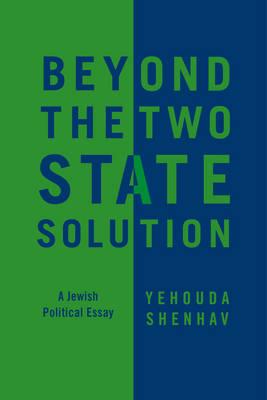
I’ve also come to believe that its high time for those who are interested in a truly just peace between Israelis and Palestinians to come forth with some new creative thinking that might provide alternatives to an obsolete two-state model. In this regard, I was happy to learn that “Beyond the Two State Solution: A Jewish Political Essay” by the great Israeli academic Yehouda Shenhav, has finally been published in English. Shenhav has long been providing precisely the kind of innovative thinking that I believe is so very lacking in political circles – and I’m delighted his work on this subject will now find a wider audience.

Using post-colonial political and critical theory, Shenhav challenges many of the fundamental paradigms and assumptions that have delineated the Israeli political “left” and “right,” while suggesting new and exciting models that might well help us to envision a better future for Palestinians and Jews in the land.

Here’s an excerpt, from his Introduction:

I am deeply concerned with the violation of the political rights of the Palestinians, but no less so with the future political rights of the Jews themselves. I believe that the combination of a persistent foundational state of emergency and blatantly racist legislation – which grows restrictive and bare-faced day by day – poses a threat not only to Palestinians, but to Jews in the Middle East. For this reason, I wish to unpack the Jewish-Israeli discourse on the conflict, to highlight the dangerous political zones within which it roams, and offer an alternative political vision in which the rights of both Jews and Palestinians are intertwined and co-determined…

In particular, I argue that the so-called “two-state solution” in the form proposed by the Israeli liberal left no only is unrealistic but in essence is based on false assumptions that sustain and reinforce the non-democratic Israeli regime and mask the essence of the conflict. Instead, I offer a different vision for political thought, which is not based on state terror or Jewish supremacy.

Shenhav is a well known thinker in Israel, but less familiar to American audiences. Whether or not you agree with his ideas, I hope you will at least be open to this sort of new thinking. I personally find it liberating – I do believe that these kinds of outside the box ideas serve to provide us with a ray of hope along what is otherwise a very dark road…

Pay a Visit to the Gaza Kitchen

gazanfood

Now that the dust has cleared from Israel’s “Operation Pillar of Defense,” Gaza has sadly faded off the media radar screen once again. In the meantime, if you’re interested in some new essential reading about this significant but chronically misunderstood region, I have just the thing: a cookbook.

Yes, “The Gaza Kitchen: A Palestinian Culinary Journey” by Palestinian blogger Laila El-Haddad and Madrid-based writer/researcher Maggie Schmitt, newly published by Just World Books, is far and away the most important book I’ve read on Gaza in some time – and I’m not even a cook.

I’ve been a huge fan of Laila El-Haddad’s work for years. Her blog “Gaza Mom” provided me with my first real “beyond-the-headlines” insights into Gazan life and culture and I remain a devoted reader. For those unfamiliar with her work, her “Gaza Mom” anthology (also published by Just World Books) is the perfect introduction – if it leaves you hungry for more, then you must check out “The Gaza Kitchen.”

If you had any doubts that this was not your typical cookbook, the authors of “Gaza Kitchen” will explicitly lay them to rest for you in their Introduction:

“(This) is a hybrid sort of book: it is mostly a cookbook which recovers and compiles both traditional and contemporary elements of a rich and little-known cuisine. But it also attempts to do a little ethnography, a little history, a little political analysis. Cuisine always lies somewhere at the intersection of geography, history and economy. What makes it such a compelling subject is that it serves as a cultural record of daily life for ordinary people, traces of a history from below made palpable in something as evocative and delicious as a plate of food. Our hope in this book is to share this food with you and in so doing, something of the indefatigable spirit of the people we interviewed.

Indeed, history has indeed left an indelible imprint on Gazan cuisine. Gaza was historically an important station along the spice route, providing a link between southern Arabia and the Mediterranean – and eastern spices continue to shape Gazan cuisine to this very day. Food historian Nancy Harmon Jenkins illuminates this point vividly in the Foreword:

In many ways, food in Gaza is classic Palestinian, Middle Eastern cuisine, but it is unique with its own regional diversity, which includes a deep appreciation for the kick of red chili peppers, the zest of eastern spices (cardamom, cloves, cinnamon), and the soothing calm of fresh dill and dill seeds. You can see this immediately in Gazan-style falafel, those those delectably crisp, deep-fried morsels of ground chickpeas with spices, universal street food throughout the Middle East, from Turkey to the banks of the Nile. In Gaza, however, the addition of chopped chilis and fresh green dill gives a special twist to felafel. (Only in Greece is dill used to the delicious extent it is in Gaza.)

More recent history has also impacted Gazan cuisine. After the Nakba of 1947/48, Gaza was filled with a massive population influx of Palestinian refugees. As Jenkins points out, this event turned the newly-created Gaza Strip into “a repository of traditional foods and dishes from all over historic Palestine, a living legacy of the refugees who flocked here, driven from their homes in the north and the east.” All this to say that “The Gaza Kitchen” succeeds not only because of its delicious recipes, but through its illumination of the social-cultural-political context from which they emerged.

Moreover, sprinkled among the dishes the authors include brief essays that consistently debunk the image of Gazans as either “hapless objects of pity or as vicious objects of fear.” It is impossible to read this book and not be powerful affected by the lives of ordinary Gazans (notably Gazan women) who struggle to maintain their cultural dignity amidst an almost total socio-economic isolation from the rest of the world.

In addition to learning new recipes, we meet Gazans themselves: we eavesdrop on neighbors sharing Arabian fables while kneading dough for hulba (feungreek cake); we meet Fatema Qaadan, a widow and single mother who supports her family by rearing rabbits through the help of a local community center; and we learn about al-Muharrarat (“Liberated Lands”), a Hamas government-sponsored initiative that responds to blockade shortages through a variety of innovative agricultural projects.

The authors also do not flinch from exploring the political impact of Zionism on Gazans and their cuisine. One interesting short essay entitled “On Schnitzel,” points out that many Gazan fast food joints serve schnitzel – the classic pan-fried “Wienerschnitzel” brought to the region by European Zionist immigrants. The authors continue:

Now, with Gaza totally isolated, it is easy to forget that for decades thousands of Gazans went every day to work in Israel, that Israeli and Gazan entrepreneurs had partnerships, that both commerce and social relations existed, albeit on unequal footing. Adult Gazans remember this, and many speak admiringly of aspects of Israeli society or maintain contact with Israeli business partners, employers and friends. But for the enormous population of young people who were not old enough to work or travel before Israel sealed the borders in 2000, this is impossible. Though their lives are completely conditioned by Israeli political decisions, they have never laid eyes on a single Israeli person except the soldiers that have come in on tanks or bulldozers, wreaking destruction. And the generation of young Israelis to which those soldiers belong has likewise never met a single Gazan Palestinian in any other context. A terrible recipe for continued conflict.

I personally consider the legacy of Israeli cuisine to be a complex and painful one. Reading through this book through the eyes of an American Jew, I was constantly reminded that so many of the foods that we assume to be uniquely “Israeli” are in fact dishes that have long been indigenous to Palestinian culture.

It is certainly true that there is really no such thing as uniquely “Jewish food.” To be sure, Jews have lived (and cooked) in a myriad of societies and cultural contexts over the centuries – and our cuisine has traditionally emerged from a (pardon the expression) fusion of Jewish sensibilities with our respective host cultures. Given the circumstances of Israel’s creation, however, I have long been troubled by Israel’s appropriation of Palestinian/Mediterranean culture – and the assumption, for instance, that dishes such as hummous and felafel are somehow “uniquely Israeli.”

(An interesting case in point occurred when the Harvard Business School cafeteria recently featured an “Israeli Mezze station” with such “authentically Israeli” dishes as Cous Cous, Za’atar Chicken, Fattoush, and Tahini Sauce. In response, Lebanese Harvard graduate Sara el-Yafi posted an impressively researached and widely shared Facebook comment that sought to set culinary record straight once and for all. Also highly recommended reading).

For their part, El-Haddad and Schmitt have now created their own cultural reclamation project. It deserves to be read, served up and shared widely. Bravo to my good friends and colleagues at Just World Books for making this delicious document available to the world.

American Rabbis to Obama: Hold Netanyahu Accountable!

Obama-and-Netanyahu-rangling-over-Iran

The following letter was just released by Jewish Voice for Peace and will soon be delivered to the White House:

Dear President Obama,

We are writing this letter to you as American rabbis, cantors and rabbinical students, serving a wide range of Jewish communities.   We were dismayed to learn that, immediately following the recognition by the United Nations of observer status for Palestine, the government of Israel issued permits to begin development of two large tracts of settlement housing in highly contested areas in  East Jerusalem (E-1) and the West Bank (Maaleh Adumim.)

As you well know, these expansion permits are damaging not only to prospects for Palestinian self-determination but also for peace in the region.  We urge you in the strongest terms to use your full authority to oppose these expansions, which are illegal under international law and which also make impossible any hope of creating a viable Palestinian state in the West Bank.

We represent a growing voice within American Jewry which seeks an end to Israel’s occupation of the West Bank and its stranglehold by blockade of the people of Gaza.  We believe that the aggressive expansion of settlements in the Occupied territories constitutes a deliberate strategy to obstruct a peaceful resolution to the conflict between Israel and Palestine.  We believe further that the United States, as the primary global source of financial and political support for the  Israeli government, has an obligation to hold the Netanyahu government accountable for these actions, which thwart the possibility of peaceful resolution of the conflict.

It is no longer the case — if it ever was — that the Jewish community in the United States  is unified in its support of the policies of successive Israeli governments, which have sought to create “facts on the ground” that obstruct the hopes of independence and sustainability for the Palestinian people.  Absent active intervention by the United States and other nations, Israel will surely continue to implement these destructive policies.

As leaders of the American Jewish community, we join you in hope for a just peace for all the peoples of the region.  Please know that you have our strong support for demanding that the government of Israel reverse for this latest action and for all that you can do to lead the way to a fair and sustainable resolution.

Yours sincerely,

Rabbi Margaret Holub

Rabbi Brant Rosen

Rabbi Brian Walt

Rabbi Lynn Gottleib

Rabbi Joseph Berman

Rabbi Laurie Zimmerman

Rabbi Elizabeth Bolton

Rabbi Julie Greenberg

Rabbi Borukh Goldberg

Rabbi Eyal Levinson

Rabbi David Mivasair

Rabbi Rebecca Lillian

Rabbi Rachel Barenblat

Alana Alpert

Cantor Michael Davis

Rabbi Michael E. Feinberg

Rain Zohav

Rabbi Zev-Hayyim Feyer

Jessica Rosenberg

Ken Rosenstein

Rabbi Shai Gluskin

Rabbi Rebecca Alpert

Ari Lev Fornari

Rabbi Art Donsky

Rabbi Jeremy Milgrom

Rabbi Linda Holtzman

Rabbi Leonard Beerman

Rabbi Alexis Pearce

Rabbi Sarra Lev

David Basior

On the Killing of Children and the Price of Our Freedom

obama-newtown-speech

Last night Hallie and I watched President Obama’s eloquent and moving speech at the interfaith prayer vigil for those killed in the Sandy Hook Elementary School shootings. About halfway through, when Obama discussed our nation’s collective responsibility to our children, a certain cognitive dissonance popped into my head – a pesky, but familiar distraction that remained with me for the rest of the speech.

Obama concluded by reciting the first name of each of the 20 children killed. When it was over we both sat silently looking at the screen. “Don’t say it, just don’t say it” I thought to myself.

“What did you think?” she finally asked me.

“Very moving” I said, “but..”

“But what?”

“What the hell,” I thought to myself, “go ahead and say it…”

“I don’t know, it’s hard for me to listen to Obama talk about our responsibility to keep our children safe knowing that he personally approves the drone strikes that kill hundreds of innocent children in other countries.”

Hallie rolled her eyes at me. But before she could say “Oh my God, can’t you give it a rest just this once?” I said it myself: “I know, I know, I can’t help it..”

Over the weekend, I thought of a certain moment in the Michael Moore documentary “Bowling for Columbine.” Toward the outset of the movie, Moore pointed out that the Columbine shooting took place during the largest one day bombing by the US in the Kosovo war.  He showed news footage from that day which showed the bloody aftermath of the bombing that killed numerous civilians, including those in a local hospital and primary school. The news footage also included President Clinton telling reporters that the US military was trying to “minimize harm to innocent people.”

Then Moore flashes the words “One Hour Later” and there’s Clinton again: “We all know there has been a terrible shooting at a high school in Littleton, Colorado.” Moore’s point was clear: there is an important connection to be made between our killing of Serbian civilians and the killing of students in Columbine.

So too, I believe there is a similar connection between the killing of innocent children in Newtown to the killing of innocent children in Pakistan.  Both are the product of a uniquely American culture of violence, insecurity and fear – and both are the consequences of a national penchant for manufacturing, selling and profiting from ever more sophisticated weapons of death.

Might it be that our Constitutional right to bear arms reflects a national sense of entitlement to create and sell weapons and to use them wherever and whenever we see fit?  And if so, might we be ready to limit this right for the sake of our children both here and around the world?

In this regard, I think the most telling moment in Obama’s speech was when he asked the rhetorical question:

Are we prepared to say that such violence visited on our children year after year after year is somehow the price of our freedom?

Would that our President would ask himself that very question before he approves his next drone strike.

(Please read this recent report by the Bureau of Investigative Journalism that determines over 160 children have been killed in seven years by US drone strikes in Pakistan’s tribal areas.)