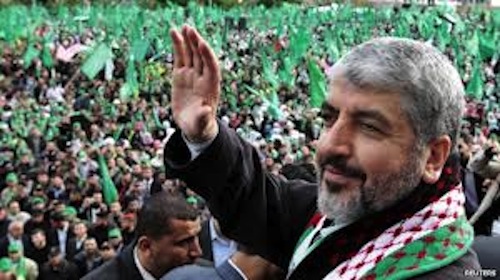
I’ve just finished reading Hussein Ibish’s excoriation of Hamas leader Khaled Meshaal’s victory speech in Gaza last week, in which he accuses Meshaal of “unhelpful escalating rhetoric” against Israel. Along the way, Ibish dishes out a fair amount of rhetorical hyperbole himself, calling Meshaal’s speech “one of the most cynical, damaging and dangerous speeches in the history of the Palestinian national movement” and “profoundly toxic from every perspective.”
It’s certainly true that Meshaal’s speech, which he delivered as he made his first-ever visit to Gaza on the occasion of the 25th anniversary of Hamas and the end of Israel’s latest military campaign, Operation Pillar of Defense, struck a note of resolute defiance.
Here’s a translated excerpt from an Al Jazeera report:
“Palestine is our land and nation from the [Mediterranean] sea to the [Jordan] river, from north to south, and we cannot cede an inch or any part of it,” he said. “We fight Zionists, not Jews. We fight whoever occupied our land, regardless of religion … Statehood will be the fruit of resistance, not negotiations,” Meshaal told cheering fans.
Hamas does not belong to the PLO, but Meshaal said a year ago that it and other factions were “on the path to joining” it.
While this is certainly strong – even incendiary – stuff, are we really to believe it was “one of the most cynical, damaging and dangerous speeches in the history of the Palestinian national movement?”
First of all, let’s take a closer look at the context in which this speech occurred. Shortly before Meshaal’s visit, Israel had leveled a devastating military assault against Hamas in Gaza. During two weeks of fighting, Hamas sent numerous missles into Israel – some of which landed close to major population centers in Tel Aviv and Jerusalem. The violence was eventually quelled through a US/Egypt brokered ceasefire.
In other words, this is what it took to elicit the US’s active engagement with Israel and Palestine. Years of IDF crushing of Palestinian non-violent demonstrators have garnered nothing but silence. The PA’s attempt to gain recourse through the UN was met with active opposition from the Obama administration. It was only the armed resistance of Hamas in Gaza that managed to bring Hilary Clinton to the region and actively engage with the Israelis and Palestinians. In the end, what kind of message does that send to the Palestinian people?
So yes, Khaled Meshaal, told a cheering crowd that “statehood will be the fruit of resistance, not negotiations.” But should we really be so surprised? While negotiations have proved disastrous for the Palestinian people, armed resistance seems to be the only way they ever catch the attention of the international community. Did Ibish really think Meshaal was going to get up on the podium and call for a resumption of the peace process?
Although those who consider Hamas to be an unrepentant “Islamist” terror organization would likely scoff, Meshaal and other Hamas leaders have in the past made noteworthy overtures that indicated a willingness to engage in a US-led peace process (albeit fundamentally different than the one embodied by the follies of Oslo.) Most notably, following President Obama’s Cairo speech (which signaled at the time, a different American attitude toward the Muslim world), Meshaal responded with an important 2009 policy speech in which he welcomed a “change of tone” from Obama. He went on to attribute this new American tone as the fruit of the “stubborn steadfastness of the people of the region, while resisting in Palestine, Lebanon, Iraq and Afghanistan” and stressed that it was not merely a change of tone but a change of policy that was needed to make progress in the region.
Meshaal added that Palestinians would judge the US not by its words but by its actions, which would have to “begin with reconstruction of Gaza and the lifting of the blockade, lifting the oppression and security pressure in the West Bank, and allowing Palestinian reconciliation to take its course without external pressures or interference.”
Whether or not one believes these overtures were genuine, we’ll never really know. Meshaal’s opening went utterly unregarded by the Obama administration, who refused to deal with Hamas and chose to maintain its support of Israel’s crippling siege of Gaza.
Given this history, are we really to believe, as Ibish would have it, that Meshaal’s recent speech is one of the most “cynical, damaging and dangerous speeches” Palestinian history? Or is it merely a reflection of its time – a moment in which the Obama administration has thoroughly squandered its own stated desire to usher in a new era of engagement in the Middle East?
In the end, Meshaal’s speech was simply that – a political speech. And history (particularly Middle East history) has shown us time and again that parsing a politicians words are a notoriously bad way to predict what he/she will eventually agree to. In the words of the very insightful Israeli blogger Noam Sheizaf:
The bottom line is that none of this matters. It’s all a huge red herring. Nothing a leader says now determines the way he will act in the future. Public statements are important only to a limited extent and agreements depend on the continued willingness of both sides to uphold them. As long as both parties feel that they benefit from a certain status quo, or that their interests are better served than by any alternative, the deal they reach could hold. If one party is coerced into signing but doesn’t have its interests and desires addressed, all the nice declarations won’t matter. Twenty years after the historic peace deal that should have ended the Israeli-Palestinian conflict but didn’t, you’d think that people would get it.
The arguments about the meaning and importance of the Hamas charter are all but identical to the decade-long debate over the PLO charter. How much effort and time was put into forcing Arafat to change it, and how little did it matter when negotiations collapsed in Camp David and violence returned. The same goes for today: Given the right pressure, a certain Palestinian leadership could be made to promise Israel anything. Yet none of it would matter if you don’t address the fundamentals of the conflict: The occupation, the refugees, the holy sites, the settlements, the access to land and to water. The leaders would change their minds and if they don’t new leaders (“more extreme”) will come. Reality will prevail over rhetoric.
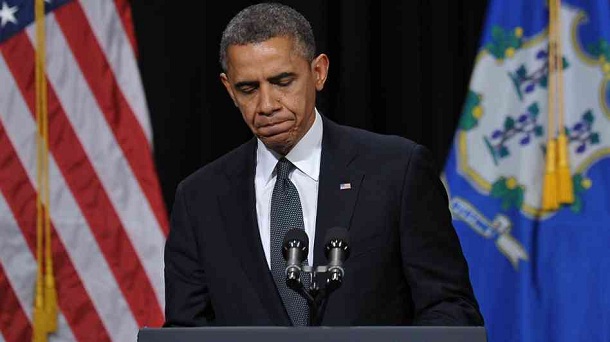
So let’s be honest. Meshaal didn’t mince his words – but in the end it is actions that ultimately matter. And in this regard, Meshaal’s words were considerably less damaging to the cause of the Palestinian national movement than the Netanyahu government’s announcement that it would build 3,000 more units in the E1 region, which would successfully cut the West Bank in half and cut it off completely from East Jerusalem, ending any reasonable hope for a viable two state solution. Sadly, the only response this deeply damaging action elicited from the Obama administration were words such as “counterproductive” and “we urge restraint.”
To my mind these kinds of words are considerably more dangerous to the cause of a just peace in Israel/Palestine.




 Shalom Rav