Category Archives: Politics

A Rosh Hashanah Wish for Israel/Palestine

Please read my editorial just published in the New York Jewish Week. Heartfelt thanks to editor extraordinaire, Emily Hauser and Brit Tzedek v’Shalom, with whom I collaborated on this piece:

One of the holiday season’s key lessons is that it’s never too late for reconciliation: between humanity and God, between loved ones, between bitter enemies. We see this later in Genesis when Abraham dies, and Isaac and Ishmael bury him together. Our rabbis teach us that the brothers had put aside their differences and reconciled – but only a fool would presume that it had been easy for them.

 As we greet our new year, President Obama is preparing a new peace initiative, intent upon bringing Israelis and Palestinians back to negotiations. Unlike his predecessor, Obama understands what so many of us know: Achieving a real Israeli-Palestinian peace will require painful compromise and difficult decisions. It will be hard. But it is doable.

Click here for the full article.

Parsing the J Street Generation

J STREET LOGOEnjoyed James Traub’s feature about J Street in yesterday’s NY Times Magazine. Great to see them getting such high profile press.

For me, the most fascinating insight in the article came from J Street director Jeremy Ben-Ami’s comments on the young ‘uns who work there:

The average age of the dozen or so staff members is about 30. Ben-Ami speaks for, and to, this post-Holocaust generation. “They’re all intermarried,” he says. “They’re all doing Buddhist seders.” They are, he adds, baffled by the notion of “Israel as the place you can always count on when they come to get you.” Living in a world of blogs, they’re similarly skeptical of the premise that “we’re still on too-shaky ground” to permit public disagreement.

I would say that this is my sense of 20-30 something Jews generally. I’m 46 myself, but I’m still old enough to remember the Yom Kippur War, Entebbe and Soviet Jewry rallies. Today’s new generation of Jews, however, has grown up with a decidedly different experience of their Jewish place in the world.  For them, the Jewish State doesn’t represent an antidote to Jewish insecurity, nor is it their last bastion of Jewish safety and survival.  Most Jewish young people I meet these days are comfortable enough in their post-modern Jewish skin and frankly, they fail understand why questioning traditionally held assumptions about Israel is considered so taboo.

I’ve long felt that unless the organized Jewish community makes an effort to grasp this, we’re going to lose this next generation. (I don’t care how many kids we send on Birthright – I don’t think the Jewish establishment is going to turn this tide around.)

Are you going to the first national J Street Conference on October 25-28? It’s increasingly looking like it’s going to be the place to be…

Gaza: Give Life a Chance

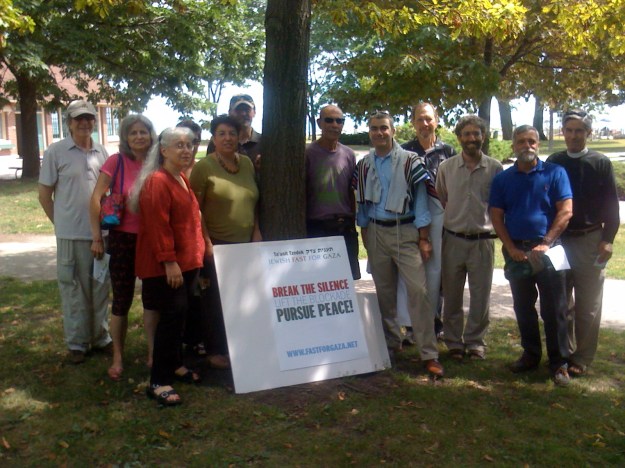
Today was the second monthly fast day for Ta’anit Tzedek – Jewish Fast for Gaza. To mark the occasion, a series of public vigils were held around the country (including one at the Liberty Bell in Philadelphia) and as far away as Glasgow, Scotland. Here in the Chicago area, it was my honor to lead a vigil at the Evanston lakefront with my good friend and colleague, Rabbi Rebecca Lillian. Here we are with some of the participants, below:

IMG_0654

Our campaign continues to grow. As of this writing we currently have 627 supporters, including 71 rabbis. I encourage you to join us, if you haven’t already – just click on the link above to become a supporter. We are continuously uploading important articles and resources, so be sure to check in regularly.

Speaking of important resources on the Gaza crisis, I commend to you the new report from Gisha – Legal Center for Freedom of Movement entitled “Red Lines Crossed: Destruction of Gaza’s Infrastructure.” See below for the full report. Click above to watch “Lift the Closure – Give Life a Chance” – a new online film recently released by eight Israeli human rights organizations to mark the two years of closure that Israel has imposed on the Gaza Strip.

Blocking for Obama

IMG_0401

This past weekend JRC hosted a national conference for the regional organizers of Brit Tzedek v’Shalom.  An eye-opening and informative two days concluded with a visit from Jeremy Ben-Ami, Executive Director of J Street (above, with outgoing BTVS Executive Director Diane Balser). Jeremy’s essential message, which resonated throughout our entire two day meeting, was that the peace process driven by the Obama administration currently has great momentum. He added, however, that realistically speaking, we have a 18-24 month window to produce meaningful results.

Jeremy used a football metaphor to describe the job of those in the Jewish community who currently advocate for the two-state solution: our job is to act as Obama’s front line, blocking for him and creating lanes through the opposition as he moves forward. To do this, he explained, we’ll have to consistently anticipate the opposition and stay two steps ahead of the administration in order to give him “room to run.”

One sobering example of this political tactic: Obama will eventually have to compromise on the settlements. There is clearly a stalemate between the US and Israel over this issue – and Jeremy explained that if the peace camp drew an unwavering line in the sand over the settlements, then the process would simply be dead at the starting gate. According to this view, it would be best for us to support a compromise on this issue now so that we can successfully maintain the momentum in the process.

As an active  (if somewhat anguished) peace process advocate, I certainly grasp the wisdom of this approach. While my principled voice screams out, “What?!! Give up on the settlements? What kind of sham is this?!!” – my practical political voice responds, “Hey, that’s politics. It’s all well and good if you want to remain unsullied in your moral ivory tower, but if you really want to be part of the solution, you have to come down and get your hands a little dirty. If you want to play then you have to be part of the game. That’s just the way it works.”

I get this. I do. But I will confess that I haven’t truly been able to drown out either voice completely. While I do understand the art of political compromise, I also believe that there may well come a point in which some of us run up against a compromise that is simply unacceptable: one that essentially betrays the very ideals that compelled us to support this process in the first place.

Obviously, this point would be placed at different places by different people. And I’m well aware that there are those on both ends of the political spectrum who believe we’ve long since passed that point.  But for for those of us somewhere in the murky middle, the reality is terribly complex – at times painfully so.

My friend Danielle Peshkin, in a comment to my last post, put it perfectly, I think:

It is always difficult, though necessary, to decide to when to sacrifice morality for strategic advantage in the long term advancement of your political goals. It’s equally difficult, though also necessary, to decide when sacrificing morality and justice for short term strategic gain will in fact harm the long term goal of establishing peace and justice.

I Can’t Dance Any More

Salah_Fam

I know there are those who wonder why, with all of the various injustices going on in the world, do I seem to dwell on Israel’s treatment of Palestinians?  It’s a fair and important question.  For me it boils down to this: I’ve come to believe that too many of us in the Jewish community will unabashedly protest persecution anywhere in the world, yet remain silent when Israel acts oppressively.

I know all too well how we actively avoid this truth. We use any number of rhetorical and political arguments to deny it, to mitigate the discomfort and pain it causes us.  We engage in a kind of tortured dance of rationalization that we save for no other world issue but this one. But for me, at least, but none of it really addresses the core issue at hand: however difficult it might be for us to face, Israel is unjustly oppressing Palestinians.

So what are we going to do about it?

Many of us deal with it by putting our faith and efforts into the peace process. And well we should: though I’ve been honest in expressing my own doubts and concerns regarding the peace process, I understand that in the end the only true solution to this conflict will be a political one.  But as the peace process enters into its latest incarnation, as the various actors involved painfully wrangle over diplomatic parameters, it is safe to say this saga will continue to take its time to unfold. And in the meantime, the real lives of real Palestinians on the ground will continue to grow increasingly intolerable.

For myself, at least, I cannot use the peace process, critical as it is, as a kind cover to keep me from facing and protesting the oppression that is occuring in Israel/Palestine every day, even as I write these very words.  While I will do what I can to advocate for a just and peaceful political settlement to this crisis, this work does not give me a pass on speaking out. If we truly believe we must protest injustice anywhere, anytime, then it seems to me that this principle must apply to Israel/Palestine as well, no matter how painful or difficult the prospect of doing so.

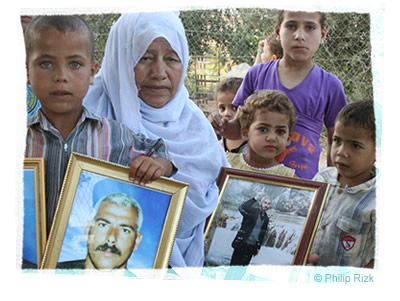
Earlier this week, I was the moderator of a discussion following the showing of a powerful new documentary, “This Palestinian Life” – a film that was often unbearably painful to watch. TPL documents a little-seen aspect of Palestinian life: the nonviolent steadfastness (in Arabic: “sumoud“) of Palestinian villagers who live with a crushing occupation, constant settler attacks, and the deliberate, relentless annexation of their farm land.

This quote from one villager sums up the movie’s essential theme:

I don’t own a gun.

I don’t own any weapons and I’m not prepared to own any…

My only weapon of defense is that I won’t leave this place…

and my hope is that the world will respond to Israel’s treatment of us.

As difficult as it was, I was honored to have been asked to moderate the post-film discussion. I know there are many who would regard my participation in such a program as an act of disloyalty or at the very least an exercise in masochism. But in the end, it really came down to this: I just can’t do the dance any more.

Iran for Iranians

28685775

In my final post from my visit to Iran this past fall, I wrote the following:

We’d be foolish to deny that there are troubling human rights issues that Iran would do well to address. But at the end of the day, the solutions to these problems are certainly not ours to impose.

I felt that passionately then and as I watch the Iranian people take to the streets day after day to demand justice in their country, I feel it even more passionately now.  I’m also immensely proud that our President refuses give in to the misguided voices that urge him to force himself on this process as it unfolds. Our country seems to finally be learning that imposing our “democracy” on other countries might not be the most effective foreign policy.

This is particularly the case with Iran, a nation that has experienced its share of empires meddle in its affairs over the centuries. Indeed, even as thousands of the Iranian people bravely demonstrate for democracy, you can be sure that it is lost on none of them that the last country to overthrow an Iranian regime was none other than the United States. The Islamic Republic may be odious in any number of ways, but at the end of the day, we must remind ourselves that it is the first Persian regime in centuries that truly belongs to its people.

Yesterday, I read a letter to the editor of the NY Times that said simply: “The Islamic Revolution has become the shah.”  A horribly mistaken analysis. For Iranians, the Shah was not simply an oppressive ruler – he was an oppressive ruler who was installed by the Americans after they took it upon themselves to overthrow Iran’s democratically elected Prime Minister.

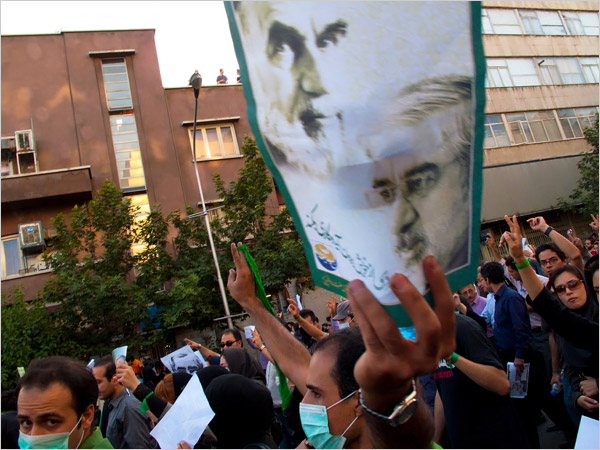
Take a look at the picture above (also from the New York Times.) It’s very telling: a demonstrator’s sign juxtaposes the Ayatollah Khomeini with Mir Hossein Moussavi (who was himself one the leaders of the 1979 revolution. An interesting article in today’s NY Times, in fact, explores the historically close relationship between Khomeini and Moussavi.)

This is enormously important for us in the West to understand: whatever we might think about Khomeini, in the eyes of many Iranians, he was the one who gave their country back to them. Whatever we might think about the republic to which the revolution gave rise, it is the Iranians’ republic. Those who demonstrate in the streets are not rebelling against the revolution – they are demanding that it live up to its promise.

“Justice, justice shall you pursue.” This is what precisely what we are witnessing in the streets of Iran. We can surely support their pusuit in any number of ways, but in the end, this particular justice is theirs’ to pursue and achieve – not ours’ to dictate.

PS: Among the many blogs and e-news outlets I’ve been following, my favorite is a photo blog called Tehran 24 that updates daily with astonishing pix of the demonstrations. Definitely worth a thousand words…

Bibi’s History Tutorial

netanyahu

I’m in agreement with the pundits who conclude that there was absolutely nothing new for consideration offered in Netanyahu’s speech. Perhaps he achieved a personal milestone by finally uttering the words “Palestinian state” but beyond this it was a tune we’ve all heard before. He offered “peace negotiations immediately without prior conditions” then proceeded to spell out the all too familiar prior conditions that everyone knows are non-starters for the Palestinians (i.e. Jerusalem remains the “united capital of Israel,” “natural growth” of the settlements will continue, there will be no right of return for the Palestinians.)

Same old, same old.   For me at least, the most interesting parts of his speech were not his tired policy pronouncements, but his extended forays into historical analysis – and in particular, his repeated justifications of the Jewish people’s right to the land:

The connection of the Jewish People to the Land has been in existence for more than 3,500 years. Judea and Samaria, the places where our forefathers Abraham, Isaac and Jacob walked, our forefathers David, Solomon, Isaiah and Jeremiah this is not a foreign land, this is the Land of our Forefathers.

It seemed clear that Netanyahu’s history lesson was a pointed rejoinder to Obama’s Cairo speech, in which Obama stated that the “Jewish homeland is rooted in a tragic history that cannot be denied.” You may have heard that following his speech, many in the Jewish community criticized Obama for connecting Israel’s right to exist to the Holocaust and failing to cite the Jewish people’s historical connection to the land.  Witness this livid Jerusalem Post editorial:

Mr. President, long before Christianity and Islam appeared on the world stage, the covenant between the people of Israel and the Land of Israel was entrenched and unwavering. Every day we prayed in our ancient tongue for our return to Zion. Every day, Mr. President. For 2,000 years.

Perhaps it’s because Palestine was never sovereign under the Arabs that even moderate Palestinians cannot find it in their hearts to acknowledge the depth of the Jews’ connection to Zion. Instead, they insist we are interlopers.

When Obama implies that Jewish rights are essentially predicated on the Holocaust—not once asserting they are far, far deeper and more ancient—he is dooming the prospects for peace.

For why should the Arabs reconcile themselves to the presence of a Jewish state, organic to the region, when the US president keeps insinuating that Israel was established to atone for Europe’s crimes?

Thus Netanyahu’s pointed words yesterday:

The right of the Jewish People to a state in the Land of Israel does not arise from the series of disasters that befell the Jewish People over 2,000 years – persecutions, expulsions, pogroms, blood libels, murders, which reached its climax in the Holocaust, an unprecedented tragedy in the history of nations…The right to establish our sovereign state here, in the Land of Israel, arises from one simple fact: Eretz Israel is the birthplace of the Jewish People.

It’s facinating to me that Netanyahu et al are so threatened by the suggestion that Israel’s establishment is ultimately bound to the Holocaust.   After all, didn’t Theodor Herzl himself found political Zionism as a reponse to world anti-Semitism?  And whatever historical claim the Jewish people might have to the land of Israel, it’s safe to say there would never have been international support for a Jewish state had it not been for the Holocaust.

Beyond this, I’m troubled by the need to continuously and defensively remind the world of the historical Jewish connection to this particular piece of land. I’m not at all sure that this is really a road we really need or want to go down.

What does it really mean for any people to have a “right” to a land?  I understand that the Jewish nation, like every nation, has its historic narrative, but let’s face it: nations don’t exist by right, they exist by fiat. Nations exist by virtue of military power and by their ability to maintain a system of governance  that will ensure their survival as a polity. Beyond this, it’s pointless to argue one’s historical or moral right to a land. It seems to me that if history has proven anything, it’s that might makes right – and all the rest is commentary.

The real question here is not who has a right to this land. The central issue is how its inhabitants will see fit to exist on the land. And on this point, I don’t see that Netanyahu gave us anything fresh to consider.

Confessions of a Peace Process Cynic

Was2345642

Don’t get me wrong. I’m on board. I’m in there with the American Jews who are reassuring Obama that we’ve got his back. But I have to say it’s all I can do to resist my cynicism when I read about Peace Process, version 5.0. (And for safety’s sake, let me just reiterate my blog’s disclaimer: I’m writing this merely as a snarky private citizen – not on behalf of any organization with which I’m affiliated.)

As I’ve written before, I’m encouraged by Obama and Clinton’s tough talk on the settlements. Nevertheless, I’ve increasingly been wondering if/how the administration would back up their tough words with meaningful action.

Thus I confess to a distinctly familiar sinking sensation when I read this in the NY Times this morning:

As President Obama prepares to head to the Middle East this week, administration officials are debating how to toughen their stance against any expansion of Israeli settlements in the West Bank.

The measures under discussion — all largely symbolic — include stepping back from America’s near-uniform support for Israel in the United Nations if Prime Minister Benjamin Netanyahu of Israel does not agree to a settlement freeze, administration officials said.

Other measures include refraining from the instant Security Council veto of United Nations resolutions that Israel opposes and making use of Mr. Obama’s bully pulpit to criticize the settlements, officials said. Placing conditions on loan guarantees to Israel, as the first President Bush did nearly 20 years ago, is not under discussion, officials said.

Call me cynical, but “symbolic measures” simply aren’t going to cut it. Not when you’re up against the juggernaut that is Israel’s settlement movement. (Read Akiva Eldar’s “Lords of the Land” if you think “juggernaut” is too strong a word.) And certainly not when you are dealing with the most pro-settlement Israeli administration in recent memory.  Already several Israeli officials are complaining loudly that the demand for a settlement freeze is “unfair.” (“There are reasonable demands and demands that are not reasonable.” Bibi said today.)

I found it interesting that the NY Times article cited George H. W. Bush and the loan guarantees – now that brought back some memories. Remember the last time an American president tried to tie US aid to Israel’s settlement activity?

For many in the Jewish community, Bush’s presidency could be encapsulated in his offhand quip to reporters in September 1991 during an AIPAC lobbying effort on Capitol Hill in support of the proposed $10 billion loan guarantee to Israel: “I’m one lonely little guy” up against “some powerful political forces” made up of “a thousand lobbyists on the Hill.”

Bush had opposed the loan guarantees as long as Israel continued settlement in the West Bank and Gaza. The president finally agreed to a loan guarantee package in August 1992, requiring as a set-off any funds Israel spent to build housing or infrastructure in the territories. Despite this action, the political damage was done. The loan guarantee controversy later motivated Jewish opposition to President Bush, who received no more than 12% of the Jewish vote in the 1992 election (down from close to 35% in 1988).

More than fifteen years later, you’d still be hard pressed to find anyone in the American Jewish establishment supporting the withholding of aid to Israel under any circumstances.  As I’ve written before, this is the “third rail” in the American Jewish community. But trust me on this: it may well be the only diplomatic stick that will get Israel’s attention at the end of the day.

Now is Obama up to that level of political courage? And even more to the point: will the American Jewish community still have his back if/when that time comes?

“Now the Hard Work Starts…”

So Netanyahu managed to spend his entire sojourn in DC without uttering the magic words “two state solution.” On the upside, however, the Obama team has laid down the line on Israel harder than any American administration in recent memory – particularly on the issue of a settlement freeze.

Note Clinton’s forceful words on the subject during this recent Al-Jazeera interview:

We want to see a stop to settlement construction – additions, natural growth, any kind of settlement activity – that is what the president has called for.

Clinton’s words here were actually very carefully chosen. Indeed, one of the latest tactics of the Israeli government to skirt this issue is to insist on allowing additional construction on existing settlements to accommodate “natural growth.”  During a visit to Washington earlier this month, the increasingly disappointing Shimon Peres, put it this way:

Israel cannot instruct settlers in existing settlements not to have children or get married. These children are not going to live on roofs.

(The mind reels with potential witty rejoinders to that whopper. I’ll refrain..)

We should at least be heartened that Obama has unequivocally drawn the line on settlements – but he still has an incredibly difficult job ahead of him. As Clinton puts it in the interview, now the hard work starts.

We in the American Jewish community are not exempt from this work. If we truly believe that a just and viable two-state solution is in the best interest of all concerned, then it’s time for us to stand up and say so.  Click here to do just that.