Category Archives: Religion

Mobilizing for Women at the Wall – Where is the Outrage for Simple Human Rights?

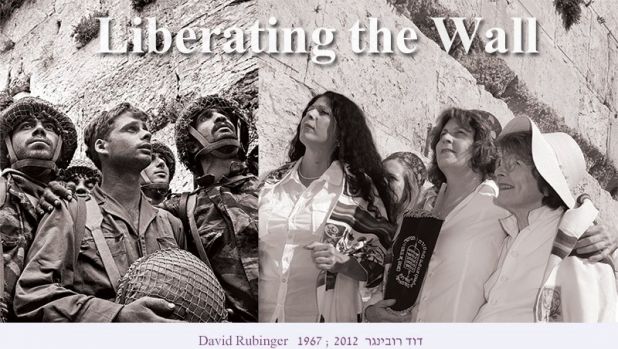
wow-liberating-wall

There is something sadly skewed with my community’s moral priorities.

I’m sure many of you have been following the growing uproar – in Israel and America – over the curtailment of women’s prayer rights at the Western Wall.  In protest, an Israeli group called the “Women of the Wall” has been holding monthly services there for the past twenty years, advocating for their “social and legal recognition of (their) right, as women, to wear prayer shawls, pray and read from the Torah collectively and out loud at the Western Wall.” This right, of course, is denied by the Israeli foundation that essentially runs the site – widely considered holy by Jews the world over –  as the world’s most famous ultra-orthodox synagogue.

The cause of the Women at the Wall was recently re-galvanized when its chairwoman Anat Hoffman was arrested for wearing a prayer shawl and leading a service there. Since then protests have been spreading across the US – led by an organization called “Wake Up for Religious Tolerance” that has organized monthly solidarity services throughout the Jewish community.

At one such service yesterday, organizer Hallel Silverman commented:

This was hundreds of people with different beliefs coming together to fight for one thing they all have in common—Jewish equality.

Oh, would that the Jewish community might galvanize this level of moral outrage for the cause of simple human equality in the state of Israel.

Case in point: during the course of these recent protests, another news item passed far lower across the organized Jewish community’s ethical radar: UNICEF’s recently released report that concluded that the ill-treatment of Palestinian minors held within the Israeli military detention system is “widespread, systematic and institutionalized.” The 22 page report carefully examined the Israeli military court system for holding Palestinian children found evidence of practices it said were “cruel, inhuman and degrading treatment or punishment.”

From a recent HuffPo feature on the report:

In a step-by-step analysis of the procedure from arrest to trial, the report said the common experience of many children was being “aggressively awakened in the middle of the night by many armed soldiers and being forcibly brought to an interrogation center tied and blindfolded, sleep deprived and in a state of extreme fear.”

Many were subjected to ill-treatment during the journey, with some suffering physical or verbal abuse, being painfully restrained or forced to lie on the floor of a vehicle for a transfer process of between one hour and one day.

In some cases, they suffered prolonged exposure to the elements and a lack of water, food or access to a toilet.

UNICEF said it found no evidence of any detainees being “accompanied by a lawyer or family member during the interrogation” and they were “rarely informed of their rights.”

“The interrogation mixes intimidation, threats and physical violence, with the clear purpose of forcing the child to confess,” it said, noting they were restrained during interrogation, sometimes for extended periods of time causing pain to their hands, back and legs.

“Children have been threatened with death, physical violence, solitary confinement and sexual assault, against themselves or a family member,” it said.

Most children confess at the end of the interrogation, signing forms in Hebrew which they hardly understand.

It also found children had been held in solitary confinement for between two days and a month before being taken to court, or even after sentencing.

During court hearings, children were in leg chains and shackles, and in most cases, “the principal evidence against the child is the child’s own confession, in most cases extracted under duress during the interrogation,” it found.

“Ultimately, almost all children plead guilty in order to reduce the length of their pretrial detention. Pleading guilty is the quickest way to be released. In short, the system does not allow children to defend themselves,” UNICEF concluded.

childfather1
I can’t help but ask: where is the moral outrage in my community over this report?  While I certainly believe in the cause of religious freedom, I find it stunning that so many liberal-minded members of the Jewish community are more concerned with “Jewish rights” in a Jewish state than the basic human rights of non-Jewish children who live in it.  Such are the sorrows of Jewish political nationalism: even the more “tolerant “among us seem only to be able to express that tolerance on behalf of those who are in our “tribe.”

A Ha’aretz article covering yesterday’s solidarity service in NYC reported:

People traveled to the event from as far away as Philadelphia. Similar gatherings took place around the U.S., including a demonstration outside Israel’s embassy in Washington, D.C. on Monday, and solidarity prayer services in Cleveland, Chicago and at Brandeis University and the University of Pennsylvania, said service organizer Rabbi Iris Richman. A “sing in” is slated outside Israel’s consulate in San Francisco for Sunday.

In fairness, I’m sure many of the individuals involved in these actions have also advocated for human rights in Israel/Palestine. But the sad truth is that our community would never see fit to mobilize this scale of collective protest in support of Palestinian children. It is well within our comfort zone to protest at Israeli consulates on behalf of Jewish rights. For reasons I understand all too well, universal human rights are still well outside that comfort zone.

Jewish Violence on Purim: Time for a Religious Reckoning?

533143-512853818766199-1284922135-n

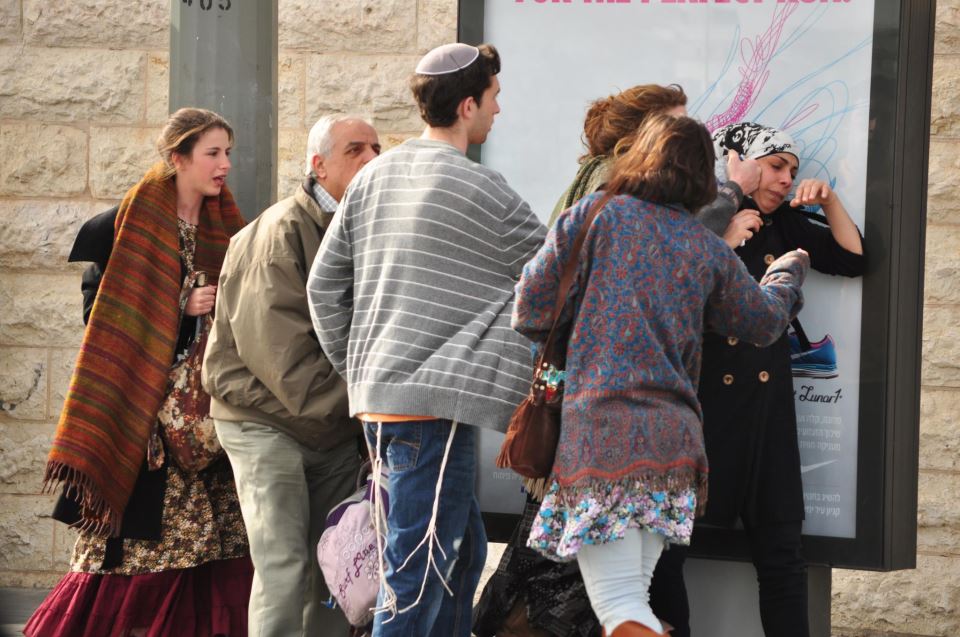
Purim 2013: A Palestinian woman is attacked by ultra-nationalist Jews in Jerusalem.

Like many Jews around the world, I dutifully celebrated Purim last week. In my case, it meant hearing the Book of Esther read aloud in my synagogue while drinking an occasional shot of scotch, enjoying our annual “Oy Vey Cafe,” (a beloved congregational tradition that mixes member-written and performed show tune and classic rock parodies) and attending our synagogue Religious School’s costume parade and Purim carnival.

I’m sure that many middle-class American Jews celebrated Purim in similar fashion. I’m also fairly sure that most middle-class American Jews are unaware that Purim has long been “celebrated” in a very different manner by ultra-nationalist Jews in Israel.

Last week on the day after Purim, it was reported that a Palestinian woman was attacked by ultra-orthodox women at a light rail station in Kiryat Moshe, Jerusalem.  According to the Israeli newspaper Ma’ariv, an ultra-Orthodox Jewish woman walked by the Palestinian woman and began punching her (see pic above).  Others soon joined in the attack and eventually tore off her hijab. According to the report, the light rail security guard, as well as some 100 religious Israeli men, stood by and did nothing. Eyewitness Dorit Yarden Dotan, who was horrified by the violence and took photos of the beating with her telephone, reported that the security guard even “watched and smiled”. “It was simply terrible,” she added.

ShowImage.ashx

Photo: Jerusalem Post

By the way, this was not the only act of Purim violence this year. On the same day as the Jerusalem attack, a Palestinian citizen of Israel, Hassan Usruf (right), was attacked by drunken Jewish youths whom police suspect had been participating in Purim celebrations during the evening. Usruf was punched, hit in the head with a bottle and kicked after he fell to the ground. He sustained injuries to his head, eye socket and jaw. The police have yet to arrest any suspects.

Those who follow the news must surely know that this kind of Jewish violence against Palestinians have become an annual inevitability in Israel. The most infamous Purim moment, of course, occurred in 1994, when Baruch Goldstein walked into the Cave of Machpelah in Hevron wearing an Israeli army uniform and opened fire on Palestinian worshipers, killing 29 and wounding more than 125.  By committing this act of mass murder, Goldstein believed he was fulfilling the the Book of Esther, which describes the slaughter of seventy five thousand Persians at the hands of the Jews. Since that time, Goldstein has become venerated by ultra-orthodox, ultra-nationalist Jews and for rest of us, Purim has never been quite the same.

FQO

Purim 2009: A Jewish settler throws wine at Palestinian woman in Hevron, West Bank, (Photo: Rina Castelnuovo, NY Times)

I’ve recently finished Elliot Horowitz’s 2006 book “Reckless Rites: Purim and the Legacy of Jewish Violence” – a deeply troubling (but to my mind, profoundly essential) book that traces the history of Jewish violence on Purim over the centuries. Among the many disturbing revelations of Purim history in Horowitz’s book, I was surprised to learn that bad Jewish behavior on Purim has a long and not so venerable history – one that most Jewish histories either gloss over or simply choose to ignore.

Horowitz also parses the history of Purim violence in contemporary Israel, going back to Purim 1981, when Jewish settlers brought down the roof of a Palestinian upholsters’ home, expelled its owner and took over the house. (The house had once been a Jewish infirmary and synagogue, “Beit Hadassah.”) Since then, the settlers’ Purim parade in Hevron has become an annual tradition of Jewish pogroms against Palestinians. As last week’s events have demonstrated, however, this brutality is now ominously expanding into Israel proper.

Yes, the Book of Esther does come off as a kind of Jewish communal revenge fantasy, one that portrays the Jews’ massacre of the ancient Persians with sick kind of relish. As for me, I’ve always read the book according to the satirical spirit of the day: an expression of the “Jewish Id” that gives us the chance to indulge our darker fantasies in this one cathartic moment, perhaps so that they might have less of a hold over us during the rest of the year.  But of course, there are – and apparently have always been – religious literalists who are all too prepared to treat what is essentially a secular tale of palace intrigue as a sacred imperative to engage in xenophobic violence against others.

In his book, Horowitz quotes the venerable Jewish scholar Samuel Hugo Bergman (1883-1975), a former rector and professor at Hebrew University, who expressed dismay at boorish and violent behavior of Jews on Purim. Bergman – a religiously observant Jew – commented that its continued observance as a religious holiday was a sign of “the deep decay of our people.”  (p. 277)

In the post-Goldstein era, I’d say Bergman’s words resonate with ever-increasing urgency.

Kindness Is Not Optional: Creating an Interfaith Covenental Community

vk dinner

Here is a text of my keynote speech at last night’s annual Vision Keepers dinner of Interfaith Action – a faith-based direct service organization that serves the hungry and homeless population of my hometown of Evanston:

I’d like to begin my remarks tonight by sharing you with one of my chronic pet peeves – and I’d like to apologize at the outset to my congregants and loved ones, who are probably getting very tired of hearing me complain about this:  I really, really don’t like the saying “Practice Random Acts of Kindness and Senseless Acts of Beauty.”

Now I say this with all due apology to any of you who might have this bumper sticker on your car – I mean you no disrespect.  And believe me: I am a huge fan of encouraging kindness and beauty. It’s just that personally speaking, I would argue the exact opposite. I would argue for “non-Random acts of kindness and mindful acts of beauty.”  After all, if by kindness we mean simple human respect and dignity – qualities that are essential to the core of our basic humanity – I think we would all agree that there should be nothing random about it. Kindness shouldn’t be random – quite frankly, it should be mandatory.

In its way, I think this slogan reflects something very profound about contemporary American culture. As a society that values individual initiative, it is natural that we will view compassion as a random, voluntary enterprise.  We act compassionately whenever we feel compassionate. And yes, we might well feel a great deal of compassion: for our loved ones, we may even feel compassion for people we don’t actually know. But the problem with this approach, of course, is that feelings cannot be guaranteed. They come and go. Feelings are, by definition, elusive and transient.

Biblical tradition provides us with a different model.  Compassion is not random – it is an imperative. Even love itself is commanded: “Love your neighbor as yourself.” “You shall love Adonai your God.” “You shall love the stranger, for you were once strangers in the land of Egypt.” In other words, feelings are wonderful, but feelings are not enough. Kindness and compassion should not be relegated to random feeling – they should be cultivated as a mindful, ongoing conscious practice. We have to teach ourselves how to be compassionate even if we are not feeling particularly compassionate – even if we are too overwhelmed to feel compassionate. Compassion is, for lack of a better word, a discipline.

In the Bible, kindness and compassion are complex and profound concepts. In fact, there are many different Hebrew words for compassion. The most well known word, “rachamim,” comes from the root rechem, or “womb” and suggests the kind of unconditional compassion that comes with parental love. More broadly, we might understand rachamim as the kind of compassion that we show toward those with whom we have a unique personal connection. The word “chen” is usually translated as “grace.”  This form of compassion generally refers to gestures of favor or goodwill.

And then there is  “chesed,” a word that is usually rendered as “lovingkindness.”  As I learned back in my Rabbinical school Biblical Hebrew class, “lovingkindness” is probably not the best definition for chesed.  It’s a little too general, a little too mushy.  Most contemporary Hebrew scholars suggest that a better definition of chesed is “covenantal loyalty.”  Indeed, if we look at the way this word is used in the Bible, it has less to do with a feeling of lovingkindess than a deep sense of responsibility that comes out of sacred relationship. God shows chesed for the Israelites – and the Israelites for God – when they remain loyal to the mutual covenant they established together at Sinai. In another example, Ruth is praised in the Bible for the chesed she demonstrates to her mother-in-law Naomi when she remains loyal to her promise to stand by her side.

In Jewish tradition, this abstract notion of chesed was applied by the ancient rabbis to the everyday life of the community. Chesed societies, for instance, were the prototypical communal welfare institutions that were the cornerstone of Jewish communities for centuries. They too were guided by the central ethic of covenantal loyalty – “commanded compassion,” if you will.  At my congregation, as at yours, I’m sure, we have a committee of members helps members in need, usually due to illness or the loss of a loved one.  We call it, naturally, the Chesed Committee. And the members who participate in it will surely at attest that they don’t participate out of a desire to be randomly kind, but rather out of the sense of responsibility that comes through belonging to a community. Probably more often than not, the members of the Chesed Committee serve people they don’t even know personally – and that, of course, is precisely the point.

So in its way, chesed presents us with a compelling and important way of understanding collective compassion.  It is intimately connected to the concept of covenant and mutual obligation. Chesed is the kind of love and compassion that comes from a deeper sense of communal accountability. When a people live in a covenantal context –with chesed – it is with the fundamental understanding that the community is accountable to the individual just as much as the individual is accountable to the community.

By the same token, all of us in the room tonight – we are part of a covenantal community as well. All of us: the congregations that make up Interfaith Action understand on a deep, spiritually cellular level, that we have an abiding sense of covenant with the Evanston community. The Interfaith Action soup kitchens, the warming centers, the homeless hospitality centers, the Producemobile, are much, much more than mere direct service projects – they are expressions of our sacred sense of commitment to the city in which we live – and of the conviction that our compassion for every single member of this community must not be regarded as random or voluntary. On the contrary, we are compelled to feed the hungry, to shelter the homeless out of a collective sense of sacred, covenantal imperative.

In this regard, I want to honor the work of our honorees tonight – and all who participate in Interfaith Action – for the sacred work you do.  I know you don’t do it just because it makes you feel good. I’m willing to bet there have been plenty of times you went over to soup kitchen when you were tired or just plain didn’t feel like going. I’m willing to go out on a limb and say there may have been times that you went even while you were doubting that your actions even made a difference. But in the end, you did go – and you continue to go – and you are here tonight because you know that at the end of the day, kindness should not be optional.

I’d like to go a bit further now, however, and offer a few thoughts about what an even deeper covenantal obligation might look like for our community.  I’ve always believed that religion is at its best when it not only comforts the afflicted, but challenges the oppressive status quo that afflicts them. What does it mean when we literally feed the hungry, but fail to challenge a system that countenances hunger in its midst?  Is it enough to provide warming centers, or should we also see it as our religious obligation to ask whether or not our city is also doing everything in its power to provide something as essential to life as heating for all its citizens?  On an even deeper level, shouldn’t we be finding ways to challenge an infrastructural reality that makes “warming centers” even necessary in the first place?

I believe that religion is at its best when it manages to balance what I would call the “pastoral” with the “prophetic.”  In other words, when our Biblical tradition demands that we clothe the naked and feed the hungry, this is a pastoral imperative. And when we are commanded to speak truth to powerful Pharaohs, to create societies of fairness and equity, to proclaim liberty throughout the land unto all the inhabitants thereof – this is a prophetic imperative.

And so I’d like to take this opportunity to ask those of us in this room – those of us who act on a deep and profound sense of pastoral commitment to the Evanston community: what would it look like for us to create a similar kind of covenantal coalition out of a prophetic commitment?  More to the point: do we believe that our city of Evanston is doing what it must to ensure that its citizens are not going to bed hungry, that they have roofs over their heads and heat in their homes?   And if the answer is no, then I believe we must ask ourselves: do we believe that holding our own city accountable is just as much a religious obligation as running soup kitchens and warming centers?

Now I know that there are a myriad of complicated policy discussions to be had on these kinds of issues, and I obviously don’t intend to parse them all right now. But I do think that too often we hide behind a mantra of “it’s complicated” to avoid dealing with some fairly simple truths. And just as often, I think, we shy away from policy debates because we feel as though we shouldn’t be mixing religion and politics.

But at the end of the day, however, it’s really not all that complicated.  There’s nothing complicated about food, shelter and heat – these are among our most human basic needs. And when it comes to mixing religion and politics, I’ll repeat again: religion should not only about comforting the afflicted – it’s also about afflicting the comfortable. It’s about challenging the attitudes of those who view the world with a scarcity mentality that claims there is only so much to go around – and that it’s not our problem if there are those who will inevitably go without.

I hope that gatherings such as this will redouble our resolve to both the pastoral and the prophetic aspects of our faith traditions. I hope that as we go forward with this sacred work, we will find ways to open conversations about what a truly covenantal Evanston faith community might look like. And I hope that in doing so, we might provide a truly prophetic voice of conscience.

Thank you again for all you do. Congratulations to our honorees tonight. May all of our efforts continue to transform the lives of others – may they ultimately transform our world as well.

Amen.

Rabbi Margaret Holub Explores Life During and After Apartheid

Jsmalltown jews4My dear friend and colleague Rabbi Margaret Holub (who recently joined me as co-chair of the JVP Rabbinical Council) has just traveled to South Africa to spend the next six weeks in Cape Town. It’s her second sojourn there and in addition to reconnecting with old friends, she’ll be spending her time interviewing clergy in the Dutch Reformed Church about their life during and after the fall of apartheid.

The DRC is the Afrikaans-speaking church which was famous – or notorious – for more or less inventing apartheid and upholding it all the way through to its end in the 1990s.  The Church has come a long way since then – their leaders recanted the doctrine of apartheid, appeared before the Truth and Reconciliation Commission to publicly ask forgiveness and have made moves to integrate their churches.

As a self-described rabbi “edging into the world of organizing about ending Israel’s occupation of Palestine,” Margaret is particularly interested in learning more about the experience of white South African clergy:

What was it like, I wonder, for the rest of them as the world’s banks and universities and entertainers boycotted South Africa, as other churches condemned and isolated the DRC?  What was it like as it became clear that white rule and the separation of the races were going to end?  Did they feel cornered?  Did these ministers have misgivings about their church’s teachings?  Did they  feel like they had to defend them even so?  Were their certain messages that penetrated their defenses?  What would they say to rabbis today, twenty years after apartheid ended, about being on the wrong side of history?  Maybe, with all this hindsight, they’d even have some advice…  I really don’t know, but I look forward to asking.

The quote above came from Margaret’s blog, “Summer in Winter,” in which she promises to faithfully chronicle her experiences on this amazing trip. I plan to follow her adventures faithfully and recommend that you do too!

Why is the RAC Holding Social Justice Conventions at Boycotted Hotels?

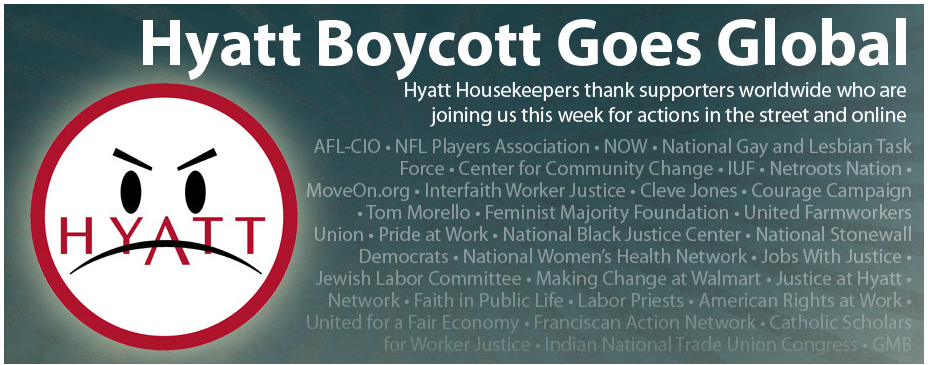
When it was announced that the Religious Action Center of Reform Judaism (RAC) had signed contracts with Hyatt Hotels for upcoming conventions – including their signature Consultation on Conscience and L’Taken Social Justice Seminars – many who stood in solidarity with Hyatt workers believed it was moment of truth for the Jewish community. Would the RAC, one of the most prominent and venerable social justice organizations in the American Jewish community, go ahead with their plans to hold high profile conventions in boycotted hotels?  Or would they grasp the critical importance of this moment and opt to hold their events elsewhere?

Some background:

When they learned of the contracts, concerned Jewish clergy as well as the Hyatt workers’ union, UNITE HERE, formally asked the RAC and the Union for Reform Judaism (URJ) to honor the recently announced global boycott of Hyatt. Last month, the URJ and RAC met with union leaders and Hyatt employees. They learned that Hyatt summarily fired nearly 100 housekeepers from three Boston-area hotels in August 2009, replacing longtime housekeepers with temps at far lower rates of pay.  They learned that Hyatt has been undermining the stability of jobs by increasingly subcontracting their workers. They learned Hyatt has been undermining the safety of jobs by increasing housekeeping workloads to dangerous levels. And they learned that Hyatt has been actively thwarting efforts by non-union hotel workers to exercise their fundamental right as workers to collectively bargain.

The RAC and the URJ also heard from high ranking officials at Hyatt. Not surprisingly, Hyatt challenged the union’s claims of unjust treatment of workers. While they admitted there may have been problems at some of their hotels in the past, they insisted that they had now been addressed.

After deliberating, the organizations publicized their final decision. In a released statement, the URJ/RAC opened with an affirmation of the Reform movement’s long-time support for unions and the labor movement, dating back to the days of “the historic Jewish garment trade unions.” (It was right about here that I started to get that familiar sinking feeling…)  After laying out an extended description of their deliberation process, they announced their decision: they had “decided not to seek to move the events in question from Hyatt hotels.”

In a subsequent article in the Jewish Daily Forward, (“When Principles and Interests Collide,” November 3, 2012) columnist (and senior adviser to the RAC) Leonard Fein offered what was essentially a condensed version of the original statement. While he recognized “the challenges faced by many hotel workers” and believed the Reform movement was “at the forefront of efforts to provide greater rights and protections for hotel workers,” Fein wrote that the request by UNITE HERE was still “hardly a no-brainer.”

The RAC/URJ statement gave three essential reasons for their decision:

1. They had done due diligence.  Prior to entering into the contracts, the URJ/RAC checked each specific hotel on INMEX (Information Meeting Exchange), a system established by UNITE HERE to help non-profits avoid entering into contracts with hotels involved in labor disputes. Because the contracts were signed long before the Hyatt global boycott was announced, none of the Hyatt hotels in question were listed as having any labor disputes at the time.

2. The situation was “complex.” Because boycotts affect “many stakeholders who have no involvement in the disputes,” the URJ/RAC only honors boycotts “in certain exceptional circumstances.”  In determining whether to honor a boycott, their process requires “detailed investigation, meetings with as many stakeholders as possible, hearing and considering arguments on all sides, and going through the often arduous process of trying to validate the claims made by the various parties.”  In the end, their support for boycotts is “the exception and not the rule.”

3. It would cost the Reform movement a great deal of money. The URJ/RAC has a fiduciary responsibility to the congregations and donors who have entrusted their funds to them. The cancellation of the contracts would cost $450,000 in penalties – funds that are critically needed given the enormous fiscal constraints on Reform congregations and the movement at large.  The loss of the money would also impede the RAC’s ongoing efforts to promote social justice, including decent working conditions in hotels. And even if they did break the contracts it would ultimately profit Hyatt hotels, as none of the $450,000 would go to the labor union or the workers.

The statement concluded:

We respect those who disagree with us. For those who do disagree, let us point out that no one has to stay at a Hyatt to participate in our conferences. We hope they will join us in education programs on the situation of workers to be held at the conferences, showing our support for hotel workers, including those at Hyatt.

For those of us who have long been fighting in the trenches with Hyatt workers for fair treatment and dignity it is particularly galling that the URJ/RAC claim to support “hotel workers, including those at Hyatt” even as they refuse to honor the workers’ boycott. For embattled workers, a boycott is the most important and effective tool for shifting the balance of power. It is plainly disingenuous for the URJ/RAC to refuse the Hyatt workers’ boycott call while claiming to support their cause.

Such a stance also misses the essential point of solidarity.  In the labor movement, as with all movements of liberation, solidarity means truly listening to the voices of those who are oppressed. It means allowing them – and not us – to be the architects of their liberation. It is patronizing in the extreme for the URJ/RAC to purport to support Hyatt hotel workers by saying, in essence, “we support your cause, but we’re going to support it our way – not your way.”

Let’s take a closer look at the rationales the URJ/RAC offered for refusing to rescind the Hyatt contracts:

1. The URJ/RAC claimed that it checked with the INMEX list and saw “there were no disputes with the Hyatt hotels in question.” In fact, INMEX does not include the union hotel guide and boycott list on its website because these lists are not useful for situations such as this – i.e., when organizations plan events far in the future. The UNITE HERE boycott list explicitly warns Group Customers that they should not solely rely on the list of currently boycotted hotels when planning events many months or years in advance.  In such cases, groups should “insist on protective contractual language”  that would address the eventuality of a future labor dispute or boycott.  For whatever reason, the URJ/RAC failed to do this. In any event, their claim that they checked the boycott list does not suffice as an valid excuse.

2.  While it is true that there are many “stakeholders” in a boycott, it is it is difficult to deny that vulnerable non-union workers who work for a barely livable wage, who are given increased and often dangerous workloads and who work with the constant risk of replacement by temps have the most at stake in this situation.  The “stakeholder playing field” cannot reasonably be considered level when you consider that workers are going up against an aggressively expanding multi-million dollar corporation. (Hyatt recently reported that its third quarter net profit earnings jumped 64% to $23 million compared to this time last year.)

On the subject of stakeholders, it bears noting that JB Pritzker, a principal owner of Hyatt Hotels Corporation, has long been a significant donor to the URJ and the RAC. Moreover, as late as 2010 he was listed as a member of the Commission on Social Action of Reform Judaism, serving at the Chair’s discretion. While there is no proof that Pritzker had any undue influence on the movement’s decision, this point is certainly germane to any discussion of significant “stakeholders.”

3. The URJ/RAC cites its fiduciary responsibility to its Reform movement constituents when considering the potential $450,000 in penalty fees for breaking its contracts with Hyatt. This overtly corporate rhetoric belies Reform Judaism’s status as a religious movement that considers social justice to be a central element of its mission. While it is certainly true that the Reform movement has a fiduciary responsibility to its members, it could also argued that the URJ/RAC has a stronger spiritual/ethical responsibility to its constituents to serve as a role model for its deeply cherished religious values of worker justice.

As the clergy report on the Hyatt, “Open the Gates of Justice,” states:

As religious leaders with a commitment to the moral bottom line, we consider it unacceptable when in good times employers keep their profits for themselves and in bad times they pass on their losses to their workers. We insist that the best business practice is the one that benefits workers, many of whom have served their hotels for over two decades. The best business practice benefits the guests, who want their rooms cleaned by trained and dedicated staff and who have sufficient time to do a thorough job cleaning each room. The best business practice benefits the community, which thrives on good jobs at good wages but which loses economic strength when the workforce is paid below a living wage.

In truth, many organizations that have honored the boycott have renegotiated their contracts with Hyatt to reduce or waive penalty fees. But even if they go forward with the contracts as they are, it is spurious to argue that the $450,000 in penalties would only benefit Hyatt and not the workers. After all, by contracting with the hotels, the URJ/RAC will ultimately pay Hyatt a significantly higher sum.  On the other hand, Hyatt workers would almost certainly exchange a $450,000 penalty put into the pockets of Hyatt for the invaluable and uplifting moral support they would gain from the public solidarity of the Reform movement.

I personally know many courageous Reform rabbis who have long stood in solidarity with Hyatt workers – and who are deeply offended that the Religious Action Center will be hosting social justice conventions at boycotted hotels. The URJ/RAC statement certainly does not stand for them and, I wager, for many lay members of the Reform movement who still cherish their denomination’s historic commitment to social justice.

My Reform colleagues understand that a real commitment to workers cannot end with the honoring of past struggles. It is simply not enough to invoke the International Ladies Garment Workers Union and offer bland statements about the historic role Jews played in building the American labor movement.

True solidarity means understanding that the struggle ever continues – and that there are flesh and blood “stakeholders” in our own day who call on us to support the sacred cause of worker justice.

Click here to re/affirm a pledge to support the Hyatt boycott.

Guest Post By Rabbi Brian Walt: We are Building Up a New World

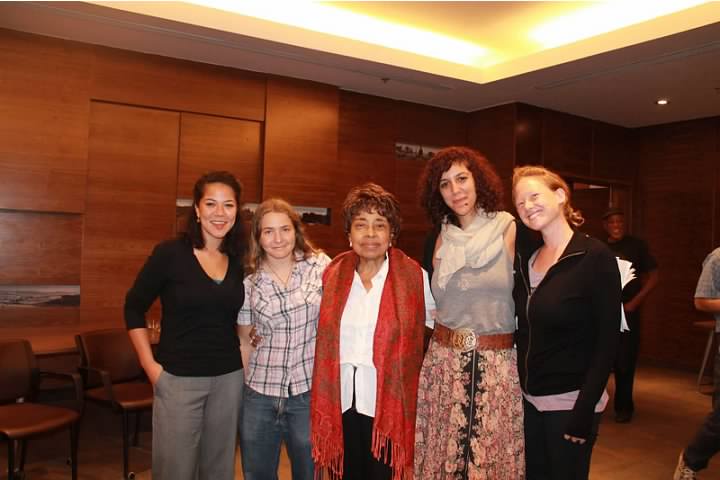
Dorothy Cotton (middle) with Israeli and Palestinian Activists (Photo: Rev. Osagyefo Sekou)

Cross-posted with Rabbi Brian’s Blog

We are building up a new world, we are building up a new world,
We are building up a new world, builders must be strong.
Courage brothers don’t be weary, courage sisters don’t be weary,
Courage people don’t be weary, though the road be long.

This is one of the many songs I sang as I led a remarkable delegation of US Civil Rights movement leaders, young human rights leaders, prominent Black academics and educators and several Jewish activists that traveled through the West Bank two weeks ago.

Our delegation was a project of the Dorothy Cotton Institute, an organization dedicated to human rights education and to building a global human rights community. Dorothy Cotton served as the Director of Education of the Southern Christian Leadership Conference (SCLC) and was the only woman on the executive staff.  She led the Citizenship Education Program that empowered the disenfranchised to exercise their rights as citizens.

The goals of this historic delegation were:

– to create and build an ongoing relationship between leaders of the US civil rights movement and the leaders of the growing Palestinian nonviolent resistance movement on the West Bank and their Israeli allies;

– to increase the visibility of this movement in the US and internationally;

– to learn from one another about nonviolence, effective solidarity and social transformation;

– and to educate Americans about the role the United States plays in supporting the status quo on the West Bank.

Our delegation spent two weeks on the West Bank.  We visited three Palestinian villages – Budrus, Bilin, Nabi Saleh – that have engaged for many years in a popular nonviolent struggle to reclaim land expropriated by the Israeli military.  We met several young Palestinians who are building the Coalition for Dignity, a grassroots, youth – led nonviolent movement.

And we met Israeli allies who stand in solidarity with the Palestinian nonviolent movement and who work in their own society to end militarism and human rights violations against Palestinians.  We learned from many Israeli and Palestinian nonviolent activists about their work, their vision and their dreams.

In short, our delegation saw and learned about realities that the overwhelming number of visitors to Israel never see or hear.

Singing was an essential part of the spiritual and political life of our trip.  Dorothy has a beautiful spirit, a powerful voice, and loves to sing.  Throughout the delegation, she always reminded us that singing was a critical tool for energizing the civil rights movement.  She told me,

We had songs for different occasions. We sang at mass meetings, and we sang at funerals … We sang, “I am going to do what the Spirit says do” and our singing inspired us to do just that.

And so our new civil rights delegation sang as we traveled through the West Bank.  Singing was just one powerful way in which our delegation made a connection between the Black-led struggle for civil rights in the US and the Palestinian struggle for justice, peace and security for all.

This, for instance, is the song we sang at the grave of a young man in Budrus who was killed in a nonviolent demonstration to protest the confiscation of his village’s land:

Come By here my Lord, come by here.
For our brother, my Lord, come by here.
For his courage my Lord, come by here.

Standing around the grave, delegates spontaneously composed the lyrics. It felt like we were praying, acknowledging the courage and the profound cost that the struggle for freedom demands.

We sang before we joined the weekly nonviolent demonstration in Nabi Saleh, another village on the West Bank fighting to reclaim their land.   The residents of the village had made special signs composed of quotations from Dr. Martin Luther King in honor of our visit.  “Injustice anywhere is a threat to justice everywhere” read one of the signs.

And we sang:

Ain’t going to let nobody turn me around, turn me around, turn me around.
Keep on walking, keep on talking, marching down to freedom land.

We sang to express our appreciation and to provide support after hearing activists tell us their stories – Palestinians and Israelis who told us of their amazing work and the toll it has taken on their lives, and sometimes even their spirits and souls.  One such occasion was after Israeli activist Gabi Laski told us of her work to defend children from villages like Nabi Saleh who are arrested at night.

We’re going to keep on marching forward, keep on marching forward, keep on marching forward, never turning back, never turning back.

We sang after standing next to the thirty foot high Separation Wall in Jerusalem dividing a Palestinian neighborhood in two.  And we sang on the bus as we went through a checkpoint on our way to the airport at the end of our trip, encouraged by our Palestinian guide to keep singing even when the soldier boarded our bus.  (Our bus was pulled aside for a security check because it was a Palestinian bus while Israeli buses and motorists were waved through the checkpoint).

We returned to the United States both inspired and disturbed by our experience.  We were inspired by the determination, vision and commitment of so many Palestinians and their Israeli allies, working tirelessly day after day, year after year, often at great personal and communal cost, for justice, freedom and equality for all.  Now that we are home, we look forward to sharing the stories and vision of these courageous civil rights activists with our friends and communities.

But our trip was not simply inspiring.  It was profoundly disturbing to witness the harsh realities of life on the West Bank that are so invisible to the discourse in America.  Every day we saw and heard about a systematic denial of human rights in countless ways: land confiscation, extensive restrictions on movement, humiliation at check points, home demolition, the arrest of children, the revocation of residency permits and many other violations.

The delegates were profoundly shocked. Several American civil rights veterans  commented that the discrimination, humiliation and injustice they witnessed was “frighteningly familiar.”

While we were on the West Bank the two presidential candidates tried to outdo one another in their public declarations of support for Israel in the final presidential debate.  They mentioned Israel 31 times with only one passing reference to Palestinians.  The contrast between American policy and what we witnessed is stark.  Now that we have returned, we are determined to share this disturbing reality with our communities; to challenge the ways in which our country funds, provides diplomatic cover, and enables these injustices.

I have visited the West Bank before but never for more than a day or two, and almost always with progressive Israeli groups.  On this visit, however, we spent virtually all out time in the West Bank – on the other side of the Separation Wall.  For me personally, it was a transformative experience.  It was a privilege to travel with such a special group of people and to see the profound impact of our delegation on the activists that we met.

Before we left on our journey, I was struck by a comment made by Dr. Vincent Harding, a close associate of Dr. Martin Luther King, a person with a long history of involvement in the struggle for freedom and a very close life-long connection to Jewish teachers, fellow travelers and co-workers.  Dr. Harding talked about “encouragement” as one of his primary goals for the trip.  I was struck by the word and the simple power of his intention.  He wanted to meet activists on the West Bank and to “encourage” them.

And that is exactly what happened. The people we met commented how encouraged they felt by meeting people who had spent their entire lives fighting for freedom in the US.  Dr. Harding and others would repeatedly ask all our presenters to tell us about themselves, their families and what motivated them to do what they were doing.

He and others always shared how much he appreciated their work and how important it was for all of us and for our collective future.  After hearing an inspiring talk by Fadi Quran, one of the young leaders of the Palestinian nonviolent movement, Dr. Harding said, “Fadi, I want to tell you how proud I am and how grateful I am for you, and want to encourage you to keep on going.”

It felt like we were building a new world.  On the very first day of our trip, Dorothy Cotton sang and danced with three women activists, Israeli and Palestinian, who had spoken to us. It was a joy to see the profound gift she was giving them and that they were giving her in return. Those who had spent their lives building a new world in America were creating a relationship with those who were building a new world in Israel/Palestine.

Towards the end of the trip we realized that we were just beginning to build a new world in another way by creating a new possibility for the relationship between Jews and Blacks in our own country.   Historically, Israeli policy has been a source of tension between the African American and Jewish communities.  While many African Americans on the delegation have deep and positive connections to Jews, it is often difficult for Blacks and Jews to have honest conversations about Israel.

There were eight Jews on this delegation.  On this trip we joined together as a group of Blacks, Jews, Christians and people with varied faith commitments, united in our commitment to nonviolence and our dedication to justice, freedom and equality in Israel/Palestine, in our own country, and around the world.  We are renewing an alliance between Blacks and Jews, an alliance rooted in our shared values.

We are building up a new world, we are building up a new world.
We are building up a new world, builders must be strong.
Courage brothers don’t be weary, courage sisters don’t be weary,
Courage people don’t be weary, though the road be long.

Rabbi Brian Walt: Christian Leaders Cannot be Cowed into Silence

Please read my friend Rabbi Brian Walt’s new piece in Ha’aretz. He has recently returned from a remarkable interfaith delegation to the West Bank; I will be posting more of his writings about his experiences in the near future.

In his recent Haaretz op-ed, “Heading toward an irreparable rift between U.S. Jews and Protestants,” my colleague, Rabbi Eric Yoffie, sharply criticized the recent letter to Congress by leaders of Protestant churches that called for U.S. military aid to Israel to be contingent on Israeli compliance with American law. Nowhere in his article, however, did Yoffie mention the central concern of the Christian leaders’ letter: the overwhelming evidence of systematic human rights violations by the Israeli military against Palestinians.

Over the past two weeks, I had the privilege of leading an interfaith delegation including several leaders of the civil rights movement, younger civil and human rights leaders, Christian clergy, academics, and several Jews, on a two-week trip to the West Bank.

We were all shocked by the widespread human rights violations that we saw with our own eyes and that we heard about from both Palestinians and Israelis. Several black members of our group, including those who participated actively in the civil rights movement, remarked that what they saw on the West Bank was “frighteningly familiar” to their own experience, a systemic pattern of discrimination that privileged one group (in this case, Jews) and denigrated another (Palestinians).

Continue reading

Rabbis Endorsing Candidiates: Advocacy for the Sake of Heaven?

Recently read an interesting blog post by Rabbi Rachel Gurevitz of Congregation B’nai Shalom (Reform), in Westborough, MA, in which she expresses her disapproval of clergy who endorse candidates for public office.

Exhibit A: “Rabbis for Obama:”

Over 600 rabbis, from across the Jewish denominations, have signed their names – as individuals – to ‘Rabbis for Obama’ … I will tell you now, my name is not on that list.  And, while I see that many of my colleagues who I deeply respect as rabbis, have chosen to add themselves to the list, I am not at all comfortable with it.  I see little difference between adding one’s name to a publicly available list of this kind, and endorsing a candidate from the pulpit.  And, while I am no constitutional scholar, and am willing to accept the possibility that individual religious leaders may have a constitutional right to something, that doesn’t mean that, as responsible religious leaders and teachers, we should necessarily exercise that right.

I’m not a constitutional scholar either, but I’m fairly certain clergy don’t endanger their 501 c3 status as long as they make it clear in their endorsements that they are speaking as individuals and not on behalf of their congregations. But be that as it may, Gurevitz’s real issue with such endorsements is less legal than philosophical:

 Each individual candidate and the parties they represent, hold diverse views on a very wide array of subjects.  It is simply not true – it cannot be – that one side is ‘right’ and the other side is ‘wrong’.  This is the case whether we are speaking in terms of ethics and morals, or whether we are speaking about issues of social equity and justice.  Our political arena has become polarized enough already.  We do absolutely no service to this country, to the well-being of our society, or to the legitimacy and value of the religious traditions we serve and represent when we add to that polarization by picking sides.

Rather exacerbate our national polarization, Gurevitz suggests, rabbis should take their cue from Jewish/Talmudic tradition, which values diversity of opinion and debates “for the sake of heaven” – and not, as she puts it, “debates for the sake of winning.”

While I appreciate Rabbi Gurevitz’s desire to mitigate the polarizing discourse in American political culture, I don’t think it’s quite fair of her to assert that rabbinical endorsements automatically translate into (as she puts it), “I’m right and you are wrong, therefore we are good and you are evil, therefore we speak in God’s name and you don’t.”

This is certainly not the message – in content or tone – set by the Rabbis for Obama website, which merely contains a list of rabbis, various links, along with this fairly mild statement:

This group of over 613 rabbis … from across the country and across all Jewish denominations recognize that the President has been and will continue to be an advocate and ally on issues important to the American Jewish community. That is why they are committed to re-electing President Obama and actively doing their part to move our country forward.

That’s a pretty far cry from “We speak in God’s name and you don’t.”

In truth, when I think of rabbis who have publicly endorsed candidates over the years, I’m hard pressed to find many who have done so in an overly polarizing or patronizing manner.  In this regard, I still remember well the words of the venerable Reform Rabbi Arnold Jacob Wolf, whose last major public statement was an article for the Jewish Week entitled “My Neighbor Barack”  – in which he voiced his support for Obama during the 2008 campaign. (His article was particularly meaningful because it was published during a period in which Obama was under withering attack from certain neo-conservative quarters of the Jewish community.)

On a deeper level, however, I think Gurevitz fundamentally misreads the legacy of rabbinic debate “for the sake of heaven.”  While the rabbinic discussions of Talmud do indeed provide a graphic representation of this legacy, I would suggest that our job as rabbis is not to emulate a page of Talmud, but to engage in the debate itself.

There is no question that the issues discussed during election cycles are of profound significance for our national community.  None of us can afford to stand aloof from these issues – least of all rabbis. Indeed, by advocating for candidates who support the policies we believe will best serve the common good, we advocate for the sacred values we purport to cherish as religious leaders.  If we preach about social issues from the pulpit, why should it be inappropriate for us to endorse the candidates who are directly responsible for enacting the policies related to these issues?

I certainly agree with Gurevitz when she exhorts clergy to must speak out against “the polarizing and vindictive narrative of political debate when we see and hear it.” But I’m not at all convinced we must stand on the sidelines during election season in order to do so.

Why Be Jewish?: A Sermon for Yom Kippur 5773

From my Yom Kippur sermon yesterday:

Let me leave you with this vision: the vision of a people who have over the centuries learned to build a nation without borders, a multi-ethnic nation suffused with the beauty of a myriad of cultures, a nation inspired by a religious tradition it constructs and reconstructs in every age and in every generation. At its heart, a nation committed to the struggle for meaning in our lives and justice in our world. And in the end, a nation that has nothing to fear and every opportunity to gain from the remarkable changes underway in the 21st century.

Click below to read the entire sermon:

Continue reading

Judaism Without Tribalism: A Sermon for Rosh Hashanah 5773

From my Rosh Hashanah sermon last Monday:

However – I also wonder if Jewish tribalism is starting to come at a cost.  I especially wonder what it means for the Jewish community to be tribal in this day and age, when we are experiencing openness and freedom in historically unprecedented ways.  Given the global realities of our 21st century world, I wonder if there might be new models for Jewish identity – ones that value tribalism less than a deeper sense of engagement and kinship with the world outside.

Click below to read the entire sermon:

Continue reading