Category Archives: War

We’re Leaving But Not Really Leaving Iraq

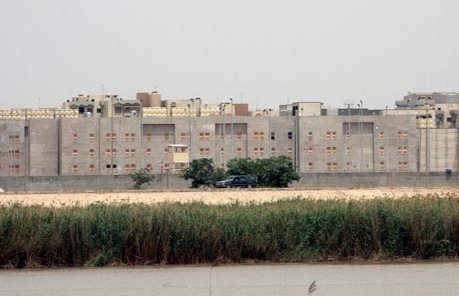
The new American embassy in Iraq is the largest in the world and is built on a tract of land roughly the size of the Vatican

In my recent Yom Kippur sermon, I linked to an article that explained why, even if Obama did honor the pledge to withdraw US troops at the end of 2011, this wouldn’t be the end of our militarized presence in that country by a long shot.

So now that Obama has formally announced the Iraq withdrawal, just pay close, close attention to the heavily militarized State Department presence that will remain.

From a recent WashPo article:

The list of responsibilities the State Department will pick up from the military is daunting. It will have to provide security for the roughly 1,750 traditional embassy personnel — diplomats, aid workers, Treasury employees and so on — in a country rocked by daily bombings and assassinations.

To do so, the department is contracting about 5,000 security personnel. They will protect the U.S. Embassy in Baghdad plus two consulates, a pair of support sites at Iraqi airports and three police-training facilities.

The department will also operate its own air service — the 46-aircraft Embassy Air Iraq — and its own hospitals, functions the U.S. military has been performing. About 4,600 contractors, mostly non-American, will provide cooking, cleaning, medical care and other services. Rounding out the civilian presence will be about 4,600 people scattered over 10 or 11 sites, where Iraqis will be instructed on how to use U.S. military equipment their country has purchased.

“This is not what State Department people train for, to run an operation of this size. Ever since 2003, they’ve been heavily reliant on U.S. military support,” said Max Boot, a national security expert at the Council on Foreign Relations.

Make no mistake: we’re all going to be paying for Bush’s Folly for a long, long time to come…

War Without End: Sermon for Yom Kippur 5772

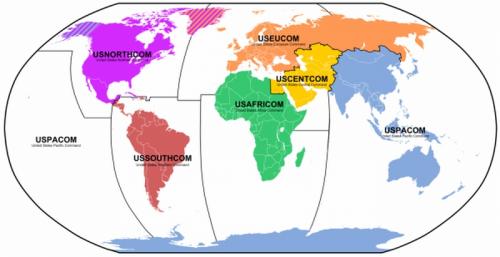
US Global Command and Control System

In 2006, I was approached by JRC’s Peace Dialogue task force and asked if I would consider adding something to our Shabbat prayer for peace. Could we, they asked, introduce the prayer by reading the names of three American soldiers, three Iraqi civilians and three Afghan civilians who had been killed in these two ongoing wars?

The reason, they explained, was to remind ourselves that peace is not just an abstract concept. If we’re going to say a prayer for peace, we should own up to the stakes – we should acknowledge that we are citizens of nation at war, that war comes with a very real human cost, and that as American citizens, we are complicit in all actions made by our country.

Continue reading

IDF and Settlers Prepare for a West Bank “Bloodbath”

There are increasingly chilling signs that September will be a very tragic month for Palestinians in the Occupied West Bank.

Last month, Ha’aretz reported that Israel is concerned about “the possibility of confrontations” with Palestinians following the expected vote in favor of Palestinian statehood at the UN General Assembly. So concerned, apparently, that the IDF is now training West Bank settlers and creating “readiness squads” in anticipation of any Palestinian demonstrations.

But as veteran Israeli peace activist Uri Avnery pointed out in a recent article, there is every reason to believe that these measures are not simply “defensive precautions” but rather preparations for a fait accomplis by the IDF and the settlers (between whom all distinctions have now become irrevocably blurred) :

In the next few weeks, the Palestinians will ask the UN to recognize the State of Palestine. They have already mustered a large majority in the General Assembly. After that, according to the official assessment of our army, all hell will break loose. Multitudes of Palestinians will rise, attack the “Separation” Wall, storm the settlements, confront the army, create chaos.

“The Palestinian Authority is planning a bloodbath,” Avigdor Lieberman cheerfully asserted. And when Lieberman predicts violence, it would be unwise to ignore him.

For months now, our army has been preparing for just such an eventuality. This week it announced that it is training the settlers, too, and telling them exactly when they are allowed to shoot to kill. Thus it confirms what we all know: that there is no clear distinction between the army and the settlers – many settlers are officers in the army, and many officers live in settlements. “The army defends all Israelis, wherever they are,” is the official line.

One of the scenarios the army is preparing for, it was stated, is for Palestinians shooting at soldiers and settlers “from inside the mass demonstrations”. That is an ominous statement. I have been at hundreds of demonstrations and never witnessed anyone shooting “from inside the demonstration”. Such a person would have to be insanely irresponsible, since he would expose all the people around him to deadly retaliation. But it is a handy pretext for shooting at non-violent protesters.

The settlers are, not surprisingly, taking their own “precautions” as well. Reuters has reported that settlers are receiving trained attack dogs from the “Civilian Dog Handlers Battalion of Judea and Samaria” (above) and just yesterday, Mondoweiss shared this chilling post from the French JDL website:

The JDL is organizing 19 to 25 September, a trip solidarity with our Israeli brothers living on the land of our ancestors Judea and Samaria.

This trip is for militants with military experience: The aim of this expedition is to lend a hand to our brothers face the aggression Palestinian occupants and thus enhance the security features of Jewish cities in Judea and Samaria.

Please keep these developments in mind as we watch events unfolding in the West Bank during the coming weeks. And let us pray for peace.

Eilat Attack Aftermath: Gazans Pay the Price Again

Since I wrote about last week’s Eilat/Gaza violence, I’ve read several news articles that report on increasing evidence that the Eilat attackers actually came from Egypt/Sinai and not Gaza.

From a +972 post by Yossi Gurvitz last week:

Yesterday evening the Egyptian newspaper Al Masry Al Youm reported that Egyptian security forces have identified three of the dead attackers. Egypt has a strong interest to claim the attackers were Gazans, since this would lessen its responsibility for the attacks; nevertheless, they say at least two of the attackers were known terrorists in the Sinai Peninsula. As far as I could find out, the rest of the bodies are in the hands of the IDF – which, again, does not reveal their identity.

This story has also been covered extensively by blogger Richard Silverstein at Tikun Olam, and more recently, by Amira Hass, writing for Ha’aretz. (Most of the mainstream media has, not surprisingly, long since moved on from this one.)

For an astute analysis of this whole tragic mess, I highly recommend Paul Woodward’s piece in War in Context:

As for those who have an interest in evidence, rather than taking comfort in deeply ingrained prejudice, the evidence suggests that the men who attacked Israelis yesterday and Egyptians today are in conflict with both states. More than likely, this has much less to do with Gaza or the Palestinian national cause than it has with the aspirations of radical groups based in the Sinai.

Those responsible for maintaining Israel’s security quickly claimed they knew exactly who was behind yesterday’s attacks in Eilat and duly dispatched the Israeli air force to rain down missiles on Gaza. No one explained why, if Israeli intelligence was so good, they had not prevented the attacks. Even so, the domestically perceived legitimacy of a security state depends less on its ability to thwart terrorism than its willingness to make a timely show of force. Indeed, the occasional tragedy has obvious political utility. The attacks in Eilat serve to remind Israelis that the state created as a safe haven for Jews can only remain safe so long as everyone remains afraid.

In the meantime, Israel’s assault against Gaza still continues. According to the Palestinian Center for Human Rights:

In the early morning of Thursday, 25 August 2011, two Palestinian civilians were killed and 25 others, including 11 children and 7 women, were wounded as Israeli warplanes bombarded a sports club in a densely-populated area in the northern Gaza Strip town of Beit Lahia. The attack resulted extensive damages to dozens of neighboring houses and facilities. On Wednesday, 24 August 2011, an elderly farmer and a worker were killed and four civilians were wounded, while three other persons are missing inside a tunnel at the Egyptian border due to an Israeli air strike against the tunnels.

It is looking increasingly likely that this latest violence has more to do with Israel-Egypt relations than Gaza. Is anyone asking why, then, is it largely Gazans who are paying the price?

Time to Leave Iraq as Promised!

At every JRC Shabbat evening service since December 2006, we’ve introduced our Prayer for Peace by reading the names of three American soldiers, three Iraqi civilians and three Afghan civilians who have been killed since these wars began in 2001.

It’s our way of very simply reminding ourselves that we are citizens of nation at war, that war comes with a real human cost, and that war is a terrible and daily reality for real life individuals. And we do it to acknowledge that as American citizens, we are complicit in all actions made by our country.

Exactly one year ago, when Obama announced a reduction of American combat forces in Iraq from 144,000 to 50,000 troops, I was tempted to stop reading the names of the Iraqi war dead during our services – but I was prevailed upon to continue by many JRC members. After all, Obama himself said that our active combat presence would be maintained until the end of 2011. And as long as this is the case, we’d be hard pressed to deny that we were still a nation at war.

And now – surprise of surprises – we’re hearing indications that Secretary of Defense Panetta and others in the Obama administration believe that “some American forces should stay beyond 2011.”

Oh yes, make no mistake: we are still very much at war in Iraq….

Obama campaigned on the promise to end this war. Americans oppose the war in Iraq by an overwhelming margin. Our economy is in crisis and Congress has committed to find $1.2 trillion in savings for the coming year.  It’s time to wake up from our slumber and let our leaders know its time to end this misbegotten adventure as promised.

Rep. Barbara Lee of California is currently sponsoring a bill known as the “Iraq Withdrawal Accountability Act” – legislation that would prohibit funding of troops and military contractors in Iraq past 2011. Please click here and join me in urging your Congressperson to co-sponsor Rep. Lee’s bill.

PS: At the risk of ending this post on an abjectly depressing note, I recently read that regardless of when the American military pulls out of Iraq, our presence there would still not be over by a long shot. Read, if you dare, this piece by ex-foreign service staffer Peter Van Buren, in which he explains what will actually happen when the American presence in Iraq is transferred from the military to the Dept. of State:

(The) State Department hasn’t exactly been thinking small when it comes to its future “footprint” on Iraqi soil. The U.S. mission in Baghdad remains the world’s largest embassy, built on a tract of land about the size of the Vatican and visible from space. It cost just $736 million to build — or was it $1 billion, depending on how you count the post-construction upgrades and fixes?

In its post-“withdrawal” plans, the State Department expects to have 17,000 personnel in Iraq at some 15 sites. If those plans go as expected, 5,500 of them will be mercenaries, hired to shoot-to-kill Iraqis as needed, to maintain security. Of the remaining 11,500, most will be in support roles of one sort or another, with only a couple of hundred in traditional diplomatic jobs. This is not unusual in wartime situations. The military, for example, typically fields about seven support soldiers for every “shooter.” In other words, the occupation run by a heavily militarized State Department will simply continue in a new, truncated form — unless Congress refuses to pay for it.

Remember the Fallen: End the War in Afghanistan

Here’s some assigned reading and viewing this Memorial Day Weekend, starting with a very thoughtful article written by David R. Henderson, a research fellow with the Hoover Institution and an economics professor at the Naval Postgraduate School.

Written immediately following Memorial Day 2008, Professor Henderson addressed the debate over the precise meaning of the day: is it to honor the soldiers who fought and died to preserve our “American freedoms,” or to mourn those who lost their lives in wars and to reflect on how to prevent this from happening in the future?

Henderson makes a compelling and eloquent case for the latter. His conclusion:

Exercise your freedom on future Memorial Days in any way that you wish as long as it’s peaceful. Take a minute or more to mourn the loss of so many U.S. soldiers and foreign soldiers, as well as millions of innocent civilians, who lost their lives because some government, whether the U.S., the USSR, the Nazis, or the Japanese government, killed them. Remember that almost all of those who die in war – even most of the soldiers who fought on the German side in World War II – are relatively innocent, even if their governments are not. And try your best to hold politicians accountable so that we’ll have fewer such deaths in the future rather than more.

After reading Henderson’s piece, please watch the clip above and sign this petition that encourages Congress to end the fruitless, tragic war in Afghanistan – currently the longest in American history.

PS: This just in today:

NATO has apologized for the deaths of Afghan civilians in an air strike in southern Afghanistan…

Authorities in Helmand Province said 14 civilians had died in the strike on May 28, 12 of them children.

Happy Independence Day?

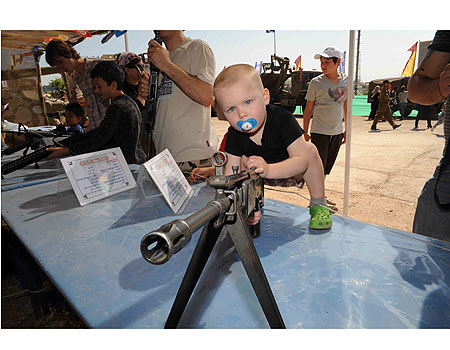
Ynet Photo: Avihu Shapira

Saw this in Ynet this morning, from an article covering Yom Ha’atzmaut celebrations in Israel. Caption: “Tens of thousands visited IDF bases.”

My first thought: the famous picture of the Palestinian baby in a bomb vest that got some major play in the Jewish press some years back.

My second thought: those Jews who claim Palestinians harbor a “culture of death” should take a good long look at this picture.

My third thought: this recent picture of an Israeli preschool – another image that stopped me in my tracks.

I really don’t know what else to think…

Gaza and the Arab Spring: A Conversation with Nadia Hijab

I’m pleased to announce that Ta’anit Tzedek – Jewish Fast for Gaza will sponsor “Gaza and the Arab Spring,” a conference call with prominent Palestinian writer and human rights advocate Nadia Hijab on Thursday, May 19 at 12:00 pm EST. 

The Arab Spring – a series of popular uprisings all over the Arab world – has brought new hope for greater freedom, justice and democracy to millions of people throughout the Arab world and beyond. The uprisings have already brought about dramatic changes in several countries and the popular movement is growing in strength. How will these changes affect the Israeli-Palestinian conflict and more particularly the people of Gaza? What is impact of related developments, such as the Hamas – PA unity agreement and Egypt’s opening of the Rafah crossing into Gaza?

Our guest, Nadia Hijab was born in Syria to Palestinian parents and was raised in Lebanon. Ms. Hijab began her career as Editor-in-Chief of Middle East Magazine and later moved to New York to work for the United Nations Development Program where she served in several UNDP departments and helped organize the Program’s contribution to the 1993 World Conference on Human Rights.

After leaving the United Nations, Ms. Hijab became Executive Director of the Palestine Center, a Washington, DC-based think tank affiliated with the Jerusalem Fund. In 2000 she established her own consulting business on human rights, human development, and gender. Ms. Hijab has served as co-chair of the US Campaign to End the Israeli Occupation and is on its advisory board, and is a Past President of the Association of Arab American University Graduates.

Ms. Hijab appears frequently as an Arab-affairs commentator on television, radio and print outlets and has authored more than 100 articles and has published two books: Womanpower: The Arab Debate on Women at Work. and Citizens Apart: A Portrait of Palestinians in Israel.

To participate in the call:

Dial the Access Number: 1.800.920.7487 

When prompted, enter your Participant Code: 92247763# 

There will be a question and answer period during the call.

Participants in the call are encouraged to read one or more of the following three articles by Ms. Hijab.

The Arab revolutions and the Israeli-Palestinian Conflict

Understanding Obama’s Settlement Posture

The Palestinian Narrative: Then and Now

We are honored to welcome Ms. Hijab to our monthly conference call and invite you to join the conversation!

Osama Bin Laden: Was Justice Done?

On nights like this one, we can say to those families who lost loved ones to al Qaeda’s terror: justice has been done (President Obama, May 1, 2011)

I can’t say that.

In Jewish tradition, there are two different terms for “justice.” The first is mishpat, which is generally understood to mean “retributive justice.” In other words, we apply mishpat when we settle our disputes by right rather than by might, through due process of law rather than by resorting to revenge or vigilantism. Jewish – as well as American – values teach that law must be held in the highest regard by any community that considers itself a free society.

By this standard, justice was certainly not done when bin Laden was summarily executed by extra-judicial assassination. Many American leaders have repeated that terrorists have declared war on American values. What does it mean, then, when we fight them by betraying the very values of justice that we purport to uphold?

Louise Richardson, whose book “What Terrorists Want” is the wisest book on terrorism I’ve ever read, hits right it on the head:

Had we captured bin Laden alive and then resisted the very human urge to exact revenge and instead handed him over to an international court of impeccable rectitude and reputation for trial on charges against humanity, we would have deprived him of glory and demonstrated, even to the skeptical, the vast difference between his values and ours (p. 198)

(Though I hold tight to this moral conviction, I have no illusions that trying bin Laden in an international court would have been anywhere near the realm of political possibility. Just last month, the White House gave up on its intention to try accused 9/11 mastermind Khalid Shaikh Mohammed in a New York civilian court. Attorney General Eric Holder now says Mohammed and four other 9/11 terror suspects will face a military trial at, you guessed it, Guantanamo Bay.)

The other word for justice is tzedek, or “distributive justice.” According to this definition, we promote justice whenever we strive to eradicate the inequities in our society, be they imbalances of wealth, power, or privilege.

By this measure, our execution of bin Laden represents the tragic failure of imagination that our government calls the “War on Terror.” We are sadly deluded if we believe we will end terror through the force of our military might. We will never fully eradicate terrorism – but we can certainly mitigate it by taking responsibility for the ways our nation may be contributing to the global injustices that create breeding grounds for terrorists around the world.

Now that we’ve killed bin Laden, are we ready to have a real national conversation about the hundreds of military bases our country maintains around the world, our ongoing wars in three Middle Eastern countries, and our unconditional military support for Israel’s occupation? For all of the billions of dollars we are pouring into our national military machine, might we be prepared to contemplate, as Richardson suggests, “the adoption of a comprehensive development agenda to address the underlying or permissive causes of terrorism?” (p. 221)

No, I do not believe justice, in any sense of the word has been achieved here. Visceral satisfaction, relief or grim pleasure, perhaps, but not justice.

An Open Letter to Our Rabbinical Colleagues

This past week, rabbis across the country received a request from the Religious Action Center of Reform Judaism to sign a public rabbinic letter to Congress that urged our Representatives and Senators not to cut any foreign aid to Israel as part of the FY2012 budget. The request was co-signed by the rabbinical leaders of four major American Jewish denominations.

As rabbis who received these appeals for our endorsement, we would like to voice our respectful but strong disagreement to the letter. We take particular issue with the statement:

As Jews we are committed to the vision of the Prophets and Jewish sages who considered the pursuit of peace a religious obligation. Foreign Aid to Israel is an essential way that we can fulfill our obligation to “seek peace and pursue it”

We certainly agree that the pursuit of peace is our primary religious obligation.  Our tradition emphasizes that we should not only seek peace but pursue it actively.  However we cannot affirm that three billion dollars of annual and unconditional aid – mainly in the form of military aid – in any way fulfills the religious obligation of pursuing peace.

This aid provides Israel with military hardware that it uses to maintain its Occupation and to expand settlements on Palestinian land. It provides American bulldozers that demolish Palestinian homes. It provides tear gas that is regularly shot by the IDF at nonviolent Palestinian protesters. It also provided the Apache helicopters that dropped tons of bombs on civilian populations in Gaza during Operation Cast Lead, as well as the white phosphorus that Israel dropped on Gazan civilians, causing grievous burns to their bodies – including the bodies of children.

In light of Israel’s past and continuing military actions, how can we possibly affirm that our continued unconditional aid fulfills the sacred obligation of pursuing peace?

We also take exception to this assertion:

U.S. foreign aid reaffirms our commitment to a democratic ally in the Middle East and gives Israel the military edge to maintain its security and the economic stability to pursue peace.

In fact our ally, the Netanyahu administration, has even rebuffed mild pressure from the US government to comply with the longstanding US position against new settlements in the West Bank. If we believe that any peaceful settlement requires the end of the Occupation and Israel’s settlement policy, how will massive and unconditional foreign aid – and the support of hundreds of rabbis for this aid – promote a negotiated peaceful settlement of the conflict?

An Israeli government that continues to settle occupied territory with impunity will not change its policy as long as it is guaranteed three billion dollars a year.  With every other ally, our government pursues a time-honored diplomatic policy that uses “sticks” as well as “carrots.” We believe the cause of peace would be better served by conditioning support to Israel on its adherence to American and Jewish values of equality and justice.

We are also mindful that the Arab world itself feels under assault by the US when it witnesses Palestinians regularly assaulted with American-made weapons. With the vast and important changes currently underway in the Middle East, we are deeply troubled by the message that this policy sends to Arab citizens who themselves are struggling for freedom and justice.

We know that many of our colleagues who have signed this statement have taken courageous public stands condemning Israel’s human rights abuses in the past. We also know it is enormously challenging to publicly take exception to our country’s aid policy to Israel. Nonetheless, we respectfully urge our our colleagues to consider the deeper implications represented by their support of this letter.

Unconditional aid to Israel may ensure Israel’s continued military dominance, but will it truly fulfill our religious obligation to pursue peace?

In Shalom,

Rabbi Brant Rosen and Rabbi Brian Walt