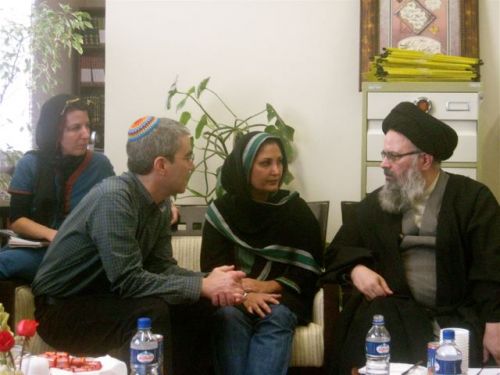
I’ve read and heard about some silly misinformation being spread around regarding my trip last year to Iran – and I’m thinking it might behoove me to set the record straight.
I will say at the outset that I gave a Yom Kippur sermon on this topic and I blogged extensively from Iran. If you haven’t read these posts yet, please do so. They will give you a pretty good sense of the why, what and how of my Iran experiences.
Right off the bat: I did not meet with Mahmoud Ahmadinejad.
Now that I’ve gotten that straightened out, I’d like to address one particular quote of mine that’s being bandied about out of context:
While I prefer not to weigh in on the rhetorical hairsplitting debate on [President Mahmoud] Ahmadinejad’s notorious 2005 threat to wipe Israel off the map, I’ll only suggest that our attitudes and foreign policy must be based on real intelligence and understanding, and not fear-based, knee-jerk assumptions.
I still think this quote should pretty well speak for itself, but apparently I need to explain further. I know of at least two instances in which this quote was used to somehow imply traitorous intentions on my part – i.e., that I prefer not to “weigh in” on the serious threats posed by Iran toward the Jewish state.
To those who doubt where my ultimate loyalties lay, I was actually referring with this quote to the rhetorical debate over the actual Farsi meaning of Ahmadinejad’s words from this oft-quoted speech. There has been an important ongoing debate as to whether these words were intended as a threat of genocide against the Jewish state or a predication of the eventual dissolution of the “Zionist regime” from within.
A recent blog post by Juan Cole represents this point of view well:
President Mahmoud Ahmadinejad did quote Ayatollah Khomeini to the effect that “this Occupation regime over Jerusalem must vanish from the page of time” (in rezhim-e eshghalgar-i Qods bayad as safheh-e ruzgar mahv shavad). This was not a pledge to roll tanks and invade or to launch missiles, however. It is the expression of a hope tha the regime will collapse, just as the Soviet Union did. It is not a threat to kill anyone at all.
As I myself am not a scholar of Farsi, I don’t consider myself qualified to weigh in on this debate, but I do believe that “our attitudes and foreign policy must be based on real intelligence and understanding, and not fear-based, knee-jerk assumptions.” I continue to stand by this assertion – I’m simply not a fan of fear-based foreign policy. I am well aware that there are those who will say, “maybe Iran does intend to destroy Israel or maybe it doesn’t, but can we really take that chance?” I’m more inclined to say it this way: “when we jump to conclusions and base our reactions on fear rather than true understanding, we may ultimately cause our deepest fears to actually come true.”
By the way, I encourage you to read Cole’s entire post, entitled “Top Things You Think You Know About Iran That Are Not True.” Whether or not you agree with his analysis, I believe his perspective provides a thought-provoking corrective to so many of the fear-based assumptions currently being bandied about regarding Iran.
Here are a few excerpts:
Belief: Iran is a militarized society bristling with dangerous weapons and a growing threat to world peace.
Reality: Iran’s military budget is a little over $6 billion annually. Sweden, Singapore and Greece all have larger military budgets. Moreover, Iran is a country of 70 million, so that its per capita spending on defense is tiny compared to these others, since they are much smaller countries with regard to population. Iran spends less per capita on its military than any other country in the Persian Gulf region with the exception of the United Arab Emirates.
Belief: Isn’t the Iranian regime irrational and crazed, so that a doctrine of mutually assured destruction just would not work with them?
Actuality: Iranian politicians are rational actors. If they were madmen, why haven’t they invaded any of their neighbors? Saddam Hussein of Iraq invaded both Iran and Kuwait. Israel invaded its neighbors more than once. In contrast, Iran has not started any wars. Demonizing people by calling them unbalanced is an old propaganda trick. The US elite was once unalterably opposed to China having nuclear science because they believed the Chinese are intrinsically irrational. This kind of talk is a form of racism.
PS: By the way, did I mention I didn’t meet with Ahmadinejad?

 It’s no longer speculation to imagine an Israeli military attack on Iran. Following his visit to Washington, Netanyahu
 This past Wednesday, JRC’s Peace Dialogue sponored a visit by longtime peace activist and nonviolence practitioner Kathy Kelly, who traveled to Gaza during the recent war.
 Shalom Rav