Category Archives: Zionism

Pride and Prejudice: A Conversation With an Israeli-American Friend

In my last post, I cited a comment from a longtime friend of mine who has been living in Israel for the past twenty years. By way of introduction: his name is David Melman and he lives with his family in a small community village in the Upper Galilee. My friendship with David goes back to our undergraduate days at UCLA, where our mutual connection to Israel was always an important aspect of our relationship. Despite the long distance and the passage of time, our families have remained close.

David and I have been in communication since his first comment to my blog. I’ve asked him if he would be willing to allow me to post our dialogue and he graciously agreed. Click below for his comment, followed by my response.

Continue reading

Jewish Conscience, Jewish Shame

A few days ago, a longtime friend of mine who has been living in Israel for the past twenty years sent me this comment:

Hi Brant. How about writing something positive about Israel for a change? Israel must mean something to you other than one large injustice to the Palestinian people. How about balancing your blogs with items that can help your readers find pride in Israel and its accomplishments, despite all the real problems that you primarily focus on.

It’s a fair and important comment – and it’s been put to me more than once. Invariably, some of them are presented in a much less tactful manner. A commenter to my January 19 post had this to say:

I honestly cannot believe the postings on this blog. The level of Israel bashing is sickening.

It gives me a strange and queasy feeling to be called an “Israel basher.” It’s an odd switch. It doesn’t feel that long ago that I felt the same way about Jews who seemed to regard Israel as little more than a source of shame.

For many years, Israel and Zionism have been central to my Jewish identity. I too had a hard time abiding by those Jews who viewed Israel, as my friend put it, as “one large injustice to the Palestinian people.” While I certainly didn’t deny many of these injustices (and would often protest them) I also had an unabashed Jewish pride in Israel – and in Zionism itself as the “national liberation movement of the Jewish people.” In my most cynical moments, it often felt that those who chronically “bashed” Israel were motivated by Jewish self-hatred more than anything else.

Those who read my blog must certainly know that my relationship to Israel is being painfully challenged – particularly since Israel’s military assault on Gaza last year. I’m well aware that I often address these painful issues head on and sometimes with uncensored candor. And I’m certainly not unmindful that the cumulative effect of these posts may well come off as unduly unbalanced, harsh – and yes, to some, as “Israel bashing.”

Those who know me well know how deeply I feel about Israel. I continue to identify deeply with many aspects of Israeli life – particularly with the new Jewish cultural spirit that is being created and re-created there. I will always love the Hebrew language, literature, and poetry – as well as the powerful rhythms of Jewish life that a Jew experiences when living in Israel.

However…

However, as a Jew I am growing increasingly heartsick that this culture has been and continues to be created on the backs of others. I am having a increasingly difficult time getting past the fact that our Jewish national rebirth has come at the expense of the Palestinians. And I am even more painfully considering whether these problems are not mere “blemishes” on an otherwise noble national project, but rather something fundamentally problematic with the Zionist enterprise itself.

I know that Israel has accomplished a great deal against all odds. And I certainly know that many feel I should “balance” my blog posts by drawing attention to these achievements. But for better or worse, I can no longer regard the Israel-Palestine reality as a balanced equation. I’m coming to believe that the moral challenges Israel faces are so critical that they fundamentally threaten the very real accomplishments Israel has achieved in its short and remarkable life.

I understand that there will be those who will never accept this – and that some people will never experience my writing as anything other than hatred for the Jewish state. Even more painfully, I am all too aware of how my words may affect my many dear friends in Israel, people who have chosen to make their lives and raise their families there and who continue to mean a great deal to me.

All I can hope is that they might somehow understand that I do not seek to “bash” Israel. Quite the opposite. My words have always and will always be motivated by Jewish conscience – not by Jewish shame.

Charles London to Daniel Gordis: Israel may be at war, but the Jewish People are not…

Here’s one I’ve been meaning to get to for a few weeks now: a great point/counterpoint between Rabbi Daniel Gordis and journalist Charles London (above).

Back in February, Gordis wrote a Jerusalem Post column in which he addressed Im Tirtzu’s nasty campaign against the New Israel Fund and its President, Naomi Chazan.  His conclusion: while Im Tirtzu may have gone a bit overboard in its rhetoric, folks need to understand that the Jewish people are at war with those who would “delegitimize Israel.”  And when you are fighting a war, you can ill-afford luxuries such as civil liberties:

Commitment to our democracy must not come at the cost of commitment to our survival. No country at war maintains the same freedoms of speech or action that countries not facing existential threat can permit themselves. Since the Jewish people is at war, it must think as a people at war must think.

London’s eloquent counter in the Huffington Post:

In my experience around the world, the Jewish people are not at war. There are Bosnian Jews building institutions in cooperation with their Muslim and Christian neighbors; there are Ugandan Jews who are at war with Malaria, HIV, and poverty, but not with some eternal anti-Jewish enemy. There are Iranian Jews struggling alongside Sunni, Shiite, Christian, and Baha’i for the very “liberties” their government denies all Iranians. There are Israeli Jews who are trying to build democratic institutions, multi-ethnic schools, and interfaith understanding, all of whom should take serious umbrage at his characterization of the Jews as a people at war.

Bravo: London’s response to Gordis’s Jewish siege mentality is spot on.

Yes, the Jewish people face challenges today, but we have faced daunting challenges throughout our history. And through them all, we have resolutely rejected the notion that physical might can ensure our survival. Mighty empires have come and gone, but the Jewish people have remained not by compromising our values (as Gordis counsels) but by affirming them.  By connecting our survival to a more transcendent truth.  By asserting that there is a Power far greater than physical power.

On this point, the young journalist eloquently reminds the rabbi:

I fear that arguments like Gordis’s war without end and war that values cannot endure undermines the spiritual genius of our culture. Jews have not survived for 2500 years because of nation-states, nor because they were not willing to risk life and limb for higher values. They have not survived merely to survive.

If this Jewish vision is your cup of tea, check out London’s recent book “Far from Zion: In Search of Global Jewish Community.”  (I far preferred it to Gordis’s “Saving Israel: How the Jewish People Can Win a War That May Never End.”)

Tel Aviv: “One of Your Own Kind, Stick to Your Own Kind…”

In past posts I’ve raised questions about the implications inherent in the establishment of a Jewish state – and the problems that invariably seem to arise in relations with Israel’s non-Jewish citizens and residents.

How do we American Jews  react, for instance, when we read that Israel is concerned about a “demographic threat” to the Jewish state? (That is to say, what would we say if  our President raised questions about the “demographic threat” of a particular minority group to the “American character” of our country?)

And now:  what would we say if an American city funded a campaign to discourage girls from dating or marrying boys from another ethnic group?

From Coteret (an Israeli news/media aggregator):

Maariv reported reported on February 23 that the Tel Aviv municipality  launched  a “counselling program” to “help”  Jewish girls who date and/or marry Arab boys.

Grassroots and governmental campaigning against interfaith mingling is  nothing new in Israel…But this is the first time officially sanctioned racism, funded by taxpayers, has come to Tel Aviv, Israel’s liberal heartland.

I’m not asking these questions to “bash Israel.”  I’m genuinely concerned by certain realities that seem intrinsic to ethnocracies. If we truly do cherish values inherent to American civil democracy, how do we react to news such as this?   Do we simply put these values on the shelf out of our desire for a Jewish state?  Or can we understand these kinds of measures in a way that is consonant with our most essential civic beliefs (beliefs, by the way that have been quite kind to the American Jewish community)?

And if not, then how will we respond?

The Politics of Archaeology Unearthed

This just in from AP:

An Israeli archaeologist said Monday that ancient fortifications recently excavated in Jerusalem date back 3,000 years to the time of King Solomon and support the biblical narrative about the era.

If the age of the wall is correct, the finding would be an indication that Jerusalem was home to a strong central government that had the resources and manpower needed to build massive fortifications in the 10th century B.C.

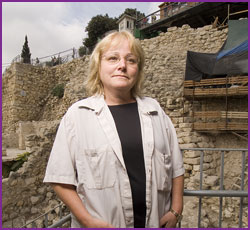
Just dig a little deeper, however and the plot thickens even more. The researcher in question is Eilat Mazar (above), an old school Israeli archaeologist whose essential goal is to prove the historical veracity of the Bible.  She’s made no bones (sorry) about this over the years.  In a 2006 interview with Moment Magazine, she made this very telling comment:

One of the many things I learned from my grandfather was how to relate to the biblical text. Pore over it again and again, for it contains within it descriptions of genuine historical reality.  I work with the Bible in one hand and the tools of excavation in the other. That’s what biblical archaeologists do. The Bible is the most important historical source and therefore deserves special attention.

The only problem with this is that the Bible is not a history book – it’s religious literature.  There certainly may be kernels of historical fact to be found in these narratives, but I’d say it’s exceedingly problematic for an archaeologist to assume ipso facto the historical veracity of the Bible.  Mazar’s comment that she works with a Bible in one hand and her tools in the other speaks volumes about her fundamental bias.

It’s also noteworthy that Mazar worked until recently for the Shalem Center, a partisan Israeli think-tank.  Among other things, the Shalem Center believes archeology should support “the claim that the Bible can be viewed as a work whose historical narrative is in large part accurate, and (strengthen) the ancient connection of the Jewish people to the land of Israel.”

It’s striking to compare Mazar’s approach to that of Israel Finkelstein, who comes from a new school of Israeli archaeologists who are aren’t driven by political ideology and are willing to go wherever their research takes them.   In a nutshell, Finkelstein and his colleagues have argued convincingly that it’s impossible to say much of anything about ancient Israel until the 7th century BCE (around the time of the reign of King Josiah). This casts doubt on the historical veracity of the Biblical narrative from the period of the Patriarchs/Matriarchs through the reigns of David and Solomon. These claims have largely been accepted as normative by most mainstream archaeologists outside of Israel.

If you are interested the current thinking of Israeli researchers who are unfazed by nationalist bias, I highly recommend Finkelstein’s 2002 book (with Neal Asher Silberman), “The Bible Unearthed.” Also check out this 2001 piece from Salon, which explores the deeper socio-political implications of Israeli archeology.

Elie Wiesel Can’t Have it Both Ways

Elie Wiesel has long walked the tightrope between pious pronouncements of universal Jewish conscience and unabashed political advocacy. He’s been trying to have it both ways for years, but it seems to me that his balancing act is becoming more and more transparent.

Last week, as Wiesel unveiled an anti-Ahmadinejad ad with other Nobel Prize laureates, he blasted the Goldstone report, calling it “a crime against the Jewish people.”  Leaving aside the issue that he took this opportunity once again to speak on behalf of the entire Jewish people, I’m still somewhat staggered that Wiesel, of all people, would use such charged Holocaust rhetoric in such a patently political manner. (I think Richard Silverstein at Tikun Olam hit it right on the head when he asked, “What was the last event in world history you can recall being a ‘crime against the Jewish people?'”)

If this wasn’t enough, now I read on Max Blumenthal’s blog that Wiesel’s foundation received $500,000.00 for one speech he delivered at the church of fundamentalist Christian Zionist John Hagee (whom he referred to as “my dear pastor.”) Yes, this is the same John Hagee who publicly sermonized that Hitler was sent by God to create the Holocaust so that Jews would emigrate to Israel.  It’s simply astonishing to me that so many Jewish leaders are perfectly willing to cozy up to the likes of Hagee even after it has become so patently clear that his views are way off the rails. (That’s Wiesel, above, with Hagee, right, and Israeli minister Uzi Landau, left).

As far as I’m concerned, Justice Richard Goldstone is precisely the kind of courageous Jewish moral hero that Wiesel himself purports to be: someone committed to advocating for universal human rights even when doing so might mean holding our own community painfully to account.  As for Wiesel, I’m finding his words and actions increasingly craven. No one begrudges him his opinions – but it’s time he dropped the pretense that he’s somehow beyond the political fray.

Rosenberg: BDS May Be Inevitable

MJ Rosenberg, a Mideast analyst I’ve respected for years, has just written a powerful blog post entitled, “Are Israeli-Palestinian Negotiations Finished?”  His words are particularly meaningful, I believe, coming from someone who is firmly ensconced in the mainstream liberal Zionist camp.

He opens with an all-too familiar concern: that Israel’s suicidal path of settlement expansion will soon make the possibility of a viable Palestinian state impossible (if it hasn’t already).

Then he takes this concern to its next logical conclusion, articulating what most two-staters are generally too frightened to say out loud:

What would happen is that the Palestinians would go to the United Nations, to the European Union, and even to the United States to seek ..consequences. And these would most likely come in the demand for sanctions. There is already a burgeoning BDS (Boycott, Divestment, Sanctions) movement that is seeking to bring down the occupation the way a similar movement brought down apartheid.

Is this what Israelis want? Do they really want those concerned about the occupation to be forced to turn to an option this extreme?

I know that the last thing I want is a successful international movement that would boycott and sanction Israel as if it was apartheid South Africa. But it’s probably inevitable unless Israelis come to their senses and begin the process of ending the occupation while the decision is still theirs to make.

In other words, sooner than later we’ll have to choose between a Jewish state and basic, fundamental human rights.  It’s not the first time we’ve heard sentiments such as this, but when they come from people like Rosenberg, it’s a sign that the lines on this issue are inexorably shifting.

Nurit Peled Elhanan’s Cry from the Heart

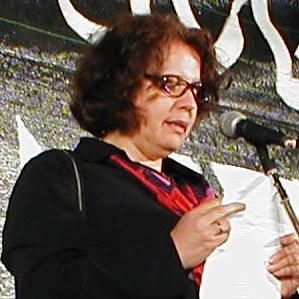
Dr. Nurit Peled Elhanan is an Israeli woman whose 13 year old daughter was killed by a Palestinian suicide bomber in 1997. Shortly after, she helped found the Bereaved Parent’s Circle, a courageous Israeli-Palestinian coexistence group about which I’ve frequently written. It’s not an exaggeration to say that over the past two decades she has become one of the most important and eloquent members of the Israeli peace activist community.

On January 2, Peled Elhanan gave an emotional speech in Tel Aviv at a rally commemorating the one-year anniversary of Israel’s military assault on Gaza. I don’t know how else to describe it but as a primal scream – a cry from deep within the reaches of her heart.  It is a gut-wrenching read, but also, in its way, enormously edifying.  More than anything else I’ve read lately, it addresses head-on the poison that has been spreading through Israel’s soul – a phenomenon many fear to be true, but few are willing to identify out loud.

Please make sure to read all the way to the end, including the footnotes, which will help you to better understand her references, as well as the Jewish soul that throughly permeates her words.

Continue reading

Gaza One Year Later: Beyond the Complications

It was exactly one year ago that I read the first news accounts of Israel’s military assault in Gaza:

Waves of Israeli airstrikes destroyed Hamas security facilities in Gaza on Saturday in a crushing response to the group’s rocket fire, killing more than 225 — the highest one-day toll in the Israeli-Palestinian conflict in decades…

(There) was a shocking quality to Saturday’s attacks, which began in broad daylight as police cadets were graduating, women were shopping at the outdoor market, and children were emerging from school. The center of Gaza City was a scene of chaotic horror, with rubble everywhere, sirens wailing, and women shrieking as dozens of mutilated bodies were laid out on the pavement and in the lobby of Shifa Hospital so that family members could identify them. The dead included civilians, including several construction workers and at least two children in school uniforms.

By afternoon, shops were shuttered, funerals began and mourning tents were visible on nearly every major street of this densely populated city.

Previously, whenever I’d hear this kind of news out of Israel/Palestine, my shock and anguish would quickly be tempered by a familiar voice telling me to calm down, don’t overreact, don’t forget how terribly “complicated” the situation is. (Indeed, I recall hearing that voice distinctly three years earlier when the IDF responded to Hezbollah rocket attacks with a similarly massive military onslaught.)

This time, though, it was different. This time I didn’t hear the voice. Somehow, it just didn’t seem all that complicated to me any more.

This is what I wrote on my blog that day:

The news today out of Israel and Gaza makes me just sick to my stomach.

I know, I can already hear the responses: every nation has a responsibility to ensure the safety of its citizens. If the Qassams stopped, Israel wouldn’t be forced to take military action. Hamas also bears responsibility for this tragic situation…

I could answer each and every one of these claims in turn, but I’m ready to stop this perverse game of rhetorical ping-pong. I don’t buy the rationalizations any more. I’m so tired of the apologetics. How on earth will squeezing the life out of Gaza, not to mention bombing the living hell out of it, ensure the safety of Israeli citizens?

We good liberal Jews are ready to protest oppression and human-rights abuse anywhere in the world, but are all too willing to give Israel a pass. It’s a fascinating double-standard, and one I understand all too well. I understand it because I’ve been just as responsible as anyone else for perpetrating it.

So no more rationalizations. What Israel has been doing to the people of Gaza is an outrage. It has brought neither safety nor security to the people of Israel and it has wrought nothing but misery and tragedy upon the people of Gaza.

There, I’ve said it. Now what do I do?

As I read this post one year later, I remember well the emotions I felt as I wrote it. I also realize what a critical turning point that moment represented for me.

As a Jew, I’ve identified deeply with Israel for my entire life. I first visited the country as a young child and since then I’ve been there more times that I can count. Family members and some of my dearest friends in the world live in Israel.

Ideologically speaking, I’ve regarded Zionism with great pride as the “national liberation movement of the Jewish people.” Of course I didn’t deny that this rebirth had come at the expense of another. Of course I recognized that Israel’s creation was bound up with the suffering of the Palestinian people. The situation was, well, it was “complicated.”

Last year, however, I reacted differently. I read of Apache helicopters dropping hundreds of tons of bombs on 1.5 million people crowded into a 140 square mile patch of land with nowhere to run. In the coming days, I would read about the bombing of schools, whole families being blown to bits, children literally burned to the bone with white phosphorous. Somehow, it didn’t seem so complicated at all any more. At long last, it felt as if I was viewing the conflict with something approaching clarity.

Of course I think we’d all agree that the Israeli-Palestinian conflict is technically complicated. But at the same time I think we all know that at the end of the day, there is nothing complicated about persecution. The political situation in Darfur, for instance, is enormously complicated – but these complications certainly haven’t stopped scores of Jews across North America from protesting the human rights injustices being committed there. We do so because we know that underneath all of the geopolitical complexities, oppression is oppression. And as Jews, we know instinctively that our sacred tradition and own tragic history require us to speak out against all oppression committed in our midst.

I’d suggest that if there is anything complicated for us here, it is in possibility that we might in fact have become oppressors ourselves. That is painfully complicated. After all, our Jewish identity has been bound up with the memory of our own persecution for centuries. How on earth can we respond – let alone comprehend – the suggestion that we’ve become our own worst nightmare?

More than anything else, this is was what I was trying to say in that anguished, emotional blog post one year ago: is this what it has come to? Have we come to the point in which Israel can wipe out hundreds of people, whole families, whole neighborhoods and our response as Jews will be to simply rationalize it away? At the very least will we able to stop and question what has brought us to this terrifying point? Have we become unable to recognize persecution for what it really and truly is?

Those who know me (or read my blog) surely know that it has been a painfully challenging year for me. My own relationship to Israel is changing in ways I never could have predicted. Since I started raising questions like those above, I’ve lost some friends and, yes, my congregation has lost some members. If Zionism is the unofficial religion of the contemporary Jewish community then I’m sure there are many who consider me something of an apostate.

But at the same time, I’ve been surprised and encouraged by the large number of people I’ve met who’ve been able to engage with these questions openly and honestly, even if they don’t always agree with me. I suppose this is what I decided to do one year ago: to put my faith in our ability to stand down the paralyzing “complexities,” no  matter how painful the prospect.

One year later, I still hold tight to this faith.