Guest Post: Rev. Chris Leighton Responds to My Open Letter

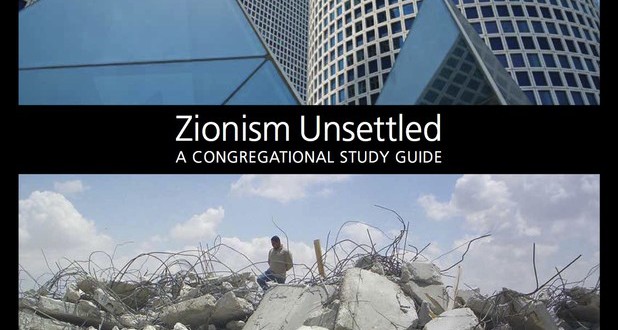
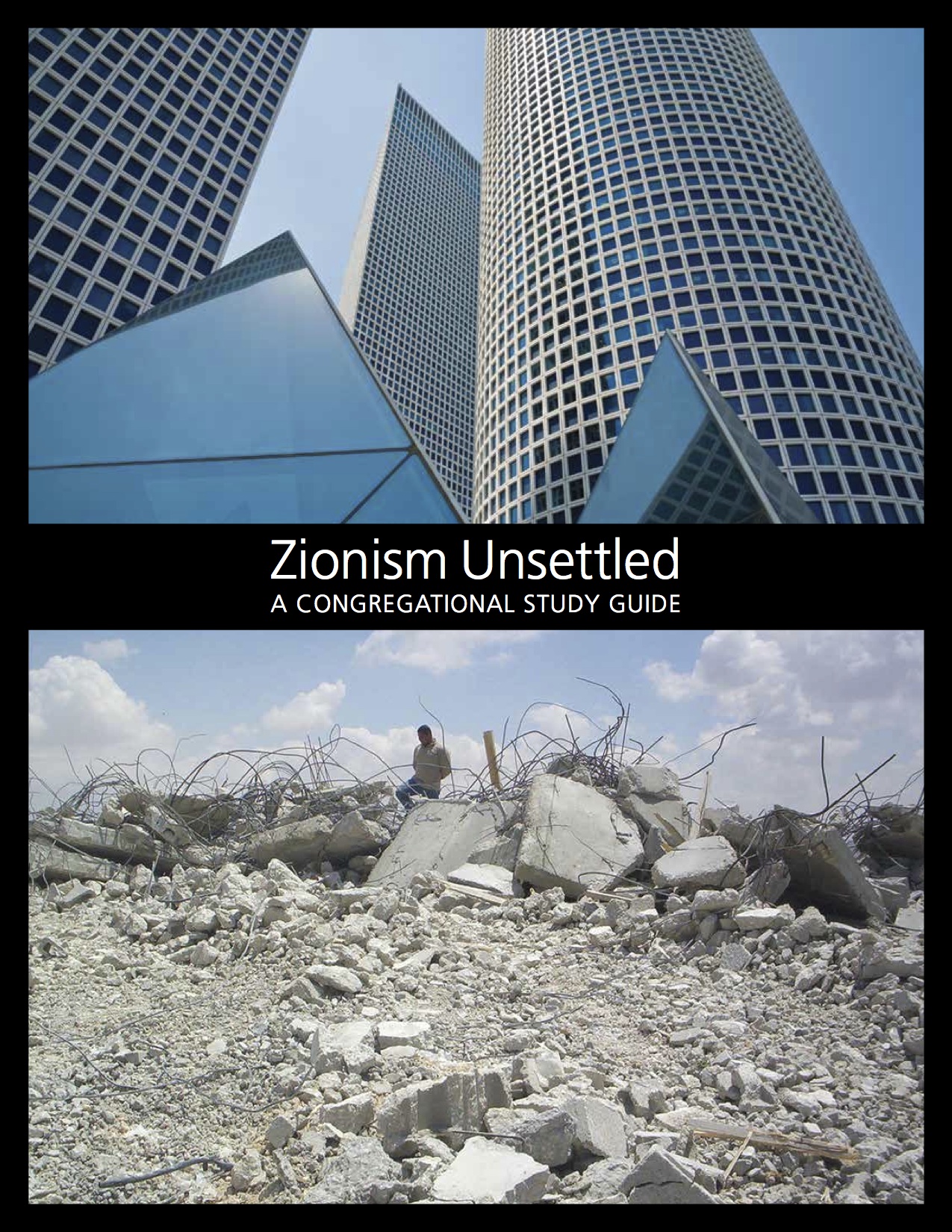
zionism_unsettledRev. Chris Leighton has responded to my open letter of February 19, in which I addressed what I considered to be his troubling and unfounded attack on the newly released study guide, “Zionism Unsettled.” I have posted his words below. I genuinely appreciate his desire to enter into dialogue and will post my own response in several days.

I appreciate the time and thought that you directed to my critique of “Zionism Unsettled.” I am not particularly interested in entering a debate that yields winners and losers and that drives combatants more deeply into their entrenched positions. I am interested in conversation that might enable people with deep disagreements to learn from one another, and I am acutely aware of how much more I have to learn in the ongoing struggle to understand and respond to the complexities of the Palestinian-Israeli impasse. Colleagues such as Nancy Fuchs Kreimer, A.J. Levine, Peter Ochs, Tikva Frymer Kensky (of blessed memory) and even your former havrutah partner and now staff member at the ICJS, Ilyse Kramer (among others including folks at the Hartman Institute) continue to rattle me out of my complacency and remind me constantly that mahloket is a rabbinic discipline desperately needed in these tempestuous times.

You make a number of observations that I want to ponder more deeply. You also indulge in some polemical excess that does not do justice to what needs to be said. At the end of the day, you believe that this congregational guide can prove a helpful resource. I think that it is so riddled with historical and theological flaws, and so dismissive of the Jewish community that it will do much more harm than good. We disagree, and the most immediate question whether our differences might prove worthy of some ongoing dialogue.

I wonder if we might begin more productively by examining some arguments that you make that I find puzzling. They may clarify our divergent readings of ZU and enable us to better understand when and where we speak past one another.

You make a strong case for the separation of Judaism from Zionism, and I think rightly note the mistakes that arise when the two are collapsed. At the same time to deny that Zionism and Judaism do not share deep historical and religious roots also strikes me as a serious error. You work with a very limited conception of Zionism as a 19th century political movement that breaks from the Jewish tradition. I work with a much broader understanding of Zionism and see this movement as driven by a yearning for a Jewish homeland with deep biblical underpinnings. The blending of peoplehood, land and Torah strikes me as integral to Jewish tradition. Even the more secular strains of Zionism that became predominant in the 19th century were suffused with biblical imagery and so this movement was not as radical a rupture from the Jewish tradition as the more secular Zionists imagined.

So here is where I found your account confounding. Do you want to uncouple Zionism from Judaism altogether, or do you want to critique its more militant and “colonial” manifestations? Can all expressions and forms of Zionism be accurately placed into an ideological lump and legitimately condemned as a movement that leads “inexorably” to the displacement and mistreatment of Palestinians, as the IPMN guide indicates? Do you think that Jews do not belong or have a legitimate claim to the land of Israel? Do you want to trace the problem to the UN’s 1947 resolution to partition the land and to establish the State of Israel? Or do want to focus on the problems that emerge in the wake of the Six Day War of 1967?

I have yet to see efforts to undo the establishment of the State of Israel produce constructive results. I have seen efforts to de-legitimize the State, to brand it as “an apartheid nation,” and to punish Israel economically and politically polarize and fragment our communities. This is not to say that all anti-Zionists are anti-Semites. Yet it would be a terrible blunder not to acknowledge that many of them are. At another time we can circle back to clarify what constitutes “antisemitism” and its relationship to “anti-Judaism” before exploring who decides when it is fair and accurate to apply these categories. I do want to note that I did not throw around the term, indeed I used it only once and quite specifically in my critique.

Back to the issue of a Jewish homeland. I believe that the quest for a home is deeply woven into the tissue of our humanity, and you would not deny that this yearning has occupied a prominent, if not central role among Jews over the centuries. My impression is that you would not annul the longing to establish a Jewish homeland nor characterize this desire as intrinsically pernicious. Does the problem then take hold when Jews move from claims to a homeland to making their bid to establish a sovereign state? Homeland is OK. Sovereign State for Jews is not (unless divinely implemented).

When a Frenchman speaks of his homeland, or an Irishman, or American, or a Palestinian, or a Tibetan are they designating an attachment to a specific land independent of the sovereignty on which the messy business of governments depend? Does not the search for a “homeland” aim at “sovereignty?” A national identity is difficult to construct and preserve without the power and freedom that is exercised by the state. One of the truly remarkable achievements of the Jewish people has been the ability to endure and even flourish over a remarkable span of history without the powers of a sovereign state. Yet to acknowledge the claims to homeland while denying Jews the opportunities and burdens of an independent of state enshrines the status of Jews as “exceptional” and refuses them the rights and conditions that every other nation claims for itself. Your line of thinking seems to me to end up creating the very phenomenon that you and the guide condemn, albeit it is a different form of “exceptionalism.”

Finally, I do not know of a nation, a religion, or even a family that does not hold to some kind of exceptionalism. Our national, religious, and familial identities are constructed on the basis of stories that distinguish us from others. Even when we insist that we are not superior to others (and hopefully we regard this task as a moral imperative), we support and sustain our nations, our religious communities, and families with financial and psychological investments that give them priority. We live our lives treating our own with greater levels of time, energy, and resource—even as we strive to respond to the legitimate claims of those who need and demand our active engagement. Furthermore, I have yet to encounter a nation that does not fuse religion and politics—and overtly or implicitly make a claim to being exceptional. The challenge is how to identify and respond when the mixture turns toxic. I suspect that we agree that this is a vital responsibility of our religious leaders.

While keenly aware that your movement has for the most part rejected the notion of “chosenness,” I do not think that this category invariably generates a sense of superiority. The rejection of “exceptionalism” strikes me as a thinly veiled rejection of a concept that remains prominent in much, if not most of the Jewish world. The step from a condemnation of “exceptionalism” and “Chosenness” to an indictment of Israel and the larger Jewish community as ethnocentrically racist is made without qualification.

The concept of “exceptionalism” (at least as it is defined and applied in this guide) strikes me as a problematic. Are not the real problems to which you point a manifestation of “nationalism?” And if every country must be vigilant about the dangerous directions in which nationalism can move, why would the guide not acknowledge this challenge within Palestinian nationalism? It certainly would not be an arduous task to illustrate the problematics by offering a brief overview from George Antonius to the Hamas Charter.

One example of dishonesty that I find troubling in the study guide is the unwillingness to offer a more comprehensive and balanced account. If the problem is that Jewish nationalism is different from other kinds of nationalism and deserving of condemnation, then the guide once again becomes guilty of the very error that it impugns. In other words, Zionism becomes an exceptional and inherently evil manifestation of nationalism. At best I think that the analytic methods used in this guide are intellectually shoddy and the terminology reinforces the tendency to use confused and confusing generalizations—thereby reinforcing the polemical discourse that generates plenty of heat and a shortage of light.

These flaws point to a more serious issue, namely the unwillingness of the study guide to come clean on what it really believes is the necessary end game. Is the goal to help Israel achieve the democratic ideal embodied in its May 14, 1948 Declaration of the Establishment of the State of Israel, or to reject this national project, work to dismantle the current State of Israel, and create a new and different national entity? What do the authors really think necessary to overcome the plight of the Palestinians? It is essential to own up to the vision that animates this study guide, because the tools that are being deployed need to be appraised on the basis of ends that they serve.

In my opinion, the vast majority of Presbyterians will not align themselves with a project that aims to disassemble the State of Israel. I think that the authors and editors of the guide know this and therefore have strategically decided to conceal the objectives for which they strive. Again this strikes me as dishonest.

There is of course much more to be discussed. Perhaps these reflections will at the very least open up some points for further exploration.

The Reverend Christopher Leighton is a Presbyterian minister and the Executive Director of the Institute for Christian & Jewish Studies in Baltimore, Maryland.

Casino Workers to Neal Bluhm: “Keep Your Promises”

1653730_10152201655757305_384378986_n

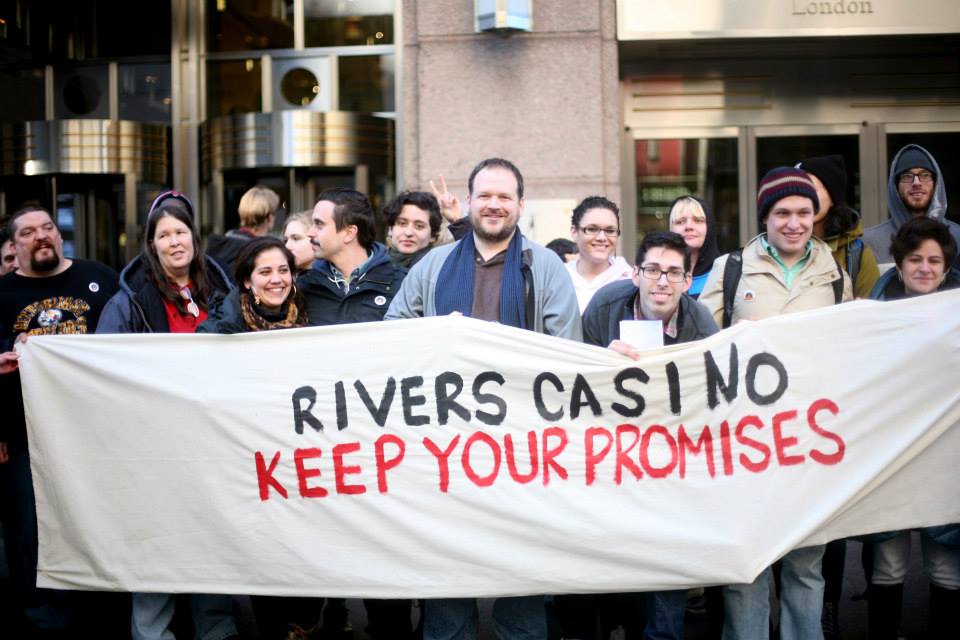
This past Wednesday I stood together with workers from Rivers Casino in Des Plaines, IL, Rivers Casino Pittsburgh, and SugarHouse Casino in Philadelphia who demanded that owner Neal Bluhm stop his draconian campaign against their organizing efforts.

Our action began as we marched down Michigan Avenue to Mr. Bluhm’s offices located at the exclusive mall, 900 North Michigan. When we entered the building, we were stopped by security – and when we requested to speak to Mr. Bluhm, we were told to leave immediately.

photo

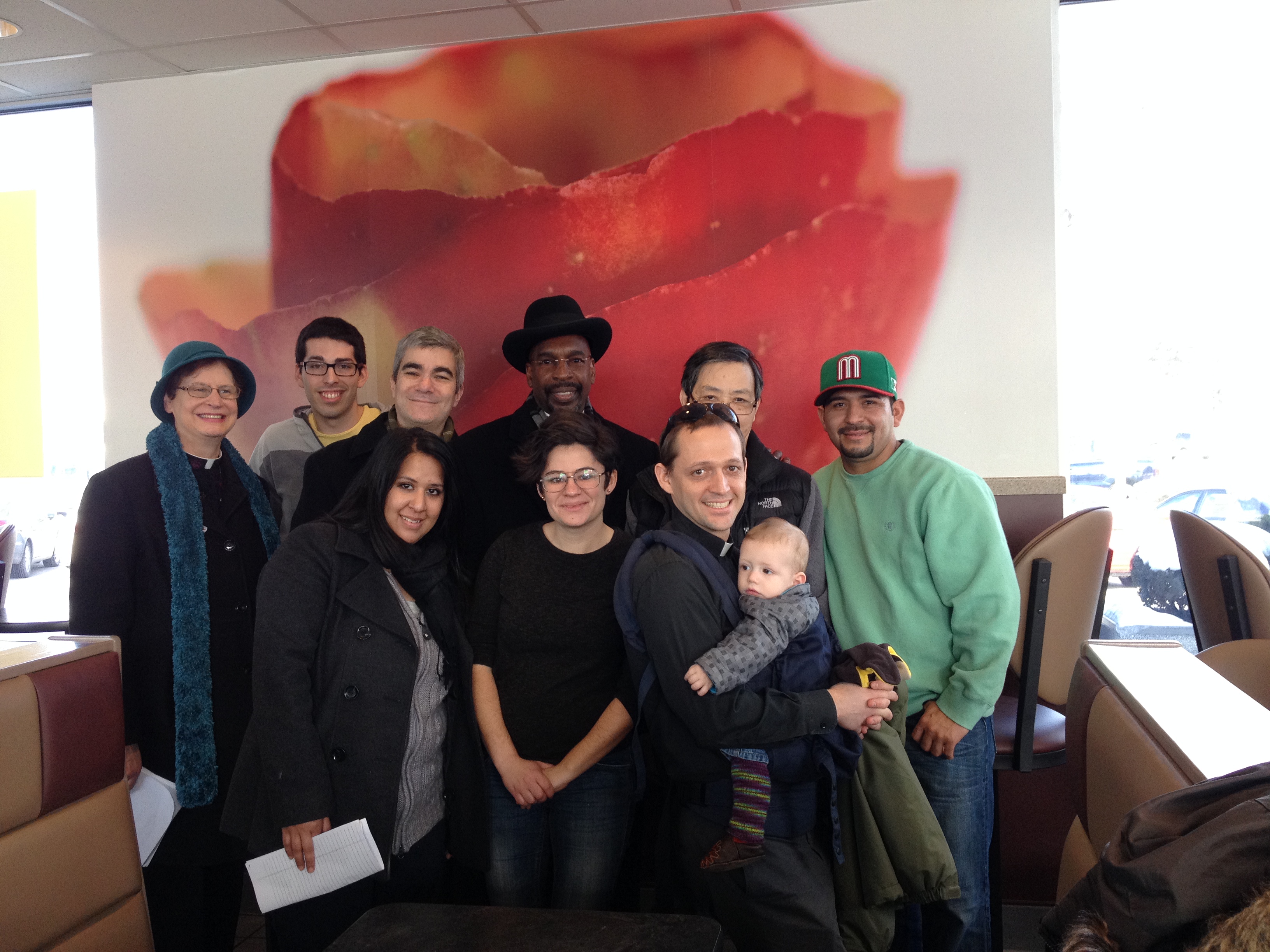
Can you spot the rabbi in this picture?

We then gathered outside on the sidewalk, pulled out our cell phones, and left messages for Mr. Bluhm and his CEO partners, asking them why his casino’s employees were making far less in wages and benefits than those doing comparable jobs at his (unionized) Ritz-Carlton Hotel.  We also asked why these workers, who were helping Bluhm’s casino’s rake in record profits, were facing harassment and intimidation from management for legally seeking to organize themselves into a union.

1653934_10152201656687305_1693308441_n

Refused entry to 900 North Michigan Ave, we hit the cell phones

Bluhm and his casino’s management are hoping they can win this one by hiring expensive anti-union firms to forcefully dissuade workers from organizing into a union. The courageous workers I met on Wednesday, however, show sign of backing down. It was my honor to stand together with them as they demand Neal Bluhm keep his promise for a fair process for them as they decide whether or not to unionize.  So far it’s been anything but fair: as I’ve previously reported, the casino’s actions have prompted 55 unfair labor practice charges to be submitted to the NLRB.

As always, I’ll continue to report on the progress of this growing organizing effort. Stay tuned.

1798800_10152201655862305_133254444_n

Unite Here Local 1 President Karen Kent addresses the crowd

1013519_10152201655762305_607878627_n

Reconsidering “Zionism Unsettled:” An Open Letter to Reverend Chris Leighton

zionism_unsettled-618x330

Dear Reverend Leighton,

I read with dismay your recent “Open Letter to the Presbyterian Church,” in which you referred to the Israel Palestine Mission Network of the Presbyterian Church (USA) as “extremist” and called to their newly-published study guide, “Zionism Unsettled” a “dishonest screed.” As a rabbi who works actively alongside the IPMN – and whose words are quoted extensively in the guide – I am saddened by your words and feel compelled to respond.

As you might imagine, I take exception to your characterization of me as an “(accomplice) to sweeping denunciations of the Jewish people and their sacred traditions.” Needless to say,  if I felt for a moment that “Zionism Unsettled” represented an attack on Jews and Judaism I obviously would never have agreed to be quoted in the guide.

Granted, ZU is not a perfect document – but while I might disagree with some of its characterizations and specific points of rhetoric, I do believe it shines a courageous and important light on the ideological roots of the political reality in Israel-Palestine. It certainly bears little resemblance to the “anti-Semitic,” “ignorant” tome you so thoroughly excoriate in your letter.

I am tempted to respond point by point to your specific criticisms of the guide – and perhaps some day we will have the opportunity to debate them more thoroughly. For now, however, I’d like to address a paragraph in your letter that I found to be particularly troubling:

Even a cursory study of history reveals the varied and complex forms that Zionism has taken over the centuries. The yearning for their national homeland has been woven into the Jewish community’s daily life for millennia. The Torah (Deuteronomy) and the Tanakh (2 Chronicles) both end with images of yearning to return to the land; synagogues face Jerusalem; the Passover seder celebrated annually concludes with the prayer, “Next year in Jerusalem.” To suggest that the Jewish yearning for their own homeland—a yearning that we Presbyterians have supported for numerous other nations—is somehow theologically and morally abhorrent is to deny Jews their own identity as a people. The word for that is “anti-Semitism,” and that is, along with racism, sexism, homophobia, and all the other ills our Church condemns, a sin.

I believe your characterization of my sacred tradition is incorrect – and dangerously so. It is prejudicial in the extreme to equate Zionism with Judaism itself.  Zionism – that is, the movement to create a Jewish nation-state in historic Palestine – is in fact a political movement that was born in 19th century Europe. As such, it was a conscious and radical break with centuries of Jewish tradition that strongly cautioned against the establishment of an independent Jewish state in the land.

While it is certainly true, as you write, that the yearning for a “return to Zion” is suffused throughout Jewish tradition, it is important to note that this yearning was pointedly directed toward a far off messianic future. The rabbinic sages repeatedly and forcefully forbid the “forcing of God’s hand” through the creation of a humanly-established, independent Jewish state in the land, which they believed would occasion disaster for the Jewish people. Throughout the centuries, the Jewish return to Zion functioned as a symbolic expression of hope – not as a political call to action.

Contrary to your assertion, “Zionism Unsettled” never makes the claim that the Jewish yearning for return “is somehow theologically and morally abhorrent.” It simply makes the correct distinction between a centuries-old religious tradition that spiritualized the notion of return and the politicization of this idea by a modern nationalist movement.

In this regard, I find your use of the term “anti-Semitism” to slur those who oppose Zionism to be particularly pernicious. In fact, as I point out in the guide, before the establishment of the state of Israel, the political Zionist idea was hotly debated within the Jewish community itself. Many reputable Jewish figures such as Rabbi Judah Magnes and Hannah Arendt warned that the establishment of an exclusively Jewish state in a historically multi-religious and multi-ethnic land would inevitably result in conflict and a permanent state of war. It was certainly not “anti-Semitic” of them to suggest such a thing. On the contrary, they – and many others like them – were motivated by their concern for the security of the Jewish people and as well as for the well-being of all peoples who lived in the land.

While it is true that Jewish anti-Zionism has become a dissident voice in our community since the establishment of the state of Israel, as a rabbi who works actively in the Jewish community, I can attest that there are growing numbers of Jews – particularly young Jews – who refuse to tie their Jewish identity so thoroughly to the highly militarized ethnic nation-state that Israel has become.

At the very least, there is a growing desire to allow non-Zionist voices to be part of the Jewish communal debate once more. One notable bellwether of this phenomenon may be found in the Swarthmore Hillel student board’s recent unanimous decision to defy the guidelines of Hillel International and declare itself an “Open Hillel.” In a statement accompanying their resolution, these Jewish students noted:

All are welcome to walk through our doors and speak with our name and under our roof, be they Zionist, anti-Zionist, post-Zionist, or non-Zionist. We are an institution that seeks to foster spirited debate, constructive dialogue, and a safe space for all, in keeping with the Jewish tradition.

I trust you would never suggest that these Jewish students are driven by “anti-Semitism.” On the contrary, they are clearly motivated by sacred Jewish values and a courageous refusal to reduce Jewish identity to one political ideology. It is particularly notable that a number of prominent liberal Zionist voices are publicly voicing their support for the students of Swarthmore Hillel, indicating that our community may well be ready to return to a truly wide-tent debate on the role of Zionism in Jewish life.

For all of this, however, “Zionism Unsettled” does not, as you suggest, “(attribute) the plight of the Palestinians to a single cause: Zionism.” On the contrary, the study guide repeatedly points out that the political strife in Israel/Palestine is rooted in religious exceptionalist attitudes that are embedded within Judaism, Christianity and American culture alike.

For many of us, these are the critical – and too often ignored – questions for interfaith dialogue: what will we do with those aspects of our religious traditions that value entitlement over humility? Do we believe that this land was promised by God to one particular group of people, or will we affirm a theology that promises the land to all who dwell upon it?  Will we lift up the fusing of religion with state power and empire or will we advocate a religious vision that preaches solidarity with the powerless, the disenfranchised and the downtrodden?

There is much more I would like to say in response to your letter – and again, I hope that we might have the opportunity to debate the specifics more thoroughly. For now, I will only encourage you to reconsider your claim that “Zionism Unsettled” represents “a theological delegitimization of a central concern of the Jewish people.”

As a Jew, I can only respond that it is not for you – or anyone – to blithely conflate the tenets of a modern nationalist movement with a venerable and centuries-old religious tradition. And it is certainly not “anti-Semitic” to say so.

Chicago Jewish Delegation Stands Up for LGBT Rights in Uganda

1240376_10152190526038257_795601751_n

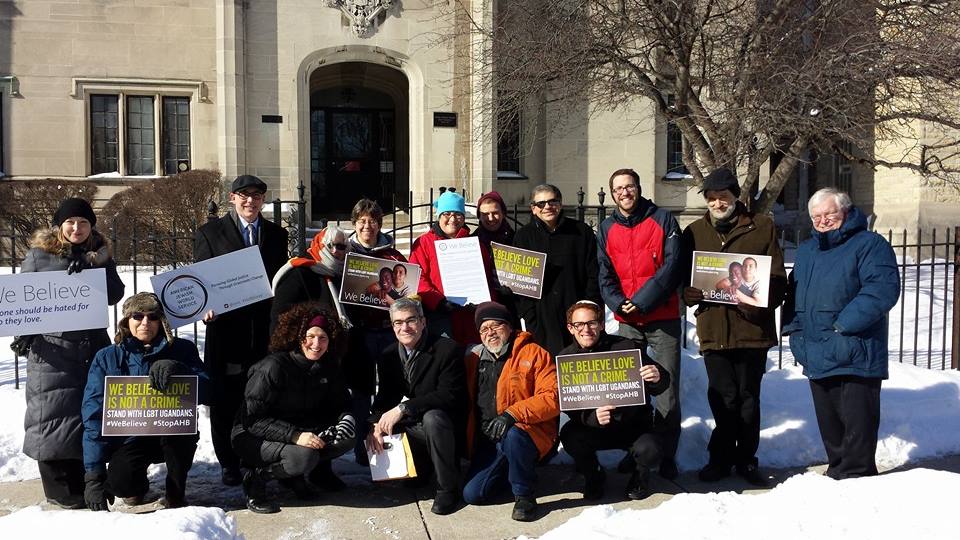
Members of the AJWS Chicago delegation delivering letter to the Ugandan Consulate

Today marked a day of global action of protest against the Ugandan Parliament’s so-called “Anti Homosexuality Bill.” It was my honor to participate by delivering a rabbinic letter to the Ugandan consulate in Chicago along with 15 other members of the the Jewish community, including five rabbis.

This bill, which was passed in December 2013, is a hate-filled piece of legislation that threatens the health and lives of LGBT Ugandans and is a grave violation of human rights. First introduced in 2009, the bill seeks to strengthen existing penalties in Ugandan law against homosexuality. Among the bill’s many cruel and unconscionable provisions is life imprisonment for “repeated homosexual behavior.” It also criminalizes what it describes as “the promotion of homosexuality,” which includes funding organizations that provide basic services such as healthcare to LGBT people.

Our action today was a sponsored by American Jewish World Service, who responded to a call from its partners in Ugandan Human Rights NGO by organizing in communities throughout the US. In addition to Chicago, similar actions took place in New York, Washington DC, Los Angeles and San Francisco.

Here’s the text of the letter we delivered to the Ugandan consul in Chicago:

Dear President Museveni,

I am writing to implore you, respectfully, to veto Uganda’s Anti-Homosexuality Bill that was recently passed by the Ugandan Parliament.

As a rabbi, I honor the inherent dignity of each and every person. Jewish theology, tradition and history compel me to uphold the values of kavod habriyot, respect for all of creation, and btzelem elohim, the notion that all people–including lesbian, gay, bisexual and transgender (LGBT) people–are created in the Divine image. Tragically, I know from our history that the stripping away of human rights from specific minorities is often a precursor to targeted destruction.

If this bill is signed into law, it would be a grave violation of human rights and would be one of the most abhorrent manifestations of discrimination against LGBT people worldwide.

My LGBT friends and colleagues in Uganda are frightened–and I believe they have every reason to be. I do not believe they should live in fear just because of who they are or who they love. I hope you share the same view.

I urge you, Mr. President, to use the power of your position to uphold the human rights and human dignity of all Ugandan citizens. Please stand on the right side of history by vetoing this bill.

I encourage you to click here to sign a similar letter currently being distributed by AJWS. (If you are a rabbi and you have not yet signed the rabbinic letter, click here.)

It’s time to stand with LGBT Ugandans – and all who are targeted by hate-legislation.

1798178_10152190525723257_1237770972_n

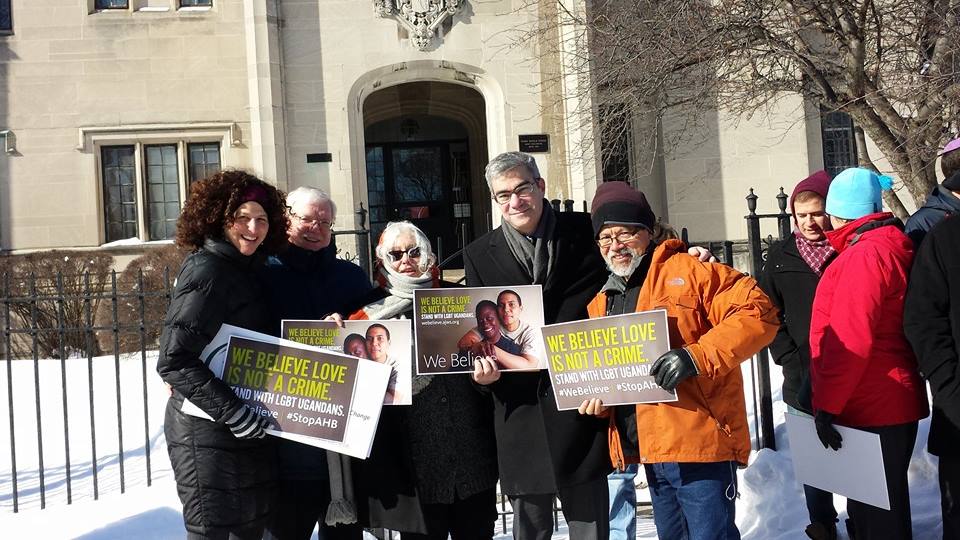
Members of my congregation, JRC, in front of the Ugandan consulate: (left to right: AJWS-Chicago Executive Director Taal Hasak- Lowy, Michael Sehr, Tina Escobar, me, Gonzalo Escobar)

“Zionism Unsettled” – A Smart and Gutsy New Church Study Guide

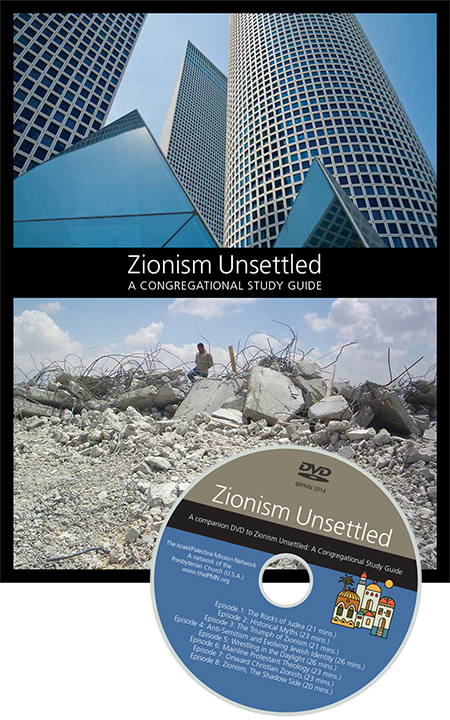
ZU-cover_DVDSo great to receive my copy of “Zionism: Unsettled” – an exciting new church study guide published by the Israel/Palestine Network of the Presbyterian Church (USA). As someone who has been collaborating with Protestant church denominations on the issue of Israel/Palestine for a number of years now, I can say without hesitation that this is a much-needed resource: smart and gutsy and immensely important.

“Zionism Unsettled” is based on the upcoming anthology, “Zionism and the Quest for Justice in the Holy Land,” to be published this summer by Wipf and Stock. While the anthology will be fairly academic in tone, “Zionism Unsettled” has digested its contents into a book and DVD for use by laypeople in congregational study settings. I’m thrilled that the IPMN has made this resource available to reach a much wider audience. (It was my honor to contribute an essay to that book, which has been adapted for a chapter in this study guide.)

ZU unsparingly examines Jewish and Christian forms of Zionism – with special attention to the way they have historically provided theological and ideological “cover” for the the dispossession of the Palestinian people. It’s a critical emphasis; indeed while there are no lack of political analyses on this subject, far less attention has been paid to the ways in which religious ideology has shaped the political context in Israel/Palestine.

This guide fills that void powerfully with careful, impressively researched chapters on the history of political Zionism as well as examinations of evangelical and mainline Protestant Zionism. My own chapter, “A Jewish Theology of Liberation” proposes a Jewish alternative to land-based nationalism – namely, a Judaism based in values of universal values of justice and dignity for all who live in the land.

As a Jew, I’m especially appreciative that while ZU is strongly critical of Zionism, it doesn’t flinch from extensive Christian self-criticism. The guide is particularly candid in its examination of the oppressive legacy of the post-Constantinan Church, replacement theology – and Christian anti-Semitism in general. In fact, throughout the guide there is a strong and palpable critique of exceptionalism of all stripes. In the end, the most basic criticism of “Zionism Unsettled” is leveled against triumphalist claims of every empire that has conquered and colonized this land throughout the centuries:

Exceptionalism is not unique to Zionism; rather it is present whenever exceptionalist religious ideology is fused with political power. Christian exceptionalist beliefs and actions contributed to the Nazi Holocaust, the genocide of Native Americans, and countless other instances of tragic brutality. Exceptionalist doctrines and behaviors within Islam have contributed to grievous human rights abuses such as the massacres during the closing days of the Ottoman Empire which crescendoed with the Armenian genocide in 1915.

I will say I do not personally agree with everything in this guide. In particular I’m at all comfortable with the theological analysis of Dr. Gary Burge, who rightly criticizes Christian replacement theology (the belief that the Jewish covenant with God has been “replaced” by the new covenant in Christ), yet seems to reaffirm it when he suggests a concept of a “’suspended blessing’ that will be restored at the end of history when ‘all Israel will be saved’”(p. 47).  It’s not at all clear to me how this conception differs fundamentally from the Christian “one covenant” theology he purports to disavow.

I was also disappointed by the chapter entitled “A Palestinian Muslim Experience with Zionism,” which does not at all apply kind of critical pedagogy to Islam that characterizes the chapters on Christianity and Judaism. While this chapter rightly spotlights “the inclusive theology of the Qur’an,” it fails to explore the exceptionalist manifestations of Islam in the same unsparing manner that pervades the rests of the book. As a result, this chapter feels to me somewhat tacked-on and represents a bit of a missed opportunity.

Despite my issues with “Zionism Unsettled,” however, I nonetheless find it to be a courageous work that has the potential to be a genuine game changer in interfaith conversations over Israel/Palestine. While I have no doubt it will be enormously controversial in many liberal religious circles, I believe it is an essential resource that boldly reframes the terms of interfaith encounter in ways that are long overdue.

I deeply admire its bravery and look forward to the conversations it will most certainly inspire.

John Kerry Says “Boycott” – Cue the Outrage

131023100453-kerry-and-netanyahu-story-top

We learned yesterday that Netanyahu and his senior ministers are all astir by remarks made by John Kerry at a recent security conference in Germany. Echoing similar warnings he’s made in the past, Kerry noted that the failure of talks would only increase Israel’s isolation in the international community:

Today’s status quo absolutely, to a certainty, I promise you 100 percent, cannot be maintained. It’s not sustainable. It’s illusionary … You see for Israel, there’s an increasing delegitimization campaign that has been building up. People are very sensitive to it. There are talks of boycotts and other kinds of things.

Responding quickly, Netanyahu criticized the remarks during a subsequent cabinet meeting. Yuval Steinitz, Israel’s minister of strategic affairs, told Israel Radio on Sunday that Mr. Kerry’s comments were “hurtful,” “unfair” and “intolerable” and added, “Israel cannot be expected to negotiate with a gun to its head.” Not to be outdone, Knesset member Motti Yogev, of the Bayit Hayehudi party said Kerry’s “obsessive pressure” had “anti-Semitic overtones.”

There’s much to be said about the escalation of a war of words between Israeli politicians and the US Secretary of State. For my part, however, I’m less interested in a diplomatic pissing match over a moribund peace process than the way the issue of boycott has now firmly become entrenched in official discourse. Can their be any surer sign that the Boycott, Divestment and Sanctions movement has become a force to be reckoned with?

In this regard, I couldn’t help but be struck by Netanyahu’s comments in response:

Attempts to impose a boycott on the state of Israel are immoral and unjust. Moreover, they will not achieve their goal.

Of course, Kerry made no such claim that boycotts were “moral” or “just” (as a defensive State Department spokesperson hastened to point out). He was simply noting their very existence. And Netanyahu’s apoplectic reaction over this harmless comment makes it clear that he takes their existence very, very seriously indeed.

As well he should. With the recent American Studies Association announcement that it is honoring the academic boycott of Israeli universities – and the even more recent attention over Scarlett Johansson’s ill-fated agreement to shill for SodaStream – BDS is increasingly moving into the mainstream media spotlight. And more importantly, it is increasingly gaining adherents.

Anecdotally speaking I can attest to the growth of this movement by the growing number of conversations/debates I’ve been having on the issue of BDS. Generally they retread over the same territory: “Is BDS anti-semitic?” “Is BDS a double-standard?” “Is BDS effective?” “Will BDS lead to the destruction of Israel?”

I’m not interested in addressing these questions here – I’ve explored them at length in numerous blog posts dating back to 2009. Besides, it seems to me that right now the most important thing we can say about the BDS movement is that it is here to stay  – and as long as Israel’s intolerable treatment of Palestinians continues, it promises to be chalking up even greater successes in the near future.

That’s why Kerry’s comments – candid though they were – smacked to me of a very real disingenuousness.   After all, what is the real “delegimization campaign” here: the BDS movement or Israel’s oppressive policies toward Palestinians?  If our government is unable or unwilling to hold Israel to account, we should not be surprised by the growth of a popular movement that does.

Clergy Delegation Meets With Rivers Casino Management

131218 Clergy and Rivers Casino Workers before Clergy Casino Delegation

Chicagoland clergy and Rivers Casino Workers before the clergy delegation to Rivers management, Dec.18, 2013

As promised, here’s an update on the workers’ campaign to organize a union at Rivers Casino in Des Plaines, IL. (For background, click here to read my post from last November).

On December 18, I was part of a clergy delegation that met with workers then visited Rivers Casino to demand a meeting with General Manager Bill Keena. The head of security arrived almost immediately and told us to leave the premises. After some back and forth, we finally were granted a meeting with him two days later.

We returned on December 20 and met with Mr. Keena and told management to immediately halt its illegal intimidation campaign against the organizing workers.  We also asked to meet with Neil Bluhm, Chairman of Midwest Gaming, the company that owns Rivers Casino.

Mr. Keena and casino’s Head Counsel did not respond to us other than to refuse to accept a letter of support for the workers signed by numerous members of the Chicagoland clergy community.  A week later, we received a response from Mr. Keena stating that “After further consideration, we have decided that no further meetings between our two organizations are necessary.”

Since the meeting, the Rivers Casino management has resumed its illegal anti-union campaign, having security personnel escort members of the organizing committee from the dining room, where they were having conversations with their coworkers about the union.  Several members of the organizing committee have been disciplined by the casino after talking to their coworkers in the dining room.  These actions prompted 25 additional unfair labor practice charges against the casino, bringing the total number of pending charges to 55.

Neil Bluhm and his management have clearly opted for a heavy handed, draconian response to the workers’ reasonable – and legal – efforts to organize themselves into a union. As those of us who were involved in the long and painfully drawn Hyatt boycott struggle would surely attest: it shouldn’t have to be this way.

In the meantime, the number of workers signing on to support unionization at Rivers is increasing – and the clergy are continuing to organize as well. This story has yet to be written – stay tuned.

Reclaiming MLK’s Vision of Economic Justice in Chicago!

1536429_471889092915536_1609444794_n

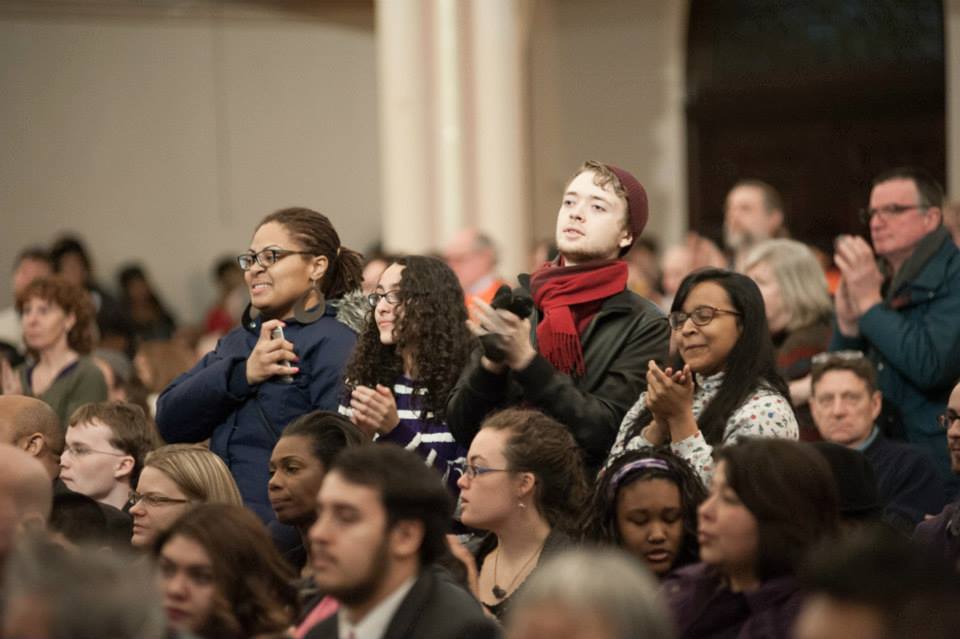
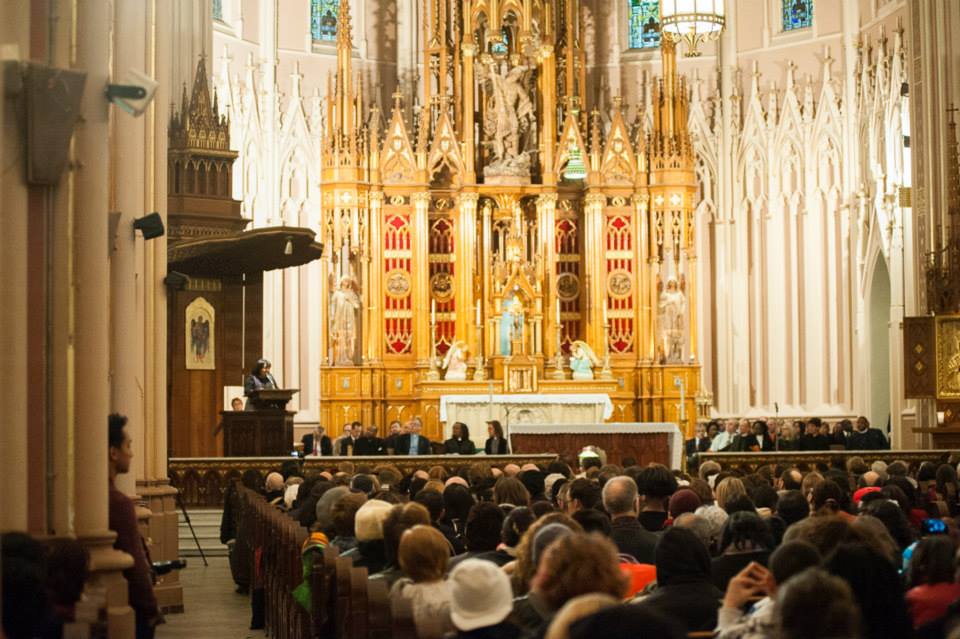
It was my great honor to participate yesterday in the profound and important MLK commemoration: “Hope in an Age of Crisis: Reclaiming Dr. King’s Radical Vision for Economic Equality.”  On a cold Sunday afternoon, an SRO crowd of 2,000 participants streamed into St. Michael the Archangel Catholic Church on Chicago’s South Side to reaffirm King’s unfinished work: the dream of economic equality for all Americans.

While few of us would deny the importance of devoting a National Holiday to the life and work of Dr. King, I believe this day too often sanitizes his legacy into meaninglessness. Even worse is the way corporate America has co-opted his name for its own profit and gain. (This morning, I opened the morning paper and was greeted by ads that invoked King to sell everything from cars to Macy’s merchandise.)

1549561_471889592915486_1435665852_n

It’s worse than ironic, when you consider how often King railed against corporate greed in this country – particularly toward the end of his life. Here’s but one example – a pointed MLK quote that was read aloud at yesterday’s gathering:

You can’t talk about solving the problem of the Negro without talking about billions of dollars. You can’t talk about ending the slums without first saying profit must be taken out of slums. You’re really tampering and getting on dangerous ground then. You are messing with captains of industry. Now this means that we are treading in difficult water, because it really means that we are saying that something is wrong with capitalism. There must be better distribution of wealth and maybe America must move toward a democratic socialism.

Our keynote speaker, Reverend Dwight Gardner, of Trinity Baptist Church in Gary Indiana, put it very, very well:

Today in this celebration we will not lift up the toothless, scrubbed and anesthetized Dr. King as created by the mainstream media and ruling elite but we will uncover the real Rev. Dr. Martin Luther King and his radical vision for economic equality.

In 1963 during the March on Washington, Dr. King gave an address that included a short section about a dream, but in the same speech he also declared that America had written the Negro a bad check that had come back stamped insufficient funds.  To paint him with only the hope that we could all just get along does his legacy a disservice and confuses Dr. King with Rodney King.

BeYHFLACUAAVM_R

And so our event, organized by the People’s Lobby and IIRON, brought together a wide range of citizens to reclaim King’s radical and unfinished legacy of economic equality. And more: to commit to creating a new movement to make it so.

Speaker after speaker spotlighted local Chicago and Illinois legislation that addressed issues ranging from corporate financial accountability, a living wage, public sector jobs, the prison industrial complex and environmental protection. One by one we invited elected officials to the stage and asked them tell us if they would support these legislative initiatives. Then we ended with a pledge to continue organizing to make this dream a reality.

One of our speakers, George Goehl, Executive Director of National People’s Action, correctly pointed out that the unprecedented inequities currently facing our nation are the product of a “masterful forty year plan hatched by CEOs and right wing politicians who were clear that they had to aggregate power to expand profit.”  Goehl noted that those of us who believe in a more equitable system will now have to develop our own long term plan for the “New Economy” with the following core goals:

– Everyday People Controlling the Economy

– An End to Structural Racism

– Corporations Serving the Common Good

– True Democracy – People in, Money Out

– Ecological Sustainability

1560529_471888859582226_130926385_n

The power of these kinds of public meetings resides in their modeling of a system that is generated by people power. Unlike most political events, in which elected leaders or candidates drive the agenda, this gathering was driven forward by the people themselves. The politicians who participated were not allowed to give stump speeches but were rather asked to say aloud to the community whether or not they intended to support these legislative efforts. As King himself taught us, our elected leaders are not change agents – it is rather the popular movements that lay their demands at their door.

I encourage you, this MLK Day, to resist the corporate co-opting of King’s name – and to support efforts in your community to create true economic justice to our nation. Click here to learn about organizing initiatives near you.

Reclaiming a Tu B’shvat of Liberation

central-park-snow-snow-covered-trees-and-benches---central-park-new-york-city-a-6sa3zgb0

Tonight is the eve of Tu B’shvat, the Jewish festival that celebrates the “New Year of the Trees.” According to the Talmud, Tu B’shvat marks the dividing point for the tithing of the fruit from trees for the year to come. Throughout the centuries, this festival has been announced by the blossoming of the white almond blossoms that proliferate throughout the central and northern parts of the land of Israel.

As a celebration of the natural world and the tentative beginnings of spring, Tu B’shvat has been celebrated in different ways during different eras of Jewish history and through a variety of Jewish cultural contexts around the world. But with the rise of the Zionist movement and the establishment of the state of Israel, Tu B’shvat has become, for many Jews, almost exclusively associated with the Jewish National Fund’s fund raising efforts to plant pine forests throughout modern-day Israel.

In a recent blog post, my friend and colleague Cantor Michael Davis underlined the darker legacy of this particular Tu B’shvat observance, noting that the JNF’s mission to create Jewish facts on the land has led to tragedy for the Palestinian people:

My first home in Israel was in a little village in the Jerusalem hills. On the bus to school in Jerusalem, I could see the pine forests stretching from the crest of the hilltops down to the dirt trail at the base of the slopes. Sometimes, I would go on hikes along these trails, passing through the deserted stone buildings of Lifta at the entrance to Jerusalem. Close up, I could see the man-made stone terraces hidden by the trees.

Occasionally, you would come across broken stone walls tracing the shape of a ruined house. The pines blurred the lines of previous ownership and concealed the destruction of Palestinian civilization that happened with the birth of the State. (Over) 80% of the forests were planted after the birth of the State of Israel, many of them on land vacated by the departing indigenous population. Some 80% of the Palestinian population left in 1948, never to return. And this project continues with JNF’s focus on land in the Palestinian areas of the State of Israel in the Galilee and Negev and the secretive planting of trees in the West Bank. (In a call-in interview that JNF just posted on YouTube, the organization’s CEO, Russell Robinson, does not answer a caller’s question about JNF tree planting over the Green Line.)

I was particularly struck by Cantor Davis’ observation that the forests of the Jewish National Fund forests are not fruitbearing, but pine:

It is deeply symbolic then that the early 20th century Eastern European settlers chose a non-native, barren tree. Symbolically and in a real sense, this foreign tree displaced the olive trees of the indigenous population.

Might there be a way to decouple Tu B’shvat from this destructive legacy of colonialism and disenfranchisement? I’d like to suggest one possibility:

I’ve long noticed the power of celebrating this “harbinger of spring” in the colder climates of the northern-hemisphere diaspora, where we are barely one month into winter and the landscape is filled not by the white of newly-budding almond blossoms, but by the white of snow-covered trees.

While some might think this would be an unlikely setting to celebrate Tu B’shvat, I actually find it quite profound to contemplate the coming of Spring in the midst of a Chicago winter. It comes to remind us that even during this dark, often bitterly cold season, there are unseen forces at work preparing our world for renewal and rebirth. Deep beneath the ground, the sap is beginning to rise in the roots of our trees. In the chilly diaspora, we can celebrate the invisible forces of liberation reborn underground even as the prison of winter seems to reign above.

Thus we observe Tu B’shvat as a welcome reminder that spring will always follow winter; that even in the coldest and darkest of times, the unseen power of liberation will inexorably rise up.

I encourage you to reclaim Tu B’shvat as a celebration of liberation: seasonal, spiritual, political, or all of the above.

Click here for more information on how you can support tree-planting for justice, not disenfranchisement.

Sharon’s Legacy: Survival at All Costs

aptopix-midease-israel-ariel-sharon.jpeg-1280x960

From Vice President Joe Biden’s remarks at the funeral of Ariel Sharon today:

Like all historic leaders, Prime Minister Sharon was a complex man about whom, as you’ve already heard from his colleagues, who engendered strong opinions from everyone.  But like all historic leaders, all real leaders, he had a North Star that guided him — a North Star from which he never, in my observation, never deviated.  His North Star was the survival of the State of Israel and the Jewish people, wherever they resided.

In talking about his spiritual attachment to the land of Israel back in an interview in the late ‘90s, he said, and I quote, “Before and above all else, I am a Jew…”

As a Jew – and as a human being of conscience – I submit that this myopic obsession with Jewish physical survival “before and above all else” has led the Jewish people down a very dark road indeed. In so many ways, Ariel Sharon represents the embodiment of this obsession – and I for one recoil at the suggestion that he might in any way be held up as a Jewish exemplar.

As the tributes of world leaders continue to roll in, please consider the life’s work of a man Joe Biden quite mistakenly claimed is “loved by the Jewish people:”

– In the early 1950s, as a young major in the Israeli army, Sharon led the infamous Unit 101, which carried out numerous cross-border “pre-emptive” and “retaliatory” attacks into the West Bank, deliberately killing and wounding Palestinian civilians.  In the most notorious incident involving Unit 101, between October 14 and 16, 1953, soldiers under Sharon’s command massacred 69 Palestinian civilians, most of them women and children, in the West Bank town of Qibya. Sharon’s orders included “total destruction of the village and maximum harm to the villagers, again forcing them to flee.”

– On October 29, 1956, Israel attacked Egypt, part of an invasion in conjunction with Britain and France. During the resulting hostilities, soldiers under Sharon’s command committed a series of massacres of POWs, including more than 100 civilians. In one incident, Israeli soldiers shot and killed 49 Egyptian prisoners of war, including civilians, after binding their hands and forcing them into a quarry. In another, 56 Egyptian civilians were murdered while sheltering in the back of a truck. In a third incident, some 50 Egyptian civilian workers were murdered by Israeli soldiers near the town of Ras Sudar.

– Following Israel’s surprise attack against Egypt in June 1967, which resulted in Israel’s occupation of the Gaza Strip, West Bank, East Jerusalem, the Egyptian Sinai peninsula, and Syrian Golan Heights, Ariel Sharon, by now a general responsible for Israel’s southern command, was tasked with “pacifying” Gaza. In his efforts to crush resistance, Sharon ordered his soldiers to execute without trial any Palestinians suspected of involvement in the resistance, resulting in the killing of more than 1000 Palestinians.

– On June 6, 1982, Israel launched a massive invasion of Lebanon, masterminded by then-Defense Minister Sharon. Between June and September, the Israeli army killed between 18,000 and 20,000 Lebanese and Palestinian civilians, bombarding and laying siege to the western half of the capital of Beirut.

– On September 16, 1982, under Sharon’s direction, Israeli soldiers surrounded the Sabra and Shatila refugee camps and sent in about 150 of their local Christian Phalangist militia allies, even though the long and bloody history between Palestinians and Phalangists in Lebanon was well known to the Israelis. Over the next three days, between 800 and 3500 Palestinian refugees and Lebanese, mostly women, children, and the elderly, were butchered by the Phalangists, who sexually assaulted, tortured and mutilated many of their victims, in one of the worst atrocities in the modern history of the Middle East.

For more details on these facts – and other aspects of Sharon’s legacy that were likely not recounted at his funeral today, click here.