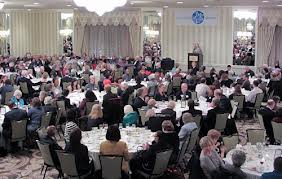
Here is a text of my keynote speech at last night’s annual Vision Keepers dinner of Interfaith Action – a faith-based direct service organization that serves the hungry and homeless population of my hometown of Evanston:
I’d like to begin my remarks tonight by sharing you with one of my chronic pet peeves – and I’d like to apologize at the outset to my congregants and loved ones, who are probably getting very tired of hearing me complain about this: I really, really don’t like the saying “Practice Random Acts of Kindness and Senseless Acts of Beauty.”
Now I say this with all due apology to any of you who might have this bumper sticker on your car – I mean you no disrespect. And believe me: I am a huge fan of encouraging kindness and beauty. It’s just that personally speaking, I would argue the exact opposite. I would argue for “non-Random acts of kindness and mindful acts of beauty.” After all, if by kindness we mean simple human respect and dignity – qualities that are essential to the core of our basic humanity – I think we would all agree that there should be nothing random about it. Kindness shouldn’t be random – quite frankly, it should be mandatory.
In its way, I think this slogan reflects something very profound about contemporary American culture. As a society that values individual initiative, it is natural that we will view compassion as a random, voluntary enterprise. We act compassionately whenever we feel compassionate. And yes, we might well feel a great deal of compassion: for our loved ones, we may even feel compassion for people we don’t actually know. But the problem with this approach, of course, is that feelings cannot be guaranteed. They come and go. Feelings are, by definition, elusive and transient.
Biblical tradition provides us with a different model. Compassion is not random – it is an imperative. Even love itself is commanded: “Love your neighbor as yourself.” “You shall love Adonai your God.” “You shall love the stranger, for you were once strangers in the land of Egypt.” In other words, feelings are wonderful, but feelings are not enough. Kindness and compassion should not be relegated to random feeling – they should be cultivated as a mindful, ongoing conscious practice. We have to teach ourselves how to be compassionate even if we are not feeling particularly compassionate – even if we are too overwhelmed to feel compassionate. Compassion is, for lack of a better word, a discipline.
In the Bible, kindness and compassion are complex and profound concepts. In fact, there are many different Hebrew words for compassion. The most well known word, “rachamim,” comes from the root rechem, or “womb” and suggests the kind of unconditional compassion that comes with parental love. More broadly, we might understand rachamim as the kind of compassion that we show toward those with whom we have a unique personal connection. The word “chen” is usually translated as “grace.” This form of compassion generally refers to gestures of favor or goodwill.
And then there is “chesed,” a word that is usually rendered as “lovingkindness.” As I learned back in my Rabbinical school Biblical Hebrew class, “lovingkindness” is probably not the best definition for chesed. It’s a little too general, a little too mushy. Most contemporary Hebrew scholars suggest that a better definition of chesed is “covenantal loyalty.” Indeed, if we look at the way this word is used in the Bible, it has less to do with a feeling of lovingkindess than a deep sense of responsibility that comes out of sacred relationship. God shows chesed for the Israelites – and the Israelites for God – when they remain loyal to the mutual covenant they established together at Sinai. In another example, Ruth is praised in the Bible for the chesed she demonstrates to her mother-in-law Naomi when she remains loyal to her promise to stand by her side.
In Jewish tradition, this abstract notion of chesed was applied by the ancient rabbis to the everyday life of the community. Chesed societies, for instance, were the prototypical communal welfare institutions that were the cornerstone of Jewish communities for centuries. They too were guided by the central ethic of covenantal loyalty – “commanded compassion,” if you will. At my congregation, as at yours, I’m sure, we have a committee of members helps members in need, usually due to illness or the loss of a loved one. We call it, naturally, the Chesed Committee. And the members who participate in it will surely at attest that they don’t participate out of a desire to be randomly kind, but rather out of the sense of responsibility that comes through belonging to a community. Probably more often than not, the members of the Chesed Committee serve people they don’t even know personally – and that, of course, is precisely the point.
So in its way, chesed presents us with a compelling and important way of understanding collective compassion. It is intimately connected to the concept of covenant and mutual obligation. Chesed is the kind of love and compassion that comes from a deeper sense of communal accountability. When a people live in a covenantal context –with chesed – it is with the fundamental understanding that the community is accountable to the individual just as much as the individual is accountable to the community.
By the same token, all of us in the room tonight – we are part of a covenantal community as well. All of us: the congregations that make up Interfaith Action understand on a deep, spiritually cellular level, that we have an abiding sense of covenant with the Evanston community. The Interfaith Action soup kitchens, the warming centers, the homeless hospitality centers, the Producemobile, are much, much more than mere direct service projects – they are expressions of our sacred sense of commitment to the city in which we live – and of the conviction that our compassion for every single member of this community must not be regarded as random or voluntary. On the contrary, we are compelled to feed the hungry, to shelter the homeless out of a collective sense of sacred, covenantal imperative.
In this regard, I want to honor the work of our honorees tonight – and all who participate in Interfaith Action – for the sacred work you do. I know you don’t do it just because it makes you feel good. I’m willing to bet there have been plenty of times you went over to soup kitchen when you were tired or just plain didn’t feel like going. I’m willing to go out on a limb and say there may have been times that you went even while you were doubting that your actions even made a difference. But in the end, you did go – and you continue to go – and you are here tonight because you know that at the end of the day, kindness should not be optional.
I’d like to go a bit further now, however, and offer a few thoughts about what an even deeper covenantal obligation might look like for our community. I’ve always believed that religion is at its best when it not only comforts the afflicted, but challenges the oppressive status quo that afflicts them. What does it mean when we literally feed the hungry, but fail to challenge a system that countenances hunger in its midst? Is it enough to provide warming centers, or should we also see it as our religious obligation to ask whether or not our city is also doing everything in its power to provide something as essential to life as heating for all its citizens? On an even deeper level, shouldn’t we be finding ways to challenge an infrastructural reality that makes “warming centers” even necessary in the first place?
I believe that religion is at its best when it manages to balance what I would call the “pastoral” with the “prophetic.” In other words, when our Biblical tradition demands that we clothe the naked and feed the hungry, this is a pastoral imperative. And when we are commanded to speak truth to powerful Pharaohs, to create societies of fairness and equity, to proclaim liberty throughout the land unto all the inhabitants thereof – this is a prophetic imperative.
And so I’d like to take this opportunity to ask those of us in this room – those of us who act on a deep and profound sense of pastoral commitment to the Evanston community: what would it look like for us to create a similar kind of covenantal coalition out of a prophetic commitment? More to the point: do we believe that our city of Evanston is doing what it must to ensure that its citizens are not going to bed hungry, that they have roofs over their heads and heat in their homes? And if the answer is no, then I believe we must ask ourselves: do we believe that holding our own city accountable is just as much a religious obligation as running soup kitchens and warming centers?
Now I know that there are a myriad of complicated policy discussions to be had on these kinds of issues, and I obviously don’t intend to parse them all right now. But I do think that too often we hide behind a mantra of “it’s complicated” to avoid dealing with some fairly simple truths. And just as often, I think, we shy away from policy debates because we feel as though we shouldn’t be mixing religion and politics.
But at the end of the day, however, it’s really not all that complicated. There’s nothing complicated about food, shelter and heat – these are among our most human basic needs. And when it comes to mixing religion and politics, I’ll repeat again: religion should not only about comforting the afflicted – it’s also about afflicting the comfortable. It’s about challenging the attitudes of those who view the world with a scarcity mentality that claims there is only so much to go around – and that it’s not our problem if there are those who will inevitably go without.
I hope that gatherings such as this will redouble our resolve to both the pastoral and the prophetic aspects of our faith traditions. I hope that as we go forward with this sacred work, we will find ways to open conversations about what a truly covenantal Evanston faith community might look like. And I hope that in doing so, we might provide a truly prophetic voice of conscience.
Thank you again for all you do. Congratulations to our honorees tonight. May all of our efforts continue to transform the lives of others – may they ultimately transform our world as well.
Amen.




 Shalom Rav